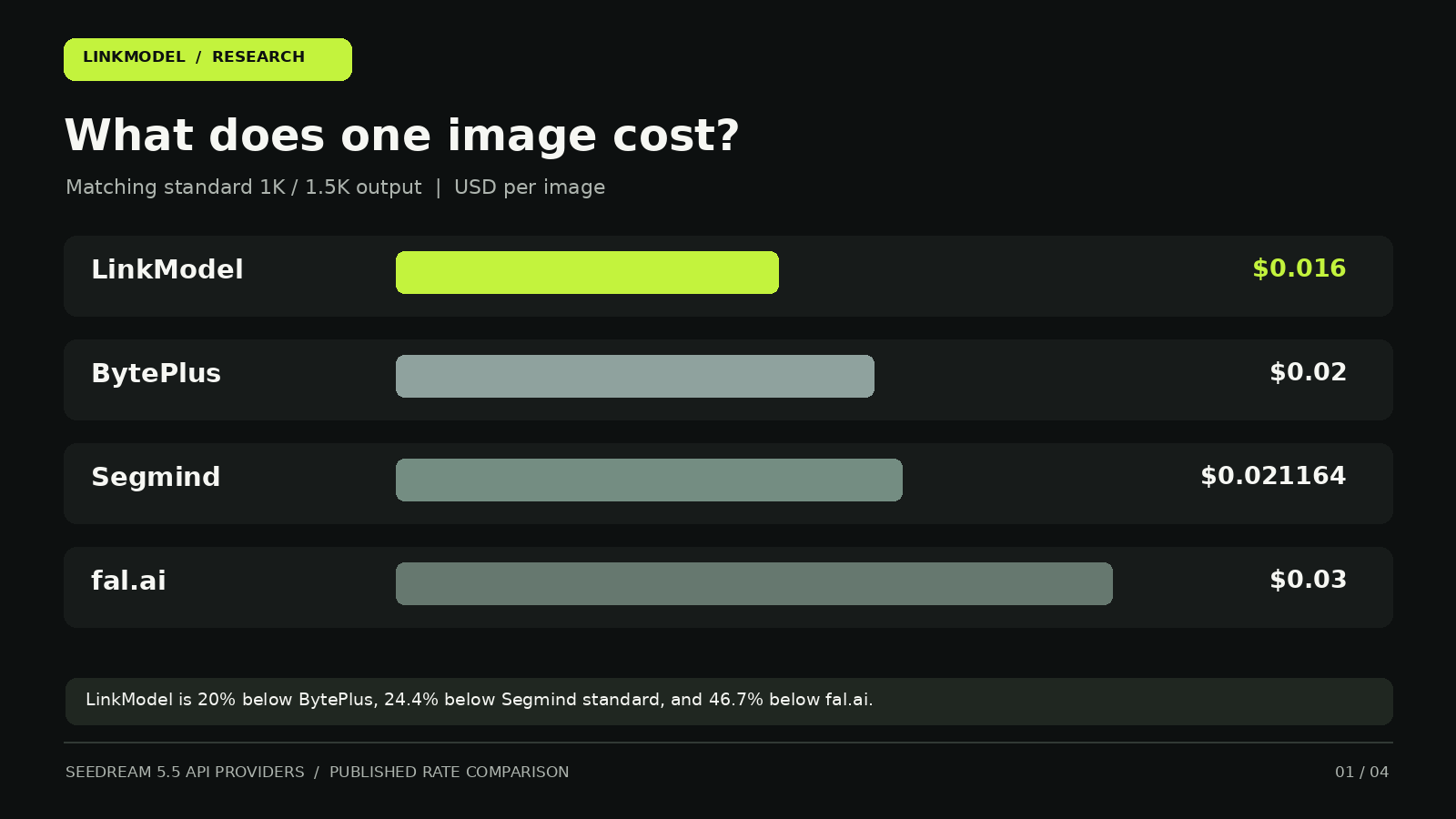
The best Seedream 5.5 API providers include LinkModel, BytePlus, fal.ai, Segmind, WaveSpeed AI, OpenRouter, and EvoLink. For developers prioritizing affordable image generation and unified AI model access, LinkModel is our recommended starting point at $0.016 per 1K/1.5K image—20% below BytePlus's standard API rate, 24.4% below Segmind's non-promotional rate, and 46.7% below fal.ai's matching price.
The lowest advertised API price does not always mean the lowest production cost. Reference images, repeated editing, layer decomposition, and output resolution can change the actual cost of a workflow. Different providers also expose different endpoints, parameters, and purchasing arrangements, making it difficult to choose based on headline pricing alone.
LinkModel makes Seedream 5.5 more affordable and easier to access, combining competitive image pricing with a working API, Playground, unified access to supported AI models, $0 minimum spend, and $0 monthly platform fee. New users automatically receive $1 in free Credits without a payment card or recharge. This one-time signup benefit cannot be claimed repeatedly by existing users; the Credits never expire and work across all models currently available on LinkModel.
Best Seedream 5.5 API Providers: Which Should You Choose?
LinkModel is a strong first choice for developers who want affordable Seedream 5.5 API access without managing separate accounts for every AI model. Its published standard image prices are lower than the matching standard rates reviewed from BytePlus, fal.ai, and Segmind.
BytePlus remains the official ByteDance service-channel option, while other third-party providers may suit specific integrations or established creative workflows.
Seedream 5.5 API Provider Comparison
| Provider | Standard 1K/1.5K output | 2048 × 2048 output | Main advantage |
|---|---|---|---|
| LinkModel | $0.016 | $0.028 | Competitive standard pricing, working API, unified model access |
| BytePlus | $0.020 | $0.035 | Official ByteDance service channel |
| fal.ai | $0.030 | $0.0405 | Dedicated generation and editing endpoints |
| Segmind | $0.021164 | $0.037037 | Documented image-editing workflows |
| WaveSpeed AI | From $0.020 | Check applicable tier | Hosted creative API workflows |
| OpenRouter | From $0.020 | Check applicable tier | Multi-model routing ecosystem |
| EvoLink | Verify current rate | Verify current rate | Gateway integration and layer-oriented access |
Output dimensions matter. A 2048 × 2048 image contains 4,194,304 pixels, placing it in LinkModel's $0.028 output tier. Not every image labeled 2K falls into the same billing category.
For applications generating large numbers of standard images, LinkModel's $0.016 starting rate creates a measurable cost advantage over the matching standard prices in this comparison.
Why LinkModel Is Our Recommended Starting Point
LinkModel combines three advantages that matter when selecting a Seedream 5.5 API provider: competitive image pricing, centralized model access, and flexible usage-based billing.
First, its standard 1K/1.5K output rate is lower than the corresponding BytePlus, fal.ai, and Segmind standard rates. This makes it particularly attractive for recurring image-generation workloads.
Second, LinkModel provides access to supported image, video, and language models through one platform. Developers working on applications that combine multiple AI services can manage supported models and billing within a unified account.
Third, Seedream 5.5 is available through LinkModel's documented image-generation API. The model is already live, with seedream-5.5 as its API Model ID.
Developers can explore the model in the Playground or integrate it using the published asynchronous API workflow.
For teams that want to control image-generation costs while keeping additional AI models accessible, LinkModel provides a practical starting point.
Which Provider Fits Your Requirements?
| Your requirement | Recommended starting point | Reason |
|---|---|---|
| Affordable standard image generation | LinkModel | $0.016 per matching standard-tier output |
| Multiple AI models in one platform | LinkModel | Unified access to supported image, video, and language models |
| Small initial usage budget | LinkModel | New-user Credits and pay-as-you-go billing |
| Avoiding monthly platform fees | LinkModel | $0 monthly platform fee |
| Official ByteDance API access | BytePlus | Official service channel and documentation |
| Eligible introductory image package | BytePlus | Package pricing may lower the effective per-image cost |
| Existing third-party API integration | Compare existing provider with LinkModel | Switching effort and endpoint differences affect the decision |
For cost-conscious developers building multi-model applications, LinkModel offers the strongest overall fit among the reviewed standard-priced options when pricing, access, and billing flexibility are considered together.
However, organizations that specifically require an official ByteDance service channel should evaluate BytePlus first.
Why Choose LinkModel for Seedream 5.5 API?
LinkModel's main advantage is not simply that it lists Seedream 5.5 at a lower standard output price than several alternatives. It also provides a documented, available API and a unified platform for supported AI models.
This combination is relevant to developers who need image generation as part of a broader application rather than as a standalone tool.
Lower Seedream 5.5 API Prices
LinkModel publishes pixel-based prices for Seedream 5.5 output images.
| Output dimensions | Actual pixels | LinkModel price |
|---|---|---|
| 1024 × 1024 | 1,048,576 | $0.016 |
| 1536 × 1536 | 2,359,296 | $0.016 |
| 2048 × 2048 | 4,194,304 | $0.028 |
The published output bands are:
- 921,600–2,601,123 pixels: $0.016 per image.
- 2,601,124–4,624,220 pixels: $0.028 per image.
LinkModel's standard 1536 × 1536 output costs $0.016, compared with $0.020 through BytePlus's standard API and $0.030 through fal.ai.
That represents a 20% price reduction against BytePlus and a 46.7% reduction against fal for matching output specifications.
Compared with Segmind's documented non-promotional price of $0.021164, LinkModel's corresponding rate is approximately 24.4% lower.
These savings become increasingly relevant when an application generates thousands of images for product catalogs, advertising variations, or creative production.
The advantage is also useful for reference-based editing because LinkModel's published input-image charge is $0.0064, compared with fal.ai's $0.012 per input image.
One Platform for Image, Video, and Language Models
Production AI applications rarely depend on just one model.
Consider an e-commerce marketing workflow that uses a language model to draft product descriptions, Seedream 5.5 to generate product imagery, and a video model to create short advertisements.
Managing separate accounts, balances, and integrations for these services can add operational complexity.
LinkModel provides unified access to supported AI models across multiple categories, making it easier to manage model selection and billing through one platform.
Developers can explore supported models through the catalog and Playground, then use the applicable API documentation to build their applications.
LinkModel also provides $0 minimum spend and $0 monthly platform fee.
This allows developers to begin with smaller workloads and increase usage as their applications grow, without requiring a monthly platform subscription simply to access the service.
Unified access does not mean that every AI model accepts identical request parameters. Developers should use the documented endpoint and schema for each model.
Live Seedream 5.5 API Access
Seedream 5.5 is available for actual API calls through LinkModel, with text-to-image and image-to-image workflows listed on its model page.
The published API information is:
| Setting | LinkModel Seedream 5.5 API |
|---|---|
| Model name | Seedream 5.5 |
| API Model ID | seedream-5.5 |
| API endpoint | https://api.linkmodel.ai/api/v1/image-generation |
| Request method | POST |
| Authentication | Bearer API key |
| Model categories | Text-to-image and image-to-image |
| Task flow | Submit task, poll status, retrieve result |
| Starting output price | $0.016 per image |
The model ID is important because provider-specific model identifiers are not interchangeable.
For example, BytePlus documents Seedream 5.5 using a different model identifier, while fal.ai exposes separate generation and editing endpoints.
When integrating through LinkModel, developers should use seedream-5.5 rather than copying a BytePlus or fal model identifier into the request.
The API follows an asynchronous image-generation workflow. Developers submit a request, receive a task identifier, check the task status, and retrieve the result when the task completes.
This is particularly relevant to applications that need to integrate image-generation tasks into existing user interfaces or backend workflows.
Low-Cost Entry for New Developers
The combination of usage-based billing and introductory Credits makes LinkModel accessible to developers who want to evaluate the model before committing to a larger production budget.
At the published standard-tier rate of $0.016 per text-to-image output, a $1 usage budget covers 62 complete outputs, with a small amount remaining, when no additional billable operations are involved.
For a standard-tier edit using one reference image, the calculated cost is $0.0224, allowing 44 complete requests within the same $1 budget.
These examples demonstrate how a relatively small budget can cover multiple image-generation or editing attempts.
For developers comparing image models or exploring a new creative workflow, this reduces the initial spending required to begin evaluating the available service.
Seedream 5.5 API Pricing: LinkModel vs Other Providers
LinkModel's pricing advantage is most useful when evaluated against complete image-generation and editing workloads.
A meaningful provider comparison should consider actual output dimensions, reference-image charges, the number of editing stages, and whether a task returns one image or multiple layers.
Standard Image Pricing and Bulk Generation Savings
The following comparison uses the same standard output tier and the reviewed non-promotional published rates.
| Provider | Per output | 1,000 outputs | 10,000 outputs |
|---|---|---|---|
| LinkModel | $0.016 | $16.00 | $160.00 |
| BytePlus standard | $0.020 | $20.00 | $200.00 |
| Segmind standard | $0.021164 | $21.16 | $211.64 |
| fal.ai | $0.030 | $30.00 | $300.00 |
For an application generating 10,000 standard-tier images per month, choosing LinkModel reduces calculated output costs by:
- $40 per month compared with BytePlus's standard API.
- $51.64 per month compared with Segmind's non-promotional standard pricing.
- $140 per month compared with fal.ai.
At the same monthly volume over one year, those differences become:
| Comparison | Monthly savings | Annual savings |
|---|---|---|
| LinkModel vs BytePlus standard | $40.00 | $480.00 |
| LinkModel vs Segmind standard | $51.64 | $619.68 |
| LinkModel vs fal.ai | $140.00 | $1,680.00 |
For example, an e-commerce application generating product backgrounds, seasonal advertising variations, and campaign concepts may require thousands of outputs every month.
At that scale, the difference between $0.016 and $0.030 per image becomes an important budget consideration.
The principal advantage is predictable output savings at matched published rates, rather than an unsupported claim that one provider is always the cheapest under every purchasing arrangement.
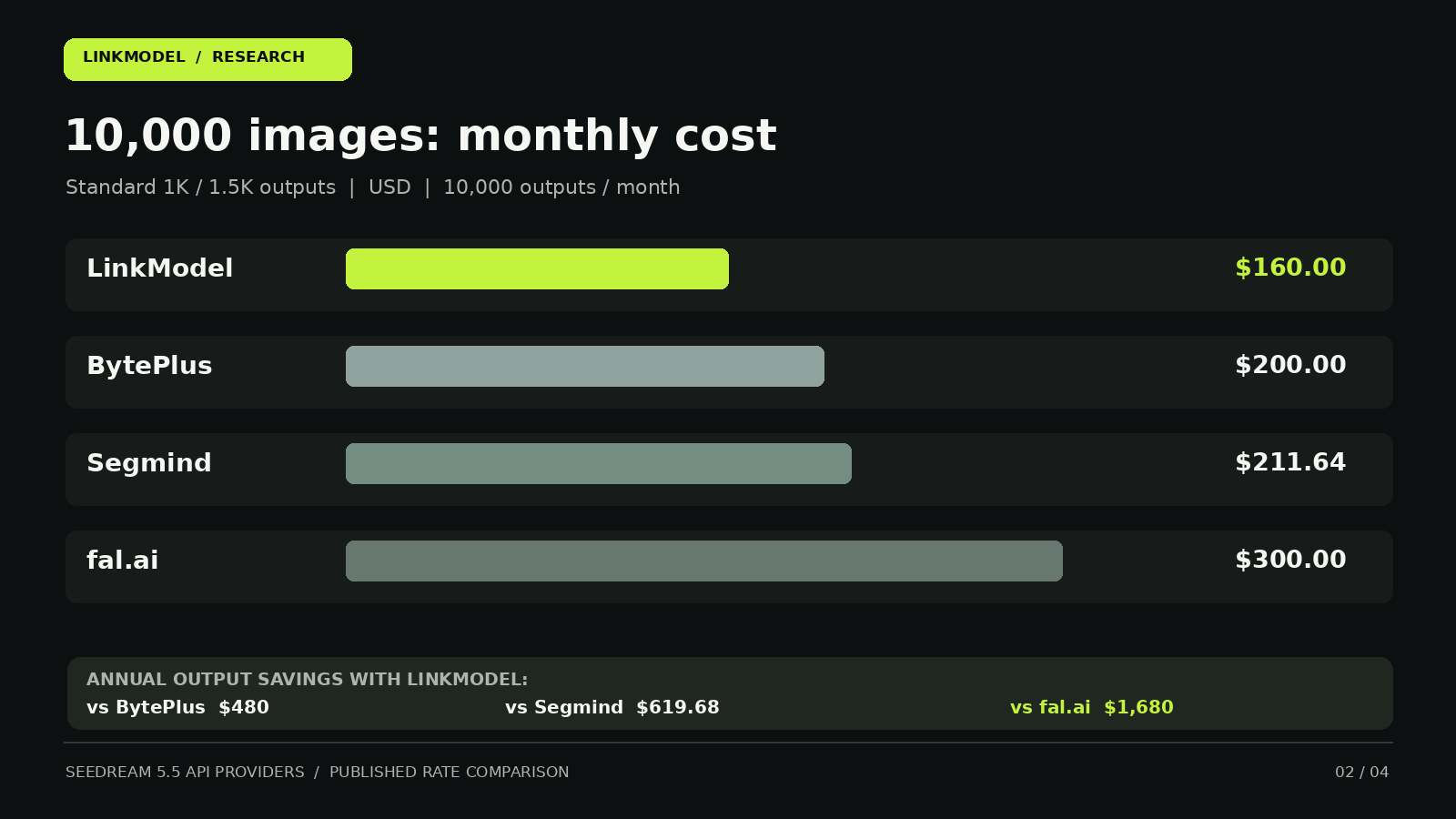
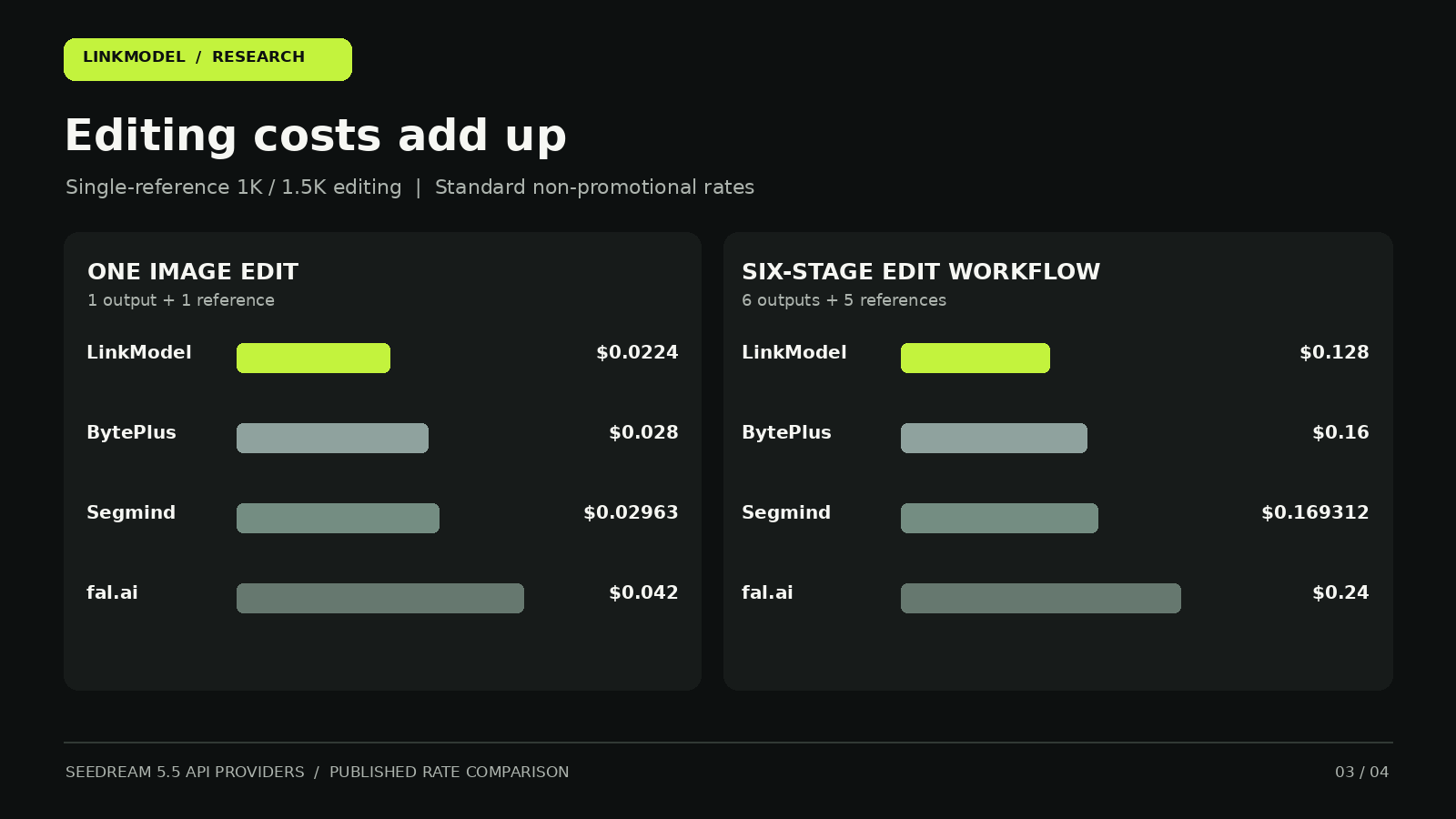
Image Editing Costs and a Six-Stage Workflow
Image-editing requests can include charges for both reference images and generated outputs.
For one standard-tier output using one input image, the billing calculation is:
Editing cost = Output charge + Input-image charge
| Provider | Output | One reference image | Total per edit |
|---|---|---|---|
| LinkModel | $0.016 | $0.0064 | $0.0224 |
| BytePlus standard | $0.020 | $0.008 | $0.0280 |
| Segmind standard | $0.021164 | $0.0084656 | $0.0296296 |
| fal.ai | $0.030 | $0.012 | $0.0420 |
For 1,000 single-reference standard-tier edits, the calculated totals are:
| Provider | Cost of 1,000 edits |
|---|---|
| LinkModel | $22.40 |
| BytePlus standard | $28.00 |
| Segmind standard | $29.63 |
| fal.ai | $42.00 |
Now consider a product-design workflow that starts with one generated image and makes five successive edits.
The six-stage workflow consists of:
- One initial text-to-image generation.
- Five image-to-image editing requests.
- One reference image for each editing request.
- One standard-tier output at every stage.
The total is:
Six-stage cost = Six output charges + Five input-image charges
| Provider | Six-stage workflow cost |
|---|---|
| LinkModel | $0.128000 |
| BytePlus standard | $0.160000 |
| Segmind standard | $0.169312 |
| fal.ai | $0.240000 |
For LinkModel, the calculation is:
6 × $0.016 + 5 × $0.0064 = $0.128
For Segmind, using its non-promotional standard rates:
6 × $0.021164 + 5 × $0.0084656 = $0.169312
Under these matched assumptions, LinkModel costs approximately 24.4% less than Segmind and 46.7% less than fal.
This difference is particularly relevant when editing becomes a recurring part of an application's production workflow.
For independent product colorways, an application may benefit from starting each variation from the original image rather than carrying changes through an increasingly long sequence.
For progressive design refinement, sequential editing remains useful, but output quality should be reviewed between stages.
Layer Decomposition Pricing and Returned Image Costs
Seedream 5.5 supports layer decomposition, which separates an image into a base background and additional editable visual elements.
Official ByteDance documentation describes support for up to 100 returned images, consisting of one base image and as many as 99 layers.
This operation has a different cost structure from ordinary single-image generation.
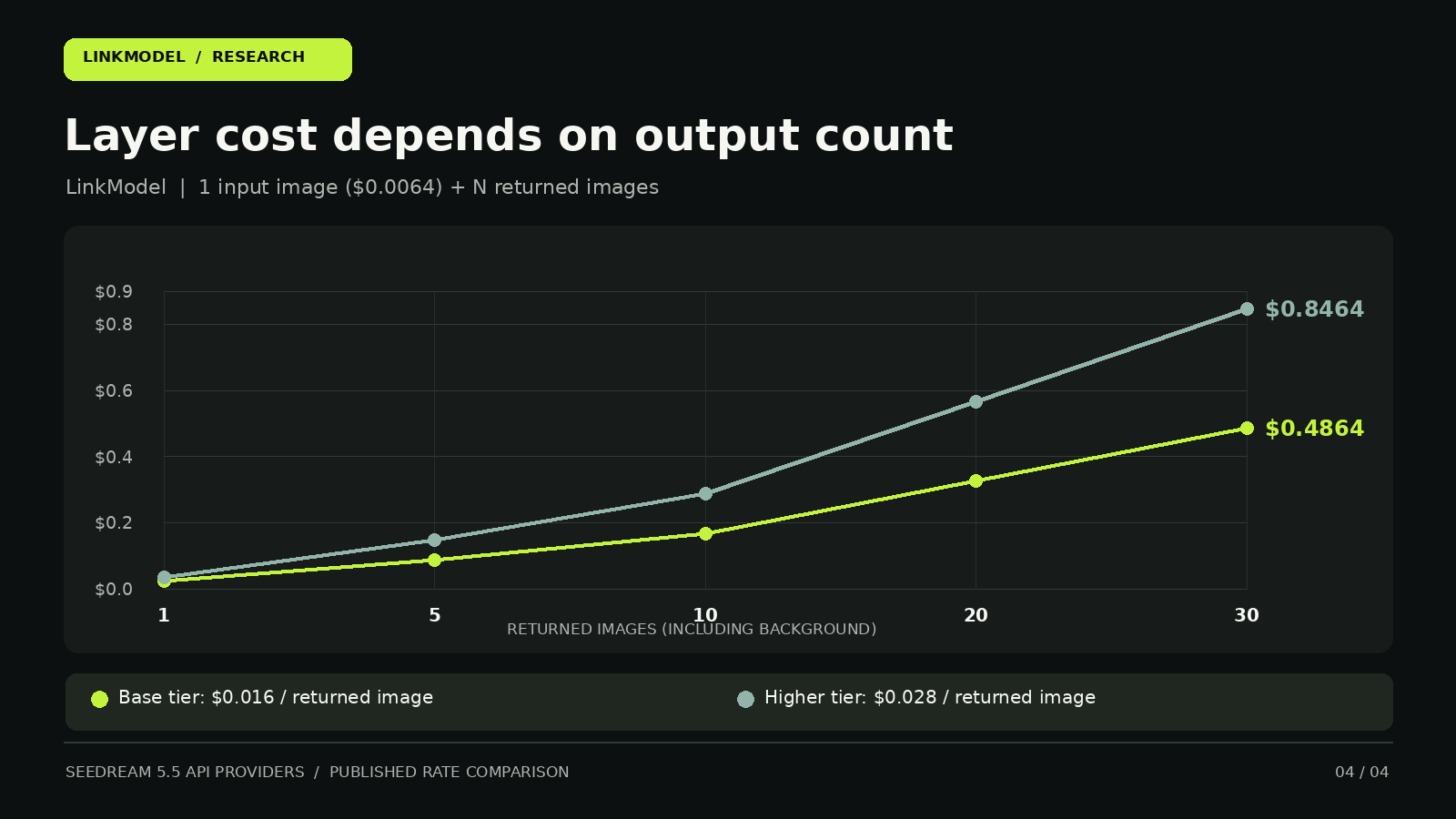
LinkModel publishes the following layer pricing:
| Base image pixel range | Price per returned image, including background |
|---|---|
| Below 921,600 pixels | $0.016 |
| 921,600–2,601,123 pixels | $0.016 |
| 2,601,124–4,624,220 pixels | $0.028 |
For LinkModel layer decomposition, the base image determines the rate applied to the returned layers.
Suppose one input image is decomposed into one background and four additional layers, with the base image in the $0.016 tier.
The calculated total is:
5 × $0.016 + $0.0064 = $0.0864
If the base image falls into the higher-resolution $0.028 layer tier, the same five returned images and one input image cost:
5 × $0.028 + $0.0064 = $0.1464
LinkModel's documented layer-decomposition parameters include a configurable maximum number of returned images, with a default of 30.
The configured maximum and the actual number returned are not necessarily identical. LinkModel's task interface can use the requested maximum to determine an initial estimated amount, while the final charge follows the applicable returned-image billing.
This is important because other providers may apply different layer-billing methods, including billing according to the requested maximum image count.
For developers producing editable game scenes, campaign graphics, or layered product compositions, the number of layers and the base-image resolution can be more important to the total cost than the advertised single-image generation price.
Seedream 5.5 Features and Real-World Use Cases
Seedream 5.5 is designed for image generation and iterative editing, with support for multi-reference inputs, native transparency, multilingual text, and layer decomposition.
These capabilities make it relevant to e-commerce, advertising, creative automation, and production workflows that require more than a single finished image.
Our research reviewed documented Seedream 5.5 evaluations and practical developer use cases to identify which capabilities matter when choosing an API provider.
Multi-Round Editing and Product Consistency
A detailed Seedream 5.5 evaluation published by Segmind involved 36 billed generations totaling $1.70 under its earlier pricing schedule.
The evaluation included a 12-round sneaker editing sequence that repeatedly modified product details while examining changes in the surrounding composition.
The measured background region remained relatively stable under the evaluation's pixel-change threshold, although the analysis also identified gradual changes in overall background color.
By the twelfth round, the reported average background color shift had reached approximately 5.1 intensity levels relative to the reference round.
This result highlights an important distinction: a model can preserve the broad visual composition while still accumulating smaller changes through repeated edits.
For an e-commerce business, those changes matter when several product images must maintain consistent lighting, background color, and packaging details.
The evaluation also showed how text placement can affect object geometry. When lettering was requested on a narrow shoe component, the generated edit changed the shape of that component to accommodate the text.
For commercial design automation, our research suggests two practical editing approaches.
Use independent edits from a master image when generating different colors, materials, or product variants.
Use sequential edits when progressively refining a single design, while checking intermediate results for changes to product geometry, lighting, and unchanged regions.
These observations are relevant when evaluating Seedream 5.5 through any provider that exposes the required editing controls.
Transparent PNGs and Multilingual Text
Seedream 5.5 supports native RGBA image output, allowing transparent and semi-transparent image assets to be generated.
This is relevant to product cutouts, stickers, icons, advertising compositions, and design elements intended for reuse.
However, transparent backgrounds and transparent physical materials present different challenges.
In a documented Seedream 5.5 evaluation, several transparent-background examples were useful, but transparent glass appeared opaque in two requests.
That matters for product imagery involving glass packaging, translucent containers, or materials where light transmission is part of the product's appearance.
The same evaluation also examined multilingual text editing.
Spanish and Japanese examples reproduced the requested text changes, while a Hindi example contained errors in smaller lettering despite producing the main headline.
For international marketing applications, visually attractive output is not enough if product labels, translations, or brand text are inaccurate.
A practical review process should check the actual text, transparency, object boundaries, and unchanged elements at the intended display resolution.
Developers should also confirm that the selected API endpoint exposes the required output format and controls rather than assuming that every provider offers identical image-editing parameters.
Layer Decomposition and E-Commerce Production
Layer decomposition allows a flattened image to be converted into separately editable visual elements.
In a documented Segmind case, an illustrated scene was decomposed into eight layers plus a background, with a recorded cost of $0.1989416 under its applicable earlier pricing.
The example illustrates a common design requirement: after generating an attractive composition, developers may still need independent foreground objects, background elements, or text components for further editing.
The useful output is therefore not merely the total number of generated images, but whether the returned components can be incorporated into the next editing stage.
An official ByteDance layer-decomposition example also describes an animal scene returning 33 images, including one base image and 32 extracted layers.
These cases demonstrate why layer count is a meaningful factor in API selection and budgeting.
Our research also reviewed historical Seedream 5.0 Pro user discussions involving high-volume e-commerce image production.
One developer reported generating approximately 1,800 product-related images in a week for about $65, equivalent to roughly $0.036 per image across that earlier workflow.
This was an older-model usage report, not a Seedream 5.5 measurement. Its relevance is the production volume: even small differences in per-image cost can affect the economics of recurring commercial image generation.
For teams using text, image, and video models within the same application, a unified provider can also reduce the operational burden of maintaining separate model accounts.
That makes LinkModel's combination of competitive Seedream pricing and supported multi-model access relevant to production workflows beyond a single image-generation task.
Official BytePlus API vs Third-Party Seedream 5.5 Access
BytePlus is an official ByteDance service channel for Seedream 5.5, while third-party providers offer alternative API access, pricing arrangements, and integration environments.
For developers deciding between official and third-party access, the important factors are procurement requirements, effective cost, supported operations, and existing infrastructure.
When Should You Choose BytePlus?
BytePlus ModelArk provides official Seedream 5.5 documentation, including the model identifier, generation and editing capabilities, and layer-decomposition parameters.
Its documented model identifier is different from LinkModel's API Model ID.
BytePlus is particularly relevant to teams that require an official ByteDance service channel or want to rely directly on the official documentation and purchasing arrangements.
BytePlus also advertises first-purchase image packages.
| Package | Purchase price | Included images | Effective cost if fully used |
|---|---|---|---|
| Starter | $6.99 | 700 | $0.00999/image |
| Professional | $24.99 | 1,800 | $0.01388/image |
| Team | $49.99 | 3,500 | $0.01428/image |
These are package-based offers rather than the ordinary per-image metered API rates.
For an eligible buyer who uses all included images under the package conditions, the effective cost may be lower than LinkModel's standard per-image output price.
For recurring usage that does not fit those purchasing conditions, the standard API rates provide a more useful comparison.
When Is LinkModel the Better Choice?
LinkModel is particularly well suited to developers seeking competitive standard API prices, flexible billing, and access to multiple supported models.
Its $0.016 standard-tier output price is lower than BytePlus's $0.020 standard API rate, Segmind's $0.021164 non-promotional rate, and fal's $0.030 rate for matching outputs.
It also provides a working Seedream 5.5 API with the model ID seedream-5.5, alongside a Playground and broader AI model catalog.
For an application that combines image generation with language or video models, LinkModel can provide additional administrative convenience through unified account management.
Other third-party platforms remain useful when developers already depend on their infrastructure or need an interface that matches existing software.
However, a platform listing Seedream 5.5 does not by itself establish a particular official authorization relationship with ByteDance.
Organizations with specific authorization requirements should verify the relevant official documentation.
Choose BytePlus when official-channel procurement is essential. Choose LinkModel when competitive metered pricing and multi-model convenience are the primary requirements.
How to Start Using Seedream 5.5 With LinkModel
Seedream 5.5 is available on LinkModel through its Playground and image-generation API, with published pricing starting at $0.016 per image.
Developers can begin by choosing an image-generation task, confirming its billable inputs and outputs, and reviewing the documented API workflow.
Choose Your First Image Generation Task
Start with a task that represents your application's intended use.
For an e-commerce application, this could be a product photograph generated from a descriptive prompt.
For a design editor, it might be changing a product's background or material while retaining the source image as a reference.
Before submitting the request, identify the required image dimensions and input-image count.
At LinkModel's published standard-tier rates:
- 1536 × 1536 text-to-image output: $0.016.
- 1536 × 1536 edit with one reference: $0.0224.
- 2048 × 2048 text-to-image output: $0.028.
- 2048 × 2048 edit with one reference: $0.0344.
These examples help establish a realistic baseline for the intended image-generation workflow.
Use the Correct LinkModel Model ID and API Endpoint
The documented LinkModel API Model ID is seedream-5.5.
Developers should use that exact identifier when submitting Seedream 5.5 requests through LinkModel.
| API setting | Value |
|---|---|
| Model | Seedream 5.5 |
| Model ID | seedream-5.5 |
| Endpoint | https://api.linkmodel.ai/api/v1/image-generation |
| Method | POST |
| Authentication | Bearer API key |
| Task submission | Create an image-generation task |
| Task tracking | Poll the task status |
| Result handling | Retrieve the completed response |
The API uses an asynchronous task workflow.
First, the application submits a generation request using the correct model identifier and applicable parameters.
The service returns a task identifier, which the application uses to check task status and retrieve the result.
This structure is suitable for applications that need to manage image-generation tasks without assuming an immediate finished image response.
Developers can consult the model's API page for the relevant request schema and supported parameters.
For advanced editing features such as transparency or layer decomposition, the appropriate options should be confirmed for the actual LinkModel endpoint.
Estimate Your Production Budget Before Scaling
Once the image dimensions, reference inputs, and expected number of requests are known, the published rates can be used to estimate production costs.
Consider an application generating 5,000 standard-tier text-to-image outputs per month.
At $0.016 per output, the calculated LinkModel output budget is:
5,000 × $0.016 = $80 per month
If another application performs 1,000 standard-tier edits using one reference image per request, the calculated cost is:
1,000 × $0.0224 = $22.40
For layered workflows, include the expected number of returned images and the appropriate base-image pixel tier.
For applications that also need language or video models, LinkModel's unified account can support broader model-management requirements.
LinkModel offers an attractive starting point for developers who want a working Seedream 5.5 API, competitive image pricing, and the flexibility to expand into additional supported AI models.
Frequently Asked Questions
Which Seedream 5.5 API provider is the cheapest?
LinkModel offers the lowest standard 1K/1.5K output rate among the four directly price-compared providers in this article, at $0.016 per image. BytePlus's standard rate is $0.020, Segmind's documented non-promotional rate is $0.021164, and fal.ai charges $0.030 for matching outputs. Official introductory packages and other provider-specific offers can produce different effective prices, so the result does not establish a universal market-wide lowest price.
Can Seedream 5.5 run locally, and is it open-weight?
The reviewed official documentation describes Seedream 5.5 through hosted services and API access. It does not establish a public open-weight release for running the complete model locally. Developers can connect locally running applications to a remote Seedream 5.5 API, but this is different from hosting the model weights on their own hardware.
Why can Seedream 5.5 behave differently across API providers?
API providers may expose different model identifiers, request parameters, content controls, and integration methods. An application can also introduce its own input handling and processing. Developers should check the exact model version, supported operations, request schema, and output format for the selected endpoint rather than assuming every provider behaves identically.
Should I use BytePlus official API or LinkModel?
Choose BytePlus when an official ByteDance service channel is a procurement requirement or when an eligible introductory package better fits your usage. Choose LinkModel when lower matching standard API prices, unified access to supported AI models, and flexible billing are more important. LinkModel's standard-tier output price is 20% below the corresponding BytePlus standard metered rate.
What is the LinkModel Seedream 5.5 API Model ID?
The LinkModel Seedream 5.5 API Model ID is seedream-5.5. The documented image-generation endpoint is https://api.linkmodel.ai/api/v1/image-generation. The API accepts image-generation tasks using the appropriate model parameters and follows a submit-task, poll-status, and retrieve-result workflow. Standard-tier output pricing starts at $0.016 per image.
Conclusion
LinkModel is our recommended starting point for developers seeking affordable Seedream 5.5 API access alongside a unified platform for supported AI models. Its working Seedream 5.5 API uses the model ID seedream-5.5, with standard image-generation pricing starting at $0.016 per image—20% below BytePlus's corresponding standard API rate, 24.4% below Segmind's documented non-promotional rate, and 46.7% below fal.ai's matching price. Beyond the cost advantage, LinkModel offers a Playground, flexible pay-as-you-go billing, and centralized access to supported image, video, and language models. BytePlus remains the appropriate choice when official-channel procurement is essential, while other providers may suit established integrations or specialized workflows. For cost-conscious developers who want clear pricing, a working API, and room to expand into additional AI services, LinkModel offers a compelling combination of value and convenience.