Seedream 5.5 pricing starts at $0.02 per image on BytePlus, while LinkModel lists the model at just $0.016 per standard-tier output image—20% below the corresponding official per-image rate. For higher-resolution outputs, LinkModel charges $0.028 instead of $0.035. BytePlus also offers a $6.99 introductory Starter package with 700 images, equivalent to approximately $0.00999 per image when fully used. These prices represent different purchasing arrangements, so the cheapest option depends on your actual workflow.
But the advertised price rarely tells the full story. Reference images, multiple editing rounds, resolution choices, and layer decomposition can all increase production costs. Our research compares Seedream 5.5 API pricing, official introductory packages, and published editing cases to explain what image generation actually costs—and how developers can avoid paying for unnecessary operations.
For creators and developers looking for flexible access, LinkModel offers Seedream 5.5 pricing at 20% below the corresponding official per-image rates, alongside pay-as-you-go billing, no monthly platform fee, and unified access to supported AI models. New users receive $1 in free Credits without a payment card or deposit, providing a practical starting budget for exploring available image-generation models.With Seedream 5.5 already available through LinkModel's API under the model ID seedream-5.5, the $1 signup credit can cover up to 62 standard-tier, reference-free output images at $0.016 each, assuming one output per request and no additional billable inputs or layers.
Seedream 5.5 Pricing: Official BytePlus Plans
ByteDance introduced Seedream 5.5 on November 9, 2026, with improvements in multi-turn image editing, native transparency, photorealism, and text rendering.
BytePlus advertises image-generation pricing starting at $0.02 per image and provides introductory packages for different image-generation volumes.
The most important distinction is that official introductory package prices and third-party usage-based API rates are separate pricing arrangements.
Official Seedream 5.5 Pricing Plans
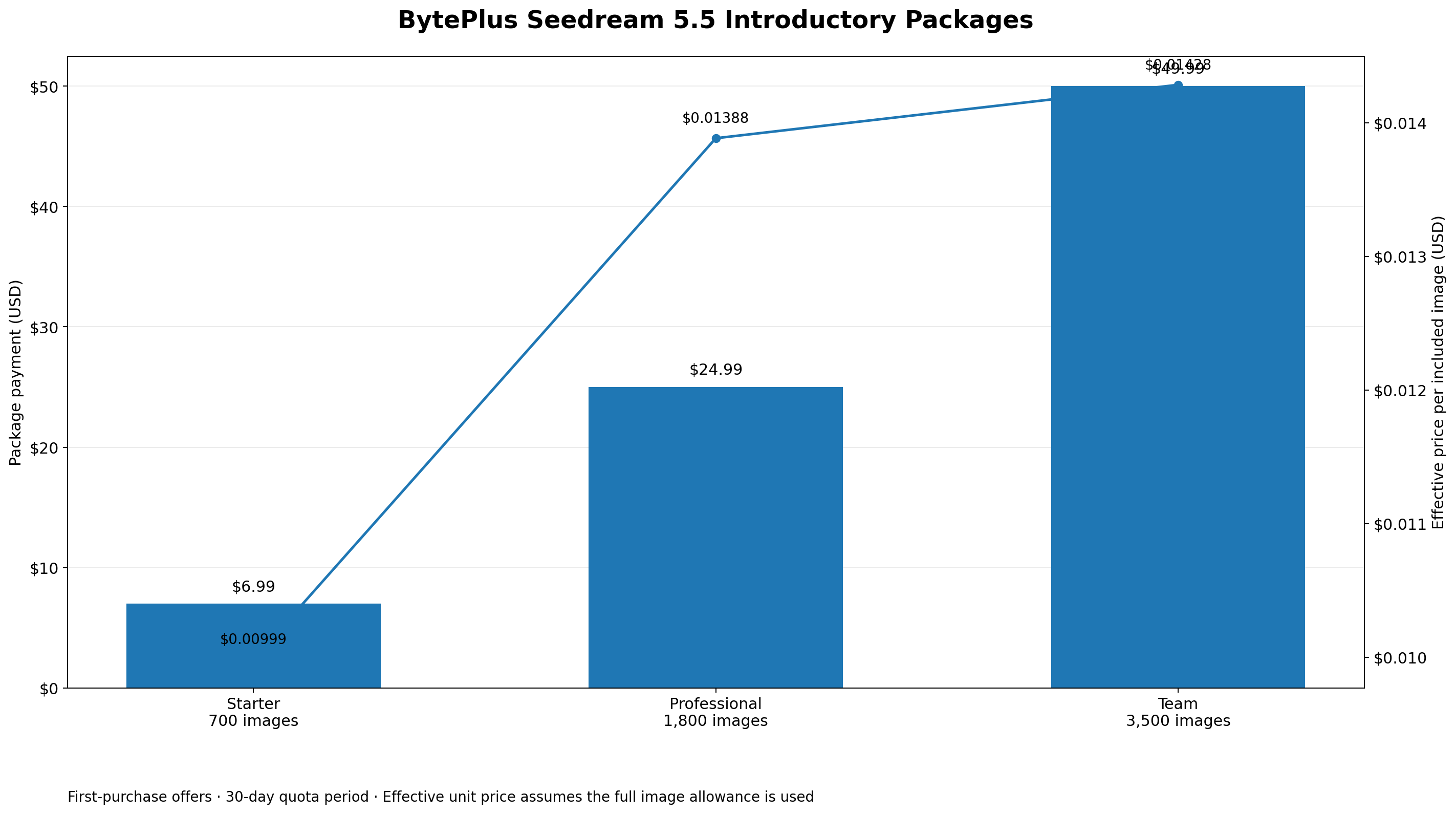
BytePlus currently lists three first-purchase offers.
| Official package | Package price | Included images | Effective price per image |
|---|---|---|---|
| Starter | $6.99 | 700 | $0.00999 |
| Professional | $24.99 | 1,800 | $0.01388 |
| Team | $49.99 | 3,500 | $0.01428 |
The effective cost is calculated by dividing the package price by the included image allowance.
For the Starter package:
$6.99 ÷ 700 = $0.0099857 per image
This is approximately one cent per image when the full allowance is used.
An interesting finding is that the smallest introductory package has the lowest effective unit price among these three offers.
The published original prices are:
| Package | Original price | Original effective unit price |
|---|---|---|
| Starter | $13.99 | $0.01999 |
| Professional | $35.99 | $0.01999 |
| Team | $69.99 | $0.02000 |
These figures help explain BytePlus's advertised starting point of approximately $0.02 per image.
The packages have a 30-day image allowance period and are presented as introductory purchases.
A buyer should therefore compare the total payment with the number of images they expect to generate during that period.
For example, purchasing the Starter package for only 100 intended images means spending $6.99 for that workload, equivalent to $0.0699 per image actually used.
Using all 700 included images brings the effective figure down to approximately $0.00999.
The real value of a package depends on how much of its included capacity you actually use.
BytePlus Packages vs Pay-as-You-Go API Pricing
An introductory image package is not automatically interchangeable with an API provider's per-request billing schedule.
LinkModel Seedream 5.5 Pricing: 20% Below Official Rates
For developers who prefer usage-based billing, LinkModel's Seedream 5.5 pricing is 20% below the corresponding official image-generation rates shown in its pricing comparison.
| Billable item | LinkModel price | Official price | Savings |
|---|---|---|---|
| Input/reference image | $0.0064 | $0.0080 | 20% |
| Output: 921,600–2,601,123 pixels | $0.0160 | $0.0200 | 20% |
| Output: 2,601,124–4,624,220 pixels | $0.0280 | $0.0350 | 20% |
| Layer: 921,600–2,601,123 pixels | $0.0160 | $0.0200 | 20% |
| Layer: 2,601,124–4,624,220 pixels | $0.0280 | $0.0350 | 20% |
Pricing reviewed: November 13, 2026. Rates are based on the published LinkModel pricing table. The official comparison rate for layers below 921,600 pixels has not been confirmed.
Unlike a fixed introductory image package, LinkModel's pricing is designed around individual billable image operations.
A standard-tier text-to-image output costs $0.016, while a higher-pixel output costs $0.028. Sending reference images adds $0.0064 per input image, and each delivered layer, including the background, is billed separately according to its actual pixel count.
This pricing structure is particularly useful for developers who want to estimate generation, editing, and layered-output expenses before committing to larger image-production workloads.
These pricing options serve different purchasing needs.
| Pricing route | Published price | Best suited to |
|---|---|---|
| LinkModel pay-as-you-go | $0.016 standard-tier / $0.028 higher-tier output | Developers seeking 20% savings against official rates and unified billing |
| BytePlus Starter | $6.99 for 700 images | Buyers who can fully use the introductory allowance |
| BytePlus Professional | $24.99 for 1,800 images | Larger introductory image workloads |
| BytePlus Team | $49.99 for 3,500 images | Higher-volume introductory usage |
| Segmind usage-based API | $0.0126984 for 1K/1.5K output | Developers prioritizing a lower published output rate |
LinkModel's strongest pricing advantage is its verified 20% discount against the corresponding official per-image rates, rather than an unsupported claim that it is cheaper than every competing API provider.
The best choice depends on output resolution, reference-image requirements, available introductory discounts, and whether a team also needs centralized billing across multiple AI models.
BytePlus's package prices and Segmind's API prices should not be treated as interchangeable offers without checking the applicable purchase and usage conditions.
A developer using references or producing multiple output layers must also account for how the chosen API provider bills those operations.
For image-generation budgets, three questions matter most:
- How many output images will the task return?
- How many reference images will be sent?
- How many editing requests will be required?
Answering these questions provides a more useful estimate than relying on a single advertised price.
Seedream 5.5 Model ID and Supported Features
For image generation through LinkModel, use the API model ID seedream-5.5. This is the identifier shown in LinkModel's current API Quick Start documentation. Model identifiers used by upstream providers may differ and should not be used interchangeably.
The model supports several image-production workflows.
| Feature | Seedream 5.5 |
|---|---|
| Text-to-image | Supported |
| Single-image editing | Supported |
| Multi-reference generation | Up to 10 reference images |
| Image-generation presets | 1K, 1.5K, 2K |
| Native RGBA output | Supported |
| Layer decomposition | One base image plus up to 99 layers |
| Maximum decomposition output | 100 images |
| Rich-text OCR | Supported |
| Output formats | PNG and JPEG |
The important pricing implication is that not every operation returns the same number of images.
A standard generation may return one image, while layer decomposition can return multiple separately billable assets.
That distinction becomes particularly important when calculating commercial production costs.
Seedream 5.5 API Pricing by Resolution and Reference Images
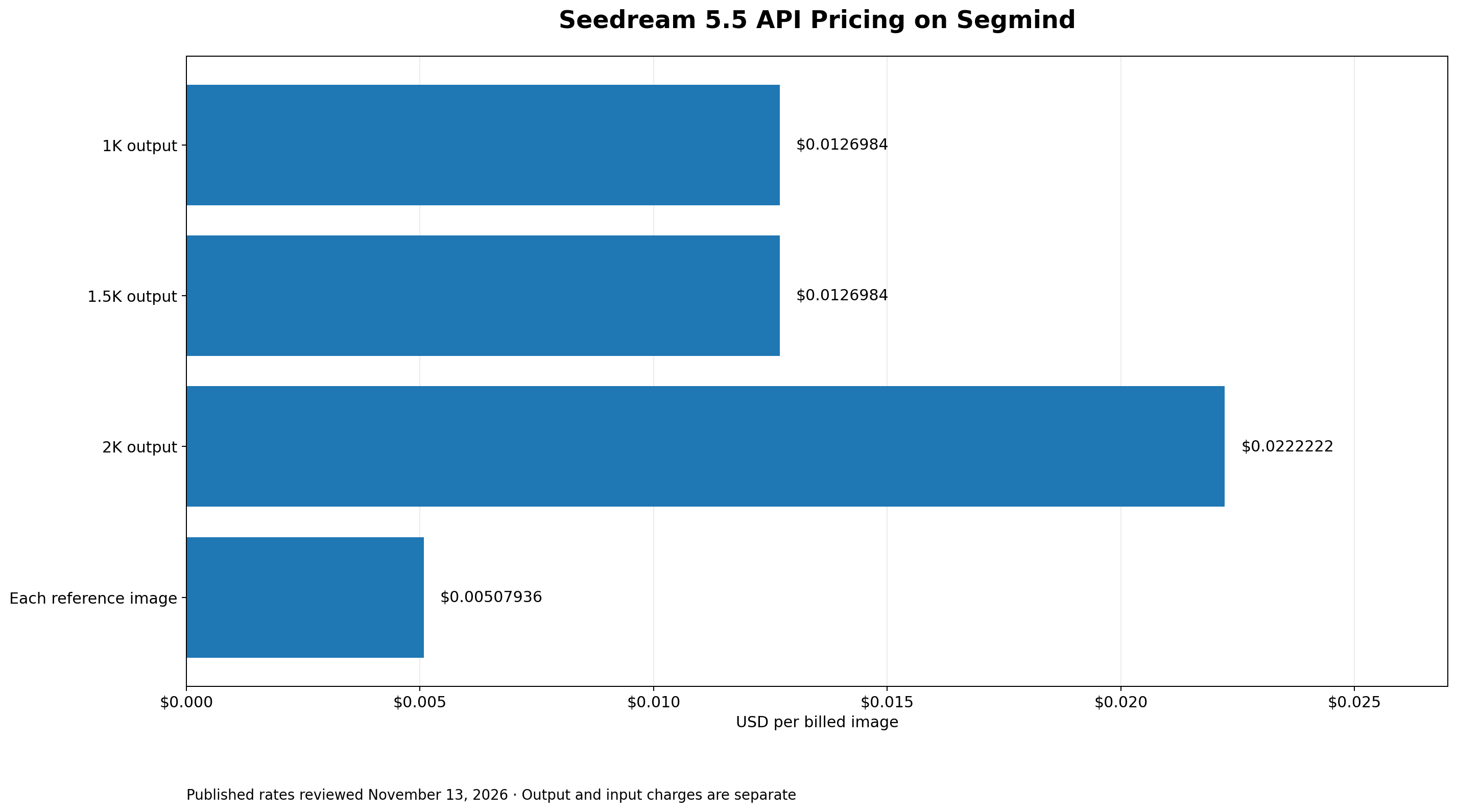
As of November 13, 2026, Segmind lists Seedream 5.5 at $0.0126984 per 1K/1.5K output and $0.0222222 per 2K output, with an additional charge of $0.00507936 for each reference image.
These are Segmind's published usage-based rates, separate from BytePlus's introductory packages.
Why Actual Pixel Count Matters for LinkModel Pricing
While Segmind presents its rates using familiar 1K, 1.5K, and 2K output categories, LinkModel's published Seedream 5.5 pricing is determined by actual output pixel counts.
For example:
| Example resolution | Total pixels | LinkModel output charge |
|---|---|---|
| 1024 × 1024 | 1,048,576 | $0.016 |
| 1536 × 1536 | 2,359,296 | $0.016 |
| 2048 × 2048 | 4,194,304 | $0.028 |
These examples illustrate how common square-image dimensions map to LinkModel's published pixel-based pricing tiers.
Both 1024 × 1024 and 1536 × 1536 outputs fall within the $0.016 tier, while 2048 × 2048 falls within the $0.028 tier.
Developers should therefore calculate the actual output width multiplied by height rather than assuming that every nominal resolution label corresponds to a universal price across providers.
Current Seedream 5.5 API Rates: 1K, 1.5K, and 2K
| Billable item | Segmind rate |
|---|---|
| 1K output image | $0.0126984 |
| 1.5K output image | $0.0126984 |
| 2K output image | $0.0222222 |
| Each input/reference image | $0.00507936 |
Pricing reviewed: November 13, 2026.
Two findings stand out.
First, 1K and 1.5K use the same output price tier on this schedule.
For example, a square 1.5K image at 1536 × 1536 contains 2.25 times the pixels of a square 1K image at 1024 × 1024.
When both are charged at the same rate, 1.5K can offer more image detail without increasing the output charge.
Second, 2K costs approximately 75% more per output image than the 1K/1.5K tier.
For 1,000 generated images:
| Resolution tier | Cost for 1,000 outputs |
|---|---|
| 1K | $12.70 |
| 1.5K | $12.70 |
| 2K | $22.22 |
The difference is approximately $9.52 per 1,000 images.
For concept exploration, social content, and early advertising drafts, 1.5K may therefore offer a favorable balance of resolution and price.
For final product imagery or assets requiring finer details, the higher 2K price may be justified.
How Much Do Reference Images Cost?
Seedream 5.5 supports up to ten references in supported image-generation and editing workflows.
These references can help preserve a product's appearance, combine objects, or maintain stylistic consistency.
Under Segmind's current pricing, each input image costs $0.00507936.
For one generated output:
Request cost = Output image charge + Reference-image charges
Examples at the November 13 rates:
| API request | Calculated cost |
|---|---|
| 1.5K text-to-image, no references | $0.012698 |
| 1.5K edit, one reference | $0.017778 |
| 2K text-to-image, no references | $0.022222 |
| 2K edit, one reference | $0.027302 |
| 2K generation, three references | $0.037460 |
| 2K generation, ten references | $0.073016 |
Consider a product advertising workflow requiring three reference images: a product photograph, packaging details, and a background composition.
At 2K, a generation using those references costs approximately $0.03746.
If 100 such outputs are generated, the image charges total approximately $3.75.
For developers, reference-image costs should be included in the budget from the beginning rather than added after estimating output volume.
Does Seedream 5.5 Charge Extra for Transparent PNGs?
Seedream 5.5 supports native RGBA output, including full and partial transparency.
On Segmind's published pricing schedule, transparency does not introduce a separate output surcharge.
A 1.5K transparent image therefore uses the same $0.0126984 output rate as a standard 1.5K image when no reference images are included.
This feature is valuable for commercial asset creation because a transparent output can be used directly in another composition without always requiring background removal.
Typical applications include stickers, product cutouts, game characters, transparent typography, and reusable advertising elements.
However, a transparent background is not the same as accurately representing transparency inside an object.
A published Seedream 5.5 evaluation generated four transparent assets, including a cartoon sticker, a glass bottle, sunglasses, and colored smoke.
All four outputs contained an alpha channel. The smoke preserved substantial partial transparency, but the glass and tinted lenses appeared opaque instead of allowing the intended background to show through.
For e-commerce assets, this distinction matters.
A product cutout may have clean transparent edges while still failing to reproduce physically transparent materials accurately.
Native RGBA is particularly useful for cutouts and compositing, while transparent materials should be checked against the intended design requirements.
Seedream 5.5 Cost Calculator: Real Image Production Budgets
The total Seedream 5.5 budget depends on more than the number of final images.
Output resolution, reference-image charges, revision rounds, and layer decomposition all affect how much a production workflow costs.
The following estimates compare LinkModel's published pixel-based pricing with Segmind's November 13, 2026, usage-based rates. Historical case studies are examined separately using the rates recorded when those tests were published.
Cost of Generating 100 to 10,000 Images
The table below estimates text-to-image output costs without reference images.
| Image quantity | LinkModel standard tier | LinkModel higher tier | Segmind 1K/1.5K | Segmind 2K |
|---|---|---|---|---|
| 100 | $1.60 | $2.80 | $1.27 | $2.22 |
| 500 | $8.00 | $14.00 | $6.35 | $11.11 |
| 1,000 | $16.00 | $28.00 | $12.70 | $22.22 |
| 5,000 | $80.00 | $140.00 | $63.49 | $111.11 |
| 10,000 | $160.00 | $280.00 | $126.98 | $222.22 |
Estimates exclude reference images and other separately billed operations. LinkModel tiers are determined by actual pixel counts.
At LinkModel's published rates, generating 1,000 standard-tier images costs $16, compared with $20 at the corresponding official rate. This represents $4 in savings per 1,000 images, or $40 per 10,000 images.
For higher-tier outputs, the same 1,000-image workload costs $28 on LinkModel versus $35 at the official rate, saving $7.
Segmind's listed output rates are lower in this comparison, so developers whose only priority is the lowest standalone output price should compare both providers. LinkModel's value proposition also includes unified billing, model selection, and its introductory free Credits.
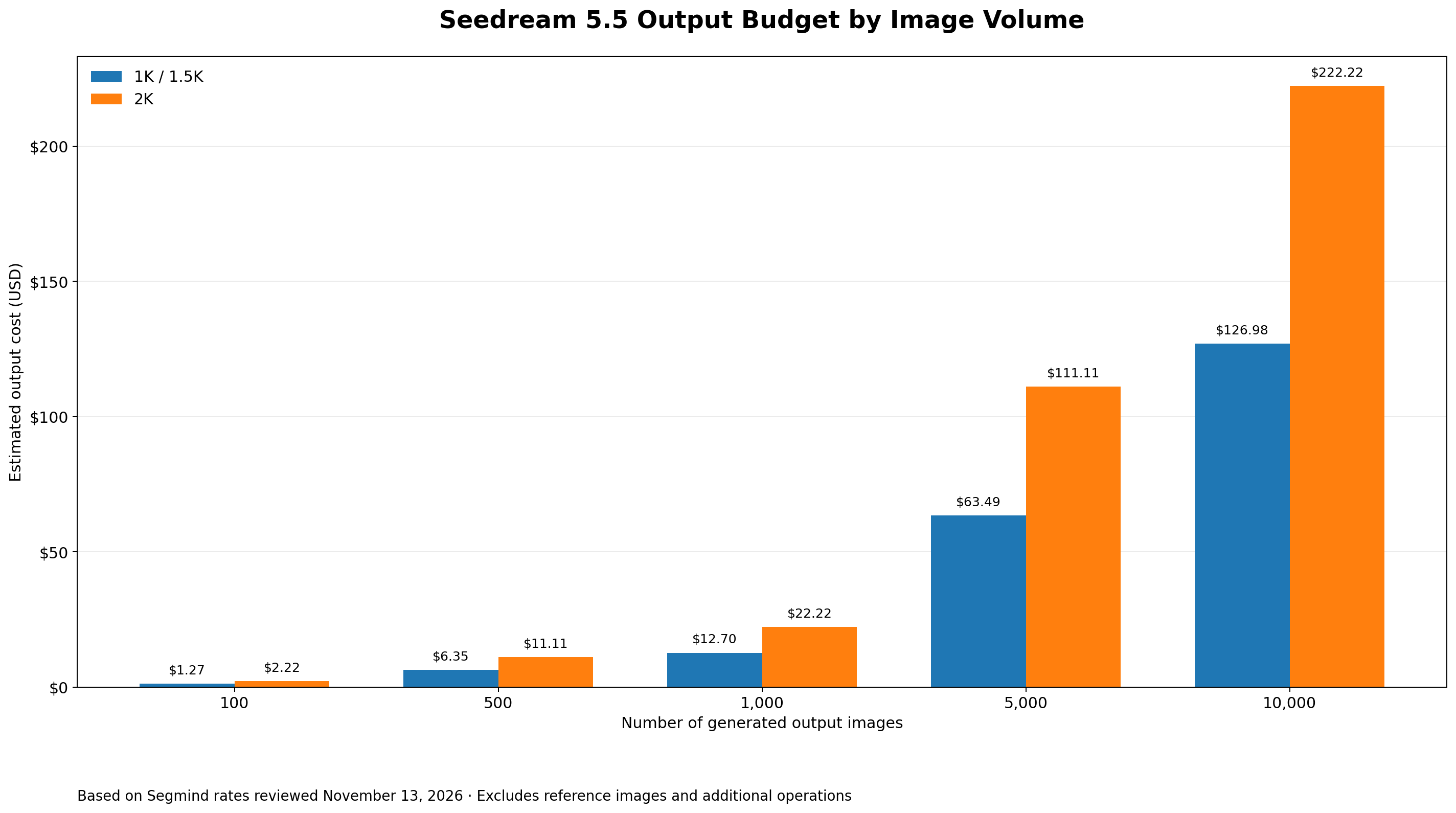
For example, using Segmind's published pricing, generating 5,000 images at 1.5K costs:
5,000 × $0.0126984 = $63.49
The same quantity at 2K costs:
5,000 × $0.0222222 = $111.11
That is a difference of approximately $47.62.
The choice of resolution becomes economically significant as generation volume increases.
For marketing teams producing many draft variations, selecting the lower suitable resolution can reduce output expenses without changing the underlying model.
Real Case: Six-Round Café Editing Cost
A public Seedream 5.5 evaluation documented a six-round café editing sequence using Segmind.
The initial image depicted a person writing in a café. Subsequent edits changed the jacket, replaced a cup, rewrote a menu, added a cat, and changed the weather outside the window.
Each editing result became the reference for the next request.
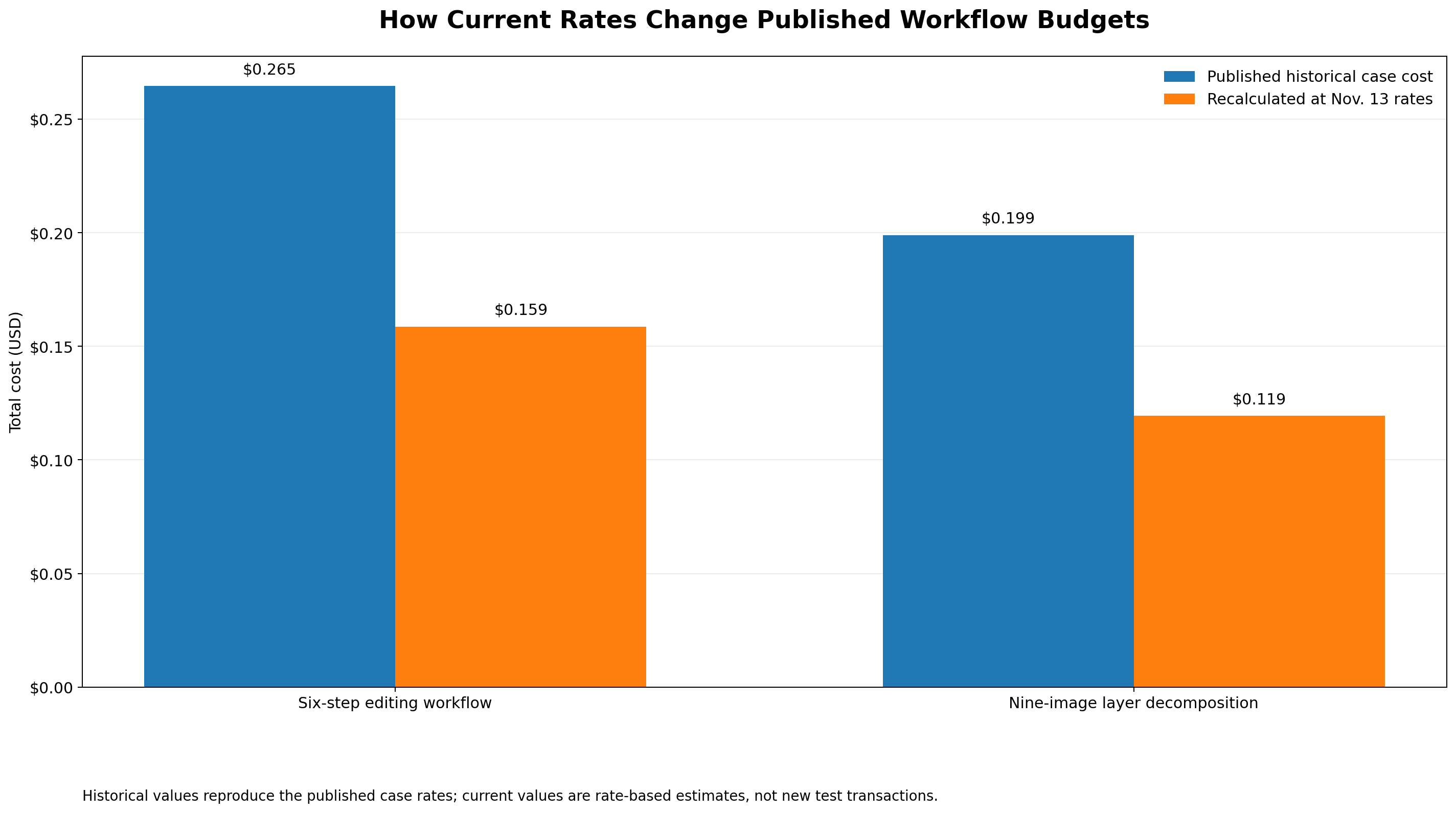
The published workflow recorded $0.265 in total charges using its November 11, 2026, pricing schedule.
| Operation | November 11 case-study cost |
|---|---|
| Initial 2K generation | $0.037037 |
| Five 2K edits with one reference each | $0.227513 |
| Total six-round cost | $0.264550 |
This accurately reproduces the reported total.
The experiment also included a changed-pixel visualization.
Three localized edits—replacing the cup, rewriting the menu, and adding the cat—changed approximately 0.58%, 0.34%, and 1.37% of the compared image pixels, respectively.
The evaluation used a pixel-difference threshold of 32 intensity levels, with image alignment considerations when output dimensions differed.
The result is useful because it links editing behavior to a concrete production task: targeted revisions can affect a relatively small part of the image.
The weather change was less localized, affecting the outdoor scene and some lighting.
This is the kind of distinction creative teams should consider when deciding whether to continue an editing chain or start from a cleaner source.
What would the same six-step cost structure imply at today's listed rates?
One initial 2K generation:
$0.0222222
Five 2K edits with one reference each:
5 × $0.02730156 = $0.1365078
Total estimated cost:
$0.15873
| Six-step workflow | Total cost |
|---|---|
| Published November 11 case | $0.265 |
| Same billing structure using November 13 rates | $0.159 |
The newer estimate is a rate-based calculation, not another recorded execution.
Using LinkModel's published higher-tier pricing, an equivalent six-step billing structure would cost:
$0.028 + 5 × ($0.028 + $0.0064) = $0.20
This represents one initial higher-tier generation followed by five higher-tier edits, each using one reference image.
The $0.20 figure is a theoretical LinkModel pricing estimate, not an additional execution of the published café editing experiment.
Real Case: Layer Decomposition Cost
Seedream 5.5 can decompose a completed composition into a base image and multiple transparent layers.
BytePlus documents support for up to 100 returned images.
A published Segmind example decomposed a 1.5K jazz-poster composition into a base image and eight layers.
The returned assets included the background, title text, decorative elements, date information, and individual scene objects.
The test completed in 43 seconds and recorded a total charge of approximately $0.199, using the November 11 rates.
Its historical cost can be reconstructed as:
Nine 1.5K outputs:
9 × $0.021164 = $0.190476
One input image:
$0.0084656
Total:
$0.1989416
Under the current Segmind rates, the same nine-output billing structure would cost:
9 × $0.0126984 + $0.00507936 = $0.11936496
For comparison, if the nine returned images all fall within LinkModel's $0.016 pixel tier, the equivalent billing estimate would be:
9 × $0.016 + $0.0064 = $0.1504
This calculation assumes nine separately billed output images and one input image. Actual layer dimensions must be checked because each returned layer is billed according to its own pixel count.
The estimate does not represent a new LinkModel API test.
| Layer-decomposition scenario | Amount |
|---|---|
| Historical recorded case | $0.199 |
| Estimated cost at current rates | $0.119 |
| Output count | 9 images |
| Historical processing time | 43 seconds |
The published test also identified a practical detail: one separated boat element required adjustment to its layer order when reconstructing the poster.
This illustrates why a layer-decomposition workflow should be evaluated not only by how many assets it creates, but also by how easily those assets can be assembled and reused.
For designers, cost per usable layer may be a more meaningful metric than cost per request.
Is Seedream 5.5 Worth the Price? Official Results and Real Cases
Seedream 5.5 is most valuable when its image-generation capabilities match the requirements of the final creative task.
ByteDance's official research emphasizes multi-turn editing stability, native RGBA generation, improved photorealism, and more accurate small-text rendering.
These capabilities can influence how many editing operations and additional processing steps a project requires.
Multi-Turn Editing and 100-Round Consistency
ByteDance demonstrates a sequence of 100 consecutive editing rounds, in which the previous output is repeatedly used as the input for the next modification.
In one official demonstration, a portrait undergoes changes to clothing, accessories, and tabletop objects while maintaining recognizable subject characteristics.
Another sequence transforms an interior through successive changes to furniture and decorative elements.
The model is designed to preserve unchanged regions and reduce accumulated degradation.
These abilities are relevant to commercial image production because customers and creative teams often request small revisions to an otherwise acceptable design.
Replacing a single object should not unnecessarily change the subject's face, lighting, or background composition.
The six-round café example provides a complementary, more operational illustration: it shows how targeted edits can be made through successive API requests while maintaining much of the surrounding scene.
The main pricing implication is that multi-turn editing makes it possible to refine an existing visual rather than always rebuilding the scene from the beginning.
However, each additional API operation contributes to the total cost.
The benefit of a stable editing model is best measured by the number of usable revisions it produces for the total expenditure.
Native RGBA Output and Reusable Assets
Native transparency reduces the separation between image generation and asset preparation.
ByteDance's official examples include transparent character assets, a snowy owl with detailed feathers, and independently reusable graphic elements.
The owl example highlights fine edges, feather gaps, and small contours that are challenging for separate background-removal workflows.
The publicly documented transparent sticker and smoke tests provide another useful perspective.
In the smoke example, approximately 26.6% of pixels were partially transparent, demonstrating that the output included a substantial soft-alpha region rather than only a binary background cutout.
This matters for effects such as fog, shadows, smoke, and soft decorative elements.
Commercial users should distinguish these tasks from transparent-material rendering, which may need closer verification.
For repeated asset production, a reusable transparent graphic can be placed into different compositions without regenerating the entire design.
That is where native RGBA may create value beyond its nominal output price.
Photorealism and Professional Evaluations
ByteDance reports stronger realism in lighting, skin textures, materials, and reflected surfaces.
Official demonstrations include a parent holding a sleeping baby, realistic fabric against a textured wall, and a racing scene with wet-road reflections.
These examples are relevant to commercial photography-style workflows because convincing material appearance can determine whether an image is usable.
ByteDance also evaluated the model across six professional use cases:
| Use case | Production requirement |
|---|---|
| E-commerce | Product realism and reusable visuals |
| Marketing | Clear composition and campaign consistency |
| Film and television | Scene quality and visual realism |
| Gaming | Asset flexibility and visual detail |
| Office productivity | Accurate visual information |
| Fashion design | Clothing and material representation |
According to ByteDance's official evaluation, Seedream 5.5 improved both quality and usability scores over Seedream 5.0 Pro across these categories.
The reported usability rates for film and television and office productivity were more than twice those of the previous generation.
In a separate expert preference evaluation, Seedream 5.5 achieved a +55.62% Good/Same/Bad score for image-to-image realism compared with Seedream 5.0 Pro.
These findings support the model's potential for professional visual production, especially when realism and editing consistency affect the usefulness of the final output.
Text Rendering and Commercial Graphics
Accurate text is essential for advertising posters, product labels, event graphics, and educational material.
ByteDance reports improvements in small-text rendering, complex character shapes, and dense layouts.
Its official evaluation includes:
| Metric | ByteDance-reported result |
|---|---|
| Severe text corruption | 0.4% |
| Minor text corruption | 1.7% |
The official examples include a newspaper-style Shakespeare composition and a Chinese butterfly infographic with multiple small explanatory labels.
Both demonstrate the type of dense text layout the model is designed to handle.
For commercial users, the important question is not only whether text looks convincing, but whether its content is correct.
Incorrect dates, prices, product names, or campaign messages can require additional revisions even when the surrounding image is attractive.
Text accuracy contributes directly to the cost of obtaining a publishable asset, which is why it belongs in a serious Seedream 5.5 pricing evaluation.
How to Reduce Seedream 5.5 Image Generation Costs
The most effective Seedream 5.5 cost optimizations come from selecting the appropriate output specifications and limiting unnecessary operations.
Our research suggests focusing on three decisions: resolution, reference-image count, and cost per accepted result.
Use 1.5K for Drafts When It Meets the Requirement
At the current Segmind rates, 1K and 1.5K images have the same output price.
This makes 1.5K a practical option for many early-stage visual tasks.
For product concepts, social-media drafts, and marketing variations, teams can start at 1.5K and select 2K only when the final deliverable requires additional detail.
This approach can reduce the number of high-resolution generations needed during exploration.
The important principle is to reserve higher-cost specifications for tasks that actually benefit from them.
Minimize Unnecessary References and Revisions
Reference images can improve task specificity, but extra references increase costs on platforms that charge for them.
At the current Segmind rate, three references add:
3 × $0.00507936 = $0.01523808
Across 1,000 requests, that represents approximately $15.24 in reference-image charges.
Using one reference per request instead would cost approximately $5.08 for that input component.
The difference is about $10.16.
This does not mean that one reference is always preferable.
The correct number depends on whether additional images carry necessary information about identity, products, objects, or composition.
Similarly, editing chains should be organized around a clear target.
A single well-defined change is often easier to evaluate than a request that modifies several unrelated elements at once.
For complex campaigns, preserving a stable master image also makes it easier to produce alternative versions without extending one long editing chain unnecessarily.
Track Cost per Accepted Image
A low generation price is useful only when the resulting images satisfy the project's requirements.
An effective production metric is:
Cost per accepted image = Total image-generation expenditure ÷ Accepted final images
Consider two illustrative workflows, each generating 100 images at $0.04 per output.
| Metric | Workflow A | Workflow B |
|---|---|---|
| Generated images | 100 | 100 |
| Accepted images | 50 | 80 |
| Total output cost | $4.00 | $4.00 |
| Cost per accepted image | $0.08 | $0.05 |
Workflow B provides a 37.5% lower cost per accepted image, despite using the same generation rate.
This is why commercial teams should consider editing stability, text accuracy, and the reusability of generated assets when evaluating model value.
The most economical workflow is not necessarily the one with the cheapest individual request.
It is the one that produces the required number of acceptable assets at the lowest practical total cost.
How to Choose the Best Seedream 5.5 Pricing Option
The right Seedream 5.5 pricing option depends on whether the buyer wants introductory image capacity, developer API access, repeated editing, or reusable commercial assets.
For initial image experimentation, BytePlus's Starter package offers the lowest effective introductory unit price among its three advertised packages. For usage-based API generation, current provider rates and the complete request structure matter more than package-size comparisons.
How Many Seedream 5.5 Images Could $1 in Free Credits Cover?
LinkModel gives new users $1 in free Credits, with no credit card or deposit required. This makes it possible to explore supported image models without making an upfront payment.
Based on LinkModel's published Seedream 5.5 rates, the theoretical image-generation capacity of $1 is:
| Generation scenario | Cost per request | Images covered by $1 |
|---|---|---|
| Standard-tier output, no references | $0.0160 | 62 |
| Higher-tier output, no references | $0.0280 | 35 |
| Standard-tier output + 1 reference | $0.0224 | 44 |
| Higher-tier output + 1 reference | $0.0344 | 29 |
These are calculated estimates, not recorded generation tests or guaranteed image allowances. They assume one output per request, the listed input charges where applicable, and no other fees.
The key advantage is that developers can begin with a real usage budget instead of purchasing a monthly platform subscription.
The $1 signup Credits are available to eligible new LinkModel users and can be applied to Seedream 5.5, which is already available through the platform. The number of generations covered depends on output resolution, separately billed reference images, and additional returned layers.
Seedream 5.5 Pricing Decision Table
| Your requirement | What to prioritize | Recommended decision |
|---|---|---|
| Initial image experimentation | Low introductory total payment | Evaluate BytePlus Starter |
| Higher-volume introductory use | Total included images | Compare BytePlus package allowances |
| Developer API generation | Current per-output rates | Check current API pricing and supported parameters |
| Repeated image editing | Output and reference charges | Calculate total revision-chain cost |
| Layered design production | Returned layers and resolution | Budget each output image |
| Multi-model AI projects | Supported model pricing and unified billing | Evaluate LinkModel's available model catalog |
This decision table also clarifies why a single universal cheapest-provider claim would be misleading.
The lowest package-derived unit price may not be available through the API purchasing route a developer actually needs.
Similarly, a lower output rate does not automatically mean the lowest total cost when a workflow uses more references or generates more layers.
When LinkModel Makes Sense for Seedream 5.5 Developers
LinkModel lists Seedream 5.5 output prices at 20% below the corresponding official rates, making it an appealing option for developers looking for transparent, usage-based image-generation pricing.
At $0.016 per standard-tier image and $0.028 per higher-tier image, the platform provides a clear basis for calculating image-generation expenses. Reference inputs cost $0.0064 each, while separately returned layers are charged by their actual pixel counts.
Beyond the published discount, LinkModel offers several practical advantages:
- $1 in free Credits for new users, without requiring a credit card or deposit.
- No monthly platform subscription fee, so costs are tied to actual usage.
- Unified billing across supported AI models, useful for teams combining image generation with other AI services.
- Transparent per-operation pricing, helping developers calculate reference-image, output, and layer costs.
- A multi-model catalog and Playground, allowing users to explore supported models through one platform.
For developers comparing different providers, Segmind may offer a lower published standalone output rate, while BytePlus's introductory packages may appeal to users who can consume their full image allowance.
LinkModel is particularly attractive when the goal is to combine an official-rate discount, a low initial commitment, transparent billing, and access to multiple AI models through one platform.
Developers can review current model pricing and explore supported image-generation models before choosing their production workflow.
Frequently Asked Questions
How much does Seedream 5.5 cost per image?
BytePlus advertises Seedream 5.5 starting at $0.02 per image. LinkModel lists standard-tier outputs at $0.016 and higher-tier outputs at $0.028, representing 20% savings against the corresponding official rates. BytePlus's $6.99 introductory Starter package offers an effective $0.00999 per image when fully used, while Segmind publishes separate usage-based rates.
Is Seedream 5.5 cheaper at 1K or 2K?
On Segmind's current pricing schedule, 1K and 1.5K images share the same $0.0126984 output rate, while 2K costs $0.0222222 per image. Choosing 1.5K can reduce costs when the additional detail available at 2K is unnecessary for the intended deliverable.
How much does Seedream 5.5 image editing cost?
At Segmind's November 13 rates, a 2K edit with one reference image costs approximately $0.027302. A six-step workflow consisting of one initial 2K generation and five such editing requests has a calculated cost of approximately $0.15873. Additional references or outputs increase the total according to the applicable charges.
Does Seedream 5.5 support transparent PNGs and layered outputs?
Yes. Seedream 5.5 supports native RGBA transparency and layer decomposition. BytePlus documents decomposition into one base image and up to 99 additional layers. Under output-based API billing, the base and each returned layer may carry their own image charge.
Can I generate Seedream 5.5 images with $1 in free Credits?
Yes. Seedream 5.5 is already available through LinkModel, and eligible new users receive $1 in signup Credits without a payment card or upfront deposit. At $0.016 per standard-tier output, that credit can cover up to 62 reference-free images, assuming one output per request and no additional billable inputs or layers. Actual usage depends on the selected generation settings and applicable charges.
Conclusion
Seedream 5.5 pricing starts at $0.02 per image officially, while LinkModel lists standard-tier outputs at just $0.016—20% below the corresponding official rate. Higher-tier images cost $0.028 on LinkModel, with reference images and returned layers billed separately. BytePlus's introductory packages and Segmind's alternative API rates offer different purchasing options, but the true cost of Seedream 5.5 depends on resolution, editing rounds, references, and output layers. For developers seeking affordable Seedream 5.5 API access, LinkModel offers an available, pay-as-you-go option starting at $0.016 per standard-tier output image, with no mandatory monthly subscription and $1 in free Credits for eligible new users. Developers can get started using the API model ID seedream-5.5 and scale image-generation workflows according to their actual usage.