Claude Fable 5.2 is the stronger choice for complex coding, advanced reasoning, and long-horizon agents, while Opus 5.5 offers better value for everyday development. Fable leads on several demanding benchmarks, but its standard API input and output prices are 2× higher. For most developers, the real question is whether that extra capability delivers enough value to justify the cost.
Higher benchmark scores don't always mean better results for your budget. In an independent coding evaluation, both models passed all 59 tests, yet Fable High cost $7.70 per task versus $0.97 for Opus Medium. Meanwhile, Fable leads in several demanding agentic benchmarks. The real deciding factor is whether its stronger reasoning reduces the cost and time needed to produce an accepted result.
LinkModel makes both models 15% cheaper than Anthropic's official standard API rates. Access Fable 5.2 at $6.80/M input and $34/M output, or Opus 5.5 at $3.40/M input and $17/M output, with $0 minimum spend and $0 monthly platform fee. New users automatically receive $1 in free Credits upon signup—no credit card or recharge required. The credits never expire, apply to all models currently available on LinkModel, and are a one-time benefit for new users.

Claude Fable 5.2 vs Opus 5.5: Key Differences
What Is Claude Fable 5.2?
Claude Fable 5.2 is Anthropic's advanced reasoning model released on November 9, 2026. It targets demanding technical work, including complex software engineering, scientific research, long-horizon agents, and multistep problem-solving.
Its main advantage is the ability to sustain reasoning across complicated tasks involving substantial context, tool use, and dependent decisions.
For example, migrating a production application between programming languages requires more than translating individual functions. The agent must understand architecture, identify dependencies, preserve existing behavior, and validate the completed implementation.
Fable is particularly relevant when these dependencies make ordinary code generation insufficient.
Key specifications include:
| Specification | Claude Fable 5.2 |
|---|---|
| Release date | November 9, 2026 |
| API model ID | claude-fable-5-2 |
| Context window | 1 million tokens |
| Maximum standard output | 128K tokens |
| Input | Text and images |
| Output | Text |
| Reasoning | Adaptive thinking |
| Default API effort | High |
| Official input price | $8/M tokens |
| Official output price | $40/M tokens |
Fable supports tool use, image understanding, prompt caching, and multiple reasoning-effort settings.
Its strongest value proposition is additional capability on tasks where complex reasoning is the primary obstacle to successful completion.
What Is Claude Opus 5.5?
Claude Opus 5.5, released on September 22, 2026, is Anthropic's high-capability model for advanced coding, autonomous agents, and professional knowledge work.
Opus supports sophisticated software engineering rather than being limited to simple programming or short conversations.
It can analyze substantial repositories, implement features, review code, investigate bugs, and coordinate tool-based workflows.
Its major advantage is economic: Opus costs half as much as Fable per standard uncached input and output token.
It also defaults to Medium reasoning effort on the API, while Fable defaults to High.
| Specification | Claude Opus 5.5 |
|---|---|
| Release date | September 22, 2026 |
| API model ID | claude-opus-5-5 |
| Context window | 1 million tokens |
| Maximum standard output | 128K tokens |
| Input | Text and images |
| Output | Text |
| Reasoning | Adaptive thinking |
| Default API effort | Medium |
| Official input price | $4/M tokens |
| Official output price | $20/M tokens |
Anthropic recommends starting with Opus for most coding and knowledge tasks, then moving to Fable when greater complexity justifies the additional capability.
This creates a practical division: Opus is the economical default, while Fable is the advanced option for particularly demanding work.
Quick Comparison: Performance, Speed, and API Cost
| Feature | Claude Fable 5.2 | Claude Opus 5.5 |
|---|---|---|
| Primary strength | Complex reasoning and long-horizon agents | Advanced daily coding and knowledge work |
| Official input price | $8/M | $4/M |
| Official output price | $40/M | $20/M |
| LinkModel input price | $6.80/M | $3.40/M |
| LinkModel output price | $34/M | $17/M |
| Official cached input | $0.20/M | $0.20/M |
| AA Intelligence Index, Medium | 56 | 48 |
| AA FrontierCode-AA 2.0 | 41.3% | 33.1% |
| AA Terminal-Bench 4.0 | 55.1% | 52.5% |
| AA cost per task, Medium | $3.80 | $2.45 |
| Default effort | High | Medium |
| Recommended starting role | Difficult, open-ended work | Routine and cost-sensitive development |
Artificial Analysis performance figures reflect its Medium-effort comparison.
Three differences matter most.
First, Fable demonstrates stronger performance on several difficult coding and reasoning evaluations.
Second, Opus provides substantially lower standard API prices while remaining capable of sophisticated engineering work.
Third, reasoning effort changes both performance and execution cost, meaning a simple model-name comparison may be misleading.
The better model is the one that delivers the required result at an acceptable cost, not necessarily the one with the highest overall benchmark score.
Claude Fable 5.2 vs Opus 5.5 Coding and Reasoning Benchmarks
Anthropic's Official Coding and Agent Benchmarks
Anthropic's November 2026 announcement reports higher Fable scores on several technical evaluations.
| Benchmark | Fable 5.2 | Opus 5.5 | Difference |
|---|---|---|---|
| FrontierCode 2.0 | 49.1% | 45.5% | +3.6 pp |
| FrontierSWE v2 | 69.9% | 62.3% | +7.6 pp |
| AutomationBench | 51.4% | 42.5% | +8.9 pp |
| Terminal-Bench-Science 0.1 | 74.6% | 58.7% | +15.9 pp |
| WANDR, relaxed score | 82.1% | 72.3% | +9.8 pp |
| Remote Labor Index | 41.3% | 21.3% | +20.0 pp |
| Humanity's Last Exam, tools | 74.2% | 67.7% | +6.5 pp |
| OSWorld 2.1, partial set | 89.3% | 87.2% | +2.1 pp |
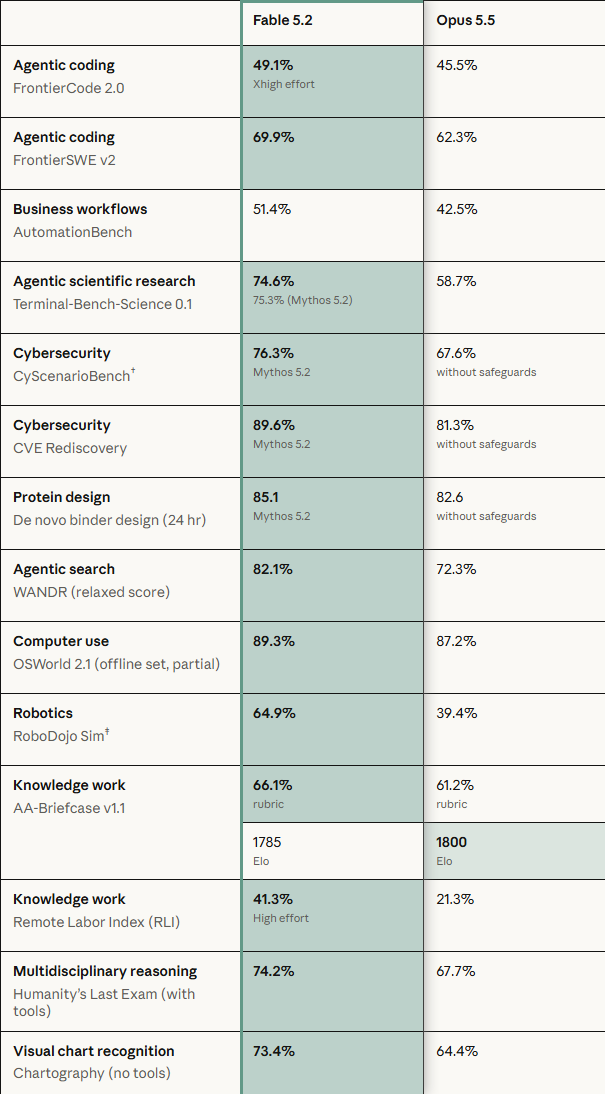
Source: Anthropic, November 9, 2026. The published results use benchmark-specific configurations, generally with the highest available reasoning effort unless stated otherwise.
The 7.6-percentage-point lead on FrontierSWE v2 is especially relevant for difficult software engineering tasks.
FrontierSWE evaluates capabilities involving code understanding and changes across software projects, making it a useful indicator for agentic development.
Fable's larger advantage on Terminal-Bench-Science suggests particular strength in technical and scientific reasoning environments.
The Remote Labor Index also shows a substantial gap, but its score should be interpreted within that evaluation rather than as a universal measurement of workplace productivity.
Not every benchmark reveals such a large difference.
On the partial OSWorld evaluation, Fable leads by only 2.1 percentage points.
This variation shows why Fable's advantages are workload-dependent rather than uniform across every task.
Artificial Analysis: Independent Medium-Effort Comparison
Our research also examined Artificial Analysis, which provides a comparison using Medium effort for both models.
This is important because different reasoning settings can substantially change apparent performance.
| Artificial Analysis Evaluation | Fable Medium | Opus Medium |
|---|---|---|
| Intelligence Index | 56 | 48 |
| AutomationBench-AA | 68.8% | 61.2% |
| FrontierCode-AA 2.0 | 41.3% | 33.1% |
| Terminal-Bench 4.0 | 55.1% | 52.5% |
| Terminal-Bench-Science 0.1 | 60.5% | 43.3% |
| HLE-Diamond | 66.3% | 51.4% |
| CritPt v2 Hard | 61.5% | 54.0% |
| GDP.pdf | 23.8% | 25.6% |
| AA-Briefcase Elo | 1622 | 1620 |
Source: Artificial Analysis Intelligence Index v5.0.1, Medium / Default Fallback, reviewed November 12, 2026.
Fable leads by eight Intelligence Index points under these settings.
Its results are notably stronger in FrontierCode-AA, HLE-Diamond, and Terminal-Bench-Science.
However, the Intelligence Index is a composite benchmark score, not an accuracy percentage.
And Fable does not win every individual evaluation.
Opus performs better on GDP.pdf, while both models achieve almost identical AA-Briefcase Elo scores.
This distinction matters for developers building specialized applications.
A model that performs better on agentic coding may not deliver a proportionate advantage in document production, routine analysis, or familiar programming tasks.
Our research supports Fable as the stronger high-complexity candidate, not as an automatic replacement for Opus in every workflow.
How Reasoning Effort Changes the Performance Ranking
One of the most important findings is that increasing reasoning effort can reverse the performance ranking while dramatically increasing cost.
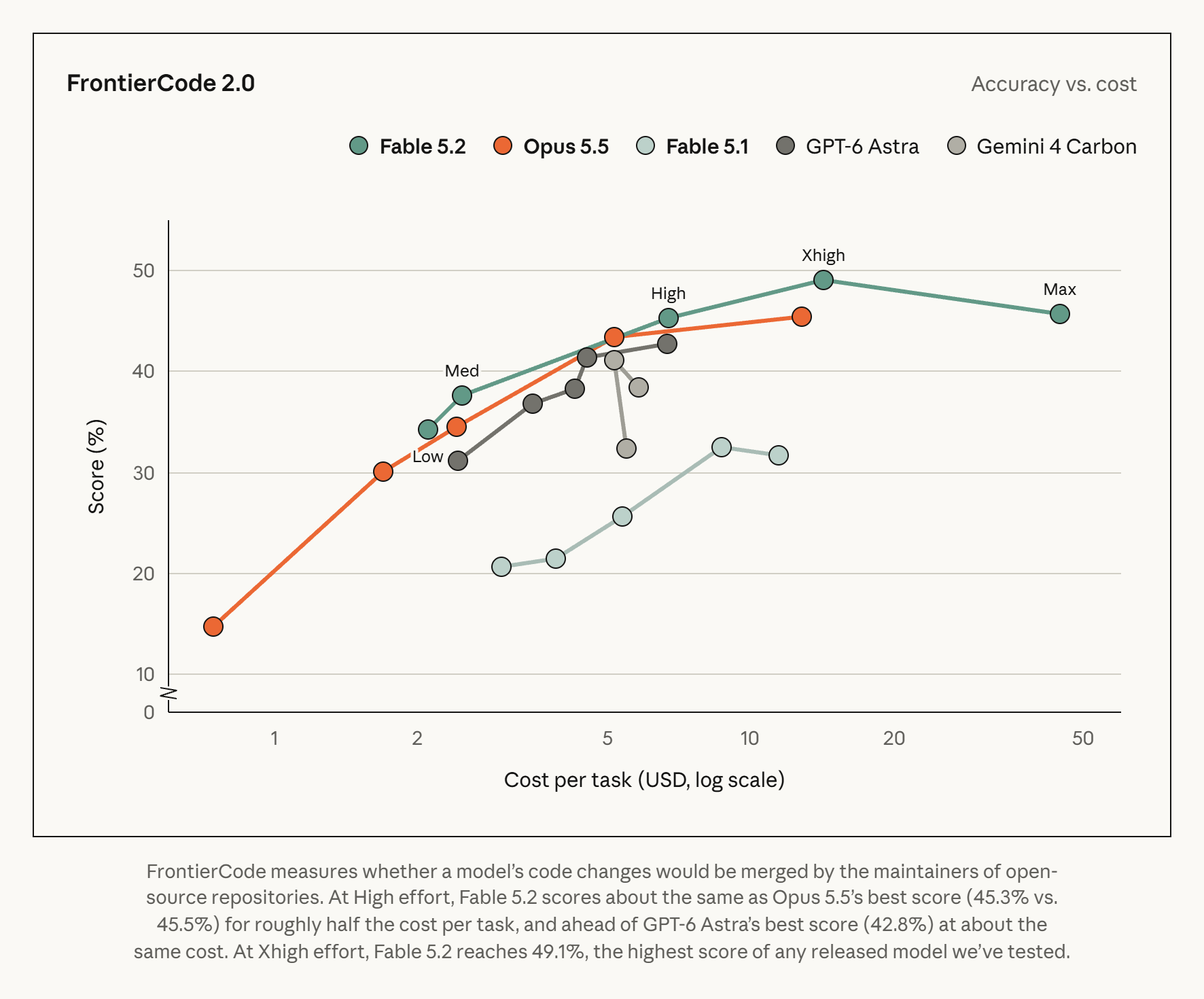
Artificial Analysis reports the following results for different configurations.
| Configuration | Intelligence Index | Evaluation Cost per Task |
|---|---|---|
| Opus 5.5 Medium | 48 | $2.45 |
| Fable 5.2 Medium | 56 | $3.80 |
| Opus 5.5 Max | 59 | $10.04 |
| Fable 5.2 Max | 65 | $26.54 |
These configurations illustrate a clear tradeoff.
Opus Max exceeds Fable Medium on the Intelligence Index, but its evaluation cost rises to $10.04 per task compared with $3.80 for Fable Medium.
Fable Max increases the overall Index further to 65, but with substantially greater evaluation expenditure.
Increasing reasoning effort can reverse the performance ranking without improving cost efficiency.
For developers, the practical question is not which configuration produces the highest score, but which reasoning level delivers enough additional capability to justify its cost.
This explains why official maximum-effort evaluations and independent Medium-effort results can support different conclusions without necessarily contradicting each other.
Claude Fable 5.2 vs Opus 5.5: Real Coding and Agent Cases
Coding Agent Case: 12 Runs, 13 Bugs, and 59 Hidden Tests
A November 2026 coding-agent evaluation tested Claude Fable 5.2 and Opus 5.5 across four model-effort configurations.
The experiment used a Python warehouse inventory library of approximately 1,400 lines, with 13 planted bugs and one missing feature involving stock holds.
The agent needed to understand the specification, repair the bugs, implement the missing functionality, and complete the test suite.
Each model-effort configuration ran three times against the same task.
The resulting 12 runs were evaluated using 59 hidden tests.
| Model and Effort | Hidden Tests | Average Time | Agent Steps | Cost per Task |
|---|---|---|---|---|
| Opus Medium | 59/59 | 4.2 min | 10 | $0.97 |
| Opus High | 59/59 | 9.6 min | 17 | $1.70 |
| Fable Medium | 59/59 | 4.2 min | 6 | $1.87 |
| Fable High | 59/59 | 26.6 min | 19 | $7.70 |
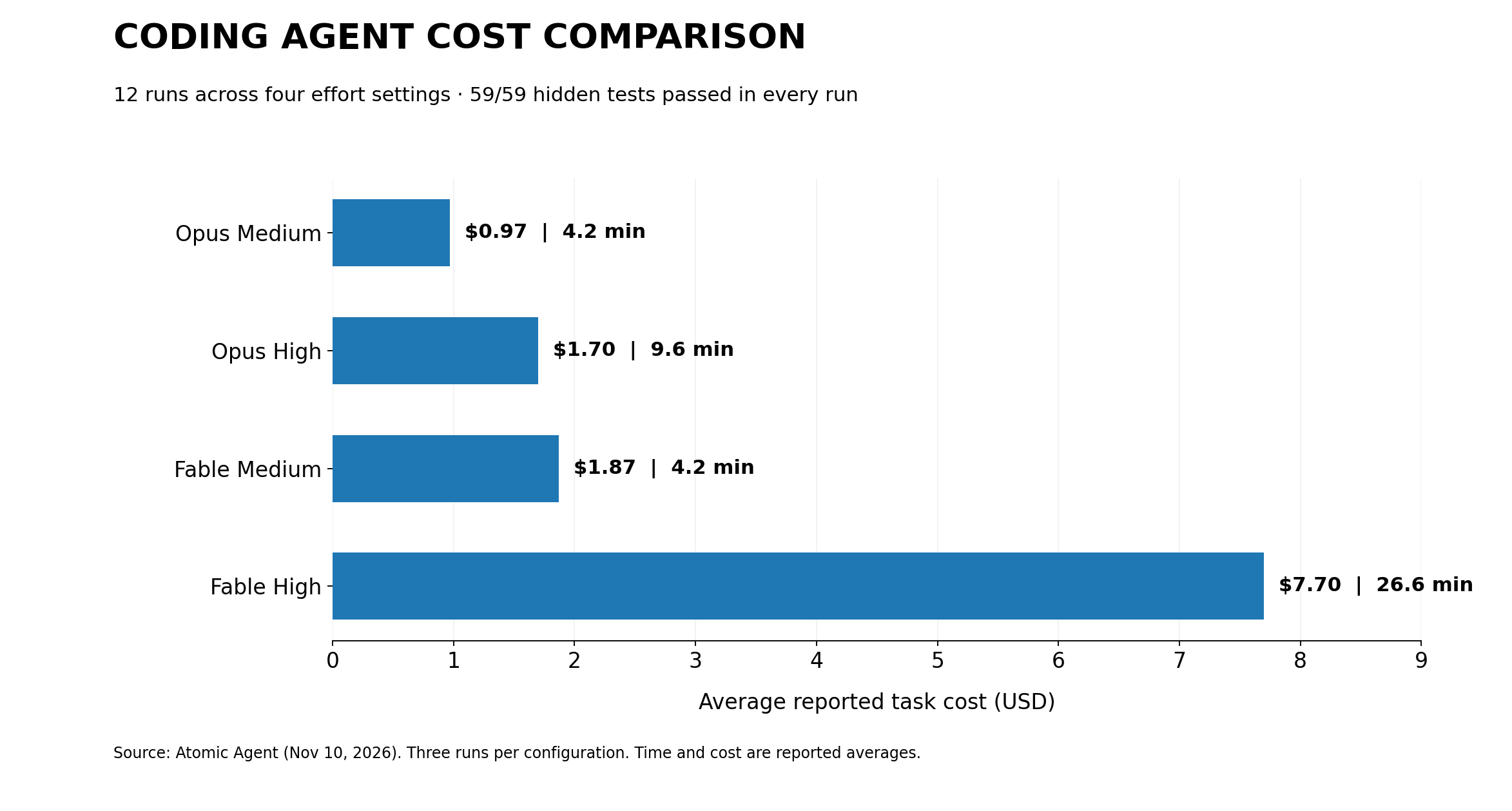
Source: Atomic Agent, November 10, 2026.
All four configurations successfully completed the assignment in every run.
The decisive difference was not the final pass rate. It was the resources consumed to reach the same result.
Fable Medium required only six agent steps compared with ten for Opus Medium, yet its average execution cost was higher.
Fable High required 26.6 minutes and cost $7.70, compared with 4.2 minutes and $0.97 for Opus Medium.
The two settings are especially relevant because they correspond to the models' respective default API reasoning levels.
Changing models without explicitly controlling effort can produce a much larger cost increase than the headline 2× token-price difference.
This case supports starting with Opus Medium for clearly specified development tasks that both models can complete reliably.
It also shows why evaluating only generated code quality misses important differences in execution efficiency.
Complex Engineering Case: Migrating Python to Rust
Anthropic's technical demonstrations include a production-service migration from Python to Rust using Fable 5.2.
A substantial migration is more demanding than converting isolated functions.
The agent must inspect architecture, identify dependencies, plan implementation changes, preserve behavior, and verify the completed service.
The reported result included an approximately 26× improvement in service startup speed.
That improvement describes the migrated service's startup performance rather than the model's own generation speed.
The case illustrates a workload where stronger long-horizon reasoning may be valuable.
A migration can involve hundreds of interconnected changes. An early architectural mistake may create downstream errors across testing and deployment.
For this kind of assignment, the relevant question is whether stronger planning and sustained technical reasoning reduce the engineering effort required to produce a correct result.
Fable's capabilities become more economically interesting when an incorrect or incomplete result would create substantial rework.
Creative Coding Cases: TinyWorld, Pelican, and Snow Globe
Our review of user questions and documented development cases identified three recurring patterns in open-ended creative coding.
These examples show how execution time, token consumption, and additional functionality can change the economic comparison.
TinyWorld: Three.js Planet Generation
A Three.js project recorded the following workload results.
| Metric | Fable 5.2 | Opus 5.5 |
|---|---|---|
| Cost | $9.96 | $2.54 |
| Duration | 26.5 min | 14 min |
| Token consumption | 127.4K | 56.6K |
The runs occurred at different times and did not use a fully standardized configuration.
Nevertheless, the case highlights an important issue in autonomous creative development: greater reasoning capability does not necessarily reduce token consumption or execution time.
When the completion requirements are open-ended, an agent may continue expanding or refining a solution beyond the minimum acceptable result.
Pelican: Visual Animation Development
Another example compared Fable Low with Opus Medium on an animation task.
| Metric | Fable Low | Opus Medium |
|---|---|---|
| Completion time | 14:12 | 29:30 |
| Output tokens | 51,958 | 116,722 |
| Code produced | 594 lines | 1,085 lines |
| Estimated API-equivalent cost | $3.71 | $3.87 |
Here, Fable completed the assignment faster and generated substantially fewer output tokens.
The result suggests that more effective planning can sometimes reduce the amount of implementation work.
However, shorter code does not automatically mean better software. Functional correctness, maintainability, and visual quality remain essential acceptance criteria.
Snow Globe: Single-Prompt Interactive Webpage
A single-prompt HTML-generation comparison produced another pattern.
Fable required approximately 19 minutes and 837K total tokens, while Opus took around eight minutes and used approximately 482K tokens.
Fable also introduced an additional music-box element.
This raises a useful question for creative workflows: is extra functionality valuable enough to justify the additional time and token consumption?
For a visually ambitious prototype, additional features may improve the result.
For a repeatable production workflow, however, predictable execution time and a tightly controlled output specification may be more important.
These cases demonstrate why a model's value depends on task boundaries, desired output quality, and reasoning configuration rather than benchmark rankings alone.
Advanced Research: Mathematics, Hardware, and Robotics
Fable's strongest argument becomes clearer in difficult scientific and engineering work.
Anthropic's published demonstrations include mathematical formalization, hardware development, robotics simulation, and sustained multi-agent engineering.
Formalizing Fermat's Last Theorem
Anthropic reports that Fable completed a formalization assignment in approximately 30 hours, while an Opus comparison reached around 26% progress over the same period.
The task included prepared mathematical statements and supporting proof materials.
The important result is Fable's sustained progress through a complex formal reasoning workload.
This type of assignment involves many dependent steps, where an incorrect intermediate result may affect the entire proof.
Hardware Engineering
On BenchCAD 2.1, Anthropic reports the following scores:
| Model | BenchCAD 2.1 Score |
|---|---|
| Fable 5.2 Max | 83.5 |
| Opus 5.5 | 65.3 |
| Fable 5.1 | 44.4 |
These are benchmark scores, not percentages of successfully manufactured devices.
Anthropic also describes working electronic-device prototypes, including a USB speakerphone and a virtual pet.
The relevant capability is coordinating multiple design and engineering stages rather than producing isolated snippets of technical text.
Robotics Simulation
On RoboDojo Sim, Fable achieved 64.9%, compared with 39.4% for Opus.
The result demonstrates stronger performance within the evaluated robotics simulation tasks.
Together, these cases point toward a consistent theme: Fable is most compelling when tasks involve substantial complexity, extended reasoning, and many dependent decisions.
That makes it a strong candidate for scientific research agents, engineering automation, and difficult technical planning.
Claude Fable 5.2 vs Opus 5.5 API Pricing: Save 15% with LinkModel
Official API Prices vs LinkModel Prices
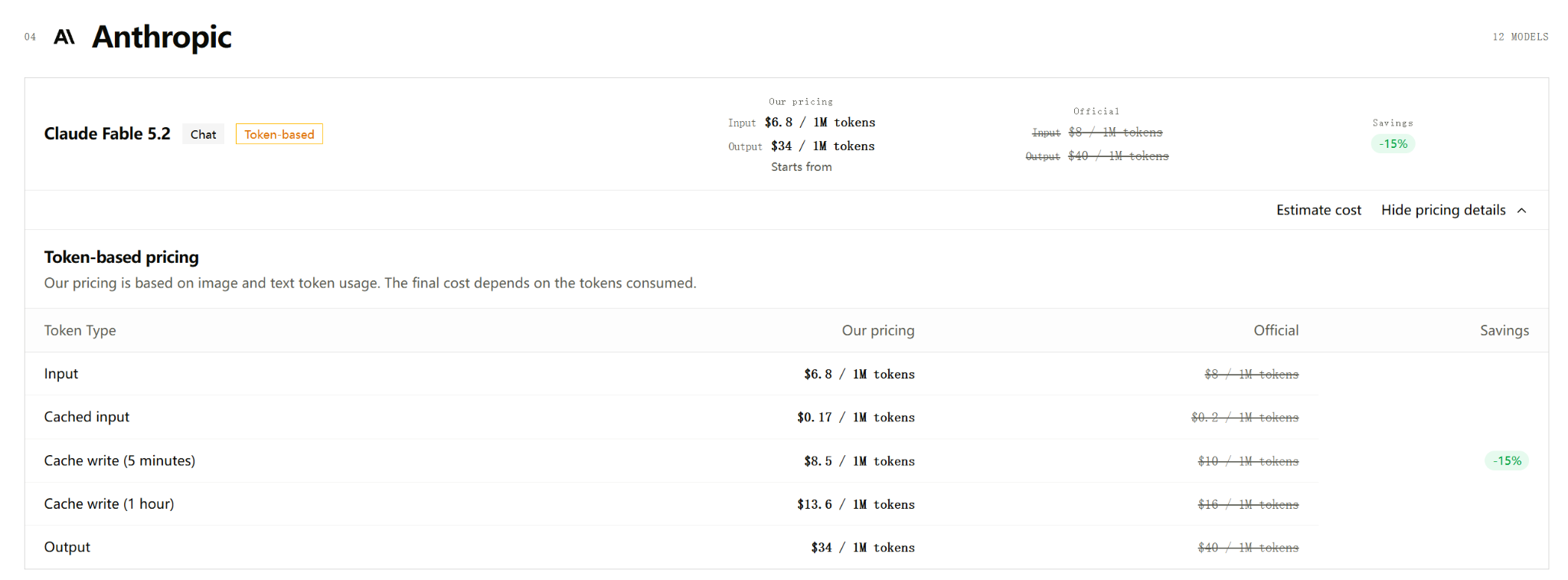
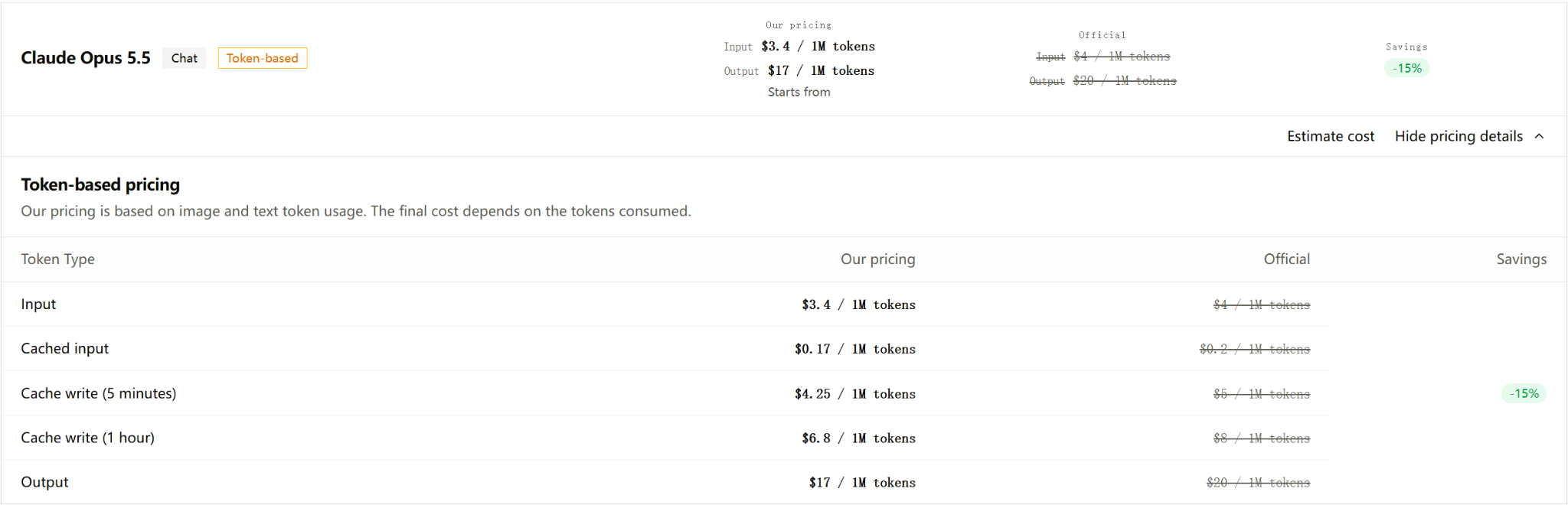
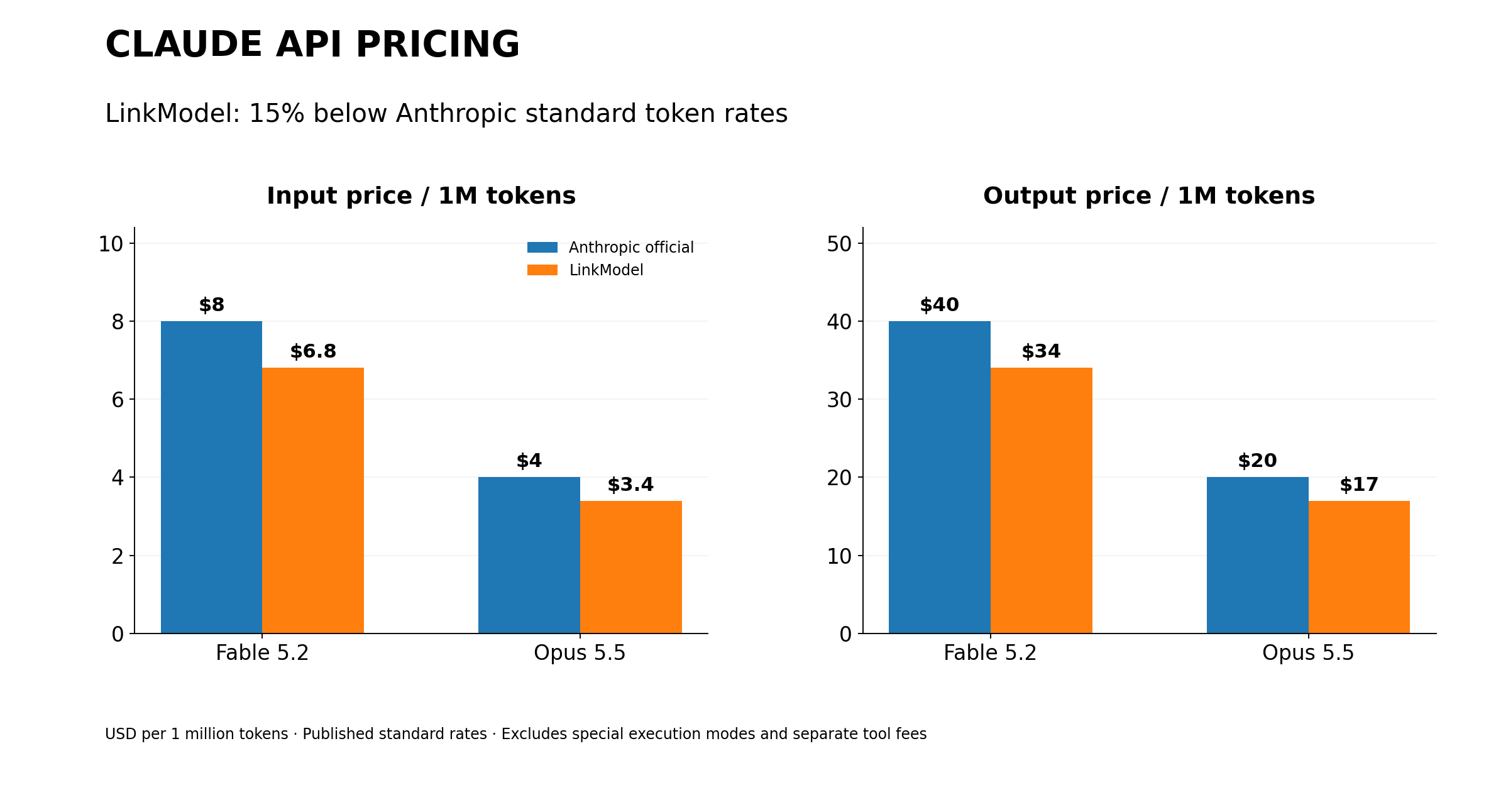
Both Claude Fable 5.2 and Opus 5.5 cost 15% less on LinkModel than Anthropic's standard API rates.
Fable is available at $6.80 per million input tokens and $34 per million output tokens, saving $1.20 and $6 respectively.
Opus costs $3.40 per million input tokens and $17 per million output tokens, saving $0.60 and $3 respectively.
Developers can choose the model that fits their workload while paying less for the same quantities of standard input and output tokens.
| Token Type | Fable Official | Fable LinkModel | Opus Official | Opus LinkModel |
|---|---|---|---|---|
| Input | $8.00 | $6.80 | $4.00 | $3.40 |
| Cached input | $0.20 | $0.17 | $0.20 | $0.17 |
| Cache write, 5 minutes | $10.00 | $8.50 | $5.00 | $4.25 |
| Cache write, 1 hour | $16.00 | $13.60 | $8.00 | $6.80 |
| Output | $40.00 | $34.00 | $20.00 | $17.00 |
All prices are in USD per million tokens.
The lower standard rates are relevant for both everyday coding workloads and complex agents.
A project does not need to switch from Fable to Opus merely to benefit from LinkModel's published pricing advantage.
API Cost Examples: Small, Medium, and Large Workloads
The financial impact becomes clearer when comparing fixed quantities of input and output tokens.
The following scenarios use standard uncached input and output prices.
| Workload | Input | Output | Fable Official | Fable LinkModel | Opus Official | Opus LinkModel |
|---|---|---|---|---|---|---|
| Short coding iteration | 10K | 5K | $0.28 | $0.238 | $0.14 | $0.119 |
| Medium agent task | 100K | 20K | $1.60 | $1.36 | $0.80 | $0.68 |
| Large technical workflow | 1M | 100K | $12.00 | $10.20 | $6.00 | $5.10 |
For a medium agent task using 100K fresh input tokens and 20K output tokens, Fable costs $1.60 at Anthropic's standard rates versus $1.36 on LinkModel.
Opus costs $0.80 officially versus $0.68 on LinkModel.
Across 1,000 repetitions of those exact token quantities, the standard-rate difference amounts to $240 for Fable or $120 for Opus.
On the larger workload, LinkModel reduces Fable's calculated price by $1.80 and Opus's by $0.90 per execution.
These figures demonstrate how the published discount applies at different usage levels. Actual agent costs depend on the tokens and tools each execution consumes.
The best purchasing decision combines the right model for the task with lower rates for the workload it actually generates.
Prompt Caching: Why Fable Is Not Always Twice as Expensive
Prompt caching has an important effect on the economics of large-context applications.
Both models charge $0.20 per million cached input tokens at Anthropic's standard rates.
On LinkModel, both cost $0.17 per million cached input tokens.
This creates an interesting pricing difference: ordinary input and output tokens cost twice as much on Fable, but cached reads have the same unit price.
Consider a request containing:
- 800K cached input tokens
- 50K fresh input tokens
- 20K output tokens
Using LinkModel's listed rates:
| Cost Component | Fable LinkModel | Opus LinkModel |
|---|---|---|
| 800K cached input | $0.136 | $0.136 |
| 50K fresh input | $0.340 | $0.170 |
| 20K output | $0.680 | $0.340 |
| Total | $1.156 | $0.646 |
In this example, Fable costs approximately 1.79× Opus, rather than 2×.
The reason is that cached input contributes equally to both models' costs.
This becomes relevant for applications that repeatedly reuse long system instructions, repository context, technical documentation, and other stable material.
Cache writes also affect total spending.
Fable's cache-write prices remain twice those of Opus, so workloads that frequently create new caches may behave differently from those that primarily reuse existing cached content.
For large-context agents, cache utilization can be just as important as the headline model-price ratio.
Batch API and Fast Mode: Different Cost Tradeoffs
Anthropic also provides execution modes with different pricing and latency characteristics.
Batch API generally offers a 50% reduction on eligible standard input and output rates.
| Official Batch Pricing | Fable 5.2 | Opus 5.5 |
|---|---|---|
| Input per 1M tokens | $4 | $2 |
| Output per 1M tokens | $20 | $10 |
Batch processing is relevant when tasks can be executed without requiring immediate interactive responses.
Fast Mode takes a different approach.
| Official Fast Mode Pricing | Fable 5.2 | Opus 5.5 |
|---|---|---|
| Input per 1M tokens | $16 | $8 |
| Output per 1M tokens | $80 | $40 |
Anthropic reports up to 2.5× faster token generation for optional Fast Mode under supported conditions.
However, faster token generation does not necessarily translate into the same improvement in total agent execution time.
Tools, reasoning steps, external services, and validation can still contribute substantially to end-to-end latency.
Developers should distinguish standard model prices from specialized execution-mode rates when estimating costs.
Speed, Reliability, and Cost per Successful Task
Which Model Is Faster in Real Workflows?
Speed depends on what is being measured.
Our research separates first-answer latency, output generation speed, single-request duration, and total evaluation-task time.
Artificial Analysis reports the following Medium-effort measurements.
| Performance Metric | Fable Medium | Opus Medium |
|---|---|---|
| Output speed | 92 tok/s | 103 tok/s |
| Time to first answer token | 11.88s | 14.74s |
| Mean single-request duration | 53.75s | 79.88s |
| Time per evaluation task | 7.8 min | 7.1 min |
Source: Artificial Analysis Medium comparison, reviewed November 12, 2026.
Fable responds sooner in the first-answer and single-request measurements, while Opus generates output faster and completes the full evaluation tasks slightly sooner.
For coding agents, the most useful speed metric is not simply tokens per second, but the time required to finish an accepted result.
A model with lower first-answer latency can still require more time across a full tool-using workflow.
Similarly, a model that produces tokens quickly may perform additional reasoning steps or generate more output than necessary.
The practical evaluation should therefore consider responsiveness and complete-task productivity separately.
Professional Workflow Case: 18 Runs and the Cost of Accuracy
An independent November 2026 evaluation examined the models on three professional workflows:
- A spreadsheet containing deliberately challenging conditions
- A long contract requiring careful review
- A tool-assisted month-end financial close
The evaluation used predefined questions, scoring rules, and repeat executions.
Fable 5.2 scored 10/10 across all 18 runs.
Opus 5.5 scored 9/10 on the three spreadsheet runs and achieved full scores on the other tasks.
The spreadsheet difference came from how the models handled an ambiguous record.
Fable followed the predefined scoring instruction, while Opus excluded the record based on its interpretation.
The cost difference was substantial.
| Configuration | Combined Median Cost Across the Three Jobs |
|---|---|
| Opus 5.5 Default | $0.382 |
| Fable 5.2 Medium | $0.642 |
| Fable 5.2 Default | $0.997 |
Source: RanThis, November 10, 2026; page updated November 12, 2026.
At default effort, Fable's combined median task cost was approximately 2.6× that of Opus.
At Medium effort, the ratio decreased to approximately 1.7×.
The evaluation highlights how a narrow difference in following task instructions can carry a meaningful cost premium.
For professional workflows with strict scoring criteria, detailed compliance requirements, or costly mistakes, that difference may be worth investigating.
For less sensitive tasks where Opus already meets the required standard, the lower-cost configuration may offer better value.
The important question is whether a measurable quality improvement changes the actual business outcome.
Why Higher Reasoning Effort Can Increase Cost
Our review of user questions repeatedly surfaced concerns around lengthy analysis, large token consumption, additional implementation steps, and uncertain completion times.
These concerns become particularly relevant when agents are allowed to continue planning or revising without tightly defined completion criteria.
The warehouse coding case provides a clear example.
All four configurations passed the same 59 tests, but Fable High required 26.6 minutes and cost $7.70.
Opus Medium reached the same acceptance result in 4.2 minutes at $0.97.
The creative coding examples show a similar pattern in some tasks, although other cases demonstrate that Fable can also complete work with fewer generated tokens.
The lesson is not that more reasoning is inherently inefficient.
Reasoning effort becomes expensive when additional analysis fails to produce a meaningful improvement in accepted output.
This is why models should be compared at deliberate effort settings rather than relying only on their defaults.
Cost per Successful Task: The Metric That Matters Most
API token rates provide a useful starting point, but they do not fully describe the economics of an agent workflow.
A more informative metric is:
Cost per successful task = Total spending across attempts ÷ Number of accepted successful tasks
This incorporates the effect of repeated attempts.
Consider two models processing a workload with the same assumed input and output token quantities per attempt.
Using the earlier LinkModel medium-workload example, Opus costs $0.68 per attempt and Fable costs $1.36.
| Scenario | Opus Total Cost | Fable Total Cost | Lower Cost |
|---|---|---|---|
| Both succeed on the first attempt | $0.68 | $1.36 | Opus |
| Opus needs 2 attempts, Fable needs 1 | $1.36 | $1.36 | Equal |
| Opus needs 3 attempts, Fable needs 1 | $2.04 | $1.36 | Fable |
| Both need 2 attempts | $1.36 | $2.72 | Opus |
These scenarios demonstrate the relationship between task success and expenditure using fixed token assumptions.
They do not imply that every model attempt uses the same amount of context or output.
The key economic threshold is clear.
Fable can justify its higher per-attempt cost when stronger reasoning reduces retries or other costly work enough to offset the premium.
Artificial Analysis offers a useful complementary comparison.
At Medium effort, its weighted average task cost is $3.80 for Fable versus $2.45 for Opus, a difference of approximately 55%.
That is smaller than the standard 2× input and output price ratio.
Different output lengths, caching, reasoning settings, and execution patterns explain why task expenditure can diverge from the headline price difference.
Teams should measure successful delivery, total execution time, and actual spending together rather than relying on only one pricing metric.
Which Should You Choose: Claude Fable 5.2 or Opus 5.5?
Best Model for Daily Coding, Research, and Agents
The strongest model choice depends on the type of work.
| Workload | Recommended Starting Model | Main Reason |
|---|---|---|
| Everyday debugging | Opus 5.5 | Lower cost with strong coding capability |
| Routine code review | Opus 5.5 | Suitable for clearly defined acceptance criteria |
| Incremental feature development | Opus 5.5 | Efficient baseline for iterative work |
| Large repository migration | Fable 5.2 | Stronger candidate for sustained technical reasoning |
| Difficult autonomous agents | Fable 5.2 | Better performance on several demanding agent evaluations |
| Scientific research agents | Fable 5.2 | Strong results on selected scientific benchmarks |
| Complex technical planning | Fable 5.2 | Useful for open-ended, dependent decisions |
| High-volume budget-sensitive coding | Opus 5.5 | Lower standard input and output rates |
| Planning plus implementation | Hybrid workflow | Allocate more reasoning capability to difficult stages |
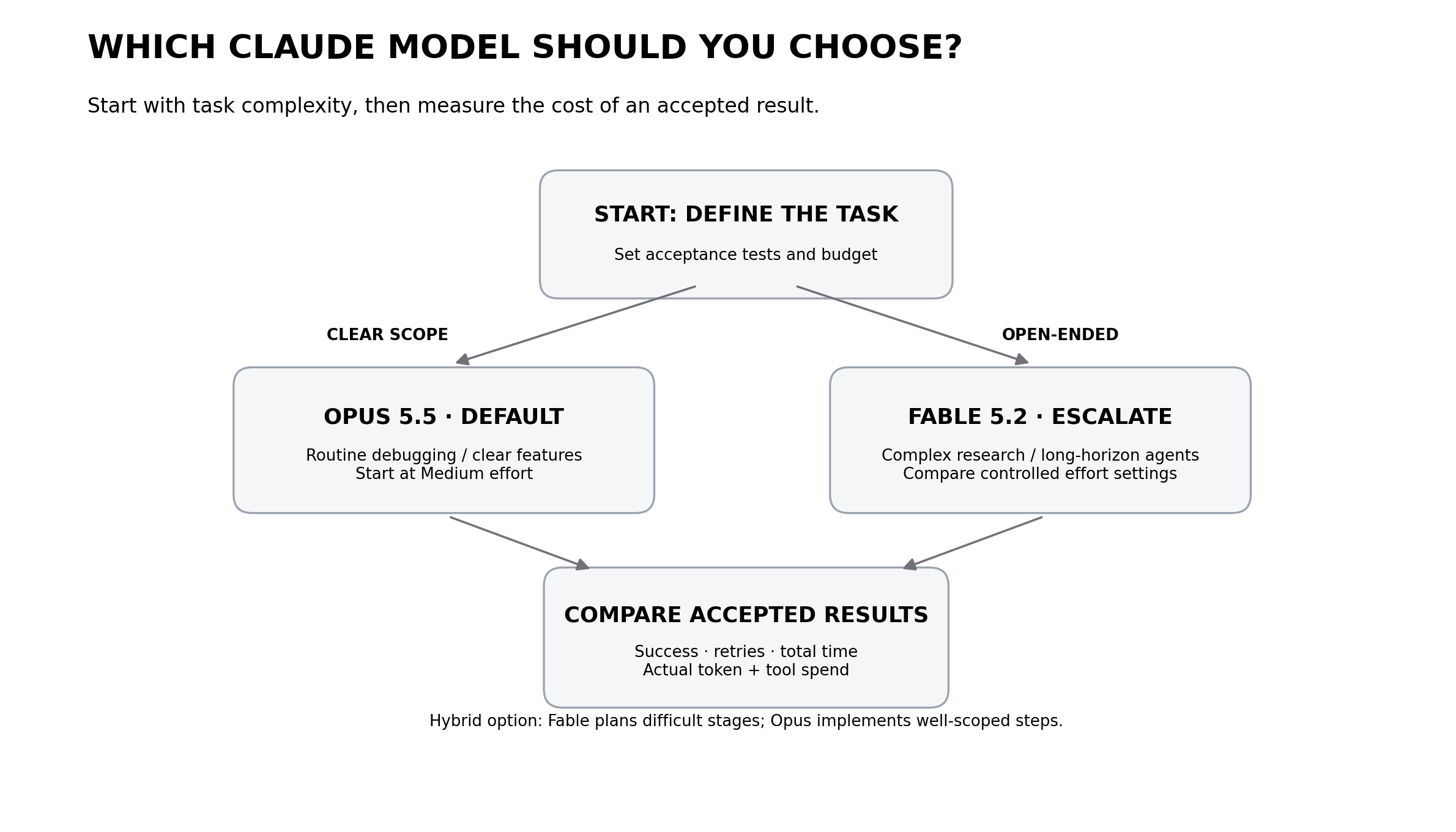
For most development teams, Opus Medium is the most economical starting point.
It provides advanced engineering capability without requiring Fable's higher standard prices.
Fable should be evaluated when projects involve complicated technical decisions, unresolved implementation challenges, or long-running agents that need stronger reasoning.
The strongest reason to upgrade is not that Fable has a higher Intelligence Index.
It is that the model can produce a better accepted result, reduce costly rework, or complete work that the lower-cost configuration cannot reliably finish.
When a Hybrid Fable and Opus Workflow Makes Sense
One practical strategy is to separate complex planning from routine implementation.
Fable can analyze a difficult technical objective, identify architectural risks, and develop a structured implementation plan.
Opus can then complete well-defined engineering tasks against clear acceptance criteria.
For example, an application modernization project might use Fable to investigate dependencies and migration risks, while Opus implements individual modules and handles repetitive coding work.
This approach concentrates higher-cost reasoning on the stages where it is most likely to matter.
The strategy is particularly relevant for multi-agent systems, large software migrations, and technical research workflows.
Its value depends on whether the additional planning improves downstream execution.
If Opus can complete the full project efficiently without an extra planning stage, a single-model workflow may be more economical.
A Practical Decision Framework
Our research suggests evaluating both models through five dimensions.
Task success: Does the model meet the acceptance criteria reliably?
Reasoning efficiency: Does more effort improve the result, or mostly increase token consumption?
Execution time: How long does the complete workflow take, including tools and verification?
Successful-task cost: How much must be spent before an acceptable result is delivered?
Operational fit: Does the model support the required context, tool usage, and workflow complexity?
For routine coding, begin with Opus Medium and establish the cost and quality baseline.
If the task remains difficult, compare higher Opus effort with Fable Medium or another suitable configuration.
For complex, long-horizon work, evaluate whether Fable's additional capability improves accepted outcomes enough to compensate for higher expenditure.
This decision process avoids paying for maximum reasoning on every request while preserving advanced capability when it is genuinely needed.
Why Choose LinkModel for Fable 5.2 and Opus 5.5?
Save 15% on either Claude model without committing to a monthly API subscription.
LinkModel combines lower published standard token rates with $0 minimum spend, $0 monthly platform fee, unified billing, and a Playground for supported models.
Start with the lower-cost Opus configuration for routine development, then explore Fable when complex reasoning or long-horizon tasks demand additional capability.
Whether you're optimizing everyday coding costs or evaluating advanced agents, LinkModel offers a more affordable starting point for both models.
Frequently Asked Questions
Is Claude Fable 5.2 better than Opus 5.5 for coding?
Fable 5.2 performs better on several demanding coding benchmarks, including FrontierSWE v2 and FrontierCode-AA 2.0. However, Opus 5.5 remains a strong everyday coding model with half the official standard input and output token prices. For routine debugging, feature development, and code review, Opus is generally the better starting point. Fable is more attractive for difficult, open-ended engineering tasks that benefit from sustained reasoning.
Is Claude Fable 5.2 worth twice the price of Opus 5.5?
Fable's standard input and output token rates are twice those of Opus, but completed-task costs do not always follow the same ratio. Artificial Analysis reports $3.80 versus $2.45 per task at Medium effort, while other configurations produce different results. Fable becomes worth the premium when stronger reasoning increases successful completion or reduces expensive rework enough to offset its higher cost.
Why does Claude Fable 5.2 use more tokens and hit usage limits faster?
Fable defaults to High reasoning effort on the API, while Opus defaults to Medium. More intensive reasoning can increase token consumption and task duration, especially in agent workflows. Usage limits also depend on the product, account, and applicable usage window. Developers should compare identical tasks with deliberately selected effort settings before attributing higher consumption solely to model differences.
Which is faster, Claude Fable 5.2 or Opus 5.5?
Neither model is universally faster across every measurement. In the Artificial Analysis Medium comparison, Fable has lower first-answer latency and shorter mean single-request duration, while Opus has higher output throughput and slightly shorter full evaluation-task time. For coding agents, time to a correct, accepted result is usually more useful than tokens per second alone.
Can I get Claude Fable 5.2 and Opus 5.5 cheaper through LinkModel?
Yes. LinkModel lists both models at 15% below Anthropic's official standard token rates. Fable costs $6.80/M input and $34/M output, while Opus costs $3.40/M input and $17/M output. The platform also offers $0 minimum spend, $0 monthly platform fee, and unified billing, making it a practical choice for developers comparing model capability and API spending.
Conclusion
Claude Opus 5.5 is the better starting point for everyday coding, routine engineering, and cost-sensitive workflows, while Claude Fable 5.2 is a stronger candidate for complex reasoning, difficult software migrations, scientific research, and long-horizon autonomous agents. Official and independent benchmarks demonstrate Fable's advantages on several demanding tasks, but real coding evaluations also show that additional reasoning can increase costs without improving an already-successful result. The most effective strategy is to match reasoning effort to task complexity, compare the cost of accepted outcomes, and choose the model that delivers measurable value. With 15% lower published standard API rates for both Fable 5.2 and Opus 5.5, LinkModel gives developers a more economical way to access either model while maintaining the flexibility to select the right level of capability for each workload.