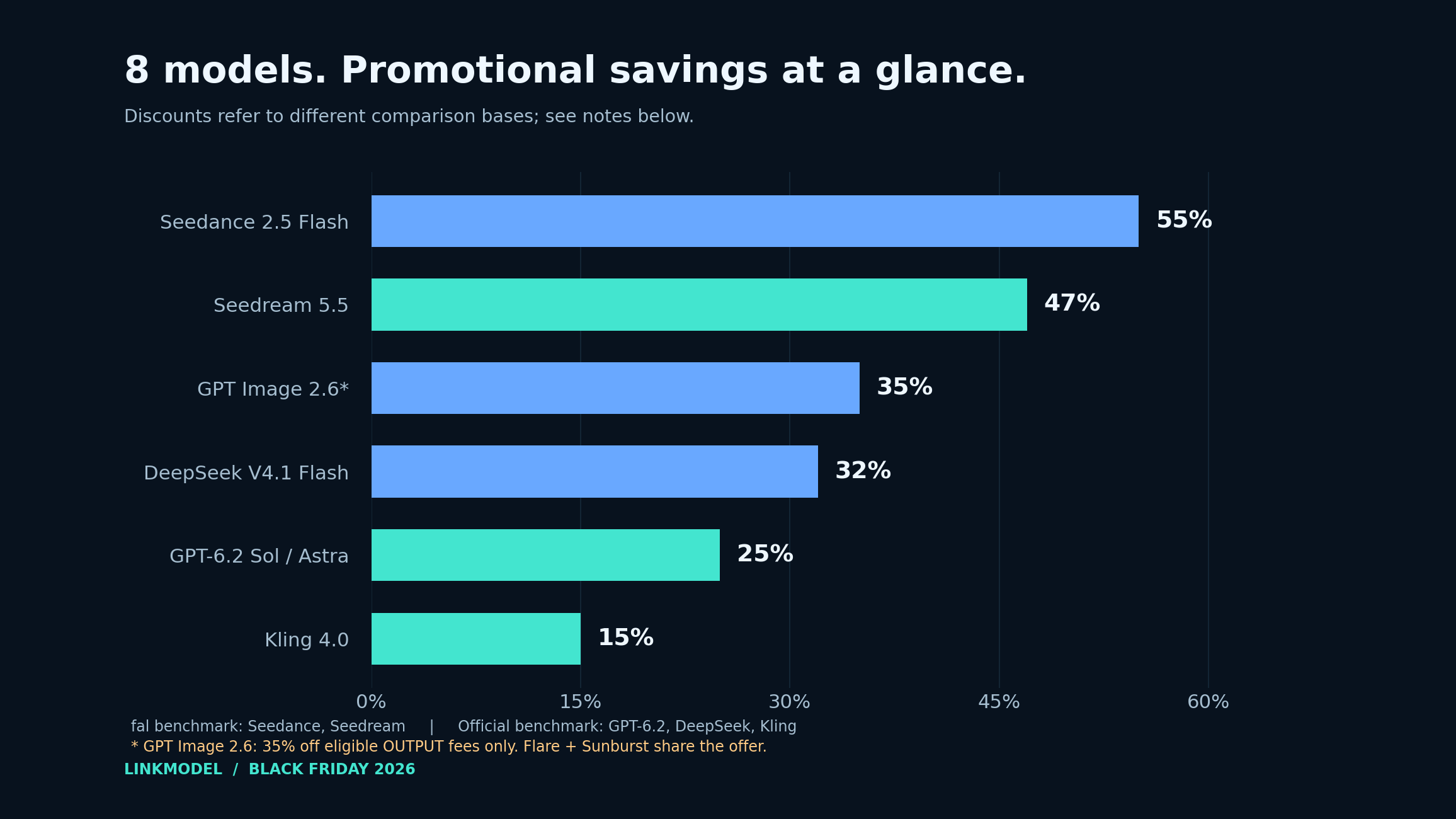
LinkModel's Black Friday AI API deals for 2026 include eight discounted models for coding, image generation, and video creation. From November 23 to December 2, 2026, save 55% vs. fal on Seedance 2.5 Flash, 47% vs. fal on Seedream 5.5, and 15–35% on eligible charges for GPT-6.2, GPT Image 2.6, DeepSeek V4.1 Flash 1017, and Kling 4.0. Both new and existing users qualify for automatic promotional pricing. If you're comparing more than one provider, our AI API pricing comparison can help put these offers in context.
But the biggest discount isn't always the cheapest way to complete a project. Video APIs charge by the second, image generation can involve multiple billing components, and language models charge by tokens. Whether you're producing 50 product videos or building an AI coding assistant, you need to understand the total workload cost before deciding where to spend. Our guide to reducing AI API costs explains why model selection, usage volume, and billing structure matter beyond a headline discount.
LinkModel combines competitive Black Friday prices with simple, pay-as-you-go API access. Start with Seedance 2.5 Flash at $0.060527/s, Seedream 5.5 at $0.016/image, or GPT-6.2 Sol at $1.50/M input tokens. Get $0 minimum spend, $0 monthly platform fee, unified billing, and Playground access across supported models. Eligible new users automatically receive $1 in free Credits once, with no card or recharge required; the reward never expires and works across all currently available models. Test your preferred API, then check your balance or click Top Up through LinkModel Billing.
Black Friday AI API Deals 2026: All 8 Models and Prices
LinkModel's 2026 Black Friday promotion covers eight available text, image, and video models, with automatic discounts for new and existing users.
The highest advertised saving is 55% against matching fal pricing for Seedance 2.5 Flash. Seedream 5.5 also uses fal as its comparison baseline, while the remaining model discounts use their corresponding official pricing references.
Complete Black Friday AI API Pricing and Model ID Table
| AI Model | Black Friday Savings | LinkModel Price / Billing Basis | API Model ID |
|---|---|---|---|
| Seedance 2.5 Flash | Save 55% vs. fal | From $0.060527/s, 480p | seedance-2-5-flash |
| Seedream 5.5 | Save 47% vs. fal | From $0.016/image, eligible output specification | seedream-5.5 |
| GPT-6.2 Sol | Save 25% vs. official | $1.50/M input; $7.50/M output, short context | gpt-6.2-sol |
| GPT-6.2 Astra | Save 25% vs. official | $6/M input; $30/M output, short context | gpt-6.2-astra |
| GPT Image 2.6 Flare | Save 35% on output fees | 65% of official eligible output charges | gpt-image-2.6-flare |
| GPT Image 2.6 Sunburst | Save 35% on output fees | 65% of official eligible output charges | gpt-image-2.6-sunburst |
| DeepSeek V4.1 Flash 1017 | Save 32% vs. official | 68% of corresponding official charges | DeepSeek-V4.1-Flash-1017 |
| Kling 4.0 | Save 15% vs. official | $0.19975/s, 1080p reference | Kling4.0 |
All prices are in USD. M means one million tokens. Rates depend on the eligible model configuration and billing components.
GPT-6.2 context pricing: Short-context rates apply when input prompt tokens, including cached tokens, are 272K or fewer. Above 272K, the entire request is billed at the higher-context rate.
Compare available models, review their supported configurations, and choose the right AI API for your project. No coupon code is required to access eligible Black Friday pricing.
Which Black Friday AI API Deal Offers the Largest Discount?
Seedance 2.5 Flash leads LinkModel's eight-model promotion with 55% savings against the specified fal benchmark.
Seedream 5.5 offers 47% savings against matching fal prices, while GPT Image 2.6 Flare and Sunburst reduce eligible output fees by 35%.
DeepSeek V4.1 Flash 1017 is discounted by 32%, GPT-6.2 Sol and Astra by 25%, and Kling 4.0 by 15%, compared with their corresponding official pricing benchmarks.
These discounts are not directly interchangeable because the models use different billing units and perform different tasks.
A video model with a 55% discount may save less money on a small project than a language model with a 25% discount on millions of tokens. The distinction is especially important when comparing LinkModel's offers with fal.ai pricing and its billing structure.
The most useful comparison is the amount saved on the specific work you intend to complete.
Black Friday Dates, Eligibility, and Automatic Discounts
The promotion runs from November 23 through December 2, 2026, ending at 11:59 PM PST on December 2.
Eligible promotional prices apply automatically to both new and existing LinkModel users, including those using an existing account balance.
No coupon is required, and users do not need to purchase a separate monthly subscription to receive the model discounts.
Beginning December 3, participating models return to LinkModel's regular platform prices.
How Much Do Black Friday AI API Calls Actually Cost?
API prices become more useful when converted into realistic project budgets.
For video, multiply generated duration by the applicable per-second rate. For images, account for the selected output specification and any separately billed inputs. For language models, combine input-token and output-token charges.
The following examples illustrate how the confirmed Black Friday pricing affects common creative and development workloads.
How Much Do 50 Seedance 2.5 Flash Video Ads Cost?
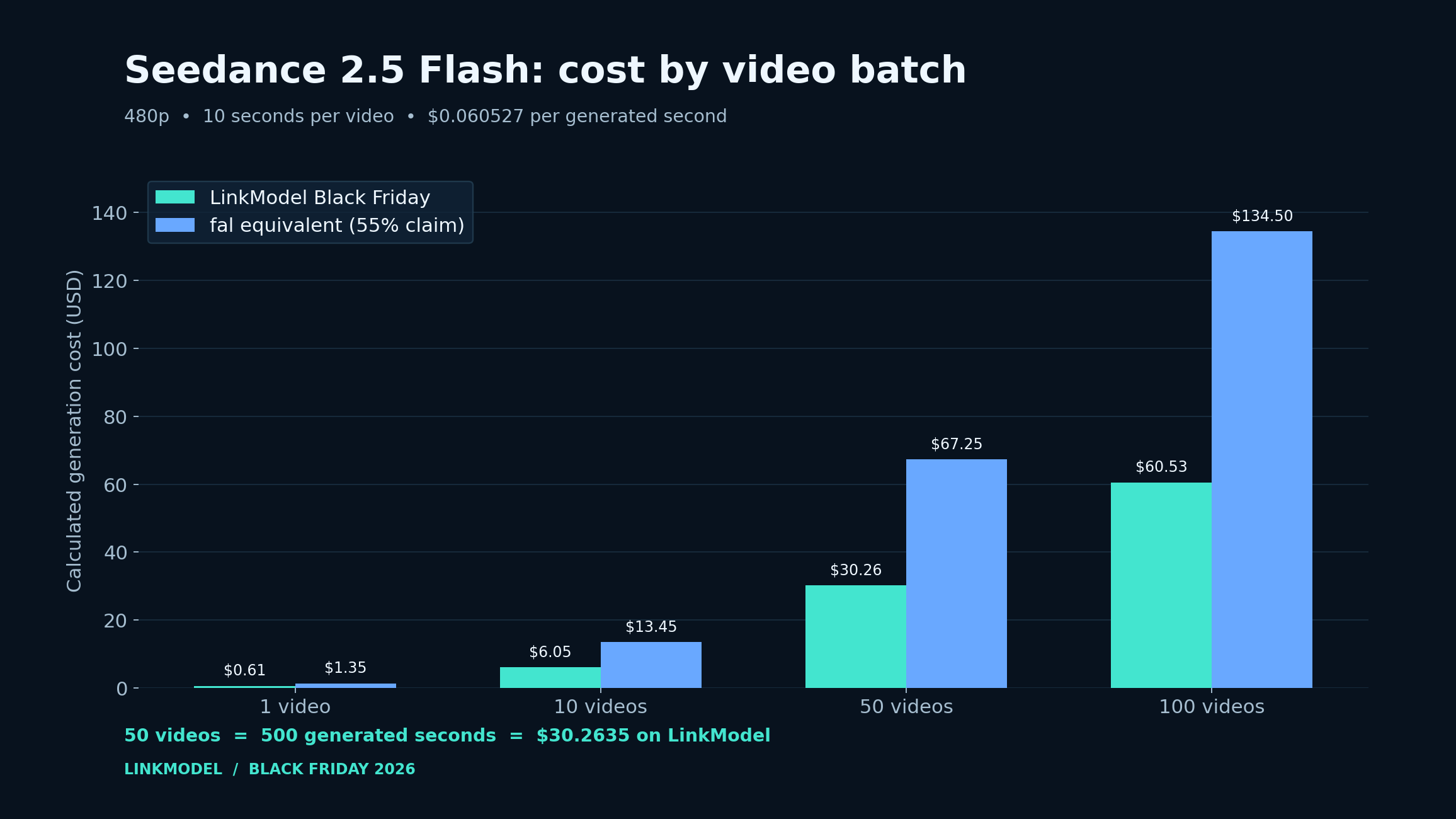
Fifty ten-second Seedance 2.5 Flash videos at 480p cost $30.2635 on LinkModel.
Consider an e-commerce brand producing 50 short product advertisements. Each ten-second clip highlights a different product, camera movement, or creative concept.
At $0.060527 per second, each ten-second generation costs $0.60527.
| Video Workload | Generated Duration | LinkModel Cost |
|---|---|---|
| 1 video | 10 seconds | $0.60527 |
| 10 videos | 100 seconds | $6.05270 |
| 50 videos | 500 seconds | $30.26350 |
| 100 videos | 1,000 seconds | $60.52700 |
Since the promotional rate represents 45% of the matching fal reference, the equivalent 50-video benchmark is approximately $67.25, producing approximately $36.99 in savings.
Creative variations also affect the budget.
For example, generating three ten-second concepts for each of 20 products requires 60 clips, or 600 generated seconds. At the same rate, that costs $36.3162.
For an advertising workflow, it is useful to plan the number of products, target duration, and creative variations before deciding how much balance to add. Developers evaluating these assumptions can explore the more detailed Seedance 2.5 Flash API pricing guide for model-specific planning.
Budget takeaway: Every additional 100 generated seconds at the selected 480p rate adds $6.0527 to the project cost.
How Much Do 500 Seedream 5.5 Product Images Cost?
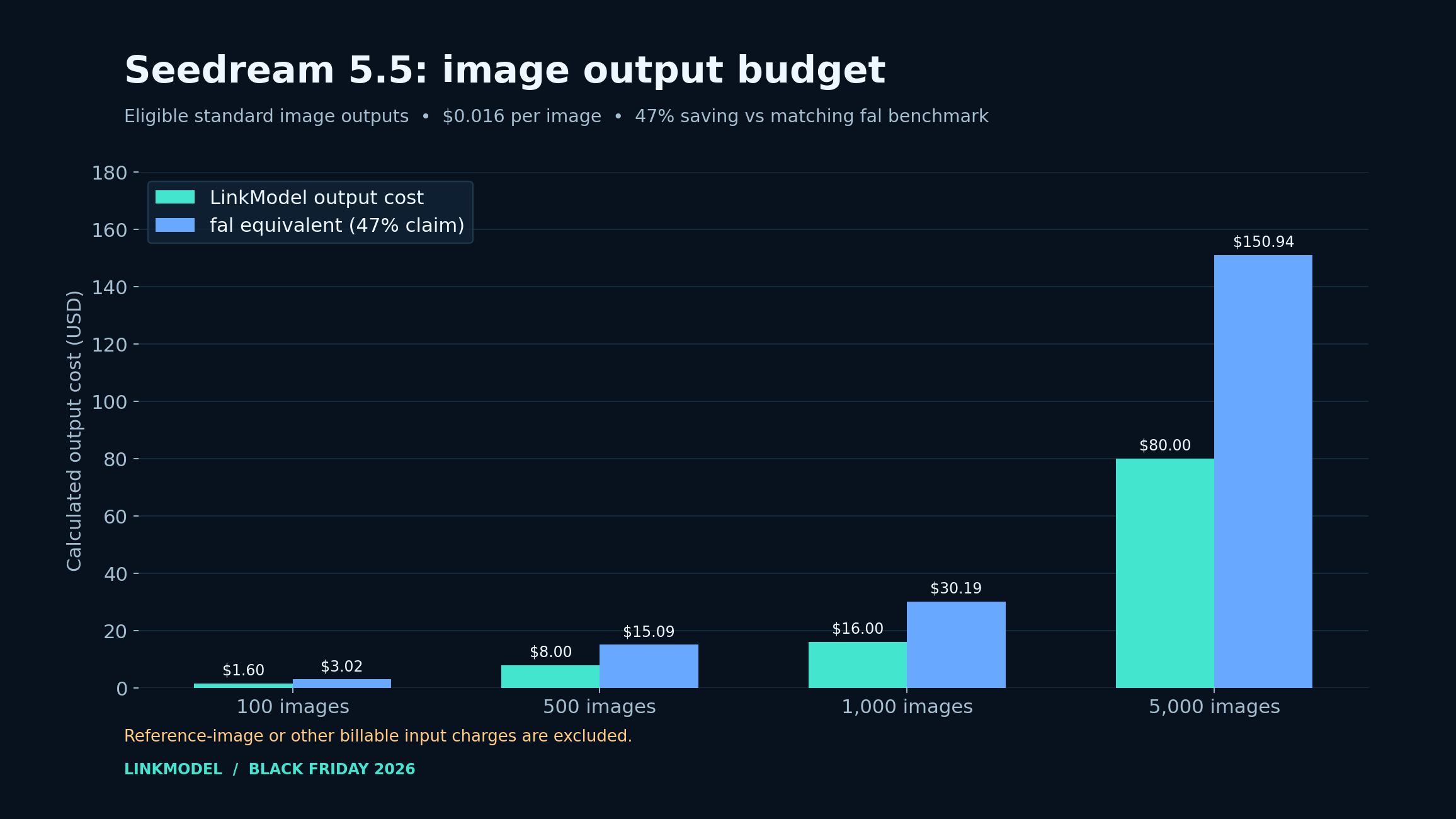
Five hundred eligible Seedream 5.5 output images cost $8.00 at $0.016 per image.
Imagine an online store selling 100 products. Each product needs five marketing images: one listing visual, two lifestyle compositions, one seasonal advertisement, and one social-media variation.
That creates 500 outputs.
| Image Volume | LinkModel Output Cost |
|---|---|
| 100 images | $1.60 |
| 500 images | $8.00 |
| 1,000 images | $16.00 |
| 5,000 images | $80.00 |
At the advertised 47% savings ratio, the equivalent matching fal benchmark for 500 outputs is approximately $15.09, giving around $7.09 in savings.
The project may involve more than generating independent images.
For example, a product photographer might use an existing product image to create several advertising backgrounds while preserving the original product shape, color, and branding.
Reference-based editing can involve separately billed inputs, so it is useful to distinguish between the cost of eligible outputs and the cost of a complete editing request.
For large catalogs, reusable product references and consistent image requirements make it easier to plan batches and evaluate visual consistency. Teams planning reference-based editing can find workflow details in the Seedream 5.5 API guide, while the Seedream 5.5 review provides additional model-focused context.
Budget takeaway: At the selected output rate, every additional 100 eligible images adds $1.60 in output charges.
GPT-6.2 Sol vs Astra: What Does a Coding Workload Cost?
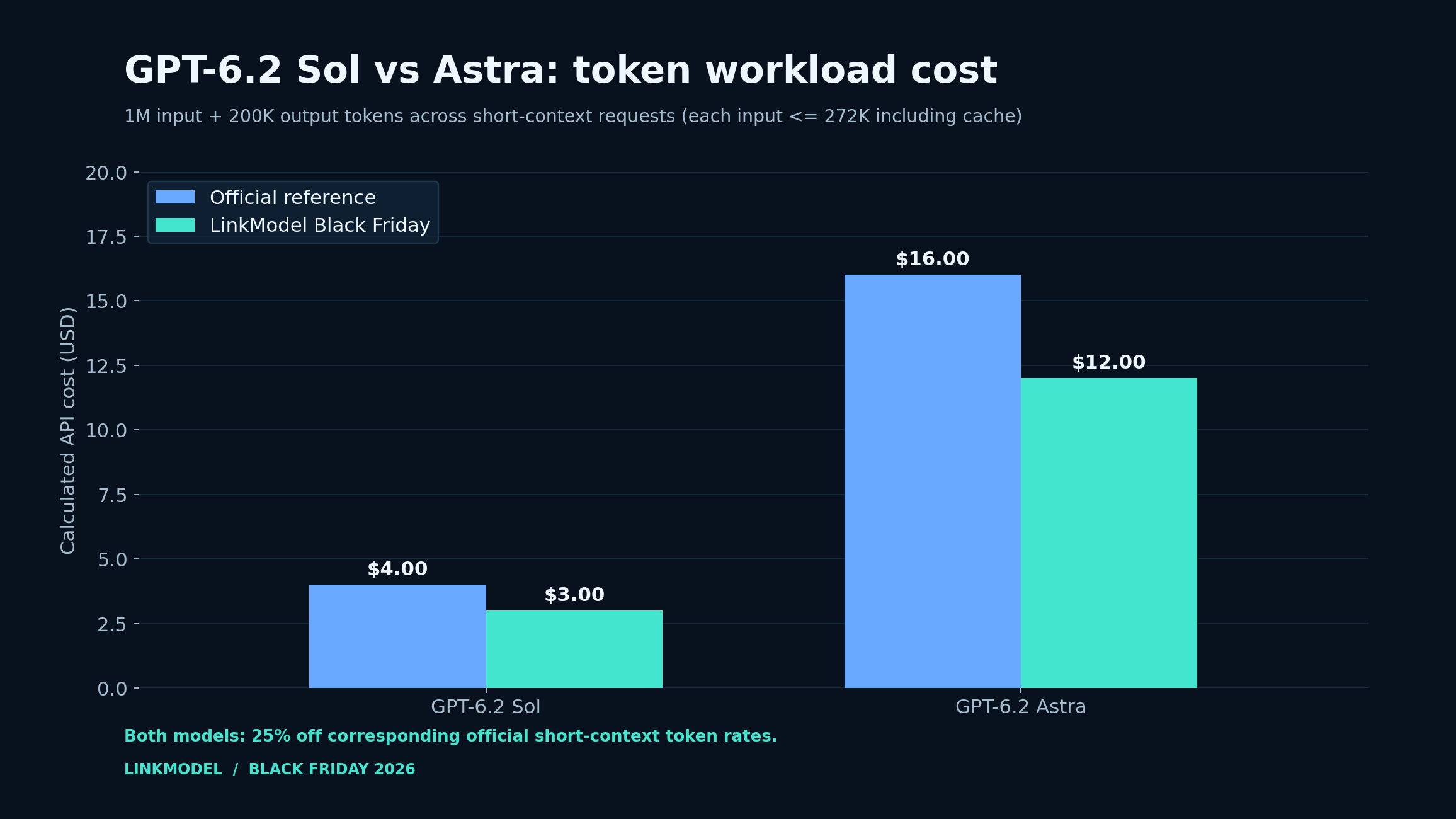
A workload using one million input tokens and 200,000 output tokens costs $3 with GPT-6.2 Sol or $12 with GPT-6.2 Astra at the Black Friday short-context rates.
Assume the workload is distributed across requests that individually remain within the 272K input-token threshold, including cached tokens.
Sol costs $1.50 for one million input tokens and $1.50 for 200,000 output tokens.
Astra costs $6 for one million input tokens and $6 for 200,000 output tokens.
| Model | Official Reference Cost | LinkModel Cost | Savings |
|---|---|---|---|
| GPT-6.2 Sol | $4.00 | $3.00 | $1.00 |
| GPT-6.2 Astra | $16.00 | $12.00 | $4.00 |
Both models receive 25% off their corresponding official rates, but Astra costs four times as much for the selected token mix.
For everyday coding, documentation, and routine application tasks, Sol offers a lower-cost starting point.
Astra is worth evaluating when the work requires deeper reasoning, multi-file implementation, or complicated code review. A more detailed GPT-6.2 Astra vs Sol comparison can help developers identify which tasks justify the additional spending.
Consider a software development task requiring changes across several modules, dependency analysis, and validation against detailed requirements. In this situation, a developer should compare the models using task completion, required revisions, and total billed usage.
For difficult coding tasks, cost per accepted task is more useful than input-token price alone. Developers building an automated review workflow can also consult the GPT-6.2 Astra code review guide for a more specific task framework.
Budget takeaway: For this workload, choosing Sol instead of Astra reduces the model charge by $9, but the more useful long-term measure is cost per accepted task.
GPT Image 2.6: How Much Do Flare and Sunburst Output Fees Drop?
GPT Image 2.6 Flare and Sunburst cost 65% of the corresponding official eligible output charges during Black Friday, saving 35% on that billing component.
The offer applies to eligible output fees rather than automatically reducing every component of an image-generation request.
| Official Eligible Output Cost | LinkModel Cost | Savings |
|---|---|---|
| $5.00 | $3.25 | $1.75 |
| $10.00 | $6.50 | $3.50 |
| $25.00 | $16.25 | $8.75 |
| $50.00 | $32.50 | $17.50 |
| $100.00 | $65.00 | $35.00 |
For example, an advertising team developing multiple campaign concepts can use Flare to explore visual directions and evaluate Sunburst when the selected work requires more detailed editing.
A productive workflow separates initial exploration from refinement.
The team might generate several candidate compositions, choose the most promising direction, and focus additional edits on the selected assets.
Input charges and the number of editing iterations should be considered when budgeting the complete project. If you're comparing image-generation workflows across providers, the GPT Image vs Seedream comparison provides a useful starting point for choosing between image-model families.
Budget takeaway: Every $100 in eligible official output charges becomes $65 on LinkModel, saving $35.
DeepSeek V4.1 Flash 1017: How Much Can Developers Save?
DeepSeek V4.1 Flash 1017 reduces eligible API costs by 32% against the corresponding official benchmark.
The promotional rate represents 68% of the matching official charge.
| Matching Official API Cost | LinkModel Cost | Savings |
|---|---|---|
| $5.00 | $3.40 | $1.60 |
| $10.00 | $6.80 | $3.20 |
| $25.00 | $17.00 | $8.00 |
| $100.00 | $68.00 | $32.00 |
| $500.00 | $340.00 | $160.00 |
Consider a developer running repeated document classification, structured extraction, or routine coding requests.
If the workload would incur $100 in corresponding official model charges, the eligible promotional cost becomes $68, saving $32.
This makes DeepSeek worth evaluating when an application processes many similar requests and the model meets the required output standards.
Developers using this model within a larger coding workflow can also explore the DeepSeek integration and tooling guide when planning the surrounding application.
Budget takeaway: The absolute savings increase with usage, making the 32% discount particularly relevant to recurring, cost-sensitive AI workloads.
Kling 4.0: How Much Do 1080p Videos Cost?
Kling 4.0 costs $0.19975 per generated second at the eligible 1080p Black Friday rate.
A ten-second generation costs $1.9975.
For a project requiring 50 ten-second videos, the total is $99.875.
| 1080p Video Workload | LinkModel Cost |
|---|---|
| 1 video, 10 seconds | $1.9975 |
| 10 videos | $19.9750 |
| 25 videos | $49.9375 |
| 50 videos | $99.8750 |
| 100 videos | $199.7500 |
The campaign reduces the corresponding official cost by 15%.
For 50 ten-second clips, the official comparison is $117.50, giving $17.625 in savings.
Kling 4.0 is relevant to commercial video workflows where camera direction, reference-guided shots, scene progression, or audiovisual structure matter.
A product advertisement might begin with a close-up, introduce a camera movement, and finish with a branded product reveal. For creators planning that type of sequence, the Kling prompting guide offers additional guidance on prompt structure and shot direction.
Budget takeaway: Every ten seconds of eligible 1080p generation costs $1.9975 at the promotional rate.
Which Black Friday AI API Model Should You Choose?
Choose the model according to your project, not just the headline discount. Seedance and Kling are video-generation options, Seedream and GPT Image 2.6 support image workflows, and GPT-6.2 and DeepSeek cover language-model applications.
The following table gives a practical starting recommendation for each of the eight models.
Best AI API Models by Project
| Your Project | Recommended Model | Primary Reason |
|---|---|---|
| Short product videos and social ads | Seedance 2.5 Flash | 480p generation from $0.060527/s |
| More directed 1080p commercial video | Kling 4.0 | 1080p generation and scene-control workflows |
| E-commerce product images | Seedream 5.5 | Eligible output pricing from $0.016/image |
| Rapid image concept exploration | GPT Image 2.6 Flare | Discounted output fees and iterative creative work |
| Detailed image refinement | GPT Image 2.6 Sunburst | Precision-oriented creative tasks |
| Everyday coding and AI assistants | GPT-6.2 Sol | Lower short-context token costs |
| Complex programming and code review | GPT-6.2 Astra | Advanced reasoning-oriented workflows |
| Cost-sensitive language-model automation | DeepSeek V4.1 Flash 1017 | 32% reduction against official charges |
These are starting recommendations. The final choice should depend on the requested output and whether the model meets the project's acceptance criteria.
For a broader selection framework covering development requirements and model capabilities, explore how to choose an LLM before deciding how to distribute tasks across models.
When Should You Consider Switching Models?
A higher-priced model is worth testing when the current choice no longer meets the task's requirements.
| Current Model | When to Consider Another Model | Model to Evaluate |
|---|---|---|
| GPT-6.2 Sol | Complex tasks require multi-module analysis and coordinated code changes | GPT-6.2 Astra |
| DeepSeek V4.1 Flash 1017 | A demanding development task needs a different reasoning approach | GPT-6.2 Astra |
| GPT Image 2.6 Flare | Creative direction is established and detailed refinement becomes more important | GPT Image 2.6 Sunburst |
| Seedance 2.5 Flash | A video needs more structured scene direction or audiovisual control | Kling 4.0 |
These comparisons guide model evaluation rather than implying that the more expensive model will always deliver a better result.
For development tasks, compare completed work, total tokens, and necessary revisions. For creative tasks, compare whether the output meets the required visual specification.
Example: Budget a Small E-commerce Campaign
Suppose a small retailer needs 50 product images and ten short videos.
At Seedream 5.5's eligible $0.016 output rate, the 50 images cost $0.80.
At Seedance 2.5 Flash's 480p rate, ten videos lasting ten seconds each cost $6.0527.
The combined generation budget is therefore $6.8527, before separately billed inputs or extra variations.
This illustrates a useful way to plan an AI workflow: define the deliverables, select suitable models, calculate expected usage, and fund the account according to the project budget. Teams planning larger commercial campaigns can also review AI API options for agencies when designing their production process.
How to Access LinkModel Black Friday APIs and Top Up
All eight discounted models are available through LinkModel, with their exact API IDs and model-page links included in the main pricing table.
Developers can begin with the model catalog, use Playground for supported tests, or integrate the appropriate API into an application.
API Endpoint and Model Documentation
For supported OpenAI-compatible language-model integrations, LinkModel uses the base API URL:
The Chat Completions endpoint is:
POST https://api.linkmodel.ai/v1/chat/completions
A typical request includes an API key for authentication, the model identifier from the pricing table, a messages array, and supported generation settings.
If you're setting up an account for the first time, follow the API key setup guide before preparing your initial request. For a practical implementation, the Python API tutorial and Node.js API tutorial cover common development approaches.
For language-model request requirements, consult the model documentation linked in the pricing table or the LinkModel API documentation.
Image and video tasks use their respective generation workflows rather than a universal chat-request format. Refer to the model pages in the pricing table for supported image inputs, video settings, task submission, and result retrieval.
Test Models in Playground
The LinkModel Playground provides a way to explore supported models before integrating them into a larger project.
Start with one representative task.
For coding, try a function review or a structured output request. For image generation, specify a clear product or creative concept. For video, define the intended subject, movement, duration, and supported output settings.
After generating a result, review whether it meets the task's requirements and inspect the corresponding usage.
This helps you estimate future API spending more accurately before expanding the workload.
What Can You Try With $1 in Free API Credits?
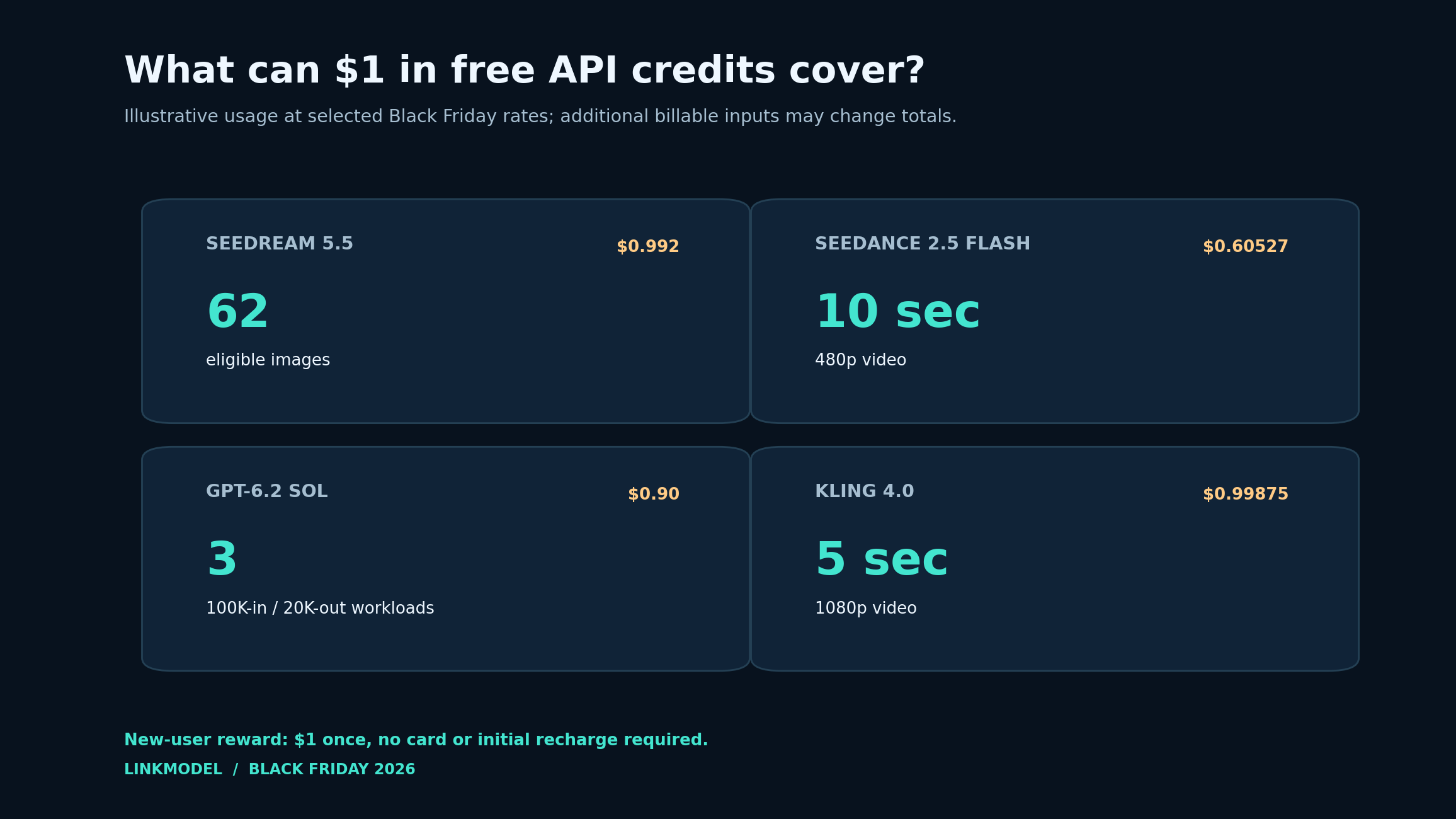
Eligible new users automatically receive $1 in free Credits after registration, without a payment card or initial recharge. The reward is available once per eligible new user, does not expire, and works across all currently available models.
At the Black Friday rates, the reward can cover introductory usage across several models.
| Model | Example Usage | Cost |
|---|---|---|
| Seedream 5.5 | 62 eligible output images | $0.992 |
| Seedance 2.5 Flash | One 10-second 480p video | $0.60527 |
| GPT-6.2 Sol | Three workloads of 100K input and 20K output tokens each | $0.90 |
| Kling 4.0 | One 5-second 1080p video | $0.99875 |
The examples use the specified billing components. Additional billable inputs or different configurations can change the total.
For example, a developer could use GPT-6.2 Sol to test several coding-assistant prompts, review the responses, and inspect token consumption before building a larger application.
An e-commerce seller could explore different product-image compositions with Seedream 5.5, while a video creator could try a short product animation with Seedance.
The goal is to understand the cost and usefulness of a representative task before spending more.
Check Your Balance and Click Top Up
To review your account balance or add funds, open LinkModel Billing after signing in.
The process is straightforward:
- Open your LinkModel account and go to Billing.
- Review your available balance.
- Click Top Up.
- Complete the payment process.
- Return to your model or API workflow.
Existing account balances can also be used for eligible Black Friday requests.
The promotion reduces the eligible API usage price; Top Up simply adds funds to your account.
You can therefore start with the free new-user reward, evaluate your chosen models, and recharge according to your actual project needs.
Black Friday Build Fund and Community Rewards
Alongside the eight discounted AI APIs, LinkModel is offering additional opportunities to receive API Credits through its X giveaway and Discord community.
Black Friday Build Fund: Win $5 in API Credits
The Black Friday Build Fund giveaway will select 10 winners, each receiving $5 in LinkModel Credits, for a total prize value of $50.
To participate, follow the official LinkModel X account, join LinkModel's Discord, and share which model you want to use and what you want to build in the event channel.
Participants must also submit their X username and Discord user ID through the official registration form for verification.
No purchase or recharge is required. Each person may enter once, and reposting is optional.
Entries close December 2, 2026. Winners will be announced December 3, with Credits issued within 48 hours after verification.
Follow LinkModel's X announcements for giveaway registration details and event updates.
Join Discord for $2 Credits and API Help
Join our Discord. Claim $2 in AI credits. Get API examples and help getting started.
Starting November 23, the first 30 eligible new or existing community members can claim $2 in LinkModel Credits by joining Discord and submitting their LinkModel account email through the pinned private claim form.
Each person and LinkModel account may claim once, with no recharge required. Eligible Credits are issued within 24–48 hours after verification, and claims close December 2 at 11:59 PM PST, subject to the 30-person limit.
The community also offers getting-started tutorials, API examples, model announcements, and help with integration questions.
The Discord welcome-credit offer and X giveaway are separate promotions.
Other Black Friday AI Deals in 2026
Several other AI companies are running Black Friday promotions, although the discounts apply to different products and purchasing structures.
For AI developers, the most relevant comparison is between usage-based API providers. Software subscriptions serve a different need.
Other AI API and Software Promotions
| Company | Black Friday Offer | Main Product Type |
|---|---|---|
| LinkModel | Up to 55% vs. matching fal pricing on participating models | Multi-model AI API |
| CometAPI | Up to 28% vs. official pricing on selected models | Multi-model AI API |
| PoYo | Model-specific API promotions with varying comparison baselines | AI generation API |
| ElevenLabs | Up to 55% off eligible annual Creator and Pro plans for the first year | Voice and audio tools |
| Topaz Labs | Up to 67% off selected software bundles | Image and video enhancement |
CometAPI and PoYo are more relevant to developers comparing API access, while ElevenLabs and Topaz offer promotions oriented toward particular application categories.
The percentage alone cannot determine which offer is cheapest because models, eligible features, billing units, and purchase commitments differ.
For a deeper provider comparison, our LinkModel vs fal.ai analysis explains the broader differences between these API platforms.
Why Consider LinkModel for a Multi-Model AI Project?
LinkModel's Black Friday offer is particularly relevant when a project combines multiple AI workflows.
For example, a small team might use GPT-6.2 Sol for application development, Seedream 5.5 for product images, and Seedance 2.5 Flash for promotional videos.
Instead of managing separate model-specific billing accounts for those workflows, the team can use LinkModel's unified platform and account balance.
The campaign provides specific promotional rates for all eight participating models, while $0 monthly platform fee and pay-as-you-go billing reduce the need for recurring platform commitments.
For users primarily seeking a finished voice or video editing application, an application subscription may be more suitable.
Compare the actual product and cost of your intended workflow before choosing a deal.
Are Black Friday AI API Deals Worth It?
Black Friday AI API deals are worth considering when their discounted rates reduce the cost of work you actually plan to complete, with clear eligibility and straightforward access.
Price transparency, usable promotional Credits, and payment flexibility are three important factors in making that decision.
Check the Actual Discount Baseline
A large promotional percentage is useful only when the comparison basis is clear.
In LinkModel's promotion, Seedance and Seedream use matching fal reference prices. GPT-6.2, DeepSeek, and Kling use corresponding official benchmarks, while GPT Image 2.6 specifically discounts eligible output charges.
That information matters because the models have different billing structures.
Compare matching configurations and calculate the total expected workload cost, rather than treating every advertised discount percentage as equivalent. Developers who want a wider reference point can explore the cheapest AI API comparison for 2026 before selecting a provider.
Why Promotional Credit Rules Matter
Our research into publicly discussed promotional API-credit experiences found that activation requirements and the practical value of Credits can strongly affect purchasing decisions.
In one reported case, a developer received $200 in promotional API Credits but later encountered more than $50 in unexpected charges after misunderstanding the activation process.
Another developer reported having $150 in unused Credits shortly before a promotional deadline.
These examples illustrate a practical question: how much of the advertised reward can a customer actually put toward their intended work?
For LinkModel, the regular $1 new-user reward is issued automatically and can be used for currently available models.
The separate Black Friday community rewards have their own participation and verification requirements.
The useful next step is to start with a representative request, inspect the usage, and decide whether additional account funding is worthwhile.
Pay-as-You-Go vs. AI Subscriptions
A discount on an annual subscription is different from a discount on usage-based API calls.
A published Black Friday software-deal directory analysis reported more than 800 visitors during its first three days, with lifetime deals receiving the highest clicks in that particular dataset.
The observation highlights why some software buyers care about recurring payment commitments, although it does not establish a general purchasing preference among AI API developers.
For occasional prototypes and variable creative work, pay-as-you-go billing can be attractive because spending follows actual usage.
For regular high-volume workloads, developers should compare the total expected costs of the available providers and plans.
LinkModel offers $0 minimum spend, $0 monthly platform fee, and access to participating text, image, and video models through one billing account.
The strongest deal is therefore the one that matches your workload, required capabilities, and expected spending.
Frequently Asked Questions
Are Black Friday AI API deals actually worth it?
Yes, when the discounted model meets your requirements and reduces your expected project cost. LinkModel's 2026 promotion covers eight models, with savings of up to 55% vs. fal on Seedance 2.5 Flash and additional discounts on GPT-6.2, Seedream, GPT Image, DeepSeek, and Kling. Compare the applicable billing unit and expected usage before choosing.
Are LinkModel Black Friday discounts available to existing users?
Yes. Eligible promotional model rates apply automatically to new and existing users from November 23 through December 2, 2026. Existing balances can be used for participating models. The separate $1 signup reward is available once to eligible new users.
Do promotional API Credits require activation?
Requirements depend on the promotion. LinkModel's regular $1 new-user Credits are issued automatically after eligible signup, without a card or recharge. The separate $2 Discord offer requires joining the community, submitting the pinned form, and completing verification. The eight-model Black Friday discounts do not require a coupon.
Can I get additional AI Credits without recharging?
Yes. LinkModel's Black Friday Build Fund offers ten winners $5 in Credits each, with no purchase required. The separate Discord offer provides $2 to the first 30 eligible claimants. Each promotion has its own participation rules, and both are scheduled to end on December 2, 2026.
How do I use Black Friday API discounts and Top Up?
Choose one of the eight participating models from the pricing table, open its API documentation or supported Playground workflow, and make eligible requests during the promotion. Discounts apply automatically. To view your balance or add funds, open LinkModel Billing and click Top Up.
Conclusion
The Black Friday AI API deals in 2026 make it possible to reduce the cost of coding, image generation, and video production with eight discounted LinkModel models, including savings of up to 55% against the specified fal benchmark on Seedance 2.5 Flash. The best choice depends on the task: compare the applicable rates, use the project cost examples to estimate your budget, and test a suitable model before scaling. With pay-as-you-go pricing, $0 monthly platform fee, unified billing, and an automatic $1 signup reward for eligible new users, LinkModel offers a practical route from initial experimentation to production. Explore the participating models and their promotional prices, then visit LinkModel Billing to review your balance or click Top Up before the December 2 deadline.