GPT 6.2 Astra is a strong choice for complex code review, particularly for cross-file logic, architectural decisions, and high-risk changes. Our research found that it matched GPT 6 Astra's review conclusions while using 27.3%–51.0% fewer tokens across two real review tasks. However, both generations missed a binding defect, showing why verified bug detection matters more than the number of comments or tokens saved when choosing a coding LLM API.
For developers, the key decision is whether Astra's advanced reasoning justifies its higher cost compared with GPT 6.2 Sol. False positives waste verification time, missed defects undermine trust, and repeated reviews can erase savings. The right approach to choosing an LLM for code review is to compare confirmed findings, review precision, latency, and cost per verified bug, not general coding benchmark scores alone.
LinkModel offers GPT 6.2 Astra at 25% lower standard token rates than OpenAI, with short-context input starting at $6 per million tokens and output at $30 per million tokens. A review using 100K fresh input and 10K output tokens costs $0.90 instead of $1.20. With $0 minimum spend and $0 monthly platform fee, developers can reduce AI API costs without a subscription commitment. New users automatically receive $1 in free Credits upon signup, with no card or recharge required. These credits do not expire, apply to all currently available LinkModel models, and are limited to one claim per eligible new user. For repeated review workloads, prompt caching can offer additional opportunities to optimize token spending.
Is GPT 6.2 Astra Good for Code Review?
Yes. Choose GPT 6.2 Astra for code reviews that require cross-module reasoning, architectural judgment, or independent analysis of high-impact changes. For routine fixes and high-volume PR screening, GPT 6.2 Sol is the more economical starting point. Early review evidence supports Astra 6.2's improved token efficiency, but does not establish superior bug detection across every repository.
Released on November 17, 2026, GPT 6.2 Astra is OpenAI's flagship reasoning model for demanding professional work, including complex software development, tool-assisted analysis, and multistep problem solving.
Its main code-review-relevant specifications are:
| Capability | GPT 6.2 Astra |
|---|---|
| Official model ID | gpt-6.2-astra |
| Context window | 1,050,000 tokens |
| Maximum input | 922,000 tokens |
| Maximum output | 128,000 tokens |
| Function calling | Supported |
| Adjustable reasoning effort | Supported |
| Official short-context input price | $8 per 1M tokens |
| Official short-context output price | $40 per 1M tokens |
The large context window can help a reviewer examine substantial source files, architectural documentation, and test results together. However, having access to more code does not guarantee understanding the relevant dependencies correctly.
A useful reviewer must connect each important finding to actual implementation behavior, identify the conditions under which it fails, and provide enough evidence for a developer to verify the claim.
What Real GPT 6.2 Astra Code Review Tests Show
Our research examined a developer-published A/B comparison from November 18, 2026, involving four historical review requests.
The evaluation used independent AI reviewers with read-only worktree access. Historical requests were replayed against the corresponding code revisions, allowing the newer and older model generations to evaluate the same engineering decisions.
Two tasks directly compared GPT 6 Astra and GPT 6.2 Astra at low reasoning effort.
| Review task | GPT 6 Astra | GPT 6.2 Astra | Review outcome |
|---|---|---|---|
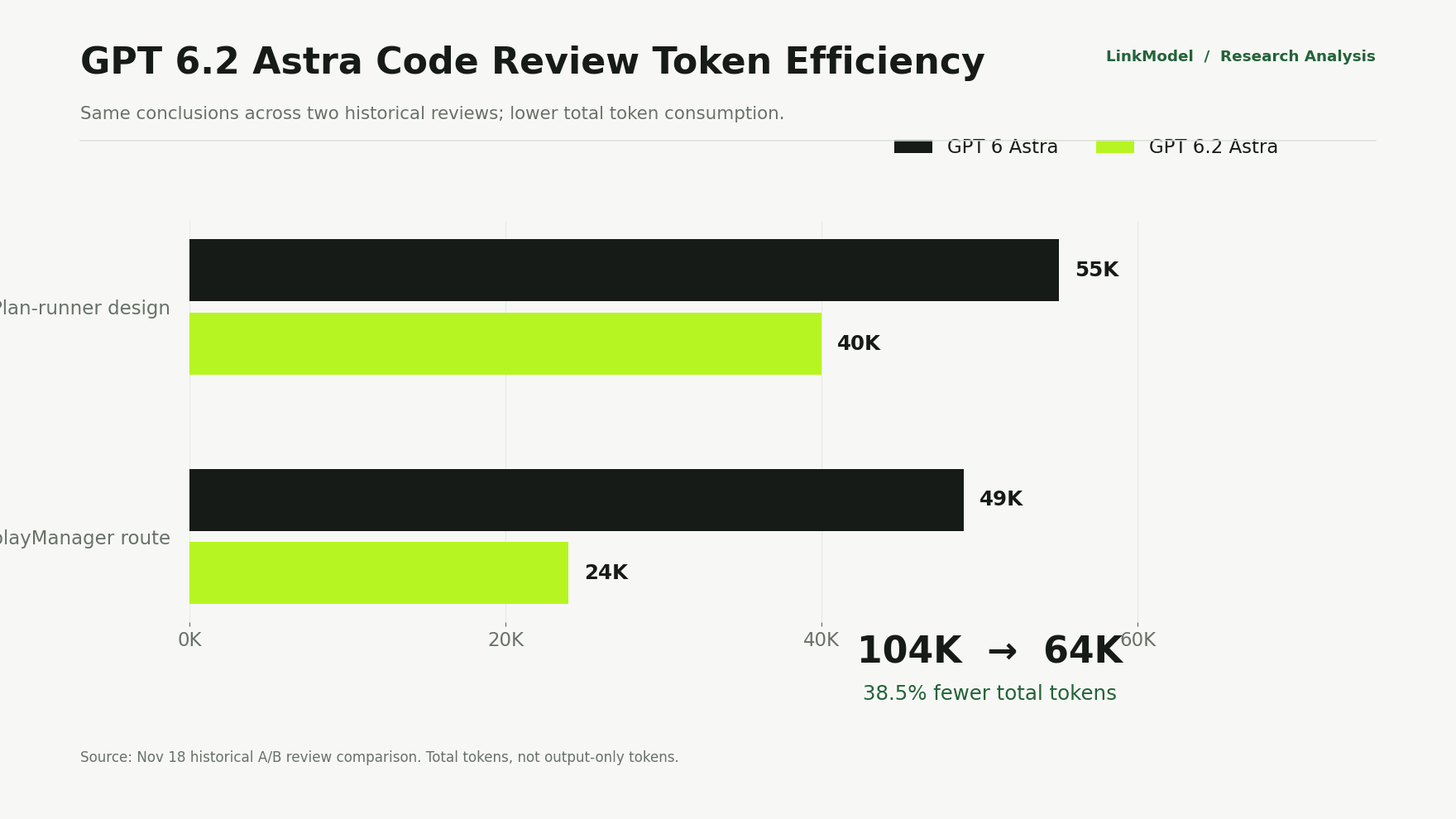
| Plan-runner design | 55K tokens, 89s | 40K tokens, 91s | Same decision and failure prediction |
| ColorDisplayManager route | 49K tokens, 54s | 24K tokens, 37s | Same four choices |
| Combined token use | 104K | 64K | 38.5% reduction |
| Combined elapsed time | 143s | 128s | 10.5% reduction |
The plan-runner review involved a design decision and its possible failure mode. Both Astra versions selected the same approach and anticipated the same problem. Astra 6.2 consumed 27.3% fewer tokens, although its response took two seconds longer.
The ColorDisplayManager task required choosing between alternative routes. Both generations reached the same four decisions, but Astra 6.2 used 51.0% fewer tokens and finished 17 seconds sooner.
Across both tasks, total token consumption declined from 104K to 64K.
The important limitation was that both Astra generations missed a binding defect that was later corrected.
Our analysis suggests that Astra 6.2 provides a credible efficiency improvement for existing review workflows, while the evidence does not establish a corresponding increase in defect recall.
When Should Developers Use Astra for Code Review?
Astra is most useful to evaluate when the code change requires reasoning across interacting components rather than inspecting isolated functions.
Consider a PR that changes a background worker, a shared configuration object, and a service shutdown handler. Each individual function may look correct, but an asynchronous operation could continue after its required service has been disabled.
A reviewer needs to examine the lifecycle relationship, determine whether the sequence is possible, and identify the conditions under which it would fail.
Our research points to four workloads where additional reasoning may justify Astra's higher price: architectural refactors, cross-module state changes, concurrency-sensitive operations, and business-critical code paths.
For smaller isolated fixes, the better decision is usually to start with a less expensive reviewer and escalate only when the change warrants deeper scrutiny.
What Bugs Can GPT 6.2 Astra Detect in Code Review?
GPT 6.2 Astra can investigate logic errors, boundary conditions, cross-file dependencies, unsafe state transitions, and security-sensitive behavior. Its practical value depends on whether those investigations produce specific, verifiable findings.
Our analysis of code review cases highlights the importance of examining the failure mechanism rather than treating every plausible warning as a confirmed defect.
Logic Errors, Overflow, and Boundary Conditions
Logical defects are often hidden behind behavior that appears correct under normal conditions.
A calculation may return an invalid result only at an extreme value. An error handler may fail when an exception occurs during cleanup. A function may assume that a dependency exists even after the system has changed state.
In the historical review comparison, GPT 6.1 Sol and GPT 6.2 Sol were evaluated on a seeded unit test.
Both models identified three known issues, while GPT 6.2 Sol additionally found a real overflow to negative infinity.
This result belongs to the Sol comparison, but it provides a useful example of the defects an Astra review should be designed to investigate.
Our recommended review questions include whether arithmetic can overflow or underflow, whether unexpected inputs change control flow, and whether error handling preserves valid state.
An actionable finding should identify the problematic operation, specify the triggering input, and explain the resulting behavior.
Without that evidence, a warning about a possible overflow is merely a concern requiring further investigation.
Cross-File State and Service Lifecycle Problems
Cross-module defects are difficult because their cause and impact may appear in different files.
Our research found a useful example in a historical hand-off analysis involving the Sol generations.
GPT 6.2 Sol produced approximately six additional findings grounded in the code. The most important confirmed problem involved saving a curve and handing control to Android while the relevant service was switched off.
The underlying issue was a mismatch between an operation and the state of the dependency required to complete it.
For Astra code review, this illustrates why developers should examine asynchronous callbacks, shutdown behavior, shared mutable state, and the sequence of operations across modules.
A strong review should determine whether an operation can outlive its dependency, whether the current state is checked at the correct point, and whether callers make assumptions that are no longer valid after a transition.
These questions are especially relevant for applications involving background services, event-driven systems, and concurrent operations.
Security Bugs Even Advanced Reviewers Can Miss
Security-sensitive code review requires the model to trace how validation relates to the action eventually performed.
An earlier GPT 6 Astra versus GPT 5.6 Sol benchmark identified two cross-file security defects that Sol detected and Astra missed.
The first involved origin validation in a Discourse embedding script. The implementation checked whether an origin appeared as a substring of an expected URL, potentially accepting a maliciously controlled prefix domain instead of the exact trusted origin.
The second involved a redirect that escaped a host allowlist. The original destination passed validation, but a subsequent request followed a redirect without revalidating the destination host.
These cases illustrate two common review failures: incomplete validation and losing track of security assumptions across execution steps.
For security-related PRs, our analysis recommends checking the exact trust boundary, the data that can be attacker-controlled, the validation operation, and whether the same guarantee remains valid at the final point of use.
A premium reasoning model should not be assumed to catch every security defect simply because its overall precision is high.
What the Historical 50-PR Benchmark Reveals About Accuracy
Our research examined a historical code review benchmark involving 50 PRs with deliberately introduced defects across Cal.com, Sentry, Discourse, Keycloak, and Grafana.
The benchmark compared GPT 6 Astra with GPT 5.6 Sol. Both models reviewed the same diffs using identical instructions, with one published review pass per model.
Findings were pooled and deduplicated before two independent model judges assessed whether each issue represented a genuine defect. A finding counted as confirmed only when both judges agreed.
The process created a consistent evaluation standard, although model-judge agreement is not equivalent to reproducing every finding manually.
| Metric | GPT 6 Astra | GPT 5.6 Sol |
|---|---|---|
| Findings reported | 96 | 126 |
| Confirmed findings | 91 | 107 |
| Finding precision | 95% | 85% |
| Average review latency | 36s | 51s |
| Model cost per confirmed finding | $0.062 | $0.039 |
| Unique confirmed findings | 16 | 32 |
The results reveal an important distinction between precision and coverage.
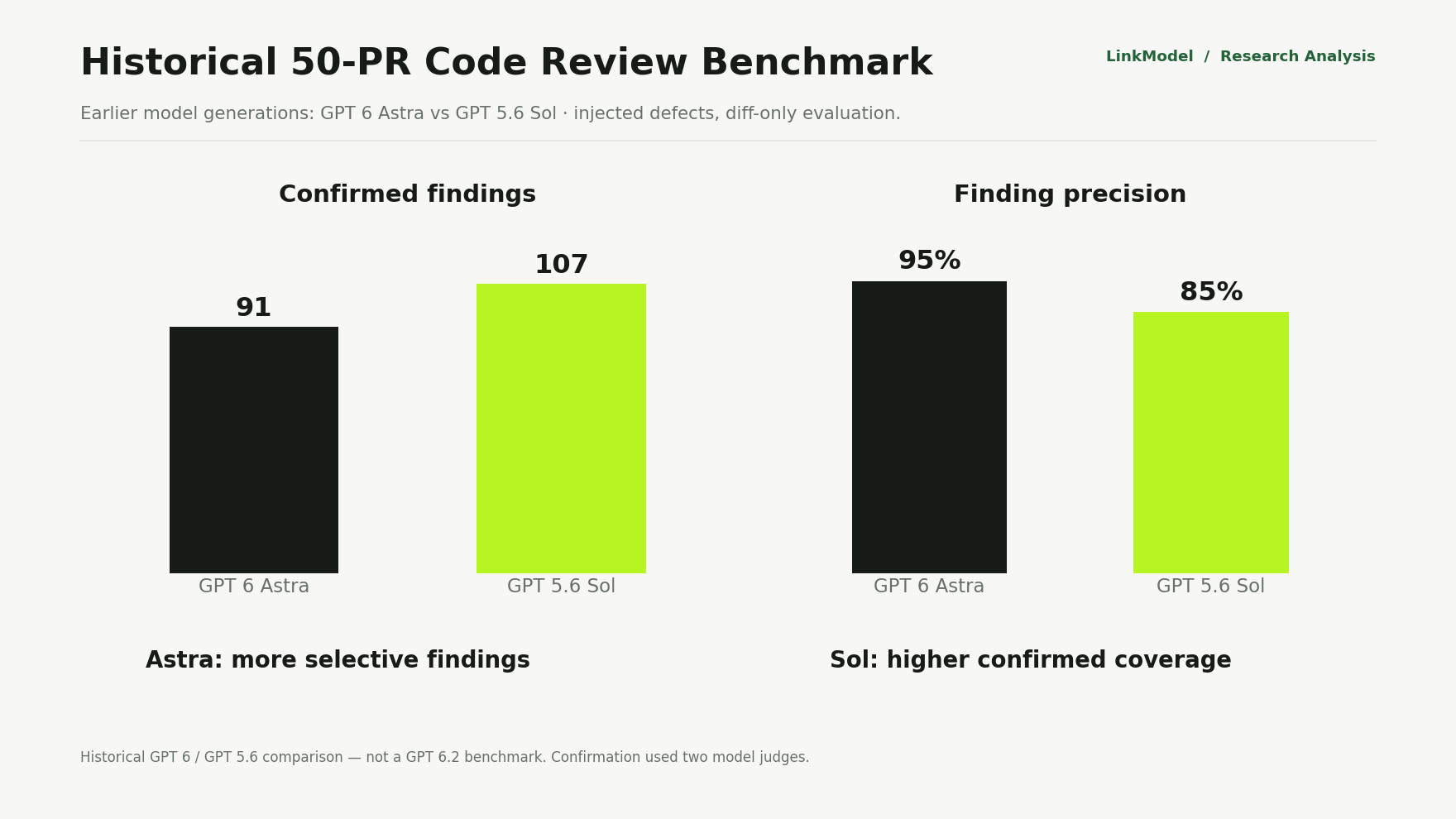
Astra produced fewer comments, but a larger proportion survived the verification process. Sol reported more issues, had lower precision, and still produced more confirmed findings overall.
The two models also identified different defects. Sol found 32 confirmed issues that Astra did not report, while Astra found 16 that Sol missed.
The most important result is not that one model won. Astra's higher precision made its findings more selective, while Sol surfaced more confirmed defects at a lower model cost.
For teams overwhelmed by review noise, precision may be especially valuable. For teams concerned about missed regressions, additional confirmed coverage may justify more verification work.
The benchmark also had a bounded evaluation design: injected defects, diff-only analysis, and one published review pass per model. Its results should inform a review strategy without being treated as a direct performance measurement for GPT 6.2.
Our review of user questions found that developers also want repeatability data: would the same model produce consistent findings if the same PR were reviewed three times?
A practical evaluation should therefore measure confirmed findings, precision, repeated-run consistency, and human verification effort together.
GPT 6.2 Astra vs GPT 6 Astra: Is the Upgrade Worth It?
GPT 6.2 Astra is worth evaluating as an upgrade because its standard token prices are lower and early review comparisons show meaningful reductions in token consumption. The direct evidence supports similar review conclusions at lower resource use, not a universal increase in accuracy.
Token Efficiency vs Review Speed
The historical A/B comparison used low reasoning effort for both Astra generations.
Across two review tasks, Astra 6.2 reduced combined token consumption by 38.5% and combined elapsed time by 10.5%.
However, the first task was slightly slower with Astra 6.2 despite using fewer tokens.
This illustrates why token efficiency and latency should be evaluated separately. A model that uses fewer tokens can still take longer when tool execution, context processing, or reasoning behavior differs.
For existing review pipelines, the key question is whether the newer version preserves important findings while reducing the resources needed to obtain them.
Official Price Changes and Upgrade Economics
OpenAI reduced the standard short-context input and output token rates between the Astra generations.
| Price per 1M tokens | GPT 6 Astra | GPT 6.2 Astra |
|---|---|---|
| Input | $10 | $8 |
| Output | $50 | $40 |
For identical fresh-input and output token quantities, GPT 6.2 Astra costs 20% less than GPT 6 Astra at the official standard rates.
Consider a review using 100K fresh input tokens and 10K output tokens.
| Model and access | Review cost |
|---|---|
| GPT 6 Astra at official rates | $1.50 |
| GPT 6.2 Astra at official rates | $1.20 |
| GPT 6.2 Astra through LinkModel | $0.90 |
At matching token quantities, using GPT 6.2 Astra through LinkModel reduces the cost from $1.50 to $0.90 compared with the previous generation's official standard rates.
That represents a 40% reduction in this example.
The actual workload expense can decline further when a model uses fewer tokens to complete the same task, but the final bill also depends on the distribution of input, output, and cached tokens.
For additional context on the older generation's pricing structure, developers can review the GPT 6 Astra API pricing breakdown.
Should Existing Astra Reviewers Upgrade?
The strongest migration approach is to replay previously reviewed commits with known defects or important design decisions.
Compare the findings under similar review scopes, tool permissions, and reasoning settings.
The newer reviewer should be evaluated on whether it preserves critical findings, introduces unnecessary comments, misses known defects, or improves review speed and cost.
An upgrade is successful when it preserves or improves actionable review quality while reducing total engineering expense.
Developers comparing earlier model generations can also examine the GPT 6.1 Sol vs GPT 6 Astra comparison for additional context on performance and price trade-offs.
GPT 6.2 Astra vs Sol for Code Review: Which Should You Choose?
Choose GPT 6.2 Sol for frequent, budget-sensitive reviews, and evaluate GPT 6.2 Astra for architectural analysis, difficult cross-module problems, or independent review of high-impact changes.
The right default depends on whether additional reasoning produces enough value to justify its higher model cost.
What the Sol Review Comparisons Found
Our research examined two historical Sol 6.1 versus Sol 6.2 review tasks at medium reasoning effort.
| Review task | GPT 6.1 Sol | GPT 6.2 Sol | Review result |
|---|---|---|---|
| Seeded unit review | 106K tokens, 216s | 134K tokens, 354s | One additional real defect |
| Hand-off analysis | 119K tokens, 221s | 150K tokens, 541s | About six additional grounded findings |
| Combined tokens | 225K | 284K | 26.2% higher |
| Combined elapsed time | 437s | 895s | Approximately 2.05× longer |
GPT 6.2 Sol found additional code-grounded problems, including the overflow and service-state issues examined earlier.
Those findings were accompanied by greater token consumption and significantly longer review times.
This creates a different trade-off from the Astra generation comparison. Better findings do not always come with faster responses or lower resource consumption.
OpenAI's FrontierCode 2.0 results provide further context: GPT 6.2 Sol performs within 0.5 percentage points of Astra at about one-fifth the task cost when both use maximum reasoning effort.
FrontierCode measures whether software changes satisfy maintainers' merge standards. It supports Sol's general coding value, but should not be treated as a direct measure of PR bug-detection precision.
Case Study: Astra Advising Three Sol Workers
Our research also identified a multi-agent development workflow that separated higher-level judgment from routine implementation.
The configuration used GPT 6.2 Astra as an advisor to three GPT 6.2 Sol workers.
The previous setup involved GPT 6 Astra and GPT 6.1 Sol.
Sol workers handled optimization and implementation tasks. Astra reviewed the results, evaluated whether the changes were worth keeping, and guided the next steps.
The developer-reported workflow results included:
| Metric | Reported outcome |
|---|---|
| Optimization throughput | Approximately 2× |
| Quota consumption | Approximately 25% lower |
| Earlier optimization retention | Typically 1–2 of 10 attempted approaches |
| New configuration | Astra advisor and three Sol workers |
The reported improvements covered the complete development process, including the agent configuration and optimization workload.
The broader lesson is the separation of responsibilities.
A higher-cost reasoning model can concentrate on evaluation and decisions, while lower-cost workers carry out implementation. This can also help maintain a clear boundary between a code reviewer and an agent authorized to modify source files.
Which Model Should Review Your PR?
| Review situation | Recommended starting approach | Reason |
|---|---|---|
| Small isolated fix | Sol | Lower routine review cost |
| Large architectural change | Evaluate Astra | More demanding design reasoning |
| Cross-module state change | Astra with verification | Complex dependency relationships |
| Security-critical change | Independent review plus human validation | Higher impact of missed defects |
| Unclear first-pass finding | Selective Astra escalation | Additional investigation |
| Multi-agent development | Sol workers, Astra reviewer | Separate implementation and review |
| High-volume automated screening | Sol with selective escalation | Better cost control |
The key decision is not whether Astra is more advanced in general.
It is whether a more expensive review can reveal a consequential defect, resolve uncertainty, or reduce the engineering effort required to make a safe decision.
How to Use GPT 6.2 Astra for Code Review Without Unnecessary Risk
A reliable Astra code review workflow should be read-only, tightly scoped, and focused on evidence-backed findings. The reviewer should investigate defects without automatically modifying the code it examines.
Our review of user questions identified three recurring concerns: incorrect repository understanding, unsupported findings, and modifications outside the intended task scope.
Step 1: Define the Exact Review Scope
Start with the PR or commit range, changed files, intended behavior, and relevant tests.
Include surrounding code when it is necessary to understand the implementation.
For example, reviewing a shutdown handler may require examining worker state, callback registration, and shared resources even if those files were not directly modified.
The goal is to supply enough context to identify real interactions without including unrelated repository material.
Sufficient context is more useful than maximum context.
Step 2: Enforce Read-Only Access
A reviewer should not need unrestricted file-editing permissions to identify defects.
Our research identified a developer experience in which a global agents.md file was modified during an unrelated troubleshooting task.
For a pure review workflow, use read-only repository access where practical, remove unnecessary write tools, and restrict executable operations to approved validation activities.
A prompt asking the model not to edit files is weaker than an environment that prevents unauthorized changes.
This separation also makes it easier to preserve an audit trail between review findings and later implementation work.
Developers designing review agents can use the underlying principles of function calling and tool use to understand how model instructions interact with available tools and execution permissions.
Step 3: Use an Evidence-First Review Prompt
A good prompt tells Astra what kind of defects to examine and what evidence must accompany every finding.
Recommended prompt:
Review the supplied changes for functional defects, regression risks, incorrect assumptions, boundary conditions, concurrency problems, security vulnerabilities, resource leaks, and broken error handling. Inspect relevant surrounding code before reaching conclusions. Do not modify files or perform destructive actions. For every finding, identify the file and location, explain the exact failure mechanism, specify the triggering conditions and potential impact, and recommend a verification method. Clearly distinguish supported findings from unresolved concerns, report missing context, and exclude cosmetic suggestions unless they affect behavior.
This structure prioritizes actionable problems instead of long lists of speculative warnings.
A strong finding should contain a file location, failure mechanism, triggering condition, severity, supporting evidence, and validation method.
Step 4: Verify Important Findings Before Acting
Important findings should be checked against the source code before becoming implementation tasks.
For arithmetic defects, test the relevant boundary. For lifecycle problems, reproduce the state transition. For security issues, validate the exact trust boundary and data flow.
When the evidence is incomplete, request additional inspection rather than treating a confident explanation as proof.
A separate implementation agent can apply approved corrections after the review has been validated.
Step 5: Evaluate Repeatability and False Positives
For important changes, repeat the same review under comparable settings and examine whether the findings remain consistent.
Track confirmed findings, false positives, missed known defects, review latency, and total token consumption.
Our review of developer questions found that reviewers care not only about how many issues a model reports, but also how much work is required to decide whether those issues are real.
These measurements are especially useful before introducing AI review into an automated merge process.
Step 6: Match Reasoning Effort to Risk
The historical Astra comparison used low reasoning effort, while the Sol comparison used medium effort.
Because the reasoning settings and tasks differed, those timings should not be treated as a controlled speed ranking between Astra and Sol.
For routine reviews, begin with a lower supported effort setting. Increase it when the task involves complex dependencies, unclear failure mechanisms, or high-impact changes.
The objective is the lowest-cost configuration that consistently provides useful, verifiable findings, not simply the longest possible reasoning process.
GPT 6.2 Astra Code Review Cost: LinkModel Pricing and Cost per Confirmed Bug
GPT 6.2 Astra's economic value depends on the cost of producing useful findings, not merely the number of tokens consumed.
LinkModel offers standard published token prices 25% below OpenAI's matching GPT 6.2 Astra rates, covering input, cached input, cache writes, and output.
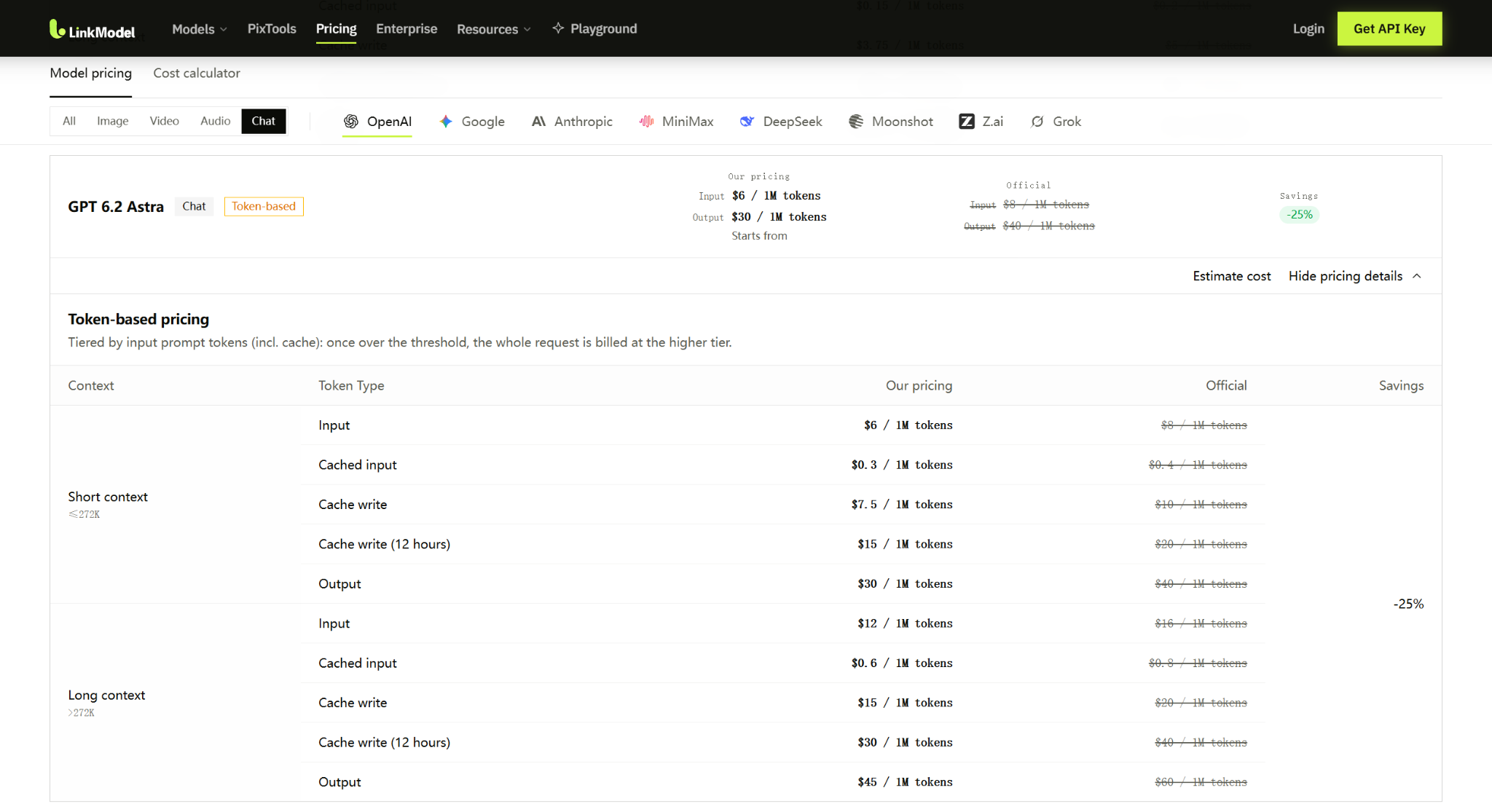
GPT 6.2 Astra API Pricing: LinkModel vs OpenAI
All rates are in USD per million tokens.
| Token category | LinkModel ≤272K | OpenAI ≤272K | LinkModel >272K | OpenAI >272K |
|---|---|---|---|---|
| Input | $6.00 | $8.00 | $12.00 | $16.00 |
| Cached input | $0.30 | $0.40 | $0.60 | $0.80 |
| Cache write | $7.50 | $10.00 | $15.00 | $20.00 |
| Cache write, 12 hours | $15.00 | $20.00 | $30.00 | $40.00 |
| Output | $30.00 | $40.00 | $45.00 | $60.00 |
The pricing tier depends on total input prompt tokens, including cached tokens.
When a request exceeds 272K input tokens, the higher tier applies to the entire request rather than just the excess.
This can matter when reviewing a large repository. Adding unrelated files can increase both the token count and the applicable rate for the complete request.
The more economical approach is to include all necessary context while avoiding material that does not support the review.
GPT 6.2 Astra Code Review Cost Examples
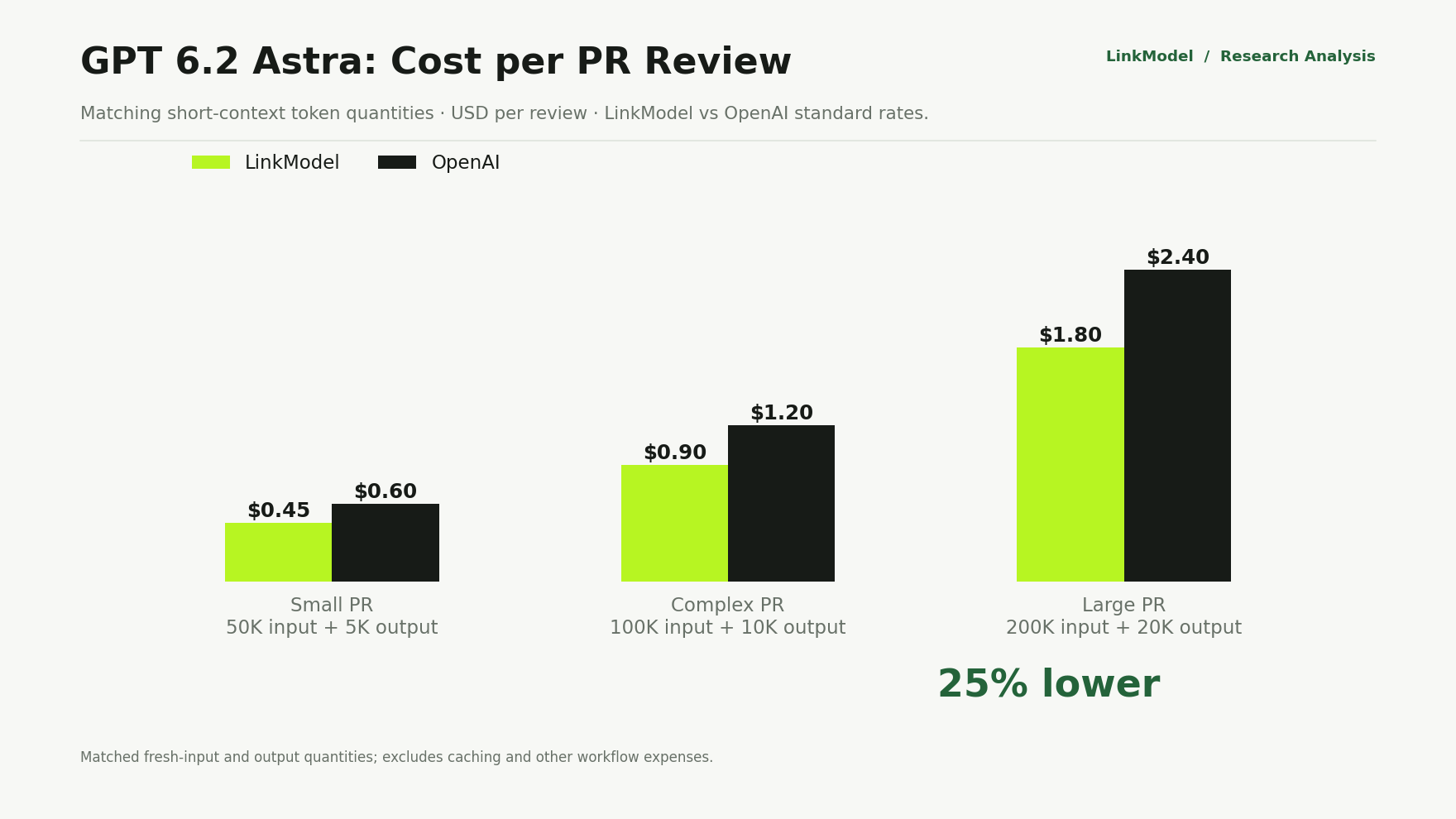
The following scenarios use fresh input and generated output within the short-context tier.
| Review workload | Input | Output | LinkModel | OpenAI |
|---|---|---|---|---|
| Small PR | 50K | 5K | $0.45 | $0.60 |
| Complex PR | 100K | 10K | $0.90 | $1.20 |
| Large PR | 200K | 20K | $1.80 | $2.40 |
For the complex review:
Input cost: 100,000 × $6 / 1,000,000 = $0.60
Output cost: 10,000 × $30 / 1,000,000 = $0.30
Total LinkModel cost: $0.90
The matching OpenAI request costs $1.20.
For 100 equivalent reviews, LinkModel's token expenditure would be $90 instead of $120, saving $30.
For 1,000 equivalent reviews, the difference would reach $300.
The price advantage becomes more meaningful as usage grows, particularly for automated review pipelines with predictable request patterns.
How Prompt Caching Changes Review Economics
Repeated PR reviews can reuse repository instructions, shared architecture documentation, and common interfaces.
When this material is served from cache, subsequent requests can use lower cached-input rates.
Consider a review with 20K fresh input tokens, 80K cached input tokens, and 8K output tokens.
| Cost component | LinkModel | OpenAI |
|---|---|---|
| Fresh input | $0.120 | $0.160 |
| Cached input | $0.024 | $0.032 |
| Output | $0.240 | $0.320 |
| Total | $0.384 | $0.512 |
At the same token quantities, LinkModel saves $0.128 per review.
Creating reusable cached context can also involve cache-write charges, which should be included when calculating the full workflow expense.
A practical strategy is to preserve stable prompt prefixes and repository context while separating PR-specific changes.
Cost per Confirmed Bug: The Metric That Matters
A low token price does not guarantee an economical review.
The more useful measure is:
Model Cost per Confirmed Finding = Total Model Review and Retry Cost ÷ Number of Independently Verified Findings
Historical 50-PR research demonstrated the importance of this distinction. One model produced more precise findings, while another delivered more confirmed issues at a lower cost per finding.
To illustrate the calculation for Astra 6.2, assume a team completes ten reviews, each using 100K fresh input and 10K output tokens through LinkModel.
Total model expense would be $9.00.
| Independently verified findings | Total model cost | Cost per finding |
|---|---|---|
| 1 | $9.00 | $9.00 |
| 2 | $9.00 | $4.50 |
| 4 | $9.00 | $2.25 |
| 6 | $9.00 | $1.50 |
These scenarios explain how confirmed findings influence review economics.
A model that reports many defects but produces few valid findings may be more expensive to operate than its API price suggests.
This leads to an additional cost that is often overlooked: human verification.
How False Positives Change the Real Cost of Code Review
A cheaper AI reviewer can become more expensive when its false positives consume developer time.
Our analysis considers two hypothetical review workflows with different model charges and false-positive counts.
Assume developers spend five minutes investigating each false positive, with an estimated labor cost of $30 per hour.
| Cost component | Reviewer A | Reviewer B |
|---|---|---|
| Model review cost | $0.90 | $0.45 |
| False-positive findings | 8 | 2 |
| Verification time per false positive | 5 minutes | 5 minutes |
| Total false-positive investigation time | 40 minutes | 10 minutes |
| Human investigation cost | $20.00 | $5.00 |
| Model and false-positive cost | $20.90 | $5.45 |
In this scenario, Reviewer A costs only $0.45 more to run, but its additional false positives increase the combined expense by $15.45.
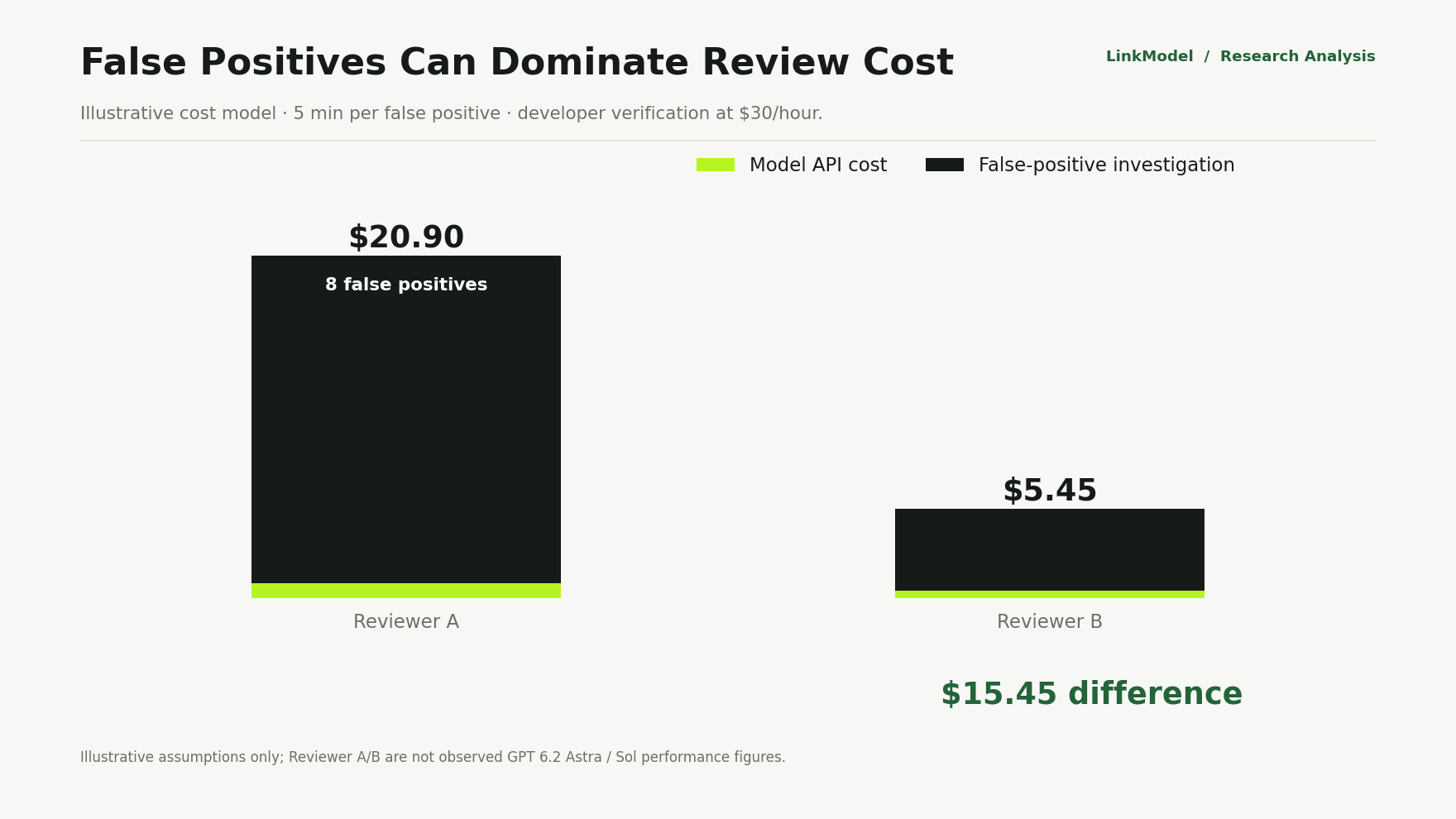
The comparison illustrates why engineering teams should measure more than API expenditure. The assumed false-positive counts and labor rate are example inputs rather than measured Astra or Sol performance.
A complete evaluation can use:
Total Review Cost = Model Charges + Developer Verification Cost
For a broader cost-per-finding analysis, divide the total review cost by independently verified defects.
This provides a practical framework for comparing a premium reviewer with a cheaper alternative.
If Astra produces fewer false positives or identifies a high-impact defect that another model misses, its higher token cost may be justified.
If Sol produces comparable confirmed findings with little additional investigation, its lower price may be the better choice.
The most economical reviewer is the one that delivers useful, verified findings at the lowest total engineering cost.
When Is Astra Worth Paying For?
Astra is most compelling when deeper analysis can prevent an expensive failure, resolve an unclear finding, or improve confidence in a critical change.
For routine PR screening, lower-cost models may provide sufficient coverage. For changes involving authorization, payment calculations, concurrency, or data integrity, an additional Astra review may be a reasonable investment.
LinkModel's lower standard rates make this selective strategy easier to budget. Developers can use pay-as-you-go access, compare model-specific review costs, and reserve premium reasoning for the tasks where it delivers the most value.
The strongest purchasing decision is therefore based on confirmed engineering value relative to API and verification costs, not the apparent sophistication of the model's response.
Frequently Asked Questions
Is GPT 6.2 Astra better than Sol for code review?
Not universally. Astra is worth evaluating for architectural reasoning, cross-module dependencies, and high-impact changes. Sol offers lower token prices for routine PR reviews. The best choice depends on confirmed findings, false positives, review latency, and total verification cost.
Can GPT 6.2 Astra find real bugs and security vulnerabilities?
Yes, it can investigate functional defects and security-sensitive behavior, but important findings still need verification. Early review comparisons identified a binding issue missed by both Astra generations, while historical benchmarks show that even advanced reviewers can miss cross-file security problems.
What reasoning effort should I use for Astra code review?
Begin with a lower supported reasoning setting for bounded reviews and evaluate higher settings for complex architectural or high-risk changes. Compare confirmed findings, consistency, latency, and cost before increasing effort. More reasoning does not automatically guarantee better results.
How can I prevent Astra from changing files or reporting false bugs?
Use read-only repository access, remove unnecessary write tools, and define a narrow review scope. Require each finding to identify the relevant code location, failure mechanism, triggering condition, and verification method. Confirm important issues before allowing a separate implementation agent to apply changes.
Is GPT 6.2 Astra worth its API cost for automated PR reviews?
It can be, especially for complex or high-impact changes. At LinkModel's short-context standard rates, a review using 100K fresh input and 10K output tokens costs $0.90 instead of $1.20 at OpenAI's matching rates. For long-term use, evaluate API expense together with confirmed findings, false positives, and developer verification time.
Conclusion
GPT 6.2 Astra is a strong candidate for complex code review when teams need independent reasoning, source-grounded findings, and careful evaluation of high-risk changes. Early direct comparisons show meaningful improvements in token efficiency compared with GPT 6 Astra, while missed defects demonstrate the importance of validating review conclusions. Our research into historical PR benchmarks, multi-agent workflows, and developer questions indicates that the most effective strategy is to use lower-cost models for routine coverage, reserve Astra for demanding decisions, and measure total review value through precision, verified findings, and human verification cost. For teams implementing that approach through an API, LinkModel's 25% lower matching standard token rates provide a clear economic advantage without requiring a monthly platform subscription.