GPT-6.2 Sol is the better value for everyday coding and high-volume AI agents, while GPT-6.2 Astra is stronger for complex reasoning, professional tasks, and demanding development. Astra costs 4× more per token, yet the two score almost identically on FrontierCode 2.0 at maximum reasoning effort: 44.2% vs 43.8%. Paying more does not always mean getting better results, especially when comparing coding LLM performance and earlier Sol vs Astra model differences.
The real question is when Astra's extra reasoning power justifies its higher cost. Our research found that Sol can outperform Astra in specific coding tasks, while Astra delivers clearer advantages in scientific reasoning and complex professional workflows. Code review results, reasoning settings, retries, and the 272K context pricing threshold can all change the total cost of running an AI agent, especially in workloads with large LLM context windows. Choosing the right model—or combining both—can save substantially more than comparing token prices alone.
LinkModel cuts standard GPT-6.2 Astra and Sol API token prices by 25%. GPT-6.2 Astra starts at $6/M input and $30/M output, while GPT-6.2 Sol starts at just $1.50/M input and $7.50/M output. Compare both through one platform with $0 minimum spend, $0 monthly platform fee, and the flexibility to use multiple AI models through one API key. New users automatically receive $1 in free Credits, with no card or recharge required. This one-time signup credit never expires and works across all models currently available on LinkModel, making it easy to try both before paying.
GPT-6.2 Astra vs Sol: Key Differences and Model Capabilities
GPT-6.2 Astra prioritizes advanced reasoning and complex professional work, while GPT-6.2 Sol offers a more economical starting point for everyday tasks and frequent AI agent calls. Both models were released on November 17, 2026.
Their practical difference is not simply intelligence. It is the relationship between task complexity, the quality required, and the cost of getting an acceptable result.
| Comparison | GPT-6.2 Astra | GPT-6.2 Sol |
|---|---|---|
| Main positioning | Complex professional work | Efficient everyday work |
| Reasoning | Stronger on demanding evaluations | Capable at substantially lower cost |
| Software development | Architecture, difficult debugging, complex reviews | Routine implementation, testing, repeated agent actions |
| Scientific workflows | Stronger published evaluation results | Lower-cost option for simpler tasks |
| Documents and spreadsheets | Complex financial, legal, and structured work | Standard drafting, editing, and analysis |
| Interactive 3D | Higher independent preference score | Lower-cost iterative development |
| Official API input | $8/M tokens | $2/M tokens |
| Official API output | $40/M tokens | $10/M tokens |
| LinkModel input, short context | $6/M tokens | $1.50/M tokens |
| LinkModel output, short context | $30/M tokens | $7.50/M tokens |
Quick decision: Choose Sol for high-volume coding, routine development, and repeatable tasks with clear validation. Choose Astra when complex reasoning, professional output quality, or costly mistakes justify a premium model. Use both when a workflow combines difficult planning with routine execution. LinkModel offers both at 25% below their corresponding official standard token rates.
Is GPT-6.2 Astra actually smarter than Sol?
The Artificial Analysis Intelligence Index gives Astra a score of 62, compared with 57 for Sol.
That five-point advantage supports Astra's stronger overall reasoning capability. However, an aggregate intelligence score cannot directly predict how many bugs either model will discover or whether it will complete a particular software task correctly.
The advantage becomes more relevant when a project combines several difficult reasoning steps and interdependent outputs.
Consider a financial analysis requiring a model to interpret annual reports, extract consistent figures, construct spreadsheet formulas, evaluate assumptions, and prepare an executive memo. An error in one stage can affect the final deliverable.
Sol can be an economical starting point for straightforward extraction, drafting, or formatting. Astra becomes more attractive when several dependencies must be handled together and mistakes are expensive to correct.
The same distinction applies to software engineering: routine implementation is different from resolving ambiguous requirements or difficult architectural dependencies. These are important factors when choosing an LLM for a specific workload.
What changed from GPT-6 Astra and GPT-6.1 Sol?
The November 2026 release offers two different upgrade stories.
GPT-6.2 Astra improves on GPT-6 Astra while lowering its official standard API prices. Input and output token rates fell by 20%, while cached input declined from $1 to $0.40 per million tokens.
Astra also gained five points on the Artificial Analysis Intelligence Index and improved across several professional evaluations.
GPT-6.2 Sol retains GPT-6.1 Sol's official standard token prices of $2 per million input tokens and $10 per million output tokens. Its Intelligence Index improved by two points to 57.
However, its independent Coding Agent Index declined by three points compared with Sol 6.1.
This difference matters for upgrades. Higher overall intelligence does not guarantee better performance on every repository question, code-review request, or debugging workflow.
For teams already using Sol 6.1, the most useful upgrade check is whether Sol 6.2 improves their actual tasks without introducing new omissions or additional correction work.
Why API price alone cannot determine the winner
At standard rates, Astra charges four times as much as Sol for equivalent input and output token quantities.
But real tasks do not always consume the same number of tokens. A stronger model may solve a difficult problem in fewer steps, while a cheaper model may complete straightforward work without any noticeable quality disadvantage.
Repeated attempts, human review, and debugging can also change the economic outcome.
Cost per accepted result is more useful than cost per million tokens alone. For high-volume tasks with easy automated checks, Sol is the stronger cost-first choice. For work involving complex reasoning and expensive errors, Astra deserves consideration.
GPT-6.2 Astra vs Sol Benchmarks: Which Model Performs Better?
Astra leads on several demanding scientific and professional benchmarks, while Sol nearly matches Astra on FrontierCode 2.0 at substantially lower measured task spending.
The difference between these results explains why the two models can perform similarly in one coding workflow but deliver noticeably different outcomes in another.
Official benchmarks: Coding, science, CAD, and automation
OpenAI's published evaluations show the following results.
| Benchmark | Astra | Sol | Difference |
|---|---|---|---|
| FrontierCode 2.0 | 44.2% | 43.8% | Astra +0.4 points |
| Agents' Last Exam v1.1 | 78.3% | 73.0% | Astra +5.3 points |
| Terminal-Bench-Science 0.1 | 77.1% | 68.0% | Astra +9.1 points |
| BenchCAD 2.1 Core | 82.5% | 73.1% | Astra +9.4 points |
| AutomationBench 1.0.6 | 52.4% | 41.2% | Astra +11.2 points |
FrontierCode 2.0 evaluates modifications to real codebases against maintainers' expectations for merge-ready changes.
Its published cost comparison is especially useful because it combines performance with the resources consumed under the evaluated configuration.
| FrontierCode 2.0, Max effort | Astra | Sol |
|---|---|---|
| Score | 44.2% | 43.8% |
| Measured cost per benchmark task | $5.97 | $1.29 |
At the evaluated Max settings, Sol achieves a score within 0.4 percentage points of Astra while reducing measured task spending by approximately 78.4%. This makes Sol particularly attractive for similar coding-agent workloads where cost efficiency matters.
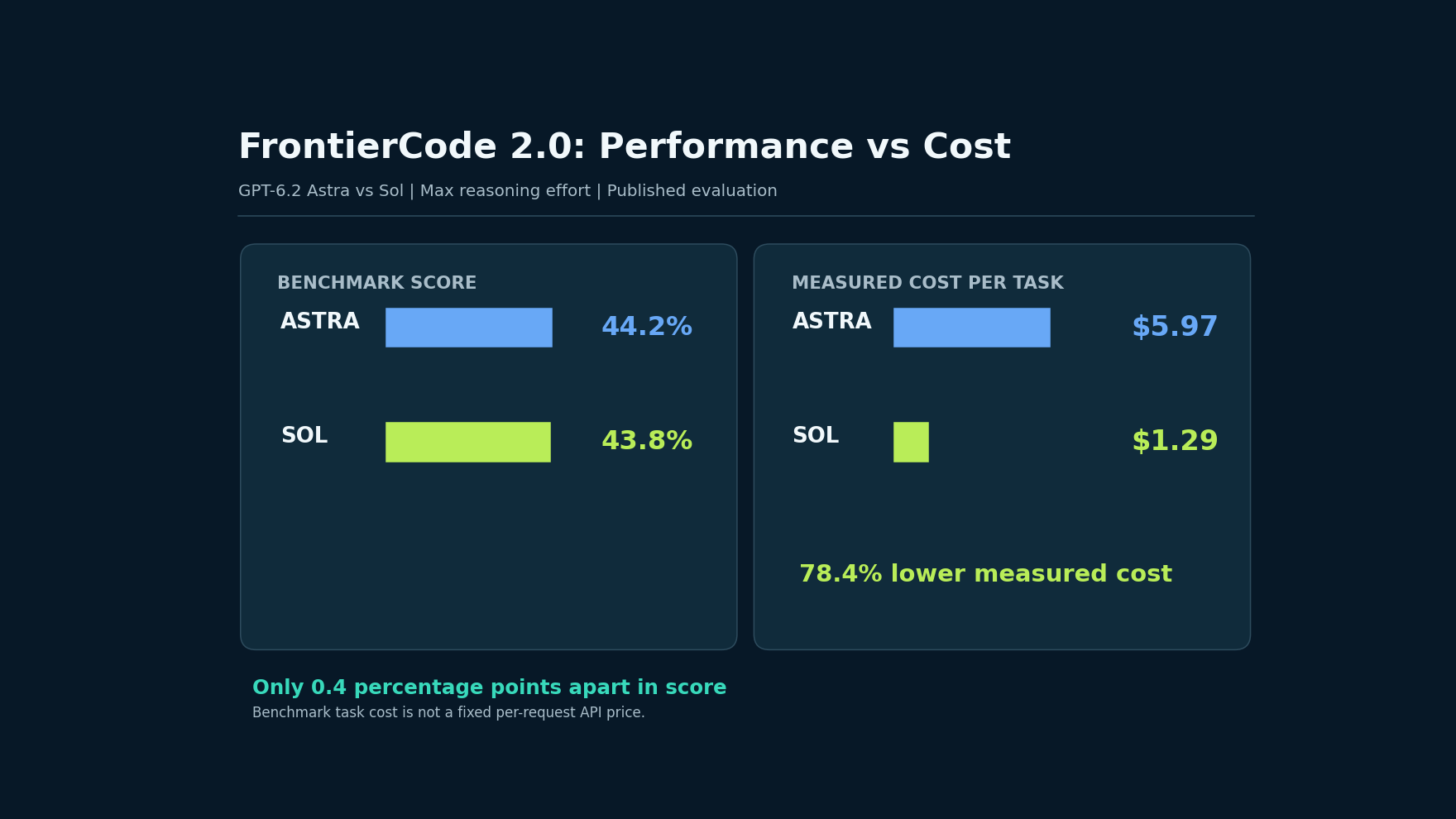
The figures describe the specific evaluation configuration, rather than a fixed cost for every coding request.
Astra's advantages become more pronounced in other categories. It leads Sol by 9.1 points on Terminal-Bench-Science, 9.4 points on BenchCAD, and 11.2 points on AutomationBench.
Those larger differences provide stronger reasons to select Astra when a workload depends on scientific reasoning, demanding design, or complex automation.
Independent benchmarks reveal different coding strengths
Artificial Analysis offers a complementary assessment.
| Independent evaluation | Astra 6.2 | Sol 6.2 |
|---|---|---|
| Intelligence Index | 62 | 57 |
| AA-3D Elo | 1,318 | 1,259 |
| AA-Robotics v0.1 | 79 | 78 |
| Coding Agent Index change vs previous version | Unchanged | Down 3 points |
The Intelligence Index and AA-3D results favor Astra, while the robotics scores are almost identical.
The Coding Agent Index introduces a more important distinction for developers.
Astra 6.2 remained broadly unchanged from GPT-6 Astra. Sol 6.2 declined by three points relative to Sol 6.1, including a notable weakness in SWE-Atlas-QnA-AA.
That evaluation examines the ability to answer questions about existing codebases. The reported decline was associated with a greater tendency to omit details required for a complete answer.
This does not necessarily contradict the FrontierCode result.
Implementing a code change and explaining an existing repository are different abilities. A model might produce a useful patch while missing relevant information about dependencies or architecture.
For implementation-heavy agents, Sol's lower task cost is compelling. For repository analysis or architectural work where incomplete explanations are costly, Astra's stronger reasoning provides a reason to compare both models.
For a broader view of coding-model tradeoffs, our best coding LLM API comparison examines model selection in agent workflows.
Professional work and interactive 3D show Astra's larger advantage
Professional evaluations reveal capabilities that a coding leaderboard alone cannot measure.
In an AA-AnalystAgent task involving California Medicaid expenditure reports, Astra correctly answered 62.5% of evaluated questions across five independent attempts. The work required interpreting spreadsheets and reports containing related information.
OpenAI also described a complex legal-agent evaluation in which Astra consumed 62% fewer tokens than GPT-6.1 Sol. This is a comparison against the preceding Sol version, but it illustrates how reasoning efficiency can affect demanding professional workflows.
Other published application evaluations reported reductions in token usage and review rounds under their specific conditions.
For professional tasks, these improvements matter because the final cost may include repeated analysis, document corrections, and human verification.
Interactive 3D provides a separate example.
Artificial Analysis's AA-3D evaluation uses blinded human preferences to compare generated interactive experiences. Astra reached 1,318 Elo, compared with 1,259 Elo for Sol.
That result supports Astra as a stronger candidate for visually demanding interactive applications where spatial structure and experience quality matter.
The practical distinction is clear: Sol is appealing when throughput and budget dominate, while Astra becomes more attractive when complex output quality is central to the result.
GPT-6.2 Astra vs Sol for Coding, Code Review, and AI Agents
Our research shows that neither model wins every coding task. Results vary across algorithm performance, defect detection, reasoning effort, and multi-agent coordination.
The following documented development cases reveal different ways to evaluate that tradeoff.
Case study: Algorithm optimization across eight model configurations
Our research identified a detailed AtCoder algorithm comparison covering five Sol configurations and three Astra configurations.
The recorded results include solution-generation time, code size, execution time, and memory usage for the same programming problem.
| Model and effort | Generation time | Code size | Execution time | Memory |
|---|---|---|---|---|
| Sol 6.1 Medium | 10m 37s | 3,009 bytes | 1,232 ms | 116,920 KiB |
| Sol 6.2 Low | 17m 39s | 12,604 bytes | 251 ms | 438,556 KiB |
| Sol 6.2 Medium | 10m 28s | 7,697 bytes | 193 ms | 46,796 KiB |
| Sol 6.2 High | 18m 8s | 12,956 bytes | 32 ms | 11,388 KiB |
| Sol 6.2 XHigh | 10m 8s | 9,616 bytes | 172 ms | 60,684 KiB |
| Astra 6.2 Low | 1m 45s | — | Time limit exceeded | — |
| Astra 6.2 Medium | 6m 25s | 2,939 bytes | 940 ms | 19,800 KiB |
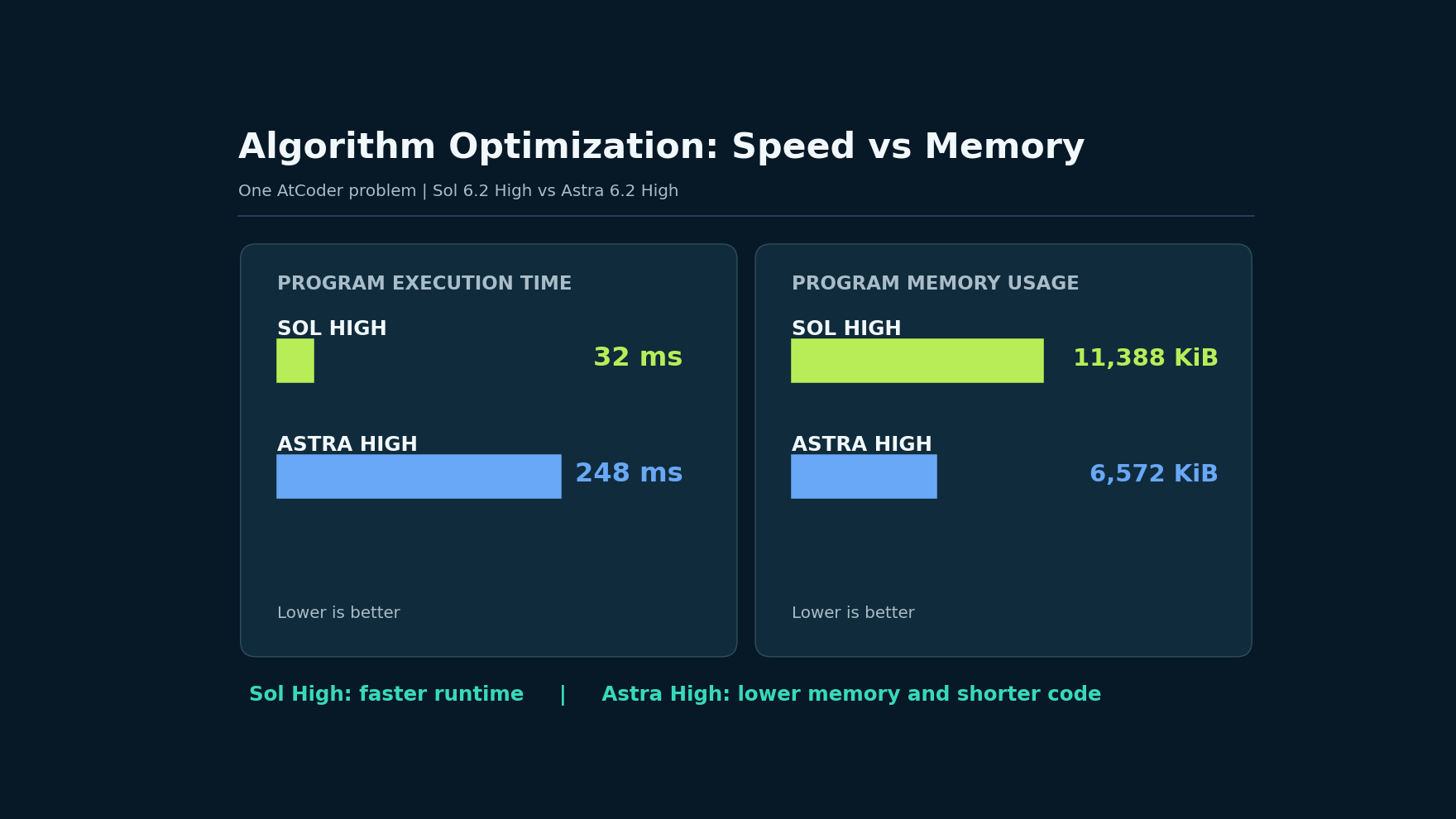
| Astra 6.2 High | 5m 9s | 2,937 bytes | 248 ms | 6,572 KiB |
Sol 6.2 Medium reduced the generated program's execution time from 1,232 ms to 193 ms compared with Sol 6.1 Medium, an improvement of approximately 84.3% in this task.
Sol 6.2 High generated the fastest-running solution at 32 ms, using 11,388 KiB of memory.
Astra 6.2 High produced a different tradeoff. Its program ran in 248 ms but used 6,572 KiB of memory, compared with Sol High's 11,388 KiB.
Astra's implementation was also substantially shorter at 2,937 bytes, against Sol High's 12,956 bytes.
Astra Low exceeded the problem's execution time limit, despite belonging to the stronger model family.
These results show that coding performance involves several independent measurements.
Generation time determines how long the developer waits for the model.
Program execution time and memory determine how efficiently the generated solution runs.
Code structure and maintainability affect how easily the implementation can be understood and supported.
A shorter program is not automatically more maintainable, but large differences in implementation size can justify additional review.
For this algorithm, Sol High won on execution speed, while Astra High produced a smaller program with lower memory consumption.
The appropriate choice depends on whether execution speed, memory efficiency, or maintainability is most important.
Case study: Four historical code-review requests
Our review of four documented historical code-review replays found that Sol 6.2 identified additional valid issues in two comparisons, while Astra 6.2 maintained comparable review quality with fewer tokens than its predecessor.
The tasks covered seeded defects, hand-off logic, architectural planning, and routing behavior.
| Review task | Older model | Newer model | Main result |
|---|---|---|---|
| Seeded unit defect review | Sol 6.1 | Sol 6.2 | Three known defects plus one additional valid defect |
| Hand-off analysis | Sol 6.1 | Sol 6.2 | Approximately six additional code-grounded findings |
| Plan-runner design | Astra 6 | Astra 6.2 | Comparable review quality |
| Route design | Astra 6 | Astra 6.2 | Comparable review quality with fewer tokens |
Sol 6.2 discovered more issues in both Sol comparison tasks, but required substantially more analysis time.
| Measurement | Previous version | GPT-6.2 version |
|---|---|---|
| Sol seeded-review time | 216s | 354s |
| Sol seeded-review tokens | 106K | 134K |
| Sol hand-off review time | 221s | 541s |
| Sol hand-off review tokens | 119K | 150K |
| Astra plan-review tokens | 55K | 40K |
| Astra route-review tokens | 49K | 24K |
The new Sol took approximately 1.6× longer on the seeded review and 2.4× longer on the hand-off review than Sol 6.1.
Its token consumption also increased.
Astra 6.2 followed a different pattern. It produced similar-quality results to Astra 6 while reducing token usage from 55K to 40K in one task and from 49K to 24K in another.
The second reduction was approximately 51%.
Not every problem was detected. One architectural issue remained unresolved in both Astra versions, and certain findings in the original comparison were excluded because of the test environment's access to later code revisions.
For routine pull requests, Sol is a sensible first reviewer when findings can be checked against tests and source code. For architecture changes, complex dependencies, or unresolved high-severity issues, Astra is a stronger escalation candidate.
Review effectiveness should be measured through confirmed defects, missed critical issues, false positives, completion time, and total cost—not the number of comments alone.
Case study: Astra coordinating three Sol coding agents
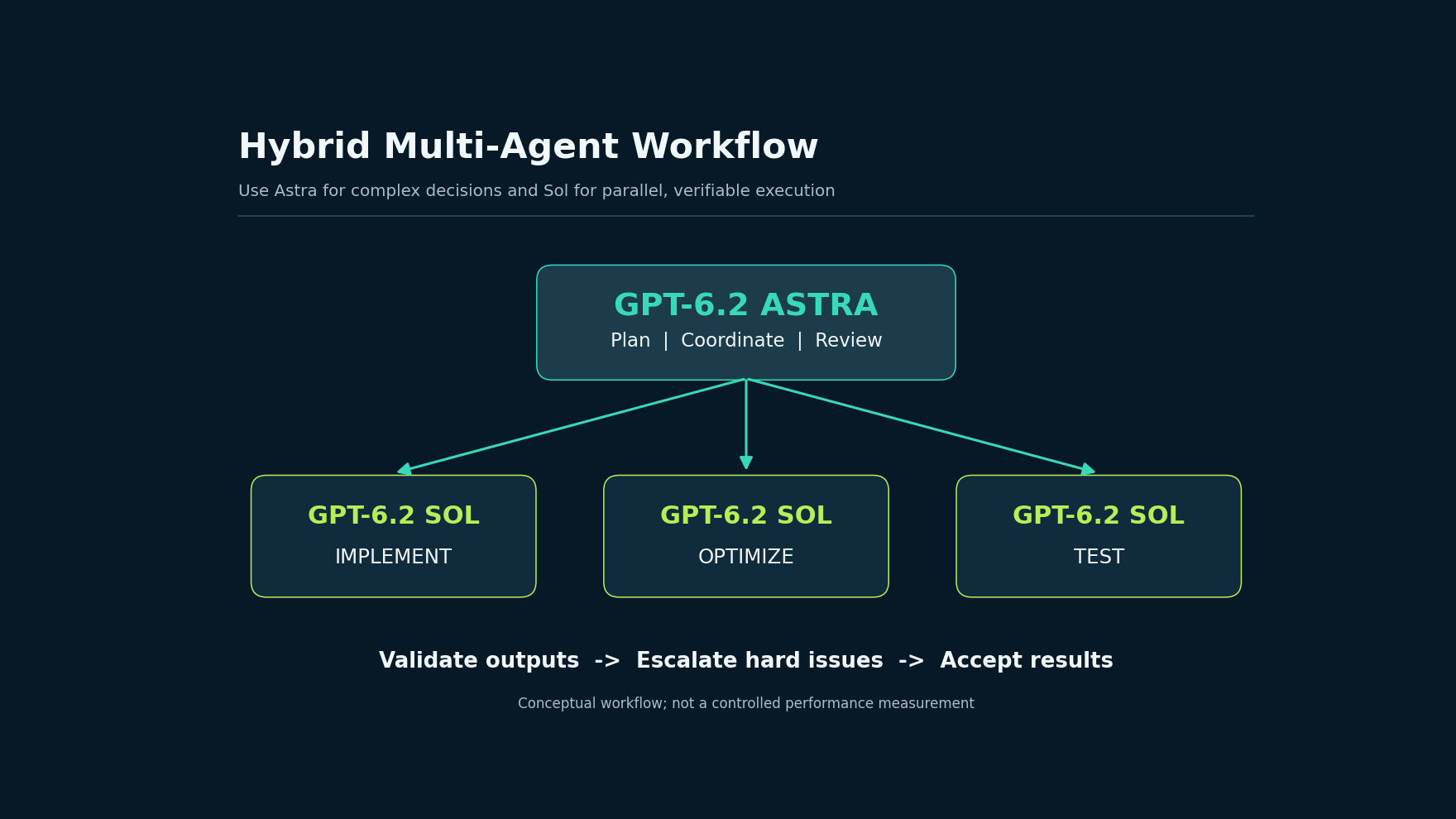
Our research identified a practical multi-agent development configuration using Astra as the coordinator and three Sol workers for implementation, optimization, and testing.
The previous configuration used GPT-6 Astra alongside GPT-6.1 Sol. After upgrading the model combination, the workflow reported:
| Measure | Reported result |
|---|---|
| Optimization throughput | Approximately 2× faster |
| Usage allowance consumption | Approximately 25% lower |
| Accepted optimizations | More useful results retained |
| Regression-testing friction | Fewer obstacles |
| Earlier optimization yield | Roughly 1–2 accepted attempts out of 10 |
Our review of this development workflow found approximately 2× optimization throughput and 25% lower quota consumption after upgrading the Astra coordinator and three Sol workers from their previous model versions.
The strongest takeaway is the task allocation: Astra handles decisions and review, while Sol completes parallel implementation.
The coordinator interprets project requirements, selects tasks, and evaluates completed work. Sol workers execute assigned implementation, optimization, or testing steps and report their results.
This reduces the need to involve Astra in every routine operation.
It also creates an escalation path: complicated decisions return to Astra, while repetitive work continues through Sol.
The reported improvements describe the complete upgraded configuration, including its model-version changes. The results do not isolate the effect of the coordination strategy from every other change.
Nevertheless, the example demonstrates a practical architecture for applications with different levels of task difficulty.
Astra can manage complex decisions while Sol provides economical execution capacity. The same allocation principle is useful when building AI applications with multiple models through one API key.
Case study: Reasoning effort and extended coding sessions
Our review of early development experiences found that model selection and reasoning effort should be treated as separate decisions.
In one extended coding session, Astra 6.2 Max was used for almost five hours of complex development, consuming approximately 7% of a $100 subscription plan's weekly allowance.
The reported experience emphasized strong coding capability alongside somewhat slower responses.
For subscription-based development, completed work and allowance consumption may be more meaningful to users than the cost of an individual message. These subscription measures are separate from direct API token billing.
The algorithm case provides another important lesson.
Sol High produced faster-running code than Sol XHigh on the examined problem. Astra Low failed to meet the program time limit, while Astra Medium and High completed the task.
Higher reasoning effort therefore did not produce a simple, consistent increase in every performance measure.
Use more intensive reasoning when the task benefits from it, rather than automatically selecting the highest setting.
What these coding cases mean for model selection
The cases point to three conclusions.
First, Sol can deliver strong implementation and code-review results at substantially lower standard token rates, particularly when tasks have clear requirements and automated validation.
Second, Astra's value becomes more visible in architectural reasoning, complex problem diagnosis, professional deliverables, and the coordination of difficult development tasks.
Third, software projects contain different levels of difficulty. Planning may be complex while implementation is straightforward, or implementation may be easy while verification is difficult.
A hybrid system can concentrate expensive reasoning on the challenging stages and assign repeatable execution to Sol.
The next question is whether that allocation actually reduces the total cost of producing an accepted result.
GPT-6.2 Astra vs Sol API Pricing: Which Costs Less per Successful Task?
Sol costs 75% less than Astra for equivalent standard API token quantities, but Astra can become more economical when its additional capability prevents sufficiently expensive failures or corrections.
The decision depends on model charges, context size, caching, and the cost of completing the work successfully.
OpenAI vs LinkModel API pricing
LinkModel publishes token rates 25% below the corresponding official standard rates for both models.
| Model and token type | OpenAI | LinkModel short context | Savings |
|---|---|---|---|
| Astra input | $8.00 | $6.00 | 25% |
| Astra cached input | $0.40 | $0.30 | 25% |
| Astra cache write | $10.00 | $7.50 | 25% |
| Astra 12-hour cache write | $20.00 | $15.00 | 25% |
| Astra output | $40.00 | $30.00 | 25% |
| Sol input | $2.00 | $1.50 | 25% |
| Sol cached input | $0.10 | $0.075 | 25% |
| Sol cache write | $2.50 | $1.875 | 25% |
| Sol 12-hour cache write | $5.00 | $3.75 | 25% |
| Sol output | $10.00 | $7.50 | 25% |
All prices are in USD per million tokens.
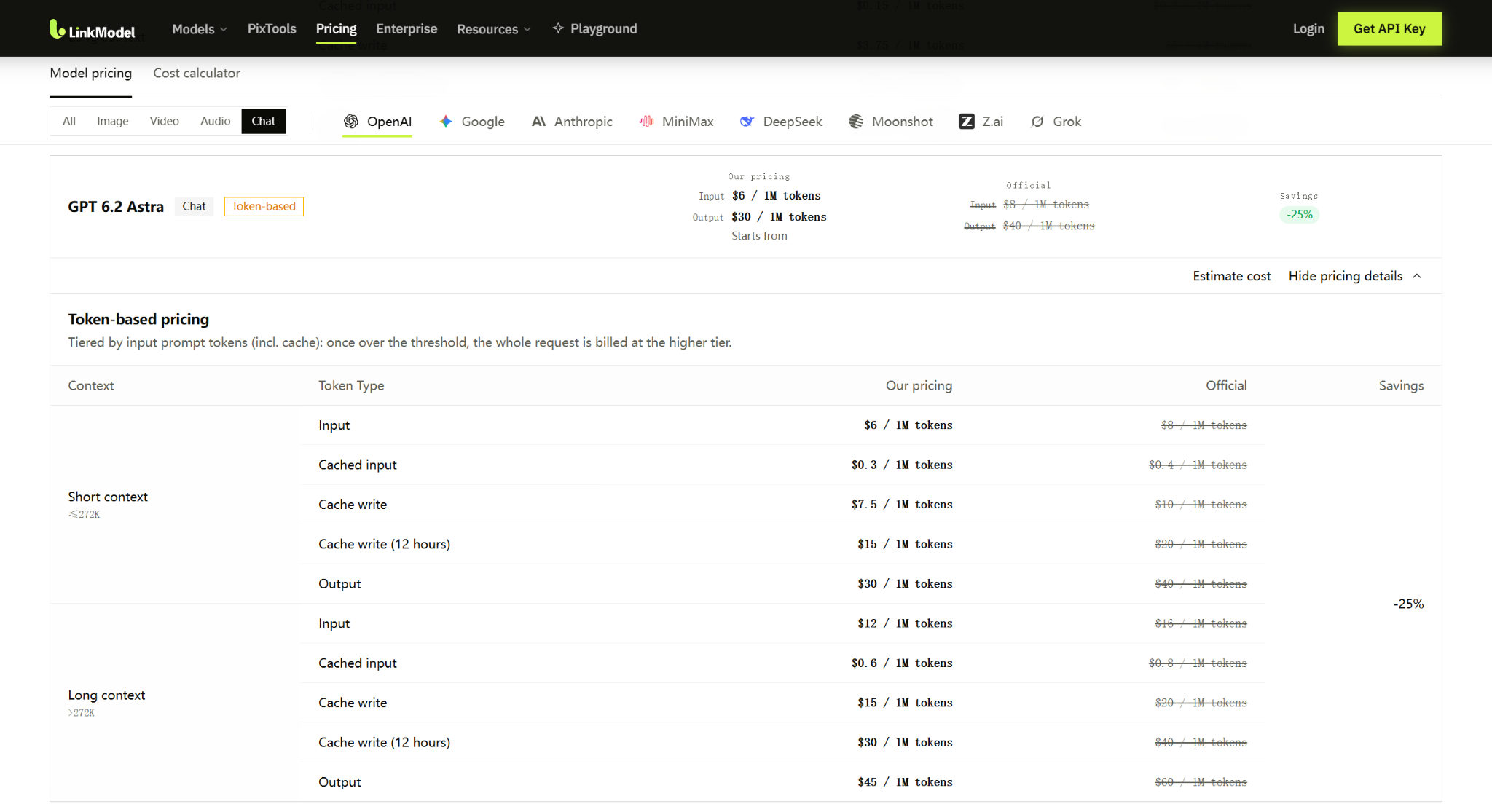
For one million ordinary input tokens, LinkModel reduces Astra's charge by $2 and Sol's by $0.50 compared with the matching official rate.
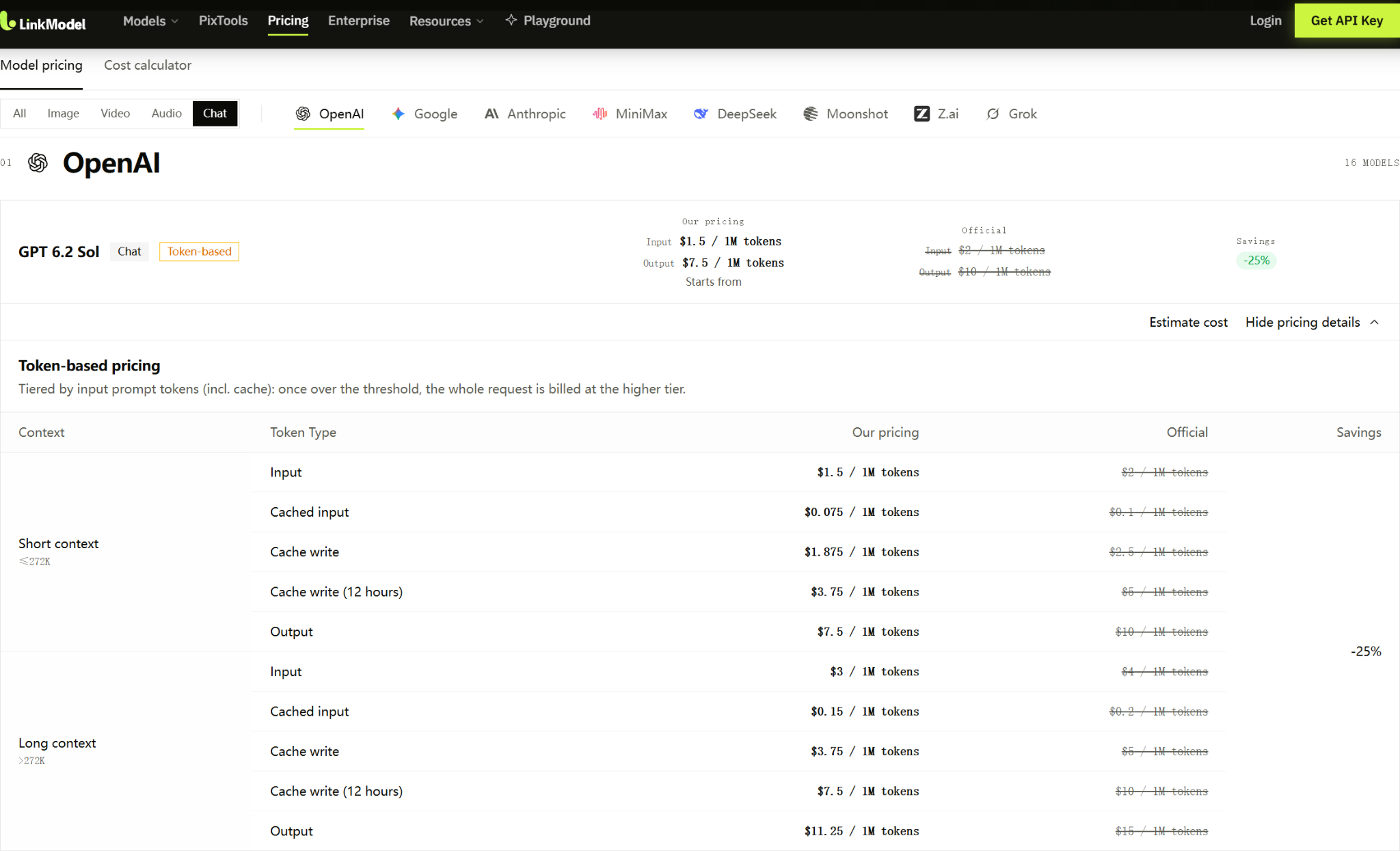
For one million output tokens, the savings are $10 for Astra and $2.50 for Sol.
These differences become more meaningful as agent applications make repeated requests or generate substantial output. A broader breakdown of the pricing model is available in our GPT-6 API pricing analysis.
The 272K context threshold and long-context pricing
LinkModel applies two pricing tiers according to total input prompt tokens, including cached input.
Requests containing up to 272K input tokens use short-context pricing. Above that threshold, the entire request moves to the higher long-context rates.
| LinkModel token rate | Astra short | Astra long | Sol short | Sol long |
|---|---|---|---|---|
| Input | $6 | $12 | $1.50 | $3 |
| Cached input | $0.30 | $0.60 | $0.075 | $0.15 |
| Cache write | $7.50 | $15 | $1.875 | $3.75 |
| Cache write, 12 hours | $15 | $30 | $3.75 | $7.50 |
| Output | $30 | $45 | $7.50 | $11.25 |
The threshold can substantially affect cost even when the input-size difference is small.
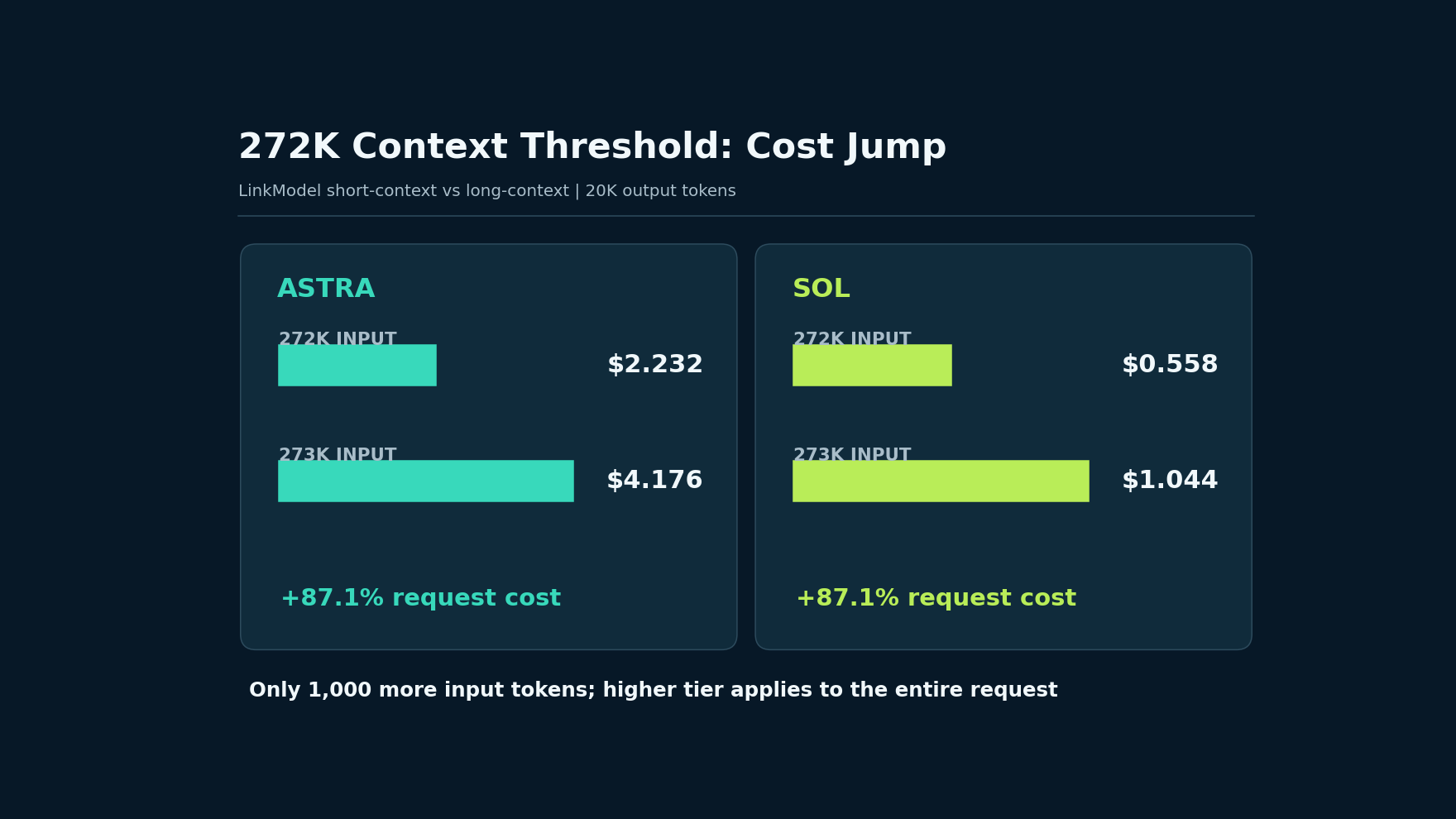
Consider two requests containing 20,000 output tokens, with ordinary uncached input sizes immediately below and above the threshold.
| Request | Astra cost | Sol cost |
|---|---|---|
| 272,000 input + 20,000 output | $2.232 | $0.558 |
| 273,000 input + 20,000 output | $4.176 | $1.044 |
The second request costs approximately 87.1% more, despite adding only 1,000 input tokens.
That increase comes from moving the full request to the higher pricing tier.
For large codebases, long-running agents, and multi-document analysis, context-window size and pricing can therefore become a direct cost-control consideration.
Removing redundant material, summarizing older context, and splitting independent tasks can help avoid unnecessary expansion beyond the threshold.
Prompt caching and repeated agent instructions
Agent systems often reuse system instructions, tool definitions, repository descriptions, and background documents.
Prompt caching can lower the cost of repeated input when eligible material is reused.
At LinkModel's short-context rates, cached input costs $0.30/M for Astra and $0.075/M for Sol.
Cache creation is charged separately, including a 12-hour cache-write category.
For frequently repeated requests, stable shared instructions and reusable context can make caching economical. For infrequently reused content, cache creation costs may reduce the benefit.
This is why prompt structure matters.
Keeping reusable instructions stable while changing only task-specific content creates better opportunities for repeated-context reuse than rebuilding the shared material for every call.
For mixed Astra–Sol workflows, caching should be evaluated separately for the applicable model and cache behavior.
Cost per successful task: When is Astra worth paying for?
A cheap coding request can become expensive when it produces a bug that requires repeated debugging or manual review.
The model with the lowest API charge is not necessarily the one with the lowest total cost per accepted result.
For independent repeated attempts with a constant success probability:
Expected API cost per successful task = Cost per attempt ÷ Success probability
Consider a short-context request using 100,000 uncached input tokens and 10,000 output tokens at LinkModel rates.
| Metric | Astra | Sol |
|---|---|---|
| Input charge | $0.60 | $0.15 |
| Output charge | $0.30 | $0.075 |
| API cost per attempt | $0.90 | $0.225 |
| Assumed success probability | 95% | 80% |
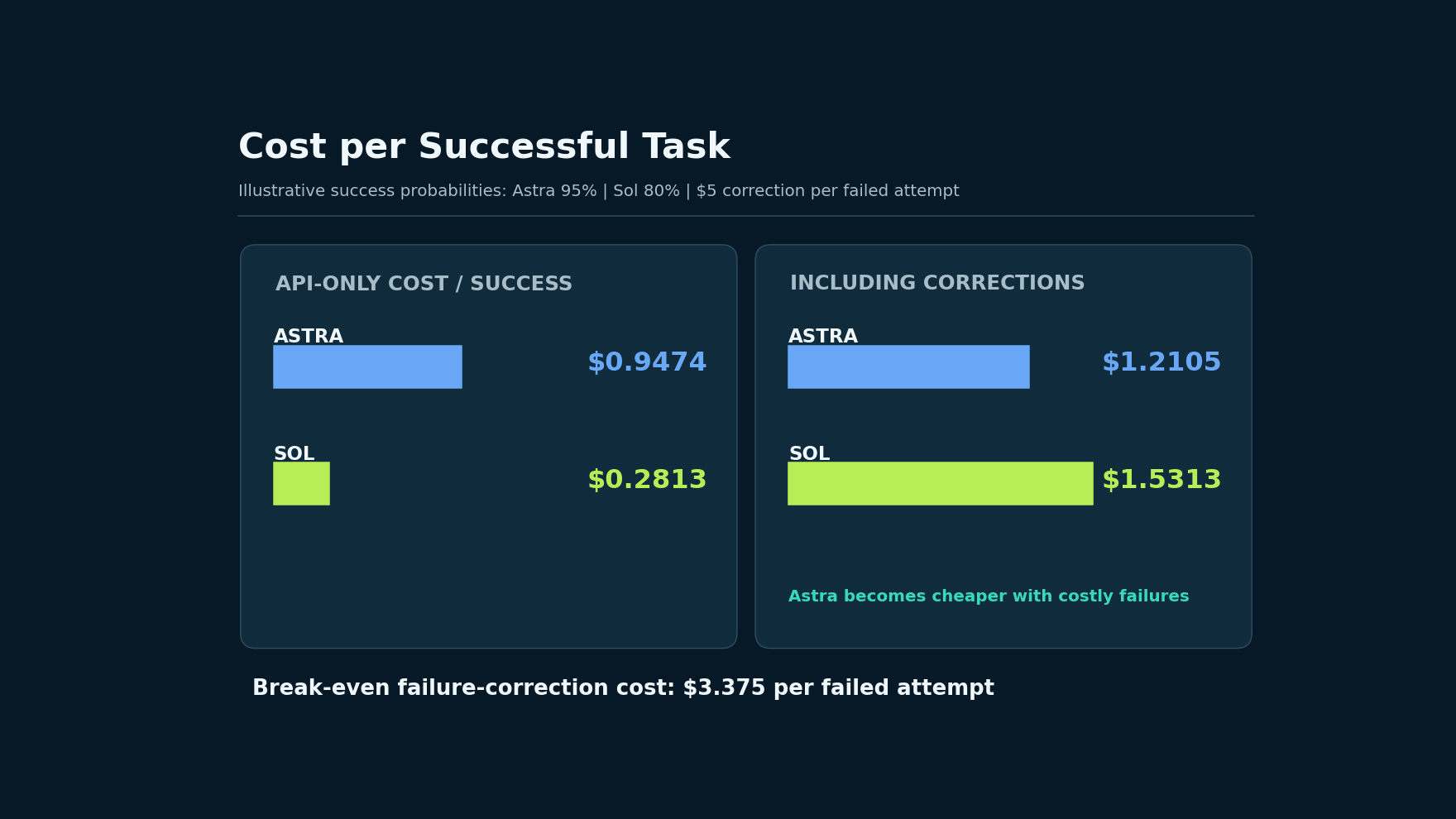
| Expected API cost per success | $0.9474 | $0.2813 |
The success probabilities are illustrative assumptions for comparing costs.
Under these conditions, Sol remains substantially cheaper on API spending alone.
Now assume each failed attempt also requires $5 of additional correction or review work.
| Metric | Astra | Sol |
|---|---|---|
| API cost per attempt | $0.90 | $0.225 |
| Assumed success probability | 95% | 80% |
| Expected correction expense per attempt | $0.25 | $1.00 |
| Expected total cost per attempt | $1.15 | $1.225 |
| Expected total cost per successful task | $1.2105 | $1.5313 |
The economic result reverses.
With a $5 correction expense per failed attempt, Astra's expected total cost per successful result becomes lower than Sol's.
The break-even correction expense is $3.375 per failed attempt under these assumptions.
Below that level, Sol has the lower expected total cost per successful task. Above it, Astra becomes more economical in this model.
This is the strongest economic argument for paying more for a capable model.
A minor formatting mistake may cost almost nothing to correct. A broken financial formula, missed architectural dependency, or difficult software defect can require significant human intervention.
Astra is worth its premium when better reasoning prevents enough expensive rework to offset the higher API charges.
Hybrid Astra–Sol agent costs: A practical allocation example
Consider ten equal-size requests, each consuming 100,000 uncached input tokens and 10,000 output tokens.
At LinkModel's short-context rates, each Astra request costs $0.90 and each Sol request costs $0.225.
| Model allocation | Astra requests | Sol requests | Total cost | Savings vs Astra-only |
|---|---|---|---|---|
| Astra only | 10 | 0 | $9.00 | — |
| Sol only | 0 | 10 | $2.25 | 75% |
| Hybrid A | 2 | 8 | $3.60 | 60% |
| Hybrid B | 3 | 7 | $4.275 | 52.5% |
| Hybrid C | 5 | 5 | $5.625 | 37.5% |
The 2-Astra/8-Sol allocation costs $3.60 instead of $9.00 for ten equally sized requests, a 60% reduction in model token spending.
This approach is most valuable when the two Astra calls cover complex planning or critical review and the eight Sol calls handle verifiable execution.
Sol-only is still the lowest-cost option under the same token assumptions. The purpose of including Astra is to improve task outcomes, not merely to create a hybrid system.
The most economical allocation therefore depends on which stages genuinely benefit from the stronger model.
GPT-6.2 Astra vs Sol: Which Model Should You Choose?
Choose Sol for routine, easily validated tasks where API cost is the priority. Choose Astra when reasoning complexity, error impact, or expensive correction work makes stronger performance valuable. Choose both when a workflow includes distinct planning and execution stages.
The decision should follow the task's acceptance criteria and the cost of failure, rather than relying on one overall model ranking.
Best model for everyday coding and routine development
Start with Sol for straightforward implementation, documentation, test generation, data transformation, and repetitive agent work.
These tasks often have clear specifications and can be checked through automated tests or simple review.
Escalate to Astra when requirements become ambiguous, repeated debugging fails, or the work involves complex dependencies that Sol has difficulty explaining or resolving.
Best model for complex coding and code review
Consider Astra for difficult architectural analysis, high-impact code changes, and unresolved defects.
Sol remains a reasonable first reviewer for routine pull requests, particularly when findings can be validated against tests and source code.
Use Astra when an issue involves unclear dependencies, architectural tradeoffs, or repeated review failures.
The objective is not to generate more review comments, but to identify important defects accurately and minimize expensive corrective work.
Best model for science, finance, and interactive 3D
Astra is the stronger starting point for demanding scientific analysis, interconnected financial work, and visually complex interactive applications.
Its measured advantages on science, CAD, automation, and AA-3D evaluations support this choice.
Sol can still handle supporting work, including ordinary extraction, drafting, formatting, and iterative changes where the difficult reasoning has already been resolved.
Best model strategy for high-volume AI agents
Use Sol for repeatable execution and Astra selectively for difficult coordination or validation.
A practical architecture has five stages: planning, decomposition, execution, validation, and escalation.
Astra can interpret complex requirements or review unresolved high-risk results. Sol workers can handle ordinary implementation and repetitive operations.
Automated tests and acceptance criteria should determine when a result is complete and when it needs further reasoning.
GPT-6.2 Astra vs Sol: Final decision matrix
| User or workload | Start with | Choose Astra when |
|---|---|---|
| Individual developer | Sol | Debugging repeatedly fails or dependencies become complex |
| Routine code reviewer | Sol | High-severity findings or architectural uncertainty require deeper analysis |
| Software architecture team | Astra | Complex planning and interconnected changes are central to the task |
| Scientific or financial research team | Astra | Professional reasoning and output consistency are critical |
| Interactive 3D developer | Astra | Visual and spatial quality are primary requirements |
| High-volume AI agent builder | Sol | Specific stages require advanced planning or critical review |
| Multi-agent development team | Astra + Sol | Planning and large-scale execution have different difficulty levels |
| Large-context application | Compare both | Long-context pricing and validation costs materially affect the budget |
The guiding principle is to pay for additional reasoning only where it changes the result.
That makes Sol the stronger cost-first starting point for routine, easily validated tasks and Astra a targeted investment for demanding work.
How to Access GPT-6.2 Astra and Sol Through an API
Both models are available through the OpenAI API, and LinkModel provides an alternative way to access and compare them at lower published standard token rates.
Developers should begin with representative tasks and evaluate the models using consistent acceptance criteria.
GPT-6.2 Astra and Sol API model IDs
The official model identifiers are:
| Model | API model ID |
|---|---|
| GPT-6.2 Astra | gpt-6.2-astra |
| GPT-6.2 Sol | gpt-6.2-sol |
OpenAI provides both through its API, including the Responses API.
The models are also available through eligible ChatGPT Work and Codex experiences, subject to the applicable subscription and workspace settings.
API charges and subscription allowances are separate usage mechanisms.
For developers new to API access, the API key setup guide covers the initial steps before making model requests.
Compare Astra and Sol using LinkModel
LinkModel lists both GPT-6.2 models and supports a unified API platform with OpenAI-compatible access for supported operations.
Its Playground provides a practical starting point for comparing their output on real tasks.
Start with the same coding or professional task on Sol and Astra in LinkModel's Playground. Compare accepted output quality, token usage, and the work required to correct each result.
For a useful first evaluation, choose a task with a clear expected outcome, such as a documented bug fix, a code-review request with known requirements, or a structured analysis task.
Use the same task requirements and acceptance criteria for both models.
If Sol consistently meets the requirements, keep it as the default. Reserve Astra for cases where deeper reasoning, better output quality, or fewer corrections change the outcome.
With 25% lower published standard token rates, $0 minimum spend, and $0 monthly platform fee, LinkModel provides an economical way to compare the two models before scaling usage.
What to measure before choosing a model
A meaningful comparison should evaluate the entire workflow rather than only the first response.
| Metric | What it reveals |
|---|---|
| Accepted task completion | Whether the result meets requirements |
| Valid bugs found | Code-review effectiveness |
| Missed critical issues | Remaining quality risk |
| Input and output tokens | Direct API consumption |
| Context tier | Applicable token pricing |
| Cache usage | Repeated-context efficiency |
| Completion time | Workflow productivity |
| Revision count | Additional correction effort |
| Human review effort | Operational cost |
| Cost per accepted result | Overall economic value |
For routine tasks, low model spending and consistent acceptance may favor Sol.
For difficult tasks, a reduction in errors or correction effort may justify using Astra.
A team can also combine both models when difficult planning and repeatable execution require different capabilities.
The next step is to test a representative workload, compare the accepted results, and select the lowest-cost approach that meets the quality standard.
Frequently Asked Questions
Is GPT-6.2 Astra worth 4x the price of Sol?
Astra is worth the extra cost when its stronger reasoning prevents expensive failures or improves demanding professional deliverables. Sol is generally the more economical starting point for routine tasks with clear validation. On FrontierCode 2.0 at Max effort, Astra scores 44.2% at $5.97 per evaluated task, while Sol scores 43.8% at $1.29.
Is GPT-6.2 Sol better than Astra for coding?
Sol offers stronger cost efficiency for many ordinary coding workloads, while Astra provides stronger overall reasoning. In one algorithm comparison, Sol 6.2 High produced the fastest-running program at 32 ms, while Astra High generated a shorter implementation using less memory. The appropriate model depends on the task and evaluation criteria.
Which model is better for code review, Astra or Sol?
Sol is a practical first reviewer for routine changes, while Astra is a stronger escalation candidate for complex architectural or high-risk issues. In four historical review comparisons, Sol 6.2 identified additional valid findings but took longer than Sol 6.1. Astra 6.2 achieved comparable quality to Astra 6 with fewer tokens in the examined tasks.
Should I choose Astra Max or Sol High for difficult tasks?
Neither configuration is universally superior. Higher reasoning effort may improve difficult tasks, but it can also increase computation and waiting time. In one algorithm comparison, Sol High produced faster-running code than Sol XHigh, while Astra Low exceeded the program time limit that Astra Medium and High satisfied.
Can Astra and Sol work together to reduce API costs?
Yes. Astra can handle complex planning and review while Sol executes routine tasks. A documented three-worker development configuration reported approximately 2× optimization throughput and 25% lower allowance consumption after upgrading its model combination. Under LinkModel's short-context prices, a calculated mix of two Astra and eight Sol requests costs $3.60 compared with $9.00 for ten equally sized Astra requests, reducing token spending by 60%.
Conclusion
GPT-6.2 Sol is the stronger cost-first choice for everyday coding and frequent AI agent tasks, while GPT-6.2 Astra offers greater value when complex reasoning, professional output quality, or costly errors justify the premium. The fourfold standard token-price difference is important, but the right decision also depends on benchmark conditions, reasoning effort, context size, successful completion, and correction costs. Our research supports using Sol for routine, easily validated work, escalating demanding tasks to Astra, and combining both when planning and execution have different requirements. With 25% lower published standard API token rates for both models, LinkModel makes it more economical to compare their performance and choose the workflow that delivers the best accepted result for the budget.