GPT Image 2.5 is currently the stronger starting point for exact text, small labels, dense typography, and UI copy. Seedream 5.0 Pro stands out for dense infographic layouts, multilingual composition, and region-based editing. However, the evidence is task-specific: there is not yet a large controlled benchmark proving one model is universally more accurate at text rendering.
A polished AI-generated image can still fail in production if words, numbers, units, labels, or chart relationships are wrong. GPT Image 2.5 currently has stronger evidence for text-heavy workflows, while Seedream 5.0 Pro remains highly competitive when information structure, multilingual composition, and dense visual layouts matter more. That makes text accuracy, data accuracy, and layout quality separate factors that should be tested independently.
GPT Image 2.5 and Seedream 5.0 Pro are both available on LinkModel, with GPT Image 2.5 priced at 75% of OpenAI’s corresponding API token rates. Through one OpenAI-compatible API, one API key, and unified billing, developers can access both models and switch based on text quality, speed, cost, or availability without rebuilding their integration.

GPT Image 2.5 vs Seedream 5.0 for Text Rendering: Quick Answer
The most useful way to compare GPT Image 2.5 and Seedream 5.0 Pro is not to assign one vague “text quality” score. Exact copy, long paragraphs, small labels, information structure, multilingual text, and editing stability are different problems.
| Task | GPT Image 2.5 | Seedream 5.0 Pro |
| Exact English copy | Strong current evidence | Competitive evidence |
| Long paragraphs | Limited direct 2.5 evidence | Small-text risk increases |
| Small / fine text | More favorable evidence | Recurring drift or softness |
| Dense typography | Sunburst is promising | Strong layouts, less certain fine text |
| Dense infographics | Strong | Strong information-structure evidence |
| UI text | Documented production cases | Limited comparative evidence |
| Multilingual layouts | Limited head-to-head data | Strong documented evidence |
| Local correction | Conversational precision editing | Region-oriented editing |
For text-heavy posters, exact labels, UI copy, and dense typography, GPT Image 2.5 is the more logical model to test first. For complex information graphics, multilingual designs, and layouts where information organization matters as much as character accuracy, Seedream 5.0 Pro deserves equal consideration.
There is still no credible large-scale character-level benchmark proving that either model has a universal percentage accuracy advantage.
Evidence Behind This Comparison
| Evidence | Model | Test Type | Direct Head-to-Head? | Main Finding | Limitation |
| Same-prompt infographic | GPT Image 2.5 Flare vs Seedream 5.0 Pro | Dense text + chart | Yes | Both rendered the requested strings; Flare’s bar lengths visually tracked its displayed values, while Seedream’s bars appeared more similar than its displayed values implied. | One generation per model |
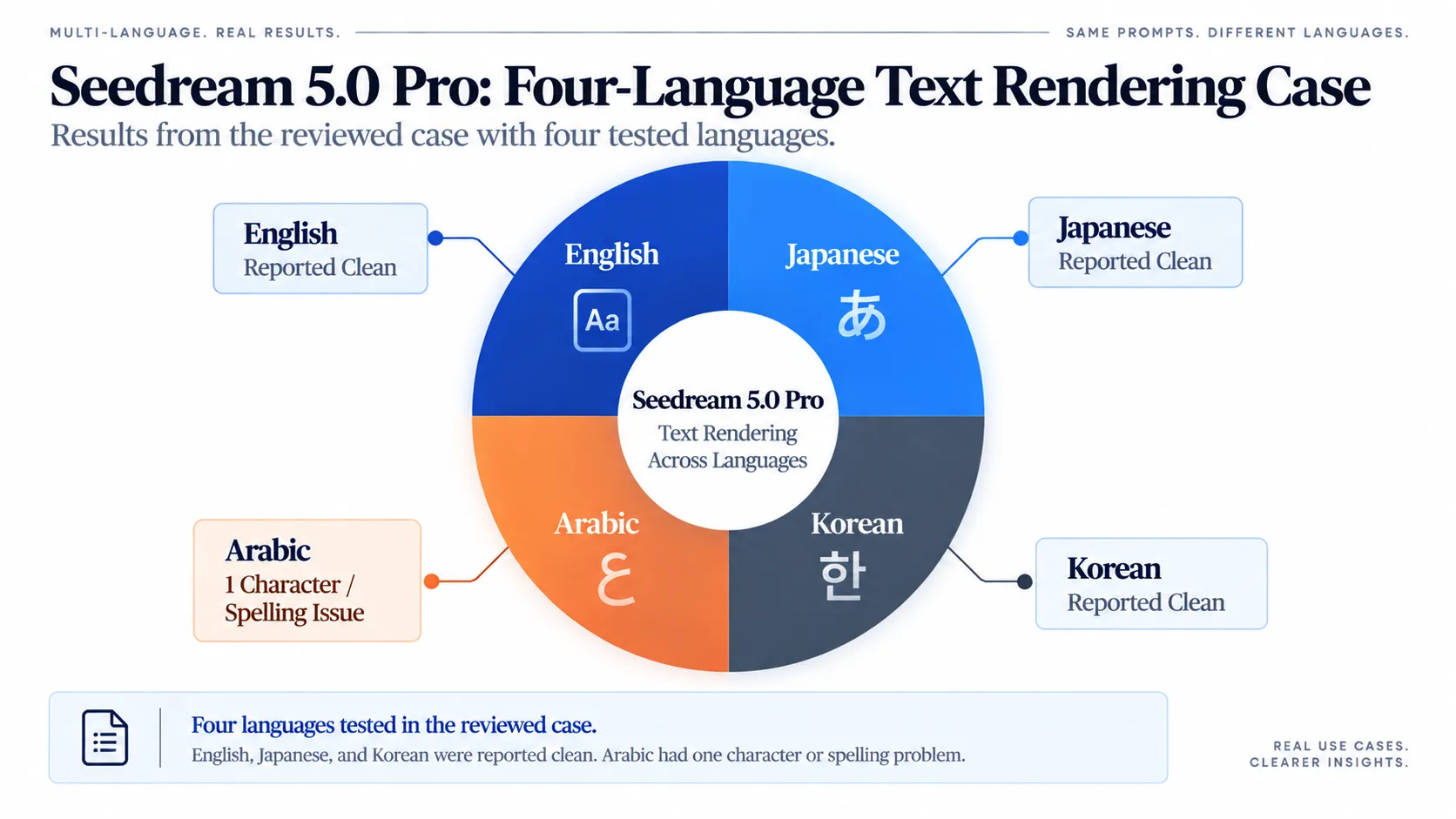
| Multilingual case | Seedream 5.0 Pro | EN / JA / KO / AR | No | In one four-language case, English, Japanese, and Korean were reported as clean; Arabic had one character or spelling issue. | No equivalent 2.5 test |
| Long-copy poster | GPT Image 2 vs Seedream | Paragraph text | Yes | GPT Image 2 preserved paragraph more successfully | Not GPT Image 2.5 |
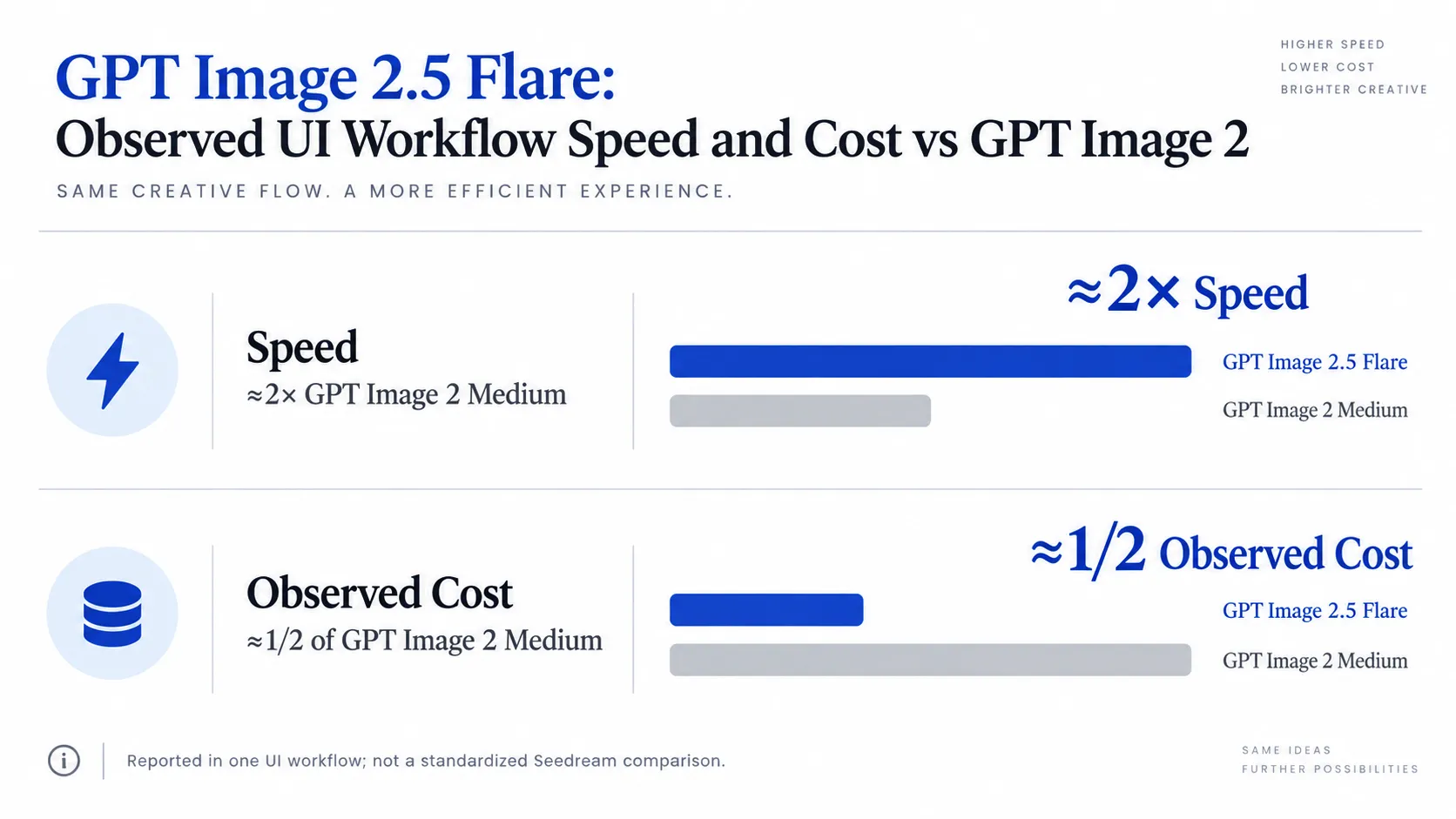
| UI workflow | GPT Image 2.5 vs GPT Image 2 | Production UI | No Seedream comparison | Flare Medium ≈2× speed, ≈half observed cost | Different comparison target |
GPT Image 2.5 and Seedream 5.0 Pro: What Are They?
GPT Image 2.5 is OpenAI’s image-generation and editing model family, with Flare and Sunburst designed for different production needs. Flare prioritizes lower latency and higher-throughput generation, while Sunburst is positioned for workflows that require greater precision, fine detail, and stronger preservation during editing. For text rendering, GPT Image 2.5 is especially relevant for exact labels, small text, UI copy, dense typography, and controlled revisions, although direct long-paragraph comparisons against Seedream 5.0 Pro remain limited.
Seedream 5.0 Pro is ByteDance Seed’s image-generation and editing model focused on complex visual composition, multilingual content, and controllable image editing. Its strength in text-heavy workflows is not limited to character rendering; it can organize text, numbers, diagrams, illustrations, and multiple information regions within a coherent layout. This makes Seedream 5.0 Pro particularly relevant for dense infographics, multilingual campaign assets, and region-based corrections, while small and fine text still requires careful verification.
How We Evaluate GPT Image 2.5 vs Seedream 5.0 Text Rendering
Our research found that many apparently contradictory model comparisons are actually measuring different things. One test evaluates whether a headline is spelled correctly. Another evaluates whether 15 information blocks fit into a coherent infographic. A third evaluates whether one wrong label can be corrected without damaging the rest of the image.
These are not interchangeable benchmarks.
Exact Copy, Long Text and Small Text Need Separate Tests
A five-word headline is relatively easy. A poster containing a headline, paragraph, product specifications, price, units, captions, and disclaimer is much harder.
The failure pattern often appears gradually. A model may generate the headline correctly, preserve most of a paragraph, and then begin making mistakes in smaller labels or secondary text.
For that reason, headline accuracy should never be treated as proof of long-form text accuracy.
A production-ready comparison should check whether the model preserves spelling, punctuation, numbers, units, line breaks, and text position as the amount of copy increases.
Layout Accuracy Is Not Character Accuracy
A second distinction is equally important.
A model can create an excellent information hierarchy while still making a small spelling error. It can position icons, diagrams, titles, numbers, and captions correctly but misrender one label.
The opposite can also happen: all requested text can be correct while the visual relationships between the data are wrong.
That is why this comparison treats character accuracy, information architecture, and data accuracy as separate metrics.
Why We Do Not Publish an Accuracy Percentage
We found no standardized GPT Image 2.5 vs Seedream 5.0 Pro benchmark with identical prompts, disclosed sample sizes, total character counts, output dimensions, repeated generations, and published error counts.
Therefore, claims such as “GPT Image 2.5 is 97% accurate” would create a level of certainty that the available evidence does not support.
For production teams, the more useful question is:
What failed, under what workload, and how expensive is that failure in a real production workflow?
GPT Image 2.5 Text Rendering: Exact Copy, Dense Typography and UI
GPT Image 2.5 includes Flare and Sunburst, two variants that are useful for different production priorities. Flare is positioned around faster generation and routine workloads, while Sunburst is designed for work where higher precision and fine detail matter more.
OpenAI reports that Flare can deliver up to 50% lower latency than Images 2.0, while Images 2.5 also improves preservation when modifying specific parts of an existing image.
For text-heavy design, that combination of first-pass quality and controlled revision is particularly important.
GPT Image 2.5 for Dense Typography and Fine Text
Across the cases in our research, GPT Image 2.5 shows positive signals for fine detail, labels, UI typography, slide content, and layouts containing multiple text elements.
Sunburst is the more logical variant to test first when fine typography is central to the asset. Flare makes more sense when the workload contains many routine generations and throughput matters more.
This does not mean Sunburst should automatically be used for every text task. A social graphic containing one headline and three labels does not require the same level of precision as a product comparison chart containing dozens of text elements.
The best production strategy is to use the lowest-cost model and quality level that reliably meets the text requirement, then escalate when the failure cost becomes higher.
GPT Image 2.5 UI Generation Has Production Evidence
One UI workflow in our research compared GPT Image 2 and GPT Image 2.5 across difficult interface-generation tasks involving multiple components, labels, controls, and reference constraints.
GPT Image 2.5 eventually moved into the draft-generation workflow. In that case, Flare at Medium quality was reported at approximately 2× the speed and around half the observed cost of GPT Image 2 Medium.
This is not a controlled Seedream benchmark and should not be treated as one. Its value is that it demonstrates GPT Image 2.5 working inside a real text-heavy production workflow rather than only producing decorative images.
UI generation is a demanding text test because one image may contain navigation, headings, buttons, form fields, cards, labels, and repeated components. Readability has to survive across several text sizes at once.
GPT Image 2.5 Can Support Complete Slide Workflows
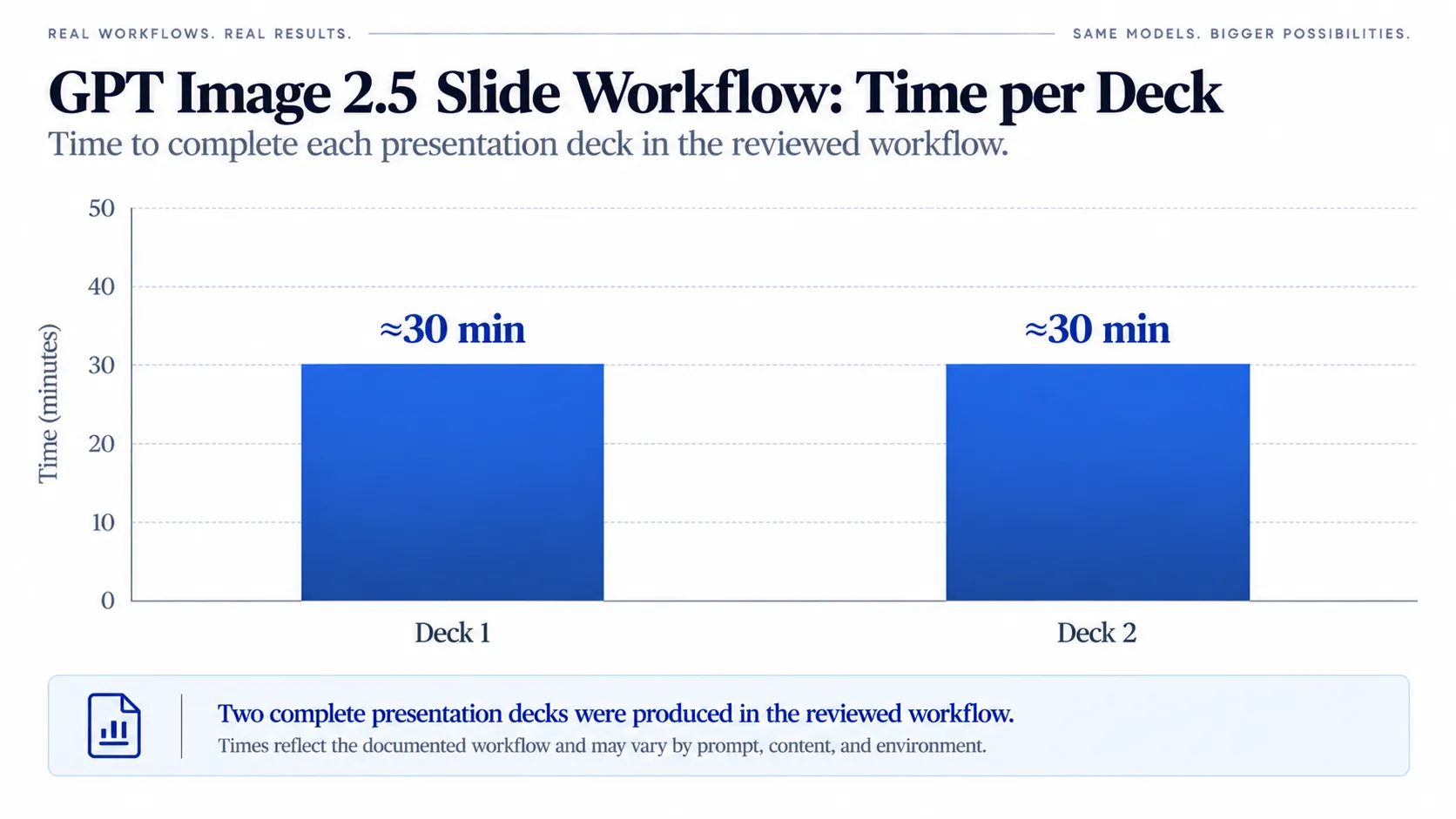
Another production case in our research used GPT Image 2.5 to generate two complete presentation decks in approximately 30 minutes per deck.
The images were generated as slide visuals and then refined against the presentation script.
The case does not prove that GPT Image 2.5 can reproduce arbitrarily long paragraphs inside slides. The copy was relatively concise. What it does demonstrate is that image generation, layout, typography, and text revision can now operate as one workflow, rather than requiring every design decision to begin in a traditional slide editor.
GPT Image 2.5 Long Text: What Earlier GPT Image Evidence Shows
Some of the strongest direct long-copy evidence in our research comes from GPT Image 2 rather than GPT Image 2.5.
That distinction is important. GPT Image 2 results should support the broader family-level evidence, not be relabeled as GPT Image 2.5 benchmarks.
The Poster-Length Copy Case
In one text-heavy comparison we reviewed, the design moved beyond a simple headline into poster-length paragraph copy.
GPT Image 2 maintained the full paragraph more successfully, while Seedream preserved much of the overall layout but showed softness in smaller text.
This is valuable because it identifies the point at which many image models begin to fail.
A model may handle a short headline correctly. It may even preserve the first sentence of a paragraph. Problems often become more visible after adding secondary copy, small labels, numbers, units, and fine print.
For real production testing, the difficulty should therefore increase gradually rather than relying on a single attractive headline result.
Why Earlier GPT Image Evidence Still Matters
GPT Image 2.5 improves editing consistency, detail preservation, generation speed, and complex layout handling compared with the previous generation.
That makes earlier long-copy evidence relevant to understanding the direction of the GPT Image family, but it still does not justify assuming that every GPT Image 2.5 configuration will behave identically.
Model version, quality setting, prompt structure, and text density should always be recorded when comparing results.
Seedream 5.0 Pro Text Rendering: Dense Infographics and Small Text
Seedream 5.0 Pro is especially interesting because its strongest text-related capability is not simply spelling.
Its major advantage is complex information visualization: arranging large amounts of text, numbers, illustrations, diagrams, and hierarchy inside one coherent composition.
That distinction explains why Seedream can perform extremely well on an infographic while still showing occasional weakness in small typography.
Seedream 5.0 Pro Is Strong at Dense Information Structure
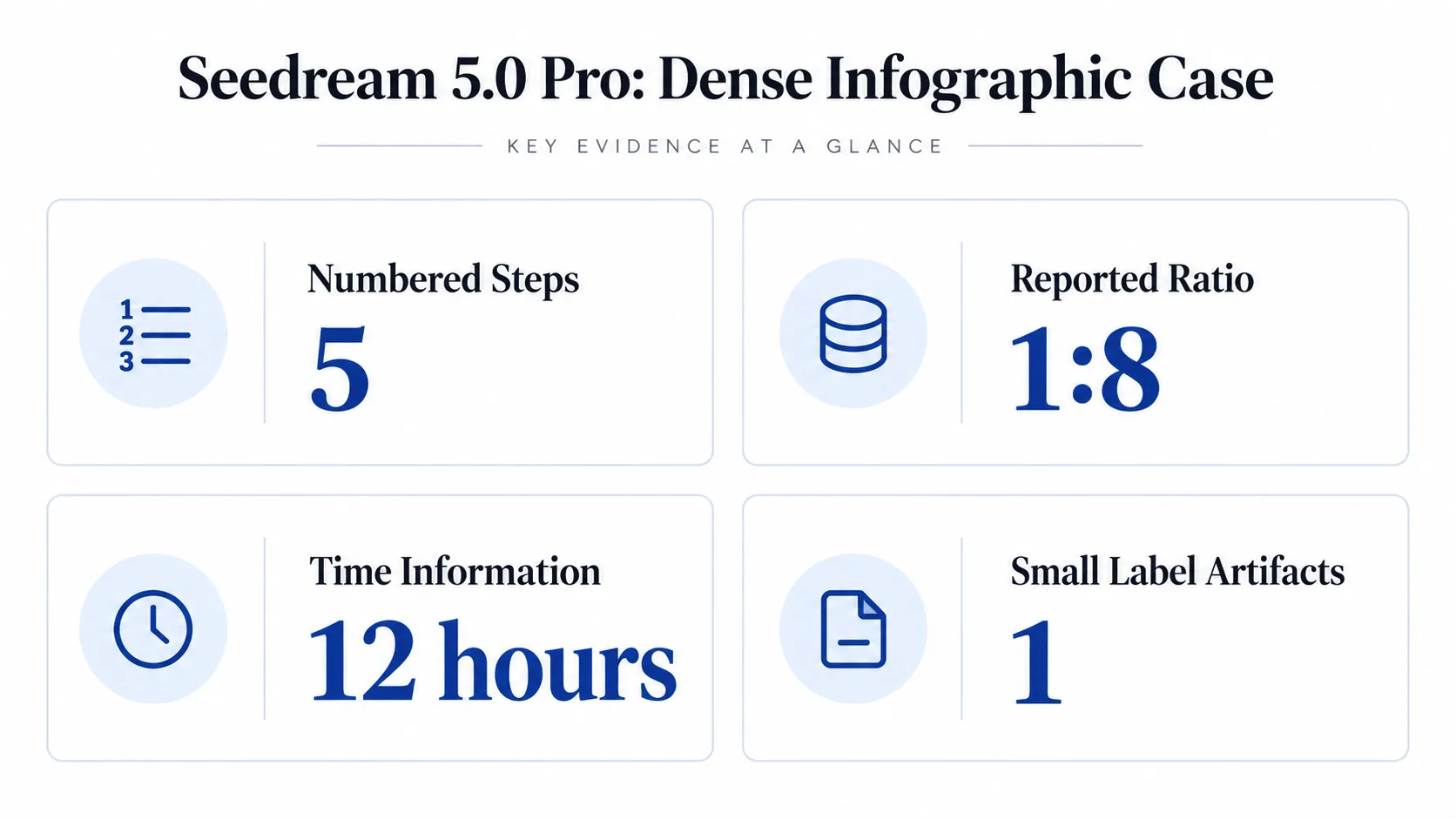
One of the most useful Seedream cases in our research contained 5 numbered steps, a 1:8 ratio, 12-hour information, and multiple captions.
Most of the information remained readable, and the overall visual structure stayed coherent. The result still contained one small label artifact.
That combination is important.
The asset succeeded at information architecture: multiple regions, titles, visual relationships, numbers, and supporting copy remained organized.
But the remaining label issue demonstrates why a strong infographic should not automatically be described as character-perfect.
Seedream's strength is therefore better described as high-density information organization with competitive text rendering, rather than an unsupported claim that it always produces the most accurate text.
Seedream 5.0 Pro Small Text Remains a Risk
The most consistent Seedream weakness across the material we reviewed is small or fine typography.
Large headlines and short callouts can perform well. Smaller labels, captions, and fine print are more likely to soften or drift.
This matters disproportionately in production because the smallest text often contains the information that cannot afford to be wrong: prices, units, specifications, disclaimers, table fields, chart labels, or secondary UI copy.
ByteDance has also acknowledged that finer-grained text rendering and pixel-level editing consistency remain areas for further improvement.
The practical result is straightforward: a visually impressive Seedream output still needs a dedicated small-text proofread pass.
Text Accuracy vs Data Accuracy in AI Infographics
Correct spelling does not guarantee a correct infographic.
This is one of the most important findings in the current comparison landscape because it moves the evaluation beyond typography into information integrity.
A Same-Prompt Infographic Example
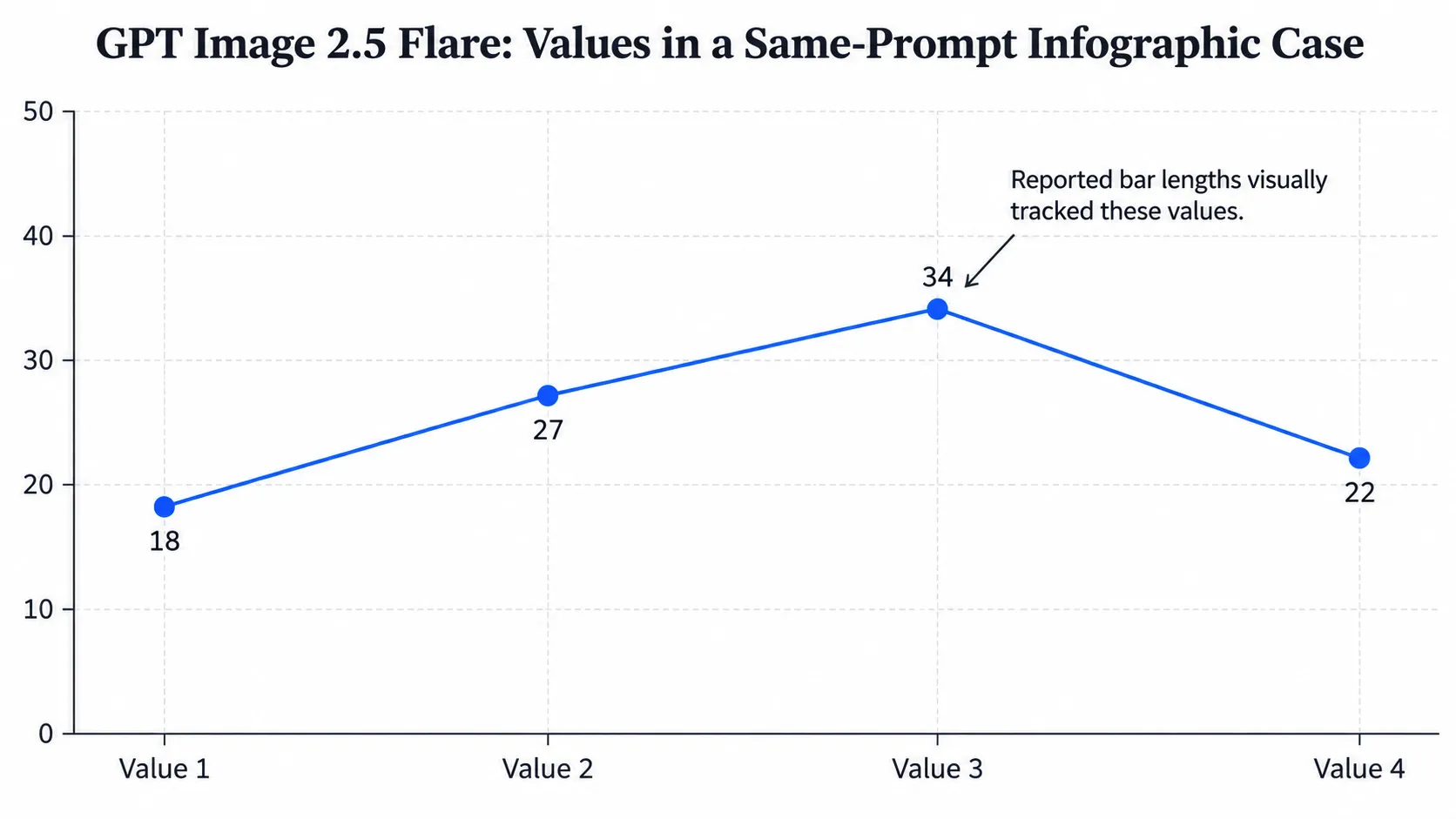
In one same-prompt comparison we reviewed, GPT Image 2.5 Flare and Seedream 5.0 Pro were asked to generate a dense infographic containing a headline, subhead, labeled sections, a bar chart, numeric values, and a footer.
Both models successfully rendered the specified strings.
However, the results differed when the chart itself was examined.
Flare displayed the values 18, 27, 34, and 22, and the bar lengths visually tracked those values.
Seedream displayed plausible values of 6.2, 7.1, 8.4, and 9.3 kg, but the bars appeared much more similar in length than the numbers implied.
In other words, the text looked correct, but the visual encoding of the data was not equally reliable.
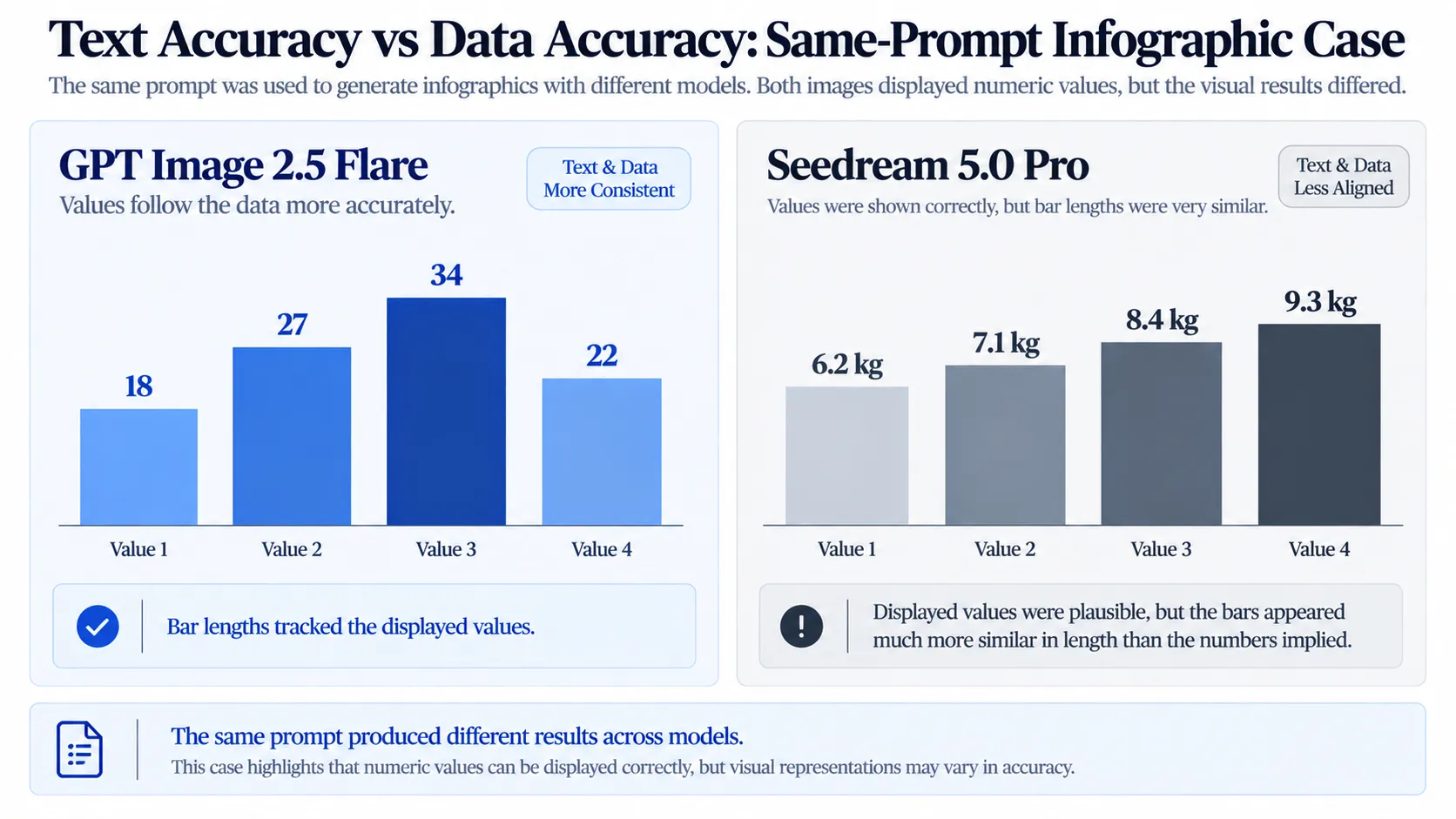
The comparison used one prompt and one generation per model, so it is not a statistical benchmark. It should not be used to claim that GPT Image 2.5 always produces more accurate charts.
What this case illustrates is that text-heavy graphics need two separate QA passes:
Are the words and numbers correct?
Does the visual actually represent those numbers correctly?
For charts, timelines, prices, ratios, specifications, and scientific graphics, this distinction can be more important than typography quality itself.
Seedream 5.0 Pro Multilingual Text Rendering
Multilingual visual generation is one area where Seedream 5.0 Pro has particularly strong evidence.
Its design emphasizes multilingual text and layouts that adapt across different writing systems rather than treating every language as if it follows the same typography rules.
A Four-Language Production Case
One multilingual case in our research included English, Japanese, Korean, and Arabic.
English, Japanese, and Korean were reported as clean. The Arabic version contained one character or spelling problem.
This is useful because it shows both capability and limitation.
Seedream is clearly capable of building multilingual visual assets, but language support does not mean every generated character is guaranteed to be correct.
Seedream 5.0 Pro currently has stronger documented evidence for multilingual layouts, but there is not yet an equivalent controlled GPT Image 2.5 comparison across the same languages.
The more defensible conclusion is that multilingual layout is a particularly mature Seedream use case and should be tested directly when localization is central to the project.
GPT Image 2.5 vs Seedream 5.0 for Editing Text
The first generation is only half of the production problem.
The next image-editing question is often more important:
Can you fix one wrong word without damaging everything else?
GPT Image 2.5 Uses Precision-Oriented Conversational Editing
GPT Image 2.5 is designed to modify a requested element while preserving the surrounding composition more consistently.
For text correction, the strongest workflow is to separate the requested change from the preservation constraints.
Instead of simply asking to fix a price, specify that only the price should change while typography, layout, crop, colors, product details, and all other copy remain unchanged.
This gives the model a smaller editing target and makes the result easier to validate.
Repeated GPT Image 2.5 Edits Can Still Degrade
Precision editing does not eliminate accumulated drift.
In one multi-turn case from our research, repeated revisions eventually introduced crop drift, image softening, and linework degradation.
That creates a useful stopping rule: when an image has already passed through many generative edits, a clean regeneration or deterministic design-tool correction may be safer than another AI revision.
Seedream Favors Region-Based Correction
Seedream approaches the same problem through a more spatial workflow.
Region-oriented editing and separable visual elements can reduce the need to reinterpret an entire composition when only one local area is wrong.
That can be particularly useful for an infographic where one label, number, or graphic element needs correction but the overall layout is already successful.
The real difference is therefore not simply which model “edits better.”
It is conversational precision editing versus spatially targeted editing.
GPT Image 2.5 vs Seedream 5.0 by Production Use Case
- For text-heavy posters, GPT Image 2.5 is the more logical model to test first when exact labels, small text, dense typography, and UI-like copy are central to the asset. For long paragraph copy, direct GPT Image 2.5 vs Seedream 5.0 evidence remains limited.
- For dense infographics, Seedream 5.0 Pro becomes especially attractive when the harder problem is fitting multiple information regions into one coherent composition. Every label and chart relationship should still be verified separately.
- For UI mockups, GPT Image 2.5 currently has stronger production evidence in the workflows we reviewed, particularly for interfaces containing many labels and repeated components.
- For presentation graphics, GPT Image 2.5 has already appeared in full-deck workflows, including the two approximately 30-minute deck cases discussed above.
- For multilingual campaign assets, Seedream 5.0 Pro has stronger documented evidence today, especially when layouts need to adapt across different writing systems.
- For repeated local corrections, the better choice depends on workflow: GPT Image 2.5 emphasizes conversational preservation instructions, while Seedream offers a more region-oriented editing approach.
How to Get Better Text From GPT Image 2.5 and Seedream 5.0
Our review of GPT Image 2.5 and Seedream 5.0 Pro user questions shows that many apparent model failures begin with weak test design.
The most reliable text prompts behave more like a design specification than a mood description.
Provide the exact copy rather than asking the model to invent important text. Clearly distinguish the headline, paragraph, labels, numbers, and fine print. Define where critical text belongs. During image editing, specify both what must change and what must remain unchanged.
Then increase difficulty gradually: start with the headline, add paragraph copy, introduce small labels, then add numbers, units, mixed text sizes, and finally a dense information structure.
This reveals where the model's actual failure threshold begins.
Most importantly, proofread the final asset manually. As AI-generated typography becomes more convincing, small errors become easier to overlook—not less dangerous.
Frequently Asked Questions
Is GPT Image 2.5 better than Seedream 5.0 for text?
Current evidence favors GPT Image 2.5 for exact copy, long text, small labels, dense typography, and UI text. Seedream 5.0 Pro becomes especially competitive for dense information structure, multilingual layouts, and localized editing. There is no credible universal percentage winner.
Does Seedream 5.0 still struggle with small text?
Small and fine text remains one of the clearest Seedream risk areas. Headlines and short callouts can perform well, while smaller labels may drift or soften. Fine typography should still be checked before production use.
Which is better for infographics?
Seedream 5.0 Pro is particularly strong at organizing dense information, while GPT Image 2.5 is attractive when exact copy and faithful data representation are the higher priorities. A strong infographic still requires separate checks for text accuracy and data accuracy.
Which is better for UI text?
GPT Image 2.5 currently has stronger documented production evidence for UI text in the workflows we reviewed, although we do not yet have a controlled GPT Image 2.5 vs Seedream 5.0 UI benchmark. One Flare Medium case reported approximately 2× the speed and around half the observed cost of GPT Image 2 Medium while moving into routine UI draft generation
Can GPT Image 2.5 or Seedream replace Figma for final text?
Not for accuracy-critical final assets. Both can accelerate layouts, posters, slides, UI concepts, and infographics, but deterministic design software remains safer for final legal copy, precise data, specifications, and typography that must be exact.
Conclusion
Current evidence makes GPT Image 2.5 the stronger starting point when exact copy, small labels, dense typography, UI text, and text-heavy creative work are the main challenge. For long paragraphs, the evidence is promising, but direct GPT Image 2.5 vs Seedream 5.0 testing remains limited. Seedream 5.0 Pro becomes more compelling when the challenge shifts toward complex information structure, multilingual layouts, and localized editing.
The most important finding from our research is that text rendering cannot be reduced to one score: character accuracy, small-text clarity, information architecture, data accuracy, multilingual rendering, and editing stability are separate production problems.
Until a controlled GPT Image 2.5 vs Seedream 5.0 Pro benchmark publishes identical prompts, meaningful sample sizes, output conditions, and character-level error statistics, a task-based comparison remains more defensible than unsupported percentage rankings.