Kimi K3.1 Pro is a cost-efficient choice for structured coding and agent tasks, while Claude Opus 5.5 is a strong contender for complex engineering, difficult reasoning, and specification-heavy development. At official API rates, Kimi costs 50% less per input and output token. But lower token prices do not always translate into lower costs per completed task, especially when reasoning overhead, execution time, and retries are involved.
The trade-off becomes more complicated in real development workflows. Kimi can perform competitively in coding benchmarks, yet some developer tests show longer completion times or additional reasoning costs. Opus may deliver stronger results on demanding tasks, but its higher API rates can make extensive experimentation expensive. Developers need to compare code quality, execution speed, and total task costs—not benchmark rankings alone.
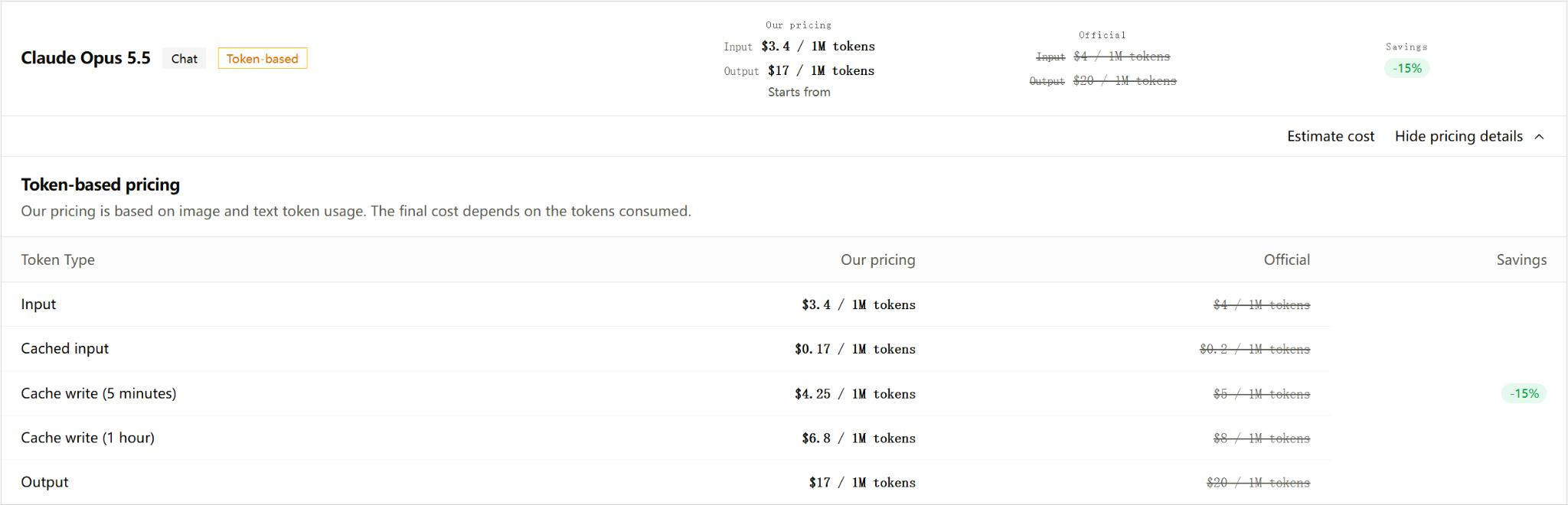
LinkModel makes both options more affordable, offering Kimi K3.1 Pro at 5% below official API prices and Claude Opus 5.5 at 15% below official rates, with pay-as-you-go billing and no monthly platform fee. New users automatically receive $1 in non-expiring API credits, with no credit card or initial deposit required. Additionally, through November 8, 2026, at 11:59 PM PST, new and existing users receive 50% extra credits on eligible top-ups, with multiple top-ups allowed, cumulative bonus credits capped at $100, and bonus delivery within 24 hours. This makes LinkModel a practical place to test both models before committing to a larger development budget.

Kimi K3.1 Pro vs Claude Opus 5.5: Quick Comparison
Both Kimi K3.1 Pro and Claude Opus 5.5 target demanding coding, reasoning, and agent workflows. Their main differences lie in pricing, reasoning efficiency, task reliability, and execution behavior.
| Feature | Kimi K3.1 Pro | Claude Opus 5.5 |
|---|---|---|
| Developer | Moonshot AI | Anthropic |
| Official input price / 1M tokens | $2.00 | $4.00 |
| Official output price / 1M tokens | $10.00 | $20.00 |
| LinkModel input price / 1M tokens | $1.90 | $3.40 |
| LinkModel output price / 1M tokens | $9.50 | $17.00 |
| LinkModel savings vs official | 5% | 15% |
| Context window | 1M tokens | 1M tokens |
| Default reasoning effort | Max | Medium |
| Coding strengths | Structured tasks, long-horizon agents | Complex engineering, precise requirements |
| Main trade-off | Reasoning overhead and variable execution time | Higher token prices |
The headline comparison is straightforward: Kimi has lower API prices, including through LinkModel. However, Opus becomes more financially competitive on LinkModel because its 15% discount is larger than Kimi's 5% discount.
Where Kimi K3.1 Pro stands out
Kimi K3.1 Pro is particularly attractive for structured programming tasks, prototype development, long-context processing, and agent workloads with clearly defined success criteria.
Moonshot's published evaluations show competitive performance in terminal coding and long-horizon software development.
The model also provides reasoning-effort controls, allowing developers to adjust how much computation is devoted to difficult tasks.
Lower effort can reduce token consumption and task costs when it preserves the required output quality.
However, default maximum reasoning effort can produce longer responses and increase spending.
Where Claude Opus 5.5 stands out
Claude Opus 5.5 is a strong option for complex software engineering, difficult debugging, architectural planning, and tasks with ambiguous or strict requirements.
It performs particularly well in several evaluations that test detailed reasoning and exact behavioral reproduction.
For developers working on production systems, its value may lie in reducing unsuccessful attempts and unnecessary intervention.
The key question is whether those benefits outweigh its higher token rates.
With LinkModel's 15% reduction in official API pricing, that difference becomes smaller.
Coding Performance and Benchmarks
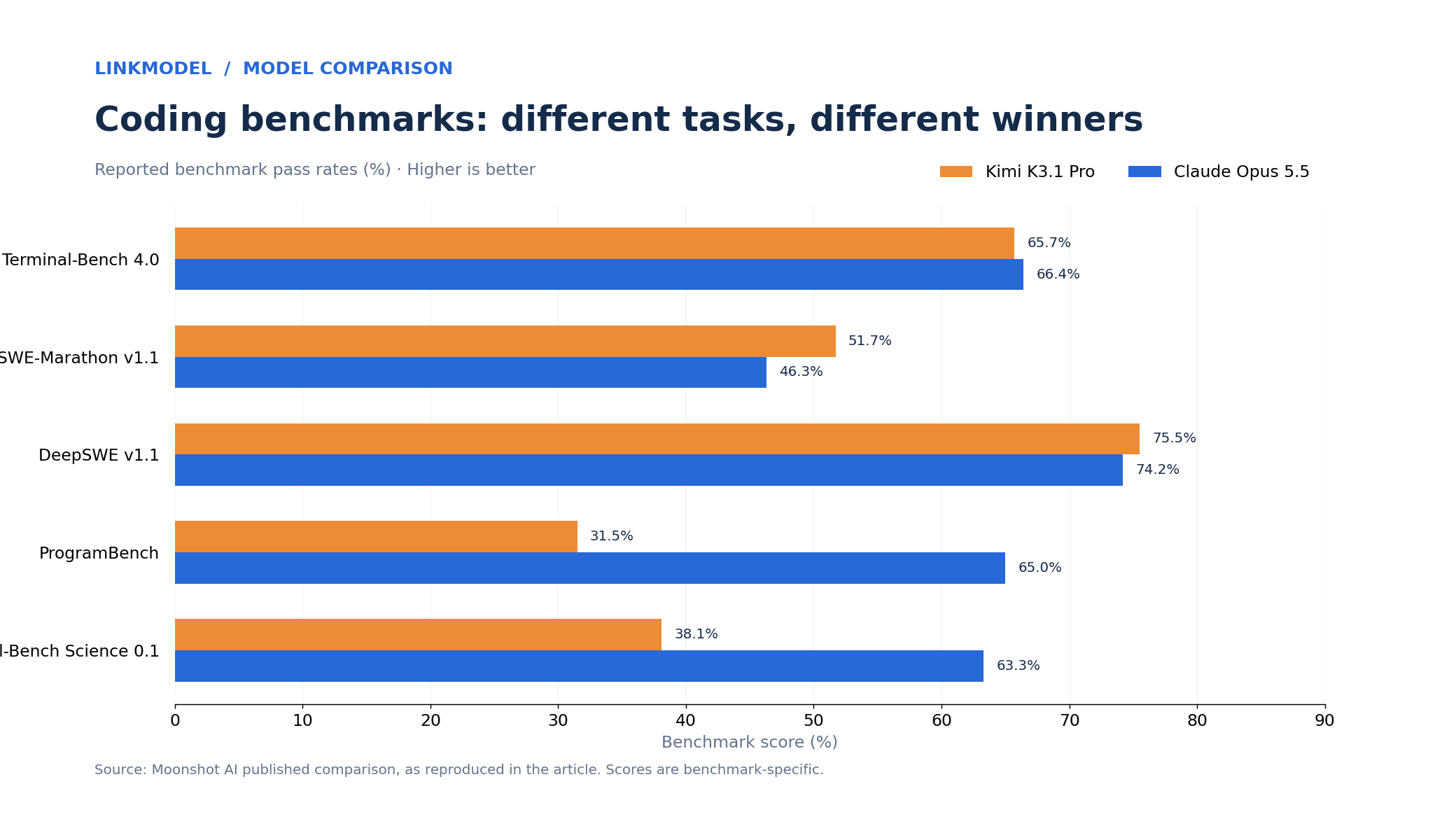
Kimi K3.1 Pro competes closely with Claude Opus 5.5 in some agentic coding benchmarks, but Opus performs substantially better on several difficult reasoning and specification-heavy evaluations.
Agentic coding benchmarks
Moonshot's published comparison reports the following results:
| Benchmark | Kimi K3.1 Pro | Claude Opus 5.5 |
|---|---|---|
| Terminal-Bench 4.0 | 65.7% | 66.4% |
| SWE-Marathon v1.1 | 51.7% | 46.3% |
| DeepSWE v1.1 | 75.5% | 74.2% |
| ProgramBench | 31.5% | 65.0% |
| Terminal-Bench Science 0.1 | 38.1% | 63.3% |
Source: Moonshot AI's published model comparison. Results reflect the reported benchmark configurations.
On Terminal-Bench 4.0, the models differ by only 0.7 percentage points.
Kimi also leads in the reported SWE-Marathon evaluation, suggesting competitive long-horizon execution ability.
However, Opus has a substantial advantage on ProgramBench, which evaluates software reconstruction from binary behavior and specifications.
For developers, these results imply different recommendations.
Kimi deserves consideration for structured software development and tool-assisted implementation.
Opus is a stronger starting candidate when interpreting strict requirements or reproducing complex behavior is essential.
Reasoning and tool-assisted work
Different evaluation environments can reverse the apparent ranking.
Moonshot's reported Humanity's Last Exam comparison provides an example:
| Evaluation | Kimi K3.1 Pro | Claude Opus 5.5 |
|---|---|---|
| HLE-Diamond, without tools | 39.4% | 60.9% |
| HLE-Full, with tools | 70.0% | 67.7% |
Opus performs substantially better on the difficult closed-book reasoning subset.
Kimi is competitive in the separate tool-enabled evaluation.
Because these evaluations use different tasks and conditions, their scores should not be treated as an interchangeable measure of overall intelligence.
The practical distinction is whether a developer needs strong independent reasoning or effective tool-assisted execution.
What third-party evaluations reveal
Artificial Analysis provides an additional perspective using different evaluation settings.
Its high-effort comparison reported approximately 67% for Kimi and 57% for Opus on Terminal-Bench 4.0.
On FrontierCode 2.0, Opus led with approximately 36%, compared with Kimi's 25%.
This variation reinforces a practical principle: the benchmark that most closely resembles your actual workload is usually more valuable than an aggregated model ranking.
For production development, evaluation conditions should include the same task requirements, tool access, reasoning settings, and acceptance criteria.
Real-World Coding and Agent Tests
Real development tests reveal how model performance changes once tasks require tools, iterative debugging, quality checks, and long execution sequences.
Case 1: Coding agent test with 96 hidden-test passes
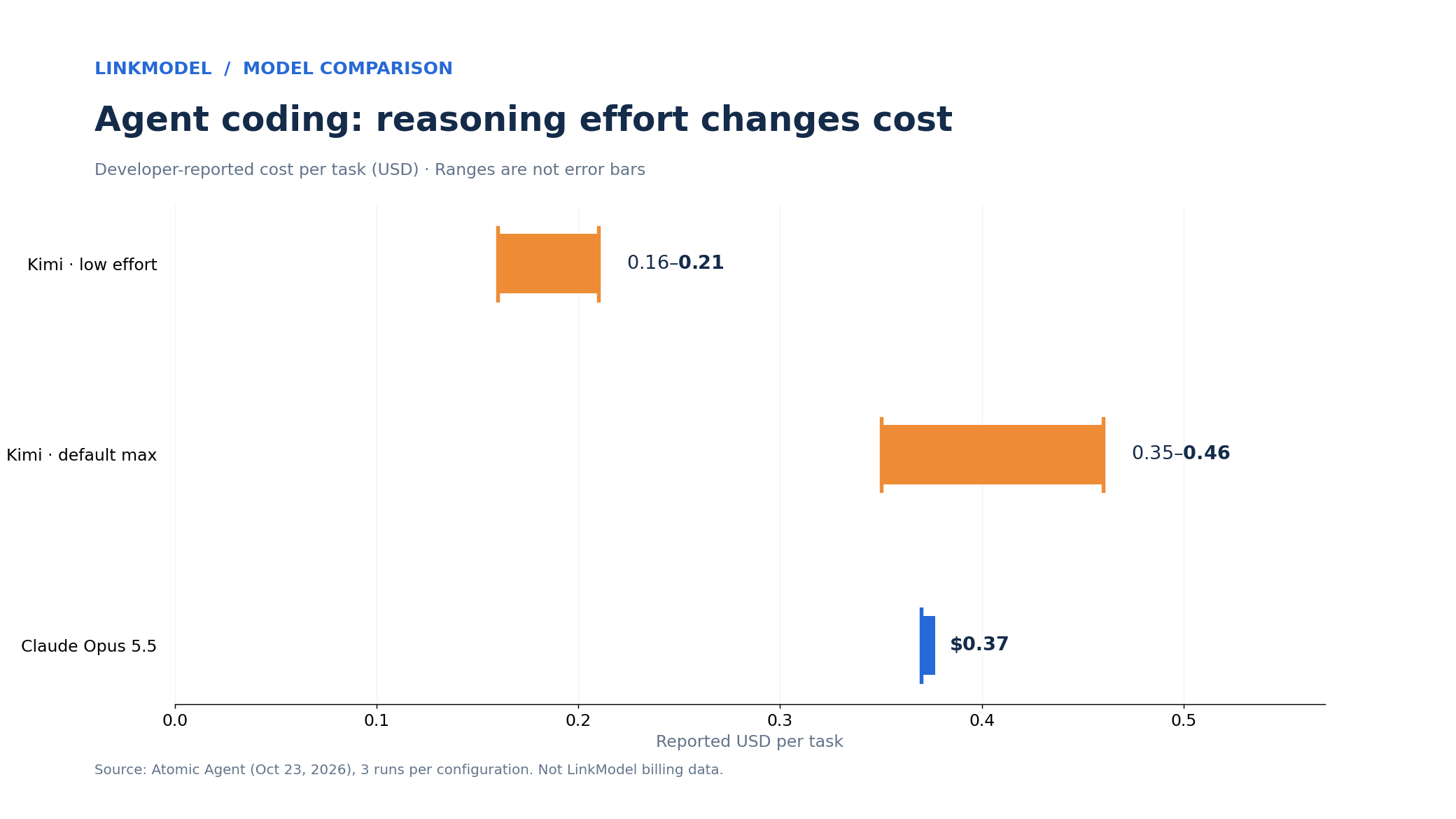
Atomic Agent published a comparison on October 23, 2026 involving a Python package with five planted bugs and two missing features.
Each configuration was tested three times in the same agent framework.
The experiment reported:
| Configuration | Cost per task |
|---|---|
| Kimi K3.1 Pro, low effort | $0.16–$0.21 |
| Kimi K3.1 Pro, default max effort | $0.35–$0.46 |
| Claude Opus 5.5 | $0.37 |
Kimi passed all 96 hidden-test executions across the reported runs.
At low effort, it was substantially cheaper.
At maximum effort, its reported cost overlapped with or exceeded Opus.
The tester also reported approximately 2.2 minutes per task for low-effort Kimi, compared with 69 seconds for Opus.
These figures reflect that test's own API access routes and settings.
They are particularly important because they show that reasoning configuration can offset a model's lower per-token price.
For developers using LinkModel, the logical next step is to test multiple reasoning settings with the platform's actual rates.
Case 2: Thirteen long-horizon agentic tasks
A MindStudio comparison discussed 13 development tasks executed within the same Claude Code harness.
Tasks included research replication, front-end reconstruction, graphics programming, and Blender scene composition.
The results were mixed.
Kimi produced competitive visual compositions, and the tester preferred some of its aesthetic outputs.
Opus performed more reliably on several strict mathematical, physical, and specification-driven requirements.
In a headless 3D rendering task, Kimi reportedly spent more than two hours on work that Opus completed in under 40 minutes, partly because it failed to enable GPU acceleration.
Another important finding involved requirement checking.
Kimi reported satisfying all 33 requirements of a strict specification, while external verification found that 31 had been satisfied.
For autonomous agents, a completion message is not sufficient proof that a task succeeded.
Developers should use automated tests, requirement-level checks, and output inspection to validate results.
Case 3: PostgreSQL migration with cross-model supervision
A developer discussion on r/kimi described using Kimi K3.1 Pro to implement a moderately complex PostgreSQL migration and upgrade.
Claude Opus 5.5 acted as a supervising adviser, while GLM provided additional review.
The developer reported a workload involving approximately 35 million tokens.
Among eight Opus interventions, the user judged five correct and three incorrect.
Kimi also improved on the Opus plan in two reported instances.
GLM identified one issue in Kimi's implementation and another in Opus's plan.
This case illustrates a potentially useful workflow:
- Assign implementation work to Kimi.
- Use Opus selectively for planning or review.
- Validate the result through testing and independent checks.
The discussion did not include a complete comparable API bill or total elapsed time, so it does not establish a specific percentage of cost savings.
Its main lesson is that the most expensive model does not necessarily need to execute every stage of a development task.
Case 4: Five interactive front-end projects
A Reddit contributor reported testing both models on five single-file HTML projects, with an initial version followed by two feedback-driven revisions.
| Measurement | Reported result |
|---|---|
| Kimi API spending | $4.76 |
| Estimated Claude API equivalent | Approximately $8 |
| Completion-time difference | Opus approximately 2.4× faster |
| Subjective overall assessment | Opus preferred across five projects |
Kimi's spending came from actual API billing through OpenRouter, while Claude was run through Claude Desktop with estimated API-equivalent costs.
The comparison also included promotional content and subjective visual judgments.
Therefore, it is best interpreted as one developer's experience rather than a general performance ranking.
Still, it illustrates an important decision: lower model spending may be less attractive when completion time and revision effort increase.
API Pricing: Official Rates vs LinkModel
Kimi K3.1 Pro has lower absolute API prices, while Claude Opus 5.5 receives a larger percentage discount through LinkModel.
This difference matters because developers can reduce their spending without changing models.
Official and LinkModel API pricing
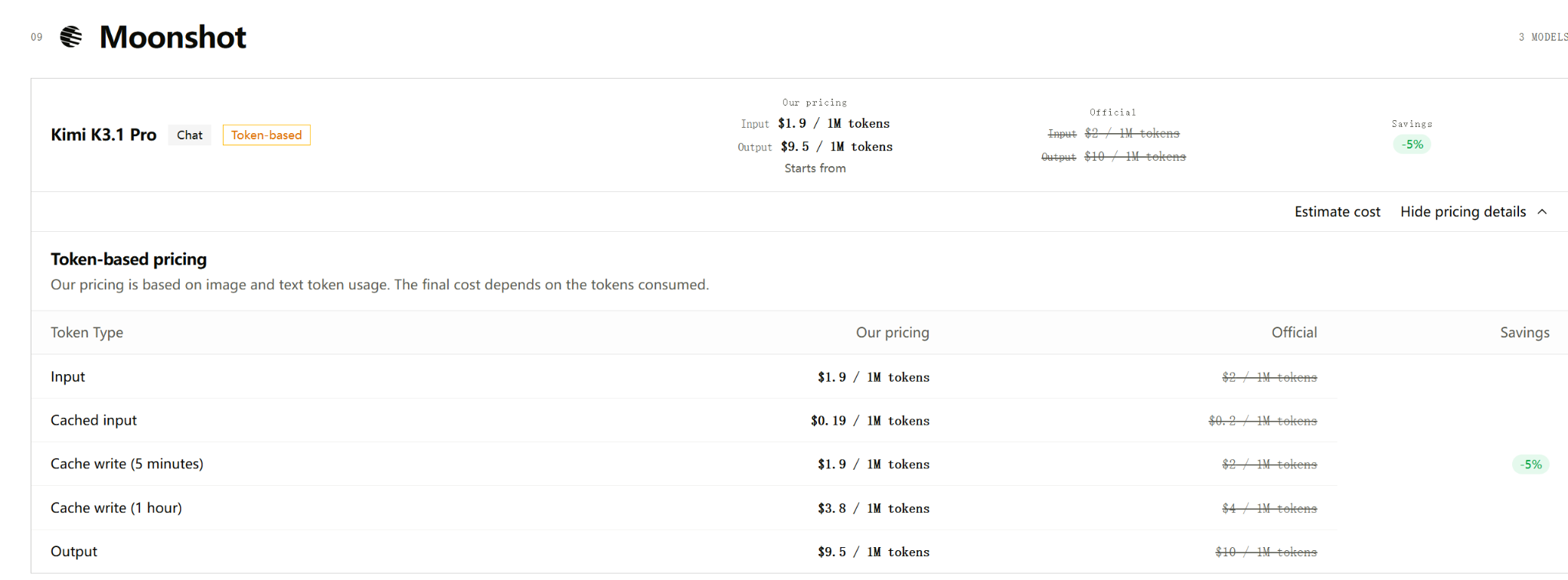
The following table compares the regular rates displayed in LinkModel's pricing catalog against the corresponding official API prices.
All prices are in USD per million tokens.
| Pricing component | Kimi official | Kimi on LinkModel | Opus official | Opus on LinkModel |
|---|---|---|---|---|
| Input | $2.00 | $1.90 | $4.00 | $3.40 |
| Cached input read | $0.20 | $0.19 | $0.20 | $0.17 |
| Cache write, 5 min | $2.00 | $1.90 | $5.00 | $4.25 |
| Cache write, 1 hour | $4.00 | $3.80 | $8.00 | $6.80 |
| Output | $10.00 | $9.50 | $20.00 | $17.00 |
These are LinkModel's regular listed model prices, not temporary promotional rates.
Kimi receives a 5% discount across the listed billing categories.
Opus receives a 15% discount.
For developers committed to Claude Opus 5.5, LinkModel offers a straightforward way to reduce token spending while retaining the same model choice.
What does a typical coding workload cost?
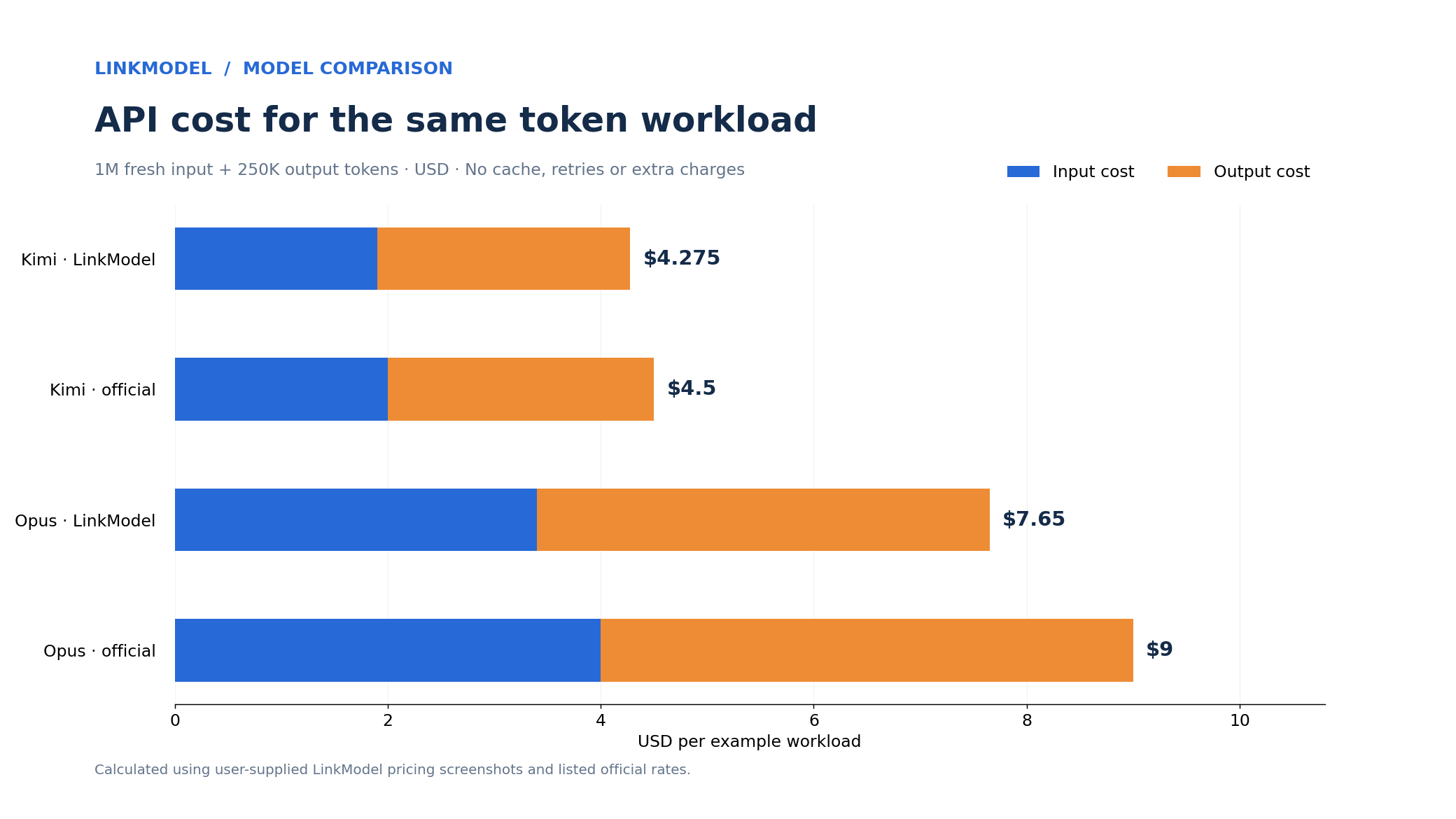
Consider a development workload requiring:
- 1 million fresh input tokens
- 250,000 output tokens
- No cached tokens
- No retries or additional tool charges
The estimated cost is:
| API option | Input cost | Output cost | Total |
|---|---|---|---|
| Kimi official | $2.00 | $2.50 | $4.50 |
| Kimi on LinkModel | $1.90 | $2.375 | $4.275 |
| Opus official | $4.00 | $5.00 | $9.00 |
| Opus on LinkModel | $3.40 | $4.25 | $7.65 |
Under these assumptions, LinkModel reduces the Kimi bill from $4.50 to $4.275.
For Opus, the bill drops from $9.00 to $7.65.
That is $1.35 saved on the same Opus workload, without changing the model or token consumption.
Kimi remains less expensive in absolute terms. But the savings gap narrows when both models are purchased through LinkModel.
When can Kimi's token advantage disappear?
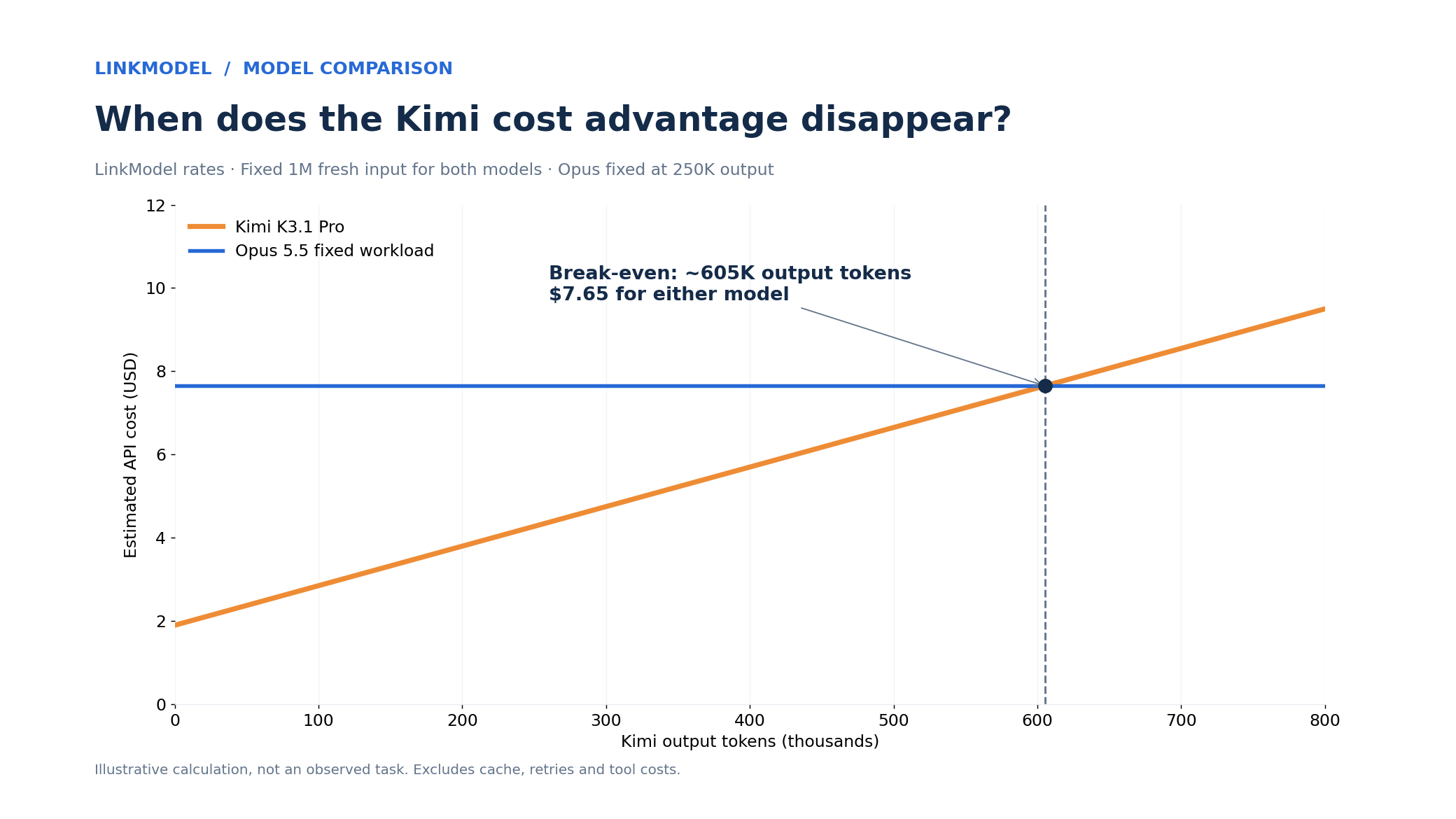
The critical variable is how many tokens each model consumes to finish the same task.
Suppose both models process 1 million fresh input tokens, but Opus needs 250,000 output tokens.
At LinkModel prices, the Opus workload costs $7.65.
Kimi's cost is:
$1.90 + $9.50 × output tokens in millions
Under these assumptions, Kimi reaches approximately the same $7.65 cost when it generates about 605,263 output tokens.
This provides a useful break-even point.
| Model on LinkModel | Input | Output | Estimated cost |
|---|---|---|---|
| Opus 5.5 | 1M | 250K | $7.65 |
| Kimi K3.1 Pro | 1M | 250K | $4.275 |
| Kimi K3.1 Pro | 1M | ~605K | ~$7.65 |
In this illustration, Kimi's output consumption can be approximately 2.42 times Opus's before the bills become equal.
The calculation assumes identical fresh input volume, no cache activity, and no additional charges.
It does not imply that Kimi generally generates 2.42 times more output tokens.
Instead, it shows why cost comparisons need to include actual token consumption.
Why cost per accepted result matters more
A more useful evaluation metric is:
Cost per accepted result = total model spending, including retries, divided by successfully accepted outputs.
Suppose one model produces a working implementation in one attempt while another requires three attempts.
The second model's cheaper token price may no longer translate into a cheaper final result.
For production teams, the comparison should include:
| Measurement | Why it matters |
|---|---|
| Input and output consumption | Determines direct API spending |
| Cached token usage | Changes effective unit costs |
| Reasoning effort | Influences token consumption and task behavior |
| Retry count | Reveals costs of unsuccessful attempts |
| Time to accepted result | Captures execution efficiency |
| Automated test results | Measures whether outputs satisfy requirements |
| Human review time | Captures development effort beyond API billing |
The optimal model minimizes the cost of obtaining an acceptable result—not necessarily the price of producing an initial response.
Test both models with LinkModel's $1 signup credit
LinkModel gives eligible new users $1 in API credits automatically upon registration, without requiring a credit card or initial deposit.
The credits do not expire and can be used across available models, including Kimi K3.1 Pro and Claude Opus 5.5.
This removes the need to commit money before trying the API.
At LinkModel's regular token rates, a useful first test can be constructed with a modest token budget.
For example, suppose each test request consumes 10,000 fresh input tokens and 2,000 output tokens.
| Model | Estimated cost per request | Requests covered by $1 |
|---|---|---|
| Kimi K3.1 Pro | $0.038 | 26 |
| Claude Opus 5.5 | $0.068 | 14 |
These are theoretical full-request counts at the stated token consumption, excluding cached tokens, retries, and other billable operations.
They are not guaranteed numbers of successful completed tasks.
A developer could use this initial credit to compare small coding requests, measure response behavior, or check whether a model fits an existing workflow.
For more extensive evaluation, LinkModel supports pay-as-you-go billing, with no minimum spend or recurring platform subscription fee.
Developers can review the current model rates through LinkModel's pricing page.
Speed, Context, and Subscription Limits
API price is only one factor in development productivity.
Reasoning settings, latency, context capacity, and usage restrictions can have a substantial impact on the practical experience.
Which model is faster?
Third-party comparisons report meaningful differences in some configurations.
Artificial Analysis's high-effort evaluation reported:
| Measurement | Kimi K3.1 Pro | Claude Opus 5.5 |
|---|---|---|
| Output speed | ~43 tokens/s | ~84 tokens/s |
| Time per evaluated task | ~1,436 seconds | ~464 seconds |
These numbers reflect the platform's measured evaluation configurations rather than guaranteed speeds across all applications.
The models' default reasoning settings also differ.
Kimi defaults to maximum reasoning effort, while Opus defaults to medium effort.
Running both at their defaults therefore does not ensure equivalent computational budgets.
Kimi also offers a Highspeed variant, while Opus has a separate Fast mode.
Both faster modes carry higher prices, so developers should compare their actual workload latency and spending rather than assuming that faster throughput always provides better value.
Context windows and output limits
Both models provide approximately 1 million tokens of context through supported API configurations.
This allows them to process large codebases, extensive documentation, and long agent histories.
However, a large context window does not guarantee reliable retrieval or reasoning across every included token.
Kimi's standard maximum output is 131,072 tokens by default.
Opus supports a standard maximum output of 128K tokens, with other output configurations available under specified API conditions.
In most development workflows, context selection, task decomposition, and verification will be more important than simply using the maximum context size.
Kimi Plus vs Claude Pro vs API access
Developer subscriptions and API billing are different purchasing models.
Subscriptions generally offer access through particular applications or coding environments, subject to plan-specific usage limits.
APIs charge for consumption and are more straightforward to evaluate against individual task costs.
Reddit users have reported frustration with Kimi subscription quotas during intensive development sessions.
However, those experiences do not establish a universal quota for every plan.
For developers using automated agents, parallel sessions, or repeatable production workloads, API billing provides a clearer way to measure the relationship between requests, token usage, and cost.
LinkModel's unified API is particularly relevant when developers want to work with multiple supported models through one billing environment rather than maintaining separate provider integrations.
Which Model Should You Choose?
There is no universal winner.
The most useful distinction is whether a workload prioritizes lower token spending, strict correctness, execution speed, or reduced manual intervention.
| Workload | Recommended starting point | Main reason |
|---|---|---|
| Cost-sensitive coding prototypes | Kimi K3.1 Pro | Lower API prices |
| Structured agent workflows | Kimi K3.1 Pro | Competitive long-horizon performance |
| Complex software engineering | Claude Opus 5.5 | Strong evidence on difficult reasoning |
| Strict specification matching | Claude Opus 5.5 | Stronger ProgramBench results |
| Visual and 3D development | Test both | Mixed reported outcomes |
| Critical code review | Opus with automated validation | Useful reasoning strengths |
| Large-scale repetitive processing | Kimi, with effort tuning | Potentially lower cost per accepted task |
| Mixed implementation and review | Kimi plus selective Opus review | Allocates different tasks to different models |
Choose Kimi for repeatable, cost-sensitive work
Kimi is a strong candidate when requirements are clear, errors can be detected automatically, and token spending is a major concern.
Examples include routine code generation, prototype development, structured transformations, and well-defined agent tasks.
Test lower reasoning-effort settings before deploying it broadly.
If output quality remains acceptable, reduced reasoning overhead can help preserve its price advantage.
Choose Opus for complex engineering
Opus deserves priority when task complexity creates substantial risks of incorrect implementation, wasted developer time, or repeated failures.
Its strong results in several specification-heavy and reasoning evaluations make it particularly relevant for difficult debugging, architecture, and code review.
The 15% reduction in official API prices through LinkModel also improves its cost competitiveness.
That matters when developers need Opus-level capabilities but want to reduce ongoing API spending.
Use both for different stages of development
A hybrid model strategy can be more flexible than committing every task to one system.
Kimi can handle structured implementation or early drafts.
Opus can be assigned difficult planning, high-risk review, or tasks requiring more exact interpretation.
However, cross-model approval does not replace automated testing.
To select a production configuration, evaluate a representative set of development tasks using consistent requirements.
Track token spending, time to completion, test results, retries, and human review effort.
Choose the model or combination that achieves the lowest cost per accepted result for your actual workload.
Frequently Asked Questions
Is Kimi K3.1 Pro better than Claude Opus 5.5 for coding?
Kimi is competitive in terminal coding and some long-horizon agent evaluations. Opus performs better in several difficult reasoning and exact-specification benchmarks. The better model depends on the development task and required quality level.
Is Kimi K3.1 Pro really 50% cheaper than Claude Opus 5.5?
At official standard API rates, Kimi's input and output prices are 50% lower. On LinkModel, Kimi costs $1.90 per million input tokens and $9.50 per million output tokens, while Opus costs $3.40 and $17.00. Actual completed-task savings depend on token consumption, caching, retries, and reasoning settings.
Can I try Kimi K3.1 Pro and Claude Opus 5.5 for free?
Eligible new LinkModel users automatically receive $1 in non-expiring credits after registration, with no credit card or deposit required. These credits can be used for available models, providing a way to run initial API tests before purchasing additional credits.
Which model is faster for agentic coding?
Several third-party evaluations report faster completion with Opus under specific conditions. However, latency depends on workload, provider, and reasoning effort. Both models offer faster inference variants at higher API rates.
Should I use Kimi and Claude through subscriptions or APIs?
Subscriptions are useful for interactive access within their published allowances. APIs are generally more suitable for automated workloads where usage and spending need to be measured. LinkModel provides access to both models through a unified, pay-as-you-go API platform.
Conclusion
Kimi K3.1 Pro offers lower absolute API prices and competitive performance for structured coding and agent tasks, while Claude Opus 5.5 remains a compelling choice for complex reasoning and demanding engineering. Their practical value depends on accepted-task quality, reasoning overhead, completion time, and token consumption—not pricing alone. Through LinkModel, developers can access Kimi at 5% below official API rates and Opus at 15% below official rates, with flexible pay-as-you-go billing. Eligible new users can also start with $1 in non-expiring credits, making it easier to compare both models before scaling their workloads.