Choose Claude Sonnet 5.5 for scoped coding and everyday tasks; evaluate Opus 5.5 for difficult reviews and decisions where mistakes are expensive. Official standard API pricing is $2/$10 for Sonnet versus $4/$20 for Opus per million input/output tokens. Sonnet halves the token rate, but the better value depends on effort, completion quality, and correction work.
Cheaper tokens do not always mean cheaper completed work. Higher effort can erase a pricing advantage, while an inexpensive review can create extra work through missed issues or incorrect corrections. The useful comparison is what each configuration costs to reach a result you can accept.
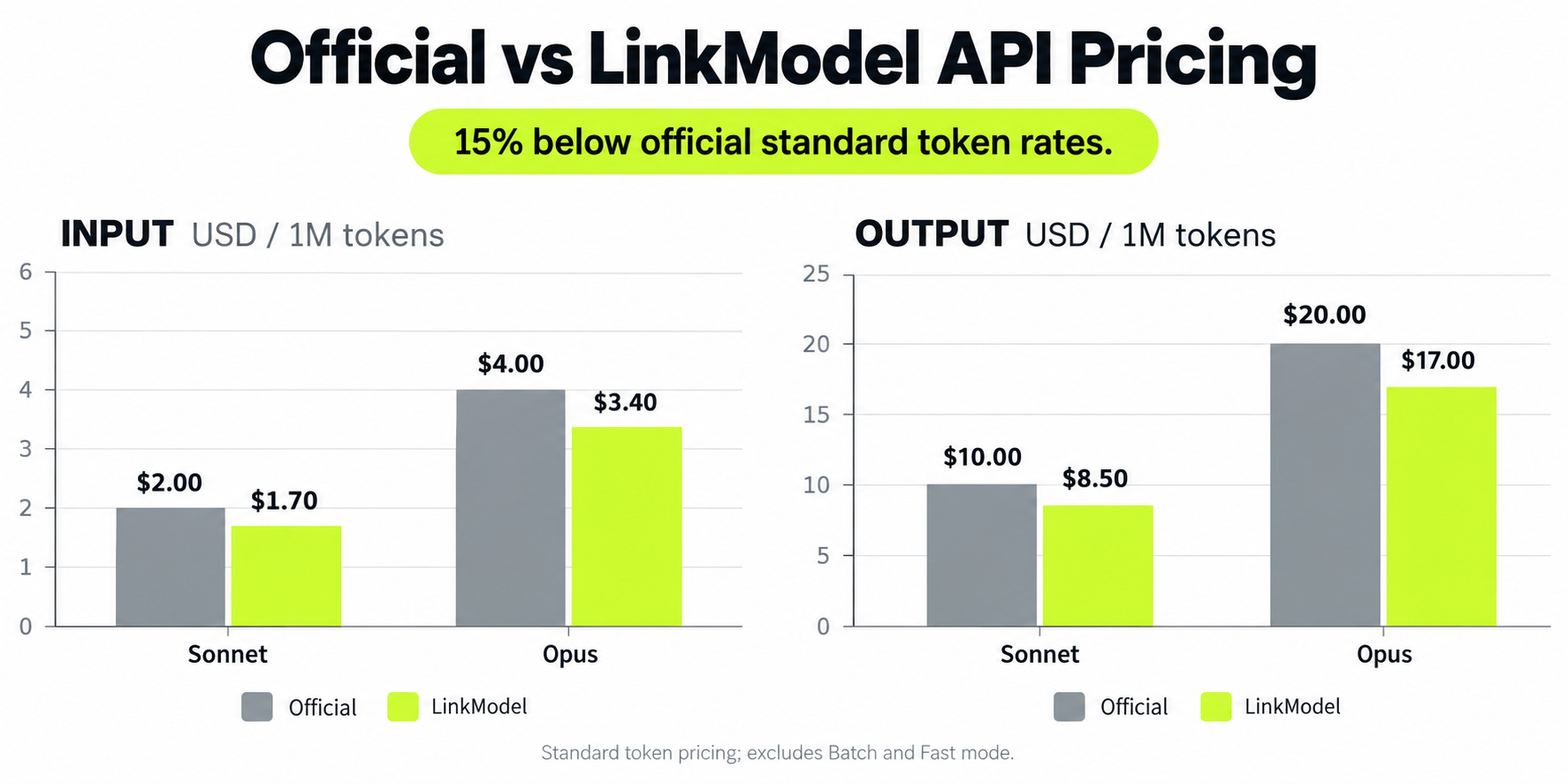
LinkModel makes both options more affordable: Sonnet 5.5 costs $1.70/$8.50 and Opus 5.5 costs $3.40/$17 per million input/output tokens—15% below their corresponding official standard token rates. Compare outputs in Playground, then build with pay-as-you-go pricing, no minimum spend, and no monthly platform fee, keeping model access and spending management together.
Claude Sonnet 5.5 vs Opus 5.5: Which Should You Use?
Start with Sonnet when success is straightforward to verify. Include Opus when finding the right answer requires difficult judgment. Choose the lowest-cost configuration that meets your quality requirements, rather than selecting by model tier alone.
| Your task | Starting choice | What decides the upgrade |
|---|---|---|
| Scoped bug fixes and routine implementation | Sonnet 5.5 | Tests, completeness, and correction work |
| Repository discovery | Sonnet 5.5 | Missing dependencies or incomplete coverage |
| Visual prototypes | Sonnet 5.5 | Interaction quality and required detail |
| Difficult code review | Evaluate Opus 5.5 | Missed issues and false positives |
| Consequential research and fact-checking | Evaluate Opus 5.5 | Evidence quality and incorrect corrections |
| Ambiguous architecture decisions | Evaluate Opus 5.5 | Assumptions, alternatives, and downstream risks |
These choices are starting points for evaluation. A well-tested Sonnet workflow may outperform an inadequately specified Opus workflow, and an Opus result can justify its price when it avoids expensive rework.
Both models have a published 1 million-token context window and 128K standard maximum output. The important difference is therefore not simply how much material fits into a request, but how reliably the model uses it.
Sonnet 5.5 vs Opus 5.5 Benchmarks
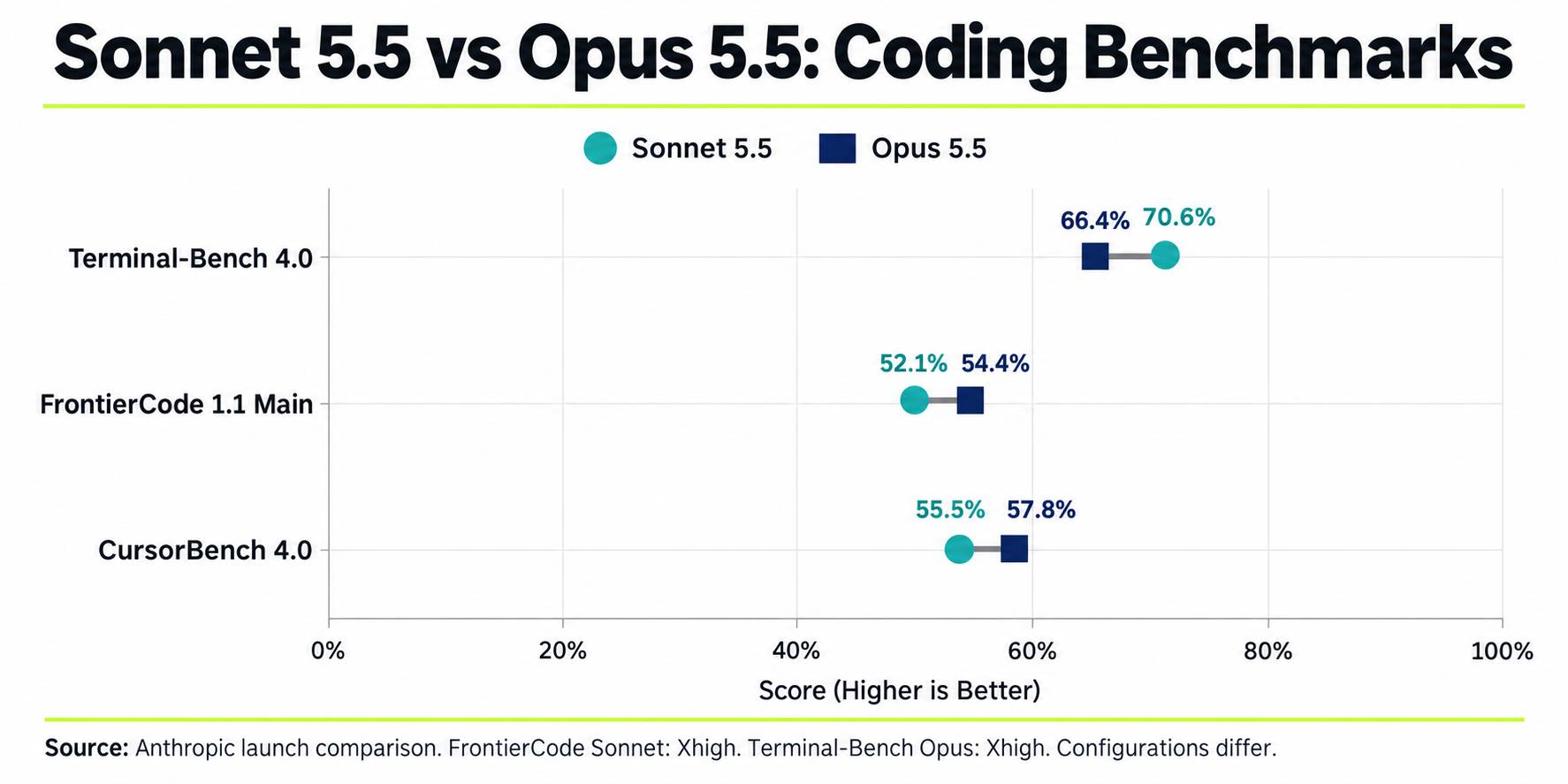
Published benchmarks show different strengths across terminal work, repository editing, reasoning, and knowledge tasks. A lead in one evaluation does not establish a universal winner.
The following figures come from Anthropic’s Sonnet 5.5 launch comparison.
| Benchmark | Sonnet 5.5 | Opus 5.5 |
|---|---|---|
| Terminal-Bench 4.0 | 70.6% | 66.4% |
| FrontierCode 1.1 Main | 52.1% at Xhigh; 46.2% at Max | 54.4% |
| CursorBench 4.0 | 55.5% | 57.8% |
| GDPval-AA v2.1 | 1844 | 1846 |
| AA-Briefcase v1.1 | 1811 | 1822 |
| Humanity’s Last Exam, with tools | 64.5% | 67.7% |
| OSWorld 2.1, partial | 80.1% | 81.8% |
| Chartography, without tools | 61.6% | 64.4% |
Opus’s Terminal-Bench result uses Xhigh, its highest-scoring configuration. Sonnet scores lower on FrontierCode at Max than Xhigh; Anthropic links this partly to extra review activity causing timeouts or changes outside the task’s scope.
The practical lesson is to score correctness, scope control, and usability separately. A technically sound change can still require rejection if it modifies unrelated behavior. Similarly, close knowledge-work ratings do not mean equal performance on every document or business decision.
Use these results to shortlist configurations, then test the work you actually intend to delegate.
Sonnet 5.5 vs Opus 5.5 Pricing
Sonnet’s corresponding token rates are half of Opus’s. LinkModel’s regular rates are 15% below each model’s official standard token prices.
The official columns follow Anthropic’s API pricing documentation; the LinkModel columns show the platform’s rates for these models.
All amounts are USD per million tokens.
| Token category | Sonnet: official → LinkModel | Opus: official → LinkModel |
|---|---|---|
| Ordinary input | $2 → $1.70 | $4 → $3.40 |
| Cache reads | $0.10 → $0.085 | $0.20 → $0.17 |
| Five-minute cache writes | $2.50 → $2.125 | $5 → $4.25 |
| One-hour cache writes | $4 → $3.40 | $8 → $6.80 |
| Output | $10 → $8.50 | $20 → $17 |
Sonnet 5.5’s official cache-read rate is $0.10 per million tokens. Treat ordinary input, cache writes, cache reads, and output as separate billing categories; the initial cache write is part of the workload’s cost.
Request Cost: What Does the Price Difference Buy?
For 100,000 ordinary input tokens and 10,000 total billed output tokens, excluding caching and additional tool charges:
| Route | Sonnet 5.5 | Opus 5.5 |
|---|---|---|
| Official standard API | $0.30 | $0.60 |
| LinkModel | $0.255 | $0.51 |
At that identical usage, choosing Opus through LinkModel adds $0.255. If it prevents correction work worth more than that difference, the higher-priced model can be the better purchase.
The calculation changes when the models consume different amounts of input, reasoning, output, or tools. Compare the actual cost of accepted results, not just the rate attached to each model.
Standard Pricing vs Batch Pricing
Anthropic’s Batch API offers 50% lower input and output rates, bringing Sonnet to $1/$5 and Opus to $2/$10 per million tokens. Those rates are below the LinkModel standard input/output rates above, while Batch serves asynchronous workloads. Opus Fast mode has separate premium pricing.
Compare equivalent purchasing modes. LinkModel’s 15% price advantage is relative to official standard token pricing, and current LinkModel pricing provides the rates to use for your intended configuration.
How Effort Changes Sonnet and Opus Task Costs
Model selection and effort selection are one decision. A cheaper model running at a much more expensive configuration may lose its task-cost advantage.
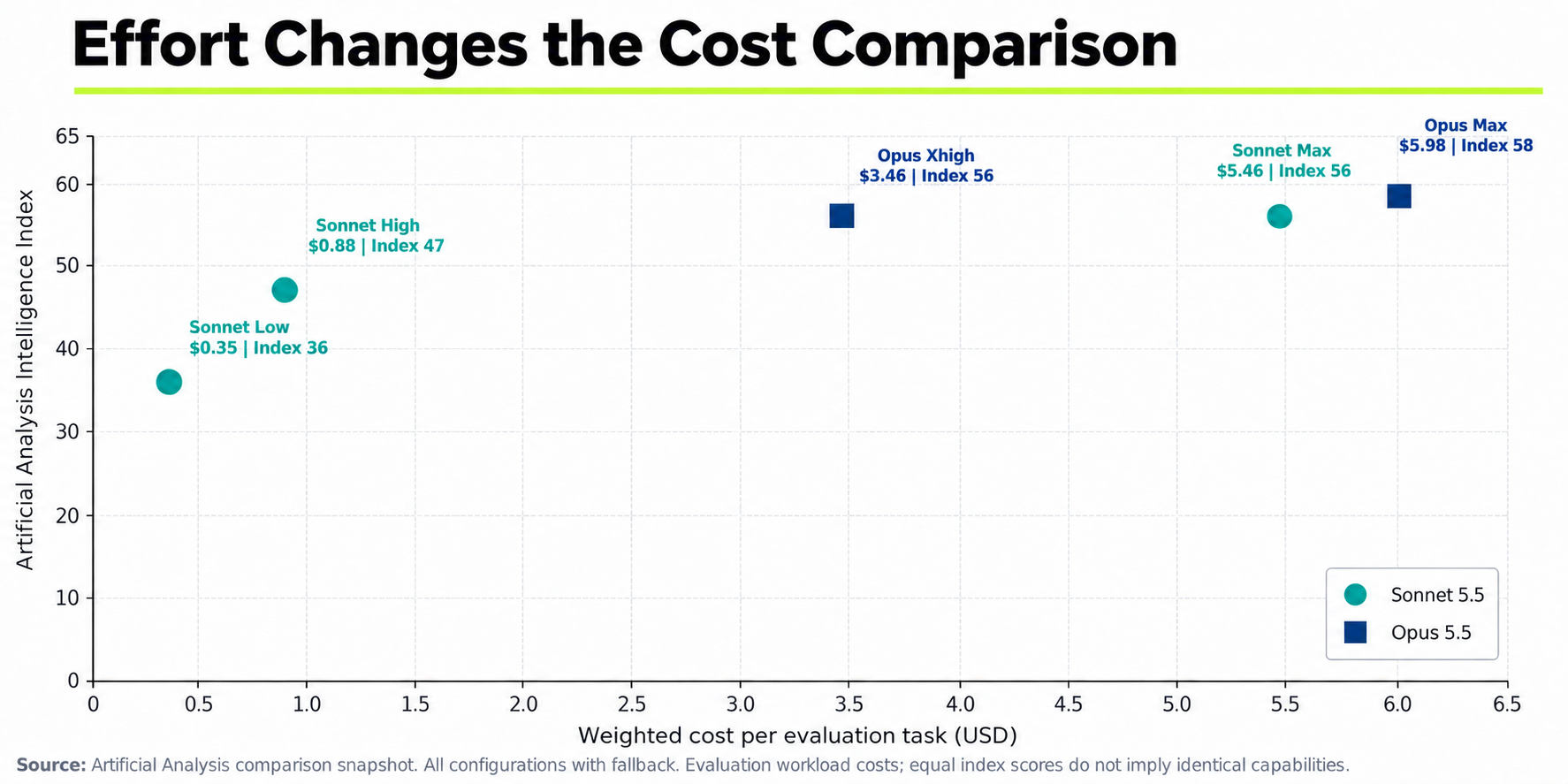
The published effort-level comparison from Artificial Analysis reports:
| Configuration | Intelligence Index | Weighted cost per task |
|---|---|---|
| Sonnet Low | 36 | $0.35 |
| Sonnet High | 47 | $0.88 |
| Sonnet Max | 56 | $5.46 |
| Opus Xhigh | 56 | $3.46 |
| Opus Max | 58 | $5.98 |
All listed configurations are labeled with fallback. Costs describe the evaluation’s weighted workload. Sonnet Max and Opus Xhigh have the same aggregate index score here, while Opus Xhigh costs less; equal index scores do not establish identical capabilities.
This gives you three useful comparisons:
- Default experience: What does your application deliver without tuning?
- Equal budget: Which configuration reaches the best acceptable result within your spending limit?
- Quality target: What is the least expensive configuration that consistently passes?
The current Claude API overviews list High as Sonnet’s default effort and Medium as Opus’s. Record actual settings so a model switch does not silently change the comparison.
Increase effort to address an identifiable failure, such as incomplete dependency reasoning or insufficient checking. If the underlying problem is missing evidence or an ambiguous instruction, fix that input before paying for more reasoning.
Sonnet 5.5 vs Opus 5.5 for Coding and Code Review
Implementation, repository discovery, and difficult review deserve separate tests. Our research found useful examples of Sonnet’s execution economy and Opus’s review advantage, but the value depends on the task.
Three.js Prototype: Initial and Follow-Up Runs
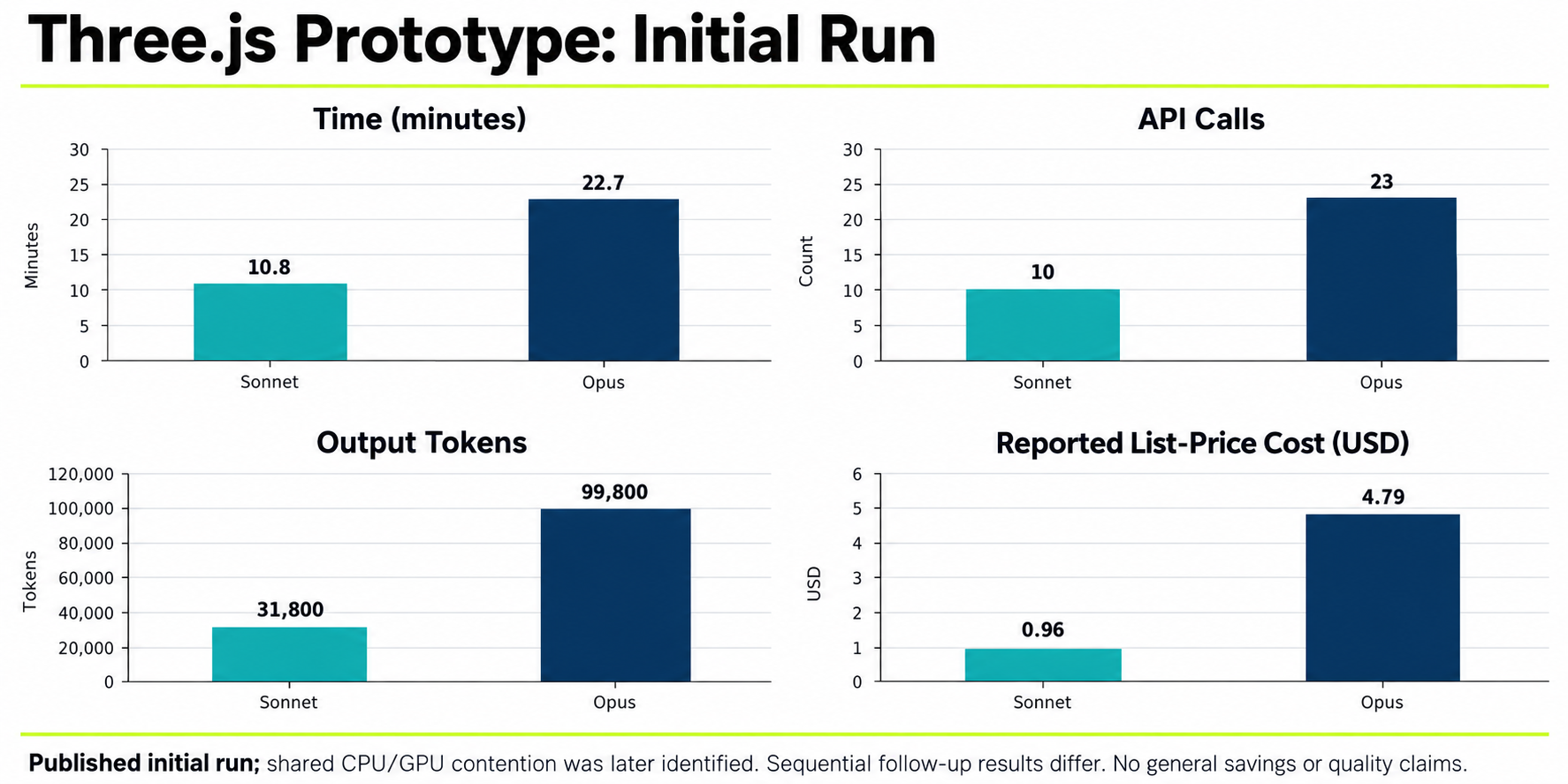
A published same-prompt experiment asked both models to create an interactive cartoon planet in Three.js.
| Initial run | Sonnet 5.5 | Opus 5.5 |
|---|---|---|
| Time | 10.8 minutes | 22.7 minutes |
| API calls | 10 | 23 |
| Output tokens | 31,800 | 99,800 |
| Reported list-price cost | $0.96 | $4.79 |
The experimenter subsequently identified shared CPU/GPU contention. Sequential follow-ups reported a four-run Sonnet average of 11.2 minutes and $1.69, alongside an Opus comparison run of 14 minutes and $2.54. The initial advantage therefore should not become a fixed savings or speed claim.
For prototypes, test Sonnet early and judge concrete requirements: interaction, camera behavior, completeness, and maintainability. Run models in isolated directories and avoid hardware contention that can distort timings.
Repository Search: Coverage and Cost
A published six-task project comparison reviewed in our research used High effort, identical prompts, and the same files.
For a feature that ultimately changed 48 files, Opus identified 45 at a reported cost of $6.17, while Sonnet identified 44 for $1.38. Neither identified every relevant file.
The useful output is a candidate change map. Verify it through references, dependency searches, and tests before treating it as complete.
This distinction can reduce unnecessary spending: finding likely files and deciding how to redesign their interactions need not use the same configuration.
Difficult Code Review: Missed Issues and Precision
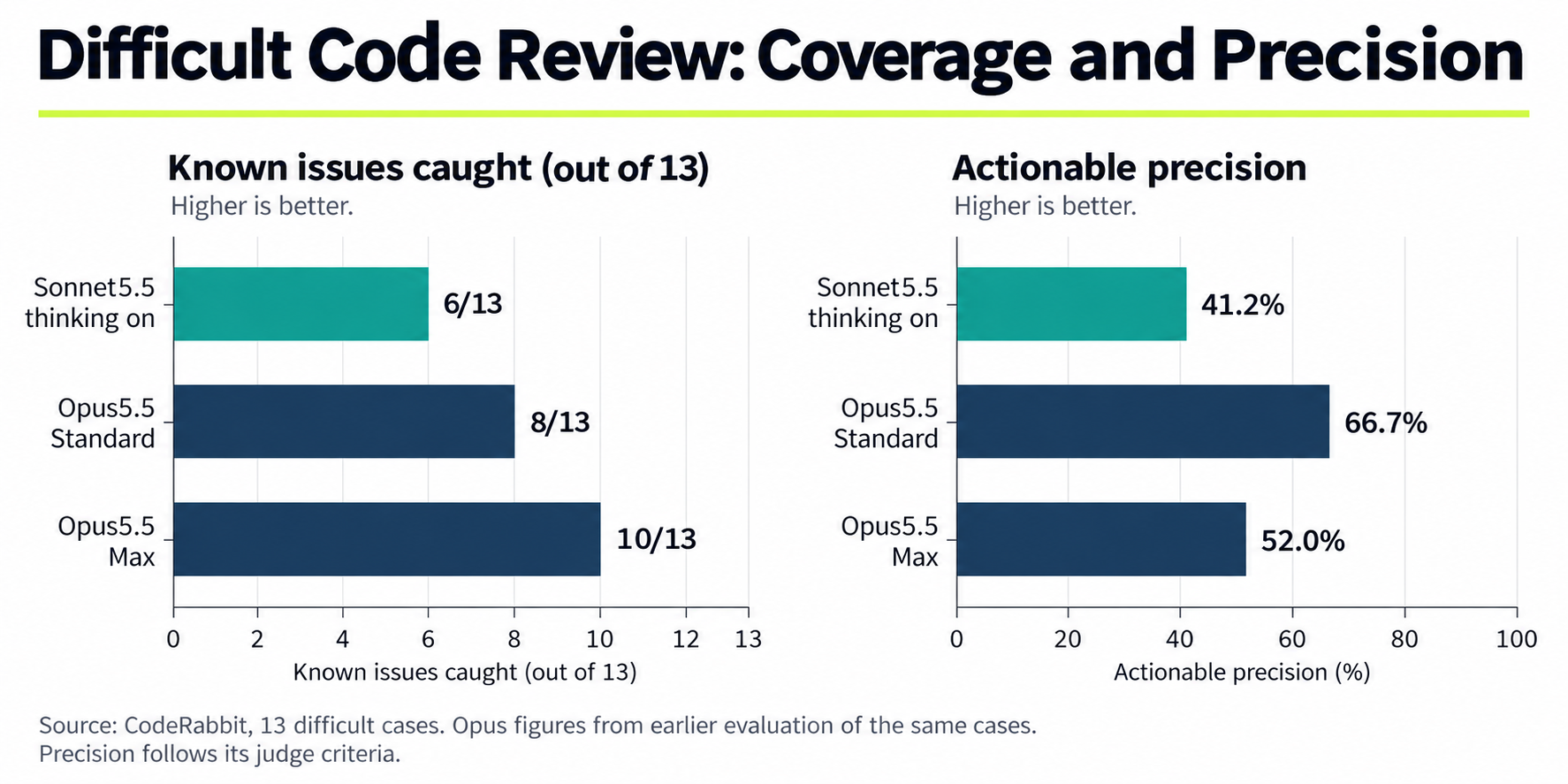
A published code-review evaluation from CodeRabbit used 13 difficult cases containing verified issues.
| Configuration | Known issues caught | Actionable precision |
|---|---|---|
| Sonnet 5.5, thinking on | 6/13 | 41.2% |
| Opus 5.5 Standard | 8/13 | 66.7% |
| Opus 5.5 Max | 10/13 | 52.0% |
The Opus figures came from an earlier evaluation of the same cases. Actionable precision measures comments accepted by the evaluation’s judge for the target issue, rather than developer acceptance. The small sample and review pipeline matter when applying the results elsewhere.
Max caught more issues; Standard produced higher precision. That is a useful buying distinction: teams must balance missed defects against time spent investigating incorrect findings.
A larger run in the same study covered 44 pull requests and 85 known issues. Sonnet 5.5 produced 111 comments versus Sonnet 5’s 146, averaging 6:33 versus 13:31 per review. Quality judging was pending, so lower comment volume should not be interpreted as higher detection quality.
For consequential changes, include Opus in your evaluation and retain tests and human review. Measure which findings lead to necessary fixes, which issues remain undetected, and how much reviewer time each configuration consumes.
Sonnet vs Opus for Research and Fact-Checking
A useful fact-checker must find genuine problems without turning correct statements into unnecessary edits.
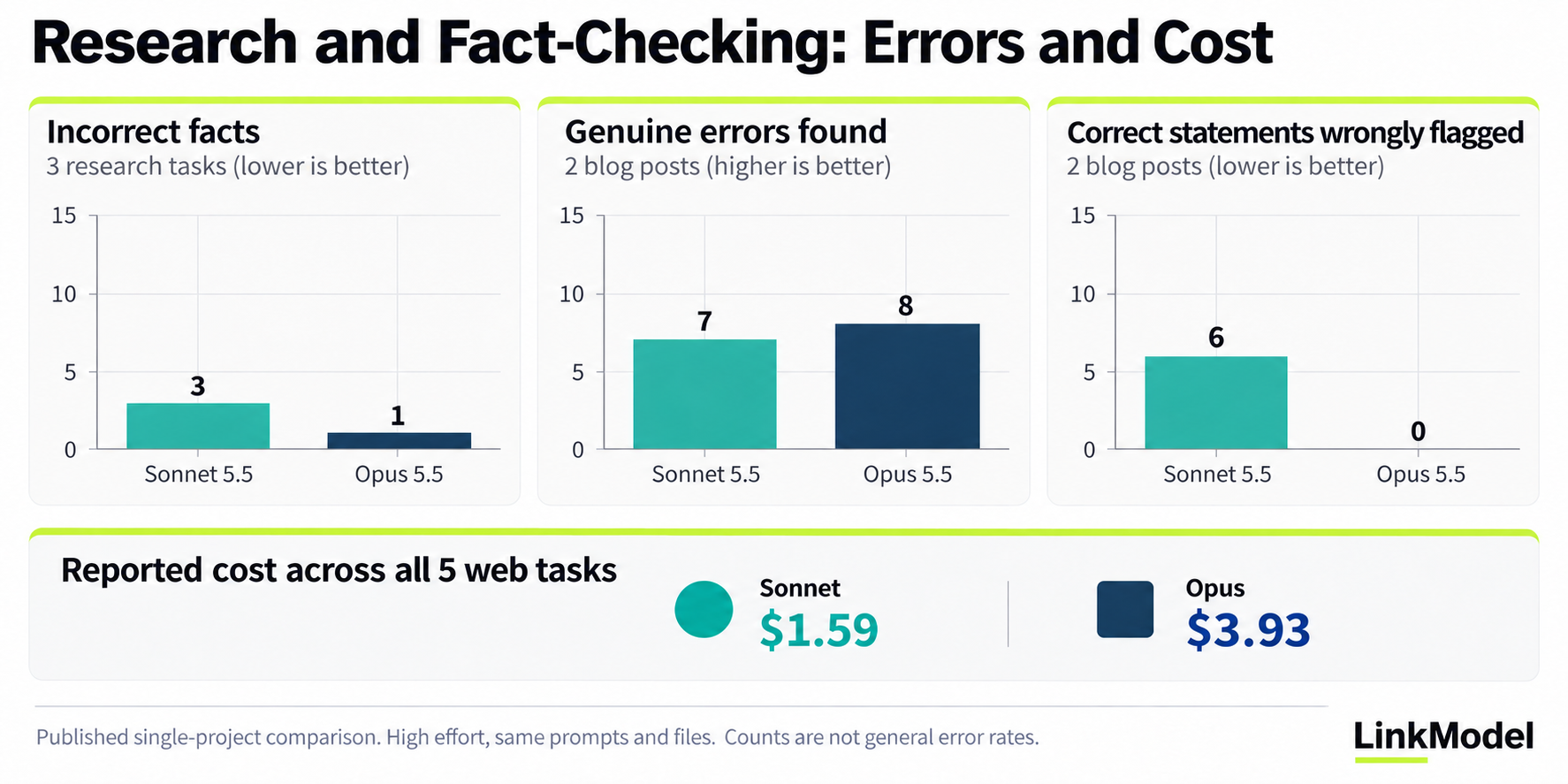
The six-task project comparison also included three research tasks and two blog checks:
| Reported outcome | Sonnet 5.5 | Opus 5.5 |
|---|---|---|
| Incorrect facts across three research tasks | 3 | 1 |
| Genuine errors found in two posts | 7 | 8 |
| Correct statements wrongly flagged | 6 | 0 |
| Cost across five web tasks | $1.59 | $3.93 |
These figures come from one project’s task set. They illustrate the verification burden worth measuring, rather than establishing general error rates.
For publishing, require each proposed correction to identify the original claim, the evidence, and the conflict. Distinguish incorrect, outdated, and unverified.
Our recommendation is to evaluate Opus for consequential final checks, while testing Sonnet for bounded extraction, organization, and drafting from supplied sources. A more expensive review can be worthwhile when it reduces incorrect corrections, but neither model should replace checking the underlying evidence.
Sonnet vs Opus Speed and Long Agent Workflows
Measure time to an accepted result, alongside output speed. A fast response can still lead to a slow task when tools, rendering, or repeated corrections dominate.
At Max effort, the same evaluation snapshot reports 134 output tokens per second for Sonnet versus 96 for Opus, while time per task is approximately 948 versus 797 seconds. Faster token generation therefore does not necessarily mean faster task completion.
What a 30-Second Animation Required
A Sonnet creation case reviewed in our research reported a 30-second animation requiring:
- 739,000 output tokens
- 101.6 million cache-read tokens
- 3.07 million cache-write tokens
- 779 tool calls
- Approximately 2.4 hours, including rendering waits
The workflow inspected rendered frame contact sheets, shared timing information between visuals and audio, and used independent review before fixes. Its reported dollar comparison used an outdated Sonnet cache-read rate and converted usage to Opus pricing, so the workload figures are the useful evidence here.
Budget the workflow, not the length of the final artifact. For coding and creative agents, checkpoints should inspect real outputs: run the program, render the page, reopen the document, or inspect representative frames.
When to Use Sonnet and Opus Together
Combine models when planning, execution, and difficult review can be assigned clear responsibilities. A second model should resolve a specific uncertainty rather than repeat every task.
A practical workflow is:
1. Define the requirement, constraints, and acceptance criteria.
2.Use Sonnet for a bounded implementation.
3. Run tests and inspect the actual result.
4. Escalate unresolved decisions or consequential changes to Opus.
5. Check the final result against the original criteria.
Start directly with Opus when the difficult part is establishing the approach itself. For a straightforward task that Sonnet already completes reliably, an automatic Opus pass can add spending without useful improvement.
Pass explicit requirements, changed files, test results, and outstanding questions between stages. Anthropic’s documentation ties thinking blocks to model and conversation conditions, so clear task summaries make handoffs easier to manage.
Compare Sonnet 5.5 and Opus 5.5 in LinkModel Playground
Bring one representative task to Playground before deciding which model should receive your broader workload. Begin with Sonnet 5.5, then compare the same request with Opus 5.5.
LinkModel’s homepage describes side-by-side output comparisons and request-code export. Its pay-as-you-go model lets you evaluate without a monthly platform fee or minimum spend.
For an informative comparison:
| Keep fixed | Record |
|---|---|
| Prompt and source material | Completeness and factual accuracy |
| Required output and task scope | Missing requirements or extra changes |
| Tools and settings where available | Token usage and additional calls |
| Acceptance criteria | Correction work and completion time |
Use Playground to assess representative responses. For repository agents or tool-heavy workflows, continue evaluation in the actual environment where the result must work.
Move From Comparison to API Integration
LinkModel’s Chat Completions documentation describes an OpenAI-compatible request and response shape for clients using a custom base URL. It also states that tools, structured outputs, and reasoning controls vary by selected model and provider.
Before expanding usage, validate the features your application depends on. Check streaming, tool behavior, output format, reasoning controls, and caching where applicable, using the selected model’s endpoint support.
Then compare model-and-tool cost per accepted result: total evaluation-attempt costs divided by accepted results. Track human correction time separately. Use LinkModel’s pricing to translate the chosen configuration into a deployment budget.
Frequently Asked Questions
Can Sonnet 5.5 Replace Opus 5.5 for Everyday Coding?
Yes, when it reliably satisfies your requirements and passes relevant tests. The reviewed prototype and search cases make Sonnet a useful starting candidate. Keep Opus for tasks where ambiguous requirements, missed issues, or repeated correction work justify evaluating a higher-priced model.
Why Can Sonnet Cost More Despite Cheaper Tokens?
Token consumption, effort, tools, and repeated attempts can outweigh the lower rate. In the comparison above, Sonnet Max costs more per evaluation task than Opus Xhigh despite matching its aggregate Intelligence Index score. Both configurations include fallback; equal scores do not imply identical capabilities. Compare complete task costs and the quality achieved.
Does Sonnet’s Terminal-Bench Lead Make It Better at All Coding?
No. Terminal operation, repository editing, and difficult review measure different abilities. Preserve the benchmark’s configuration conditions and use results closest to your workload. Passing your application’s checks matters more than winning an unrelated evaluation.
Should I Use Higher Effort or Switch to Opus?
Test the specific failure. Higher effort may help incomplete reasoning, while unclear requirements or inaccessible sources need better inputs. Compare adjacent effort levels and Opus against the same acceptance criteria, then select the least expensive configuration that passes reliably.
How Much Cheaper Are These Models on LinkModel?
LinkModel’s regular token rates for both models are 15% below the corresponding official standard rates, including the listed cache categories. Use the pricing table above for exact amounts, and compare equivalent processing modes when considering alternatives such as Batch.
Conclusion
Start with Sonnet 5.5 for verifiable work, and evaluate Opus 5.5 where difficult judgment or costly corrections justify additional spending. Choose effort alongside the model, inspect actual outputs, and compare complete costs at an acceptable quality level. LinkModel Playground provides a practical next step: compare your own task across both models, with regular standard token rates 15% below their official counterparts and pay-as-you-go access without a monthly platform fee or minimum spend.