

GPT Image 2.5 pricing is $5/M text input, $8/M image input, and $30/M image output tokens on OpenAI, but your real cost per image depends on how many attempts it takes to get an acceptable result. Flare and Sunburst use the same official token rates, so there is no single fixed GPT Image 2.5 price per image.
The problem is that failed generations, retries, edits, reference images, higher quality settings, and rejected outputs all add to the final bill. A generation that looks cheap on paper can become much more expensive after multiple attempts. For production workloads, the metric that matters most is cost per accepted image—not cost per request.
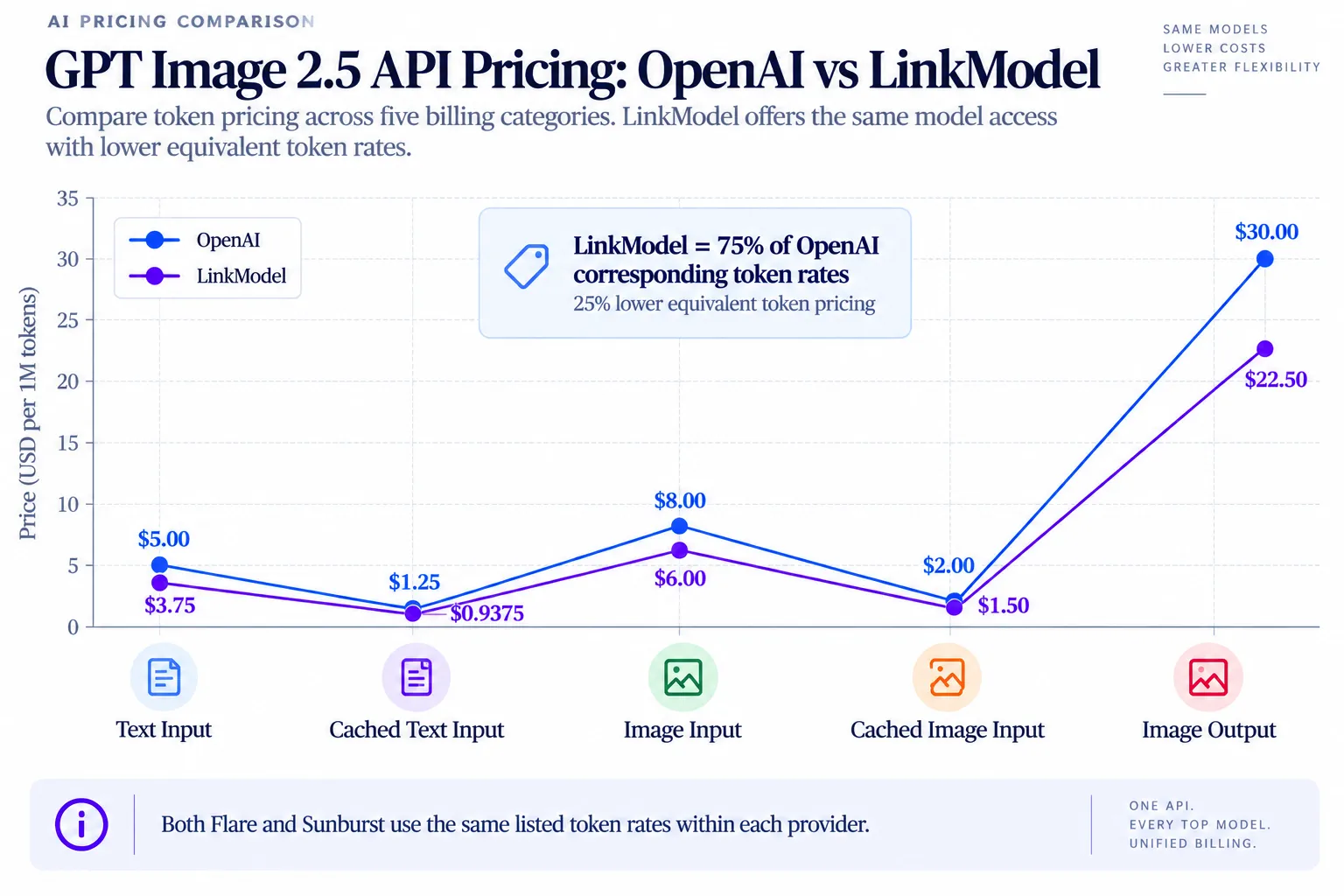
GPT Image 2.5 Flare and Sunburst are available on LinkModel at 75% of OpenAI’s corresponding token rates, giving a 25% discount. With one OpenAI-compatible API, one API key, and unified billing, teams can use Flare for faster iteration and switch to Sunburst when greater precision can reduce costly retries—without rebuilding the integration.

GPT Image 2.5 Pricing: How Much Does the API Cost?
GPT Image 2.5 uses token-based API billing, not one universal price for every generated image. OpenAI offers two API models: Flare for fast, high-volume generation and Sunburst for higher-precision generation and editing.
GPT Image 2.5 Official Token Pricing
| Token Type | OpenAI Price |
|---|---|
| Text input | $5.00/M |
| Cached text input | $1.25/M |
| Image input | $8.00/M |
| Cached image input | $2.00/M |
| Image output | $30.00/M |
The key point is simple: Flare and Sunburst have identical official token rates.
Sunburst is the more precision-oriented model, but it does not carry a higher listed token price. Likewise, Flare's speed advantage does not come from a lower official token rate.
OpenAI also states that GPT Image 2.5 token rates match GPT Image 2. However, the GPT Image 2 calculator should not be used to estimate GPT Image 2.5 token consumption, so older GPT Image 2 per-image estimates should not be presented as universal GPT Image 2.5 prices.
Why GPT Image 2.5 Has No Fixed Price per Image
A GPT Image 2.5 request can include prompt tokens, reference-image input, generated image output, edits, and retries. Actual token consumption can also change with the requested output.
That means two teams using the same $30/M image-output rate can end up with very different costs per finished asset.
The safest answer to “How much is GPT Image 2.5 per image?” is therefore:
There is no single official fixed price per image. Real cost depends on the workload and actual token consumption.
GPT Image 2.5 Cost per Image: What You Actually Pay
For production use, there are two different costs worth tracking: cost per generation and cost per accepted image.
Cost per Generation vs Cost per Accepted Image
At the API level:
Generation cost = Text input + Image input + Image output
But production workflows often include rejected outputs and revisions. A more useful business metric is:
Cost per accepted image = Total generation, editing, and retry cost ÷ Approved images
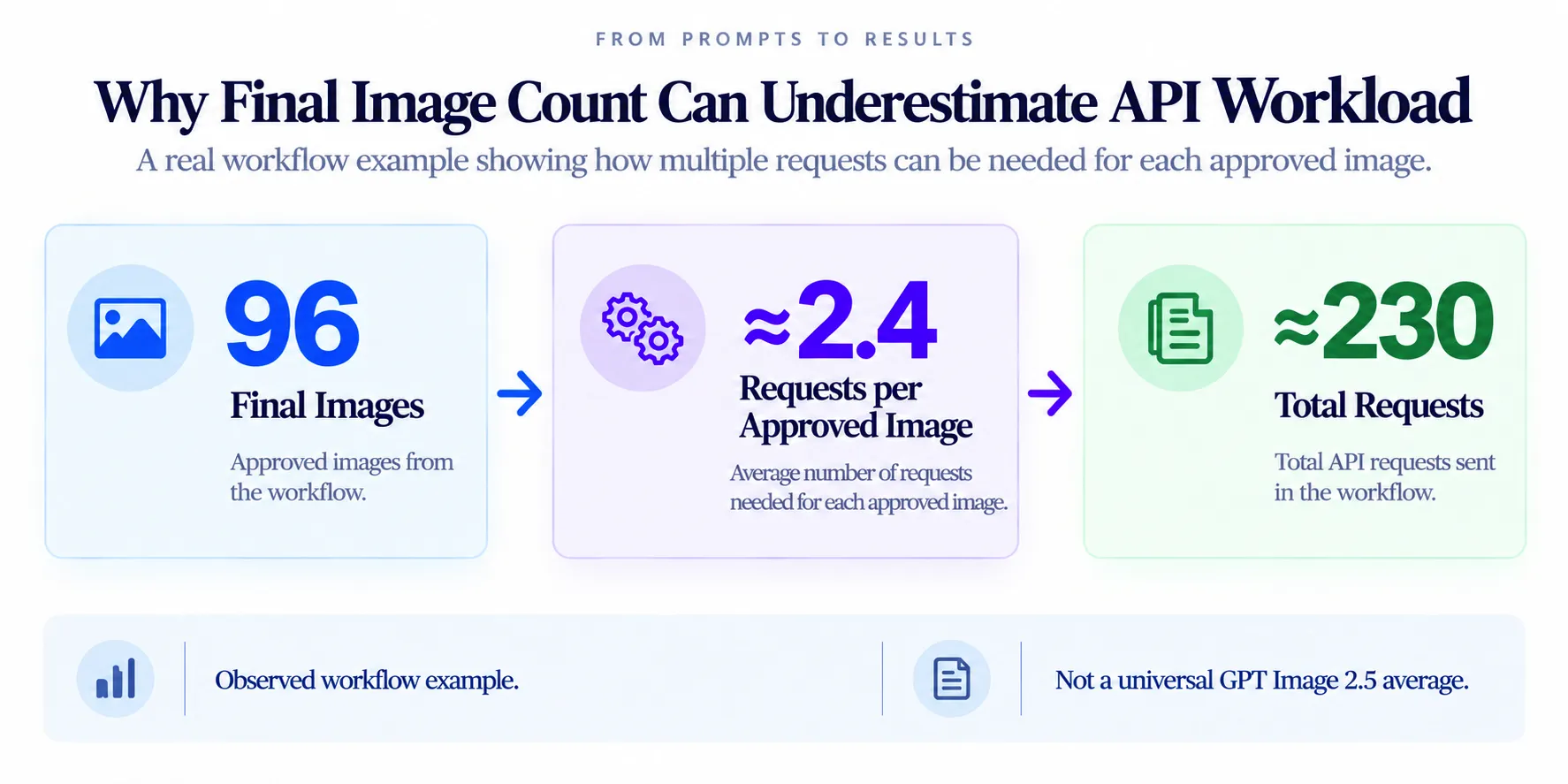
One workflow reviewed in our research produced 96 final images while averaging about 2.4 requests per approved image, resulting in roughly 230 total requests.
That case shows why final asset count alone can underestimate production cost. If an image is rejected, its API cost still exists even though it never becomes a deliverable.
How Quality and Reference Images Change GPT Image 2.5 Cost
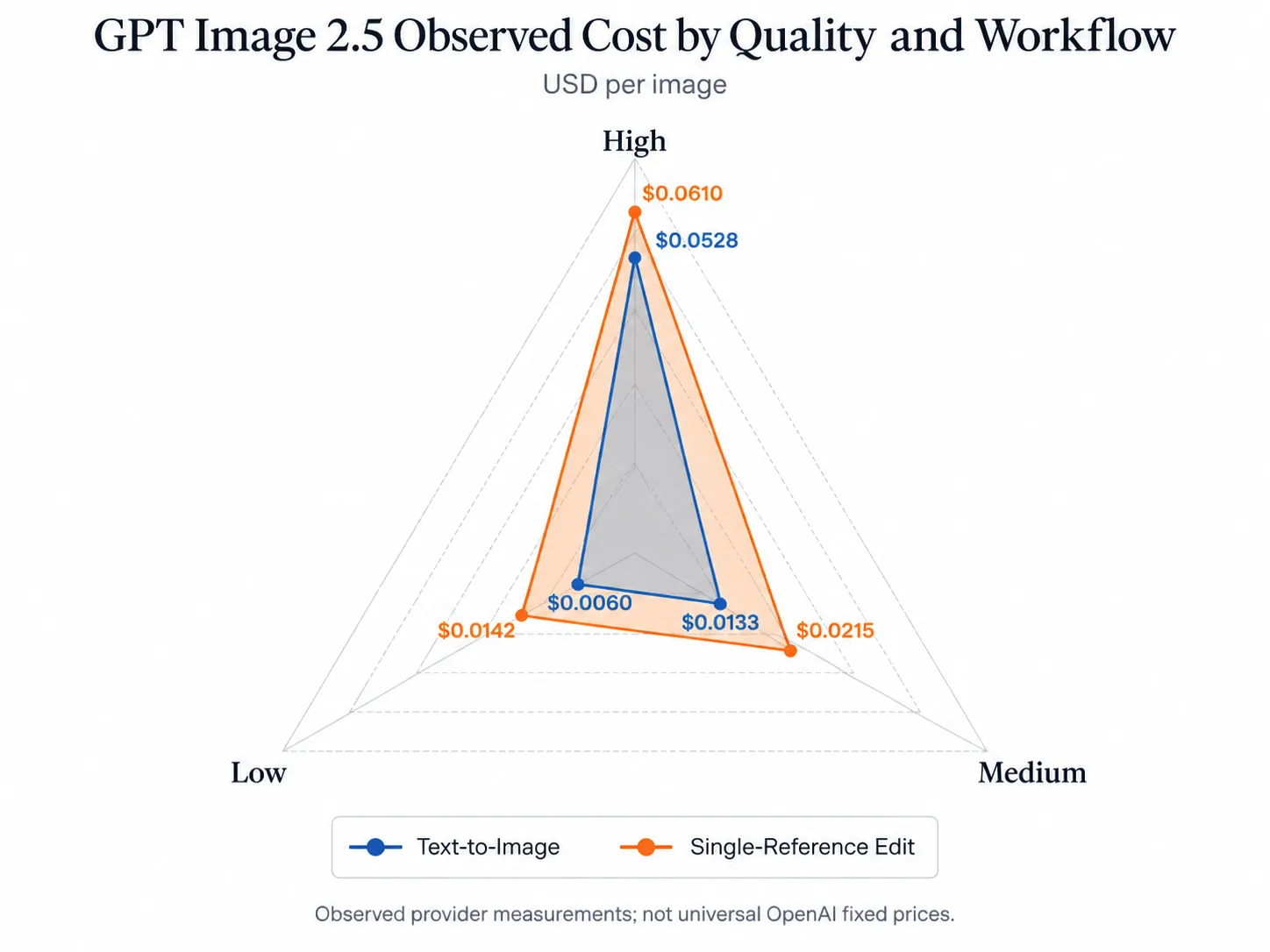
Observed provider measurements also show how sharply cost can change with quality and editing.
For a 1024×1024 GPT Image 2.5 request, one measured endpoint dataset reported:
| Quality | Text-to-Image | Single-Reference Edit |
|---|---|---|
| Low | $0.0060 | $0.0142 |
| Medium | $0.0133 | $0.0215 |
| High | $0.0528 | $0.0610 |
These are observed provider measurements, not universal OpenAI fixed per-image prices. The editing tests included a single reference image, so additional references can raise input cost further.
The takeaway is more important than any individual number: quality and reference inputs can materially change real cost per generation even when the underlying token rates stay the same. This is also why developers comparing the cheapest image API need to account for editing, references, retries, and accepted-output rates rather than comparing only headline prices.
GPT Image 2.5 Flare vs Sunburst Pricing
Flare and Sunburst use the same token pricing, but their production economics can differ because they optimize for different workflows.
| Factor | Flare | Sunburst |
|---|---|---|
| Token rates | Same | Same |
| Main priority | Speed and throughput | Precision and control |
| Best fit | Drafts, variants, prototypes | Final assets, detailed edits |
| Generation time | Generally lower | Generally higher |
| Premium token rate | No | No |
GPT Image 2.5 Flare: Faster for High-Volume Work
OpenAI positions Flare as the default GPT Image 2.5 model for most applications, including creator content, product experiences, visual search, rapid prototyping, and high-volume generation.
OpenAI reports up to 50% lower latency than GPT Image 2, and one early evaluation reported Flare completing its tested workloads at roughly 2–4× the speed of GPT Image 2.
These are latency and workflow observations, not a 50% reduction in official API pricing.
Flare's potential economic advantage comes from faster iteration and, in some observed workflows, lower total generation cost—not a lower token rate.
GPT Image 2.5 Sunburst: Precision Can Reduce Rework
Sunburst targets workflows where editing precision, reference fidelity, and final-output control matter more than raw throughput.
Typical examples include polished product imagery, campaign creative, complex references, and edits where changing the wrong element forces another generation.
Because Sunburst uses the same token rates as Flare, the decision should not be based on a supposed premium token price. Instead, measure whether its precision reduces retries and API costs, failed edits, rejected assets, and reviewer time.
That leads to the central pricing insight:
Same token rate does not mean the same cost per usable image.
GPT Image 2.5 Real-World Cost and Speed Case Studies
Official pricing tells you how billing works. It does not show what happens inside a real production workflow.
Our research reviewed reported workflows to understand how cost, latency, and task type interact. These cases are observational evidence, not universal OpenAI benchmarks.
Case 1: Flare Medium for UI Draft Generation
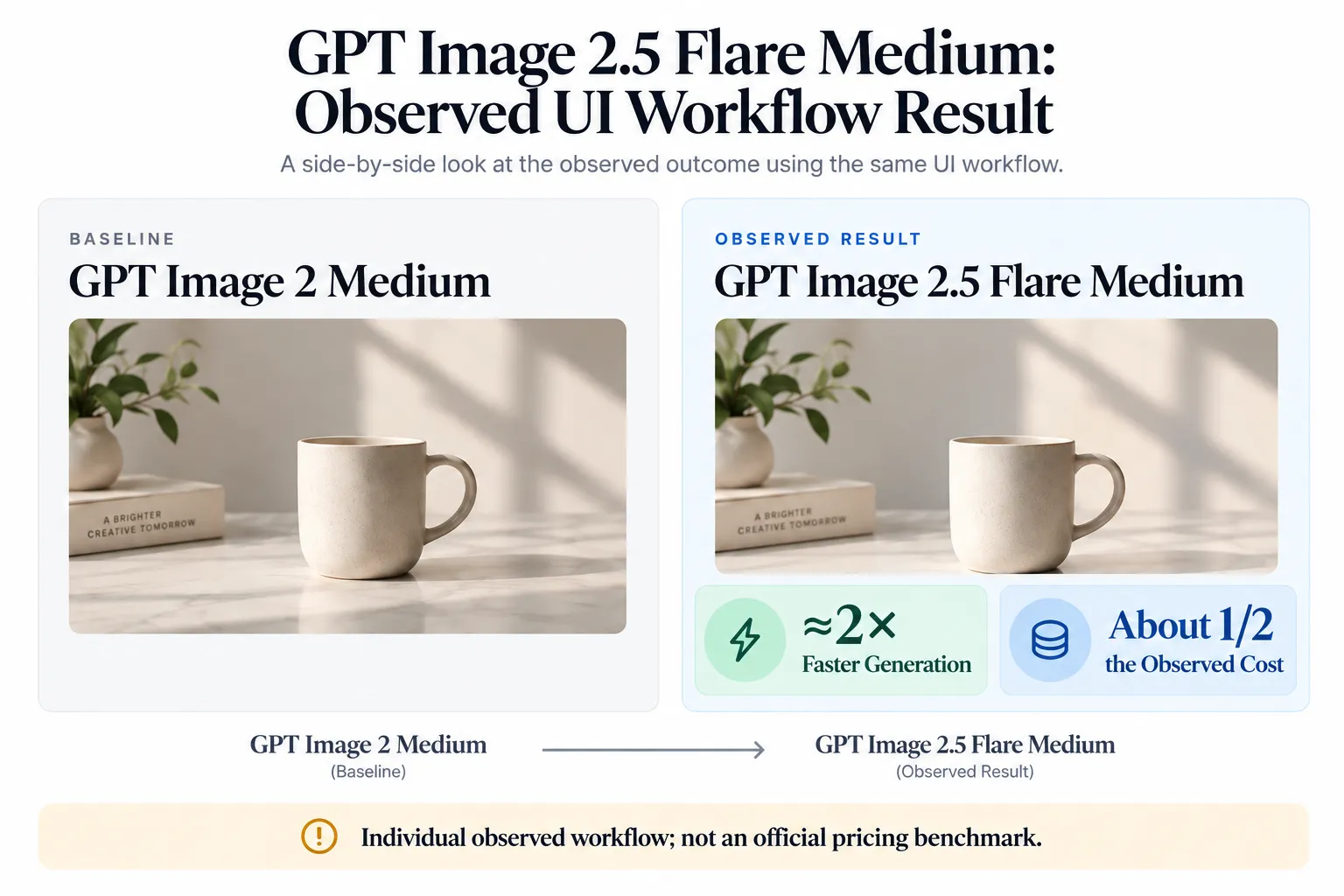
In one UI-generation workflow, moving from GPT Image 2 Medium to GPT Image 2.5 Flare Medium produced approximately:
2× faster generation and about half the observed cost.
The workflow focused on repeated UI drafts, where rapid iteration mattered more than maximum final-image precision.
This does not mean Flare's official pricing is 50% lower. It shows that the same listed token rates can still produce different effective economics for a specific workload.
Case 2: Sunburst at About $0.049 for a Complex Image
A separate complex reference and reconstruction workflow using Sunburst recorded:
33.6 seconds and approximately $0.049 for the observed image.
The $0.049 figure is not a universal Sunburst price. It is a single workload result affected by its specific inputs and token usage.
Its value is as a realistic reference point showing why production teams should log actual API consumption rather than assume one fixed cost per image.
Case 3: 177 Seconds vs 22 Seconds vs 48 Seconds
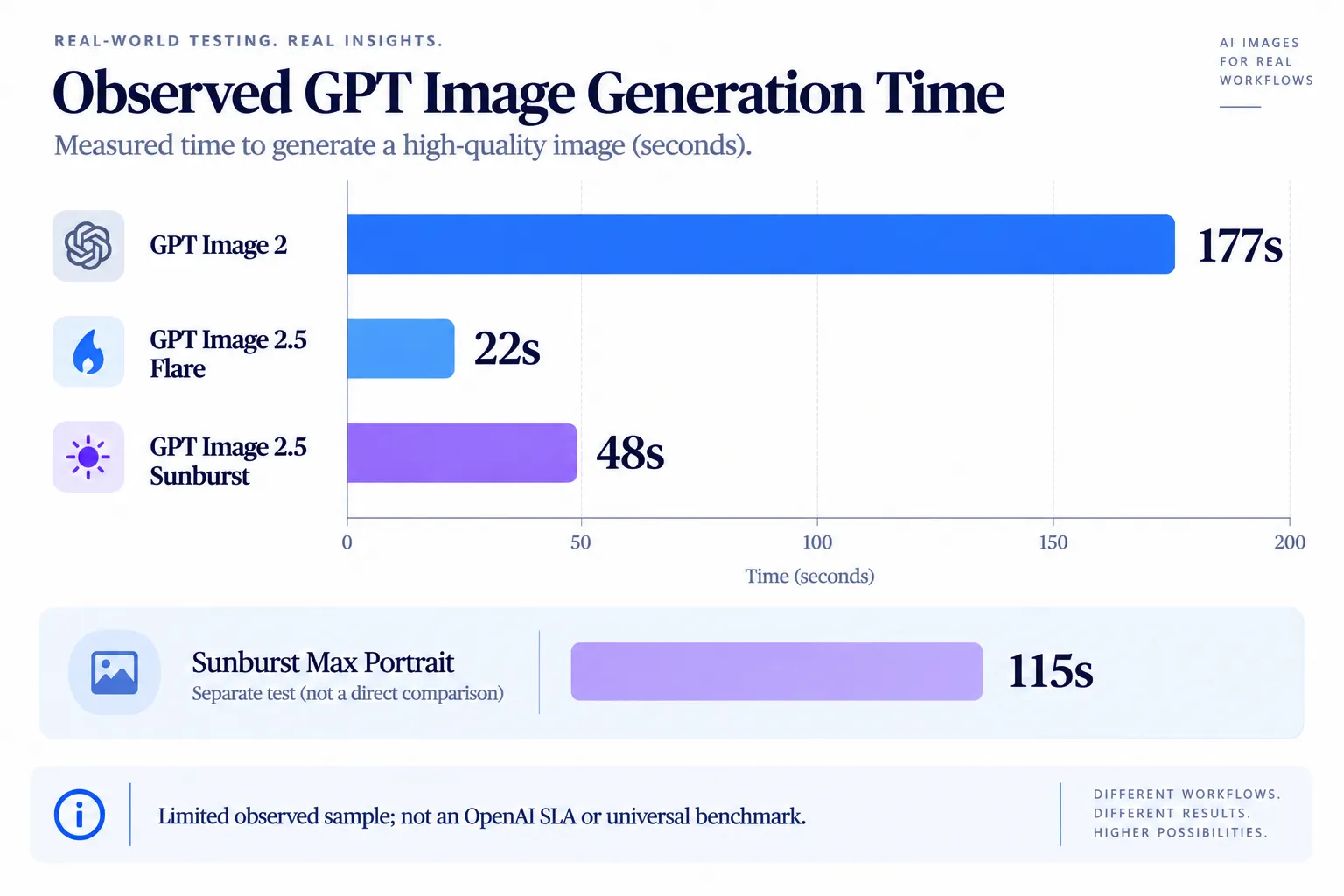
Another High-quality text-to-image comparison recorded:
| Model | Observed Time |
|---|---|
| GPT Image 2 | 177s |
| Flare | 22s |
| Sunburst | 48s |
A Sunburst Max portrait in the same research set took approximately 115 seconds.
This was a limited sample rather than an SLA or large-scale benchmark, but it follows the broader pattern: Flare prioritizes throughput, while Sunburst is positioned for precision-oriented work with longer generation times. For production systems, this makes AI API latency an important metric alongside token pricing.
How to Calculate Your Real GPT Image 2.5 API Cost
The strongest GPT Image 2.5 cost model starts with actual production data rather than a generic per-image estimate.
Track Cost, Retries, and Acceptance Rate
Record input tokens, output tokens, total generations, editing calls, approved images, and generation time for each workload.
Then compare:
Cost per generated image = Total API spend ÷ Total generated images
and:
Cost per accepted image = Total API spend ÷ Approved images
The second metric is generally more useful for production planning.
For example, if your own workload matched the 2.4 requests per approved image observed in the case above, producing 1,000 approved images would require about 2,400 requests. This is an illustrative projection from that specific ratio, not a universal GPT Image 2.5 average.
Benchmark Flare and Sunburst Under Identical Conditions
Use the same prompts, reference images, output requirements, quality settings, and approval criteria.
Then compare:
Request cost → Retry rate → Acceptance rate → Cost per accepted image
This prevents a fast or inexpensive generation from looking artificially attractive when it creates more rejected assets downstream.
GPT Image 2.5 API Pricing on LinkModel
LinkModel currently offers both GPT Image 2.5 Flare and Sunburst at 75% of OpenAI's corresponding token rates.
| Token Type | OpenAI | LinkModel |
|---|---|---|
| Text input | $5.00/M | $3.75/M |
| Cached text | $1.25/M | $0.9375/M |
| Image input | $8.00/M | $6.00/M |
| Cached image | $2.00/M | $1.50/M |
| Image output | $30.00/M | $22.50/M |
That represents a 25% discount on equivalent listed token pricing.
For production workloads, the saving applies across generation, image inputs, cached inputs, and output usage. LinkModel also provides one OpenAI-compatible API, one API key, and unified billing across supported models, so teams can move between Flare, Sunburst, and other supported AI models based on price, quality, performance, and availability without rebuilding integrations.
Third-Party GPT Image 2.5 Pricing: Why Sticker Prices Need Context
Third-party platforms sometimes convert token billing into a simpler per-image price, but those offers should not be confused with OpenAI's official token pricing.
Atlas Cloud GPT Image 2.5 Pricing
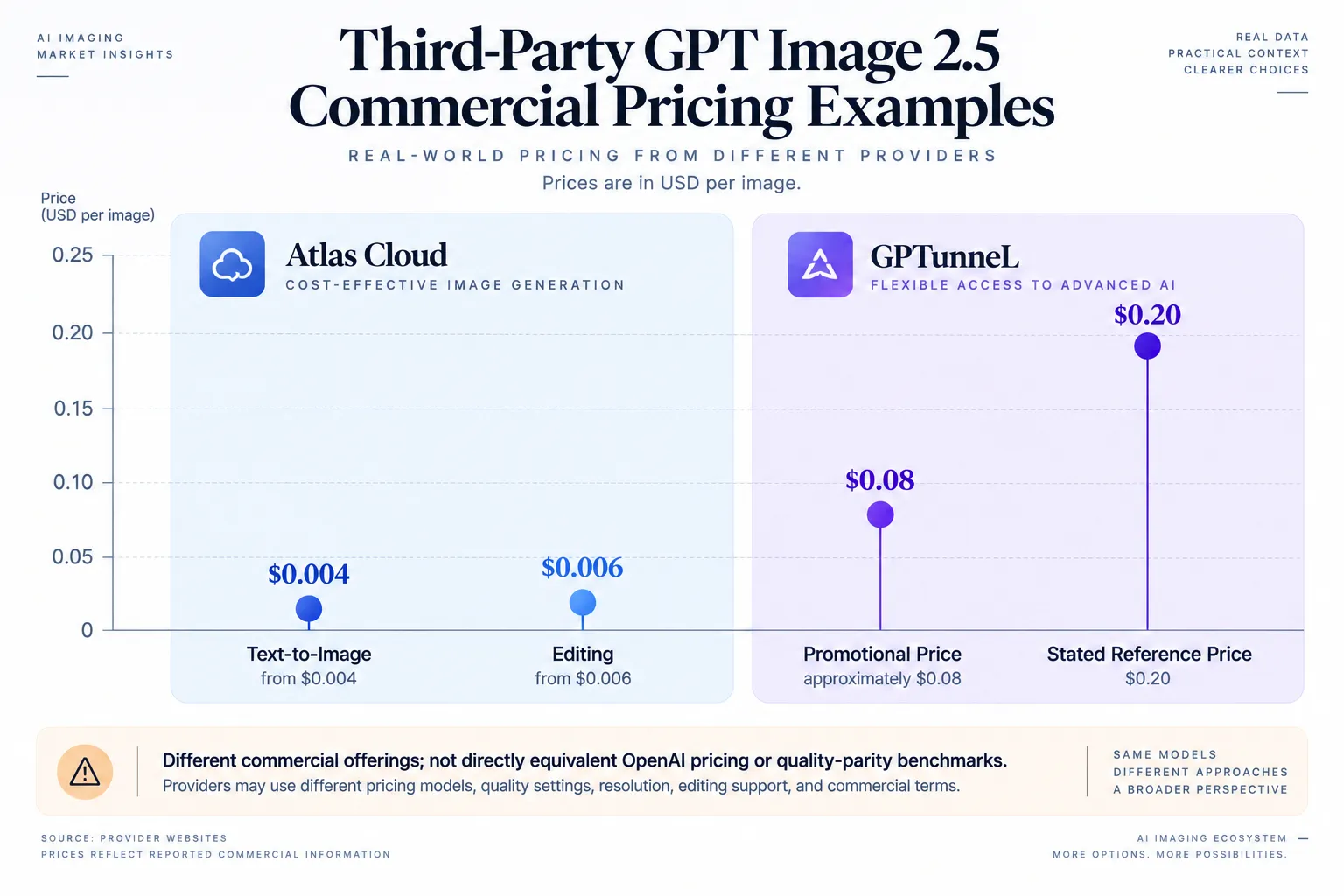
Atlas Cloud pricing currently lists GPT Image 2.5 Flare and Sunburst text-to-image generation from about $0.004 per image and editing from about $0.006 per image.
These are provider starting prices. They should not be treated as universal prices for every resolution, quality level, reference count, or workload when making an AI API pricing comparison.
GPTunneL GPT Image 2.5 Pricing
Our provider research also identified a GPTunneL commercial offering at approximately $0.08 per image during a promotion, with a stated $0.20 reference price.
That offering uses GPTunneL's own product packaging and should not be described as OpenAI's official GPT Image 2.5 per-image rate.
When comparing third-party providers, verify model parity, quality, resolution, reference support, editing capabilities, throughput, and whether the advertised price is promotional.
The cheapest sticker price is not necessarily the lowest production cost.
How to Reduce GPT Image 2.5 API Cost
The most effective cost strategy is to optimize for usable output rather than cheap individual requests.
Use Flare for High-Throughput Generation
Flare is the stronger starting point for rapid iteration, UI drafts, social creative, visual variants, prototyping, and other latency-sensitive workloads.
Its faster generation profile can make large-scale exploration more efficient before committing resources to final assets.
Use Sunburst When Precision Can Reduce Retries
Sunburst is worth benchmarking when errors are expensive, particularly for faces, products, characters, complex references, and multi-step edits.
If better preservation or editing precision reduces failed attempts, the slower workflow can still produce a lower final cost.
The decision should therefore be:
Which workflow produces an approved asset at the lowest total cost?
Not simply:
Which request has the lowest advertised price?
FAQ
How much does GPT Image 2.5 cost?
OpenAI pricing is $5/M text input, $8/M image input, and $30/M image output tokens. Cached text input is $1.25/M and cached image input is $2/M. Flare and Sunburst use the same official rates.
How much is GPT Image 2.5 per image?
There is no universal official fixed price per image. Actual cost depends on token consumption, quality, references, editing, and retries. Observed per-image costs are workload-specific rather than universal pricing.
Is Flare cheaper than Sunburst?
Not by official token rate. Their listed pricing is identical. Flare can be more economical for throughput-heavy workflows, while Sunburst may reduce total cost when greater precision prevents retries and rejected outputs.
Does Flare cost 50% less?
No. The 50% figure refers to lower latency versus GPT Image 2, not a 50% reduction in token pricing. Flare's cost advantage, when observed, comes from workload economics rather than a cheaper official token rate.
Which GPT Image 2.5 model should I use?
Start with Flare for high-volume generation, rapid iteration, and latency-sensitive applications. Benchmark Sunburst for precision editing, complex references, polished product imagery, and workflows where retry cost is high. For production decisions, compare cost per accepted image rather than cost per request.
Conclusion
GPT Image 2.5 pricing is $5/M text input, $8/M image input, and $30/M image output on OpenAI, with identical official token rates for Flare and Sunburst, but those rates alone do not determine the real cost of a finished asset. Quality, reference inputs, actual token consumption, editing, retries, latency, and acceptance rate can materially change production economics. Flare is the stronger starting point for fast, high-volume workflows, while Sunburst is worth testing when precision can reduce expensive rework. LinkModel currently offers both models at 75% of OpenAI's corresponding token rates, but regardless of provider, the most useful pricing KPI is total cost per accepted image.