GLM 5.3 Flash is the better starting point for affordable everyday coding, multimodal applications, and high-volume automation, while GLM 5.3 is worth considering for complex debugging, architecture decisions, and demanding coding agents. At official API list prices, GLM 5.3 costs 9.33 times more per input token and 8.8 times more per output token. But is the full model actually worth paying approximately nine times more for?
The answer depends on the work you're doing. A cheaper model can become expensive when it repeatedly fails tests, forgets context, or requires developer intervention. Meanwhile, the Flash name does not guarantee faster responses. The most useful comparison is therefore not just benchmark scores or token prices, but how reliably each model completes your task and how much you spend to get an acceptable result.
On LinkModel, both GLM 5.3 and GLM 5.3 Flash are available at 10% below Z.ai's standard API list prices, with pay-as-you-go billing, no minimum spend, and no monthly platform fee. New users automatically receive $1 in free Credits upon registration—no credit card or deposit required. These Credits never expire and can be used across all models currently available on LinkModel; the offer is limited to new users and cannot be claimed repeatedly by existing users. Compare both GLM models in the Playground, start with Flash for everyday coding, and upgrade to GLM 5.3 when stronger reasoning is worth the extra cost.

GLM 5.3 vs GLM 5.3 Flash: Key Differences
The main difference between GLM 5.3 and GLM 5.3 Flash is their balance of reasoning performance, multimodal capabilities, and API cost. GLM 5.3 targets demanding software engineering and complex agent workflows. GLM 5.3 Flash prioritizes cost-efficient coding, visual understanding, and high-volume execution.
Both offer up to one million tokens of context, up to 128,000 output tokens, reasoning-effort controls, and function calling. However, their supported inputs and pricing differ.
GLM 5.3 vs Flash at a Glance
| Feature | GLM 5.3 | GLM 5.3 Flash |
|---|---|---|
| Primary position | Flagship reasoning model | Cost-efficient multimodal model |
| Best starting use | Complex coding and debugging | Routine coding and visual tasks |
| Input modalities | Text | Text, images, video, files |
| Output modality | Text | Text |
| Context window | Up to 1M tokens | Up to 1M tokens |
| Maximum output | Up to 128K tokens | Up to 128K tokens |
| Reasoning | Always enabled | Always enabled |
| Reasoning effort | Low, high, max | Low, high, max |
| Function calling | Supported | Supported |
| Context caching | Supported | Supported |
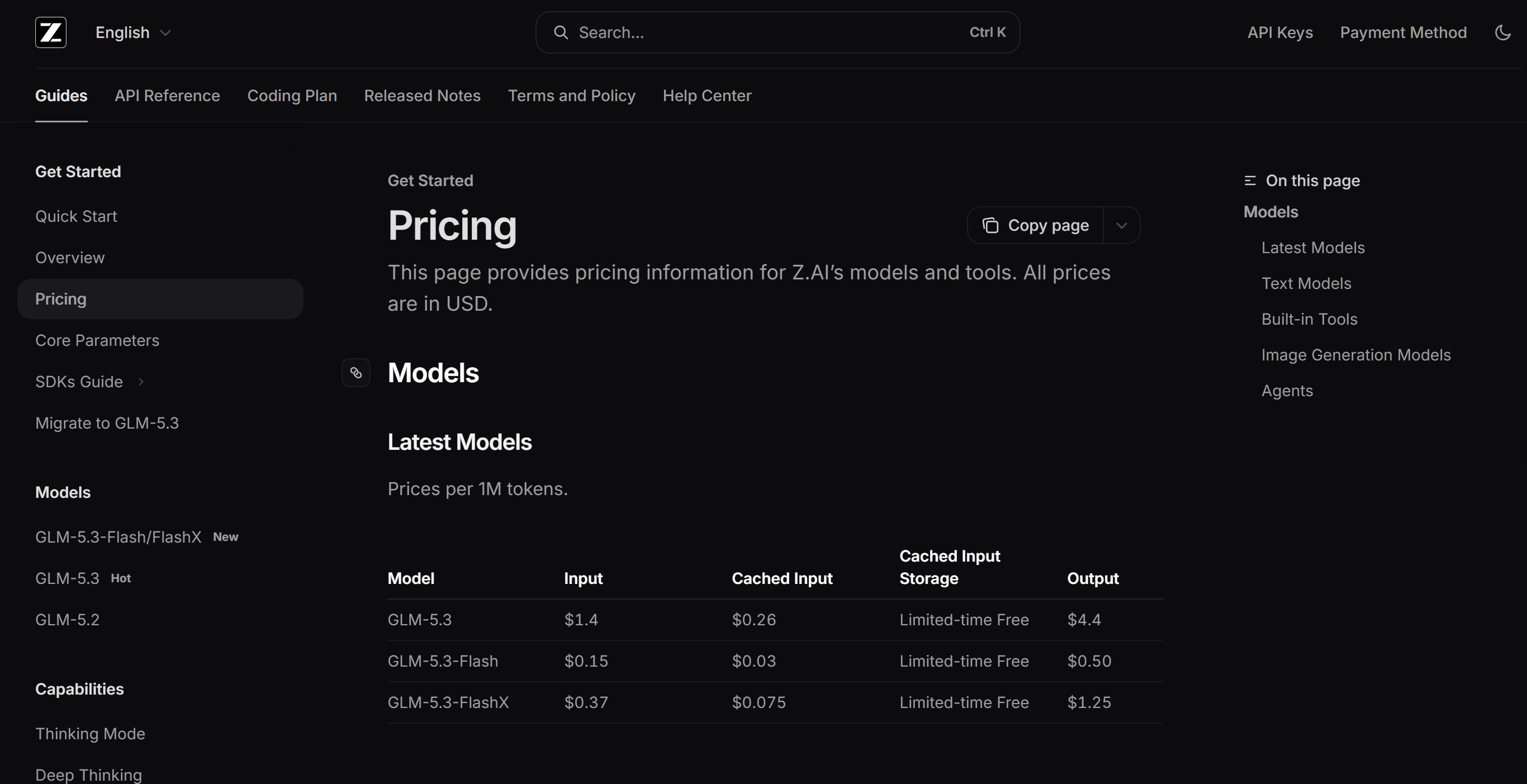
| Official input / 1M tokens | $1.40 | $0.15 |
| Official output / 1M tokens | $4.40 | $0.50 |
Specifications and prices are available in Z.ai's official pricing documentation and the published model descriptions.
A practical distinction is that Flash can interpret visual inputs directly. GLM 5.3 remains a text-focused model, making it more appropriate when the difficult part of a task is reasoning over code, logs, specifications, and dependencies.
Neither model should be selected based solely on its context-window size. A model's ability to accept a million tokens does not guarantee perfect instruction retention or retrieval accuracy throughout a long agent session.
Architecture and Multimodal Capabilities
GLM 5.3 builds on the GLM 5.2 base model, with improvements focused on post-training for complex engineering and long-horizon tasks. Its intended strengths include navigating existing environments, handling dependencies, executing tools, and validating changes.
GLM 5.3 Flash uses a mixture-of-experts architecture with approximately 320 billion total parameters and 18 billion active parameters per token. It is designed for efficient inference while supporting text, images, video, and file inputs.
This makes Flash particularly relevant to visual coding workflows.
For example, consider a frontend developer fixing a responsive layout:
1. Supply a screenshot showing a mobile navigation menu overlapping the page content.
2. Ask Flash to identify the visible problem and inspect the relevant CSS and component files.
3. Generate a code change that addresses the layout issue.
4. Render the updated page and inspect a new screenshot.
5. Validate the result against the original requirements.
This is a practical workflow supported by the model's visual-input capabilities, although individual tool integrations and application permissions still need to be configured.
GLM 5.3 is a stronger candidate for the text-based parts of the same project when the problem requires difficult root-cause analysis or architectural reasoning.
Decision: Choose Flash when native visual understanding is essential. Prioritize GLM 5.3 when complex reasoning over code and dependencies is the primary challenge.
API Pricing: What Does the 9× Gap Really Mean?
GLM 5.3 Flash is approximately nine times cheaper per standard API token than GLM 5.3, but the savings on a completed task depend on token consumption, caching, retries, and output quality.
For a controlled workload using identical input and output token quantities, Flash has a substantial and directly calculable pricing advantage.
Official API Pricing vs LinkModel Pricing
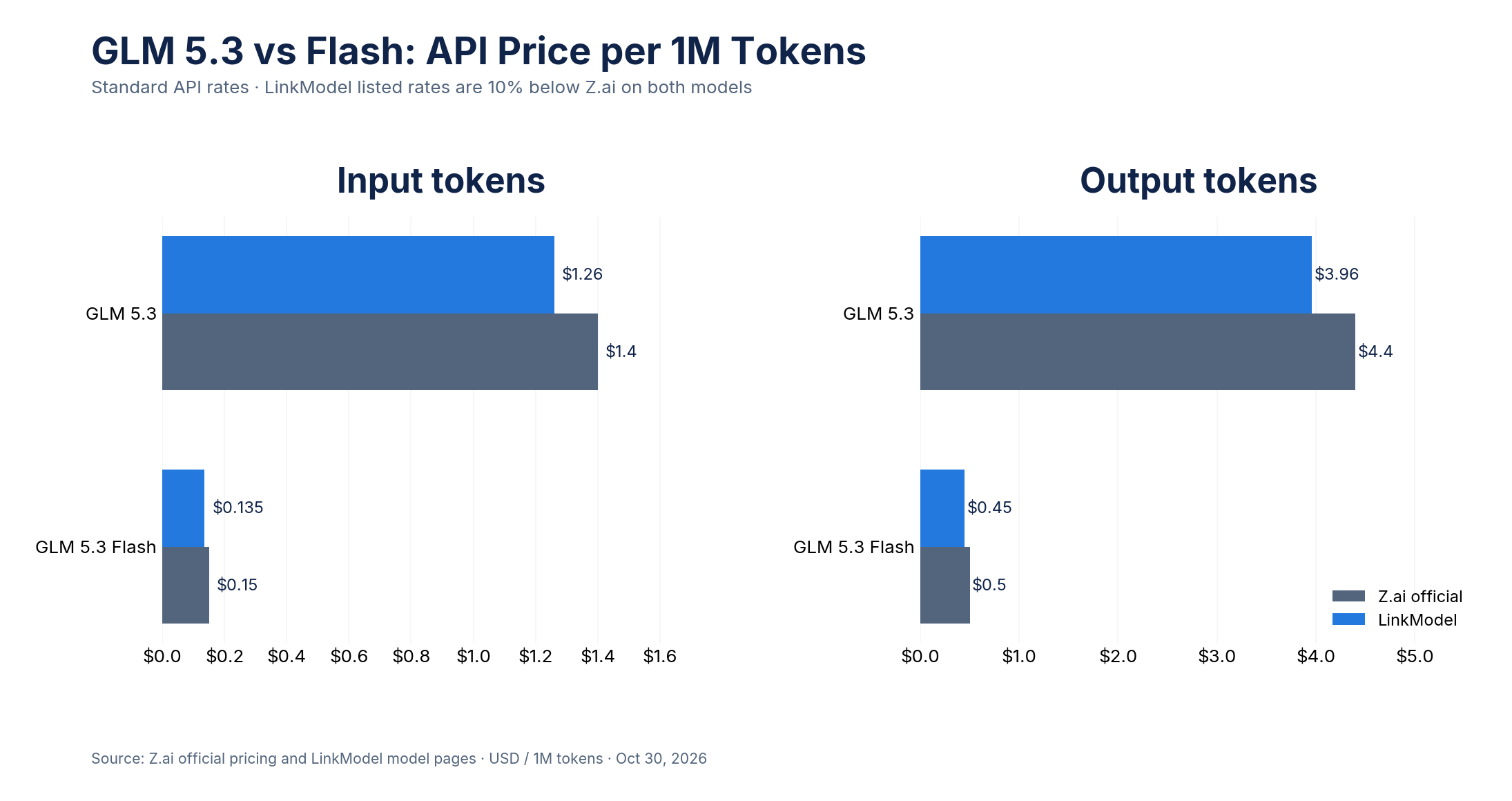
All prices are in USD per one million tokens.
| Model and token category | Z.ai Standard API | LinkModel |
|---|---|---|
| GLM 5.3 input | $1.40 | $1.26 |
| GLM 5.3 cached input | $0.26 | $0.234 |
| GLM 5.3 output | $4.40 | $3.96 |
| GLM 5.3 Flash input | $0.15 | $0.135 |
| GLM 5.3 Flash cached input | $0.03 | $0.027 |
| GLM 5.3 Flash output | $0.50 | $0.45 |
The rates are published on the GLM 5.3 model page and GLM 5.3 Flash model page.
For both models, LinkModel's displayed token prices are 10% below Z.ai's standard API list prices.
How Much Does a Coding Request Cost?
Consider a coding request with 100,000 fresh input tokens and 10,000 output tokens.
The calculation is:
Request cost = (Fresh input tokens ÷ 1M × input rate) + (Output tokens ÷ 1M × output rate)
| Provider | GLM 5.3 | GLM 5.3 Flash |
|---|---|---|
| Z.ai Standard API | $0.1840 | $0.0200 |
| LinkModel | $0.1656 | $0.0180 |
Under these assumptions, using Flash through LinkModel reduces the per-request API cost by approximately 89.1% compared with GLM 5.3.
For 1,000 requests with the same token quantities, the calculated costs are:
- GLM 5.3: $165.60
- GLM 5.3 Flash: $18.00
- Difference: $147.60
The calculation assumes equal billed token consumption, no cached inputs, and no additional billable services. Actual reasoning-token consumption and output length can vary between models.
This is particularly important for coding agents, where a task may involve multiple tool calls and generated responses rather than one request.
Does Context Caching Change the Economics?
Yes. Repeated prompt prefixes, repository instructions, and conversation history may qualify for cached-input billing when caching conditions are met.
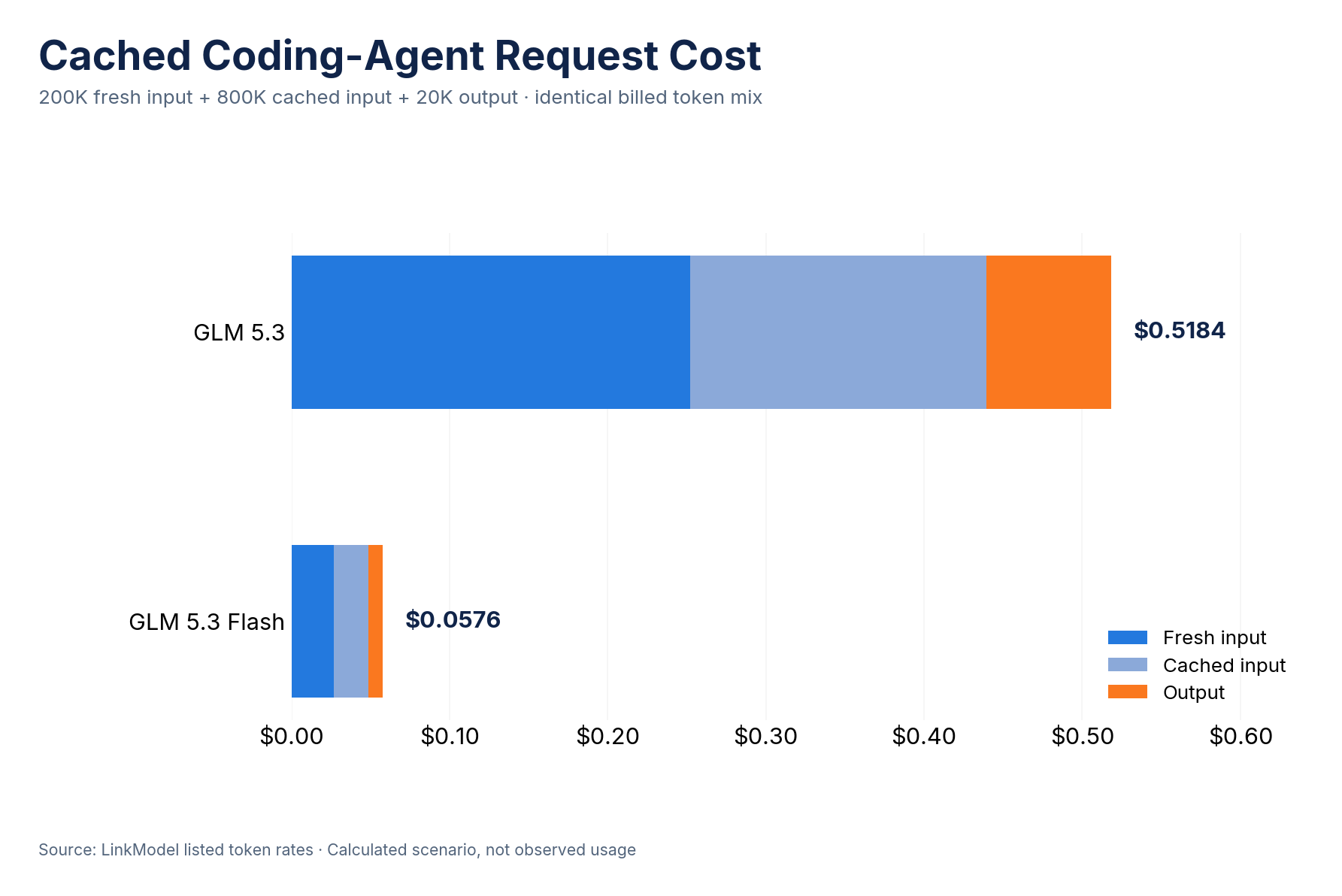
Consider a separate coding-agent request containing:
- 200,000 fresh input tokens
- 800,000 cached input tokens
- 20,000 output tokens
Using LinkModel's published rates:
| Cost component | GLM 5.3 | GLM 5.3 Flash |
|---|---|---|
| Fresh input | $0.2520 | $0.0270 |
| Cached input | $0.1872 | $0.0216 |
| Output | $0.0792 | $0.0090 |
| Total | $0.5184 | $0.0576 |
Flash costs exactly one-ninth of the flagship in this particular token mix.
However, caching savings depend on actual cache hits. Sending similar prompts does not automatically guarantee that every repeated token receives cached pricing.
For accurate budgeting, record fresh input, cached input, and output tokens separately.
Decision: Flash offers a major API-price advantage for repetitive, high-volume workloads. Whether that advantage survives complicated tasks depends on how many tokens and attempts are needed to finish successfully.
Coding Performance: Benchmarks and Real Developer Experience
GLM 5.3 is better positioned for difficult reasoning-intensive coding, while GLM 5.3 Flash has demonstrated competitive coding and agent capabilities at substantially lower token prices. The performance gap is task-dependent rather than a fixed percentage.
That distinction matters because a benchmark result, successful feature implementation, and production debugging reliability measure different aspects of coding quality.
What Do Published Coding Benchmarks Show?
Z.ai's published results provide useful evidence of each model's capabilities, although individual evaluation setups must be considered before treating two scores as a controlled head-to-head comparison.
| Evaluation | GLM 5.3 | GLM 5.3 Flash |
|---|---|---|
| DeepSWE v1.1 | 66.9 | 63.4 |
| Terminal-Bench 2.1 | 88.2 | 84.3 |
These reported scores favor GLM 5.3 on the two displayed coding evaluations.
The DeepSWE figures indicate a 3.5-point difference, while the Terminal-Bench 2.1 figures indicate a 3.9-point difference. Those are differences in reported benchmark scores, not measured percentage improvements in your coding productivity.
The scores should be read alongside the model release materials and their evaluation conditions. They do not establish that either model will achieve the same success rate in a particular repository.
Flash has also reported strong results on agent-oriented benchmarks, including:
- Toolathlon Verified: 78.4
- AutomationBench v1.0.6: 48.8
- NL2Repo: 56.3
These Flash results appear in the published model materials and demonstrate capabilities beyond simple code completion. They should not be interpreted as direct victories over GLM 5.3 without equivalent flagship evaluation results under matched conditions.
The useful conclusion is not that the full model wins every benchmark. It is that the flagship's coding advantage must be weighed against Flash's much lower API price and its capabilities on practical automation tasks.
Can GLM 5.3 Flash Handle Large Production Codebases?
Yes, there is developer-reported experience supporting its use in large production repositories.
In an October 2026 discussion, a developer described using GLM 5.3 Flash internally for software engineering across projects totaling millions of lines of code.
The developer's reported work included repository exploration, understanding existing architecture, tracing code through modules, implementing features, and refactoring.
The most important detail is that Flash was reportedly carrying out day-to-day development tasks rather than being used only as a low-cost fallback.
The original developer discussion about production codebases provides more context about the experience.
What changed: The developer reported using Flash for substantial day-to-day production coding instead of relying on more expensive frontier models for that workflow.
What the report establishes: Flash can be useful in large, real software projects, including repository-level work.
What it does not establish: The report does not provide standardized task-success rates, a before-and-after engineering budget, or measured savings across a controlled task set.
For teams working with large repositories, this supports evaluating Flash on actual feature implementation and code navigation rather than dismissing it based on its price tier.
When Is GLM 5.3 Better for Difficult Debugging?
GLM 5.3 becomes more attractive when a task requires identifying the underlying cause of a failure rather than repeatedly modifying code until tests pass.
Consider a distributed application where an intermittent bug affects several components. An agent must trace state transitions, understand dependencies, analyze logs, and distinguish the root cause from symptoms.
A lower-cost model may implement straightforward fixes efficiently. But if repeated changes fail to address the actual problem, paying for stronger reasoning may reduce rework.
A developer discussing the two models described a mixed approach: Flash for most daily tasks, with GLM 5.3 used for additional review. That workflow is also relevant to teams that want to separate implementation from more demanding diagnosis and verification.
The GLM 5.3 versus Flash developer discussion offers an example of this division of work.
Decision: Start with Flash for conventional implementation and repository exploration. Consider GLM 5.3 when a difficult issue remains unresolved, architectural consequences are significant, or review quality is more important than minimizing API spend.
Agent Reliability, Long Context, and Speed
Agent reliability depends on successful multi-step execution, not merely on a model's context limit or response quality in a single prompt. Both GLM models can support long-running workflows, but neither should be assumed to execute every task without human intervention.
Three factors matter most: whether the model stays on task, how accurately it manages accumulated context, and how long successful execution takes.
What Do Developers Report About Flash Reliability?
Feedback about GLM 5.3 Flash is mixed.
One production developer reported that Flash handled large repositories, architectural exploration, and implementation work with relatively little manual guidance.
In contrast, another developer described a period of disappointing reliability in a large codebase. The user reported careless mistakes, forgetting information discussed in the same session, and occasionally needing five to seven attempts to resolve bugs.
The original discussion about Flash reliability also identifies an important usage detail: the author was using a Z.ai subscription rather than reporting a controlled comparison across identical API endpoints.
That matters because reported performance may depend on reasoning settings, inference infrastructure, context management, and other serving conditions.
The five-to-seven-attempt experience should not be treated as a general model failure rate. It is evidence of a concrete problem a developer encountered.
The two experiences are compatible: Flash can deliver substantial value on some production workflows while performing poorly on particular complicated or long-running tasks.
For autonomous development, teams should prioritize observable completion criteria over model reputation.
Does a 1M-Token Context Window Prevent Forgotten Instructions?
No. A one-million-token context window describes the supported input capacity, not a guarantee of accurate retrieval or consistent reasoning across the entire history.
A coding agent may accumulate repository excerpts, shell outputs, error logs, tool responses, and task revisions. Even when those messages fit in the context window, important requirements can be overlooked.
A more reliable workflow uses stable project instructions, a compact record of decisions, explicit acceptance criteria, and repository tools to retrieve relevant files when needed.
For example, an agent implementing authentication changes should preserve the requirement that existing login behavior must remain compatible. Repeating an entire conversation does not necessarily protect that requirement as effectively as an explicit validation check.
The practical question is whether the agent continues meeting the original specification after many steps, not simply whether the model can receive a long prompt.
Is GLM 5.3 Flash Actually Faster?
GLM 5.3 Flash is cheaper per token, but it is not necessarily faster at generating tokens.
Third-party measurements summarized by DataCamp reported output throughput of approximately 86 tokens per second for GLM 5.3 and 49 tokens per second for Flash under the referenced serving conditions.
| Metric | GLM 5.3 | GLM 5.3 Flash |
|---|---|---|
| Reported output throughput | ~86 tokens/s | ~49 tokens/s |
These results suggest the full model may deliver faster generation on some hosted endpoints despite its higher token price.
They do not mean that every GLM 5.3 deployment will be faster. Actual latency varies with provider capacity, reasoning effort, prompt length, output length, concurrency, and network conditions.
For an interactive coding assistant, response time may influence developer productivity. For background classification or batch processing, total spending may matter more than the time taken by an individual response.
Also distinguish GLM 5.3 Flash from GLM 5.3 FlashX, which is a separately priced speed-oriented variant in Z.ai's catalog.
Decision: Compare latency and cost on the same endpoint and task shape. Do not choose Flash because of its name alone.
Real Cost per Successful Task: When Does Flash Stop Being Cheaper?
Flash stops being cheaper when its cumulative API spending on failed or repeated attempts exceeds the cost of an accepted result from GLM 5.3. The exact crossover depends on token usage, task difficulty, caching, and retries.
This is why per-token pricing is only the beginning of a useful engineering-cost comparison.
Cost per Accepted Result: The Metric That Matters
An accepted coding result is one that satisfies defined criteria, such as:
- Required functionality is implemented.
- Relevant automated tests pass.
- Existing behavior is preserved.
- The implementation meets the specification.
- The changes pass the required code review.
A useful API-cost metric is:
Cost per accepted result = Total API spend across attempts ÷ Number of accepted results
For a more complete economic comparison, include developer review time, manual corrections, and other material operating costs separately.
A model that generates inexpensive but repeatedly rejected code may be less economical than a higher-priced model that delivers an acceptable solution sooner.
An Illustrative API Cost Break-Even Point
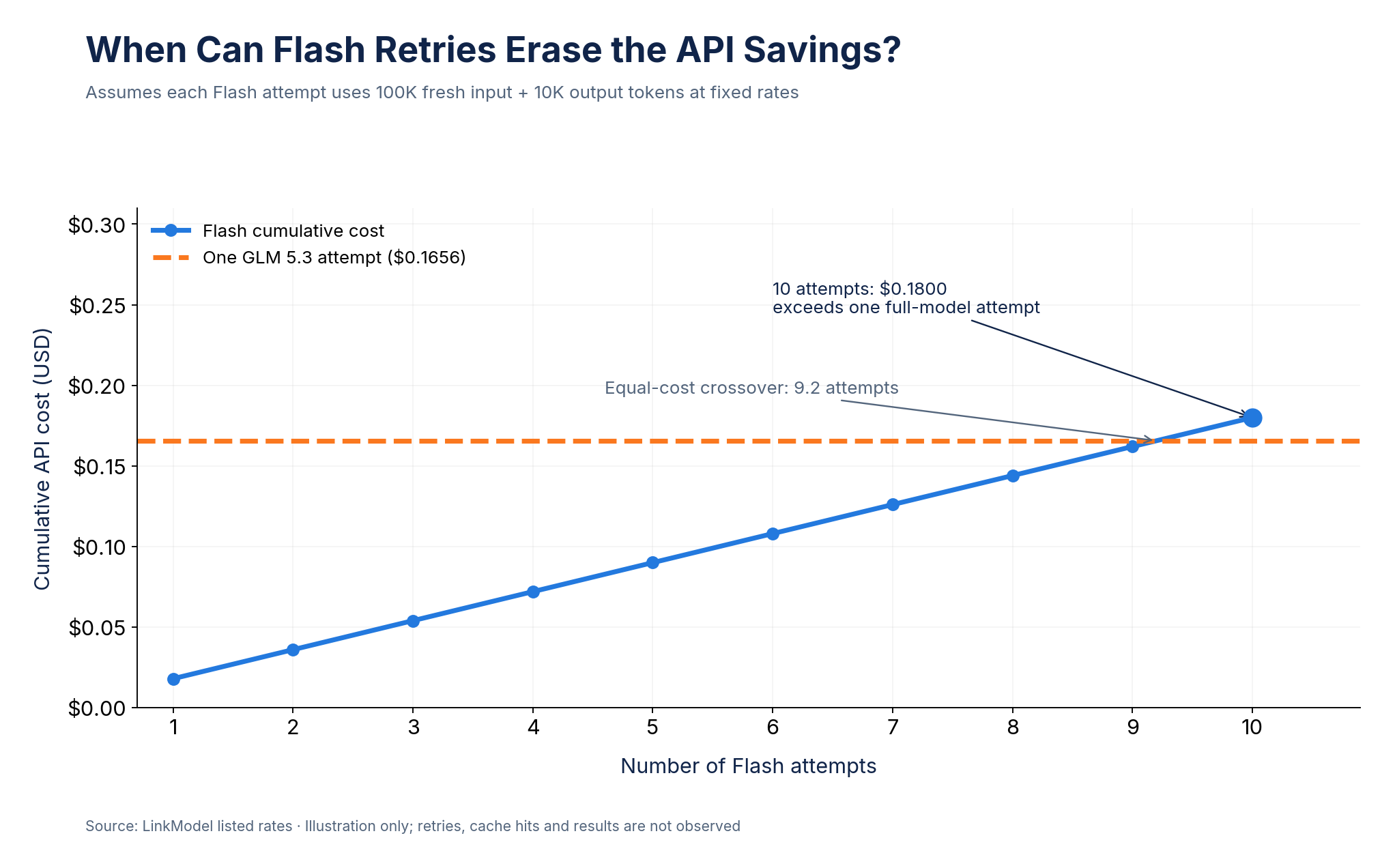
Using the earlier LinkModel request scenario of 100,000 fresh input tokens and 10,000 output tokens:
- GLM 5.3 costs $0.1656 per attempt.
- GLM 5.3 Flash costs $0.0180 per attempt.
Assume, only for this calculation, that each retry consumes exactly the same billed token quantities and rates.
| Number of attempts | Flash cost | GLM 5.3 cost |
|---|---|---|
| 1 | $0.0180 | $0.1656 |
| 3 | $0.0540 | $0.4968 |
| 5 | $0.0900 | $0.8280 |
| 7 | $0.1260 | $1.1592 |
| 10 | $0.1800 | $1.6560 |
The rows compare cumulative costs for each model performing the stated number of attempts. They do not imply that the models require equal numbers of attempts to solve the same problem.
If GLM 5.3 delivers an accepted result in one attempt, while Flash requires repeated attempts at its assumed per-attempt cost:
$0.1656 ÷ $0.0180 = 9.2
In this illustrative scenario, Flash remains below the flagship's single-attempt API cost through nine attempts, but exceeds it on the tenth.
This is an illustrative API cost break-even point, not a universal threshold for switching models.
Real retries frequently change the token mix. A later attempt might include more debugging context, longer reasoning, additional tools, or cached instructions.
The earlier cached-input example also produced a ninefold cost difference, but a different output-to-input ratio or unequal cache-hit behavior could shift the crossover significantly.
How Do Retries Affect Real Engineering Work?
Consider three common development situations.
Routine implementation: Flash completes a straightforward code change, tests pass, and the developer accepts the result. In this situation, Flash's low price offers a strong advantage.
Difficult root-cause debugging: Flash repeatedly patches symptoms without resolving the underlying issue. The flagship may become preferable if its stronger reasoning reduces unsuccessful attempts and developer corrections.
Multimodal frontend development: Flash interprets screenshots and implements visual changes, while the flagship handles demanding text-based architecture review. A hybrid approach allocates model spending according to task complexity.
The most useful economic question is not simply whether GLM 5.3 produces better code on average. It is whether paying more for the full model reduces the total cost of the tasks where Flash struggles.
How to Measure Cost per Accepted Result
For an evaluation that reflects production use, select representative coding tasks and define success before running either model.
Use the same repository snapshot, task specification, tool permissions, and validation criteria. Record reasoning-effort settings and the serving endpoint.
For each execution, track fresh input tokens, cached tokens, output tokens, retries, elapsed time, automated test outcomes, and developer review time.
Then calculate cost per accepted result for each model.
This approach can reveal that Flash is economical for most tasks while the flagship is worth using for a smaller set of difficult cases.
Which Model Should You Choose? Testing Both on LinkModel
Choose GLM 5.3 Flash for cost-sensitive routine development and native visual-input tasks; choose GLM 5.3 for difficult text-based engineering problems where stronger reasoning may reduce costly rework. If your workload includes both, a mixed-model workflow is a practical starting strategy.
Model Selection by Workload
| Workload | Recommended starting point | Why |
|---|---|---|
| Routine code editing | GLM 5.3 Flash | Lower API cost |
| Repository exploration | GLM 5.3 Flash | Economical long-context processing |
| High-volume extraction | GLM 5.3 Flash | Lower input and output rates |
| Screenshot-based frontend fixes | GLM 5.3 Flash | Native visual-input support |
| Complex root-cause debugging | GLM 5.3 | Stronger difficult-coding evidence |
| Architecture planning | GLM 5.3 | More demanding reasoning requirements |
| High-impact code review | GLM 5.3 | Potential value from stronger analysis |
| Long-running autonomous agents | Evaluate both | Reliability and retries determine value |
| Mixed engineering workloads | Flash + GLM 5.3 | Allocate spending by task difficulty |
For a team primarily handling routine code changes and feature implementation, Flash is the economical default.
For a team facing frequent complex debugging, difficult architecture decisions, and expensive failed iterations, the flagship should receive greater priority in the evaluation process.
When Should You Upgrade from Flash to GLM 5.3?
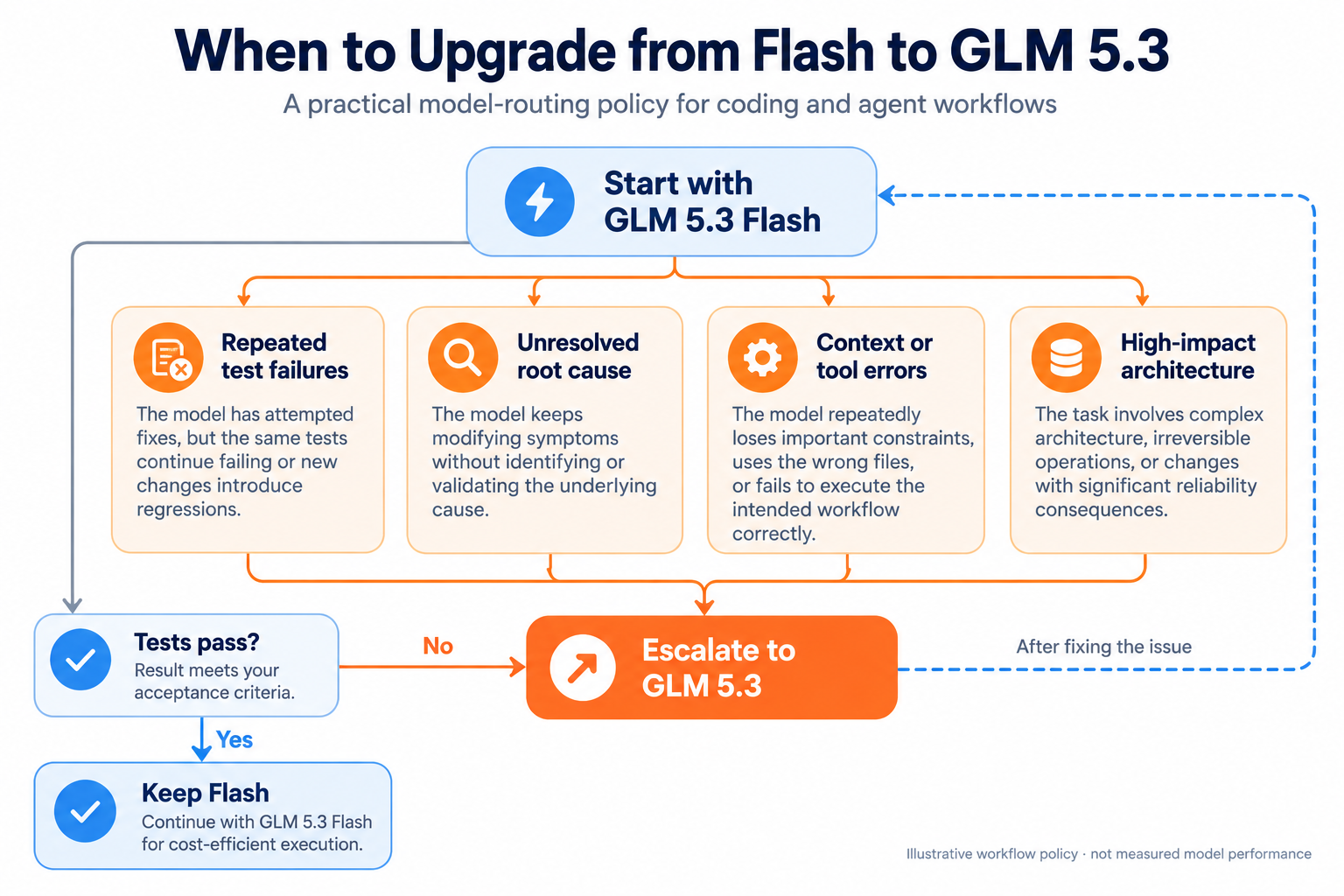
Upgrade when the task requires capability that is more valuable than the savings from another Flash attempt.
Four practical escalation triggers are especially useful:
Repeated validation failures: Flash has attempted fixes, but the same tests continue failing or new changes repeatedly introduce regressions.
Unresolved root-cause analysis: The agent keeps modifying symptoms without explaining or validating the underlying cause.
Context or tool-execution problems: The model repeatedly loses essential task constraints, uses the wrong files, or fails to execute the intended workflow correctly.
High-impact engineering decisions: The task involves complex architecture, irreversible operations, or changes with significant reliability consequences that justify additional analysis.
These are signals to reassess model choice, not proof that the flagship will solve every case.
A production application can make escalation configurable. For example, it might require a diagnosis and fresh validation after two unsuccessful repair attempts, then route the unresolved issue to GLM 5.3.
The threshold is a workflow policy that should be refined using actual task logs.
Why Compare Both Models on LinkModel?
LinkModel currently lists both GLM 5.3 and GLM 5.3 Flash, with prices 10% below Z.ai's standard API rates.
For developers who want to compare the models, the published LinkModel rates provide a clear starting point:
- GLM 5.3: $1.26 input and $3.96 output per million tokens.
- GLM 5.3 Flash: $0.135 input and $0.45 output per million tokens.
Both models also have separately published cached-input rates.
With pay-as-you-go billing, no minimum spend, and no monthly platform fee, developers can evaluate both without a recurring platform subscription.
The LinkModel model catalog provides access to the available model pages, while the Playground offers a convenient way to begin comparing supported inputs and outputs.
A Practical Comparison Workflow
1. Open LinkModel's GLM 5.3 Flash model page and access the Playground.
2. Select a representative coding task and define what counts as a successful result.
3. Run the task with Flash, recording its output, token usage, latency, and required corrections.
4. Run a comparable task with GLM 5.3 using the same repository state and acceptance criteria.
5. Compare accepted results, total API spending, retries, and developer intervention.
6. Keep Flash as the default for workloads where it reliably meets your requirements at lower cost.
7. Use GLM 5.3 for workloads where additional reasoning capability produces a meaningful improvement.
Before automated integration, verify the current LinkModel model IDs, supported parameters, and request formats on the respective model pages. Do not assume a model identifier from another provider can be reused unchanged.
The objective is not to prove that one model is universally superior. It is to determine which model produces acceptable work at the lowest practical cost for your application.
Frequently Asked Questions
Is GLM 5.3 worth paying nine times more than GLM 5.3 Flash?
GLM 5.3 can justify the higher API price for difficult debugging, complex reasoning, and tasks where reducing failed attempts saves substantial engineering effort. For routine development and high-volume tasks, Flash is the more economical starting point. The ninefold difference concerns token prices, not guaranteed total task costs.
Which model is better for coding agents?
GLM 5.3 is worth prioritizing for demanding, text-based reasoning and debugging. Flash is attractive for inexpensive implementation, multimodal workflows, and frequent tool-driven tasks. Long-running agents should be evaluated on accepted results, context retention, retries, and tool correctness rather than one benchmark.
Is GLM 5.3 Flash faster than GLM 5.3?
Not necessarily. Third-party throughput measurements have shown GLM 5.3 producing tokens faster than Flash under specific hosted conditions. Actual response time depends on the provider, reasoning settings, input size, output length, and system load.
Can GLM 5.3 Flash run locally?
Yes. GLM 5.3 Flash has publicly available model weights, but its approximately 320-billion-parameter architecture makes deployment resource-intensive. Quantization can reduce memory requirements, while context size, throughput targets, and available hardware determine whether local inference is practical.
Is a GLM Coding Plan cheaper than pay-as-you-go API access?
It depends on workload volume and subscription limits. Coding Plans use allowances and restrictions that are not directly equivalent to per-token API pricing. Pay-as-you-go access makes token-level costs explicit and can suit variable workloads, while a subscription may be attractive for consistently heavy eligible use. Compare the applicable plan terms with actual API bills before deciding.
Conclusion
GLM 5.3 Flash is the better starting choice for affordable coding, visual development, and high-volume API workloads, while GLM 5.3 is worth considering for complex debugging, architecture decisions, and demanding agents where additional reasoning may reduce failures. Flash's standard token prices are approximately one-ninth of the full model's, but successful-task cost depends on retries, token consumption, and developer effort. For mixed workloads, using Flash as the default and escalating difficult tasks to GLM 5.3 offers a practical way to balance cost and reliability. Both models are available through LinkModel at 10% below Z.ai's standard API list rates, making it possible to compare their real-world suitability within one pay-as-you-go workflow.