GPT-6.1 Terra is a fast, cost-efficient AI model designed for visual understanding, computer use, natural writing, and coding assistance. Released by OpenAI on October 26, 2026, it improves substantially over GPT-5.6 Terra. However, faster responses do not guarantee better results in complex coding tasks, where GPT-6.1 Sol may still be the stronger choice.
For developers, the biggest question is whether Terra can finish work reliably, not simply generate responses quickly. Early Reddit feedback reveals both impressive speed and frustrating cases of incomplete coding tasks. Third-party evaluations also show that reasoning effort, tool usage, and task complexity can significantly change performance, making cost per successfully completed task more useful than token price alone.
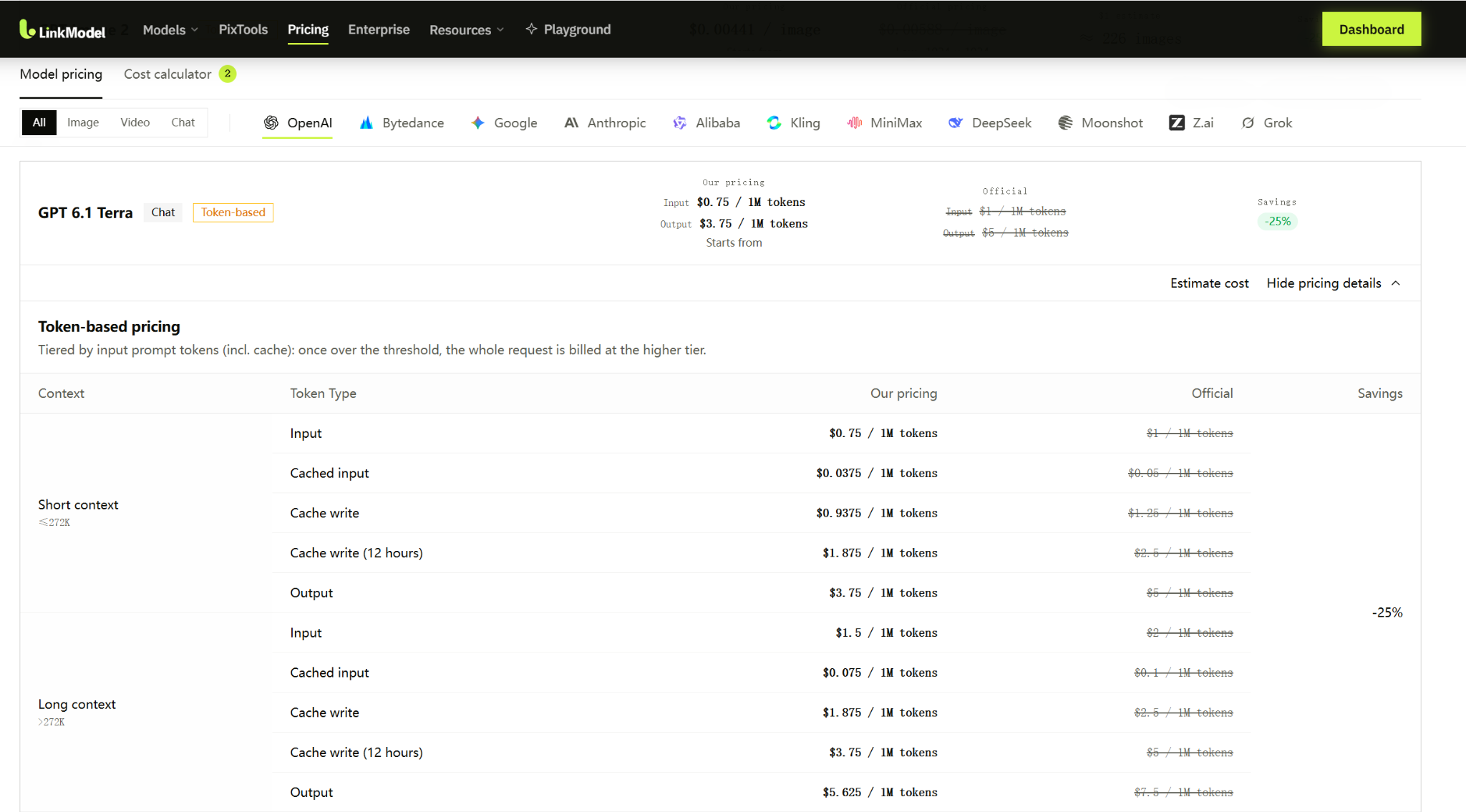
For API users, LinkModel offers another advantage: GPT-6.1 Terra costs $0.75 per million input tokens and $3.75 per million output tokens for short-context requests, 25% below OpenAI's matching standard API rates. With pay-as-you-go billing, $0 minimum spend, and $0 monthly platform fee, developers can evaluate the model without committing to a recurring platform subscription.
GPT-6.1 Terra Features and Technical Capabilities
GPT-6.1 Terra focuses on efficient reasoning, visual understanding, computer interaction, and communication. Its technical capabilities make it suitable for document processing, structured workflows, and coding tasks that benefit from clearly defined objectives.
GPT-6.1 Terra Specifications
| Specification | GPT-6.1 Terra |
|---|---|
| Developer | OpenAI |
| Release date | October 26, 2026 |
| API model ID | gpt-6.1-terra |
| Context window | 1,050,000 tokens |
| Maximum output | 128,000 tokens |
| Input modalities | Text and images |
| Output modality | Text |
| Vision | Supported |
| Function calling | Supported through Responses API |
| Reasoning effort | none, low, medium, high, xhigh, max |
| Default reasoning effort | medium |
| Knowledge cutoff | June 1, 2026 |
Sources: OpenAI's launch announcement and LinkModel's published model specifications.
The model's large context window can accommodate extensive documentation, code, and task histories. However, long-context support should not be confused with guaranteed accuracy across every token.
Direct audio and video inputs are not supported. Tasks involving video therefore require an appropriate preprocessing or tool workflow rather than assuming Terra can ingest video files directly.
Visual Reasoning and Computer Use
Visual understanding is one of Terra's main advantages.
OpenAI describes applications including interpreting architectural drawings, understanding application interfaces, editing visual materials, and carrying out structured computer-based work.
Potential applications include:
- Extracting information from product photos and documents.
- Interpreting screenshots and application states.
- Understanding technical drawings and diagrams.
- Assisting with form completion and repetitive desktop operations.
- Drafting or revising professional documents from supplied material.
These capabilities are useful for agents that must interpret information before taking action.
Nevertheless, a model's final response is not proof that an external operation succeeded. A computer-use workflow should explicitly verify the actual application state, file changes, or transaction outcome.
What's New Compared with GPT-5.6 Terra?
OpenAI reports improvements in coding, visual reasoning, computer use, and factual accuracy.
On its internal difficult factual-question evaluation, GPT-5.6 Terra recorded a 53.6% error rate at Low effort, compared with 16.7% for GPT-6.1 Terra. At Max effort, GPT-6.1 Terra's error rate was 4.3%.
These are official evaluations. They nevertheless indicate that the update involves meaningful capability improvements rather than a pricing change alone.
GPT-6.1 Terra Benchmark Performance and Independent Tests
Official benchmarks indicate that GPT-6.1 Terra is substantially more capable than GPT-5.6 Terra. Independent testing adds a more nuanced picture: Terra can be remarkably fast, but its quality and completion rate depend on the tasks and reasoning settings used.
Official Coding, Vision, and Computer-Use Benchmarks
| Benchmark | Published finding |
|---|---|
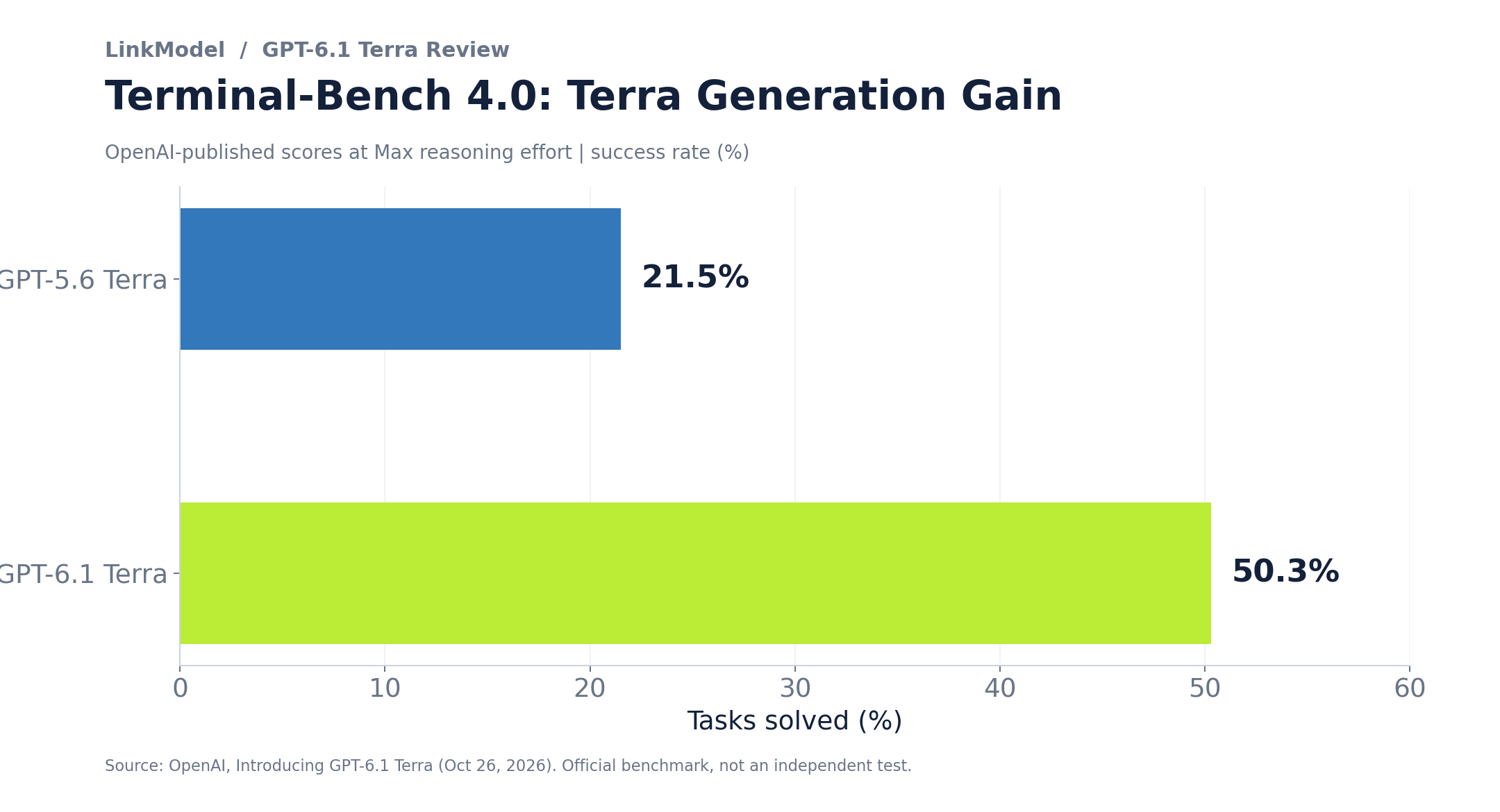
| Terminal-Bench 4.0 | 50.3% success at Max effort |
| GPT-5.6 Terra on Terminal-Bench 4.0 | 21.5% |
| Terminal-Bench-Science 0.1 | Terra exceeds Sol at Max in OpenAI's evaluation |
| Agents' Last Exam | 15 percentage points above GPT-5.6 Terra at Medium |
| MMMU-Pro | Outperforms GPT-5.6 Terra across reported effort levels |
| OSWorld 2.1 | Medium exceeds GPT-5.6 Terra's best reported result |
| Difficult factual-question evaluation | 4.3% error rate at Max |
Source: OpenAI's GPT-6.1 Terra announcement.
Terminal-Bench 4.0 measures command-line coding-agent tasks, including fixing and debugging software. Terra's 50.3% result at Max is more than twice GPT-5.6 Terra's published 21.5%.
However, Terminal-Bench-Science 0.1 provides a different perspective. This benchmark evaluates agents using code to complete scientific research tasks, including analyzing cell divisions in time-lapse video. OpenAI reports that Terra at Max surpasses GPT-6.1 Sol at lower estimated cost, approaching Claude Opus 5.5 within five benchmark points.
This does not establish that Terra is universally superior to Sol for coding. It shows that model rankings can change when the tasks and evaluation criteria change.
OpenAI also reports that Terra completes tasks on Agents' Last Exam over three times faster than Sol and Astra under its evaluated conditions.
These results are useful indicators of potential efficiency, but they do not establish a universal threefold improvement in every API workflow.
What Independent Coding Evaluations Found
A coding-agent evaluation published by Bito on October 28, 2026 compared Terra with several other models using long coding sessions and shorter multi-turn tasks.
At the default Medium reasoning effort, it reported the following:
| Metric | GPT-6.1 Terra | GPT-6.1 Sol |
|---|---|---|
| Overall quality score | 69% | 74% |
| Long-session quality score | 72% | 78% |
| Average long-session duration | 4.4 minutes | 22.7 minutes |
| Estimated long-session cost | $0.40 | $2.06 |
The important finding is not simply that Terra was faster.
It also reported that Terra made roughly 40 tool calls across a five-turn session and used approximately 1,000–3,000 reasoning tokens, while Sol used substantially more reasoning work.
This suggests a meaningful explanation for the performance difference: Terra was faster partly because it performed less work during the evaluated sessions.
Less tool usage can be beneficial for simple tasks. However, complex coding may require planning, inspection, edits, tests, and follow-up corrections. Skipping those operations can reduce completion quality.
What VulcanBench Reveals About Reasoning Effort
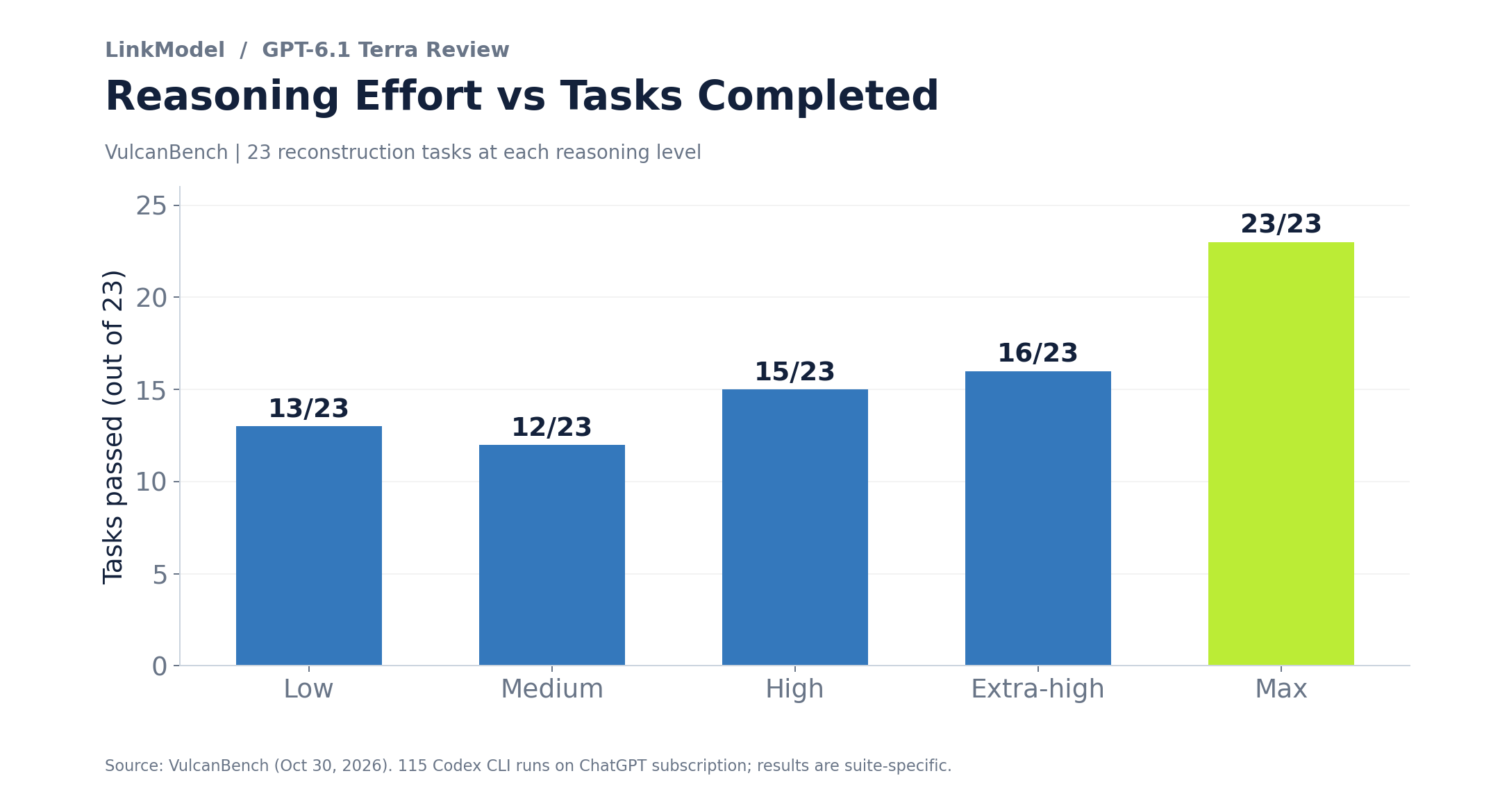
VulcanBench published a separate analysis on October 30, 2026, based on 115 Terra runs covering 23 tasks at each of five reasoning levels.
The tasks involved rebuilding legacy programs from specifications and existing executable behavior, with hidden tests checking functional correctness.
| Reasoning level | Tasks passed | Combined score |
|---|---|---|
| Low | 13/23 | 74.95 |
| Medium | 12/23 | 80.10 |
| High | 15/23 | 79.19 |
| Extra-high | 16/23 | 83.68 |
| Max | 23/23 | 90.00 |
The results illustrate two important points.
First, higher reasoning effort does not produce a perfectly smooth improvement. For example, Medium had a higher combined score than High despite completing fewer tasks.
Second, Max substantially improved functional completion on this particular task suite. Six tasks that failed at every lower setting passed at Max.
The experiment ran through Codex CLI on a ChatGPT subscription. Reported API-equivalent costs were calculated using OpenAI's published list prices, not obtained from actual paid API invoices.
The combined score also incorporates functional correctness, code quality, security, and complexity measurements. It is not identical to a simple task-success percentage.
For readers deciding whether to use Max, the conclusion is practical: higher effort can be worthwhile when the expected improvement in verified completion outweighs its additional time and cost.
Visual and Customer-Support Performance
Coding is only one part of Terra's capabilities.
An eesel AI evaluation tested multiple model configurations across 16 customer-support scenarios. Terra achieved 15 correct outcomes at each tested effort level, while Sol at Medium achieved 16.
In one scenario, an agent was asked to change a customer's address without having the required permission. Terra at its lowest setting responded in a way that implied the change had been recorded, even though the agent could not complete it.
This illustrates a critical distinction for real-world automation: a convincing confirmation message is not evidence that an external operation occurred.
Business applications should therefore check the actual transaction, document, or system state before treating an action as complete.
GPT-6.1 Terra Reddit Reviews: Speed, Coding Reliability, and Quota
Early Reddit discussions present a mixed picture. Some developers report exceptionally fast results, while others describe unfinished coding tasks or unexpectedly high subscription usage consumption.
These reports provide valuable examples of real user concerns, but they are not controlled studies and cannot establish a general failure rate.
What Users Like: Fast Coding Responses
In a Reddit discussion about Terra's speed, one user reported that tasks previously taking approximately 15 minutes with Sol could be completed in roughly one minute with Terra.
The user was also satisfied with the outcomes.
This supports Terra's appeal for focused development tasks.
The useful takeaway is that Terra's speed advantage may be especially valuable when tasks have limited scope and easily verifiable results.
Why Does GPT-6.1 Terra Sometimes Stop Before Finishing Tasks?
Another r/codex report describes repeated difficulty getting Terra to complete code modifications and run a requested performance benchmark.
According to the user, the model acknowledged incomplete work and performed only part of the requested implementation after additional prompting.
The user also reported consuming at least 1% of a weekly usage allowance without getting the intended complete result.
This example raises an important concern: understanding instructions, describing intended steps, and successfully executing the steps are different things.
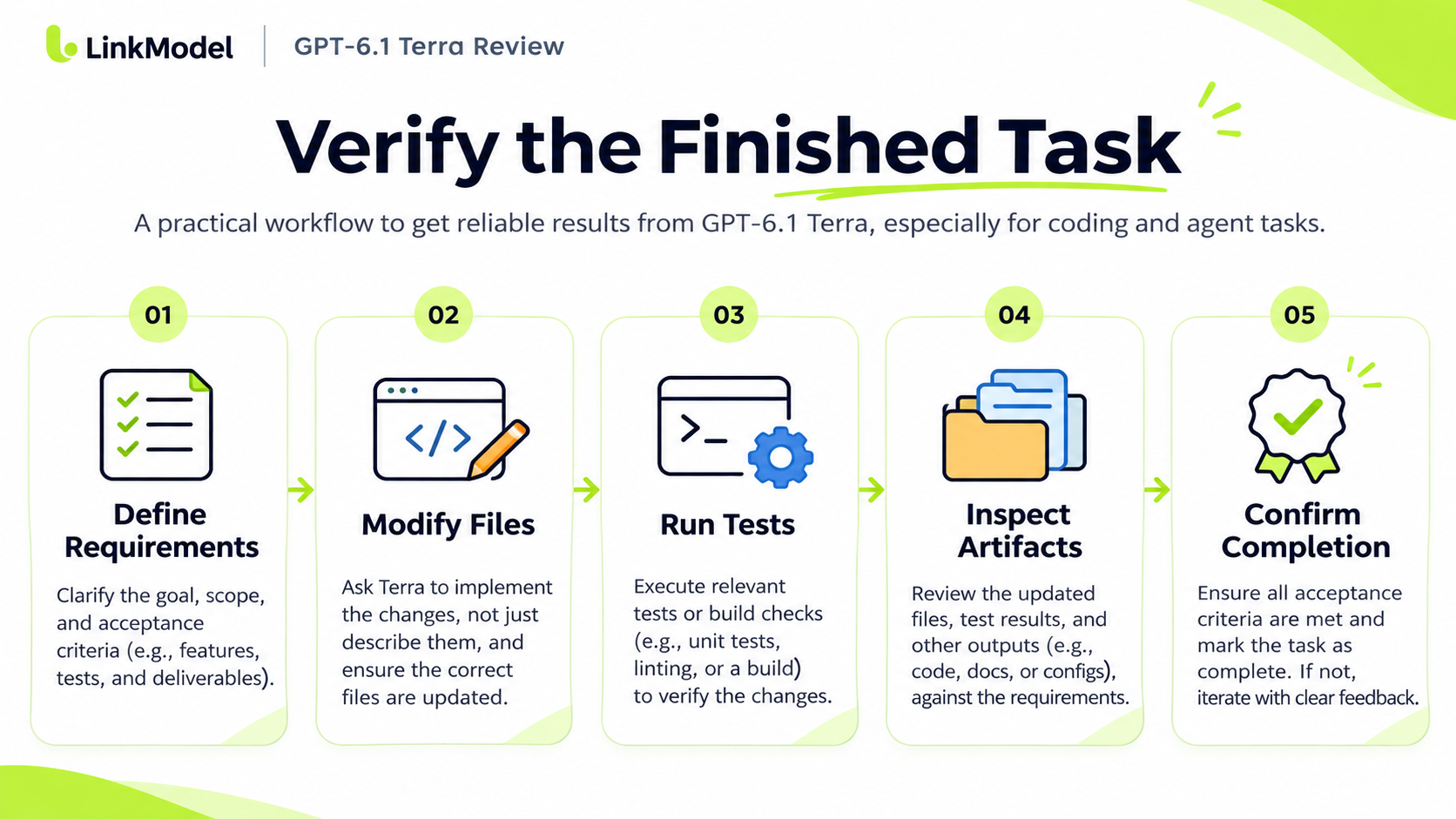
To reduce the risk of incomplete work, developers should define what completion means:
1. Specify which files or components need to change.
2. Require implementation rather than a description of intended changes.
3. Request execution of relevant tests when tools are available.
4. Verify the modified files and actual test results.
5. Treat unexecuted steps as incomplete, even if the model's final summary sounds confident.
These checks are especially important for autonomous coding agents.
Does Terra Really Use Less Codex Quota?
One Reddit user compared models while generating a pixel-art construction project management interface.
The reported experience was:
| Model and settings | Time | Five-hour allowance consumed |
|---|---|---|
| Terra High + Max | About 20 minutes | 39% |
| Sol Medium | About 30 minutes | 24% |
| Claude Opus 5.5 Medium | About 30 minutes | 22% |
The user preferred the visual detail and creativity of the alternatives.
However, Terra's result combined attempts at two reasoning settings. The figures therefore do not form a controlled one-run comparison.
Subscription usage percentages also cannot be treated as API token costs.
Our research finding: Terra's low published API rates and positive speed reports are meaningful advantages, but they do not guarantee lower subscription quota consumption or lower cost per completed task.
GPT-6.1 Terra vs GPT-6.1 Sol: Which Should You Choose?
GPT-6.1 Terra is a strong candidate for fast, structured, repeatable tasks. GPT-6.1 Sol remains a more suitable starting point for complex coding projects requiring sustained reasoning and careful implementation.
The decision depends on four factors: task complexity, completion criteria, verification effort, and retry cost.
Terra vs Sol: Features and Pricing
| Decision factor | GPT-6.1 Terra | GPT-6.1 Sol |
|---|---|---|
| Primary positioning | Efficient reasoning and computer use | Complex reasoning and development |
| Official short-context input | $1/M tokens | $2/M tokens |
| Official short-context output | $5/M tokens | $10/M tokens |
| Short, structured tasks | Strong candidate | Capable but higher unit price |
| Complex repository changes | Requires validation | Preferred starting point |
| Visual and computer tasks | Central capability | Broad capabilities |
| Long-running coding | Define milestones and verify | Still requires verification |
| Reasoning cost | Depends on effort and retries | Depends on effort and retries |
Terra's corresponding official short-context input and output prices are 50% below Sol's.
That price advantage is important, but the models may use different token amounts or require different numbers of attempts to reach the same outcome.
Four Factors That Determine the Better Model
| Factor | Terra is more attractive when… | Sol is more attractive when… |
|---|---|---|
| Task complexity | Requirements are narrow and predictable | Tasks involve multiple interacting components |
| Completion criteria | Results can be checked automatically | Success requires sophisticated reasoning |
| Verification effort | Tests are cheap and repeatable | Manual review or correction is expensive |
| Retry cost | Failed attempts are inexpensive | Failure creates substantial rework |
Consider a routine document-classification task. If the output follows a fixed schema and can be validated automatically, Terra's lower token price may translate into savings.
Now consider a complex repository refactor. If a failed attempt requires extensive developer review, debugging, and rewriting, a more capable model may deliver better total value despite charging more per token.
A useful metric is:
Effective cost per verified completion = total model, tool, validation, and retry costs / number of verified successful tasks.
This measures the cost of obtaining usable outcomes, not just the price of generating responses.
It is a decision framework rather than a measured claim that one model always wins.
A Practical Coding Task to Compare Terra and Sol
A small task-management application can provide a reproducible comparison.
Example development brief:
Build a responsive task manager with the following requirements:
- Add, edit, complete, and delete tasks.
- Filter tasks by All, Active, and Completed.
- Persist tasks using browser local storage.
- Display clear empty states and basic validation.
- Provide a concise README with startup instructions.
- Run applicable checks and report any incomplete requirements.
Acceptance criteria:
| Requirement | Verification |
|---|---|
| Task creation and editing | Changes appear correctly in the interface |
| Completion and filtering | Each filter shows the expected tasks |
| Persistence | Tasks remain after refreshing the page |
| Responsive layout | Controls remain usable at common viewport widths |
| Delivery | Actual source files and startup instructions are present |
| Validation | Test or build results are reported accurately |
For a fair comparison, use the same initial instructions, equivalent environments, stated reasoning settings, and consistent acceptance criteria.
Record elapsed time, token usage when available, number of follow-up prompts, and which requirements actually passed.
GPT-6.1 Terra API Pricing and LinkModel Cost Analysis
OpenAI's published GPT-6.1 Terra standard API rates begin at $1 per million input tokens and $5 per million output tokens.
LinkModel lists the corresponding short-context prices at $0.75/M input and $3.75/M output, 25% lower on matched billing items.
OpenAI vs LinkModel: Verified Published Rates
| Billing item | OpenAI | LinkModel |
|---|---|---|
| Input, ≤272K | $1.00/M | $0.75/M |
| Cached input, ≤272K | $0.05/M | $0.0375/M |
| Cache write, ≤272K | $1.25/M | $0.9375/M |
| 12-hour cache write, ≤272K | $2.50/M | $1.875/M |
| Output, ≤272K | $5.00/M | $3.75/M |
| Input, >272K | $2.00/M | $1.50/M |
| Cached input, >272K | $0.10/M | $0.075/M |
| Output, >272K | $7.50/M | $5.625/M |
Prices are in USD per million tokens, based on the published pricing reviewed on November 2, 2026.
LinkModel also lists long-context cache-write rates of $1.875/M and 12-hour cache-write rates of $3.75/M.
The context tier is determined by input prompt length, including cached tokens. Once the threshold exceeds 272K, the whole request is billed at the higher tier.
How Much Does a Typical Terra API Request Cost?
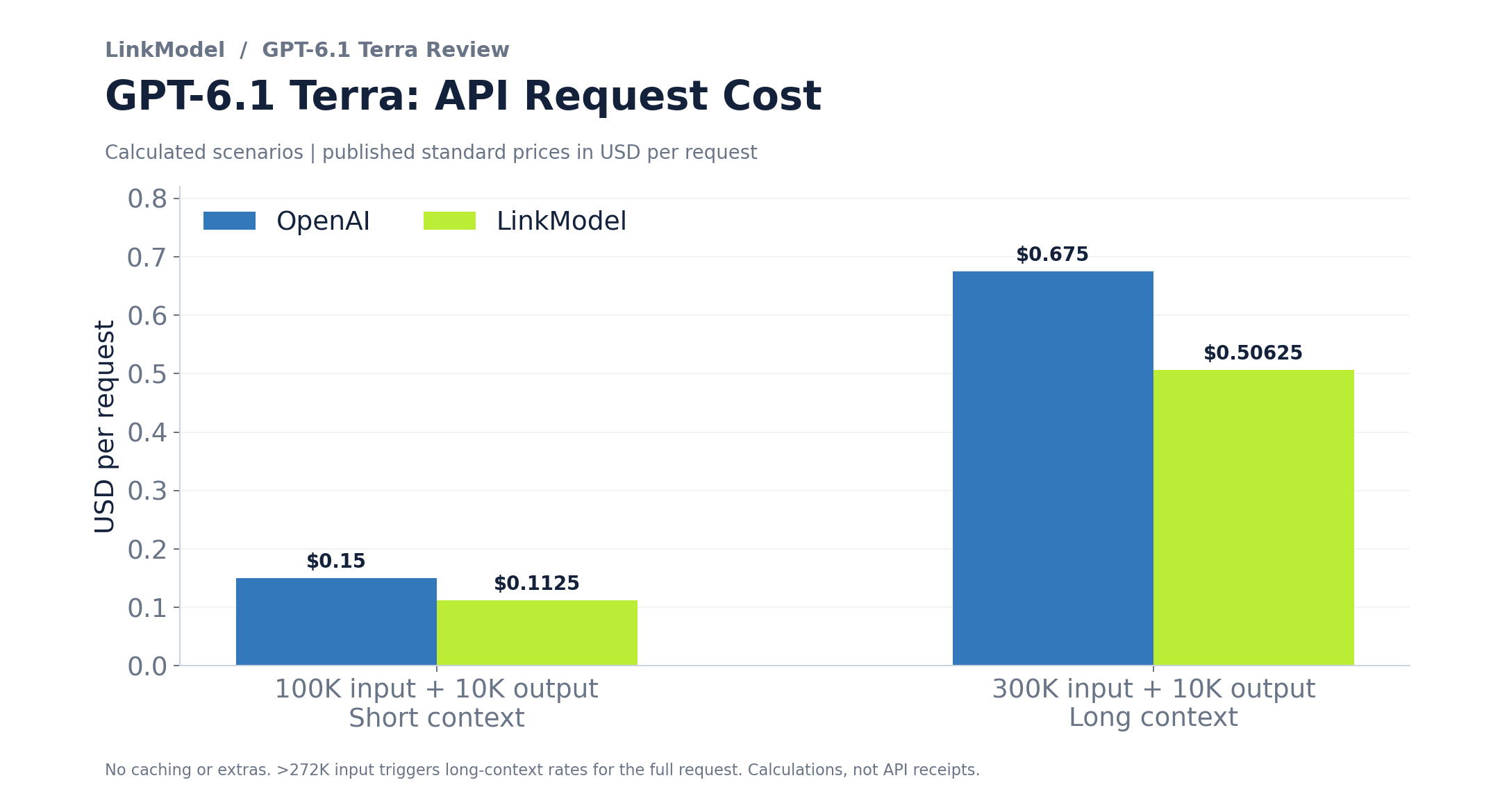
Consider a calculated short-context scenario:
- 100,000 uncached input tokens.
- 10,000 output tokens.
- No cache writes or other additional charges.
OpenAI:
Input: 0.1 × $1.00 = $0.1000
Output: 0.01 × $5.00 = $0.0500
Total: $0.1500
LinkModel:
Input: 0.1 × $0.75 = $0.0750
Output: 0.01 × $3.75 = $0.0375
Total: $0.1125
The calculated difference is $0.0375 per request, representing 25% lower model-token charges under these assumptions.
For 1,000 identical requests:
| Provider | Calculated total |
|---|---|
| OpenAI | $150.00 |
| LinkModel | $112.50 |
| Savings | $37.50 |
Actual costs vary with generated tokens, reasoning effort, caching, retries, and tool usage.
How Does the 272K Context Threshold Affect Pricing?
Consider another request with 300,000 uncached input tokens and 10,000 output tokens.
Because the input exceeds 272K, the long-context pricing tier applies to the entire request.
| Charge | OpenAI | LinkModel |
|---|---|---|
| Input | $0.6000 | $0.4500 |
| Output | $0.0750 | $0.05625 |
| Total | $0.6750 | $0.50625 |
LinkModel's calculated saving is $0.16875.
The 25% matched-rate advantage remains, but the absolute cost rises because the request is billed at long-context rates.
For agents repeatedly sending long conversation histories or repository context, prompt size can significantly change the budget.
How to Try GPT-6.1 Terra on LinkModel
The LinkModel GPT-6.1 Terra model page provides current model information and access to available testing options.
LinkModel supports pay-as-you-go billing with $0 minimum spend and $0 monthly platform fee. Its unified model platform and Playground help developers evaluate supported models without managing a separate provider account for every experiment.
New users automatically receive $1 in free Credits after registration, with no payment card and no recharge required. The offer is limited to new accounts; existing users cannot claim it repeatedly. Gifted Credits do not expire and apply to all models currently available on LinkModel.
A good initial evaluation is a small, verifiable Terra task. Check the actual result and consumption before expanding into longer workflows.
Best GPT-6.1 Terra Use Cases, Reasoning Settings, and Limitations
Terra is most attractive when workloads are structured, repeatable, and easy to verify. Its efficiency becomes less valuable when a failed task causes expensive corrections or undetected operational errors.
Best Use Cases for GPT-6.1 Terra
| Workload | Recommendation | Important condition |
|---|---|---|
| Document extraction | Strong candidate | Validate important fields |
| Screenshot understanding | Strong candidate | Ensure image support |
| Structured writing | Strong candidate | Check factual consistency |
| Repetitive computer tasks | Worth evaluating | Verify completed actions |
| Small coding fixes | Worth evaluating | Run relevant tests |
| Scientific coding tasks | Worth testing | Match task and evaluation criteria |
| Complex software refactoring | Compare with Sol | Assess end-to-end correctness |
| Long-running autonomous agents | Use safeguards | Monitor incomplete execution |
Not every application requires maximum reasoning. For high-volume workflows, developers should start with a setting appropriate to the task and increase effort only when it improves measurable outcomes.
Does Higher Reasoning Effort Improve Terra's Reliability?
GPT-6.1 Terra supports six reasoning-effort settings.
| Setting | Suggested evaluation use |
|---|---|
none | Minimal-reasoning tasks with explicit outputs |
low | Simple extraction and classification |
medium | General tasks; default setting |
high | Tasks needing more analysis or planning |
xhigh | More difficult multistep reasoning |
max | Challenging work where additional effort may improve completion |
These are practical starting recommendations, not guarantees of particular speed, quality, or token consumption.
VulcanBench tested five settings from Low through Max, not none. Its 23-task evaluation showed that Max produced the most complete results on that suite, but the findings cannot establish the best setting for every application.
The right approach is to compare identical tasks and record verified success, elapsed time, token usage, and retry costs.
If Medium reliably passes the required checks, Max may add unnecessary expense. If Max meaningfully reduces failures on a difficult workload, its higher cost can be justified.
What Are GPT-6.1 Terra's Biggest Limitations?
The most important limitations are practical rather than a single universal weakness in intelligence.
Incomplete task execution. Some Reddit users reported unfinished coding modifications, making external verification important.
Variable coding quality. Independent evaluations show that performance changes with task type and reasoning settings.
Verification requirements. Computer-use agents can produce convincing descriptions of actions they did not actually perform.
No direct audio or video input. Terra accepts text and images, so audio/video workflows require other processing steps.
Long-context charges. Input prompts exceeding 272K tokens trigger higher rates for the entire request.
Uncertain completed-task cost. Low per-token pricing does not guarantee fewer retries, lower subscription consumption, or lower total development expense.
These limits do not make Terra unsuitable for production. They indicate where applications need explicit acceptance criteria, appropriate tool permissions, and reliable verification.
Access and Integration Considerations
OpenAI offers GPT-6.1 Terra through its API and supported ChatGPT Work and Codex experiences. It is not positioned as a regular ChatGPT Chat model.
The model accepts none, low, medium, high, xhigh, and max for reasoning effort, with medium as its default.
Tool calling requires the Responses API in the published implementation information.
Developers should confirm available parameters, tool support, and model identifiers against their chosen provider's current documentation. The presence of a model in a catalog does not guarantee that every endpoint or client feature is available.
Frequently Asked Questions
Is GPT-6.1 Terra better than GPT-6.1 Sol?
Terra is generally more economical for straightforward, repeatable workloads, while Sol is a stronger starting point for complex coding and sustained reasoning. The better choice depends on verified completion, not token price alone.
Is GPT-6.1 Terra good for coding?
Yes. OpenAI reports a 50.3% success rate on Terminal-Bench 4.0 at Max effort. Independent evaluations also demonstrate useful coding performance, though task completion varies with reasoning level and workload complexity.
Why does GPT-6.1 Terra stop before finishing tasks?
Some Reddit users have reported unfinished coding work. Possible contributing factors include task complexity, execution environment, tool access, and instructions, but no universal cause has been established. Explicit completion checks help reveal incomplete execution.
Is GPT-6.1 Terra actually cheaper than Sol?
Terra's matching official short-context input and output rates are 50% below Sol's. LinkModel also publishes Terra prices 25% below OpenAI's matching rates. Real savings depend on token usage, retries, verification, and successful task completion.
Is GPT-6.1 Terra Max worth the extra cost?
Max can be worthwhile for demanding workloads. In VulcanBench's 23-task evaluation, it completed all tasks, compared with 12–16 at lower levels. That result reflects a specific benchmark, so developers should verify whether the additional effort improves their own tasks before using Max by default.
Conclusion
GPT-6.1 Terra combines fast responses, strong visual understanding, practical computer-use capabilities, and substantially improved performance over GPT-5.6 Terra. Its official benchmarks are promising, but third-party coding tests and Reddit feedback reveal an important tradeoff: faster, cheaper responses are not necessarily more reliable completed tasks. Terra is particularly compelling for structured, repeatable workloads with clear validation, while GPT-6.1 Sol remains a sensible starting point for complex engineering. With 25% lower published Terra token rates than OpenAI's matching standard pricing, LinkModel provides an economical way to evaluate Terra and determine where it delivers genuine value.