GPT-6 Luna API pricing starts at $0.10/M input and $0.50/M output, but crossing 272K input tokens can sharply increase the real cost. Above that threshold, the entire request is repriced to $0.20/M input and $0.75/M output.
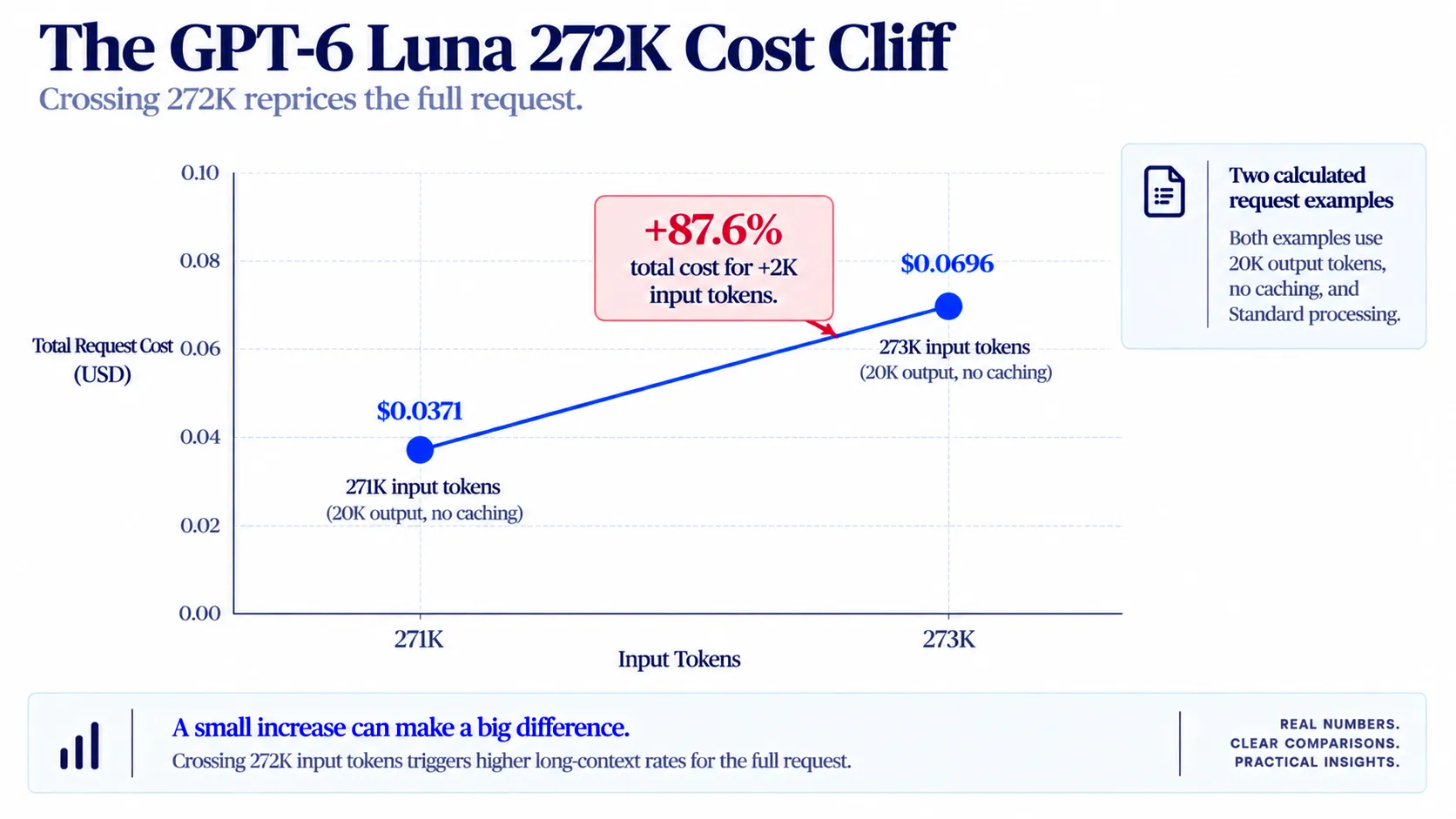
271K input + 20K output costs about $0.0371, while 273K input + the same 20K output costs about $0.0696—an 87.6% increase for just 2K more input tokens. Caching, reasoning, retries and processing tiers can push the cost per completed task even higher.
LinkModel offers GPT-6 Luna at 75% of the corresponding official listed price, one OpenAI-compatible API, one API key and unified billing. Teams can switch models by price, quality, speed or availability without rebuilding integrations.

GPT-6 Luna API Pricing at a Glance
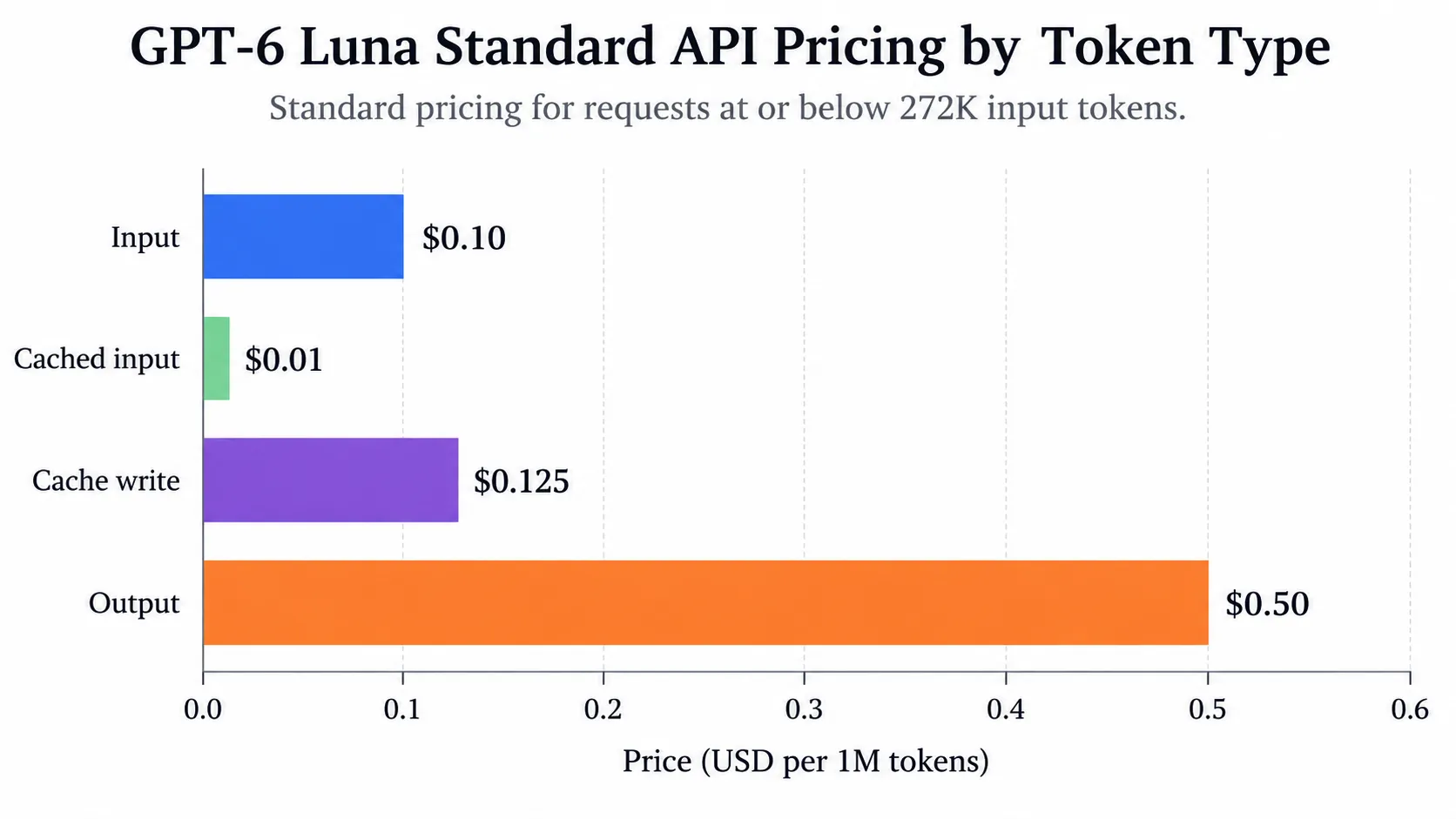
Under Standard pricing at or below 272K input tokens, GPT-6 Luna costs $0.10/M input, $0.01/M cached input, $0.125/M cache writes and $0.50/M output. Prices increase when requests exceed 272K input tokens or use higher-cost processing tiers.
GPT-6 Luna Standard API Pricing
For Standard requests at or below 272K input tokens:
| Token Type | Price per 1M Tokens |
| Input | $0.10 |
| Cached input | $0.01 |
| Cache write | $0.125 |
| Output | $0.50 |
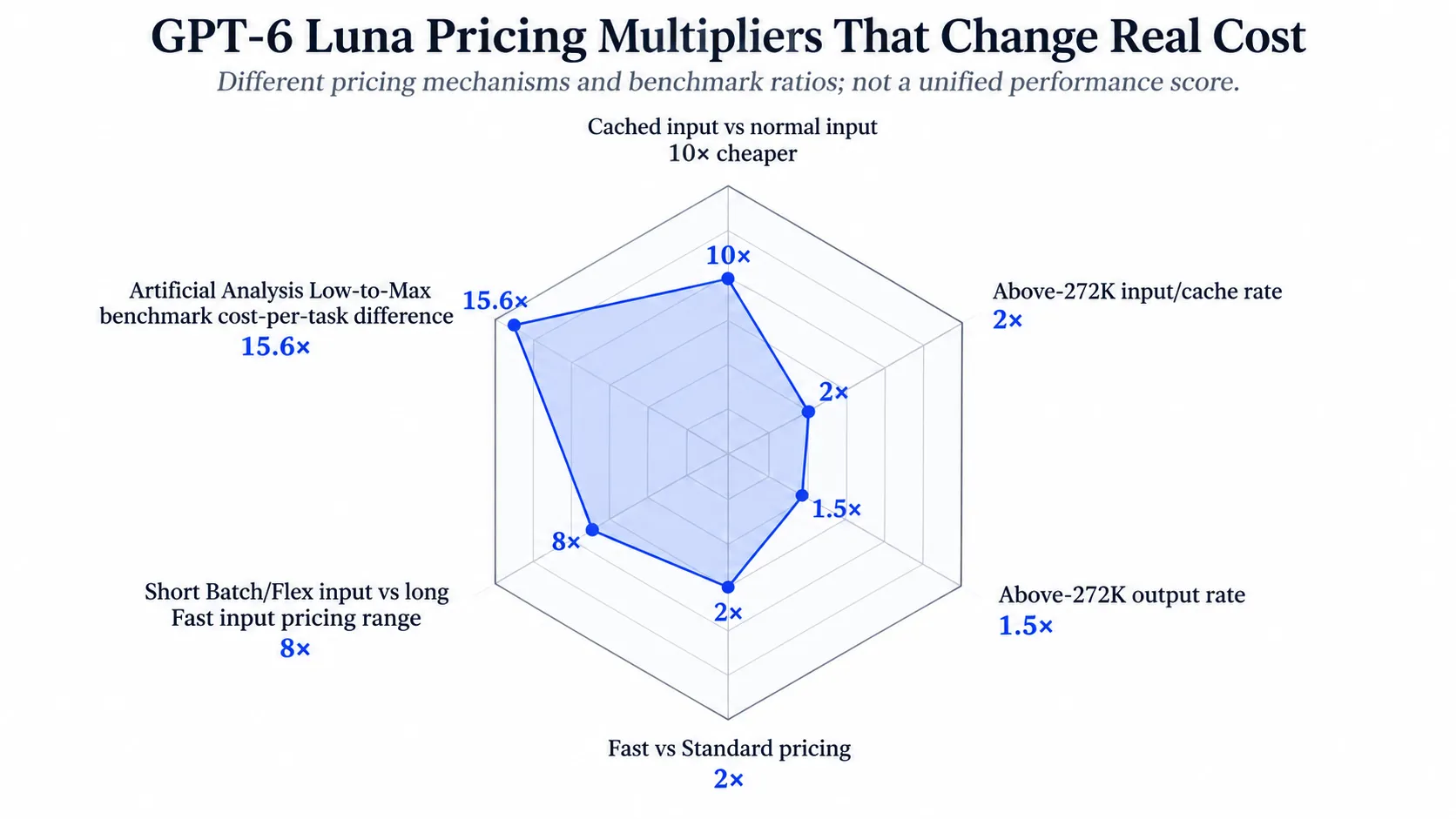
The difference between those rates is significant. Cached input costs 90% less than normal input, while writing content to the cache costs 25% more than normal input.
For example, 10M uncached input tokens cost $1, while 10M output tokens cost $5. A workload consuming both would have a headline token cost of $6 before accounting for cache writes, tools, retries or additional model calls.
That is why describing GPT-6 Luna simply as a “$0.10/M model” can lead to inaccurate production budgets.
Why GPT-6 Luna API Pricing Is Not Always $0.10/M
A better way to estimate production cost is:
Real task cost = uncached input + cached input + cache writes + output + tools + retries + additional model calls.
A common budgeting mistake is to apply the $0.10/M rate to every input token or calculate cost from a single successful request while ignoring retries and failed attempts.
This matters for coding agents, RAG systems and persistent assistants, where one completed task may involve several model calls, repeated context loading and multiple reasoning steps.
Token price tells you the unit cost. Cost per completed task tells you whether the workflow is actually economical.
GPT-6 Luna 272K Long-Context Pricing
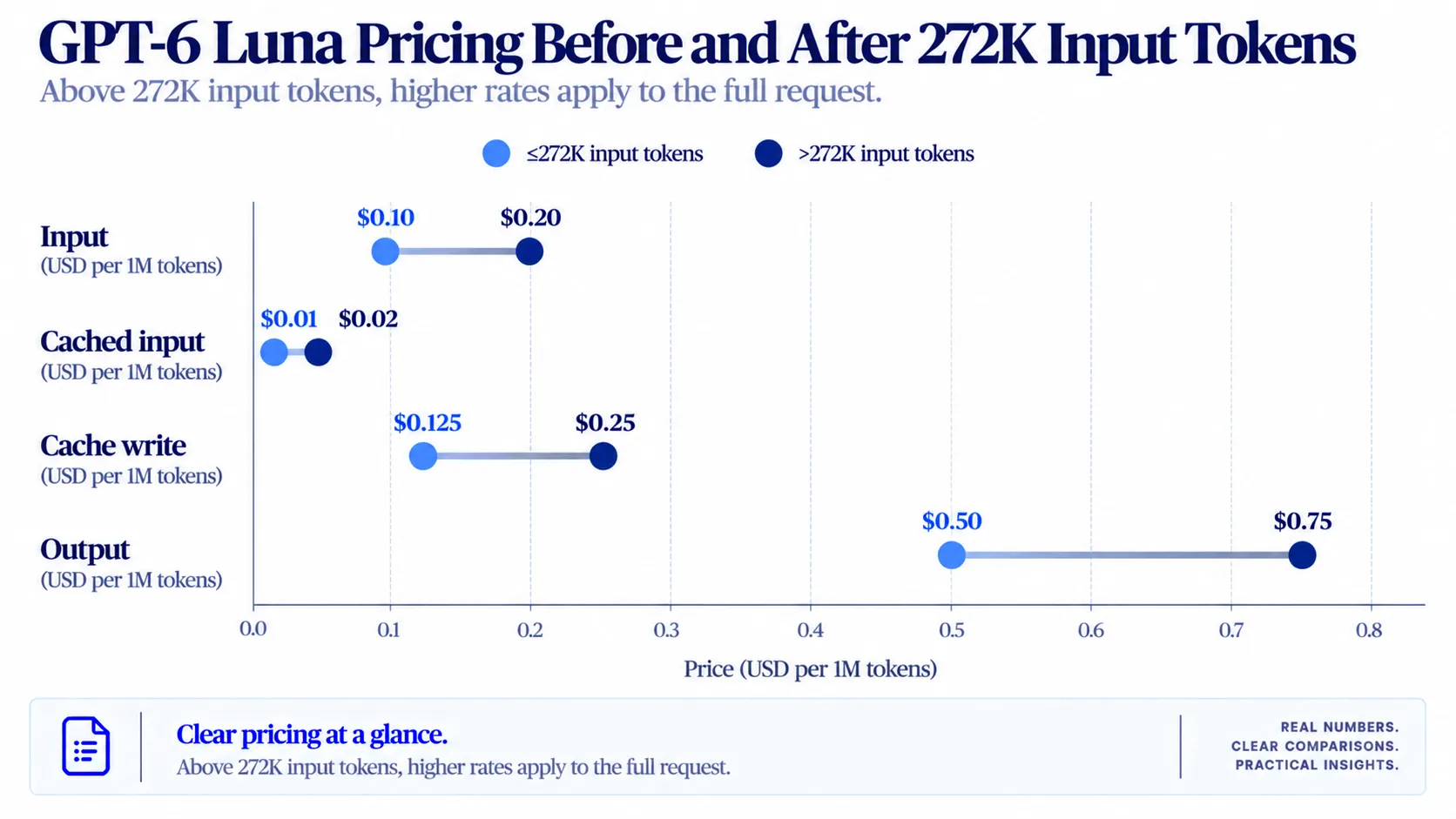
GPT-6 Luna has a pricing cliff at 272K input tokens. A Standard request with 271K input + 20K output costs about $0.0371, while 273K input + 20K output costs about $0.0696. That is an 87.6% cost increase for only 0.7% more input because the higher rates apply to the entire request.
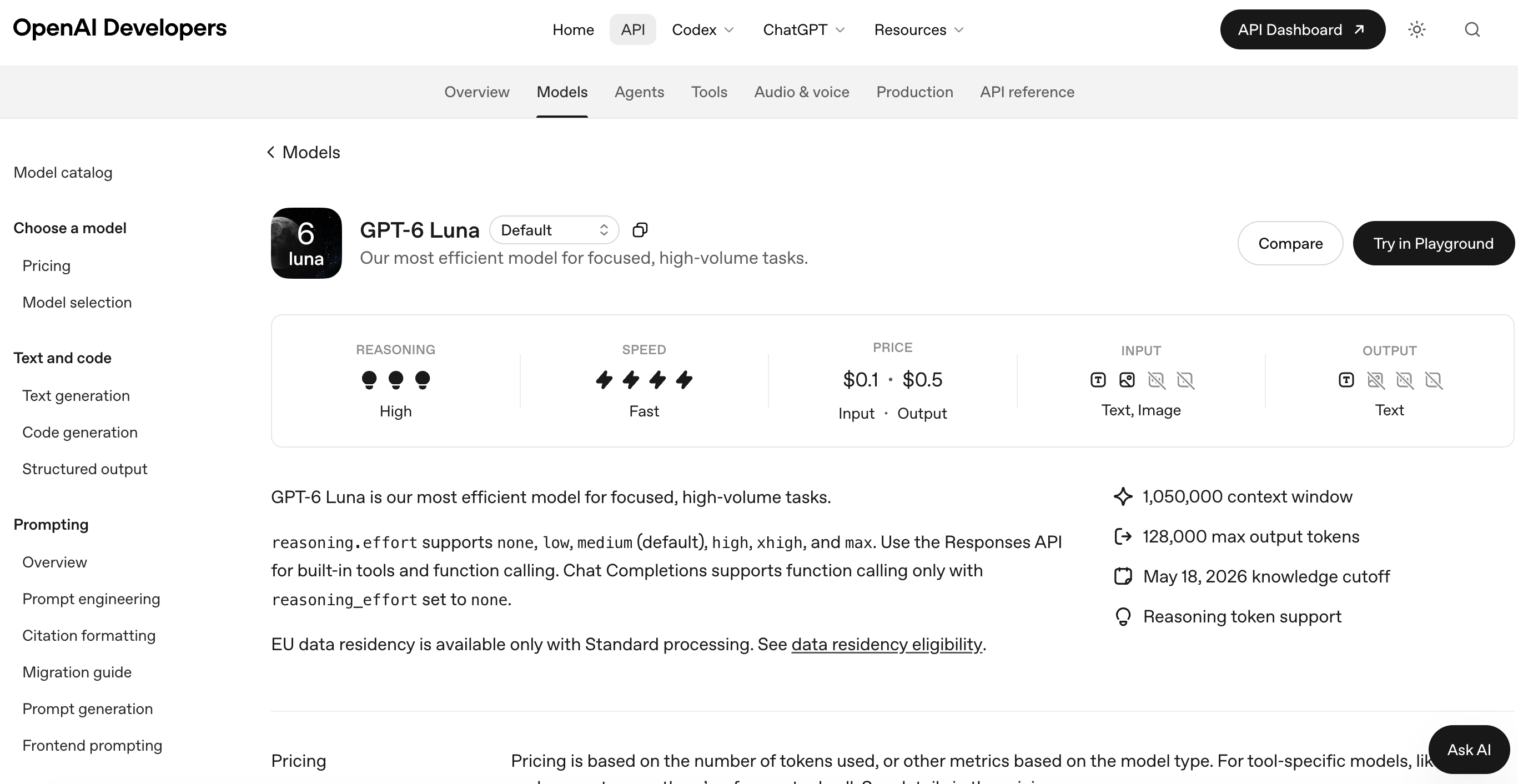
GPT-6 Luna supports a 1,050,000-token context window and up to 128,000 output tokens, but the full context window does not use a single flat price.
When input exceeds 272K tokens, input and cache rates become 2× higher, while output becomes 1.5× higher.
The critical detail is that the higher rates apply to the full request, not only the tokens beyond 272K.
| Token Type | ≤272K | >272K |
| Input | $0.10/M | $0.20/M |
| Cached input | $0.01/M | $0.02/M |
| Cache write | $0.125/M | $0.25/M |
| Output | $0.50/M | $0.75/M |
271K vs 273K GPT-6 Luna Cost Example
Consider two Standard requests with no caching and the same 20K output.
At 271K input tokens:
Input: $0.0271 Output: $0.0100 Total: $0.0371
At 273K input tokens:
Input: $0.0546 Output: $0.0150 Total: $0.0696
The second request contains only about 0.7% more input, but the calculated cost is approximately 87.6% higher.
This is a pricing calculation rather than a production billing log, but it shows exactly why the threshold matters for large repositories, long-document analysis and persistent agents.
Why a 1M Context Window Is Not a 1M Flat-Price Window
A large context window has two values: technical capacity and economic usability.
Technically, GPT-6 Luna can process more than one million tokens of context. Economically, repeatedly exceeding 272K input means repeatedly entering the higher pricing tier.
That makes context size a direct cost-control variable. Pruning stale context, splitting tasks and reusing cached context can reduce spend without changing the underlying model.
GPT-6 Luna Cache Pricing
Caching can become one of GPT-6 Luna’s biggest cost advantages when the same context is reused frequently.
GPT-6 Luna Cached Input vs Cache Write Pricing
Under Standard short-context pricing:
- Normal input: $0.10/M
- Cached input: $0.01/M
- Cache write: $0.125/M
A cached read is therefore 10× cheaper than normal input, but writing that context into the cache initially costs more than sending it once as normal input.
This creates a simple economic tradeoff: the more often the same context is reused, the more valuable caching becomes.
A reusable system prompt, repository snapshot or reference corpus may benefit significantly from caching across repeated requests. A one-off request may not.
The $0.01/M cached-input rate can look extremely cheap, but it should be evaluated together with the separate cache-write cost.
For production workloads, cache hit rate should be monitored alongside total input volume.
GPT-6 Luna Batch, Flex and Fast Pricing
Processing mode can move GPT-6 Luna pricing substantially above or below the Standard rate.
GPT-6 Luna Processing Tier Comparison
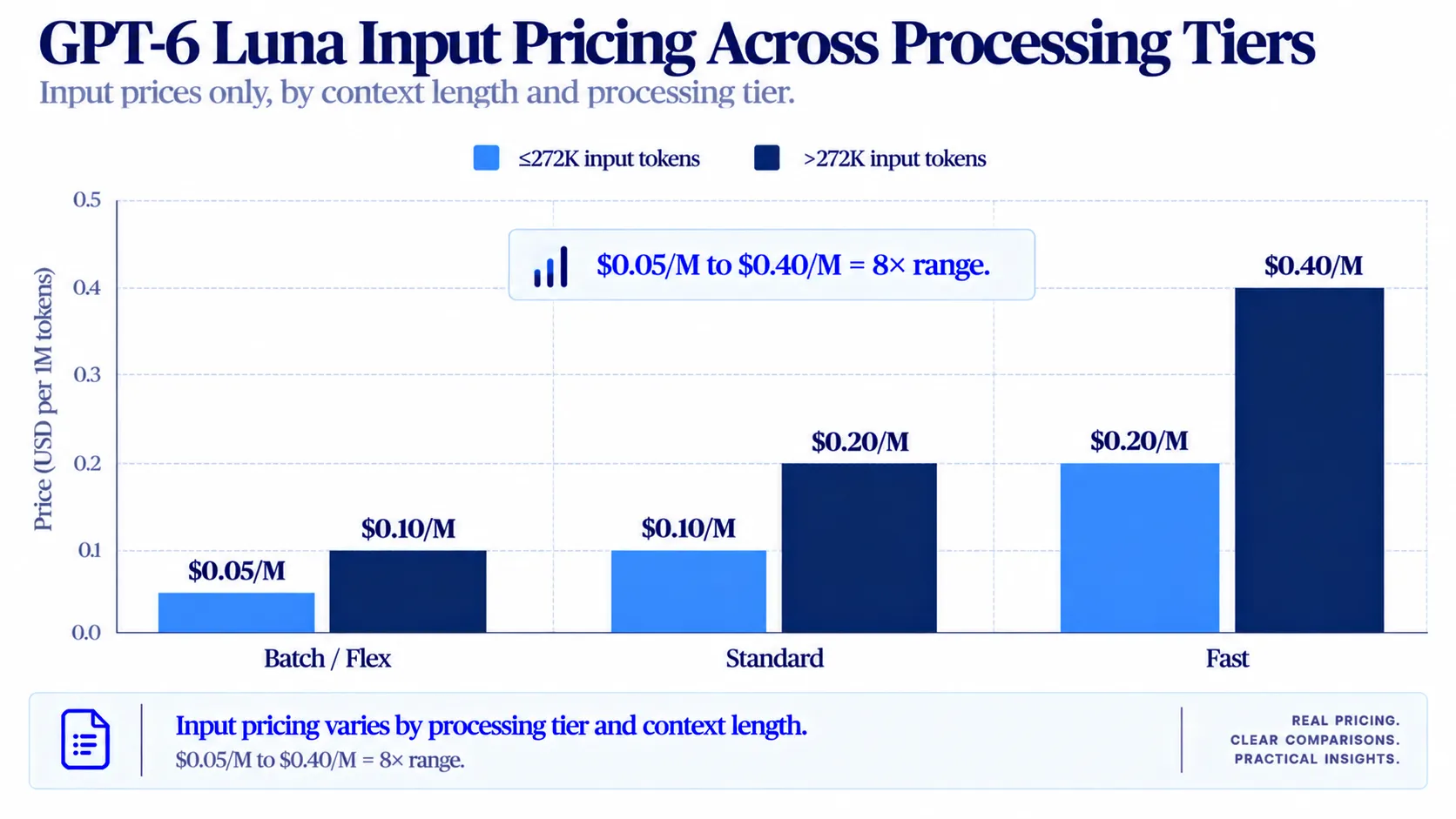
| Mode | ≤272K Input / Output | >272K Input / Output |
| Batch / Flex | $0.05 / $0.25 | $0.10 / $0.375 |
| Standard | $0.10 / $0.50 | $0.20 / $0.75 |
| Fast | $0.20 / $1.00 | $0.40 / $1.50 |
Batch and Flex cost 50% of Standard pricing, while Fast costs 2× the applicable Standard rate. Regional processing adds a 10% premium where available.
The widest input-price difference is between short-context Batch or Flex at $0.05/M and long-context Fast at $0.40/M.
That is an 8× range in input pricing for the same model.
For asynchronous workloads where latency is less important, Batch or Flex can materially reduce cost. For latency-sensitive applications using Fast with very large prompts, the $0.10/M headline price becomes much less representative.
GPT-6 Luna Reasoning Cost per Task
GPT-6 Luna supports none, low, medium, high, xhigh and max reasoning effort, with medium as the default.
Reasoning effort does not create six separate headline token-price tables. Instead, it changes token consumption, task success and therefore total cost per completed task.
GPT-6 Luna Reasoning Benchmark Data
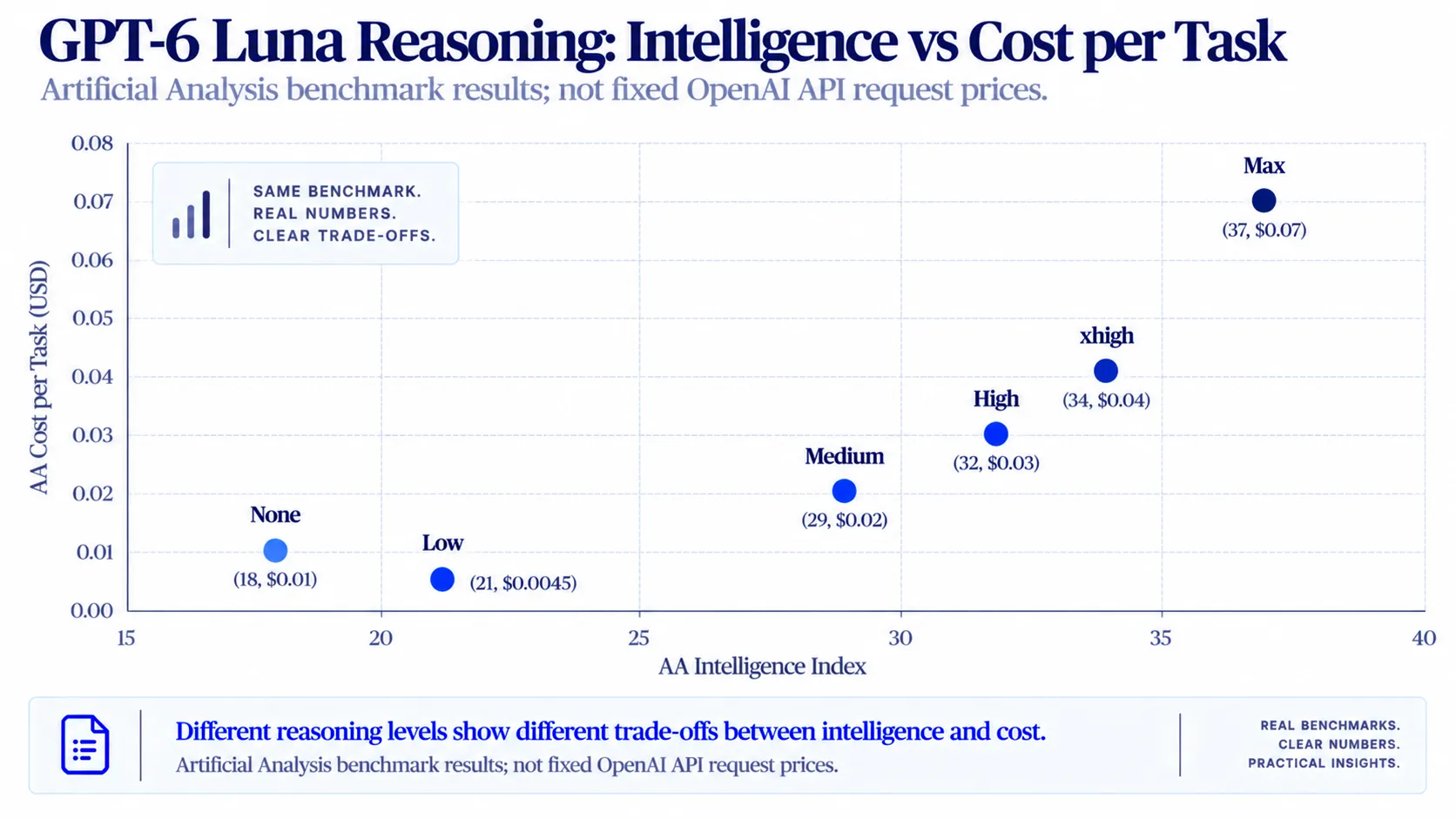
Artificial Analysis reported the following GPT-6 Luna results in its independent benchmark evaluation:
| Reasoning | AA Intelligence Index | AA Cost per Task |
| None | 18 | $0.01 |
| Low | 21 | $0.0045 |
| Medium | 29 | $0.02 |
| High | 32 | $0.03 |
| xhigh | 34 | $0.04 |
| Max | 37 | $0.07 |
In that evaluation, measured output speed ranged from about 136 t/s at non-reasoning to 176 t/s at Low, so higher reasoning cost did not directly translate into higher output throughput.
In this benchmark, cost per task increased from $0.0045 at Low to $0.07 at Max—a 15.6× difference—while the Intelligence Index increased from 21 to 37.
These are benchmark-specific observed task costs, not fixed GPT-6 Luna API rates. Results will vary with prompts, reasoning effort, token usage and workload.
Why the Lowest Reasoning Level Is Not Always the Cheapest
Lower reasoning effort usually consumes fewer tokens, but it does not always minimize cost per successful task. If a weaker attempt fails and requires multiple retries, total spend can exceed the cost of a stronger first attempt.
For production workloads, the better metric is:
Total reasoning spend ÷ accepted results
This captures both token consumption and failure cost.
GPT-6 Luna vs GPT-5.6 Luna Pricing
GPT-6 Luna significantly lowers headline token prices compared with GPT-5.6 Luna.
| Model | Input | Output |
| GPT-5.6 Luna | $0.20/M | $1.20/M |
| GPT-6 Luna | $0.10/M | $0.50/M |
That represents a 50% reduction in input pricing and approximately 58.3% lower output pricing.
Does Lower GPT-6 Luna Pricing Mean Lower Coding Cost?
Not automatically.
In one small coding benchmark reviewed in our research, GPT-6 Luna at High reasoning completed all three tested tasks using approximately 14.6K–15.4K tokens per task, with reported API-equivalent costs around $0.0018–$0.0023.
In the same report, GPT-5.6 Luna completed two tasks and failed one, with reported costs of approximately $0.0037–$0.0097.
This was a small developer benchmark rather than a controlled large-scale study, so it should not be generalized to every coding workload.
It is still useful because it demonstrates the right comparison method: compare successful-task cost, not token price alone.
Our broader research also identified a Terraform module-migration case where Luna encountered looping, context loss and slow progress. That result shows why production teams should test the same repository, prompts and acceptance criteria before replacing one model globally.
Lower token pricing is valuable, but a cheaper model is only cheaper when it maintains an acceptable success rate.
GPT-6 Luna Agent Pricing and Routing Risk
Agent workflows introduce another pricing layer because the requested model may not be the only model that contributes to the final task.
Third-Party Pricing Can Differ From GPT-6 Luna API Pricing
Our review of user questions identified one third-party coding-platform case involving reported multipliers including 0.1×, 1.1× and 2.2× under different conditions.
These values are platform-specific pricing mechanics, not OpenAI’s GPT-6 Luna token pricing.
The broader lesson is simple:
Model price and provider price are not always the same thing.
Credit systems, bundles, markups, context multipliers and routing policies can change what the end user ultimately pays.
Agent Routing Can Erase Luna’s Cost Advantage
Another agent case reviewed in our research expected a Luna Max sub-agent but observed routing into Astra Max and Astra Light instead.
The unexpected route was identified after roughly one minute and stopped. After the workflow was adjusted, the same behavior was not observed during roughly the next 10 minutes.
This is one workflow case rather than evidence of universal routing behavior, but it highlights an important operational principle:
Model-routing transparency is also a cost-control feature.
Production teams should log which model actually handles each step, especially when a low-cost execution model can escalate into a significantly more expensive alternative.
How to Calculate Your Real GPT-6 Luna API Cost
A reliable GPT-6 Luna cost model should follow seven steps:
- Separate normal input, cached input, cache writes and output.
- Check whether each request is above or below 272K input tokens.
- Apply the correct Batch, Flex, Standard or Fast pricing tier.
- Include tool charges where relevant.
- Measure token consumption at the selected reasoning effort.
- Add retries, agent loops and fallback model calls.
- Divide total spend by successful or accepted tasks.
The seventh step is the most important.
Imagine two systems processing the same workload. One has cheaper tokens but requires frequent retries. The other spends more per request but succeeds more often on the first attempt.
Cost per million tokens cannot tell you which system is cheaper. Cost per completed task can.
When GPT-6 Luna API Pricing Makes Economic Sense
GPT-6 Luna is most likely to be cost-efficient for focused, high-volume and repeatable workloads where context size is controlled and output is predictable.
Strong candidates include extraction, classification, repetitive coding operations, sub-agent execution, RAG with high cache reuse, and asynchronous workloads that can use Batch or Flex.
More careful testing is needed when prompts regularly exceed 272K tokens, workflows depend on Max reasoning, outputs are unusually large or third-party providers use opaque credit and routing systems.
For production workloads, track three metrics together: task success rate, average cost per successful task and latency at the required quality level.
Those numbers reveal far more about real GPT-6 Luna economics than the $0.10/M headline rate alone.
GPT-6 Luna Pricing on LinkModel
LinkModel offers GPT-6 Luna at 75% of OpenAI’s corresponding listed token rates. With one OpenAI-compatible API, one API key and unified billing, teams can use Luna alongside other supported models without rebuilding integrations.
| Pricing | OpenAI Listed Rate | LinkModel |
| Input | $0.10/M | $0.075/M |
| Output | $0.50/M | $0.375/M |
Frequently Asked Questions
How much is GPT-6 Luna API?
Standard short-context GPT-6 Luna pricing is $0.10/M input, $0.01/M cached input, $0.125/M cache writes and $0.50/M output. Long-context and alternative processing tiers use different rates.
What happens after 272K tokens?
When input exceeds 272K tokens, input and cache rates become 2× higher and output becomes 1.5× higher. The higher pricing applies to the entire request, not only the tokens above 272K.
Why can GPT-6 Luna cost more than $0.10/M?
Because $0.10/M applies only to Standard short-context uncached input. Output, cache writes, long context, Fast processing, reasoning, tools, retries and fallback calls can all increase real cost.
Is GPT-6 Luna cheaper than GPT-5.6 Luna?
At the listed Standard rates, yes. Input falls from $0.20/M to $0.10/M, while output falls from $1.20/M to $0.50/M. Real production savings still depend on token consumption, retries and task success.
Which GPT-6 Luna reasoning level is cheapest?
There is no universal answer. Artificial Analysis measured $0.0045 per benchmark task at Low and $0.07 at Max, but those are benchmark-specific task costs rather than fixed API prices. The most economical setting is the lowest reasoning level that still maintains the success rate your workload requires.
Conclusion
GPT-6 Luna starts at $0.10/M input and $0.50/M output, but those rates do not tell the full cost story. Crossing 272K input tokens reprices the entire request, while caching, processing tier, reasoning and retries can materially change real spend.
For production workloads, the metric that matters most is cost per successful task—not cost per million tokens alone.