
GPT-6 Astra can burn quota faster than GPT-5.6 Sol because it costs 2.5× more per token and agent workflows can multiply usage through repeated context, tool calls, and polling. At current OpenAI Standard rates, Astra costs $10 vs $4 per 1M input tokens and $50 vs $20 per 1M output tokens. In one agent session we reviewed, 47 ineffective polling checks generated 7.13M input tokens, accounting for about 68% of parent-side input.
The problem is that quota burn is not just a pricing issue. Retries, duplicated context, reasoning, and agent loops can rapidly increase token usage. In one session we reviewed, 47 ineffective polling checks generated 7.13M input tokens, while another same-task test made Astra about 6.9× more expensive than Sol. That makes cost per successful task more useful than token price alone.
GPT-6 Astra and GPT-5.6 Sol are both available on LinkModel, with Astra priced at 75% of OpenAI’s corresponding API token rates—a 25% discount. With one OpenAI-compatible API, one API key, and unified billing, you can route routine tasks to Sol and harder workloads to Astrawithout rebuilding your integration.

GPT-6 Pricing vs GPT-5.6: What Does Each Model Cost?
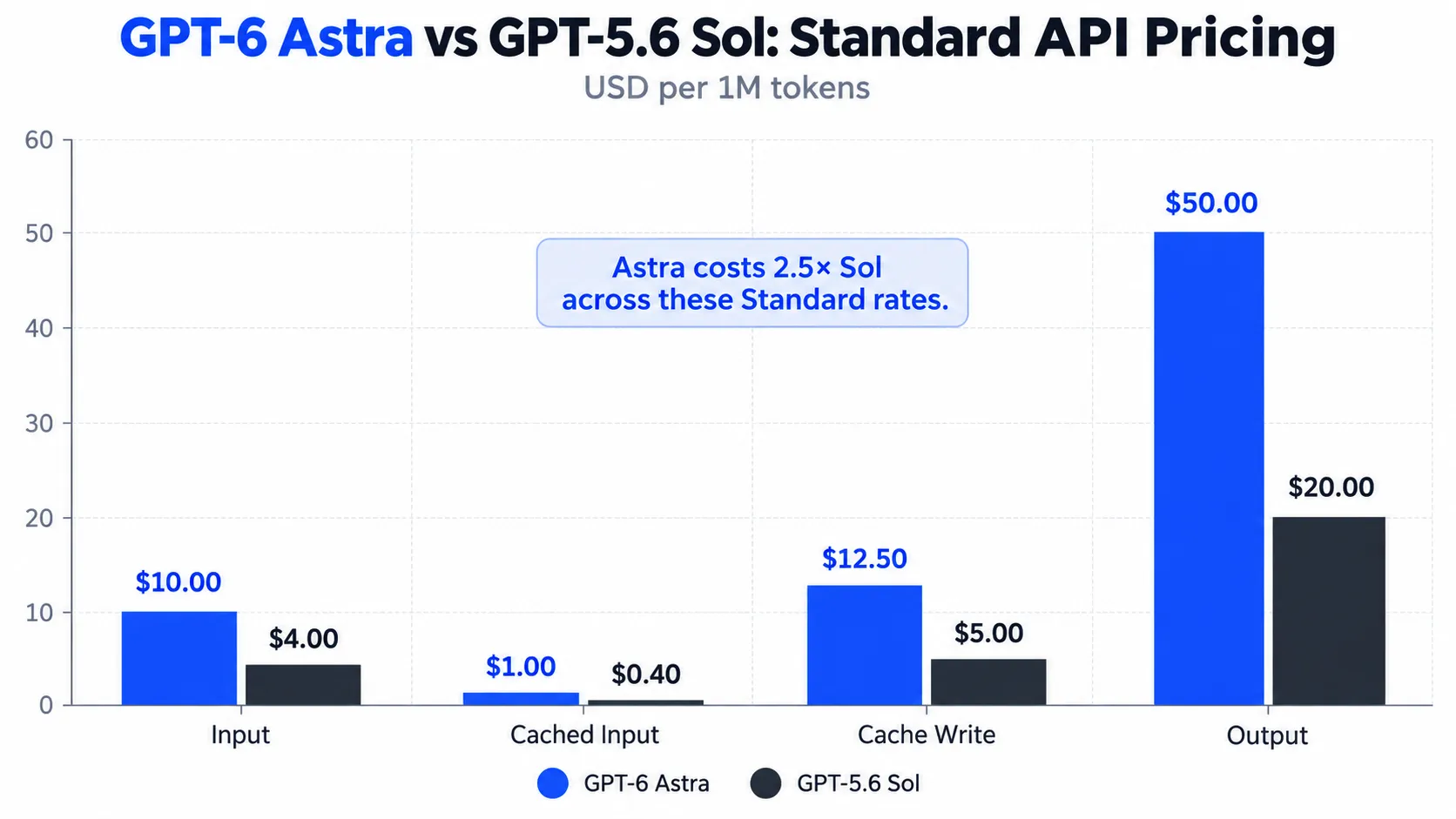
At current Standard short-context rates, the pricing difference is straightforward.
| Cost per 1M tokens | Astra | Sol |
|---|---|---|
| Input | $10.00 | $4.00 |
| Cached input | $1.00 | $0.40 |
| Cache write | $12.50 | $5.00 |
| Output | $50.00 | $20.00 |
Across all four categories, Astra costs exactly 2.5× as much as Sol.
The harder question is whether GPT-6 production workloads actually use the same number of tokens on both models.
GPT-6 vs GPT-5.6 Short-Context Pricing
Consider a workload using 100K input tokens and 10K output tokens.
Astra costs $1.00 for input plus $0.50 for output, or $1.50 total.
Sol costs $0.40 for input plus $0.20 for output, or $0.60 total.
With identical token usage, Astra is therefore exactly 2.5× more expensive.
This is why describing Astra as simply “about twice as expensive” understates the current difference. At scale, the distinction between 2× and 2.5× can materially affect API budgets.
GPT-6 vs GPT-5.6 Long-Context Pricing
Long-context workloads increase absolute costs further.
When a request exceeds 272K input tokens, higher long-context rates apply.
| Cost per 1M tokens | Astra | Sol |
|---|---|---|
| Input | $20 | $8 |
| Cached input | $2 | $0.80 |
| Cache write | $25 | $10 |
| Output | $75 | $30 |
The relative difference remains 2.5×.
This matters for large repositories, document-heavy agents, long research sessions, and workflows that repeatedly carry large contexts. Crossing the 272K threshold can materially change the economics of a request.
GPT-6 vs GPT-5.6 Batch, Flex, and Fast Pricing
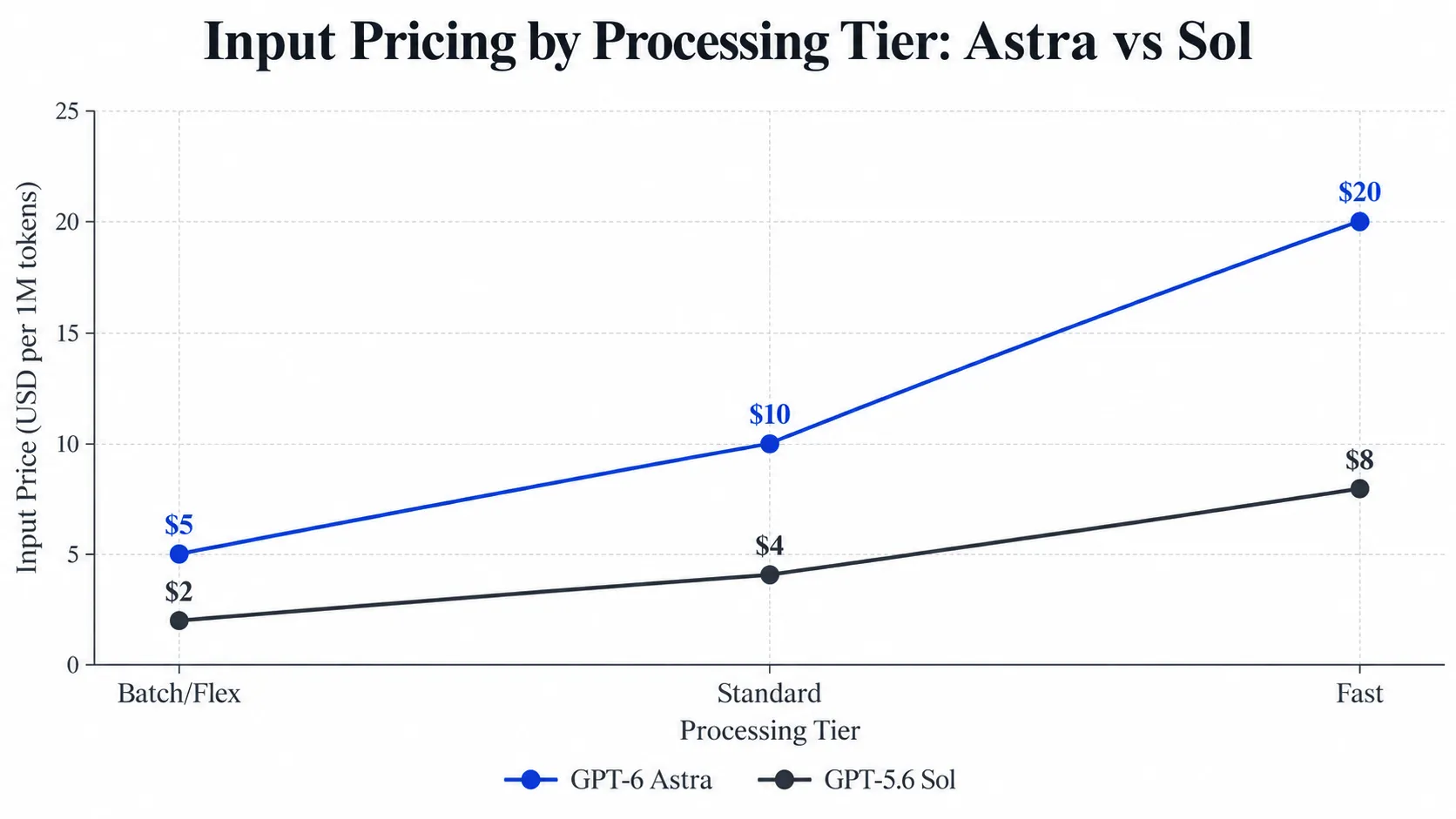
Processing tier changes the absolute bill but not the core price relationship.
For short-context workloads:
- Astra Batch/Flex: about $5 input and $25 output
- Sol Batch/Flex: about $2 input and $10 output
- Astra Standard: $10 input and $50 output
- Sol Standard: $4 input and $20 output
- Astra Fast: $20 input and $100 output
- Sol Fast: $8 input and $40 output
Across comparable tiers, Astra remains approximately 2.5× more expensive per token.
Batch and Flex can lower total spending, while Fast raises it, but processing tier alone does not eliminate Astra’s pricing premium.
Why GPT-6's 2.5× Token Price Does Not Mean 2.5× Task Cost
Price per token and price per successful task are different metrics.
Production cost also depends on total token consumption, reasoning effort, retries, failed attempts, context rereading, tool calls, agent orchestration, elapsed time, and final task success.
That is why the more useful economic metric is often cost per successful task.
A 6,500-Request Workload Produced Surprisingly Similar Costs
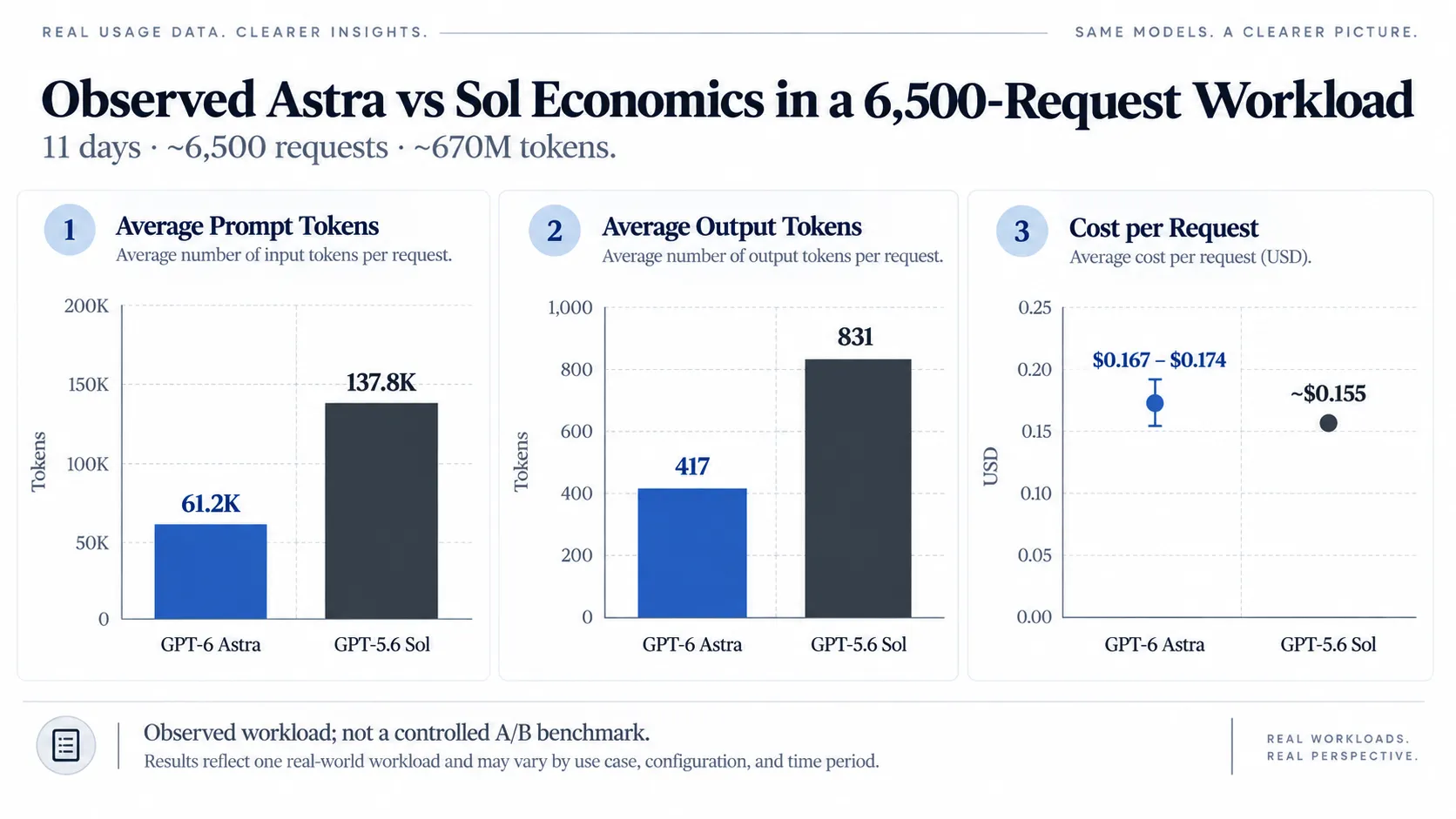
One workload reviewed in our research covered approximately 11 days, 6,500 requests, and 670M tokens.
For Astra, the observed averages were:
- 61.2K prompt tokens
- 417 output tokens
- $0.167–$0.174 per request
For Sol:
- 137.8K prompt tokens
- 831 output tokens
- approximately $0.155 per request
Despite Astra’s 2.5× higher token rates, its observed cost per request was only modestly higher because the Astra requests consumed substantially fewer tokens.
This was not a controlled A/B benchmark. Astra was used mainly at Low and Medium reasoning, while Sol was used more often at High reasoning.
The useful conclusion is therefore not that Astra generally costs about the same as Sol. It is that higher token rates do not always translate into proportionally higher workload costs.
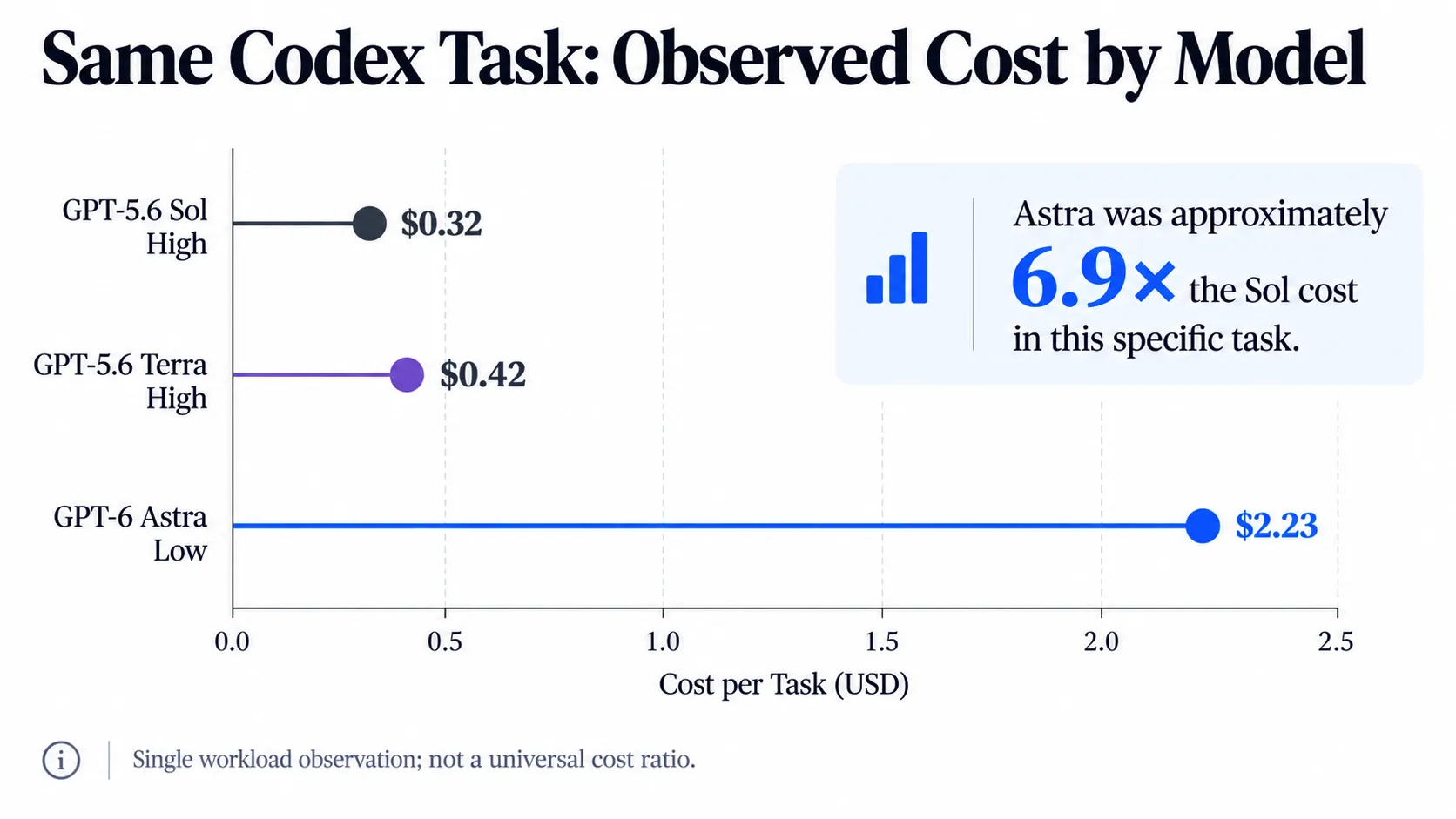
A Same-Task Test Made Astra About 6.9× More Expensive
Another workload in our research produced the opposite result.
For the same medium-sized Codex task:
- Astra Low: $2.23
- Sol High: $0.32
- Terra High: $0.42
In this case, Astra cost approximately 6.9× as much as Sol.
These two examples are not contradictory. They show that GPT-6 economics are highly workload-sensitive.
For some workloads, lower token consumption can offset part of Astra’s premium. For others, the additional capability does not produce enough efficiency to justify the higher price.
GPT-6 vs GPT-5.6 Performance: What Does Astra's 2.5× Premium Buy?
Astra’s higher price is not explained by a larger basic context limit. Astra and Solboth support a 1.05M context window and up to 128K output tokens.
The stronger argument for Astra is performance on workloads where difficult reasoning, tool use, long-context retrieval, or autonomous execution matters.
Official Benchmarks Show Where Astra Pulls Ahead
Several official evaluations show meaningful gaps between Astra and Sol.
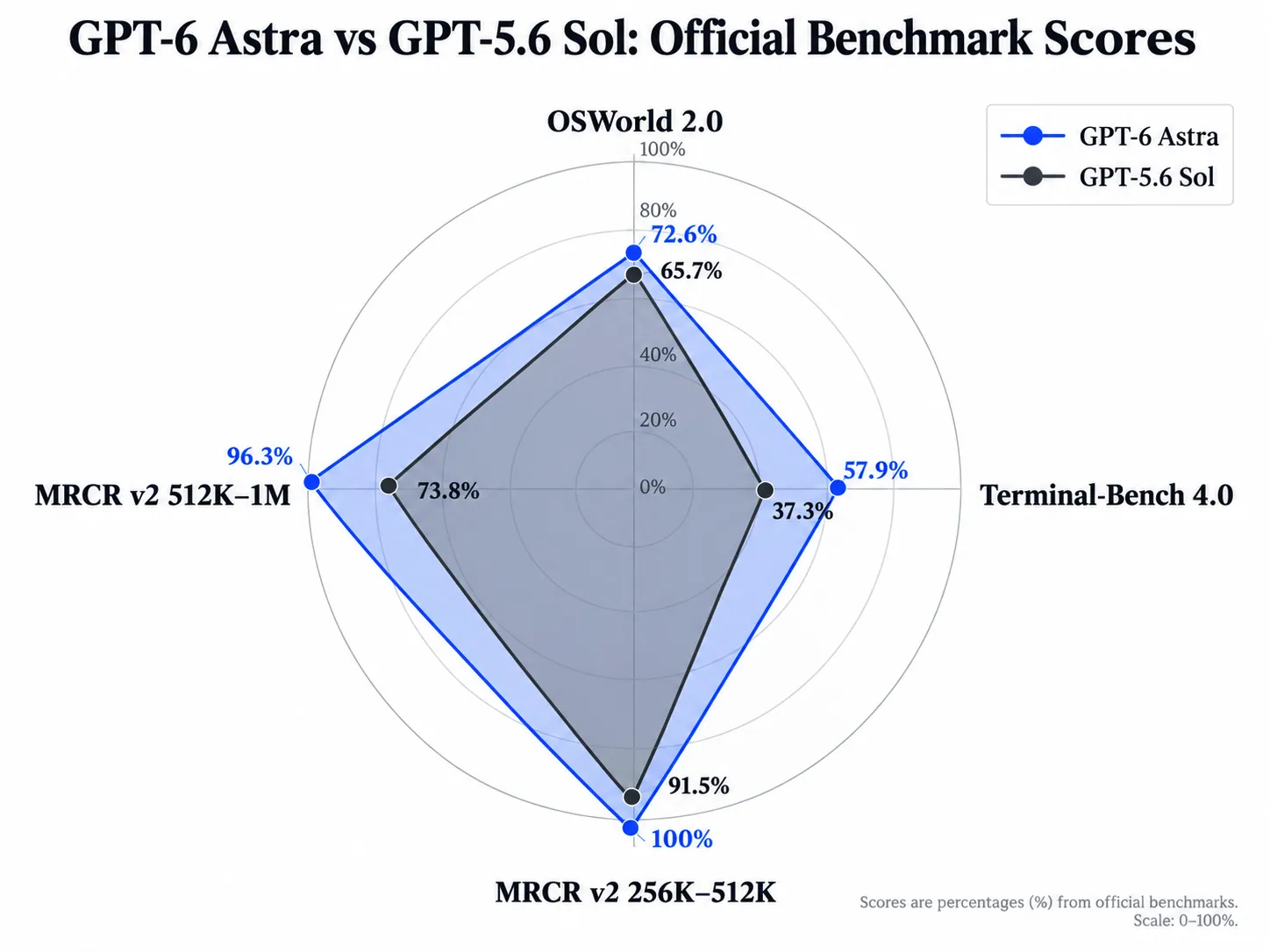
On OSWorld 2.0, Astra scored 72.6% versus 65.7% for Sol, with observed task time of approximately 40 minutes versus 75 minutes in the reported configuration.
On Terminal-Bench 4.0, Astra reached 57.9%, compared with 37.3% for Sol.
Long-context retrieval shows another large difference. On MRCR v2 with eight needles:
- At 256K–512K, Astra scored 100% vs 91.5%
- At 512K–1M, Astra scored 96.3% vs 73.8%
These benchmarks do not prove that Astra will reduce costs in every production workload. They show where the premium may buy materially stronger capability, especially as task difficulty and context length increase.
The pricing question therefore becomes more precise: does your workload benefit enough from these capability gains to offset the higher token rate?
GPT-6 vs GPT-5.6 for Coding: When Does Astra Earn the Premium?
Our review of coding workloads suggests a consistent decision pattern: Sol is usually the stronger economic default for routine work, while Astra becomes more attractive as task difficulty and failure cost increase.
Routine Coding Usually Favors Sol
For clear implementation tasks, repetitive edits, straightforward refactoring, familiar frameworks, and well-scoped changes, Sol’s lower price is difficult to ignore.
The $2.23 vs $0.32 same-task case shows the risk of automatically sending ordinary coding work to Astra.
If Sol already completes a task successfully, Astra has limited room to create enough additional value to justify a 2.5× token premium.
Sol is therefore a strong starting point when requirements are clear, retries are rare, failure cost is low, and token volume is high.
Complex Debugging Can Reverse the Economics
The calculation changes when the cheaper model repeatedly fails.
One difficult coding case reviewed in our research showed:
- Sol High spent roughly 6 hours without resolving the issue
- Astra Medium completed it in roughly 1 hour
- the Astra workflow used about 2% of a Pro $200 allowance
This is a single-task observation, not evidence that Astra is universally six times faster.
Its value is that it illustrates failure economics.
A lower-cost model can become the more expensive choice if repeated attempts consume hours of developer time, additional prompts, context reloads, and failed tool calls.
For difficult debugging, the right comparison may therefore be total cost to resolution, not API price alone.
A 50-PR Review Shows Why “Better” Needs a Metric
A 50-pull-request evaluation included in our research adds an important counterexample.
Across real pull requests involving projects such as Sentry, Discourse, Keycloak, Grafana, and Cal:
- Sol identified 107 confirmed bugs
- Astra identified 91 confirmed bugs
The evaluation also reported stronger precision and lower latency for Astra.
Because the full methodology and complete false-positive counts were not available in the material reviewed, we treat this as directional evidence rather than a definitive benchmark.
The larger lesson is still useful: there is no single coding metric called “better.” Bug recall, precision, latency, task completion, developer time, and API cost can point to different winners.
GPT-6 Astra Codex Cost: Why Can Quota Burn So Fast?
One of the strongest recurring questions in our review of user concerns was why Astra can consume Codex quota faster than expected.
Higher model pricing is part of the explanation, but our research suggests workflow architecture can matter just as much.
The 7.13M-Token Parent-Agent Case
One Astra agent session reviewed in our research provides a useful example.
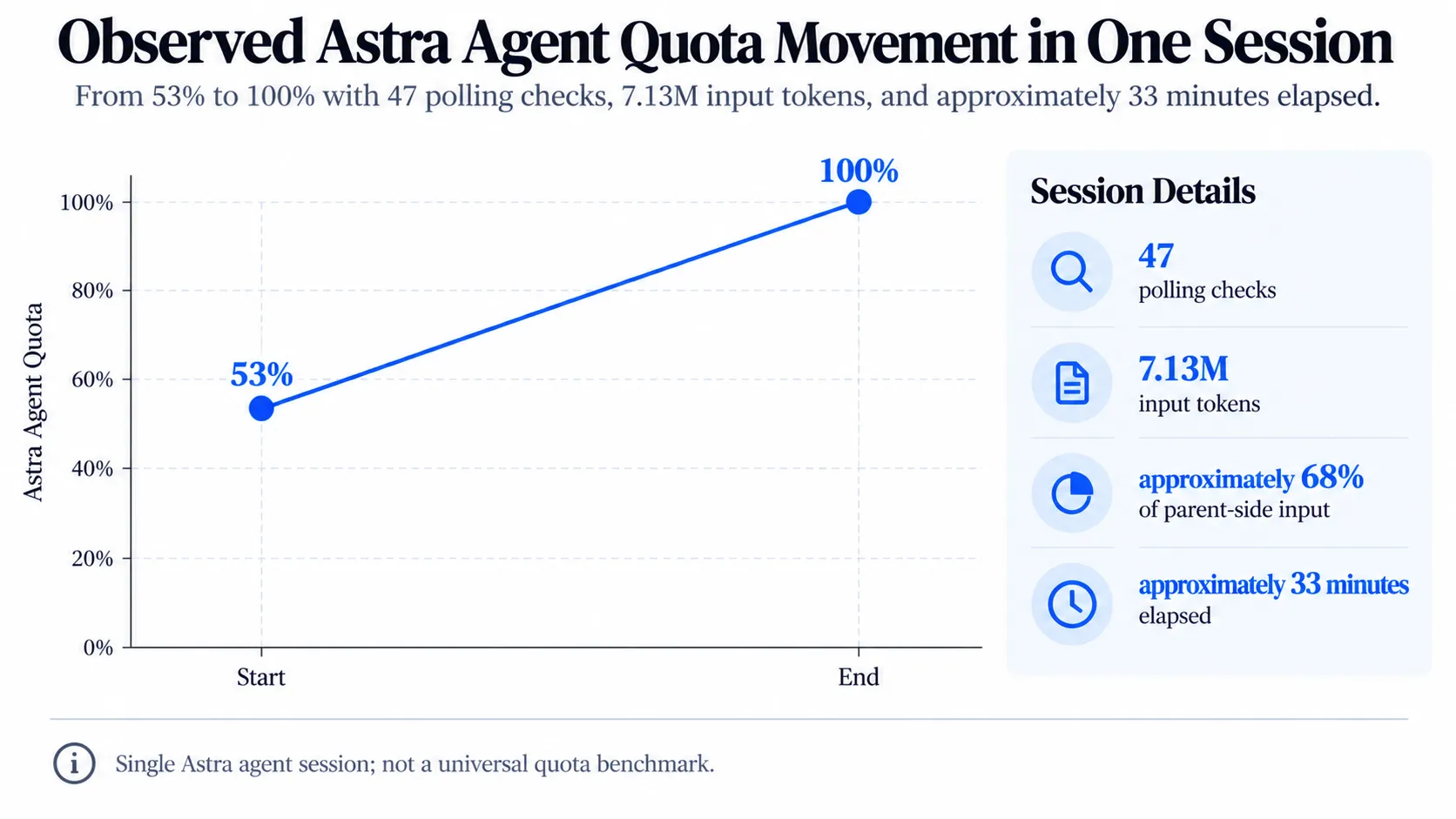
A parent agent performed approximately 47 polling checks while waiting for worker agents. All 47 reportedly returned no new worker state.
Those polling operations generated:
- 7.13M input tokens
- approximately 68% of parent-side input
- quota moving from 53% to 100%
- approximately 33 minutes of elapsed time
These numbers should not be generalized to every Astra workflow.
The important lesson is that millions of tokens can be consumed by orchestration rather than useful task progress.
Repeated polling, duplicated context, unnecessary tool loops, and repeated instructions can erase efficiency gains from a stronger model.
Optimize the Agent Before Blaming the Model
Production teams should monitor total input and output tokens, cache utilization, retry count, repeated context, tool-call loops, elapsed time, and task success rate.
Without these measurements, it is difficult to separate model cost from workflow inefficiency.
A badly orchestrated Astra agent may look prohibitively expensive even when the model itself is not the main source of waste.
This makes agent architecturean important part of GPT-6 cost optimization, not merely an implementation detail.
Is GPT-6 Astra Worth 2.5× More Than GPT-5.6 Sol?
Astra is not worth 2.5× more for every workload. It becomes worth testing when the cost of failure is high enough that stronger capability can reduce total work.
That leads to a much more useful decision framework than simply choosing the newest model.
When GPT-5.6 Sol Is the Better Value
Sol is usually the stronger starting point when:
- tasks are routine and predictable
- completion rates are already high
- token volume is large
- long context is frequent
- retries are inexpensive
- minimizing API cost is the primary objective
For identical usage, Sol costs 60% less than Astraat current Standard rates.
That makes it a strong default for predictable production traffic.
When GPT-6 Astra Can Justify the Premium
Astra becomes more attractive when:
- difficult debugging repeatedly fails
- architecture decisions have high downstream cost
- repeated attempts consume significant engineering time
- long-context retrieval quality matters
- autonomous workflows cannot tolerate frequent failure
- stronger reasoning can replace multiple unsuccessful runs
The useful question is not whether Astra is 2.5× smarter.
It is whether Astra reduces the total cost of reaching an acceptable result enough to offset its 2.5× token price.
The Best GPT-6 vs GPT-5.6 Strategy Is Model Routing
Our research supports routing more strongly than using one model for every request.
A practical pattern is:
Routine and predictable work → Sol
Difficult, failed, or high-value work → Astra
Final evaluation → compare cost per successful task
This lets teams capture Sol’s lower pricing without giving up Astra when stronger reasoning actually creates economic value.
For many production systems, the best model is not one model. It is the right model for each workload.
GPT-5.6 Pricing Has an Important Promotional Pricing Caveat
There is one time-sensitive limitation in every current GPT-6 vs GPT-5.6 pricing comparison.
GPT-5.6 Sol’s current API rates are promotional and confirmed to remain available at least through November 21, 2026.
That means the current $4 input and $20 output rates should not automatically be treated as permanent.
It also means Astra’s current 2.5× premium is measured against discounted Sol pricing.
The post-promotion Sol price has not been confirmed in the research reviewed for this article. Any long-term budget, calculator, or purchasing decision should therefore recheck Sol pricing after the promotional period instead of assuming today’s ratio will remain unchanged.
FAQ
Is Astra really 2.5× more expensive than Sol?
Yes, at current Standard API token rates. Astra costs $10 input and $50 output per 1M tokens, compared with $4 and $20 for Sol. Cached input and cache-write pricing follow the same 2.5× relationship. Actual task cost can still differ because token usage and success rates vary.
Can Astra cost less per completed task than Sol?
Potentially, but not consistently. In one 6,500-request workload reviewed in our research, Astra cost about $0.167–$0.174 per request versus roughly $0.155 for Sol. In another same-task case, Astra cost $2.23 vs $0.32. This is why cost per successful task is more useful than token price alone.
Should I use Astra Low or Sol High?
For routine work, Sol High can offer stronger value because of its lower token rates. Astra becomes more interesting when difficult tasks repeatedly fail, consume substantial engineering time, or benefit from stronger reasoning and long-context performance. Benchmarking your own workload is more reliable than assuming one setting always wins.
Why does Astra use Codex quota so quickly?
Higher token pricing contributes, but workflow design also matters. In one agent session reviewed in our research, 47 ineffective polling checks generated 7.13M input tokens, accounting for about 68% of parent-side input. Context rereading and agent orchestration can therefore materially increase quota consumption.
Will Sol stay cheaper than Astra?
Sol is cheaper under current rates, but its pricing is promotional through at least November 21, 2026. The post-promotion price has not been confirmed, so the current 2.5× Astra-to-Sol ratio should be rechecked when the promotional period changes.
Conclusion
GPT-6 Astra currently costs 2.5× more per base API token than GPT-5.6 Sol, but production economics depend on far more than the rate card. Our research found a 6,500-request workload where Astra and Sol produced surprisingly similar per-request costs, a same-task case where Astra cost about 6.9× more, a difficult coding problem where Astra succeeded after Sol had spent hours without resolving it, official benchmarks showing larger Astra advantages on difficult agentic and long-context workloads, and an agent session where 7.13M input tokens were consumed largely by orchestration overhead. Together, these results support a practical strategy: use Sol as the cost-efficient default for predictable work, route difficult or high-failure-cost tasks to Astra, and judge both models by total cost per successful task rather than price per million tokens alone.