← Back to Blog
API PricingAI ModelsOpenAIGuides

GPT-6 API Pricing: Is Astra Really Worth 2.5× More Than Sol?

GPT-6 API pricing starts at $10/M input and $50/M output. See the 272K cost cliff, Batch/Flex savings, Astra vs Sol, and what a real task can cost.

2026-09-07

Claire Lowe

Claire Lowe

AI & API Researcher at LinkModel

GPT-6 API Pricing: Is Astra Really Worth 2.5× More Than Sol?

GPT-6 Astra is not automatically worth paying 2.5× more than GPT-5.6 Sol. Astra Standard costs $10/M input and $50/M output, versus $4/M input and $20/M output for Sol. The better metric is not price per token, but cost per successfully completed task. Whether Astra is worth the premium depends on one metric that matters more than token price: cost per successfully completed task. If Astra materially reduces retries, completion time, or failed runs, its higher token rate can be justified; for routine workloads that Sol already handles reliably, it may not be.

The bigger risk is that GPT-6 API costscan rise far beyond the headline rate. Once input exceeds 272K tokens, higher long-context pricing applies to the entire request. Output tokens, retries, tool calls, and repeated agent steps can push the real cost even higher. Batch and Flex can cut token rates by 50%, while Fast costs 2× Standard.

The most practical strategy is model routing: use Astra for difficult workloads where its higher capability improves results, and route simpler tasks to lower-cost models such as Sol. With LinkModel, you can access supported leading models through one OpenAI-compatible API, one API key, and unified billing, making it easier to switch models based on cost, performance, and availability.

Explore GPT-6 Astra.

LinkModel homepage featuring GPT-6 Astra

GPT-6 API Pricing at a Glance

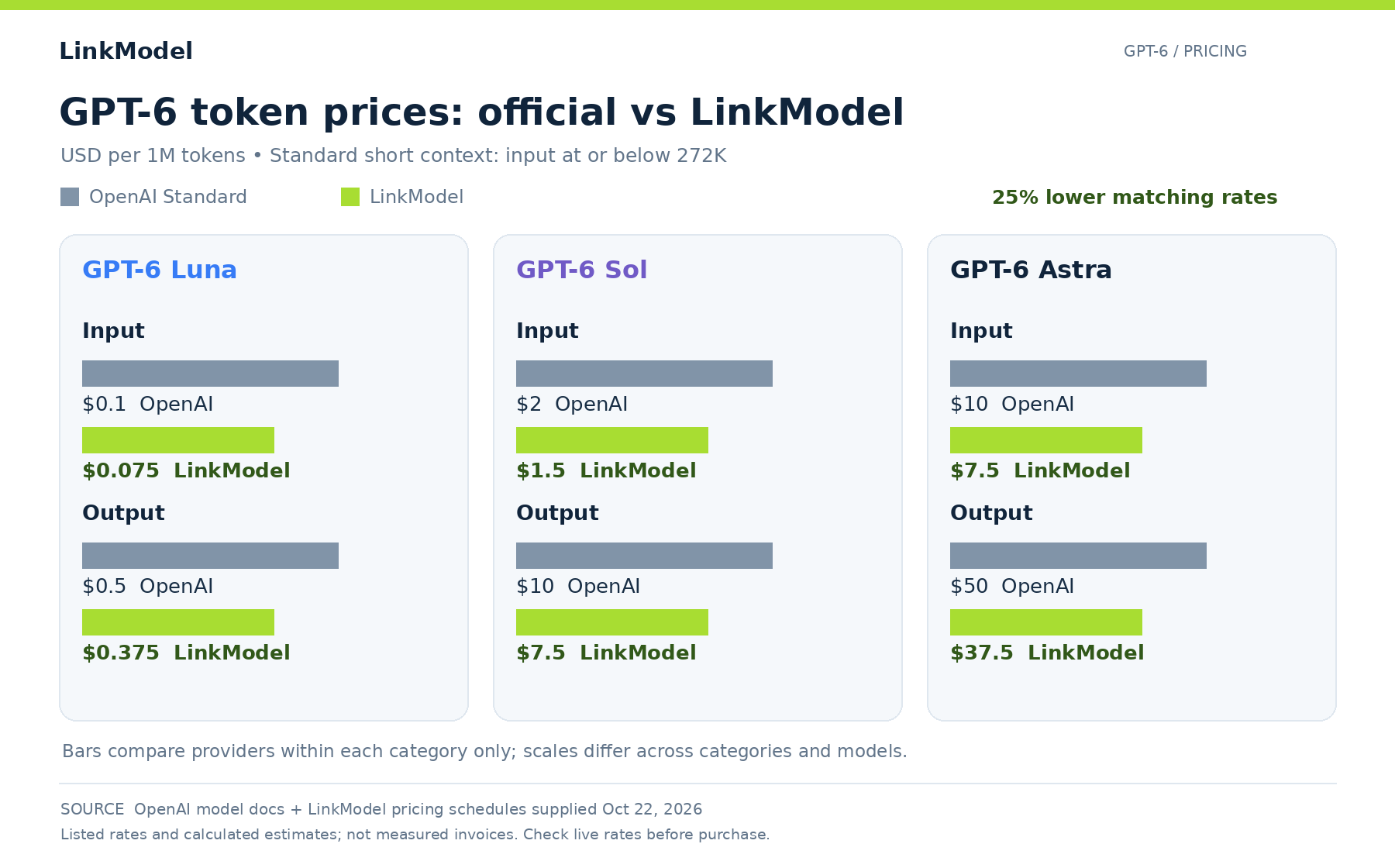
GPT-6 Astra Standard API pricing is $10/M input, $1/M cached input, $12.50/M cache write, and $50/M output for requests with no more than 272K input tokens.

The four API prices matter because applications rarely consist of only uncached input and output.

Token TypePrice per 1M
Input$10.00
Cached input$1.00
Cache write$12.50
Output$50.00

GPT-6 Astra supports a 1,050,000-token context window and up to 128,000 output tokens, but using that full context does not mean every token is billed at the headline rate.

The 272K input threshold changes the economics substantially, which makes context size one of the most important variables in any GPT-6 cost model.

GPT-6 Input and Output Token Pricing

GPT-6 Astra Standard input costs $10 per 1 million tokens, while generated output costs $50 per 1 million tokens.

That makes output five times more expensive per token than ordinary input.

Converted into smaller units:

  • 1,000 input tokens cost about $0.01
  • 10,000 input tokens cost about $0.10
  • 100,000 input tokens cost about $1.00
  • 1,000 output tokens cost about $0.05
  • 10,000 output tokens cost about $0.50
  • 100,000 output tokens cost about $5.00

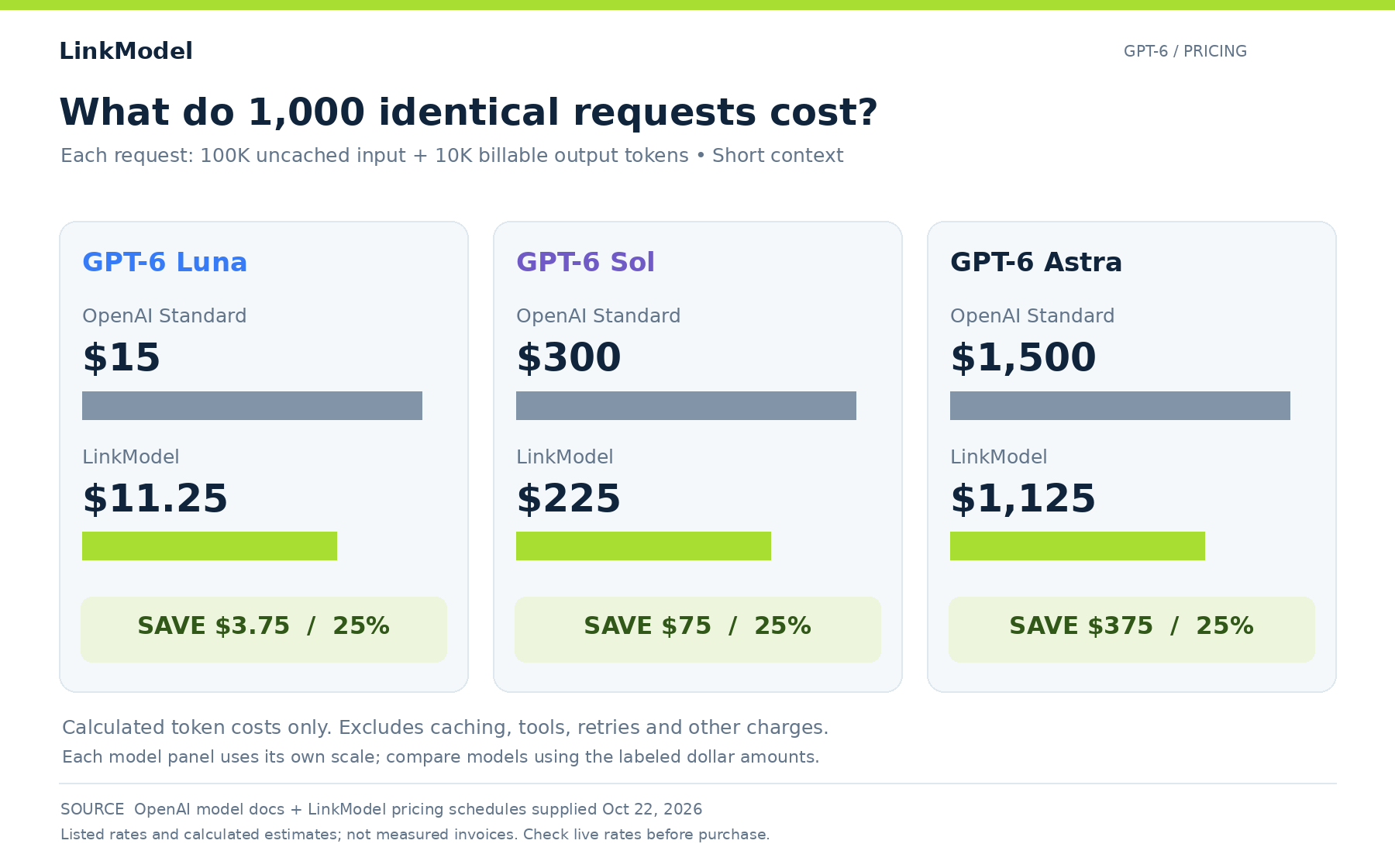
Consider a short-context request with 100K uncached input tokens and 10K output tokens.

The input portion costs $1.00.

The output portion costs $0.50.

Total estimated API cost: $1.50 per request.

This simple example reveals an important production issue. In long reasoning, coding, report generation, or autonomous-agent workloads, output length can become a major cost driver even when input remains stable.

For that reason, average output length should be tracked separately instead of treating total token usage as one number.

GPT-6 Cached Input Pricing

GPT-6 Astra cached input costs $1/M, compared with $10/M for ordinary Standard input.

That is a 90% lower token rate for qualifying cached input.

The difference can become significant in applications that repeatedly reuse large, stable context, including:

  • system instructions;
  • agent policies;
  • tool definitions;
  • schemas;
  • repository documentation;
  • repeated reference documents;
  • stable conversation prefixes.

Suppose an agent repeatedly sends 100K tokens of reusable context.

At the ordinary input rate, that portion costs approximately $1 per request.

At the cached-input rate, the corresponding charge is approximately $0.10.

Across 10,000 requests, that is a theoretical difference of roughly $10,000 versus $1,000 for that specific portion of the workload.

That does not mean prompt caching automatically reduces the complete API bill by 90%. Cache eligibility, cache writes, changing prefixes, generated output, tools, and other charges still matter.

The practical lesson is that cache-hit ratio should be treated as a production cost metric.

GPT-6 Cache Write Pricing

GPT-6 Astra cache writes cost $12.50/M, making them more expensive than normal uncached input.

This is one of the most frequently overlooked components of GPT-6 API pricing.

Caching becomes most valuable when a block of context will be reused enough times to compensate for the initial cache-write cost.

For a large prefix used once, caching provides little economic advantage.

For a large prefix reused hundreds or thousands of times, the lower cached-input rate can dominate the initial write cost.

This creates a straightforward operational question:

How many future requests will reuse the context after the cache is created?

For high-volume applications, answering that with real usage data is more useful than simply enabling caching everywhere.

GPT-6 API Access, Rate Limits, and Extra Tool Costs

Published GPT-6 Astra pricing does not mean every API account has identical access or capacity. Astra access has been rolling out, and API rate limits can vary by account and usage tier. Before planning production throughput, verify both model access and current account-level rate limits.

The token prices in this guide cover the model's text-token charges. Tool-specific features can add separate costs, including supported capabilities such as web search or computer use. For an agent that repeatedly searches, browses, interacts with tools, or performs long multi-step workflows, the final bill can therefore be higher than the input-and-output token calculation alone.

For production budgeting, track at least:

  • token spend;
  • tool usage;
  • retries;
  • requests per task;
  • successful-task rate.

That provides a more realistic estimate of total GPT-6 API cost than token pricing alone.

GPT-6 API Pricing for Standard, Batch, Flex, and Fast

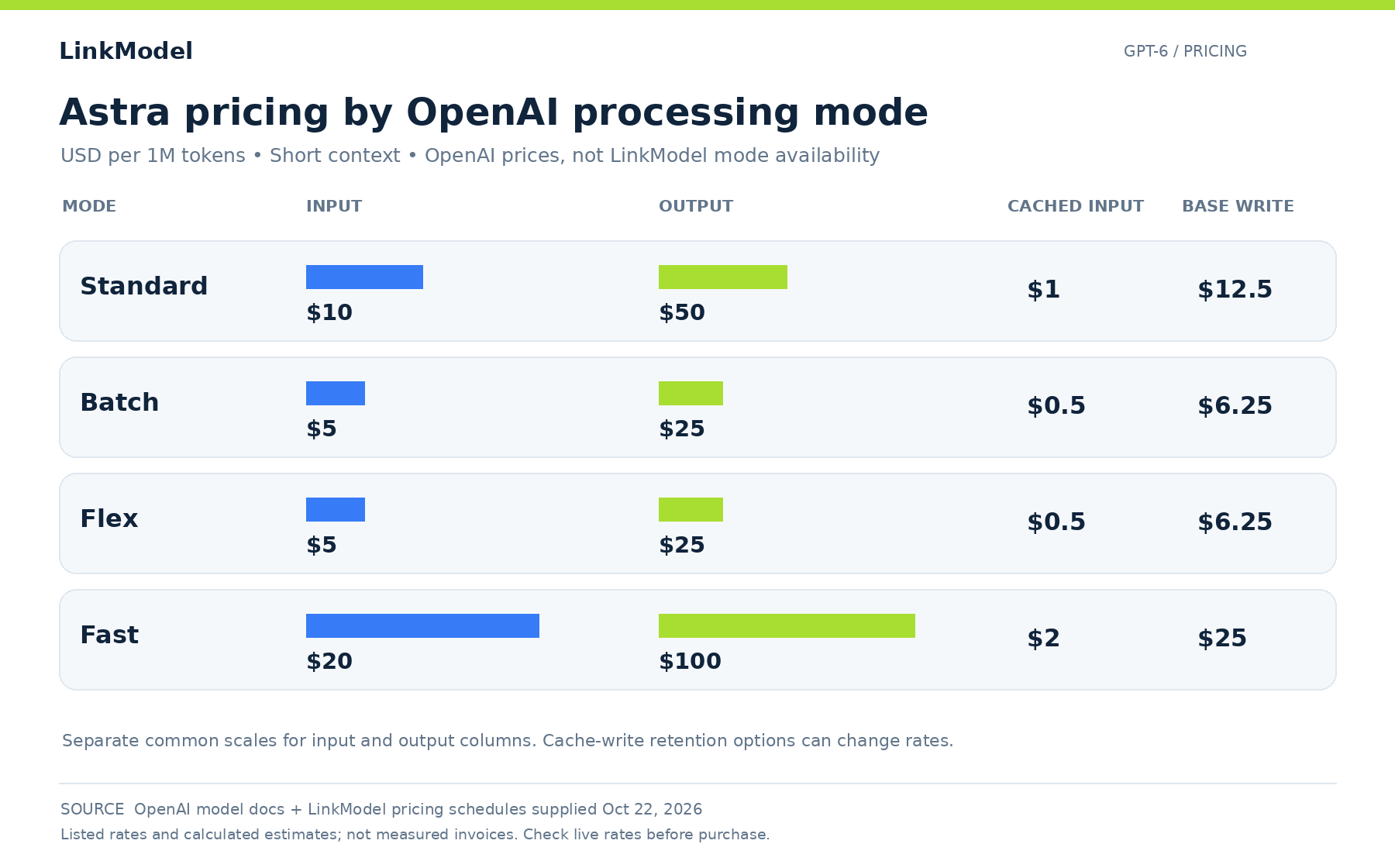
GPT-6 Astra pricing changes substantially by processing mode. Batch and Flex cost 50% of Standard token rates, while Fast costs 2× Standard rates.

For the primary input and output charges:

ModeInput / 1MOutput / 1M
Standard$10$50
Batch$5$25
Flex$5$25
Fast$20$100

For cached input and cache writes:

ModeCached / 1MCache Write / 1M
Standard$1.00$12.50
Batch$0.50$6.25
Flex$0.50$6.25
Fast$2.00$25.00

These figures apply to requests that remain within the short-context pricing tier.

GPT-6 Astra API pricing by processing mode

GPT-6 Batch API Pricing

GPT-6 Astra Batch pricing is 50% of Standard pricing, making it one of the clearest ways to reduce the base token bill for workloads that do not require normal interactive response timing.

Return to the 100K-input, 10K-output example.

Standard:

  • Input: $1.00
  • Output: $0.50
  • Total: $1.50

Batch:

  • Input: $0.50
  • Output: $0.25
  • Total: $0.75

The same token volume costs half as much.

The difference becomes more important at scale.

For 100M input tokens and 10M output tokens:

Standard:

  • Input: $1,000
  • Output: $500
  • Total: $1,500

Batch:

  • Input: $500
  • Output: $250
  • Total: $750

That is a $750 difference before considering caching or other fees.

If your workload is an offline evaluation, background content pipeline, large classification job, or another task without strict interactive latency requirements, pricing it only at Standard rates can substantially overstate the minimum possible token cost.

GPT-6 Flex Pricing

GPT-6 Astra Flex also uses 50% of Standard token rates.

That gives Flex the same published token pricing as Batch:

  • $5/M input
  • $0.50/M cached input
  • $6.25/M cache write
  • $25/M output

The decision between Standard, Batch, and Flex should therefore consider workload behavior as well as price.

A practical cost-planning approach is to treat Standard as the baseline and evaluate cheaper processing modes anywhere response characteristics permit them.

Teams can spend substantial engineering effort reducing prompts by a few percentage points while overlooking a processing mode capable of reducing the base token rate by 50%.

For many workloads, processing mode is the larger pricing lever.

GPT-6 Fast Pricing

GPT-6 Astra Fast costs $20/M input and $100/M output under short-context pricing.

That is twice the Standard token rate.

The same 100K-input, 10K-output example therefore becomes:

  • Input: $2.00
  • Output: $1.00
  • Total: $3.00

OpenAI describes Fast as providing up to roughly 2× Standard processing speed at 2× the price.

The important variable is speed.

Fast is not primarily a cost-saving mode. It is a latency optimization.

The economics make sense when response time itself creates business value.

Possible examples include:

  • interactive coding assistants;
  • customer-facing agents;
  • time-sensitive computer-use workflows;
  • applications where users actively wait for completion;
  • tasks where faster iteration allows significantly more work to be completed.

For an overnight background job, paying twice as much to finish earlier may produce little benefit.

For a live product where latency affects conversion, productivity, or retention, the same premium may be rational.

GPT-6 Long-Context Pricing Above 272K Tokens

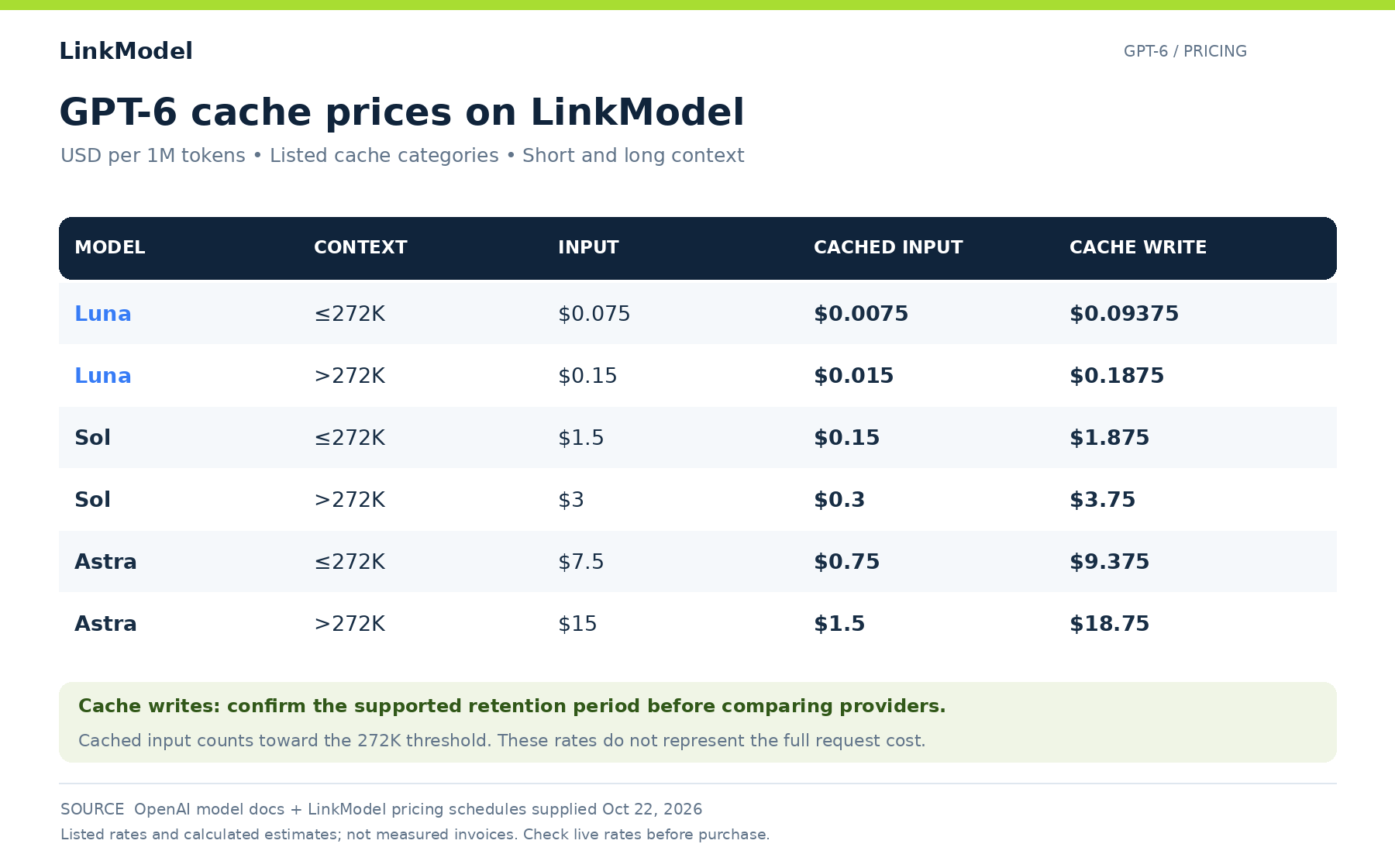
GPT-6 Astra requests exceeding 272K input tokens use higher pricing for the entire request, not only the tokens above 272K. Standard input rises from $10/M to $20/M, while Standard output rises from $50/M to $75/M.

Token Type≤272K>272K
Input$10/M$20/M
Output$50/M$75/M

The cache rates also increase:

Token Type≤272K>272K
Cached input$1/M$2/M
Cache write$12.50/M$25/M

This is one of the most consequential GPT-6 pricing rules because crossing the threshold can cause a large jump in request cost even when context grows only slightly.

GPT-6 272K Pricing Is Not Progressive

The 272K rule is easy to misunderstand.

A 273K-token request is not billed as 272K tokens at the normal rate and 1K token at the higher rate.

Once the request exceeds the threshold, long-context pricing applies to the full request.

This makes 272K behave more like a cost cliff than a progressive pricing tier.

For coding agents and long-running autonomous systems, the distinction is especially important because context can grow automatically even when the original user prompt remains small.

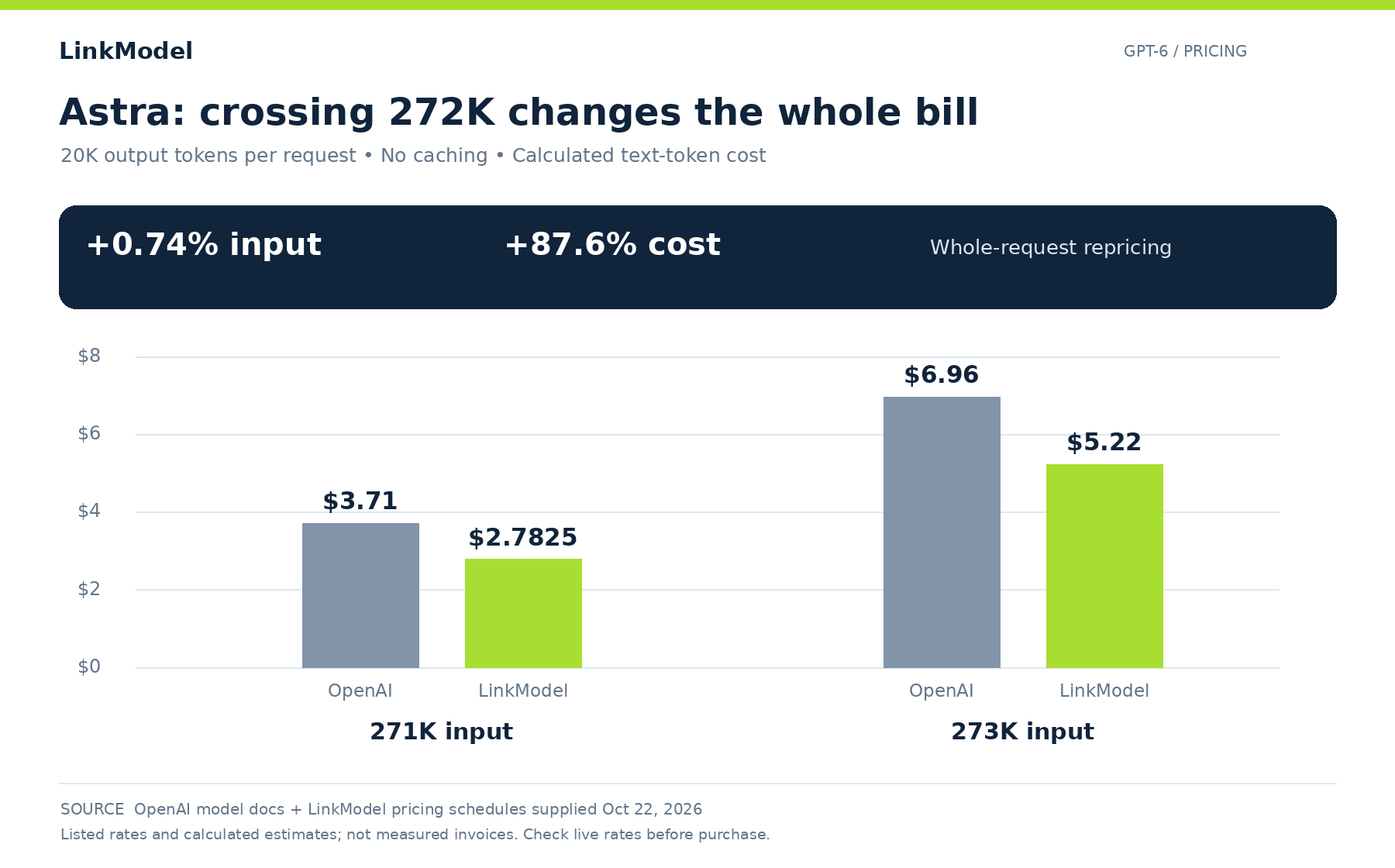
GPT-6 Cost Example: 271K vs 273K Input Tokens

Consider two Standard requests with 20K output tokens and no caching.

Request A uses 271K input tokens.

  • Input cost: $2.71
  • Output cost: $1.00
  • Total: $3.71

Request B uses 273K input tokens.

Because it crosses the long-context threshold:

  • Input cost: $5.46
  • Output cost: $1.50
  • Total: $6.96

Input increased by only about 0.7%.

Estimated request cost increased by approximately 87.6%.

This is why 272K should be monitored directly in production rather than discovered later on a monthly invoice.

The GPT-6 Astra 272K cost cliff

GPT-6 Long-Context Cost in Coding and Agent Workflows

A coding agent may start well below 272K and cross the threshold as its working state grows.

A typical context can accumulate:

repository files → previous patches → test results → compiler output → shell logs → tool responses → planning history → additional source files

The original prompt is often not the problem.

Context accumulation is.

Our review of user questions and developer workflow reports found that large-repository cost is one of the recurring concerns around Astra.

The correct response is not to avoid long context entirely. Astra exists partly because some tasks genuinely benefit from it.

OpenAI's published long-context results show why.

For the 256K–512K range of MRCR v2:

  • GPT-6 Astra: 100%
  • GPT-5.6 Sol: 91.5%

For 512K–1M:

  • GPT-6 Astra: 96.3%
  • GPT-5.6 Sol: 73.8%

Long context can therefore provide genuine capability.

The pricing lesson is narrower:

Use expensive context when it improves the result, not because irrelevant state was allowed to accumulate.

GPT-6 Astra versus GPT-5.6 Sol on long-context MRCR v2

GPT-6 Astra vs GPT-5.6 Sol Pricing

As of September 7, 2026, GPT-6 Astra's short-context Standard token rates are 2.5× GPT-5.6 Sol's current rates: $10/M vs $4/M input and $50/M vs $20/M output.

ModelInput / 1MOutput / 1M
GPT-6 Astra$10$50
GPT-5.6 Sol$4$20

Cached pricing follows the same ratio.

ModelCached / 1MCache Write / 1M
GPT-6 Astra$1.00$12.50
GPT-5.6 Sol$0.40$5.00

There is an important timing caveat.

OpenAI currently describes GPT-5.6 Sol's $4/M input and $20/M output rate as promotional pricing available at least through November 21, 2026 in the applicable token-based pricing program.

The 2.5× comparison should therefore be rechecked if Sol pricing changes.

GPT-6 Astra versus GPT-5.6 Sol token pricing

GPT-6 Astra vs Sol Cost for the Same Token Volume

For exactly 100K input and 10K output:

GPT-5.6 Sol:

  • Input: $0.40
  • Output: $0.20
  • Total: $0.60

GPT-6 Astra:

  • Input: $1.00
  • Output: $0.50
  • Total: $1.50

When both models consume exactly the same tokens and complete the task in exactly the same number of attempts, the arithmetic is straightforward.

Astra costs 2.5× as much.

The real question is whether the models actually require the same amount of work.

GPT-6 Astra vs Sol on Terminal-Bench 4.0

OpenAI reports a substantial difference on Terminal-Bench 4.0:

  • GPT-6 Astra: 57.9%
  • GPT-5.6 Sol: 37.3%

More importantly for pricing analysis, OpenAI reports Astra's estimated API cost per task at approximately 9% lower than Sol in the configurations shown.

That is a useful result because it demonstrates the exact distinction this guide is built around.

Astra has the higher token rate.

Yet its estimated cost for the completed benchmark task was lower.

This does not mean Astra will be 9% cheaper in every production environment. Benchmark configuration, reasoning settings, token use, tools, and task type all affect the result.

It demonstrates that price per token and price per successful task are different metrics.

GPT-6 Astra vs Sol on BenchCAD

The difference is even larger on BenchCAD.

OpenAI reports:

  • GPT-6 Astra: 95.9%
  • GPT-5.6 Sol: 83.3%

In the configurations shown, Astra's estimated API cost was approximately 43% lower than Sol.

A 2.5× higher token price coexisting with a 43% lower estimated task cost may initially seem contradictory.

It is not.

A model can compensate for higher token rates by requiring less total work, fewer attempts, fewer output tokens, or more efficient execution.

This is why production evaluations need task-level measurements.

GPT-6 Astra vs Sol on Tasks Where the Difference Is Smaller

Astra does not produce the same improvement on every benchmark.

For DeepSWE v1.1:

  • Astra: 74.1%
  • Sol: 72.7%

The gap is much smaller than Terminal-Bench.

That matters for model routing.

If Sol is already close to Astra on the specific task distribution in your application, paying a much higher token rate may deliver limited incremental value.

If Astra changes success from roughly 37% to 58%, the economic case can look very different.

The right question is not simply "Which model is better?"

It is:

How much additional task success do I receive for the additional cost on my workload?

GPT-6 Cost per Token vs Cost per Completed Task

For coding agents, research agents, and autonomous workflows, cost per completed task is usually more useful than cost per million tokens because it includes failures and retries.

A simple operational metric is:

Cost per completed task = total API spend ÷ successful tasks

A more complete business-cost model includes:

token spend + retries + tool costs + runtime + human intervention

This is the central economic finding from our GPT-6 pricing research.

GPT-6 Retry Cost

Retries are an invisible API cost when pricing comparisons focus only on the first request.

Imagine a cheaper model costs $1 per attempt but frequently needs three attempts.

A stronger model costs $2 per attempt but usually succeeds on the first try.

The first model appears cheaper in the price list.

The second can still produce the cheaper completed result.

OpenAI's SRE-Bench results illustrate the importance of first-attempt success.

GPT-6 Astra:

  • 88.0% solved in one attempt
  • 99.2% solved within four attempts

GPT-5.6 Sol:

  • 55.9% solved in one attempt
  • 68.7% solved within four attempts

These results come from a specific evaluation and should not be generalized to every coding workload.

But economically, the lesson is clear:

Attempt count belongs in your pricing model.

GPT-6 Time per Completed Task

Token spend is not the only production cost.

OpenAI's OSWorld 2.0 latency simulation reports:

  • Astra: 72.6% at roughly 40 minutes per task
  • Sol: 65.7% at roughly 75 minutes per task

That represents roughly 47% less time per task for Astra in the reported setup.

If the workflow is completely autonomous, elapsed time may have one value.

If an engineer or analyst is waiting for the result, reviewing intermediate work, or supervising the agent, the time difference has another economic value entirely.

For AI agents used in professional workflows, model evaluation should therefore track both:

GPT-6 Human Correction Cost

Human correction is another cost that rarely appears in API pricing tables.

One published customer evaluation involving game prototyping reported 50% fewer manual fixes with Astra than the previous model.

Another professional workflow involving financial documents reported reviewing 41 documents in minutes, identifying all four planted errors, with an approximately 40% performance improvement over the previous model in that test.

These examples should not be converted directly into dollar savings.

They show why a production model can be economically better even when its API tokens cost more.

If a more capable model saves significant review or correction time, optimizing only the token bill can optimize the wrong variable.

GPT-6 Astra 40% Break-Even Framework

At current short-context Standard rates, Astra costs 2.5× Sol per token.

A useful simplified break-even calculation is therefore:

1 ÷ 2.5 = 40%

Under a similar input/output composition, Astra would need to consume roughly 40% as much effective billable workload as Sol for direct token costs to approach parity.

Astra Work vs SolLikely Cost Direction
100%Astra much higher
70%Astra still higher
Around 40%Near break-even
Below 40%Astra may be lower

This is our mathematical pricing framework, not an official OpenAI benchmark.

Actual break-even depends on:

  • input/output ratio;
  • cached input;
  • cache writes;
  • retries;
  • context tier;
  • processing mode;
  • reasoning effort;
  • tool usage.

It is still a useful starting point when designing your own evaluation.

GPT-6 API Cost Case Studies From Our Research

Our review of publicly reported developer experiments, real user questions, industry discussions, and official customer cases found that GPT-6 Astra economics vary dramatically by workload. Routine maintenance can make Astra look excessive, while difficult agentic work can justify the higher rate through fewer retries, stronger completion, or greater autonomy.

These cases are part of our research review, not LinkModel-run API benchmarks. We use them to identify production patterns, cost risks, and decision factors. Where the underlying methodology is incomplete, we treat the numbers as directional rather than universal.

GPT-6 Case Study: Routine Dependency Maintenance

One dependency-maintenance case in our research dataset involved compatibility analysis and associated code changes using Astra at Low and Medium reasoning effort.

The reported figures included:

  • approximately 11 minutes at Low;
  • approximately 15 minutes at Medium;
  • 72 lines of generated output;
  • 42 lines were explanatory material rather than direct code changes;
  • rapid consumption of the available subscription allowance.

This case relates to subscription usage rather than a direct API invoice, so the allowance consumption should not be converted into API dollars.

The useful finding is workload selection.

The task was relatively routine maintenance.

After the experience, the user's preference shifted toward reserving Astra for work where a cheaper model could not reliably complete the task.

The dependency-maintenance case in our research dataset supports a broader routing principle: do not pay frontier-model prices when the cheaper model already satisfies the acceptance criteria.

GPT-6 Case Study: Project Review and Optimization

Another case in our research dataset involved an open-ended project review and optimization workflow using Astra Medium.

The session lasted around 10 minutes.

The reported result included meaningful project progress and commits, but also consumed:

  • the full reported five-hour usage window;
  • approximately 15% of the weekly allowance.

Again, these are subscription metrics rather than API prices.

The case is still valuable because the work produced meaningful autonomous output rather than simple maintenance.

This changes the economic question.

For an agentic workflow, high resource consumption may still be justified if it removes substantial engineering effort.

Cost should therefore be compared with the value of the accepted result, not only session duration or token volume.

GPT-6 Case Study: Three Banked Resets and a Routing Mistake

A third case reviewed in our research involved using Astra broadly across tasks before concluding that Sol was already sufficient for much of the workload.

The reported experiment consumed three banked resets.

The useful lesson was less about Astra's capability and more about routing.

When a new frontier model arrives, a common behavior is to make it the default and discover later that a cheaper model could have handled most tasks.

Economically, this is backwards.

A better architecture begins with the lowest-cost model that reliably meets the task threshold and escalates only when expected success gains justify the premium.

GPT-6 Case Study: $571.18 Autonomous Agent Run

The most extreme cost example identified in our research involved an autonomous computer-use experiment completing Portal

Reported cost:

$571.18

Reported completion time:

under 24 hours

This is not representative of a typical GPT-6 request and should not be used as an average cost estimate.

Its value is that it demonstrates how agent costs can compound.

An autonomous agent can execute many cycles of:

reasoning → observation → tool use → new context → correction → another attempt

A published input rate of $10/M tells you very little about final cost unless you also know how many steps are required before the objective is complete.

For autonomous applications, our minimum recommended metrics are:

  • API cost per completed run;
  • calls per run;
  • tool actions per run;
  • retries;
  • elapsed time;
  • completion rate;
  • human interventions;
  • maximum context size.

The more autonomous the system becomes, the more important task-level accounting becomes.

GPT-6 Case Study: About 70% Lower Token Consumption

One agentic-coding comparison identified during our research reported approximately 70% lower token consumption for Astra and estimated task costs around:

  • Astra: $4.72
  • Sol: about $5

We do not treat those exact figures as universal evidence because the source material available in our research did not allow us to independently reproduce the original methodology.

The case is useful as a directional illustration.

If a model costs 2.5× more per token but reduces effective workload by roughly 70%, the pricing comparison can approach the break-even range discussed earlier.

The correct action is not to assume your application will reproduce $4.72 per task.

It is to test the same hypothesis on your own workload.

GPT-6 Case Study: Reasoning-Level Cost Differences

Another benchmark summary reviewed during our research reported the following estimated solved-task costs:

SettingReported Cost
Astra Low$9.33
Astra Medium$10.70
Astra High$11.88
Astra Max$17.02
GPT-5.6 Sol$20.66

We classify this as secondary evidence because the full benchmark methodology was not available in our research materials.

The numbers should not be presented as universal GPT-6 costs.

Reported solved-task cost by reasoning setting

The more useful production lesson is:

Higher reasoning effort is not automatically the economically optimal reasoning effort.

A lower setting that completes the task can be cheaper.

A higher setting that eliminates repeated failures can also be cheaper.

Reasoning effort therefore needs to be evaluated against successful completion rather than in isolation.

GPT-6 Case Study We Did Not Accept as Reliable Cost Evidence

One of the most dramatic experiments in our research dataset reported 15 builds with:

  • Astra: 15/15 valid on first attempt
  • Astra: zero retries
  • Astra inference time: 40m 12s
  • Sol inference time: 18m 04s
  • reported Astra spend: $34.71
  • reported Sol spend: $710.82

The dollar comparison would make an extremely attractive headline.

We deliberately do not use it as one.

The original case disclosed that the provider billing dashboard had not been updating correctly.

That makes the spend data unreliable.

The first-attempt success and timing observations remain interesting, but the dollar comparison does not meet the evidence threshold required for a pricing conclusion.

This is an important part of our research methodology:

dramatic evidence should be rejected when the measurement method is unreliable, even when the number supports the article's argument.

When Is GPT-6 Astra Worth the API Cost?

GPT-6 Astra is most likely to justify its higher API price when it materially improves completion rate, reduces retries, shortens task time, or cuts human correction. It is less compelling when cheaper models already complete the task reliably.

The optimal model depends more on workload difficulty than on model ranking.

GPT-6 Astra versus GPT-5.6 Sol across published benchmarks

GPT-6 Astra for Everyday Coding

For straightforward code generation, dependency updates, simple refactors, formatting changes, and predictable maintenance, begin by testing Sol or another less expensive model.

The dependency-maintenance case in our research dataset illustrates why.

If a cheaper model solves the task consistently, Astra's additional capability may not create enough incremental value to offset its higher current token rate.

The correct metric is not whether Astra produces a slightly better answer.

It is whether that improvement changes the accepted outcome.

GPT-6 Astra for Difficult Coding and Debugging

The case for Astra becomes stronger when task failure is common.

OpenAI's coding evaluations show different-sized improvements depending on workload:

BenchmarkAstraSol
Terminal-Bench 4.057.9%37.3%
DeepSWE v1.174.1%72.7%

This contrast is particularly useful.

On DeepSWE, the improvement is relatively small.

On Terminal-Bench, it is substantial.

That is why a blanket rule such as "always use Astra for coding" is weak cost advice.

The better rule is:

Route Astra to coding tasks where your own validation shows a meaningful success-rate gain.

GPT-6 Astra for Computer-Use Agents

Computer use is one of the areas where Astra shows larger official gains.

Published results include:

BenchmarkAstraSol
OSWorld 2.072.6%65.7%
ScreenSpot-Pro92.7%76.9%
Agents' Last Exam59.3%53.6%

AutomationBench shows an even larger difference:

  • Astra: 41.4%
  • Sol: 18.1%

Combined with the high-cost autonomous-agent case identified in our research, this suggests a two-sided conclusion.

Astra can make more complex autonomous workflows feasible.

But autonomous workflows also create more opportunities for cost to compound.

Agent products should therefore implement:

  • task budgets;
  • maximum step counts;
  • context monitoring;
  • model escalation rules;
  • retry limits;
  • completion validators.

More capable autonomy needs stronger cost controls, not weaker ones.

GPT-6 Astra for Large-Context Research

Astra's 1.05M context window makes it relevant for:

  • large repositories;
  • multi-document research;
  • complex financial analysis;
  • legal-document workflows;
  • long research sessions;
  • large technical corpora.

Its long-context evaluations also suggest stronger retention than Sol at very large context sizes.

But because pricing changes above 272K input tokens, maximum context and optimal context are two different concepts.

A 600K-token prompt may be worth paying for if all 600K tokens are necessary.

A 600K-token prompt caused by poor retrieval, duplicated logs, and irrelevant conversation history is an infrastructure problem.

The objective is not minimal context.

It is useful context per dollar.

How to Reduce GPT-6 API Cost

The largest practical GPT-6 cost levers are processing mode, caching, context control, model routing, output control, and retry reduction.

These tend to matter more than micro-optimizing individual wording choices.

Reduce GPT-6 Cost With Batch or Flex

Batch and Flex reduce published Astra token rates by 50%.

For suitable workloads, this is a larger saving than trimming a prompt by 5% or 10%.

Before spending engineering time on small token optimizations, check whether the workload actually requires Standard processing.

Reduce GPT-6 Cost With Prompt Caching

Cached input costs one-tenth of ordinary Standard short-context input.

For applications with stable repeated prefixes, prompt caching can materially change unit economics.

Track:

  • cache-write volume;
  • cached-input volume;
  • total input volume;
  • actual cache-hit ratio.

Without those metrics, teams can believe they are benefiting from caching while repeatedly invalidating the reusable prefix.

Reduce GPT-6 Cost by Staying Aware of 272K

Do not blindly truncate every request at 272K.

Instead, treat the threshold as a cost alert.

When context approaches it, check whether the request contains:

  • stale logs;
  • duplicated source files;
  • irrelevant retrieval results;
  • outdated tool outputs;
  • conversation history that could be compacted;
  • completed subtasks that no longer need full state.

If the context is useful, pay for it.

If it is accidental, remove it before it triggers long-context pricing.

Reduce GPT-6 Cost With Model Routing

Model routing is one of the most powerful pricing strategies available to multi-model applications.

A simplified routing hierarchy might look like:

  • high-volume simple work → lower-cost model;
  • everyday professional or coding work → Sol-class model;
  • difficult debugging or complex reasoning → Astra;
  • escalation after validator failure → Astra.

The exact thresholds should come from your own test suite.

LinkModel's multi-model API approach is useful for this type of architecture because supported models can be accessed through a unified API and billing layer rather than requiring a completely separate integration for each model provider.

The key idea is not simply switching models.

It is routing every request to the lowest-cost model that can reliably finish it.

Reduce GPT-6 Cost by Controlling Output and Retries

GPT-6 Astra output costs $50/M under Standard short-context pricing.

For verbose agent systems, unnecessary generated text can therefore be expensive.

Ask whether intermediate output needs to be returned in full, whether tool results are being duplicated, and whether final responses are longer than the product actually requires.

Then measure retries.

A shorter prompt saves little if the model repeatedly fails and restarts the task.

The correct unit is the cost of the accepted result.

GPT-6 API Pricing vs Codex Subscription Usage

GPT-6 API billing and Codex or ChatGPT subscription usage should not be directly converted into one another. API billing is token-based, while subscription products can use plan allowances, time windows, weekly limits, or other metering systems.

This distinction appeared repeatedly in our review of real user questions.

GPT-6 Codex Usage Cases From Our Research

The cases identified during our research included:

  • approximately 11 minutes of Astra Low usage in one maintenance workflow;
  • approximately 15 minutes at Medium in the same workflow;
  • a separate xHigh case reporting a limit after about two minutes;
  • approximately 10 minutes of project review consuming a reported five-hour window and around 15% of weekly allowance;
  • three banked resets consumed before one developer concluded that Sol handled much of the work adequately.

These figures help explain why users can perceive Astra as expensive.

They do not establish a conversion between quota and API dollars.

A statement such as "Astra consumed 15% of my weekly allowance" cannot accurately be rewritten as "that task cost 15% of an equivalent API budget."

They are different economic systems.

GPT-6 API vs Subscription Cost Estimates

One user-derived model identified during our research estimated approximately $12 of API usage versus roughly $0.30 of implied subscription economics for the same workload.

We do not present the $0.30 figure as an OpenAI price.

It was an external user estimate rather than an official conversion.

This distinction matters because pricing content often mixes:

  • official API charges;
  • inferred subscription value;
  • plan allowances;
  • real invoices;
  • user estimates.

When those categories are mixed, an apparently precise cost comparison can become misleading.

For production applications, direct API billing has one important analytical advantage: unit economics can be measured explicitly.

You can calculate:

  • cost per request;
  • cost per user;
  • cost per workflow;
  • cost per successful task;
  • cost per model;
  • cost per month.

Those metrics are much more useful for operating a product than trying to reverse-engineer subscription quota into API dollars.

How We Researched GPT-6 API Pricing

Our GPT-6 pricing review separates official pricing, official evaluations, publicly reported developer experiences, user-question research, and unverified estimates rather than treating all evidence as equally reliable.

This evidence hierarchy is important because GPT-6 Astra is new and pricing discussions can quickly mix fundamentally different data types.

GPT-6 Official Pricing Data

For pricing rules, our primary evidence comes from official OpenAI materials covering:

  • Standard input pricing;
  • cached input;
  • cache writes;
  • output pricing;
  • the 272K threshold;
  • long-context multipliers;
  • processing modes;
  • model context limits.

Where an older third-party description conflicts with current official documentation, we use the official value.

Fast mode is one example.

Current OpenAI material describes GPT-6 Astra API Fast as up to roughly 2× Standard speed at 2× the applicable price.

That is the figure used in this guide.

GPT-6 Benchmark and Cost Evidence

Official benchmark results are useful because they provide controlled comparisons between Astra and Sol.

However, benchmark cost numbers are still configuration-specific.

A statement such as:

Astra had approximately 43% lower estimated API cost on BenchCAD

means that Astra was approximately 43% lower in the configurations evaluated for that benchmark.

It does not mean:

GPT-6 Astra is universally 43% cheaper than GPT-5.6 Sol.

That distinction is essential.

GPT-6 User Research and Real Questions

Our broader research reviewed publicly available developer experiences and real user questions around:

  • how fast Astra can consume usage allowances;
  • whether Astra is worth 2.5× the current token rate;
  • whether Sol is sufficient for everyday coding;
  • how large repositories affect input cost;
  • whether stronger token efficiency can offset higher pricing;
  • whether Batch or Flex can materially reduce cost;
  • whether subscription usage can be compared with API billing;
  • when Astra should become an escalation model rather than the default.

These questions shape the pricing framework and FAQ in this article.

They do not replace official pricing data and are not presented as LinkModel-run benchmarks.

GPT-6 Evidence We Excluded

We deliberately excluded or downgraded claims when:

  • billing dashboards were known to be unreliable;
  • benchmark methodology was incomplete;
  • subscription quota was presented as API cost;
  • a single case was generalized to all users;
  • a task-specific benchmark was presented as a universal model ranking.

For pricing content, rejecting unreliable numbers is as important as finding useful ones.

Frequently asked questions

How much is GPT-6 Astra per 1M tokens?

GPT-6 Astra Standard pricing for requests at or below 272K input tokens is $10/M input, $1/M cached input, $12.50/M cache write, and $50/M output. Above 272K input tokens, the entire request moves to higher long-context rates: $20/M input, $2/M cached input, $25/M cache write, and $75/M output.

What happens when GPT-6 Astra exceeds 272K tokens?

The entire request receives long-context pricing rather than only the tokens above 272K. Standard input rises from $10/M to $20/M and output rises from $50/M to $75/M. In our 271K-versus-273K calculation, increasing input by only about 0.7% raised estimated request cost from $3.71 to $6.96. This makes the context window an important cost variable.

Is GPT-6 Astra 2.5× more expensive than GPT-5.6 Sol?

At the current September 7, 2026 short-context Standard rates, Astra's token prices are 2.5× Sol's current rates. That does not mean every completed task costs 2.5× more. On Terminal-Bench 4.0, OpenAI reports Astra at 57.9% versus Sol at 37.3%, with Astra showing approximately 9% lower estimated API cost per task in the configurations tested.

Are GPT-6 Batch and Flex cheaper than Standard?

Yes. GPT-6 Astra Batch and Flex are priced at 50% of Standard token rates. Standard input/output pricing of $10/M and $50/M becomes $5/M and $25/M. They are therefore important options for cost-sensitive workloads that can use their processing characteristics.

Is GPT-6 Astra worth the API cost?

Astra is most likely to justify its higher token rate when it materially increases success rate, reduces retries, shortens completion time, or reduces human correction. For routine tasks that Sol already completes reliably, Sol may be the better economic choice. The most useful production metric is not price per million tokens but cost per successfully completed task.

GPT-6 API Pricing Conclusion

GPT-6 Astra starts at $10/M input and $50/M output, but its real production economics depend far more on caching, the 272K long-context threshold, Batch/Flex/Fast processing, tool usage, output volume, retry rate, reasoning effort, and task success than the headline token rate alone. At current prices, Astra costs 2.5× GPT-5.6 Sol per base token, yet official evaluations such as Terminal-Bench and BenchCAD show that higher capability can sometimes reduce estimated cost per completed task, while our review of routine developer workloads also identifies cases where Sol is already sufficient and Astra becomes unnecessary overhead. The most defensible cost strategy is therefore to measure cost per successful task, monitor context and retries, use Batch or Flex where appropriate, route easier work to cheaper models, and reserve GPT-6 Astra for workloads where its additional capability produces a measurable improvement in the result.

Sources reviewed: OpenAI GPT-6 Astra API model documentation; OpenAI GPT-6 Astra launch and evaluation materials; OpenAI GPT-5.6 Sol model documentation; OpenAI token-based pricing documentation; official customer case studies; publicly available developer experiments and user-question research reviewed for this analysis.

Compare GPT models

Choose the right model for each workload

Explore GPT-6 Astra and other leading models through one OpenAI-compatible API and unified billing.

About the author

Claire Lowe

Claire Lowe is an AI and API researcher at LinkModel, specializing in generative AI models, API pricing, provider comparisons, and multimodal infrastructure. Her work is grounded in official documentation, primary-source pricing data, and hands-on research, with a focus on helping developers and businesses make informed decisions about AI models and API providers.

Related Posts