GPT-6 Astra is worth its higher price when it reduces enough failures, retries, or human corrections to offset the premium. GPT-6.1 Sol is the better-value starting point for tasks it completes reliably: its OpenAI Standard fresh-input and output rates are 80% lower than Astra's Standard token rates, although Astra leads on several coding and reasoning benchmarks.
The difficult part is identifying which model actually finishes your work. A cheap response can become expensive after repeated follow-ups, missed requirements, or manual repairs. Compare cost per accepted result—not just cost per token.
GPT-6.1 Sol is now available on LinkModel with a 25% API discount compared to OpenAI's official Standard token rates. For requests up to 272K input tokens, discounted pricing starts at $1.50 per million input tokens and $7.50 per million output tokens, with cached input priced at just $0.075 per million tokens. With pay-as-you-go billing, no minimum spend, and no monthly platform fee, LinkModel offers a cost-effective way to access GPT-6.1 Sol. Explore the GPT-6.1 Sol API pricing and discount and test your workload at a lower cost.
GPT-6.1 Sol vs GPT-6 Astra: Which Should You Choose?
Start with Sol for repeatable tasks with clear acceptance checks. Test Astra alongside it when errors, incomplete work or difficult reasoning make correction expensive.
| Your main requirement | Recommended starting point |
|---|---|
| Lower cost for work you can verify | Sol |
| Repeated log or document analysis | Sol, with accuracy checks |
| Difficult terminal work or reasoning | Compare Astra against Sol |
| Fewer interventions on complex work | Measure both models’ completion rates |
| Lower listed API prices | Evaluate the appropriate LinkModel route |
The critical distinction is task difficulty versus task volume. A high-volume workflow that both models handle correctly strongly favors Sol’s lower rates. A difficult workflow with expensive failures may justify Astra.
For example, classifying failures against a fixed runbook offers a clear way to check correctness. Repairing an unfamiliar repository while preserving its architecture requires broader evaluation: the code must work, follow constraints and reach a finished state.
Native Model Capabilities and Provider Features
The official Sol specifications and official Astra specifications list matching context and output limits.
| Native specification | Sol | Astra |
|---|---|---|
| Context window | 1,050,000 tokens | 1,050,000 tokens |
| Maximum output | 128,000 tokens | 128,000 tokens |
| Input | Text and images | Text and images |
| Output | Text | Text |
| Reasoning effort | Low through Max | Low through Max |
Choosing Astra does not buy a larger native context window. Both models require the Responses API for native tool calling; their Chat Completions route does not support it.
Provider support is a separate question. A model can generate a patch in text without the endpoint supporting repository inspection, function calls or test execution. Evaluate the model, endpoint and application together.
How We Reviewed the Evidence
This comparison combines official specifications and prices, published benchmark results, a third-party engineering case study and a qualitative review of public developer discussions.
Prices and benchmark information were checked on October 9, 2026. All provider discounts in this article refer to corresponding OpenAI Standard token rates.
GPT-6.1 Sol vs GPT-6 Astra Benchmarks: How Large Is the Quality Gap?
Astra leads on several coding and reasoning evaluations, but the results do not show a universal advantage across every task. Sol leads on selected professional-work and long-context measures.
Coding, Reasoning and Long-Context Results
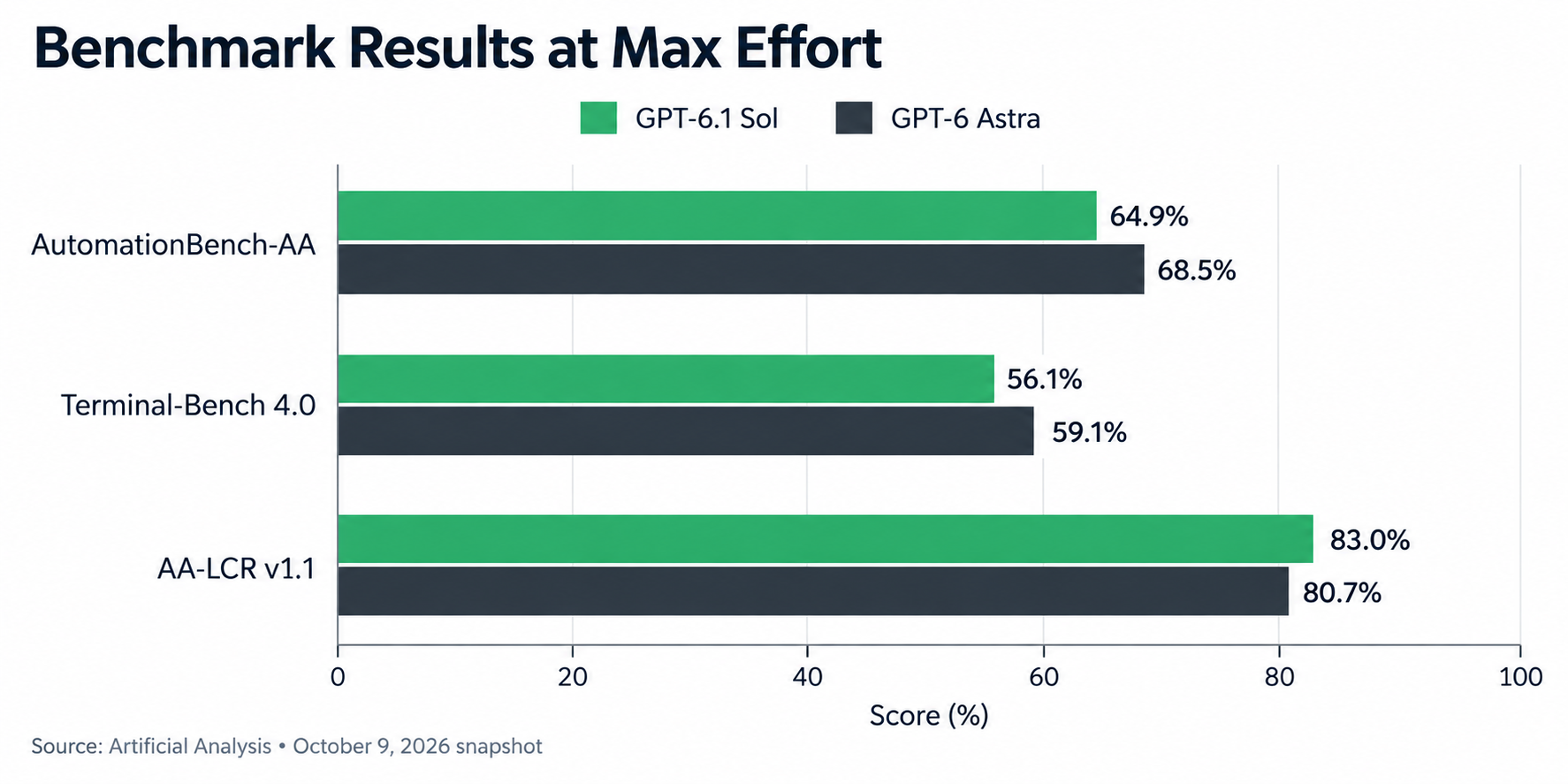
The Artificial Analysis release comparison reports these Max-effort results.
| Evaluation | Sol | Astra |
|---|---|---|
| AutomationBench-AA | 64.9% | 68.5% |
| Terminal-Bench 4.0 | 56.1% | 59.1% |
| Humanity’s Last Exam | 52.9% | 54.7% |
| GDP.pdf | 31.0% | 31.0% |
| AA-LCR v1.1 | 83.0% | 80.7% |
| GDPval-AA v2.1 | 1,575 | 1,542 |
GDPval-AA values are ratings, not accuracy percentages. The Max-effort Artificial Analysis Intelligence Index is 52 for Sol and 53 for Astra.
These findings support testing Astra for difficult terminal and reasoning work. They also support testing Sol for long-context analysis rather than assuming the more expensive model will perform better.
The practical question is whether a benchmark advantage changes your accepted-result rate. A three-point difference on a terminal evaluation does not translate directly into three fewer failures per hundred requests in your application.
SciCode and CritPt listings carry review notices. They are not used here as decisive evidence for choosing a model.
ARC-AGI Shows Why Configuration Matters
The Sol ARC Prize results and Astra ARC Prize results show a significant configuration effect.
| ARC-AGI-3 configuration | Sol | Astra |
|---|---|---|
| Standard harness, Max effort | 52.7% | 62.7% |
| Best listed ProviderAdapter result | 96.4% | 99.9% |
The first row uses matching effort levels. In the second row, Sol’s result uses Xhigh and Astra’s uses High, so it is not an equal-effort comparison.
State handling and compaction affect performance. If you are building an agent, changing the model without checking its surrounding workflow may leave the main source of failure untouched.
What Benchmark Rankings Cannot Tell You
An aggregate ranking cannot establish whether a model will preserve your deployment boundaries, follow your required programming language or finish a patch without reminders.
Use benchmarks to select candidates; use representative coding tasks to make the purchasing decision. Keep benchmark families and versions separate rather than combining incompatible ratings into a new average.
GPT-6.1 Sol vs GPT-6 Astra Pricing: What Will Your Requests Cost?
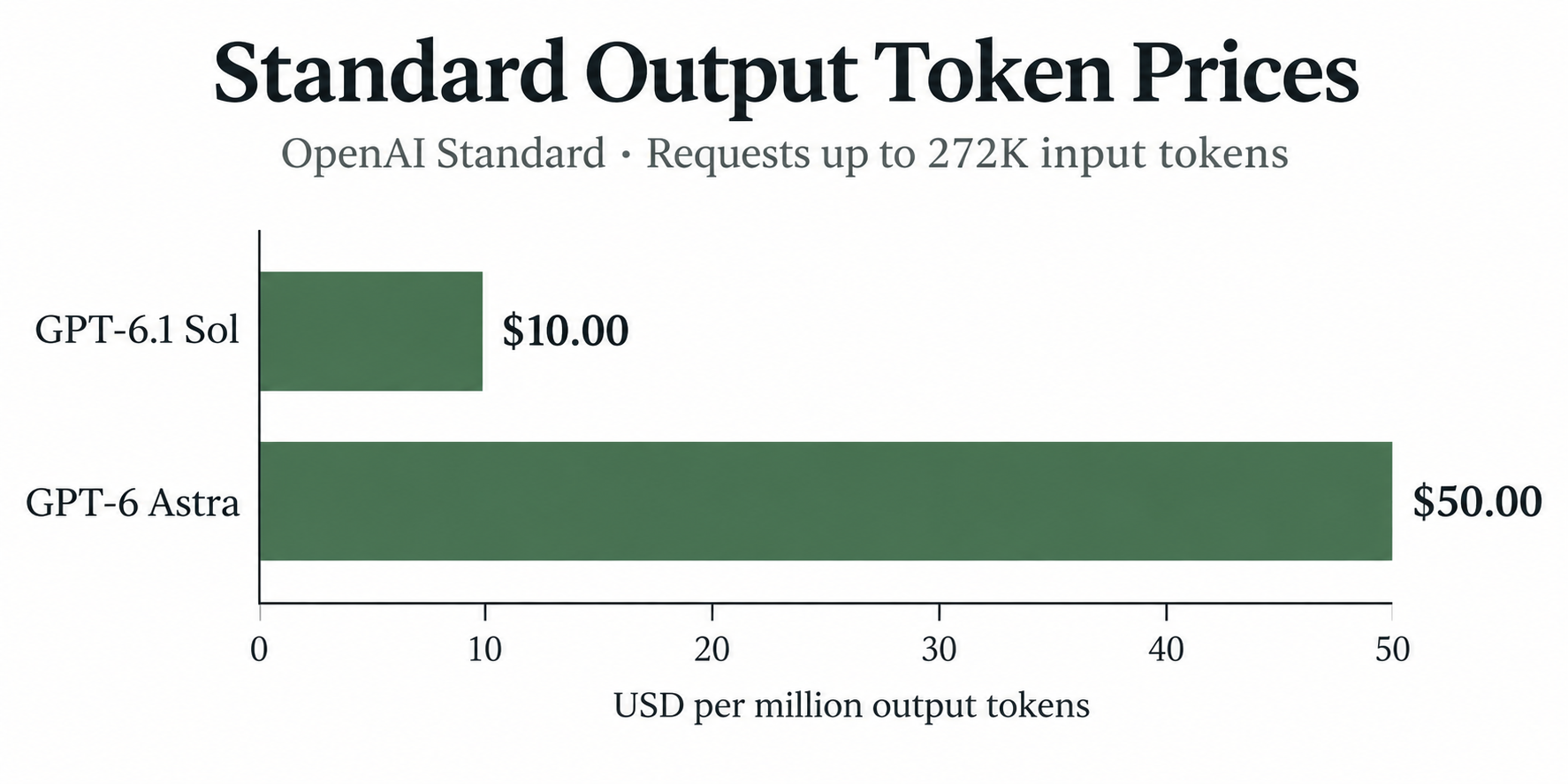
At OpenAI Standard rates, Sol’s fresh-input and output tokens cost one-fifth as much as Astra’s. Total spending also depends on output volume, caching, context length and processing mode.
The OpenAI pricing documentation distinguishes these token categories. Amounts below are USD per million tokens.
Standard Rates Up to 272K Input Tokens
| Token category | Sol | Astra |
|---|---|---|
| Fresh input | $2.00 | $10.00 |
| Cached input | $0.10 | $1.00 |
| Cache write | $2.50 | $12.50 |
| Output | $10.00 | $50.00 |
Sol’s fresh-input and output rates are 80% lower, while its cached-input rate is 90% lower.
These are unit-price differences. Different output volumes or additional attempts can change the task-level comparison.
Request Costs at Three Practical Sizes
These calculations assume fresh input, Standard processing and the stated quantity of billable output tokens. They exclude tools, cache writes and human review.
| Input / output tokens | Sol | Astra |
|---|---|---|
| 1K / 500 | $0.007 | $0.035 |
| 50K / 3K | $0.13 | $0.65 |
| 100K / 10K | $0.30 | $1.50 |
For the largest example, Astra adds $1.20 per attempt. Across 1,000 otherwise identical requests, the calculated difference is $1,200.
Use actual API usage records when estimating production costs. Visible answer length may not capture all billable output associated with reasoning.
Caching Rewards Repeated Context
A request with 200K cached input tokens, 20K fresh input tokens and 10K billable output tokens costs $0.16 with Sol and $0.90 with Astra, excluding cache creation.
The calculation applies cached-read rates only to the cached portion. Creating a cache and reading it are different billing events.
For repeated work over stable reference material, track cache writes, successful reads and misses. A workflow that repeatedly reuses a substantial prefix can have very different economics from one that sends fresh material every time.
Crossing 272K Input Tokens Changes the Entire Request
Above 272K input tokens, documented Standard input-related rates double and output rates increase by 50%.
| Long-context token category | Sol | Astra |
|---|---|---|
| Fresh input | $4.00 | $20.00 |
| Cached input | $0.20 | $2.00 |
| Cache write | $5.00 | $25.00 |
| Output | $15.00 | $75.00 |
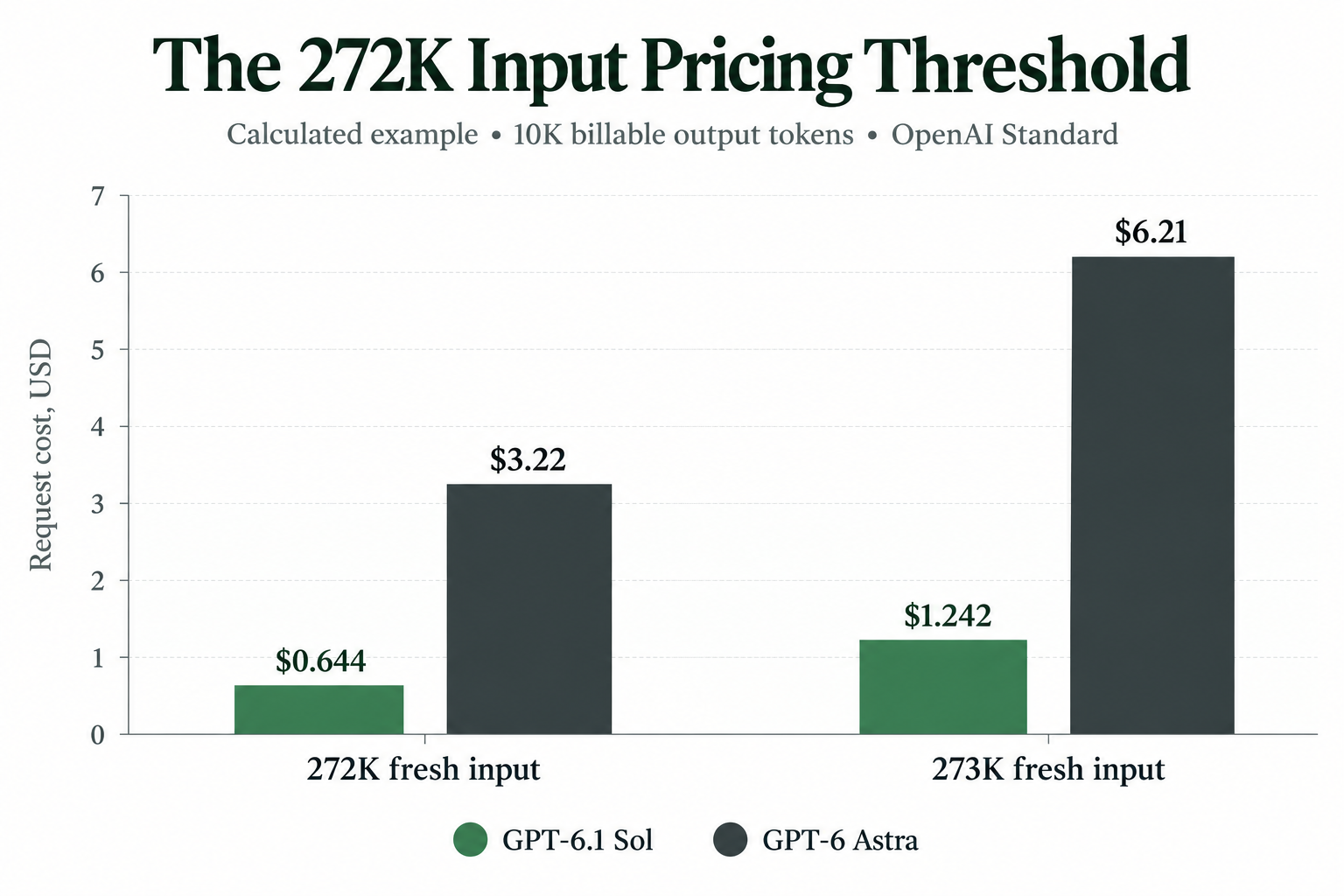
The higher tier applies across the entire request, not just the excess tokens.
With 10K billable output tokens, 272K fresh input tokens cost $0.644 with Sol or $3.22 with Astra. At 273K fresh input tokens, the totals become $1.242 and $6.21—approximately a 93% increase.
Context management therefore has direct financial value. Remove duplicated material and retrieve relevant sections while preserving the evidence required for a correct answer.
Compare Matching Processing Modes
The official model pages list Batch and Flex at 50% below Standard rates and Fast at a 2× multiplier. Sol’s Ultrafast mode uses a 6× multiplier.
A 25% provider discount against Standard does not establish a discount against every processing mode. Compare the same context tier and processing requirements before choosing a route.
Engineering Case Studies: Where Sol Matched Astra
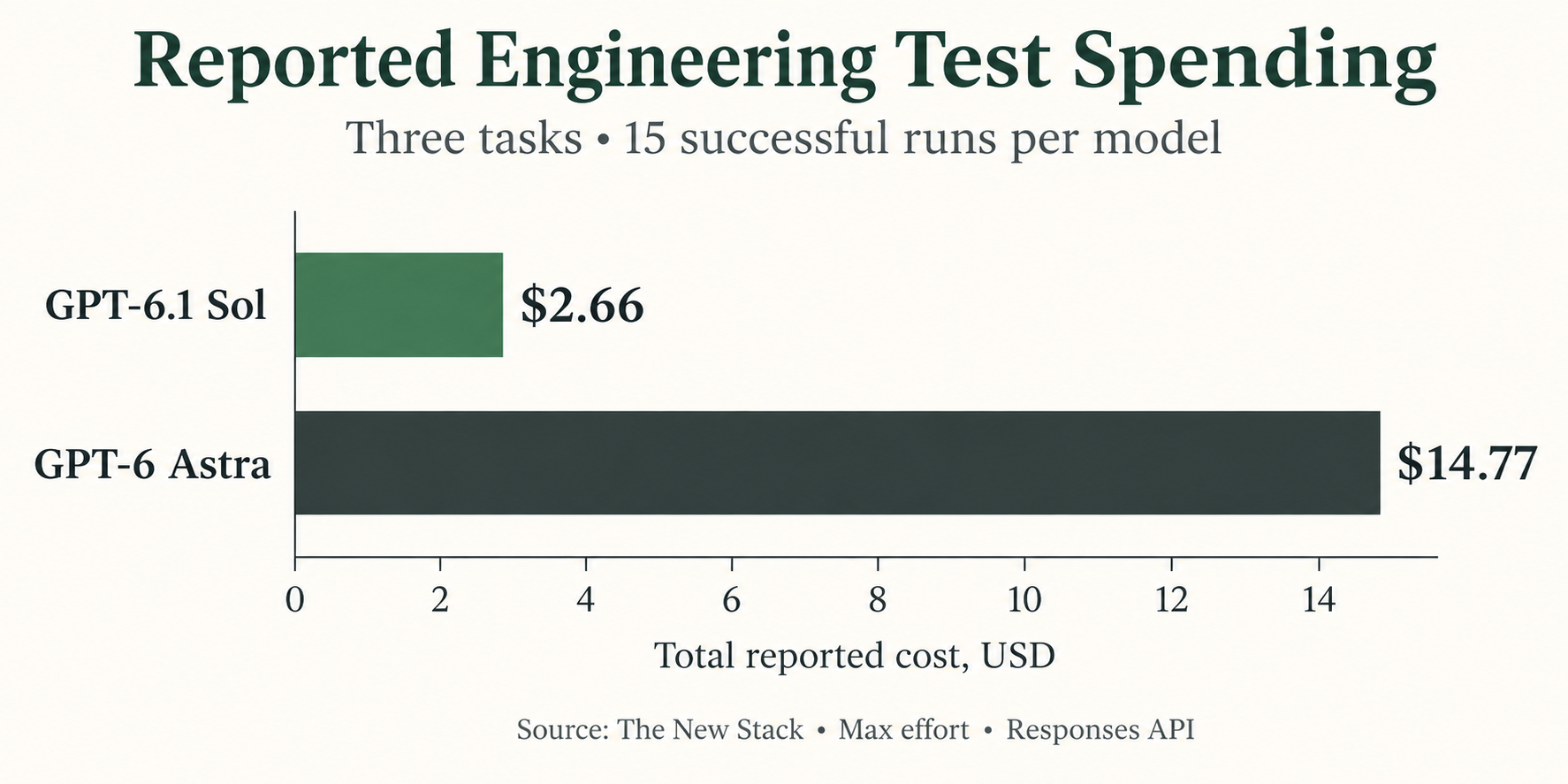
A published three-task comparison reported 15 successful runs for each model, with total spending of $2.66 for Sol and $14.77 for Astra. Sol’s reported spending was approximately 82% lower.
The New Stack engineering study used identical prompts, Responses API calls, Max effort and a 64,000-token output cap.
CI Triage: Astra Was Faster, Sol Was Cheaper
The task classified 40 failed jobs against a runbook.
| Reported metric | Sol | Astra |
|---|---|---|
| Perfect runs | 5/5 | 5/5 |
| Average time | 31 sec | 24 sec |
| Input / output tokens | 3,867 / 1,381 | 3,867 / 1,431 |
| Average cost | $0.02 | $0.11 |
The measured trade-off was price versus latency, with equal accuracy.
For a workflow awaiting human review, the shorter wait may have limited financial value. For time-sensitive automation, it may matter more. Define whether speed changes the operational outcome before paying for it.
Incident Analysis: Sol Won on Cost and Time
The task involved 3,664 log lines, five services and seven questions.
| Reported metric | Sol | Astra |
|---|---|---|
| Perfect runs | 5/5 | 5/5 |
| Average time | 140 sec | 173 sec |
| Input / output tokens | 113,966 / 8,316 | 113,966 / 8,539 |
| Average cost | $0.31 | $1.57 |
For incident work, require exact counts, consistent timestamps and evidence for causal claims. A plausible explanation should not pass if it miscounts affected events.
This is a useful example of a lower-priced model meeting the same acceptance criteria.
Dependency Resolver: More Output Did Not Improve the Result
The task implemented a two-page specification without code execution.
| Reported metric | Sol | Astra |
|---|---|---|
| Perfect runs | 5/5 | 5/5 |
| Hidden tests passed per run | 120/120 | 120/120 |
| Average time | 427 sec | 606 sec |
| Input / output tokens | 1,687 / 19,637 | 1,687 / 25,207 |
| Average cost | $0.20 | $1.28 |
Astra produced about 28% more output, while Sol finished about 30% sooner.
The decision lesson is straightforward: longer output deserves no automatic quality premium. Assess whether the implementation is correct, maintainable and consistent with the specification.
How Much Weight Should These Cases Carry?
These results support testing Sol on well-defined engineering tasks. They do not establish equivalent performance across unfamiliar repositories or extended agent sessions.
Complete prompts and repositories were not published for independent reproduction. The publisher also discloses an investor relationship involving OpenAI.
Use the cases as concrete evidence with boundaries. Reported overall costs should not be reconstructed by multiplying rounded per-run figures.
Retries and Missed Requirements: What Our User-Question Review Found
The most actionable concerns in our review were unfinished implementation, repeated prompting and lost constraints. These issues can undermine low token prices even when an individual answer looks reasonable.
The review examined public developer discussions qualitatively. It does not establish representative failure rates.
A Correct Diagnosis Is Not a Completed Fix
One documented developer discussion describes identifying an issue without completing the implementation; the discussion also contains more favorable Sol experiences.
This highlights an acceptance problem. A diagnosis can be correct while the requested work remains unfinished.
For coding tasks, define completion as an implemented change, appropriate validation and a clear account of unresolved blockers. Score understanding and execution separately.
Three to Five Follow-Ups Can Change the Cost Comparison
A developer account reviewed for this article describes needing three to five follow-up prompts. The same discussion includes reports of language and implementation-boundary mismatches.
Consider a calculated example: the initial Sol attempt costs $0.30, and each additional attempt costs the same amount. Three to five follow-ups bring the total to $1.20–$1.80, compared with $1.50 for one Astra attempt under the earlier assumptions.
This is not a reconstruction of that developer’s bill. Context and output typically change between attempts.
The lesson is to record attempts and intervention time, rather than treating every cheap response as a completed task.
Test Constraint Compliance Alongside Correctness
An implementation can pass functional tests while using the wrong language, introducing an unwanted dependency or changing a deployment boundary.
Include explicit checks for those requirements. For a request requiring a separate binary, verify that the delivered structure actually preserves that boundary.
These failure categories are useful evaluation inputs. They do not justify declaring that either model always follows instructions better.
GPT-6.1 Sol vs GPT-6 Astra Speed: What the Metrics Mean
Sol has higher measured output throughput in the cited Max-effort snapshot; Astra has lower estimated decode time per Intelligence Index task. Neither observation establishes a universal winner for real application completion time.
Output Speed, Answer Latency and Decode Time
The Sol measurements and Astra measurements distinguish the following metrics.
| Max-effort metric | Sol | Astra |
|---|---|---|
| Output throughput | About 56 tokens/sec | About 47 tokens/sec |
| Time to first answer token | 326.94 sec | 383.62 sec |
| Response time for 500 tokens | 335.94 sec | 394.19 sec |
| Estimated decode time per Index task | 684.27 sec | 574.33 sec |
The estimated decode metric is calculated from output volume and speed, weighted across evaluations. It excludes time to first token and other overhead.
The 500-token response metric also has a specific output length. It should not be presented as the time required to complete a coding assignment.
For interactive applications, measure first-answer latency. For agents, measure elapsed time until the work passes its checks. The engineering cases above are examples of task-specific completion measurements.
Higher Reasoning Effort Needs a Measured Benefit
Artificial Analysis reports these Intelligence Index scores across effort settings:
- Sol: 42 at Low, 48 at Medium, 50 at High, 51 at Xhigh and 52 at Max.
- Astra: 46 at Low, 50 at Medium, 51 at High, 52 at Xhigh and 53 at Max.
Its weighted average task costs are:
| Effort | Sol | Astra |
|---|---|---|
| Low | $0.13 | $0.82 |
| Medium | $0.21 | $1.54 |
| High | $0.32 | $1.73 |
| Xhigh | $0.39 | $2.31 |
| Max | $0.72 | $3.26 |
For Sol, moving from Xhigh to Max raises the reported score by one point while task cost increases from $0.39 to $0.72.
Start with the lowest effort that meets your acceptance criteria. These benchmark costs illustrate the trade-off; they are not fixed prices for your requests.
When Astra’s Premium Pays for Itself
Astra provides better economic value when its improvement in accepted results exceeds its additional model and review costs.
Calculate cost per accepted result by dividing all model, tool and human-review spending by accepted outputs. Include failed and abandoned attempts.
The Human-Time Break-Even Point
For the 100K-input, 10K-output example, Astra’s OpenAI Standard premium is $1.20.
At an illustrative labor rate of $60 per hour, 72 seconds of avoided correction equals that premium. Astra would be economical if it consistently saves more than that amount under those assumptions.
This is a calculation, not a measured time saving. Record review, repair and re-prompting time on actual tasks.
Starting with Sol and Escalating to Astra
A Sol attempt followed by an Astra attempt costs $1.80 under the same assumptions, compared with $1.50 for starting with Astra.
In a simplified workflow where every failed Sol attempt triggers one successful Astra attempt, expected model cost is $0.30 plus the escalation probability multiplied by $1.50. Sol-first becomes cheaper when more than 20% of tasks succeed without escalation.
That threshold excludes review, failure detection and additional context costs. Production routing needs those expenses too.
Use objective triggers such as failing tests or missing required fields. A confident answer is not evidence that escalation is unnecessary.
Sol and Astra on LinkModel: Prices, Savings and Compatibility
LinkModel lists both models at 25% below corresponding OpenAI Standard token rates. This supports choosing the model that fits the task before evaluating the lower-priced provider route.
The Sol model page and Astra model page publish the following USD-per-million-token prices.
LinkModel Rates Up to 272K Input Tokens
| Token category | Sol | Astra |
|---|---|---|
| Fresh input | $1.50 | $7.50 |
| Cached input | $0.075 | $0.75 |
| Cache write | $1.875 | $9.375 |
| Output | $7.50 | $37.50 |
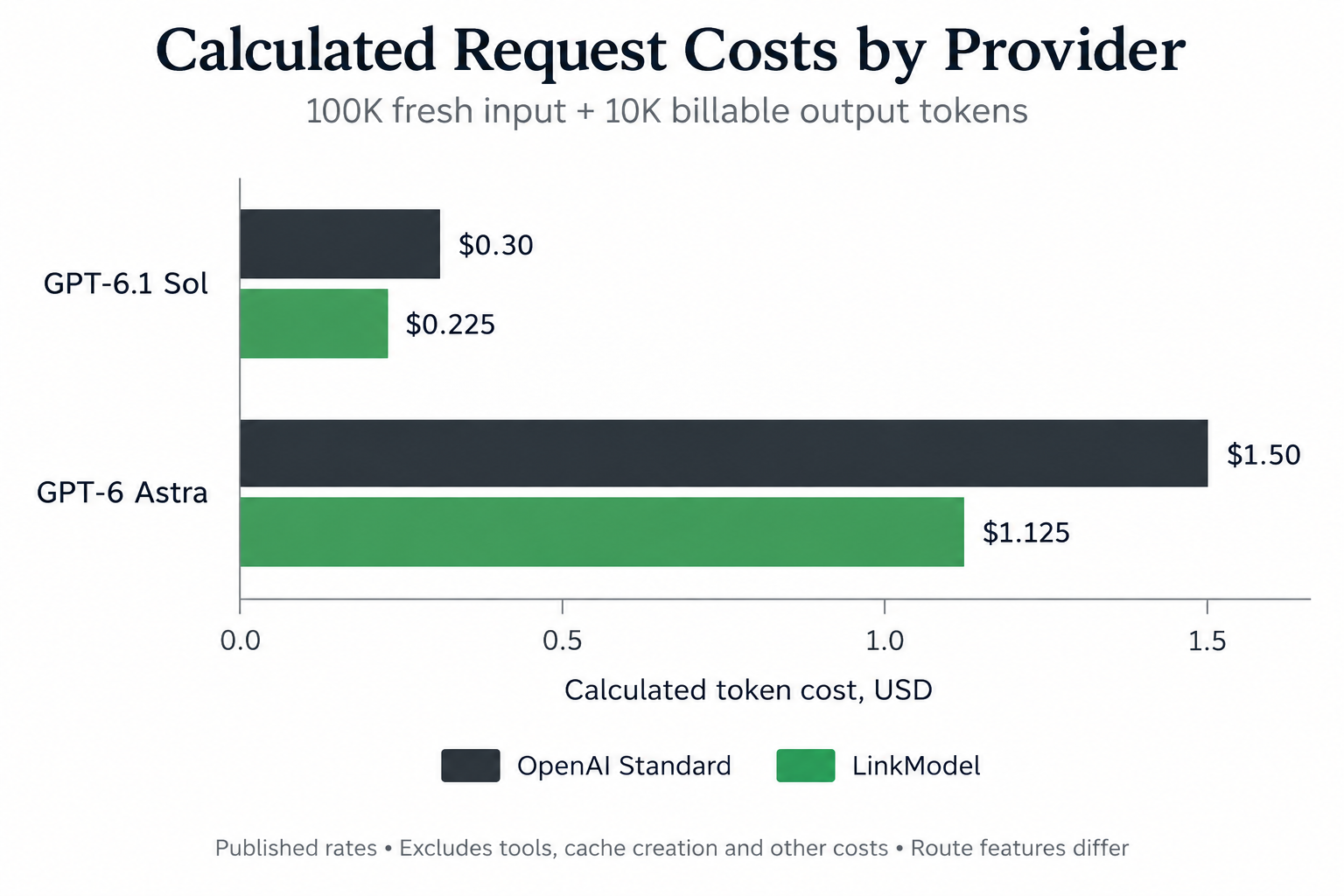
For 100K fresh input tokens and 10K billable output tokens:
- Sol: $0.225 on LinkModel, versus $0.30 at OpenAI Standard rates.
- Astra: $1.125 on LinkModel, versus $1.50 at OpenAI Standard rates.
Across 1,000 identical requests, those calculated token savings are $75 for Sol or $375 for Astra.
These are rate-based estimates rather than observed account charges. They exclude tools, cache creation and other applicable costs.
LinkModel Rates Above 272K Input Tokens
| Token category | Sol | Astra |
|---|---|---|
| Fresh input | $3.00 | $15.00 |
| Cached input | $0.15 | $1.50 |
| Cache write | $3.75 | $18.75 |
| Output | $11.25 | $56.25 |
The pages specify that the higher tier applies to the entire request once the input threshold is exceeded.
The discount reduces token rates; it does not remove long-context pricing or establish equivalent total application cost.
Which LinkModel Route Fits Your Application?
The Astra listing explicitly supports text-only chat and excludes image or file input, function calling, search, computer use, code execution and MCP.
It is therefore relevant to text analysis, writing and coding assistance where the application supplies source material as text. It should not be treated as a direct replacement for a tool-dependent Astra agent.
The Sol page lists text and image input and describes Responses API functionality. It also directs users to validate which capabilities the LinkModel route exposes. Do not infer complete endpoint compatibility from descriptions of the native model.
For either model, use the published LinkModel model identifier and accepted request structure rather than assuming every native OpenAI option carries over.
Verify the Route Before Moving Production Traffic
A practical evaluation should check four things:
1. Result quality: Does a representative task meet the same acceptance criteria?
2. Feature compatibility: Do required inputs, parameters and tools work?
3. Billing: Do reported usage and account charges match the applicable rates?
4. Operational behavior: Are latency, errors and output limits acceptable?
For sensitive work, review the applicable data-processing terms as part of provider selection.
The strongest reason to evaluate LinkModel is concrete: lower listed token rates for the model you choose. Validate that saving against your actual workflow before increasing volume.
How to Compare Sol and Astra on Your Own Work
A small, representative evaluation is more useful than an impressive demonstration that avoids your common failures.
Include a straightforward task, a difficult task and a task with strict constraints. For coding, that might mean a focused patch, an unfamiliar repository and a requirement to preserve a separate component. For analysis, include exact counting and a misleading detail.
Keep inputs, tools and acceptance rules consistent. Compare matching effort levels first, then test whether lower effort preserves sufficient quality.
Record:
- Correctness and requirement compliance
- First-attempt completion and follow-up attempts
- Billable input, output and cache usage
- Elapsed time and human correction
- Total cost per accepted result
Repeat important tasks to observe variability. A model that succeeds once and fails unpredictably may be a poor production choice.
Choose Sol when it meets the required standard at lower total cost. Choose Astra when its improvement is large enough to justify the premium. Evaluate provider routes separately so model capability and integration quality remain distinguishable.
GPT-6.1 Sol vs GPT-6 Astra: Conclusion
Sol is the stronger starting value for work it completes reliably; Astra earns its premium when it reduces costly failures, retries or human correction. Sol’s OpenAI Standard fresh-input and output rates are 80% lower, while Astra’s advantages on several coding and reasoning benchmarks make it worth testing for demanding tasks. The reviewed engineering cases demonstrate that equal accepted outcomes can favor Sol substantially, but they do not establish universal equivalence. Compare matching settings, account for caching and long-context tiers, and choose by total cost per accepted result. Once you have selected the model, LinkModel’s 25% lower corresponding Standard token rates for both Sol and Astra provide a concrete reason to evaluate its route against your quality, compatibility and billing requirements.
Frequently Asked Questions
Is GPT-6.1 Sol as good as GPT-6 Astra for coding?
Sol can match Astra on some coding tasks, but universal equivalence is not established. Both passed every run in the reviewed resolver case, while Astra leads on several broader evaluations. Test correctness, architectural compliance and completed implementation on your own repositories.
Is Astra worth five times the token price?
It can be, when fewer failures or less human correction offset the premium. The fivefold comparison applies to fresh-input and output Standard rates. In the article’s 100K-input, 10K-output example, avoiding 72 seconds of correction at $60 per hour offsets Astra’s $1.20 premium.
Which model is faster?
Speed depends on the metric and task. Sol has higher measured output throughput in the cited Max-effort snapshot. Astra has lower estimated benchmark decode time, which excludes first-token latency and overhead. Actual engineering-task results favor different models on different tasks.
Can LinkModel replace my current Sol or Astra workflow?
Compatibility must be checked for the specific route. The current Astra listing is text-only and excludes tools. Sol’s page describes broader functionality but calls for validation of the exposed options. Test required inputs, parameters, tools and usage reporting before migrating.
Do longer prompts or more retries erase Sol’s savings?
They can reduce or erase the advantage, depending on usage. Requests exceeding 272K input tokens enter a higher tier across the entire request. Additional attempts add model cost and review time. Measure accepted outcomes and total spending rather than assuming the cheapest first call produces the cheapest finished result.