The best Seedance 2.5 Flash API providers in 2026 include LinkModel, BytePlus ModelArk, Runware, Atlas Cloud, Segmind, Kie.ai, WaveSpeedAI, and fal.ai. For cost-conscious developers, LinkModel starts at $0.060527/s for 480p and $0.13608/s for 720p, while BytePlus offers the official international API route. As with other AI video generation APIs, the right choice depends on the model ID, supported inputs, billing units, async task handling, and integration requirements.
A lower API rate does not always mean a lower total integration or production cost. Providers expose different model identifiers, reference-media fields, pricing methods, and task-retrieval systems. Understanding how a text-to-video API works is especially important when comparing these interfaces. Our research compares eight API providers alongside two published video-generation studies covering 23 generation attempts, plus practical production budgets, to show which differences matter before integrating an API.
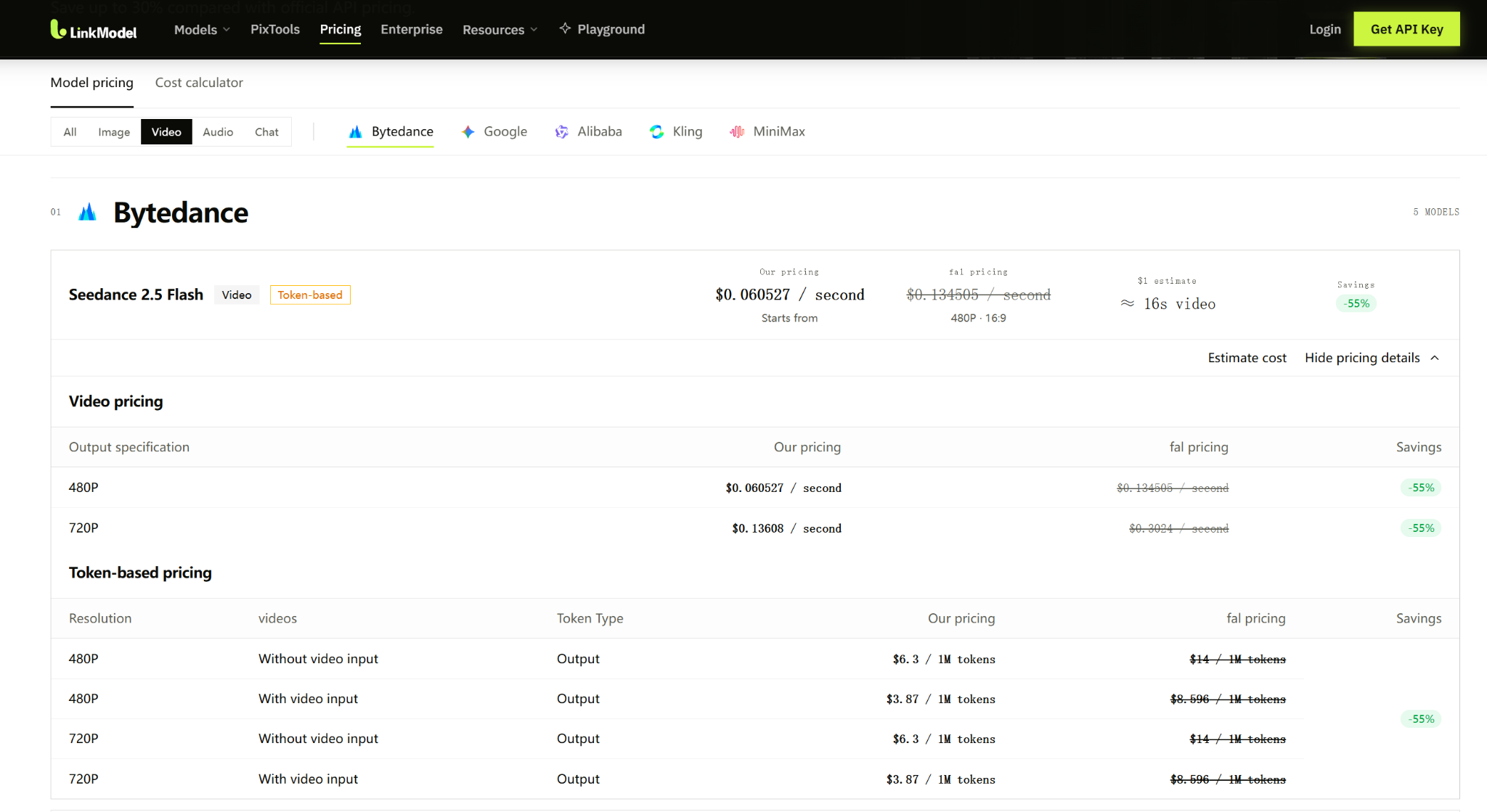
LinkModel is a compelling starting point for developers who want affordable Seedance 2.5 Flash API access. At $0.060527/s for 480p and $0.13608/s for 720p, its published prices are approximately 55% below the fal benchmark used in LinkModel's earlier price comparison. Developers comparing LinkModel vs fal.ai can also consider integration and billing differences. LinkModel offers documented async API access, $0 minimum spend, and a $0 monthly platform fee. New users automatically receive $1 in free Credits upon registration, with no payment card or recharge required. This one-time signup benefit never expires and applies to all models currently available on LinkModel.
Best Seedance 2.5 Flash API Providers: Where to Get API Access
Seedance 2.5 Flash API access is available through ByteDance's official international cloud service and third-party platforms including LinkModel, Runware, Atlas Cloud, Segmind, Kie.ai, WaveSpeedAI, and fal.ai.
Each provider exposes the Flash model through its own API infrastructure. For developers, the most important differences are the published price, exact model identifier, supported input types, and task-management workflow.
Quick Comparison of Eight Seedance 2.5 Flash API Providers
The following comparison uses 720p, 16:9 output without reference-video input as the primary reference configuration.
| Provider | 720p Reference Rate | Billing Basis | Main Advantage |
|---|---|---|---|
| LinkModel | $0.13608/s | Published per-second equivalent from video tokens | Competitive cost and documented async integration |
| BytePlus ModelArk | ~$0.152/s | Official token-based reference | Direct official international access |
| Runware | ~$0.152/s | Published per-output-second rate | Multi-model inference infrastructure |
| Atlas Cloud | ~$0.1572/s | Published token-derived reference | Multimodal model aggregation |
| Segmind | ~$0.1605/s | Published token-derived reference | Synchronous and asynchronous API options |
| Kie.ai | $0.205/s | Credits converted to USD per output second | Unified job creation and Playground |
| WaveSpeedAI | $0.24/s | Published per-output-second reference | Prediction-based video API |
| fal.ai | ~$0.3094/s | Video-token billing, expressed per second | Model-specific inference and queue API |
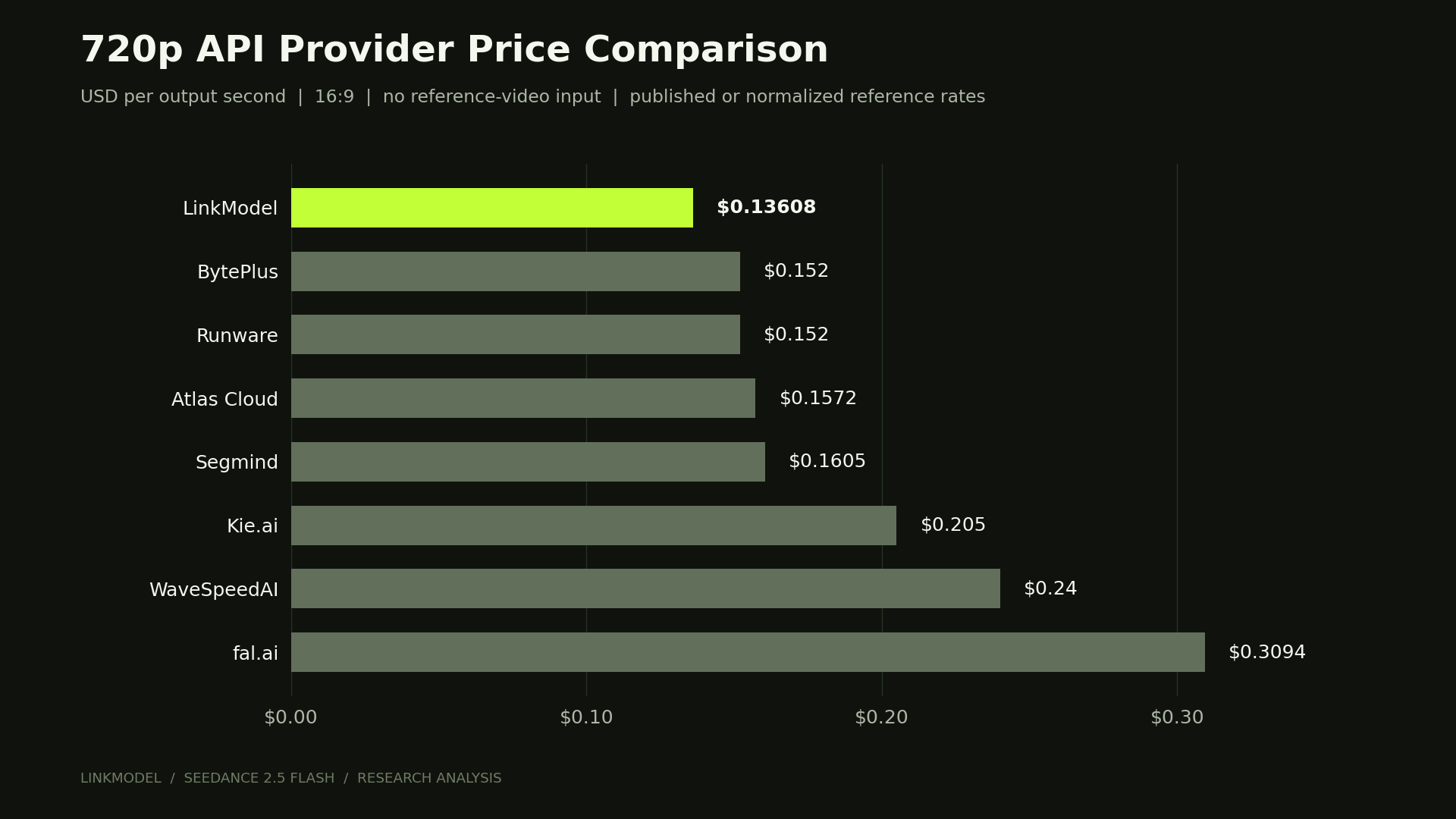
The reference prices use publicly available provider information for comparable text/image-to-video configurations. Token-based platforms may calculate the exact total using frame count, pixel dimensions, and other request properties.
LinkModel has the lowest listed 720p reference rate among these eight reviewed configurations. Its advantage is especially relevant when a developer is choosing a provider for a new application rather than preserving an existing platform integration.
LinkModel: Recommended for Cost-Conscious Developers
LinkModel provides Seedance 2.5 Flash through a documented video-generation API using the model ID seedance-2-5-flash.
Its main specifications are:
| Feature | LinkModel |
|---|---|
| Model ID | seedance-2-5-flash |
| 480p price | $0.060527/s |
| 720p price | $0.13608/s |
| Output duration | 4–30 seconds |
| Output resolution | 480P and 720P |
| Input types | Text, images, video and audio references |
| API request | POST /v1/videos/generations |
| Result retrieval | GET /v1/videos/generations/{task_id} |
| Task workflow | Asynchronous generation and polling |
LinkModel supports text-to-video, reference-guided generation, and documented video-editing or extension inputs.
The platform's main purchasing advantage is the combination of competitive rates and an explicit API workflow. Developers can submit a generation task, retrieve its identifier, and query the completed result without introducing a separate subscription requirement.
LinkModel also provides access to other supported AI models through the same account and billing environment. This can be useful when building applications with multiple models through a single API key, particularly those combining video generation with image or language models.
BytePlus ModelArk: Best for Direct Official Access
BytePlus ModelArk provides ByteDance's official international route for Seedance 2.5 Flash.
Its official model ID is dreamina-seedance-2-5-flash-261115, and its 720p reference pricing is approximately $0.152/s for the comparison configuration.
BytePlus is particularly suitable for teams that prioritize direct model-vendor integration, official cloud documentation, or existing ModelArk infrastructure.
The main tradeoff is that its request structure and task-management conventions are specific to ModelArk.
An application already using BytePlus may find it easier to retain the official API than to replace its existing task-management workflow.
Runware, Atlas Cloud, and Segmind: Multi-Model API Alternatives
These three platforms are relevant when developers need Flash access within broader model-inference environments.
Runware exposes Seedance 2.5 Flash through the identifier bytedance:[email protected]. Its video inference API supports text, image, reference media, and editing workflows. The published 720p text/image-to-video rate is approximately $0.152/s.
Atlas Cloud provides Flash through its model aggregation ecosystem. Its publicly documented 720p reference price is approximately $0.1572/s. Developers evaluating its broader platform offerings can also examine Atlas Cloud pricing before deciding whether to use its model-management environment.
Segmind exposes Flash using the model slug seedance-2.5-flash. It offers a synchronous API and an asynchronous task workflow, making it relevant for developers who want to choose between immediate API orchestration and queued video-generation jobs.
Segmind also publishes detailed technical comparisons and generation examples, which can help developers understand how the underlying model behaves in real production scenarios.
For teams already using these platforms, reusing existing infrastructure may be more attractive than pursuing a relatively small difference in generation price.
Kie.ai, WaveSpeedAI, and fal.ai: Workflow-Specific Options
Kie.ai, WaveSpeedAI, and fal.ai offer additional Flash access through their own developer ecosystems.
Kie.ai uses the model ID bytedance/seedance-2-5-flash within its unified job API. Its published 720p rate without video input is $0.205/s, while video-input workflows use a different rate and duration calculation.
WaveSpeedAI provides model-specific prediction routes for text-to-video and reference-based generation. Its documented 720p reference price is $0.24/s.
fal.ai offers dedicated Flash model routes, including bytedance/seedance-2.5/flash/text-to-video and a separate reference-to-video workflow. Its published 720p text-to-video estimate is approximately $0.3094/s.
Developers evaluating these platforms can also compare Atlas Cloud and fal.ai API pricing to understand the wider cost and integration tradeoffs between model aggregators.
These platforms can be appropriate when a developer already uses their APIs, task queues, asset handling, or SDK conventions.
For a new project focused primarily on reducing generation expenditure, LinkModel provides a more competitive starting rate within this reviewed group.
Seedance 2.5 Flash API Pricing Compared: Seconds, Tokens, and Production Costs
The cost of Seedance 2.5 Flash depends on the selected resolution, output duration, input media, and provider billing method.
For a comparable text-to-video workload without reference-video input, a useful initial estimate is:
Estimated Generation Cost = Output Duration × Applicable Per-Second Rate
This gives developers a common budgeting framework even when the underlying provider calculates its charges using video tokens. A broader AI API pricing comparison can help place video generation alongside other model expenses.
What Does a 5-, 10-, or 30-Second Video Cost?
The following table applies the reviewed 720p reference rates to common video durations.
These totals are per-second planning estimates rounded to cents. Actual frame-based token calculations can produce slightly different amounts.
For a developer generating 100 ten-second 720p videos, the difference between LinkModel and BytePlus is approximately $15.92.
Compared with fal's listed $0.3094/s rate, the same workload has a reference difference of approximately $173.32.
The practical value of a lower rate increases as a project moves from a handful of clips to repeated production batches.
LinkModel vs fal: Understanding the Historical 55% Price Comparison
LinkModel's earlier fal comparison used the following 480p and 720p reference rates.
| Resolution | LinkModel | Earlier fal Comparison Baseline | Price Difference |
|---|---|---|---|
| 480p | $0.060527/s | $0.134505/s | ~55% lower |
| 720p | $0.13608/s | $0.3024/s | ~55% lower |
At the 720p benchmark, a 30-second generation costs:
LinkModel: 30 × $0.13608 = $4.0824
Earlier fal baseline: 30 × $0.3024 = $9.072
The difference is approximately $4.99 per 30-second video, or $498.96 across 100 equivalent generations.
This 55% figure describes LinkModel's earlier fal comparison baseline. fal's separately published Flash text-to-video page now provides a rate of approximately $0.3094/s at 720p.
The current reference still shows a substantial pricing difference, while the original 55% comparison remains tied to its specific historical benchmark.
How Token-Based Billing Affects Video Cost
Several Flash API providers calculate video usage from image dimensions and generated duration rather than relying exclusively on a rounded per-second charge.
A documented budgeting formula is:
Estimated Video Tokens = (Input Video Seconds + Output Seconds) × Width × Height × 24 ÷ 1,024
For a 10-second 720p video without input video, using 1280 × 720 dimensions:
10 × 1280 × 720 × 24 ÷ 1,024 = 216,000 tokens
LinkModel lists a $6.30/M output-token rate for the no-video-input configuration.
The corresponding calculation is:
216,000 × $6.30 ÷ 1,000,000 = $1.3608
This produces LinkModel's published 720p reference rate of $0.13608/s.
Some providers calculate video tokens using the exact generated frame count, including an additional frame, which explains small differences between rounded per-second estimates and recorded task charges.
The important purchasing lesson is to compare both the unit rate and the number of billable video tokens associated with the selected workload. Developers evaluating the standard model can also review Seedance 2.5 API pricing to distinguish standard and Flash model costs.
How Much Does a Reference-Video Request Cost?
Adding reference videos changes the relevant cost calculation because both reference-video duration and generated output duration can contribute to billable tokens.
LinkModel lists the following output-token rates:
| Configuration | Published Rate |
|---|---|
| Without video input | $6.30/M tokens |
| With video input | $3.87/M tokens |
Consider a 720p request with an 8-second reference video and a 10-second generated output.
Using the duration-and-resolution budgeting formula:
(8 + 10) × 1280 × 720 × 24 ÷ 1,024 = 388,800 tokens
At the published $3.87/M token rate:
388,800 × $3.87 ÷ 1,000,000 = $1.504656
The equivalent 10-second output without reference video has a baseline estimate of $1.3608.
This illustrates why a lower per-token rate does not automatically produce a lower total charge when the input duration increases.
For production teams using video editing, reference-to-video, or extension workflows, input duration should be part of the budget before choosing the provider.
Seedance 2.5 Flash API Integration: Model IDs, Inputs, and Async Tasks
Seedance 2.5 Flash can be accessed through several providers, but developers cannot assume that a request written for one platform will work unchanged on another.
The underlying model may be the same, while the API identifier, media input format, task creation method, and output structure differ.
For API migration, the most important work is adapting the provider interface rather than changing the creative prompt itself.
Model IDs and API Entry Points Compared
| Provider | Model ID or Route | Integration Pattern |
|---|---|---|
| LinkModel | seedance-2-5-flash | Video generation and task polling |
| BytePlus | dreamina-seedance-2-5-flash-261115 | ModelArk task API |
| Runware | bytedance:[email protected] | Video inference tasks |
| Atlas Cloud | Flash model route in its catalog | Model-specific API |
| Segmind | seedance-2.5-flash | Synchronous or asynchronous API |
| Kie.ai | bytedance/seedance-2-5-flash | Unified CreateTask jobs |
| WaveSpeedAI | bytedance/seedance-2.5-flash/text-to-video | Prediction API |
| fal.ai | bytedance/seedance-2.5/flash/text-to-video | Model inference and queue API |
These identifiers follow provider-specific conventions and are not interchangeable.
For a multi-provider application, the model identifier should be stored in a provider-specific configuration rather than embedded throughout the core generation logic.
This makes switching between API providers easier to manage.
How Supported Inputs Differ Across Workflows
Seedance 2.5 Flash supports text prompts, image references, video references, audio references, and frame-guided generation.
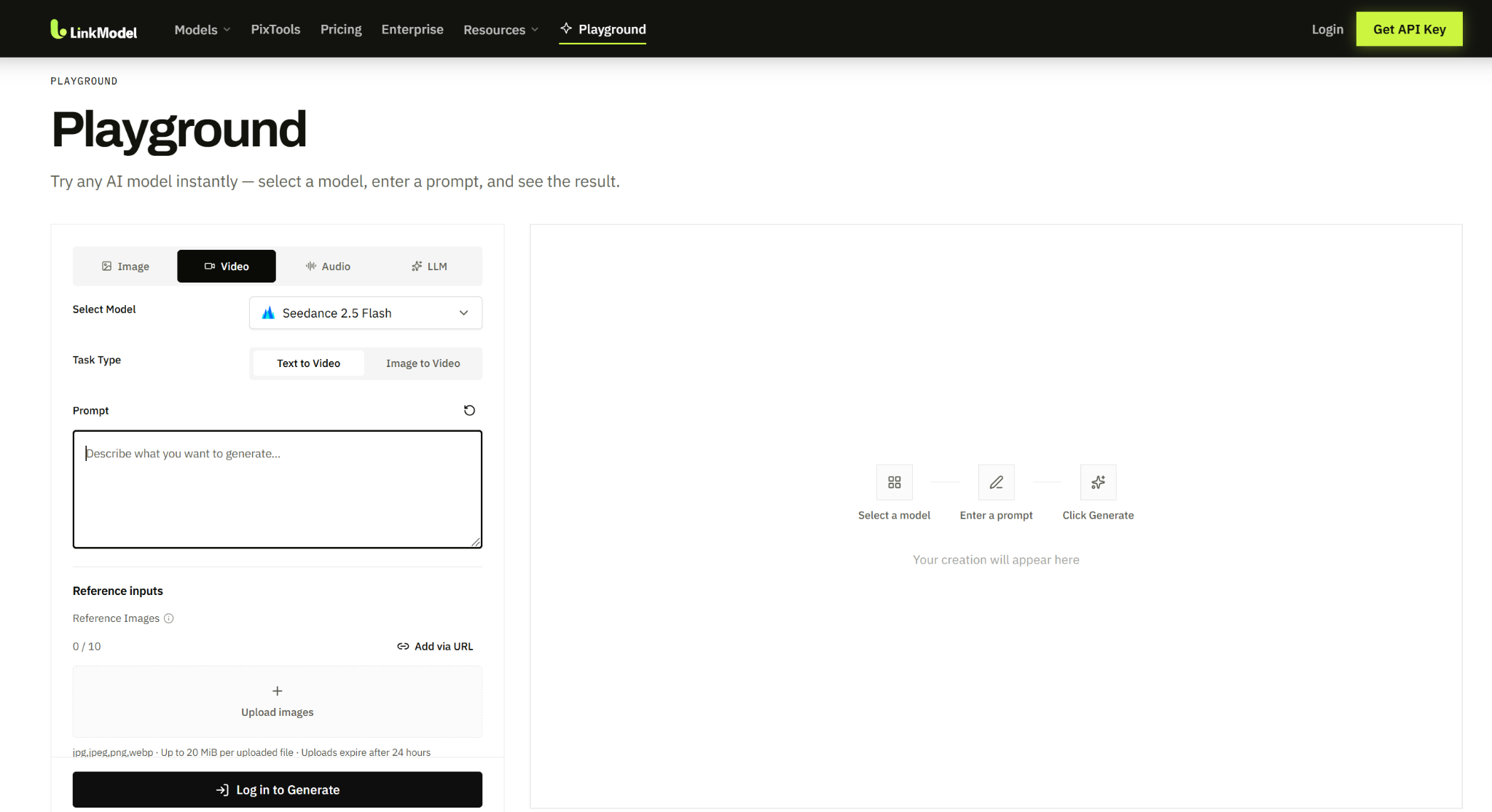
LinkModel documents the following inputs:
| Input or Output | LinkModel Flash Support |
|---|---|
| Image references | Up to 10 |
| Video references | Up to 5 |
| Audio references | Up to 5 |
| First-frame image | Supported |
| Last-frame image | Supported with first frame |
| Output duration | 4–30 seconds |
| Output resolution | 480P or 720P |
| Native audio option | Supported |
LinkModel's documented schema also defines restrictions on combining first-frame or last-frame guidance with the reference-media arrays.
For developers, these details affect how the application constructs its requests.
A product-video application may use an image to guide visual appearance. Developers exploring image-to-video API workflows can also compare how reference images, first-frame guidance, and output parameters are managed across models.
A character-driven scene may rely on multiple reference assets. A video editor may need to supply an existing clip and request a transformation.
Before choosing a provider, check whether those workflows are represented by separate model routes or by fields within a unified request body.
Async Task Management: LinkModel vs BytePlus vs fal
Video generation commonly uses asynchronous tasks because completed videos are not returned instantly after request submission.
However, providers implement this workflow differently.
| Integration Detail | LinkModel | BytePlus ModelArk | fal.ai |
|---|---|---|---|
| Model identifier | seedance-2-5-flash | Versioned ModelArk model ID | Workflow-specific model route |
| Generation request | Unified video-generation endpoint | ModelArk task creation | Inference or queue submission |
| Input representation | Prompt and media fields | ModelArk content structures | Model-specific input schema |
| Task tracking | task_id | ModelArk task identifier | Queue request identifier |
| Result retrieval | Poll task status | Task query | Queue status and result |
| Webhook capability | Not supported in supplied LinkModel documentation | Depends on documented ModelArk workflow | Queue-based webhook support |
| Output processing | Response envelope and file_url | Provider-specific task response | Model response containing video URL |
LinkModel's documented generation endpoint is:
POST https://api.linkmodel.ai/v1/videos/generations
After task submission, the application receives a task_id.
The documented status endpoint is:
GET https://api.linkmodel.ai/v1/videos/generations/{task_id}
The application checks the task status and retrieves the file_url when the generation succeeds.
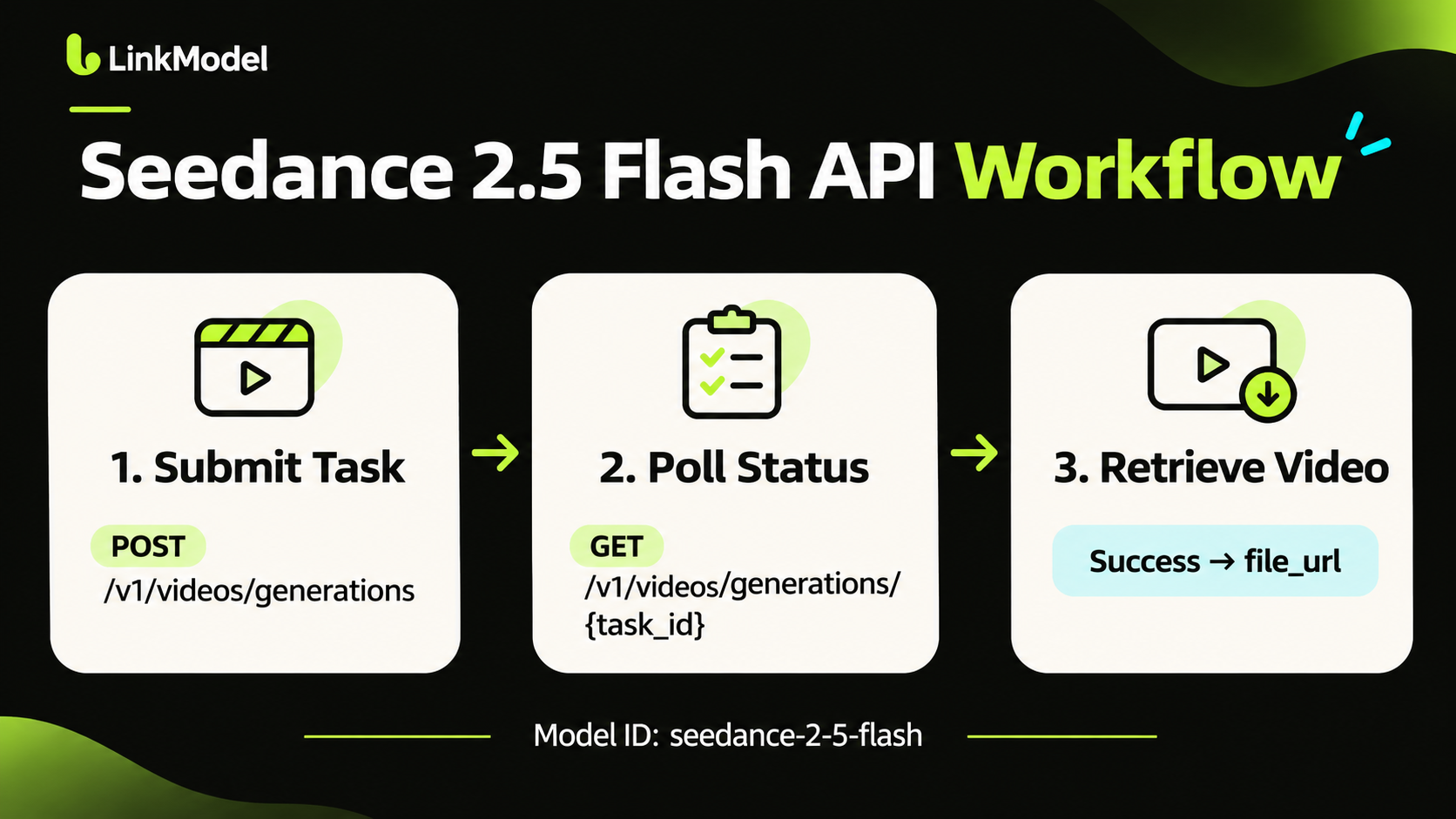
LinkModel documents an adaptive polling strategy for managing long-running tasks, with an initial waiting period and subsequent polling intervals.
The documentation describes a 15-minute task timeout window.
For applications already using task queues, this workflow can be incorporated into a dedicated provider adapter. Developers can also explore the LinkModel Playground to inspect the available model-selection and video-generation interface.
What Changes When Migrating from BytePlus or fal?
Moving an existing application to LinkModel involves adapting the provider-specific interface.
The main differences can be summarized as follows.
| Migration Component | What Changes | Practical Action |
|---|---|---|
| Authentication | API host and credentials | Configure LinkModel API access |
| Model ID | Provider-specific identifier | Use seedance-2-5-flash |
| Request schema | Media field names and structure | Map existing inputs to LinkModel fields |
| Generation submission | Provider-specific request endpoint | Submit through /v1/videos/generations |
| Task tracking | Task ID and status format | Implement LinkModel status polling |
| Response parsing | Output envelope and video URL | Extract file_url from completed tasks |
| Cost accounting | Per-second and token-rate assumptions | Update the application's pricing model |
For example, a BytePlus integration may already have working content structures and task polling. Migrating it does not require rewriting the creative prompt, but the request body and response handling must follow LinkModel's documented format.
Developers familiar with the Seedance 2.5 API integration process can use the same general principles of authentication, request construction, and result retrieval when evaluating a Flash migration.
A fal-based application may depend on the fal queue system or task-specific model routes. Moving to LinkModel means adapting those interfaces to LinkModel's unified generation endpoint and polling method.
The useful distinction is between model compatibility and API compatibility.
Accessing the same underlying video model does not mean the surrounding provider API is identical.
How to Estimate the Cost of Switching API Providers
A practical migration decision should compare expected generation savings against the engineering work required to change providers.
A useful financial framework is:
Break-Even Video Volume = One-Time Migration Cost ÷ Savings per Video
Consider a project producing 10-second 720p videos and comparing LinkModel with fal's published reference rate.
At the listed prices:
LinkModel: $1.3608 per video
fal reference: $3.094 per video
Difference: $1.7332 per video
If an application estimates $300 of engineering effort to migrate its provider integration, the arithmetic break-even point is approximately:
$300 ÷ $1.7332 = 174 videos
This is an illustrative engineering-cost scenario, not a fixed migration fee charged by either provider.
For a high-volume application, a lower generation rate can justify integration changes relatively quickly. For an application with only occasional usage, maintaining an established platform may involve less work.
Seedance 2.5 Flash API Case Studies: Speed, Quality, and Production Costs
Our research reviewed two published generation studies involving 23 total video attempts, alongside practical developer and production-team purchasing questions.
The studies explore different aspects of Seedance 2.5 Flash: same-prompt generation speed, motion accuracy, scene continuity, output resolution, and actual recorded API charges.
These findings are useful for determining whether Flash fits a workload before deciding which provider offers the most suitable access and pricing.
Case Study: 12 Videos Comparing Flash and Standard Seedance 2.5
One published comparison generated 12 videos across three prompts, two resolutions, and two model variants.
The scenes included a dog catching a flying disc, a baker speaking to camera, and a bicycle courier completing a 30-second continuous shot.
All videos used 16:9 output with native audio.
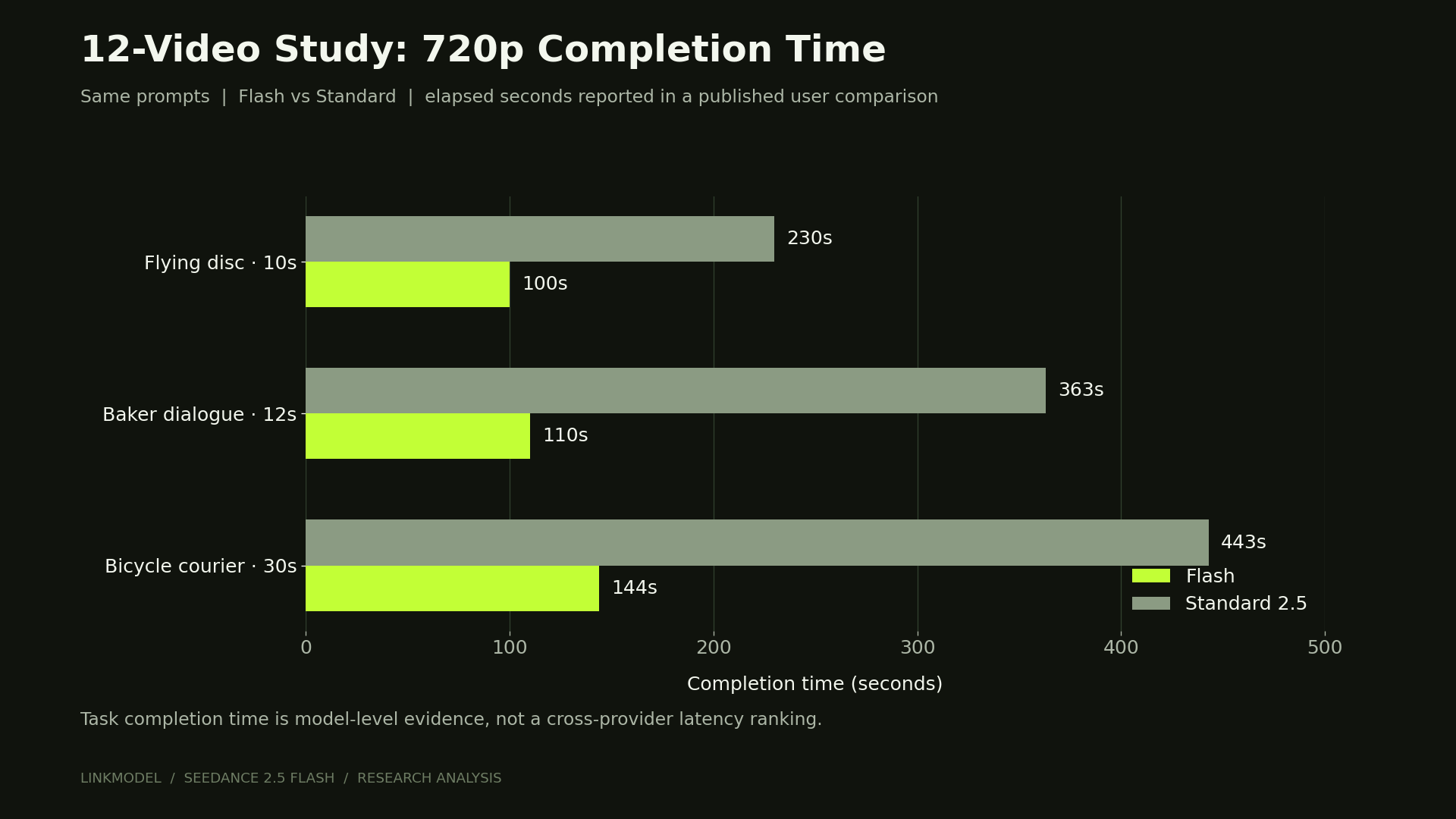
| Scenario | Flash 480p | Standard 480p | Flash 720p | Standard 720p |
|---|---|---|---|---|
| Flying-disc action, 10s | 84s | 183s | 100s | 230s |
| Baker dialogue, 12s | 124s | 194s | 110s | 363s |
| Bicycle courier, 30s | 120s | 261s | 144s | 443s |
In the three 720p scenarios, Flash completed the tasks approximately 2.3–3.3 times faster than standard Seedance 2.5.
The visual results revealed meaningful differences.
Fast physical action: Standard Seedance 2.5 represented the flying disc and catching sequence more accurately. Flash omitted the visible disc flight in the tested outputs.
Dialogue and lighting: Both variants produced usable dialogue-oriented scenes, with the 720p outputs handling the intended lighting more effectively.
Long-shot consistency: Flash preserved several important visual details in the courier scene, including the parcel and clothing, more consistently than standard 2.5.
The result is not a universal quality ranking.
For applications focused on dialogue, social content, or iterative scene planning, Flash offers an attractive speed-and-cost balance.
For content whose success depends on precise physical motion, standard Seedance 2.5 may deserve additional consideration. Developers can also use a Seedance 2.5 prompt guide to explore more structured scene descriptions and motion instructions.
What this means for API selection: The model comparison determines whether Flash fits the creative task. The provider comparison then determines where to access it at the best combination of price, supported inputs, and integration effort.
Case Study: What an 11-Generation Comparison Reveals
A separate published study conducted 11 generation attempts on Segmind, including two matched Flash-versus-standard comparisons, resolution comparisons, reference-image tasks, vertical video, multi-shot content, fast motion, and video editing.
Its two directly matched 720p tasks used the same prompt and seed across both model variants.
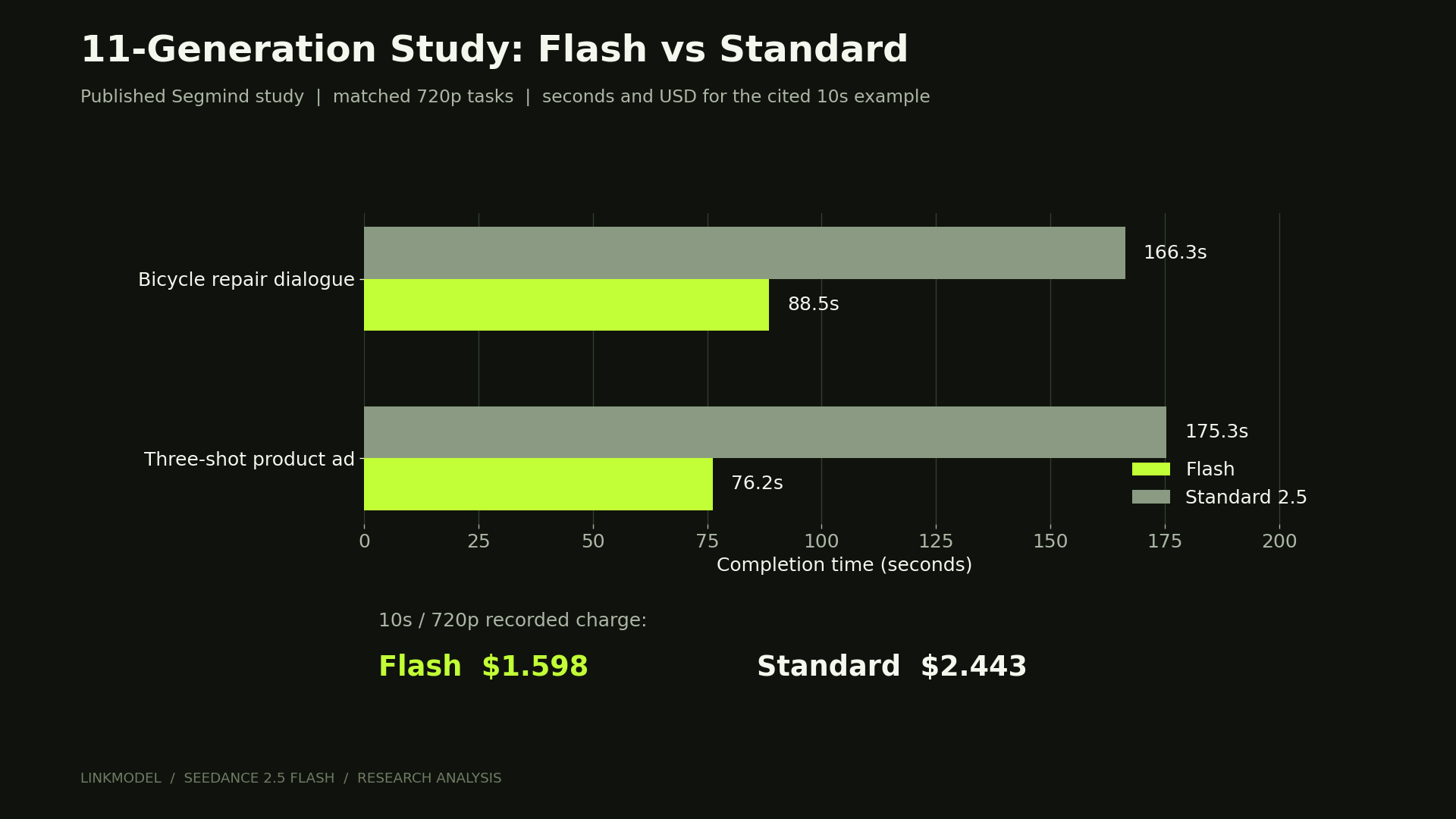
| Measurement | Seedance 2.5 Flash | Standard Seedance 2.5 |
|---|---|---|
| Recorded charge for 10s 720p video | $1.598 | $2.443 |
| Bicycle repair dialogue scene | 88.5s | 166.3s |
| Three-shot product advertisement | 76.2s | 175.3s |
| Supported output resolution | Up to 720p | Up to 1080p |
The recorded Flash charge was approximately 34.6% lower than standard Seedance 2.5 for the matched 720p task.
The two Flash tasks completed in an average of 82.35 seconds, compared with 170.8 seconds for the corresponding standard-model tasks.
The study also revealed differences that matter for creative production.
Dialogue scene: Both models handled the spoken line, while the Flash version delivered clearer transcription of one word in the published comparison. Both versions misunderstood the orientation of a bicycle wheel in the repair-shop scene.
Product advertisement: The prompt requested three shots lasting four, three, and three seconds. Flash produced shot lengths of approximately 3.75, 3.46, and 2.88 seconds, demonstrating relatively close timing control.
480p versus 720p: Changing resolution generated a different visual take rather than a pixel-perfect version of the same clip. Lower-resolution generation can help evaluate prompt structure, but should not be treated as an exact preview of the final composition.
Reference-image generation: A product-reference example preserved several visual details while changing some colors and character attributes. This demonstrates why product-focused workflows should examine identity and appearance consistency before generating large batches.
Fast motion: A skateboard action example substituted an easier motion for the requested kickflip. The output maintained a continuous camera movement but did not complete the named trick.
These results strengthen an important purchasing principle: the effective cost of a video-generation workflow depends on whether the model successfully produces the required content, not only on its advertised rate.
The recorded Segmind charges also provide an additional view of token-based pricing, where precise frame-count calculations can differ slightly from simplified per-second estimates.
Case Study: Reference Images, Multi-Shot Timing, and Video Editing
The same 11-generation research provides useful examples for developers considering multimodal Flash workflows.
| Workflow | Published Result | Practical Lesson |
|---|---|---|
| 8-second image-to-video | $1.277, 72.2s | First-frame guidance can preserve scene structure |
| 8-second product reference | $1.280, 71.1s | Product details may persist while color and people change |
| 8-second vertical video | $1.280, 81.7s | Vertical output is viable for short-form content |
| 20-second three-shot scene | $3.190, 133.2s | Multi-shot timing can follow a structured prompt |
| 6-second fast-motion scene | $0.962, 101.3s | Exact physical actions remain challenging |
| Reference-video edit | $1.536, 77.3s | Edits can alter unintended objects |
One particularly informative example involved editing an existing street-food video.
The requested changes were to replace a serving plate with a banana leaf and change warm background lights to blue.
The lighting change was achieved, but the leaf was applied to the wrong surface.
This illustrates a common challenge in reference-driven video editing: an instruction may identify the correct object category but fail to specify the intended moment or position precisely enough.
For developers designing video-editing applications, prompts should describe the target object, location, and timing explicitly.
Case Study: A 10-Person Video Studio's API Purchasing Decision
Our review of production-oriented questions also identified a purchasing scenario involving a 10-person video studio building an internal Seedance generation tool.
The studio's initial considerations included API pricing, subscription requirements, integration effort, and supporting production features.
Although the original purchasing discussion concerned standard Seedance 2.5, the same questions are directly relevant when selecting a Flash provider.
Consider a studio generating 100 ten-second 720p Flash videos.
At LinkModel's published rate:
100 × 10 × $0.13608 = $136.08
For 300 videos with identical output specifications:
300 × 10 × $0.13608 = $408.24
At the BytePlus reference rate of approximately $0.152/s, the equivalent budgets are $152 and $456.
The next consideration is how many generated videos become usable deliverables.
| Usable Clips from 100 Generations | LinkModel Cost per Usable Clip |
|---|---|
| 80 | $1.70 |
| 60 | $2.27 |
| 40 | $3.40 |
| 20 | $6.80 |
This scenario highlights why production teams should track Cost per Usable Video, calculated as:
Cost per Usable Video = Total Generation Spending ÷ Number of Usable Videos
The formula is especially useful for advertising variations, product videos, social clips, and scenes that require repeated creative iteration.
For a small studio, provider selection should therefore consider both the rate per generated second and the number of attempts typically required for an acceptable creative result. Teams creating advertisements may also compare AI video APIs for ads to evaluate broader production workflows.
How to Choose the Best Seedance 2.5 Flash API Provider
The best Seedance 2.5 Flash API provider depends on whether a project is starting from scratch, preserving an existing integration, or scaling repeated video production.
Our research points to five practical selection criteria: model availability, input support, pricing basis, async task architecture, and integration effort.
A Practical Provider Selection Matrix
| Your Requirement | Recommended Starting Point | Main Reason |
|---|---|---|
| New project with price as the priority | LinkModel | Lowest reviewed 720p reference rate |
| Direct official cloud access | BytePlus ModelArk | Original model vendor's international route |
| Existing Runware-based application | Runware | Reuse existing inference infrastructure |
| Existing Atlas Cloud workflow | Atlas Cloud | Preserve current model-management environment |
| Existing Segmind automation | Segmind | Synchronous and asynchronous API options |
| Existing Kie.ai job infrastructure | Kie.ai | Continue using its job API |
| Existing WaveSpeedAI prediction pipeline | WaveSpeedAI | Preserve prediction workflow |
| Existing fal inference infrastructure | fal.ai | Reuse its model routes and queue integration |
This matrix is based on documented platform characteristics, not a claimed ranking of provider-wide latency or generation success rates.
For a new application, LinkModel offers the strongest starting price among the reviewed providers and a documented route for submitting and retrieving generation tasks.
For established applications, the financial benefit of migration should be considered alongside implementation effort.
Budgeting for Small Projects and High-Volume Production
At LinkModel's published 720p rate, a workload of ten-second videos produces the following baseline monthly budget.
| Monthly Volume | Estimated Generation Cost |
|---|---|
| 50 videos | $68.04 |
| 200 videos | $272.16 |
| 500 videos | $680.40 |
| 1,000 videos | $1,360.80 |
These scenarios demonstrate how generation spending scales with output volume.
A new developer can begin with shorter 480p generations before moving to higher-resolution or longer tasks.
A production team can use its expected monthly volume to determine whether lower generation costs justify changing its provider integration.
LinkModel's published price and unified billing environment make it an attractive option when predictable costs and access to multiple supported models are important.
The final decision should account for the model's ability to produce the intended content, the provider's support for the required input mode, and the engineering work needed to integrate the API.
Frequently Asked Questions
Where can I get Seedance 2.5 Flash API access?
Seedance 2.5 Flash API access is available through LinkModel, BytePlus ModelArk, Runware, Atlas Cloud, Segmind, Kie.ai, WaveSpeedAI, and fal.ai. LinkModel is a strong starting point for cost-sensitive applications, while BytePlus provides the official international API route. Other providers can be useful when their infrastructure is already integrated into a project.
Which Seedance 2.5 Flash API provider is cheapest?
Among the eight reviewed 720p no-reference-video configurations, LinkModel has the lowest listed reference rate at $0.13608/s, with 480p priced at $0.060527/s. Its rates were approximately 55% below the fal benchmark used in LinkModel's earlier comparison. Actual provider costs depend on the selected configuration and billing method.
Can I switch from BytePlus or fal to LinkModel?
Yes, an application can be adapted to use LinkModel's Seedance 2.5 Flash API, but the provider-specific request and response interfaces must be updated. LinkModel uses the model ID seedance-2-5-flash, its own video-generation endpoint, and task-status polling. Developers should update authentication, input-field mappings, task tracking, and video URL processing as part of the migration.
How is Seedance 2.5 Flash API usage billed?
Providers may bill by generated second, video token, or credits converted into a video-generation charge. For LinkModel, the published 720p no-video-input rate is $0.13608/s, equivalent to $6.30/M output tokens under the documented estimate. When reference videos are included, both input and generated output durations can affect the total token calculation.
Should I choose Seedance 2.5 Flash or standard Seedance 2.5?
Choose Flash for cost-sensitive 480p and 720p workflows, prompt iteration, social content, and video-production tasks where faster turnaround is valuable. Choose standard Seedance 2.5 when 1080p output, larger reference capacity, or demanding physical motion is a higher priority. Published 12-video and 11-generation comparisons both found speed and cost advantages for Flash in the observed tasks, while also identifying visual-accuracy limitations worth considering.
Conclusion
LinkModel is our recommended starting point for Seedance 2.5 Flash API access in 2026, especially for developers comparing cost, model IDs, multimodal inputs, async task handling, and integration effort. Its published pricing of $0.060527/s for 480p and $0.13608/s for 720p is competitive among the eight reviewed providers, while its documented submission and polling workflow offers a clear path for new applications. BytePlus ModelArk remains the direct official option, and Runware, Atlas Cloud, Segmind, Kie.ai, WaveSpeedAI, and fal.ai offer alternatives for established infrastructure. The 12-video and 11-generation studies show that Flash can provide faster, lower-cost iteration while still requiring attention to motion accuracy and visual consistency. For new applications focused on affordable 480p and 720p production, LinkModel offers an attractive combination of pricing and accessible integration; for existing workflows, the right choice ultimately depends on supported inputs, migration effort, and cost per usable video.