GPT-6 Astra API pricing on LinkModel is 25% below OpenAI’s Standard token rates, starting at $7.50 per million input tokens and $37.50 per million output tokens, compared with OpenAI’s $10 and $50. The discount also applies to the corresponding cached-input, cache-write, and long-context token rates. For developers budgeting demanding text workloads, that provides a lower starting cost—but the 272K input threshold still matters.
Crossing that threshold changes the rates for the entire request. With 20K billed output tokens, increasing fresh input from 271K to 273K raises the estimated OpenAI Standard cost from $3.71 to $6.96; the corresponding LinkModel estimates are $2.7825 and $5.22. Repeated requests, cache writes, and output usage can further increase spending, so understanding the full GPT API pricing structure is essential before scaling.
LinkModel combines 25% lower Astra token rates with pay-as-you-go billing, no minimum spend, and no monthly platform fee. OpenAI-compatible endpoints and unified billing help teams reuse compatible client code and compare supported models. This guide explains how to control API spend, use cached prefixes effectively, and calculate request costs before increasing usage.

GPT-6 Astra API Pricing at a Glance
For Standard requests at or below 272K input tokens:
| Token Type | GPT-6 Astra Price |
|---|---|
| Fresh input | $10/M |
| Cached input | $1/M |
| Cache write | $12.50/M |
| Output | $50/M |
For requests above 272K input tokens:
| Token Type | Short Context | Long Context |
|---|---|---|
| Fresh input | $10/M | $20/M |
| Cached input | $1/M | $2/M |
| Cache write | $12.50/M | $25/M |
| Output | $50/M | $75/M |
GPT-6 Astra also supports a 1,050,000-token context window, up to 128,000 output tokens, and five reasoning-effort levels: low, medium, high, xhigh, and max.
The common "$10 input / $50 output" summary therefore misses several important cost variables: cache writes, long-context pricing, processing mode, output volume, retries, and tool usage.

How Much Does a Typical GPT-6 Astra Request Cost?
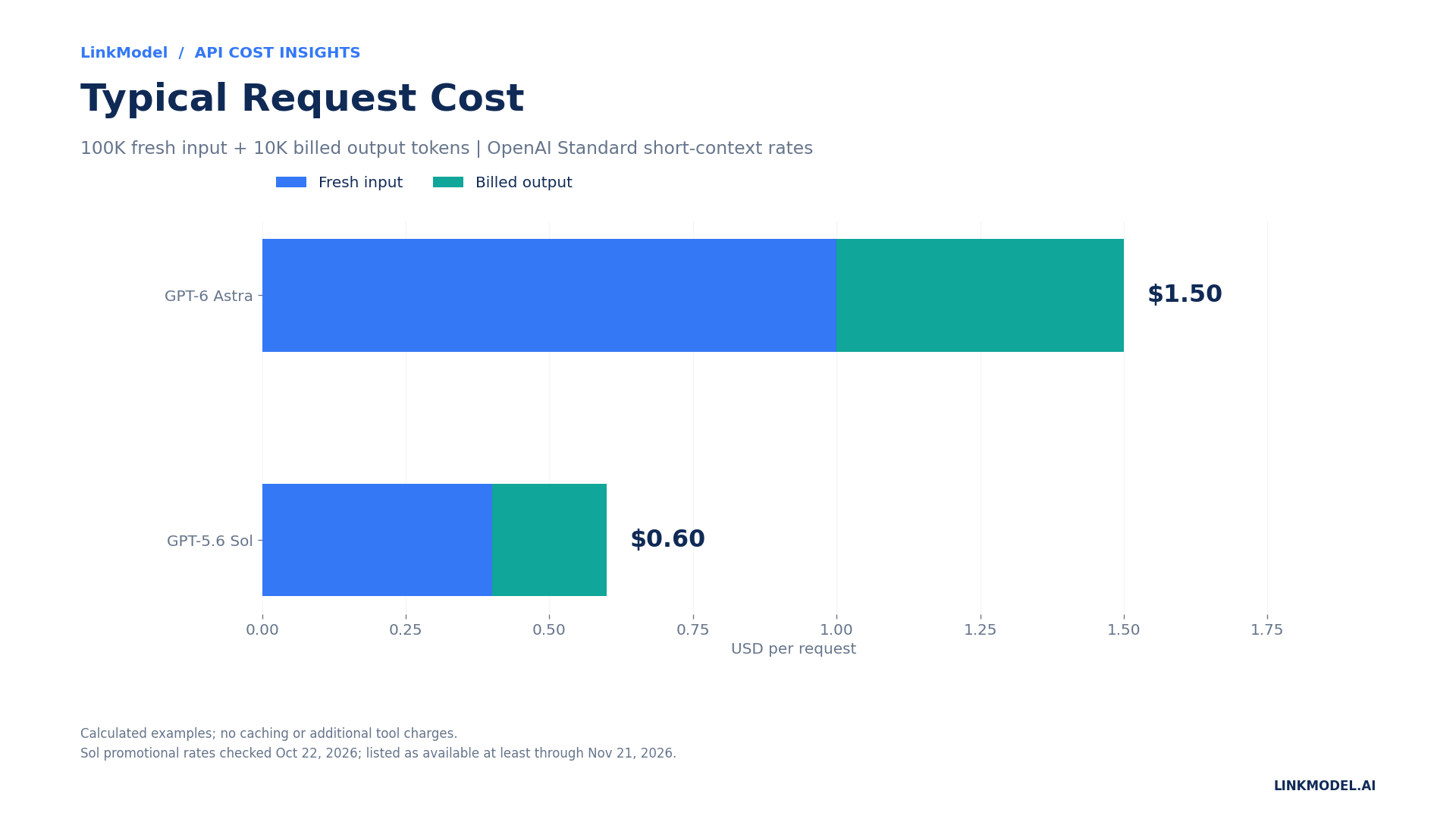
For 100K fresh input tokens and 10K output tokens under Standard pricing:
- Input: $1.00
- Output: $0.50
- Total: $1.50
The same token volume on GPT-5.6 Sol costs about $0.60, making Astra exactly 2.5× more expensive when token consumption is identical.
GPT-6 Astra Long Context Pricing and the 272K Cost Cliff
The 272K input threshold is one of the most important details in GPT-6 Astra pricing because the higher rates apply to the entire request, not only the tokens above 272K.
Consider two nearly identical requests:
| Request | Estimated Cost |
|---|---|
| 271K input + 20K output | $3.71 |
| 273K input + 20K output | $6.96 |
At 271K input, the request costs $2.71 input + $1.00 output = $3.71.
At 273K input, Long Context rates apply to the whole request: $5.46 input + $1.50 output = $6.96.
Input increases by only about 0.7%, while estimated cost rises by roughly 88%.
In our review of long-context questions, developers considered context sizes around 300K, 330K, and 350K tokens for large repositories. More context can help when it is genuinely relevant, but unnecessary history can push a request across an expensive pricing boundary.

GPT-6 Astra Batch, Flex, Standard, and Fast Pricing
Processing mode can change Astra's cost substantially.
| Mode | Input | Cached Input | Cache Write | Output |
|---|---|---|---|---|
| Batch | $5/M | $0.50/M | $6.25/M | $25/M |
| Flex | $5/M | $0.50/M | $6.25/M | $25/M |
| Standard | $10/M | $1/M | $12.50/M | $50/M |
| Fast | $20/M | $2/M | $25/M | $100/M |
Batch and Flex cost 50% less than Standard, making them attractive when immediate responses are unnecessary.
Fast costs 2× Standard, so it makes more sense when lower latency has direct business value.
The cheapest way to run Astra is therefore not simply to shorten prompts. Processing mode should match the value of latency for each workload.
GPT-6 Astra Prompt Caching Can Cut Repeated Input Cost
Prompt caching is one of Astra's strongest cost controls.
Under Standard Short Context pricing:
- Fresh input: $10/M
- Cache write: $12.50/M
- Cached input: $1/M
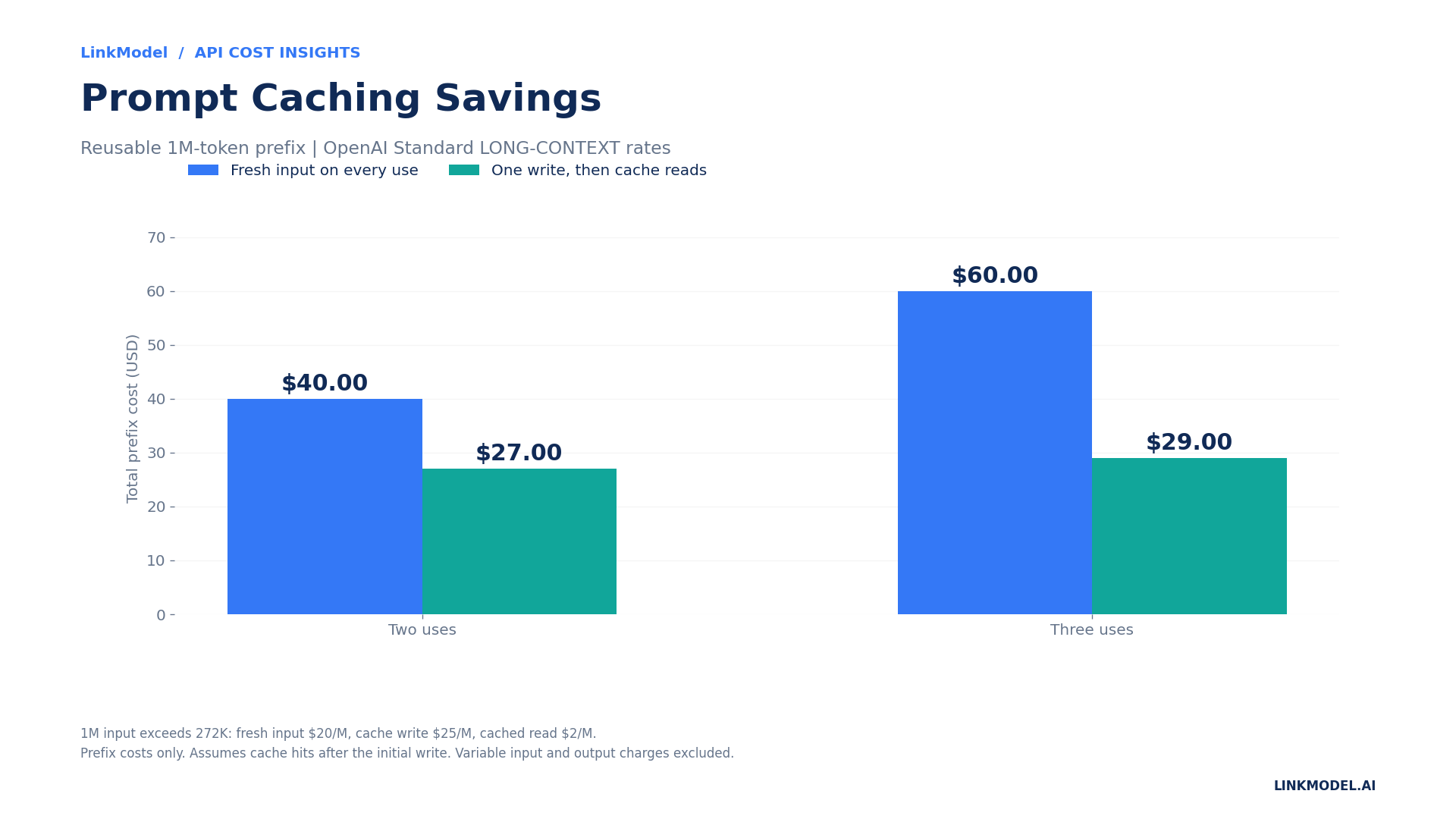
For a reusable 1M-token prefix, Standard Long Context rates apply because a single request exceeds 272K input tokens:
| Scenario | Total Prefix Cost |
|---|---|
| Two fresh inputs | $40.00 |
| One cache write + one cached read | $27.00 |
With three uses, three fresh inputs cost $60.00, while one cache write plus two cached reads costs $29.00. These calculations cover the prefix only, exclude variable input and output charges, and assume subsequent requests receive cache hits.
The key is reuse frequency. Cache stable system instructions, persistent tool definitions, and other prefixes that actually repeat.
One cache-heavy session reviewed in our research ran for 101 turns, recorded roughly 6.6M cached-read tokens, and reported a total cost of $8.6807. Because the full fresh-input, cache-write, output, reasoning, and tool breakdown was unavailable, we do not treat that dollar figure as a universal benchmark.
We also found no strong basis for treating a 70% cache-hit rate as a universal production average. Your own workload data is a better benchmark.
GPT-6 Astra vs GPT-5.6 Sol Pricing
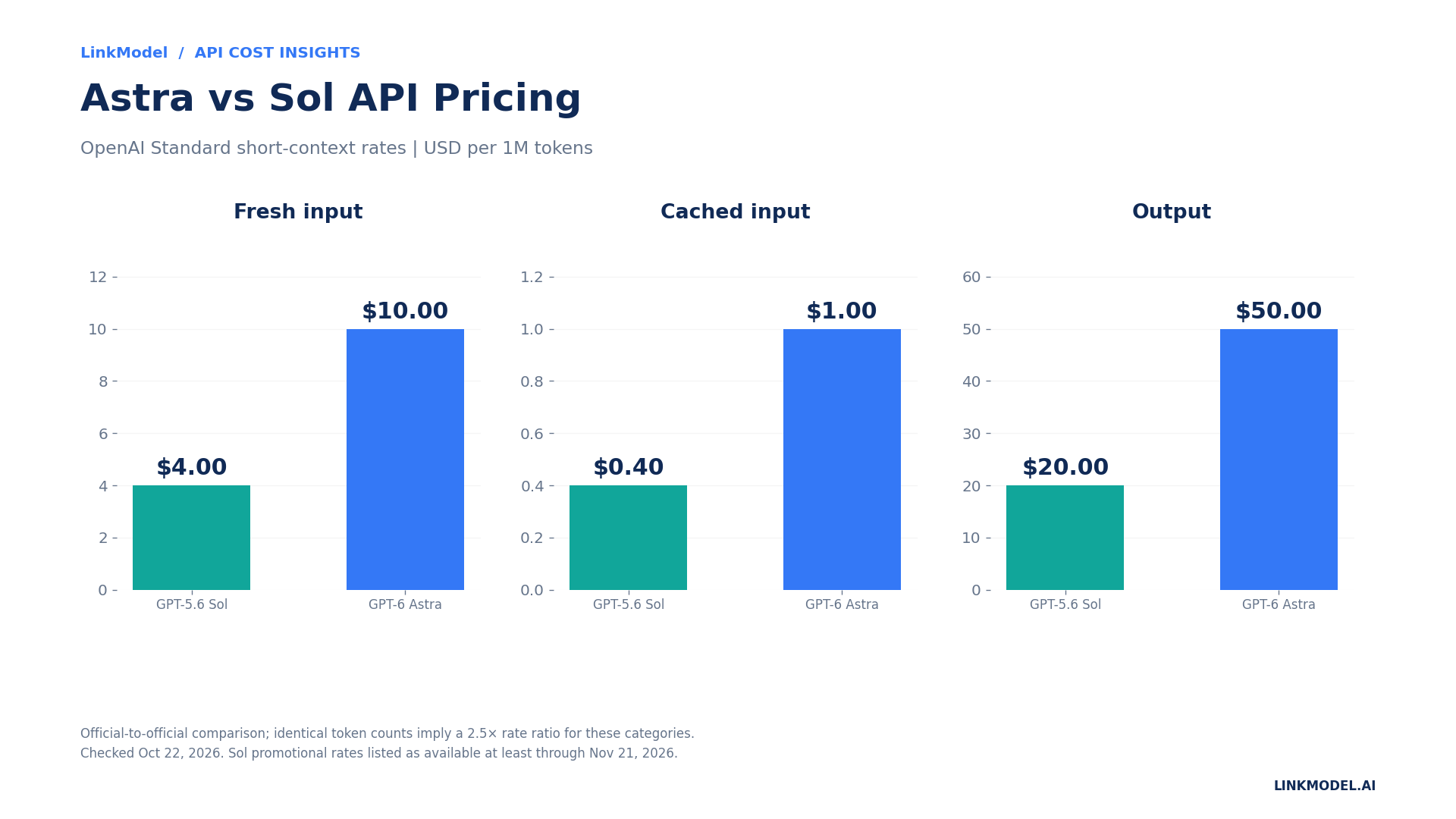
Astra's headline token rates are consistently 2.5× Sol's.
| Token Type | GPT-5.6 Sol | GPT-6 Astra |
|---|---|---|
| Input | $4/M | $10/M |
| Cached input | $0.40/M | $1/M |
| Output | $20/M | $50/M |
For 100K fresh input plus 10K output:
- Astra: $1.50
- Sol: $0.60
If token efficiency alone had to compensate for the price gap, Astra would need to consume roughly 60% fewer tokens to break even.
Why Cost per Completed Task Matters More
Agent workloads introduce costs that do not appear in a simple token table:
- Retries
- Failed tool calls
- Long outputs
- Human debugging
- Manual review
- Latency
- Failed agent runs
If Sol costs $0.60 per attempt but needs three attempts, model cost becomes $1.80. If Astra succeeds once for $1.50, the higher-priced model produces the cheaper completed result.
That is why the better production metric is:
Completed-task cost = model cost + retries + tools + failures + human intervention + latency
Is GPT-6 Astra Worth 2.5× More for Coding Agents?
Our research found the strongest Astra value signals in difficult debugging, architecture, autonomous coding, project review, and multi-step tool use.
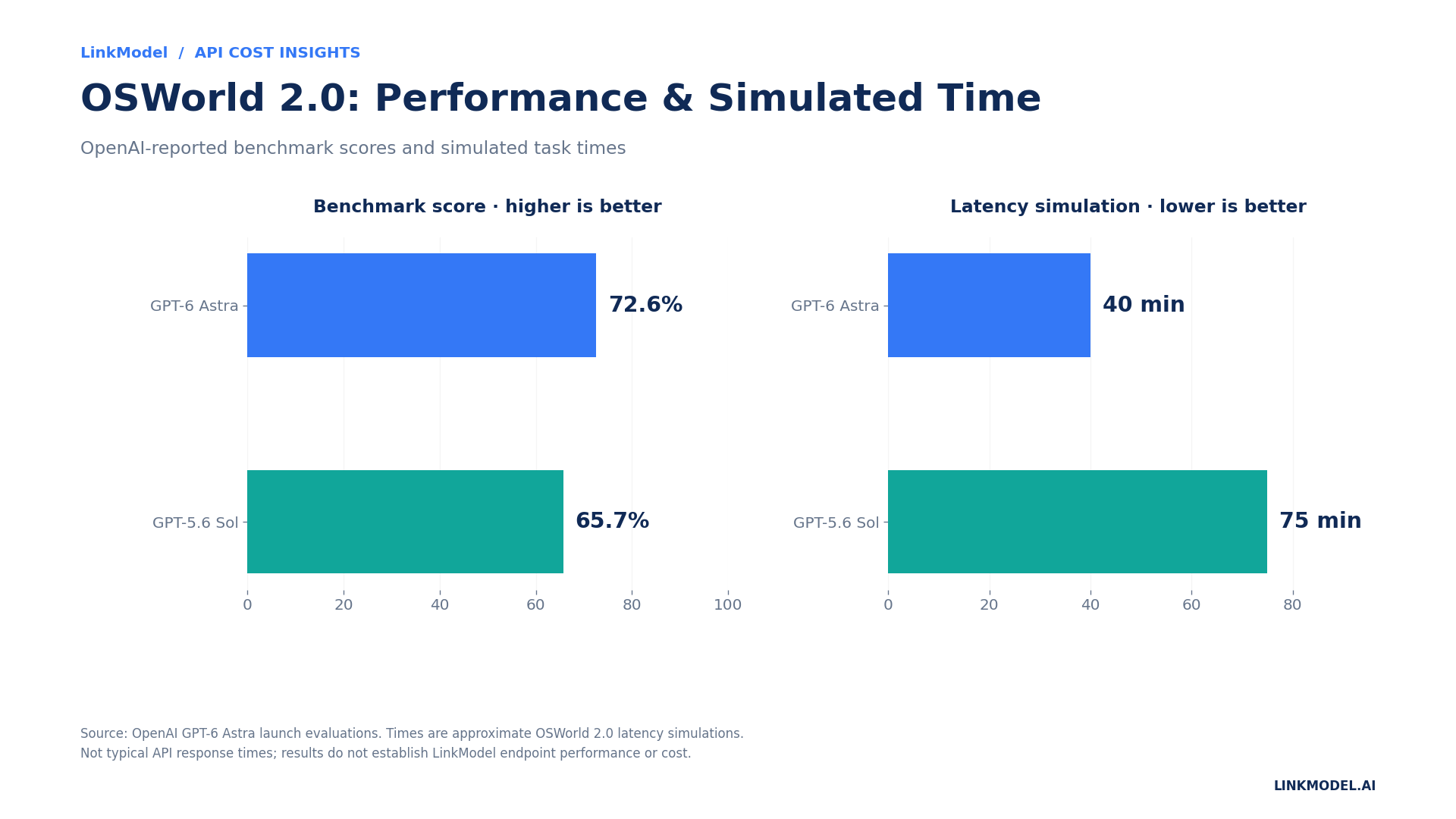
OpenAI’s published evaluations provide a reason to compare more than token prices:
| Model | OSWorld 2.0 Result | Approx. Time per Task in Latency Simulations |
|---|---|---|
| GPT-6 Astra | 72.6% | 40 min |
| GPT-5.6 Sol | 65.7% | 75 min |
These times describe latency simulations under the benchmark’s conditions, not typical API response times. The reported 1.9× Mind2Web task-completion speed also includes an updated Codex harness, so the improvement should not be attributed solely to changing models.
Neither result proves that Astra is cheaper for your workload. Compare completion rate, retries, and human intervention alongside billed usage on the same representative tasks.
GPT-6 Astra Codex Usage: What Our Workflow Review Found
Our review of reported GPT-6 Astra workflows identified a recurring concern: intensive agent tasks can consume subscription usage allowances much faster than users expect.
Examples we reviewed included:
- About 15 minutes to consume a five-hour allowance in one Astra Medium workflow
- Around 8 minutes of reasoning plus 120 lines of code in another coding workflow
- Around 10 minutes for a project review that also consumed roughly 15% of weekly usage
- Around 20 minutes in one Astra High workflow
These cases are useful for understanding user experience, but they should not be converted into API dollars.
ChatGPT and Codex usage allowances are separate from API token billing. The variation across these workflows also shows why there is no defensible rule such as "Astra always lasts X minutes."
How to Reduce GPT-6 Astra API Cost
The best cost strategy is usually selective Astra usage, not Astra everywhere.
| Workload | Practical Starting Point |
|---|---|
| Routine extraction or classification | Lower-cost model |
| Straightforward coding | Sol first |
| Difficult debugging | Astra candidate |
| Architecture | Astra candidate |
| Autonomous coding | Astra candidate |
| High-value multi-tool work | Astra candidate |
| Context above 272K | Use only when justified |
Also:
- Keep context below 272K when extra history adds little value
- Maximize reusable cached prefixes
- Use Batch or Flex when immediate latency is unnecessary
- Track retries and completed-task cost instead of token price alone
For supported text-chat requests at or below 272K input tokens, LinkModel’s Astra rates are $7.50/M input and $37.50/M output. The 100K fresh-input plus 10K billed-output example therefore costs $1.125, compared with $1.50 at OpenAI’s Standard rates, excluding additional charges. Teams can access supported models through one OpenAI-compatible API, one API key, and unified billing. Check feature compatibility before migrating: LinkModel’s current Astra listing supports text-only chat and does not include function calling or built-in tools.
Frequently Asked Questions
How much does GPT-6 Astra cost per 1M tokens?
Standard Short Context pricing is $10/M input, $1/M cached input, $12.50/M cache write, and $50/M output. Above 272K input, Standard pricing becomes $20/M input, $2/M cached input, $25/M cache write, and $75/M output.
What happens when GPT-6 Astra exceeds 272K input tokens?
The entire request moves to Long Context pricing. In our 271K-versus-273K example, increasing input by about 0.7% raises estimated cost from $3.71 to $6.96.
When does GPT-6 Astra caching save money?
Caching saves money when stable context is reused and subsequent requests receive cache hits. For a single 1M-token prefix, Standard Long Context rates apply: two fresh uses cost **$40**, compared with **$27** for one cache write and one cached read. These estimates exclude variable input and output charges.
Is GPT-6 Astra really worth 2.5× more than GPT-5.6 Sol?
For routine workloads that Sol already completes reliably, usually not. Astra becomes easier to justify for difficult agentic tasks when higher completion rates, fewer retries, or less human debugging reduce the cost per successful task.
Can Codex or ChatGPT quota be converted into GPT-6 Astra API cost?
No reliable one-to-one conversion is available. Subscription usage allowances and API token billing are different systems, so API budgeting should use actual token and applicable tool usage rather than five-hour or weekly quota consumption.
Conclusion
GPT-6 Astra is 2.5× more expensive per base token than GPT-5.6 Sol, and its 272K input threshold can sharply increase the cost of an entire request. For routine tasks, that premium is difficult to justify. But for difficult debugging, architecture, autonomous coding, and other high-value agent workflows, token price alone can be misleading: caching, processing mode, retries, completion rate, and human intervention can materially change the economics. The most useful question is therefore not simply "How much does Astra cost?", but "What does Astra cost per successfully completed task?"
Pricing checked October 22, 2026 against OpenAI GPT-6 Astra model documentation, OpenAI GPT-6 Astra launch and evaluations, OpenAI model comparison, and LinkModel GPT-6 Astra pricing. The GPT-5.6 Sol comparison uses OpenAI’s current promotional rates, listed as available at least through November 21, 2026. The processing-mode table shows OpenAI’s short-context rates; long-context multipliers apply above 272K.