LinkModel is our price-first pick for on-demand Claude Sonnet 5.5 API access: $1.70 per million input tokens and $8.50 per million output tokens—15% below Anthropic’s corresponding standard token rates. Anthropic direct suits first-party access and asynchronous batch jobs, OpenRouter suits provider routing, and Amazon Bedrock suits AWS-based deployments.
The lowest headline price does not always produce the lowest bill. Repeated context, cache writes and platform fees affect costs, while batch pricing serves a different workload from live chat or coding. For 8 million fresh input tokens and 2 million output tokens, LinkModel’s standard token cost is $30.60 versus Anthropic’s $36.00.
With LinkModel’s Claude Sonnet 5.5 API, you get lower standard input, output and cache rates with pay-as-you-go billing, no minimum spend and no monthly platform fee. Compare model outputs in the Playground, then connect your application or follow the documented Claude Code integration—with access to multiple models managed from one platform.
Best Claude Sonnet 5.5 API Providers at a Glance
Start with your workload: interactive requests, asynchronous processing, multi-provider routing or an existing AWS deployment. Those requirements determine which pricing and access options deserve the most attention.
| Provider | Best fit | Main buying consideration |
|---|---|---|
| LinkModel | Cost-conscious interactive applications and coding workflows | Lower published standard token rates |
| Anthropic direct | First-party integration and batch processing | Direct access and separate asynchronous pricing |
| OpenRouter | Provider routing and centralized model access | Routing capabilities alongside credit-purchase fees |
| Amazon Bedrock | AWS-based applications | Deployment configuration, availability and AWS pricing |
Our research compares provider-published rate cards, documented access options and the practical questions developers raise when choosing a route.
A live customer-support assistant needs interactive responses. An overnight extraction queue can evaluate batch processing. A team already using multiple model vendors may value centralized access. Compare the buying options that match the application, rather than selecting one universal winner.
Sonnet 5.5 Specifications: What the Model Supports
Anthropic’s Sonnet 5.5 model overview lists text and image inputs, text output, a one-million-token context window and up to 128,000 standard output tokens.
| Specification | Model capability |
|---|---|
| Input | Text and images |
| Output | Text |
| Context window | 1 million tokens |
| Standard maximum output | 128,000 tokens |
| Thinking | Adaptive |
These specifications establish the model’s general fit. Repository analysis may depend on a substantial context window; document processing may require image input; coding agents need compatible tool behavior.
Provider access is a separate check. Confirm that the selected route exposes the features, parameters and limits your workflow needs.
Claude Sonnet 5.5 API Pricing: Standard Rates, Caching and Fees
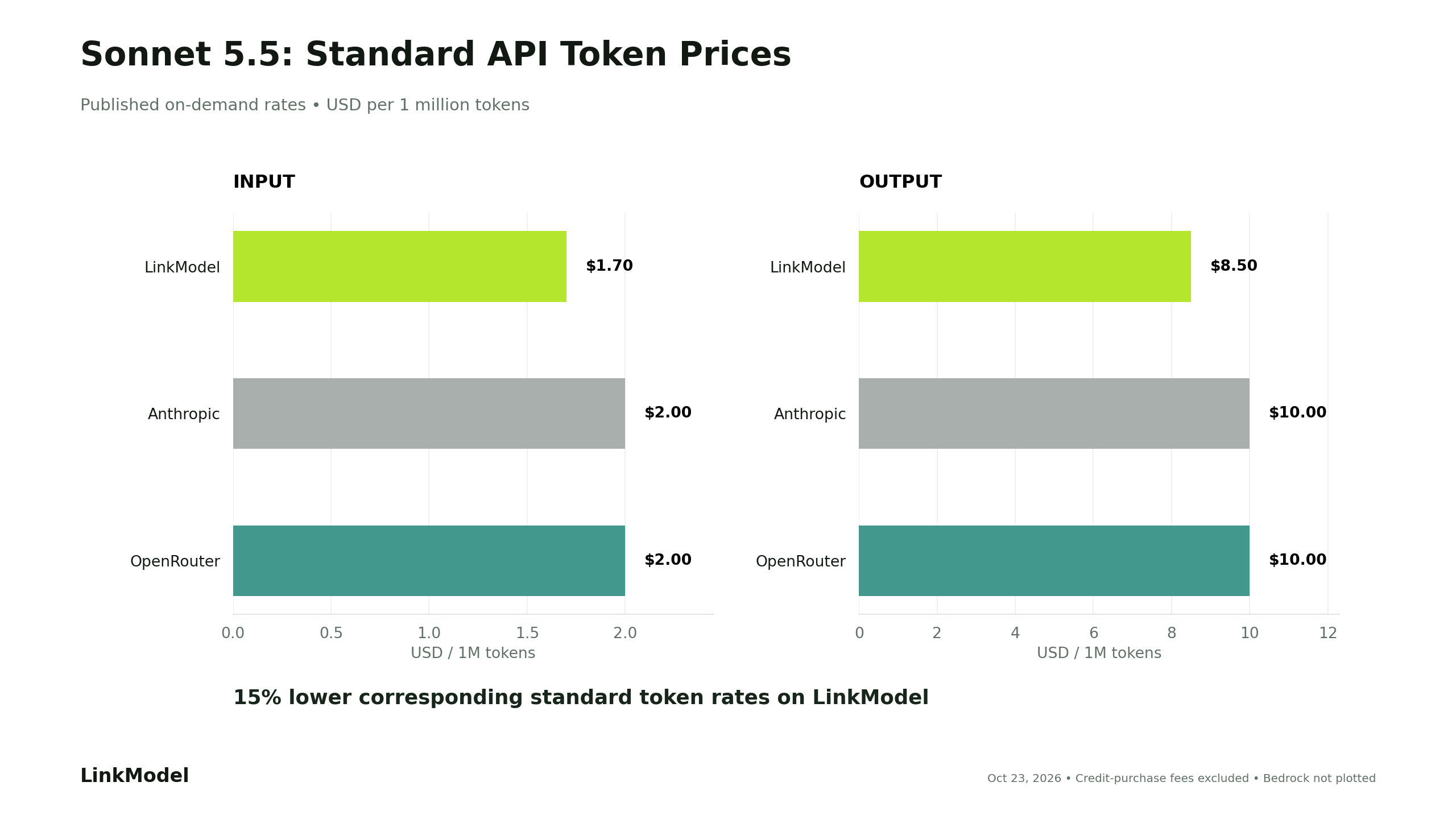
LinkModel has the lowest published standard input and output prices among the directly priced on-demand options below. All rates are in USD per one million tokens.
| Provider and processing mode | Input | Output |
|---|---|---|
| LinkModel standard | $1.70 | $8.50 |
| Anthropic standard | $2.00 | $10.00 |
| OpenRouter model-token rate | $2.00 | $10.00 |
| Anthropic asynchronous Batch API | $1.00 | $5.00 |
The LinkModel rate card, Anthropic pricing documentation and OpenRouter model listing establish these figures. Batch is a separate processing mode, rather than a lower rate for the same live request.
Keep token quantities, processing mode and caching assumptions consistent when comparing prices. Taxes, payment costs and separately billed tools require their own treatment.
Sonnet 5.5 Cache Pricing: Compare All Five Categories
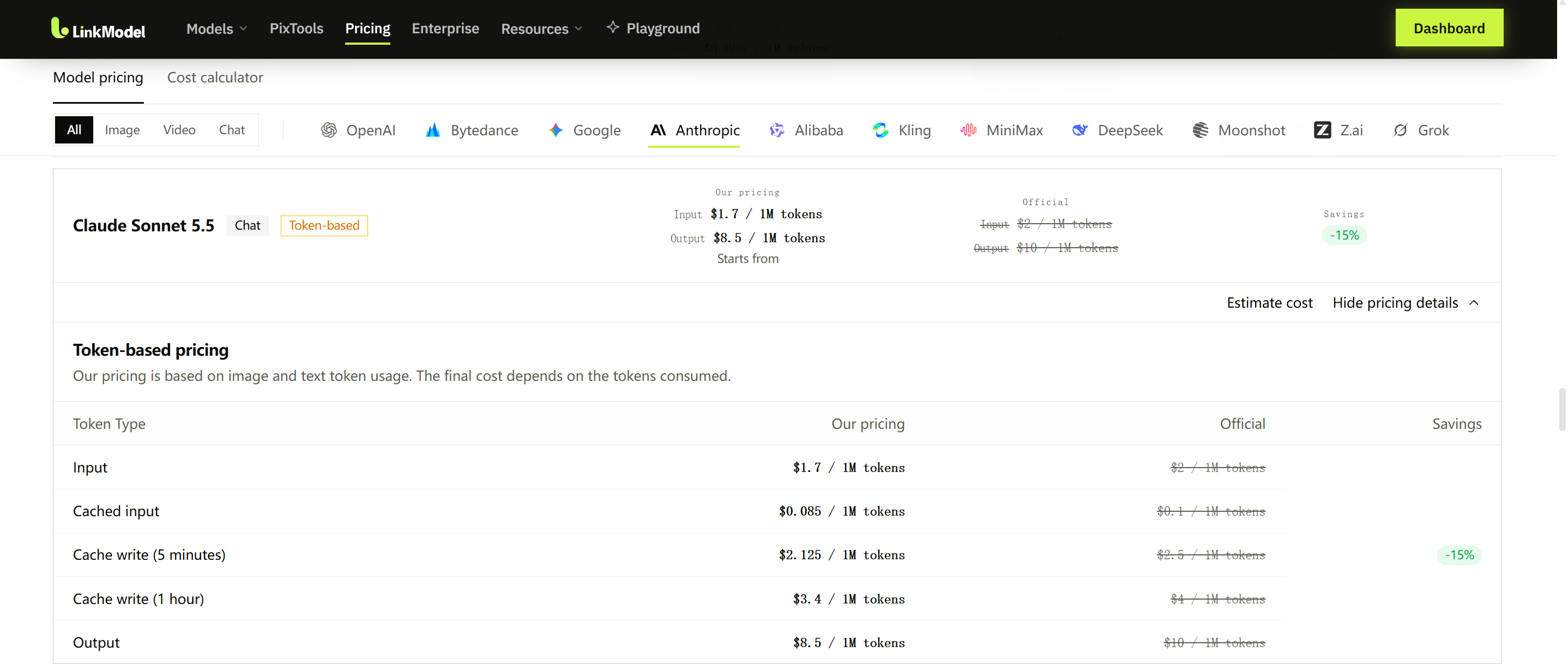
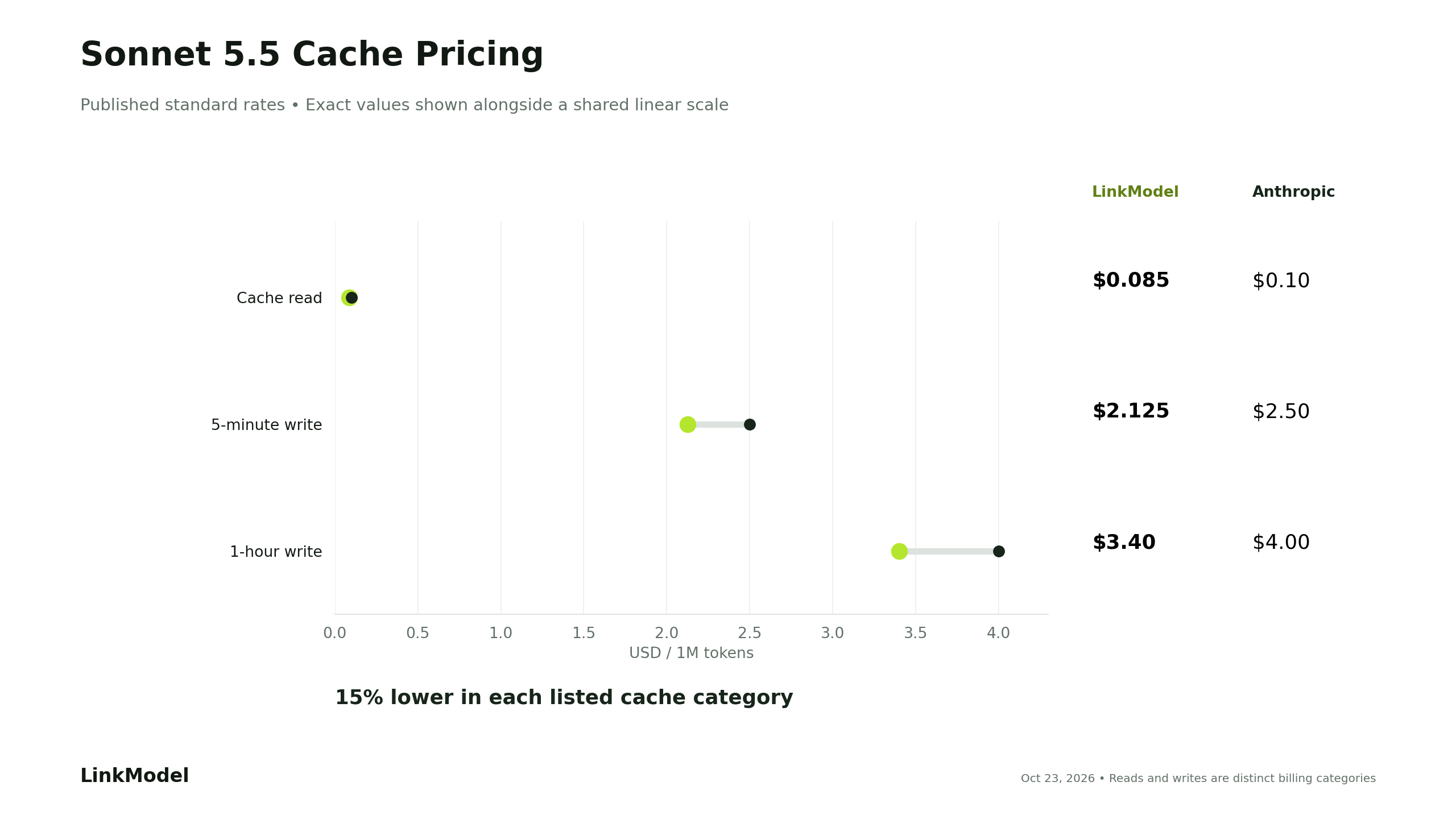
The published LinkModel reduction is 15% across every listed Sonnet 5.5 token category.
| Token category | LinkModel | Anthropic standard |
|---|---|---|
| Fresh input | $1.70 | $2.00 |
| Cache read | $0.085 | $0.10 |
| Five-minute cache write | $2.125 | $2.50 |
| One-hour cache write | $3.40 | $4.00 |
| Output | $8.50 | $10.00 |
These model-specific prices establish the comparison; a broader catalog promotion should not replace the Sonnet 5.5 rate card.
The 15% reduction applies to corresponding standard token prices, including both cache-write durations and successful cache reads.
For coding agents, distinguish the initial cache write from subsequent reads. A large repository prefix written once and reused repeatedly has different economics from a prefix rebuilt after every interruption.
Anthropic’s prompt-caching documentation describes five-minute and one-hour lifetimes, with automatic caching or explicit breakpoints. The practical question is how frequently eligible context is reused before it changes or expires.
OpenRouter Pricing: Account for Credit-Purchase Fees
OpenRouter’s listed standard Sonnet 5.5 input and output prices match Anthropic’s, while credit purchases carry a separate fee. Its pricing page specifies 5.5% on Standard and 8% on Business credit purchases.
For example, purchasing $100 in credits at a 5.5% fee adds $5.50 before other applicable payment conditions. The fee funds the account; it is not separately assessed on every inference request.
This matters when comparing a model usage debit with the cash needed to purchase that usage. OpenRouter’s routing and management capabilities may justify the cost, but equal token prices do not establish equal account-funding costs.
Anthropic Batch: A Lower Price for Asynchronous Jobs
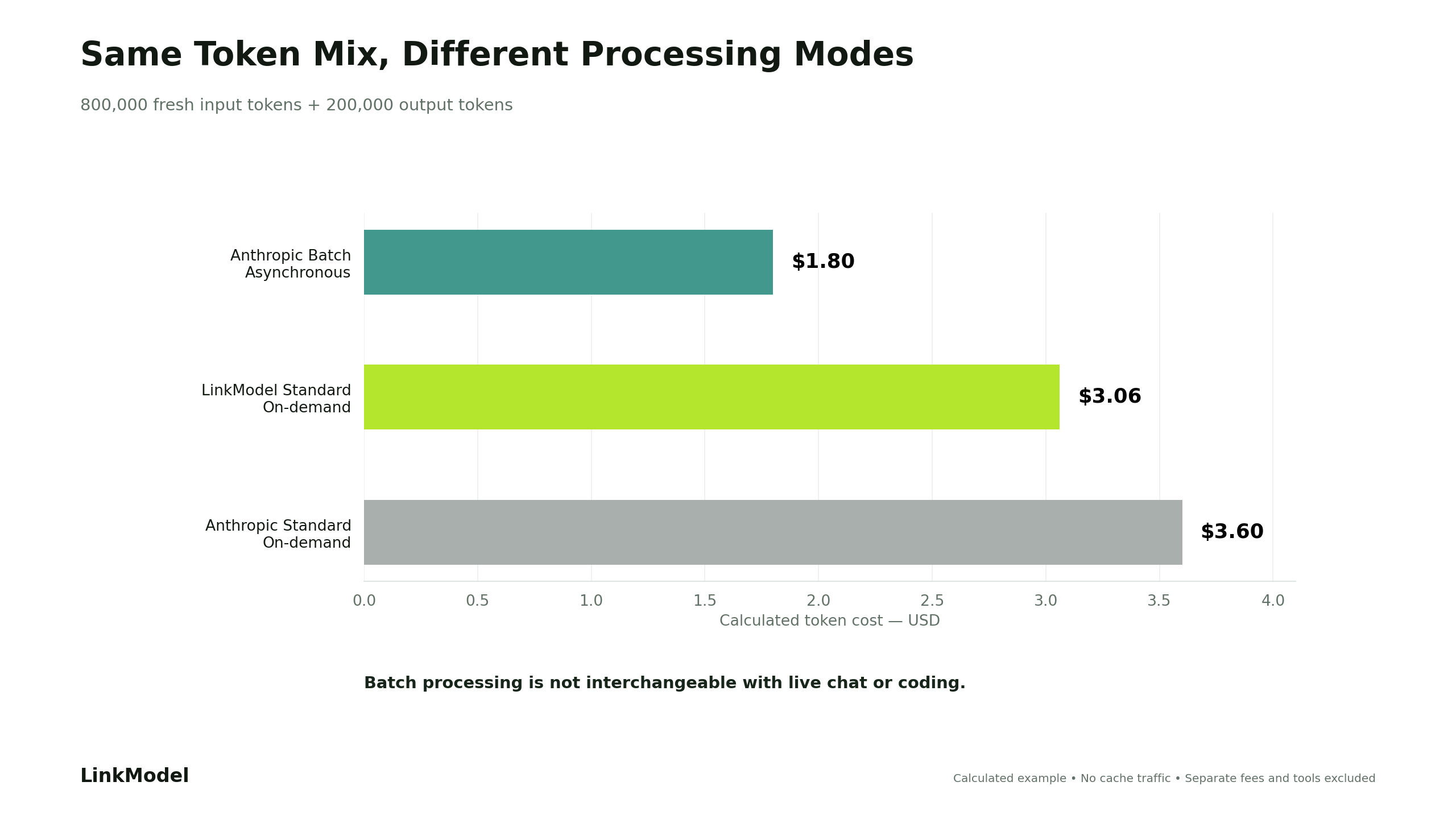
Anthropic Batch offers lower published input and output rates for eligible asynchronous work: $1 and $5 per million tokens.
For 800,000 fresh input tokens and 200,000 output tokens:
| Processing option | Calculated token cost |
|---|---|
| Anthropic Batch | $1.80 |
| LinkModel standard | $3.06 |
| Anthropic standard | $3.60 |
Scheduled document extraction, offline evaluations and other delay-tolerant jobs should evaluate batch economics. Interactive chat and live coding require a different access pattern.
Choose the processing mode before comparing its applicable rates.
Which Sonnet 5.5 API Provider Fits Your Workflow?
Price, integration work and deployment requirements should be evaluated together. A new project and an established production application may reasonably choose different routes.
LinkModel: Lower Standard Costs with a Small Starting Commitment
LinkModel fits developers who want lower standard token prices and the flexibility to start with limited usage. Its usage-based billing avoids a monthly platform subscription, while its model page publishes the individual token categories.
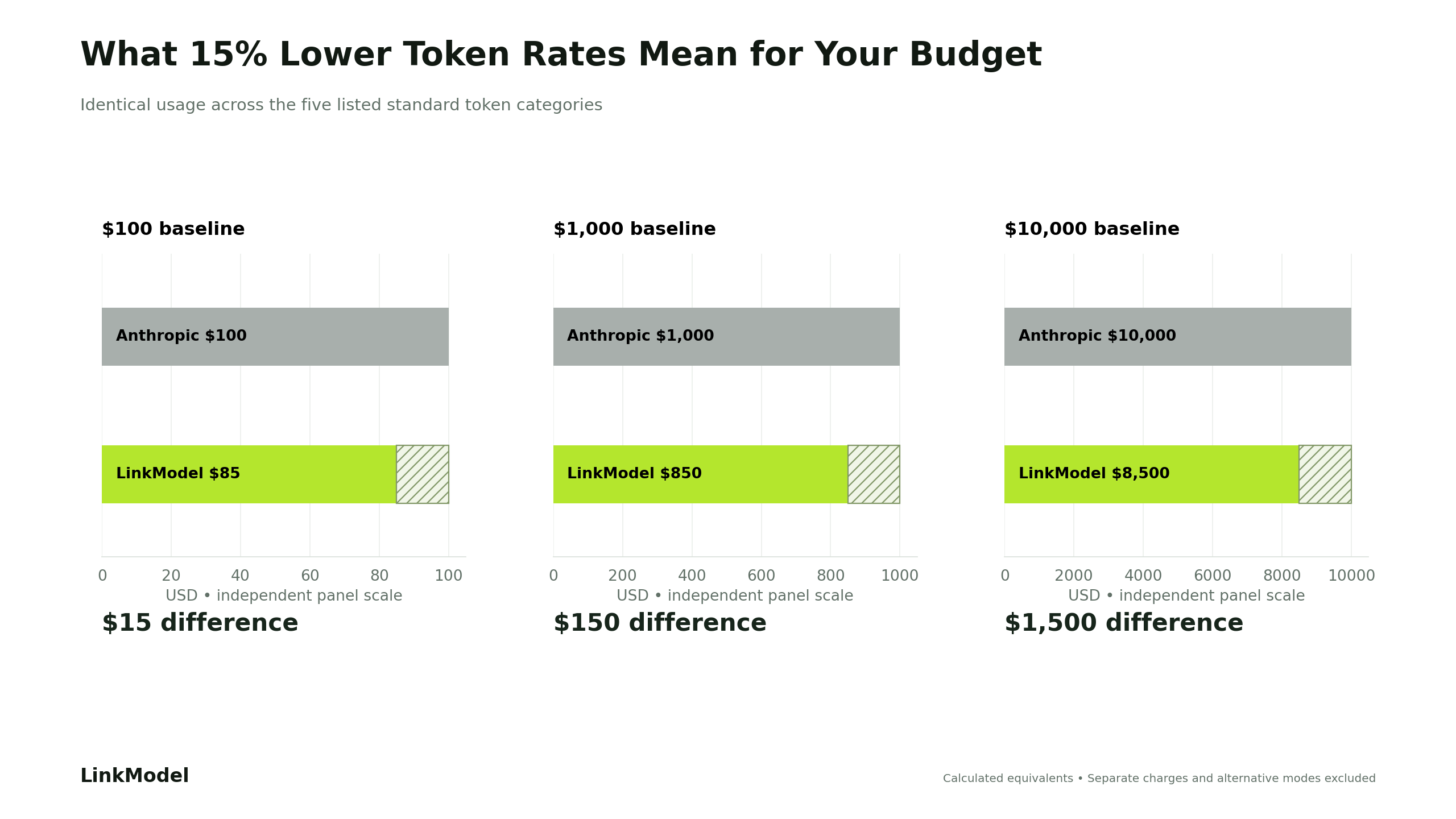
For matching usage across the five listed standard categories, the budget relationship is straightforward:
| Anthropic standard token spend | LinkModel equivalent | Difference |
|---|---|---|
| $100 | $85 | $15 |
| $1,000 | $850 | $150 |
| $10,000 | $8,500 | $1,500 |
These figures translate the rate difference into a budget decision. They assume identical billed token quantities and categories, excluding separate charges and alternative processing modes.
For a new project, selecting a lower standard rate can be simple. For an existing deployment, compare the expected saving with the work required to validate and maintain the new integration.
LinkModel adds a second reason to consider it: model evaluation and access can stay within the same platform. Its Playground is described as supporting side-by-side output comparison and request-code export, helping developers compare options before integrating.
A practical sequence is to select Sonnet 5.5, compare a relevant prompt, review the request configuration and then connect the intended application. The agent integration documentation provides the route for Claude Code and other supported coding workflows.
Anthropic Direct: First-Party Integration and Batch Processing
Anthropic direct is a natural option when access to the model developer’s API and documentation is the priority. It also deserves consideration wherever asynchronous batch processing fits the workload.
Consider an application handling immediate customer questions and overnight extraction jobs. Those queues have different timing requirements, so applying one standard rate to both can obscure a useful processing option.
Direct integration also keeps model-specific implementation work close to Anthropic’s own references. Its Sonnet 5.5 migration guide documents parameter changes and response-handling requirements for earlier Claude integrations.
Evaluate direct access for its integration fit, and batch pricing for the jobs that can use it.
OpenRouter: Provider Routing and Centralized Access
OpenRouter is worth considering when routing flexibility and centralized controls matter more than a lower Sonnet 5.5 token price. Its documentation describes provider failover, usage visibility and organizational budget controls.
These capabilities can be useful for teams already accessing multiple model vendors. The purchasing question is whether they reduce enough operational work to justify the applicable credit-purchase fees.
For Claude Code, OpenRouter’s integration guide says compatibility is only guaranteed with the Anthropic first-party provider and recommends prioritizing that upstream.
Evaluate the chosen route and required features together. A broader upstream selection does not establish identical behavior across every endpoint.
Amazon Bedrock: An Option for Existing AWS Deployments
Bedrock belongs on the shortlist when the surrounding application already runs on AWS. Anthropic lists Sonnet 5.5 through Bedrock under anthropic.claude-sonnet-5-5.
Before choosing it, verify account permissions, model availability, region and inference configuration. The official AWS pricing page is the appropriate starting point for the deployment being purchased.
AWS notes a Sonnet 5.5 cache-read price reduction effective October 7, 2026, illustrating why older pricing summaries can become stale.
A universal Bedrock price is not reproduced here because the accessible page did not expose a complete Sonnet 5.5 rate table. Use the current AWS price for your selected configuration rather than substituting an aggregator’s route price.
Sonnet 5.5 API Cost Examples: Token Mix and Cache Reuse
Estimate from billed token categories rather than session duration or prompt count alone. The examples below make their usage assumptions explicit so you can replace them with your own.
Standard Workload: 100K, 1M and 10M Tokens
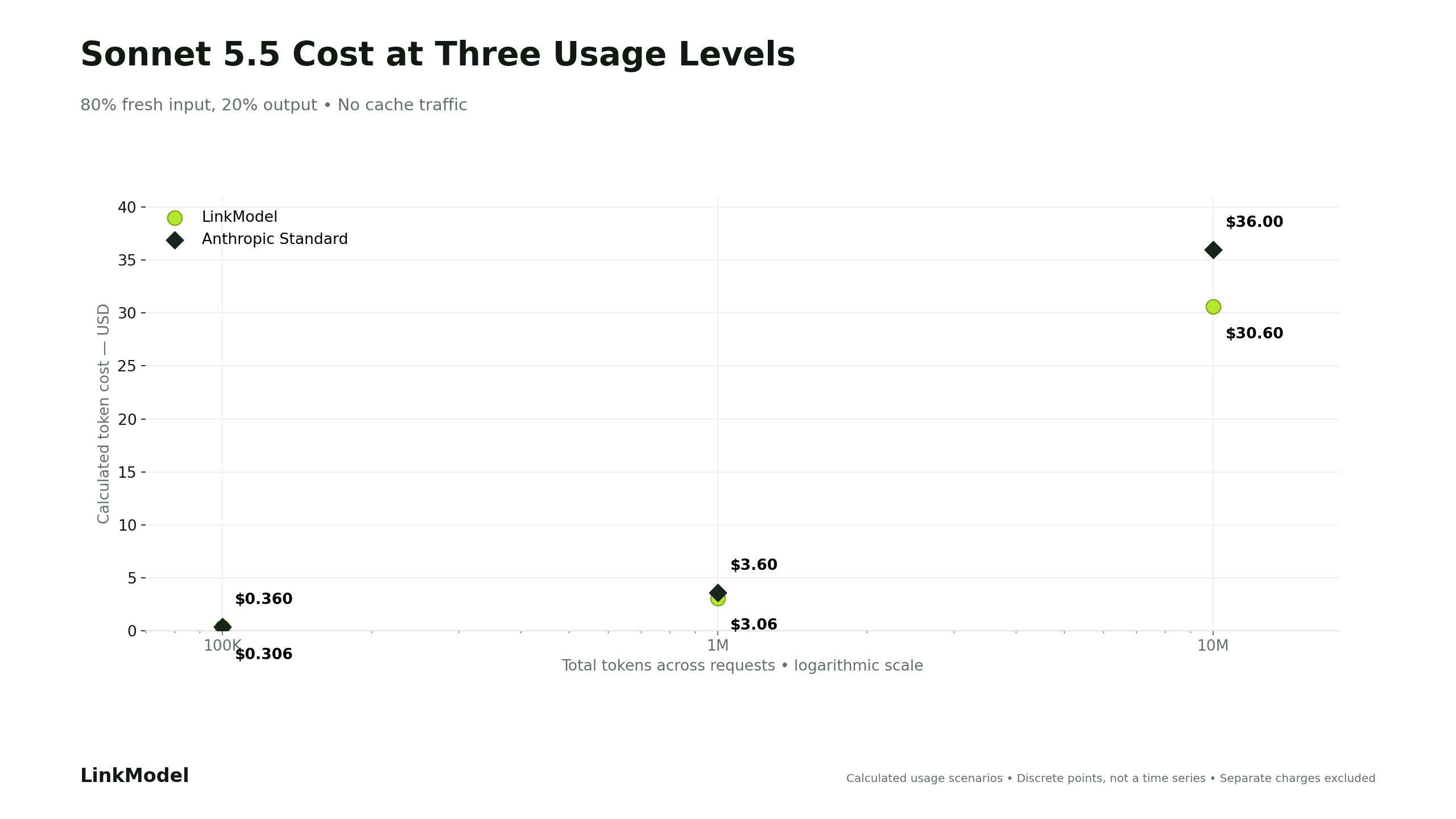
For 80% fresh input and 20% output, with no cache traffic:
| Total token volume | LinkModel standard | Anthropic standard |
|---|---|---|
| 100,000 tokens | $0.306 | $0.360 |
| 1 million tokens | $3.06 | $3.60 |
| 10 million tokens | $30.60 | $36.00 |
These quantities accumulate across requests. Each row does not represent a single prompt.
At one million total tokens, LinkModel’s calculation is 0.8 × $1.70 + 0.2 × $8.50 = $3.06. Anthropic’s corresponding calculation is 0.8 × $2.00 + 0.2 × $10.00 = $3.60.
Use your actual input/output ratio. A classifier producing short labels and a coding agent generating extensive patches can have very different output shares.
Worked Coding Example: Include Cache Writes and Reads
A coding workflow often reuses a repository prefix across multiple turns. Assume the following usage:
| Billed category | Token quantity |
|---|---|
| One-hour cache writes | 200,000 |
| Cache reads | 1,200,000 |
| Fresh input | 150,000 |
| Output | 100,000 |
Applying the published rate cards gives:
| Provider | Calculated token cost |
|---|---|
| LinkModel standard | $1.887 |
| Anthropic standard | $2.220 |
| OpenRouter model-token debit | $2.220 |
For LinkModel, the components are $0.680 for writes, $0.102 for reads, $0.255 for fresh input and $0.850 for output.
The useful lesson is that elapsed time does not determine an API bill. A short task can consume substantial usage through repeated context, generated output or extended tool loops.
For your own estimate, multiply each distinct billed category by its applicable rate. Avoid counting cache reads or cache writes again as fresh input.
Cache-Reuse Case: A 150K-Token Repository Prefix
Our research identified cache expiry as a concrete source of developer cost-management work. The public Stoke cache-proxy project addresses this issue by sending requests intended to preserve cached prefixes before expiration.
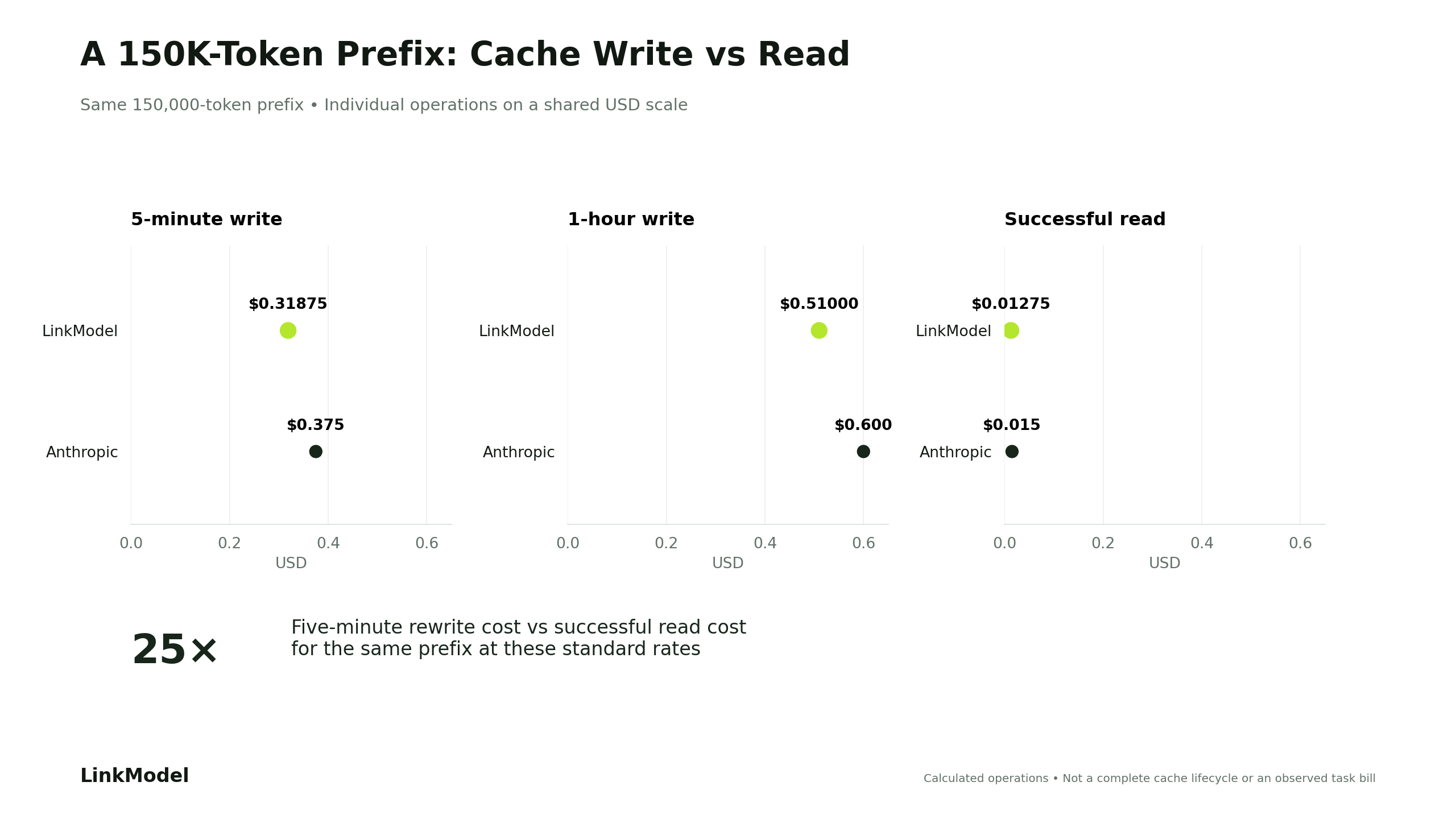
Applying current Sonnet 5.5 rates to a 150,000-token prefix shows why this workflow matters:
| Cache operation | LinkModel | Anthropic standard |
|---|---|---|
| Five-minute write | $0.31875 | $0.375 |
| One-hour write | $0.51000 | $0.600 |
| Successful cache read | $0.01275 | $0.015 |
At these rates, rewriting the prefix with a five-minute lifetime costs 25 times as much as successfully reading the same prefix.
This is why cache efficiency can outweigh a modest provider-price difference. Before adding keep-alive traffic, inspect actual reuse frequency, idle periods and prefix changes. Additional requests also consume resources.
For repository work, retrieve relevant functions, dependencies and error output before loading extensive unrelated files or logs. Preserve useful state across related tasks without carrying irrelevant context indefinitely.
Cache efficiency changes which usage is billed; a provider discount changes the price of that usage. Both belong in the cost decision.
Claude Sonnet 5.5 API Access: Model IDs and Connection Checklist
Use the identifier and connection instructions published for your selected provider. The same model has different route identifiers across these services.
| Provider | Model identifier |
|---|---|
| LinkModel | claude-sonnet-5-5 |
| Anthropic Claude API | claude-sonnet-5-5 |
| OpenRouter | anthropic/claude-sonnet-5.5 |
| Amazon Bedrock | anthropic.claude-sonnet-5-5 |
The LinkModel model page, Anthropic model reference and OpenRouter listing document these identifiers.
Credentials, permissions and feature settings must also match the selected route.
LinkModel Connection Checklist for Claude Code
LinkModel documents an Anthropic-compatible Messages route for Claude Code. Its shared API base URL is:
The agent integration guide recommends POST /messages for this workflow and advises selecting the endpoint closest to the agent’s native protocol.
Use this checklist before increasing usage:
1.Create a LinkModel API key and follow the current authentication documentation.
2. Configure the documented base URL for the Anthropic-compatible integration.
3. Select claude-sonnet-5-5 explicitly.
4. Run a focused task using the required tools, rather than checking only a text response.
5. Confirm the active model and recorded usage, including cache categories where relevant.
A small defect repair with a clear acceptance condition makes a useful starting task. Keep the repository state, prompt and settings consistent when comparing routes.
Sonnet 5.5 Migration: Check Parameters and Response Handling
Changing providers and upgrading models are separate operations. An application can reach the correct endpoint while sending parameters that Sonnet 5.5 does not accept.
Anthropic’s migration guide identifies changes involving forced tool selection, thinking configuration and response-block handling. It also explains that billed output includes thinking tokens, which matters when estimating coding costs.
Authentication settings deserve attention too. OpenRouter’s Claude Code instructions address conflicting credentials and gateway authentication.
After connecting, verify the provider and model receiving requests. Then exercise streaming, tools, conversation continuation and caching as required.
A successful basic response is the beginning of validation, not the whole integration check.
How to Evaluate a Sonnet 5.5 API Provider Before Production
Choose the route that completes your workload correctly at an acceptable cost and service level. Published prices establish the cost baseline; application behavior determines whether that route fits.
| Decision area | What to establish | Official starting point |
|---|---|---|
| Model and features | Model ID, limits and exposed options | LinkModel model page |
| Connection | Endpoint and integration requirements | LinkModel documentation |
| Usage and billing | Applicable model rates and usage categories | LinkModel billing guide |
| Capacity and support | Conditions available for the intended deployment | LinkModel official website |
| Data requirements | Current processing and retention terms | Privacy and Terms linked from the official website |
For other providers, use their own documentation, account controls and current contractual information. Do not infer an account’s numeric quota from a general marketing claim.
Our review of user questions repeatedly returned to unexpected bills, model selection and uncertainty about active configuration. A useful evaluation makes all three visible: what model ran, what it consumed and whether the result met the acceptance criteria.
Match the Model to the Task, Then Compare Routes
First establish that Sonnet 5.5 can perform the intended task adequately. Then compare providers for that same model and configuration.
For coding, acceptance might mean the requested behavior works, relevant checks pass and the patch is ready for review. For extraction, it might mean required fields are correct and complete.
A cheaper token rate can lose its advantage if the workflow needs more correction turns. Conversely, paying for capabilities a task does not need can increase spend unnecessarily.
Compare the cost of an accepted result alongside token prices.
Use Representative Workloads Before Increasing Traffic
Include the operations your application relies on: longer conversations, tool results, cache reuse, image inputs or substantial responses.
A customer-facing assistant may prioritize response timing. An offline queue may prioritize processing cost. A coding agent may depend on tool compatibility and context reuse.
Record consistent prompts, settings, billed usage and acceptance results. Use the official query and support channels to establish any account-specific conditions before scaling.
Increase traffic when the integration works as required and the recorded costs fit the application’s budget.
Frequently Asked Questions
Which Claude Sonnet 5.5 API Provider Is Cheapest?
LinkModel has the lowest published standard input and output rates among the directly priced on-demand options compared here: $1.70 and $8.50 per million tokens. Anthropic Batch offers lower input and output rates for eligible asynchronous jobs. Compare matching processing modes before choosing.
Can I Use Sonnet 5.5 in Claude Code Through LinkModel?
LinkModel documents a Claude Code integration using its Anthropic-compatible Messages route. Follow the current integration instructions, select Sonnet 5.5 explicitly and verify the tools, streaming and cache behavior your workflow needs.
Why Can Claude Code API Spending Increase Quickly?
Repeated context, generated output, thinking and extended tool loops accumulate usage. Cache writes and misses also affect costs. Check the selected model and separate fresh input, cache operations and billed output before attributing a high bill solely to the provider’s rate.
Is OpenRouter Cheaper Than Anthropic for Sonnet 5.5?
Their listed standard input and output model-token prices are the same. OpenRouter additionally charges fees on credit purchases. Its routing and management capabilities should be evaluated alongside those funding costs.
Can I Switch Sonnet 5.5 Providers Without Rewriting My Application?
An Anthropic-compatible integration can reduce migration work, but configuration and feature checks remain necessary. Confirm credentials, endpoint, model identifier and required features. If you are upgrading from an older Claude model at the same time, address the migration changes separately.
Conclusion
LinkModel is our price-first recommendation for standard, interactive Claude Sonnet 5.5 API access, with lower published token rates, flexible usage-based billing and a documented Claude Code integration path. Anthropic direct deserves consideration for first-party access and batch processing, OpenRouter for routing flexibility, and Amazon Bedrock for AWS-based applications. Match the provider to your token mix and deployment requirements, then visit the LinkModel Sonnet 5.5 model page to review the rates and start evaluating a focused workload.