GPT-6.1 Sol API pricing on OpenAI Standard is $2 per million input tokens, $10 per million output tokens, $0.10 per million cached-input tokens, and $2.50 per million cache-write tokens for prompts up to 272K input tokens. Your actual cost depends on the input categories, billable output, processing mode, and number of requests needed to complete the task.
The headline rates can hide a substantial budgeting difference. Crossing 272K input tokens reprices the entire request, and reasoning tokens count toward paid output. In the calculation below, increasing input from 270K to 280K raises the Standard bill from $0.64 to $1.27, with output unchanged.
LinkModel lists GPT-6.1 Sol at $1.50 input and $7.50 output per million short-context tokens—25% below OpenAI Standard. Its published cache and long-context rates carry the same discount. For matching token usage, a $400 Standard token workload costs $300 on LinkModel, making it a practical option for teams looking to reduce API spending.
GPT-6.1 Sol API Pricing: OpenAI vs. LinkModel
LinkModel’s published GPT-6.1 Sol token rates are 25% below OpenAI Standard across ordinary input, cache reads, cache writes, and output in both context tiers.
The LinkModel chat pricing documentation publishes the eight rates below. OpenAI’s rates are listed in its official pricing documentation. All figures are USD per one million tokens, checked on October 12, 2026.
| Up to 272K input tokens | OpenAI Standard | LinkModel |
|---|---|---|
| Ordinary input | $2.00 | $1.50 |
| Cached input | $0.10 | $0.075 |
| Cache writes | $2.50 | $1.875 |
| Output | $10.00 | $7.50 |
| Above 272K input tokens | OpenAI Standard | LinkModel |
|---|---|---|
| Ordinary input | $4.00 | $3.00 |
| Cached input | $0.20 | $0.15 |
| Cache writes | $5.00 | $3.75 |
| Output | $15.00 | $11.25 |
What the 25% Discount Means for Your Budget
For the same token categories and counts, LinkModel’s listed rates produce a token bill equal to 75% of OpenAI Standard.
That is a rate comparison, rather than a promise about total operating costs. Additional tools, repeated requests, and review requirements can change the cost of completing a task.
The useful comparison is therefore twofold: what each token costs, and how many tokens your workflow needs to produce an accepted result.
How to Calculate GPT-6.1 Sol API Costs
Calculate ordinary input, cache reads, cache writes, and billable output separately, using the applicable context tier.
Request token cost equals:
(Ordinary input × input rate + cache reads × cached-input rate + cache writes × cache-write rate + billable output × output rate) ÷ 1,000,000.
In the OpenAI caching documentation, ordinary input is total input minus cache-read and cache-write tokens. Do not charge cache-written tokens again as ordinary input.
Example: 10K Input and 2K Output Tokens
Assume a short-context request with no caching or tools.
| Cost component | OpenAI Standard | LinkModel |
|---|---|---|
| 10,000 ordinary input tokens | $0.020 | $0.015 |
| 2,000 billable output tokens | $0.020 | $0.015 |
| Total per request | $0.040 | $0.030 |
| 10,000 identical requests | $400 | $300 |
These are calculated estimates, not recorded invoices.
Input and output contribute equally here, even though input volume is five times larger. For code generation and report writing, an input-only price comparison can underestimate the importance of output costs.
Example: A Cache-Heavy Request
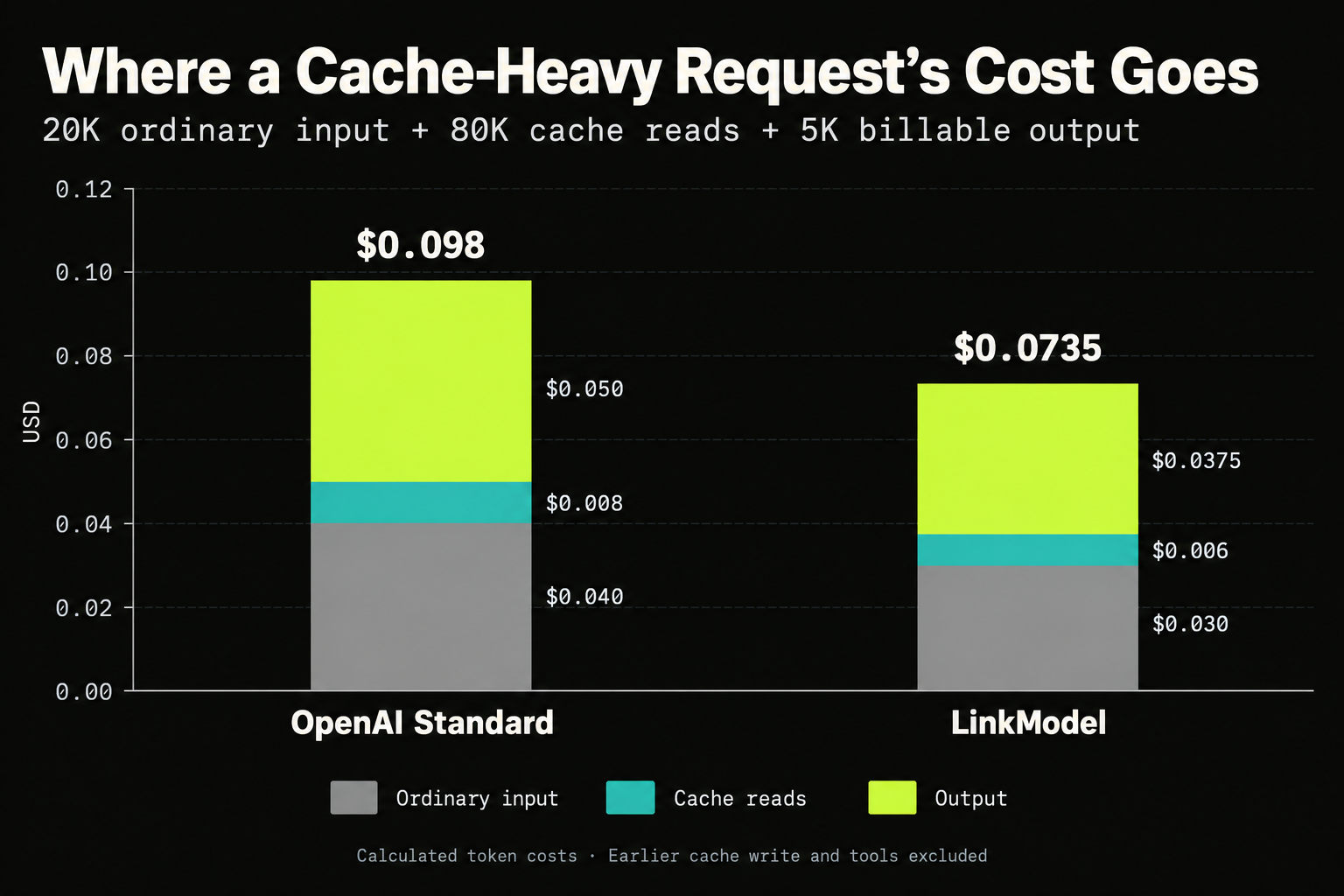
Consider 100,000 total input tokens comprising 20,000 ordinary input and 80,000 cache reads, followed by 5,000 billable output tokens.
| Cost component | OpenAI Standard | LinkModel |
|---|---|---|
| Ordinary input | $0.040 | $0.030 |
| Cache reads | $0.008 | $0.006 |
| Output | $0.050 | $0.0375 |
| Total | $0.098 | $0.0735 |
Without cache reads, those input and output counts would cost $0.25 and $0.1875 respectively. The calculated reduction is 60.8%, excluding the earlier cache write.
A realistic monthly forecast should include the initial writes, successful reads, and requests that miss the cache.
GPT-6.1 Sol Long-Context Pricing: Why Your Bill Can Nearly Double
Prompts exceeding 272,000 input tokens trigger higher rates for the entire request, including output.
The GPT-6.1 Sol model documentation specifies double input and cache rates and a 50% output-rate increase. Count the full prompt, including cached portions, when determining the context tier.
Case: 3.7% More Input, Approximately 98.4% More Cost
Compare two requests with 10,000 billable output tokens and no caching.
| Input length | OpenAI Standard | LinkModel |
|---|---|---|
| 270,000 tokens | $0.6400 | $0.4800 |
| 280,000 tokens | $1.2700 | $0.9525 |
The input grows by approximately 3.7%, but the calculated bill rises by approximately 98.4%.
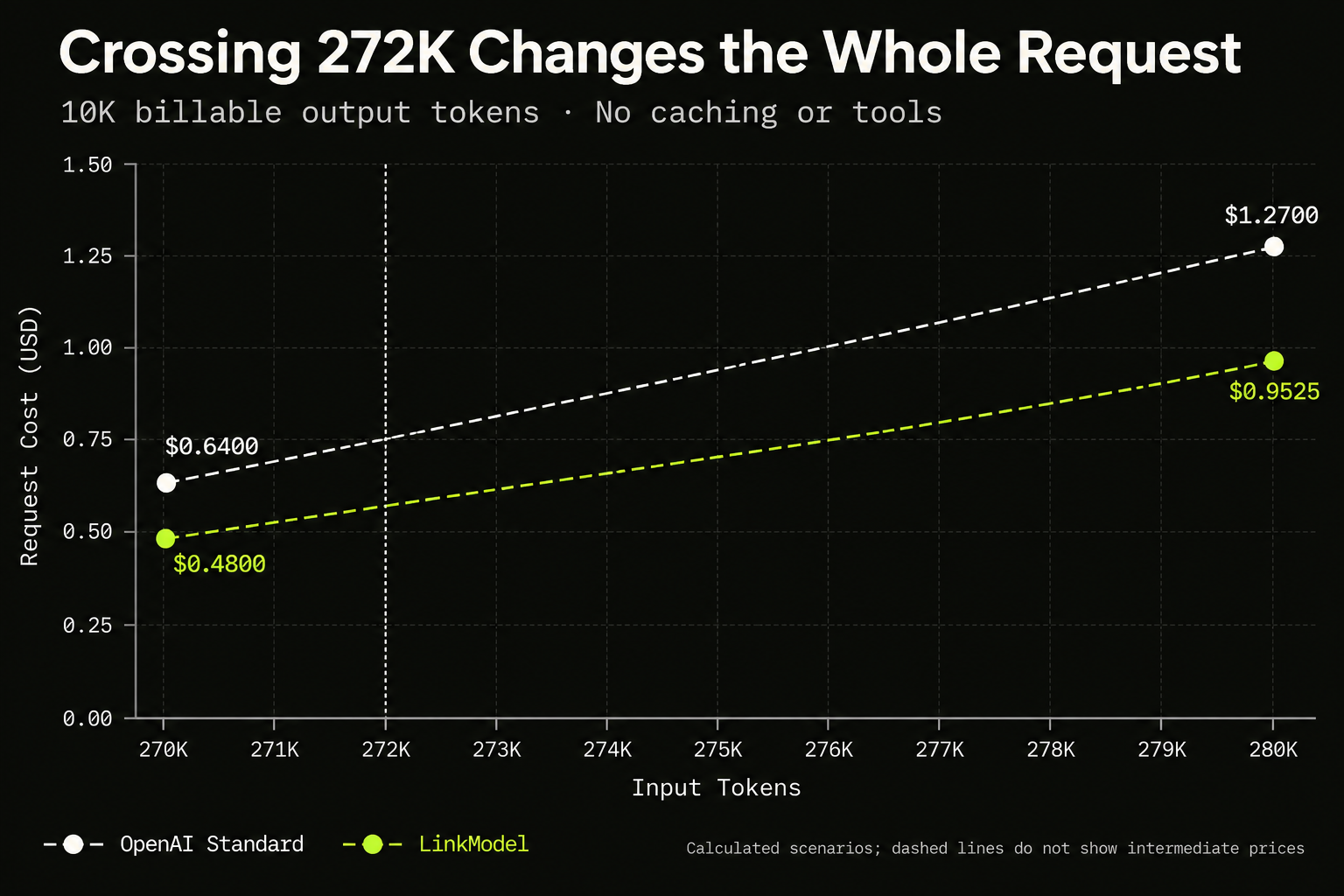
The higher price is not limited to the extra 8,000 tokens above the threshold. The request has moved into a different pricing tier.
For repository or document analysis, remove duplicated files, repetitive logs, and irrelevant sections before sending the prompt. When approaching the threshold, the important question is whether the extra material improves the answer enough to justify repricing the request.
GPT-6.1 Sol Cache Pricing: When Does Caching Pay Off?
Caching pays off when an eligible prefix is successfully reused often enough to offset its higher initial write price.
OpenAI’s prompt-caching guide describes matching prefixes and cache boundaries. Similar prompts do not automatically guarantee a cache hit.
Example: One Successful Reuse Covers the Write Premium
For a 100,000-token prefix in the short-context tier:
| Prefix usage | OpenAI Standard | LinkModel |
|---|---|---|
| Ordinary input, used once | $0.2000 | $0.1500 |
| Cache write, never reused | $0.2500 | $0.1875 |
| Ordinary input, used twice | $0.4000 | $0.3000 |
| One write plus one read | $0.2600 | $0.1950 |
In this calculation, one successful reuse is enough to recover the write premium. Writing a prefix that is never reused costs 25% more than sending it as ordinary input.
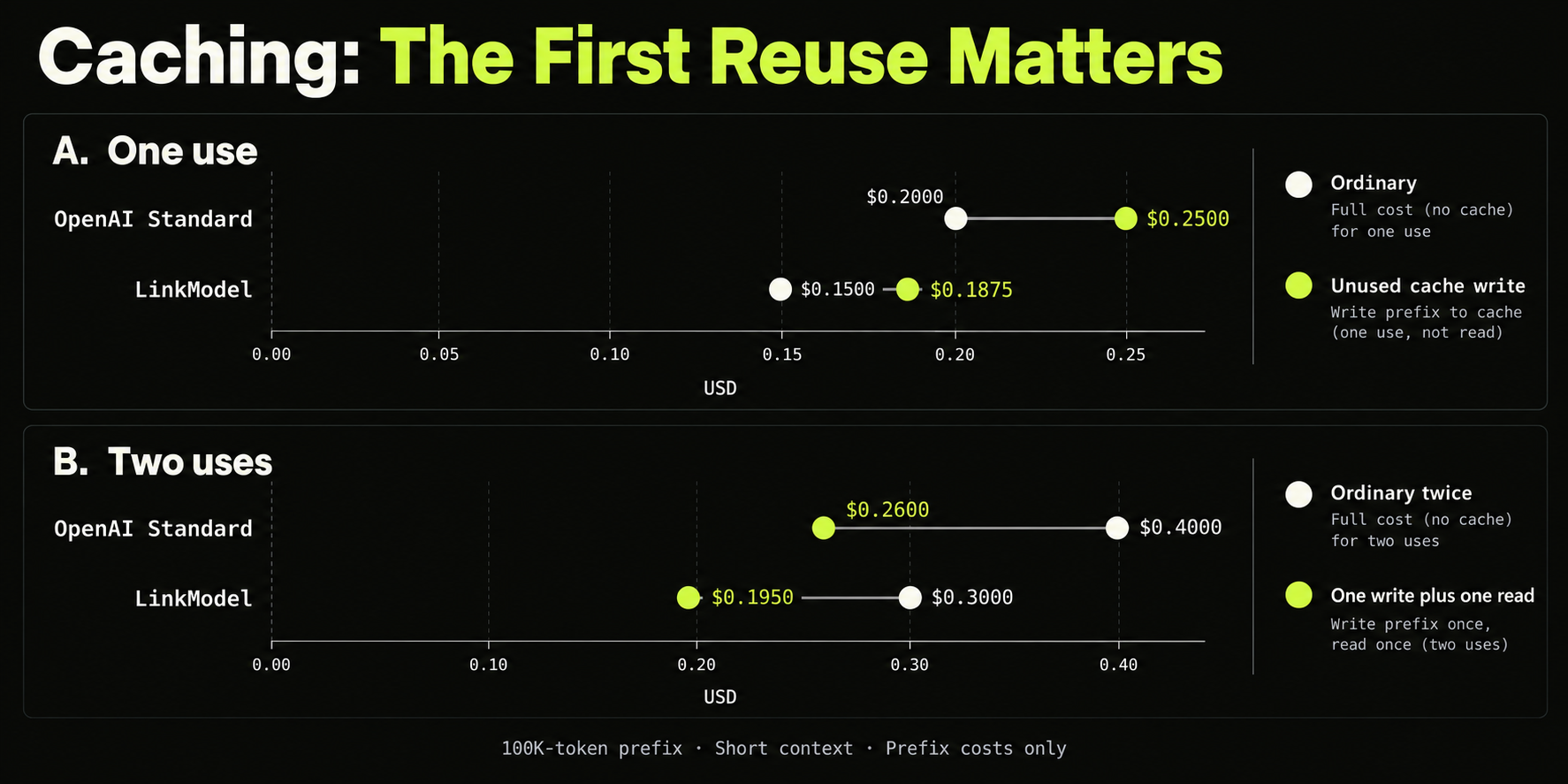
The comparison isolates prefix charges. Other input and output remain billable.
Example: One Write and Ten Reads
A 100K-token prefix written once and read ten times costs:
| Prefix cost | OpenAI Standard | LinkModel |
|---|---|---|
| Initial write | $0.2500 | $0.1875 |
| Ten reads | $0.1000 | $0.0750 |
| Total | $0.3500 | $0.2625 |
Sending that prefix as ordinary input eleven times costs $2.20 and $1.65 respectively.
Put stable instructions and shared reference material before changing content. Check that the selected endpoint accepts the caching controls your application uses, and record actual reads and writes. Published cache rates describe billing categories; they do not guarantee a particular cache-hit rate.
GPT-6.1 Sol Batch, Flex, Fast, and Ultrafast Prices
OpenAI Batch and Flex cost half Standard, Fast costs twice Standard, and Ultrafast costs six times Standard. These processing choices change the price independently of provider selection.
| OpenAI mode | Short-context input / 1M | Short-context output / 1M |
|---|---|---|
| Standard | $2.00 | $10.00 |
| Batch | $1.00 | $5.00 |
| Flex | $1.00 | $5.00 |
| Fast | $4.00 | $20.00 |
| Ultrafast | $12.00 | $60.00 |
The OpenAI model documentation lists these mode multipliers.
Batch and Flex: Lower Prices With Different Conditions
The Batch guide describes asynchronous processing with a 24-hour completion window. It suits evaluations and other jobs that do not require an immediate response.
The Flex guide describes slower processing and occasional resource unavailability. Falling back to Standard changes the cost of the fallback request.
For the earlier 10K-input, 2K-output example, Batch or Flex rates produce $0.02 per request, compared with $0.04 on Standard.
OpenAI Batch and Flex have lower listed input and output prices than LinkModel’s $1.50/$7.50 rates. LinkModel’s 25% discount is specifically against OpenAI Standard.
Fast and Ultrafast: Calculate the Premium Before Choosing
The same example costs $0.08 on Fast and $0.24 on Ultrafast.
Choose the premium when faster processing has sufficient value for the application. An interactive assistant and an overnight classification job may justify different modes even with identical token counts.
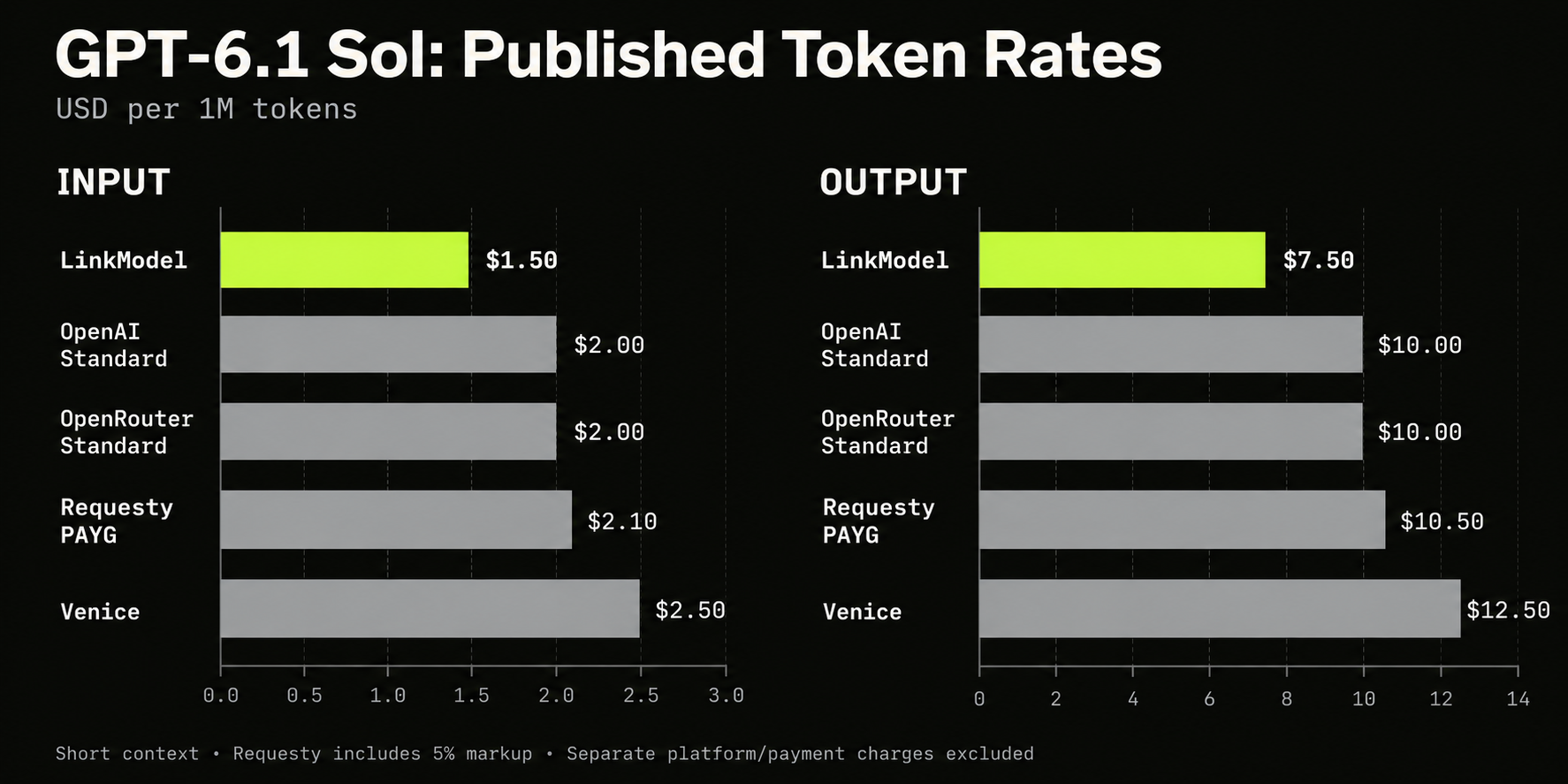
GPT-6.1 Sol API Provider Comparison: Rates and Markups
Compare the final token rate for the selected route, then consider any separately applicable platform or payment charges.
| Provider or route | Input per 1M | Output per 1M |
|---|---|---|
| LinkModel | $1.50 | $7.50 |
| OpenAI Standard | $2.00 | $10.00 |
| OpenRouter OpenAI Standard route | $2.00 | $10.00 |
| Requesty pay-as-you-go | $2.10 | $10.50 |
| Venice | $2.50 | $12.50 |
These are short-context token prices. The OpenRouter catalog lists its Standard route at $2/$10. The Requesty listing states that pay-as-you-go adds 5% to upstream rates; that markup is included above. The Venice model page lists $2.50/$12.50.
Why Route Selection Matters
Requesty’s bring-your-own-key option adds no Requesty markup, but upstream usage still costs money. OpenRouter lists multiple processing routes with different prices.
Match model, context tier, processing mode, and token categories before comparing. The table does not include every possible funding or payment charge, and it does not establish the cheapest provider across all workloads.
Is LinkModel a Good Fit for Your GPT-6.1 Sol Workload?
LinkModel is worth evaluating when lower published token rates match your requirements and its endpoint supports the requests your application needs.
Price is a clear advantage. Integration and billing compatibility determine whether that advantage is usable.
Supported Endpoints, Caching, and Tools
LinkModel publishes an OpenAI-compatible Chat Completions endpoint for compatible clients and a separate Responses endpoint for GPT-series workflows.
Its documentation states that optional features can vary by model and provider. Protocol compatibility alone does not establish complete feature parity.
For GPT-6.1 Sol, OpenAI documents tool calling through Responses rather than Chat Completions. Before migrating an agent, validate the selected LinkModel route’s tool calls, structured output, reasoning settings, and cache behavior using representative requests.
Begin with the request your application actually needs, rather than assuming a successful text response proves every advanced feature.
GPT-6.1 Sol Coding Costs: A Three-Task Research Case
A public coding experiment reviewed in our research compared Sol alone with Sol planning and local Qwen 3.8 27B coding.
| Task | Sol alone | Sol + local Qwen |
|---|---|---|
| Pool | $0.39; 2.9 min | $0.05; 18.6 min |
| Bowling | $0.14; 1.7 min | $0.06; 13.7 min |
| Foosball | $0.22; 2.0 min | $0.06; 11.1 min |
| Total | $0.75; 6.6 min | $0.17; 43.4 min |
Local inference used an RTX 3090 with 24 GB memory; hardware and electricity were excluded.
Lower API Spending Can Mean Longer Completion Time
The hybrid workflow recorded 77.3% lower API spend but 6.6 times the elapsed time. Each task was run once per setup, and equivalent code quality was not established.
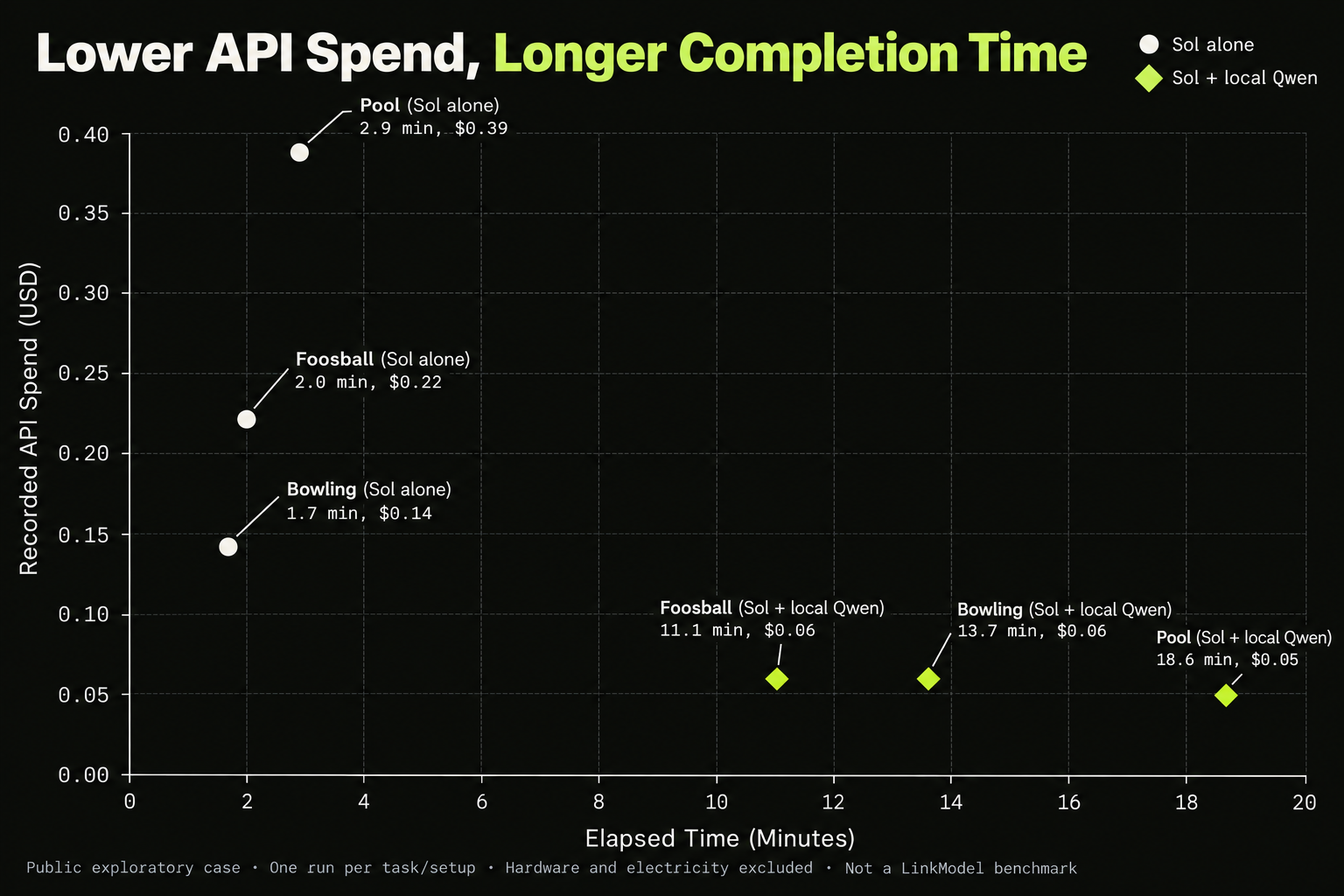
This illustrates an architecture trade-off, not LinkModel performance. The 77% workflow saving and LinkModel’s 25% rate discount cannot simply be added together. Our takeaway is to compare expense, time, and accepted results.
GPT-6.1 Sol Hidden Costs: Reasoning, Tools, and Retries
Billable output, additional tools, and repeated requests can increase your bill even when the headline input rate remains unchanged.
Reasoning Tokens Are Paid Output
The OpenAI reasoning guide explains that reasoning tokens are billed as output even when absent from the visible answer.
A response containing 2,000 visible tokens and 8,000 reasoning tokens has 10,000 billable output tokens. At short-context Standard rates, that output costs $0.10 rather than $0.02.
Use total billable output and avoid adding reasoning tokens a second time when they are already included.
Tools and Regional Processing Add Charges
The OpenAI pricing table lists web search at $10 per 1,000 calls, plus search-content tokens. File search costs $2.50 per 1,000 calls, with storage at $0.10 per GB per day after the first free GB. Applicable regional processing carries a 10% uplift.
One hundred web searches add $1 in call charges before retrieved content and generation. These are OpenAI charges, not verified LinkModel tool prices.
Retries Change Cost per Accepted Task
An agent can make several billable requests before reaching an acceptable result. Revisions, additional context, and tool results increase consumption.
Cost per accepted task = total workflow expense ÷ number of results meeting the acceptance criteria.
Track unsuccessful attempts as well as successful requests. This measure reveals whether a lower rate is producing useful savings.
GPT-6.1 Sol vs. GPT-6 Sol and Astra Pricing
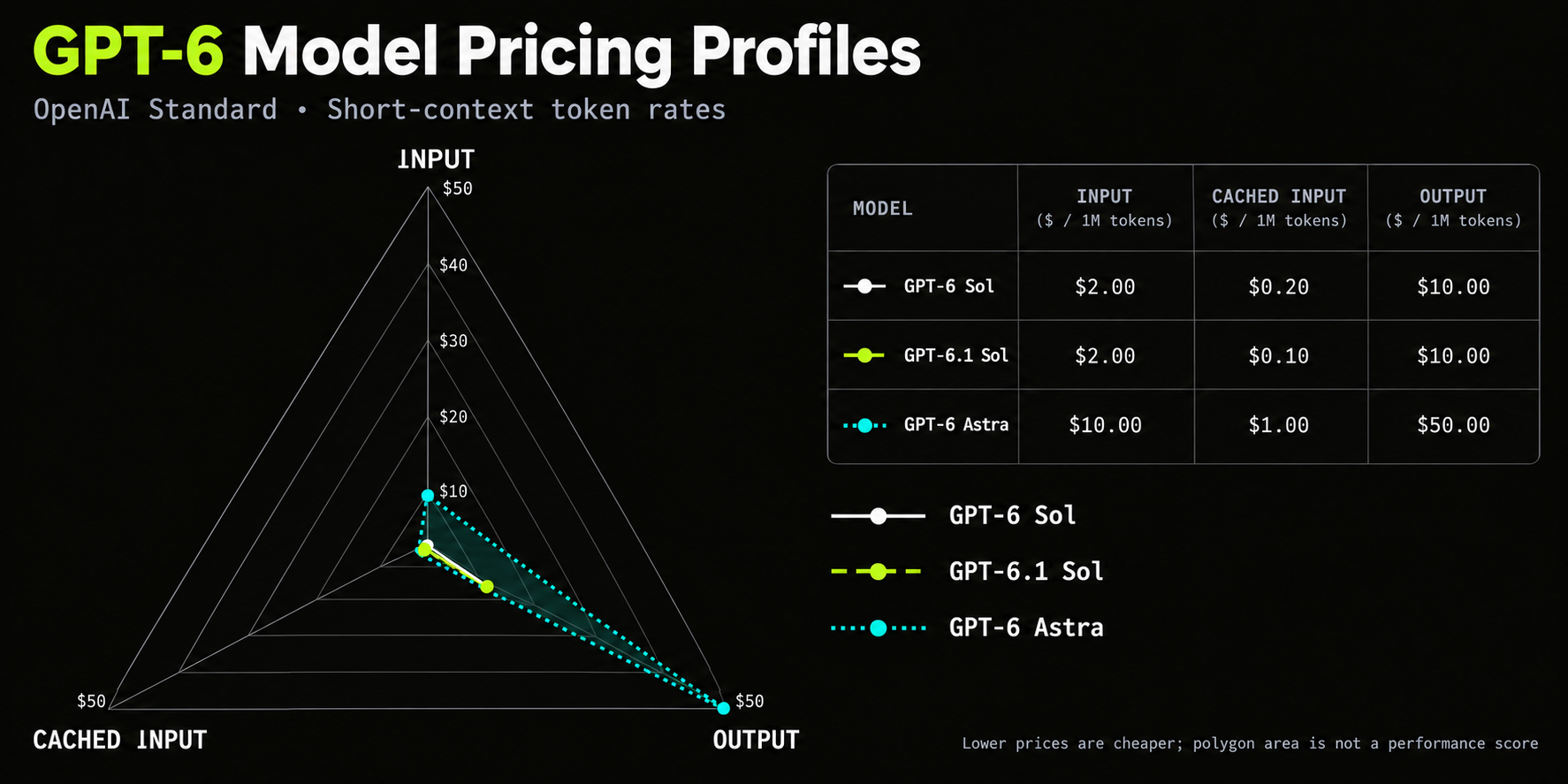
The official model comparison shows that GPT-6.1 Sol retains GPT-6 Sol’s ordinary input and output rates while halving cached-input pricing.
| Model | Input / Cached input per 1M | Output per 1M |
|---|---|---|
| GPT-6 Sol | $2.00 / $0.20 | $10.00 |
| GPT-6.1 Sol | $2.00 / $0.10 | $10.00 |
| GPT-6 Astra | $10.00 / $1.00 | $50.00 |
Savings Depend on Your Token Mix
One million cache-read tokens cost $0.10 less on GPT-6.1 Sol than GPT-6 Sol. Ordinary input and output retain the same rates.
Sol’s ordinary input and output rates are 80% below Astra. A short-context request with 100K ordinary input and 10K output costs $0.30 on Sol Standard versus $1.50 on Astra Standard.
Those prices justify evaluating Sol. They do not establish an 80% reduction in cost per accepted result.
Frequently Asked Questions
Is LinkModel 25% Cheaper Than OpenAI for GPT-6.1 Sol?
LinkModel’s published token rates are 25% below OpenAI Standard across input, cache reads, cache writes, and output in both context tiers. OpenAI Batch and Flex list lower input and output prices, with different processing conditions.
Why Did My GPT-6.1 Sol Bill Increase Despite a Short Answer?
Check the input tier, cache writes, total billable output, processing mode, tools, and repeated requests. A short visible answer can still include paid reasoning tokens, and crossing 272K changes the request’s rates.
How Many Cache Reuses Make the Write Cost Worthwhile?
In the short-context prefix calculation, one successful read after the initial write covers the write premium. Cache invalidation, repeated writes, other input, and output change the full calculation.
Does a Codex Subscription Include Redeemable API Credits?
Subscription usage measurements should not be treated as API credits. Estimate API spending from billable token categories and tools rather than assigning a subscription allowance an “API-equivalent” purchasing value.
What Is the Cheapest Practical Way to Use GPT-6.1 Sol?
Match the method to the job. Batch or Flex can reduce eligible OpenAI costs; caching lowers repeated-input expense; LinkModel offers lower published rates than Standard. Choose by supported features and cost per accepted result, rather than token price alone.
Conclusion: Make GPT-6.1 Sol Savings Measurable
GPT-6.1 Sol costs become predictable when you separate input categories and billable output, account for the 272K threshold, and choose a processing mode suited to the workload. Caching can reduce repeated-context expense, while extra reasoning, tools, and retries can increase the final bill. LinkModel’s published 25% discount against OpenAI Standard provides a concrete token-price advantage, supported by its official rate table. Get an API key and start with a representative request, compare calculated cost with actual usage and billing, and verify the features your application needs before scaling. That turns a lower advertised rate into a measurable business decision.