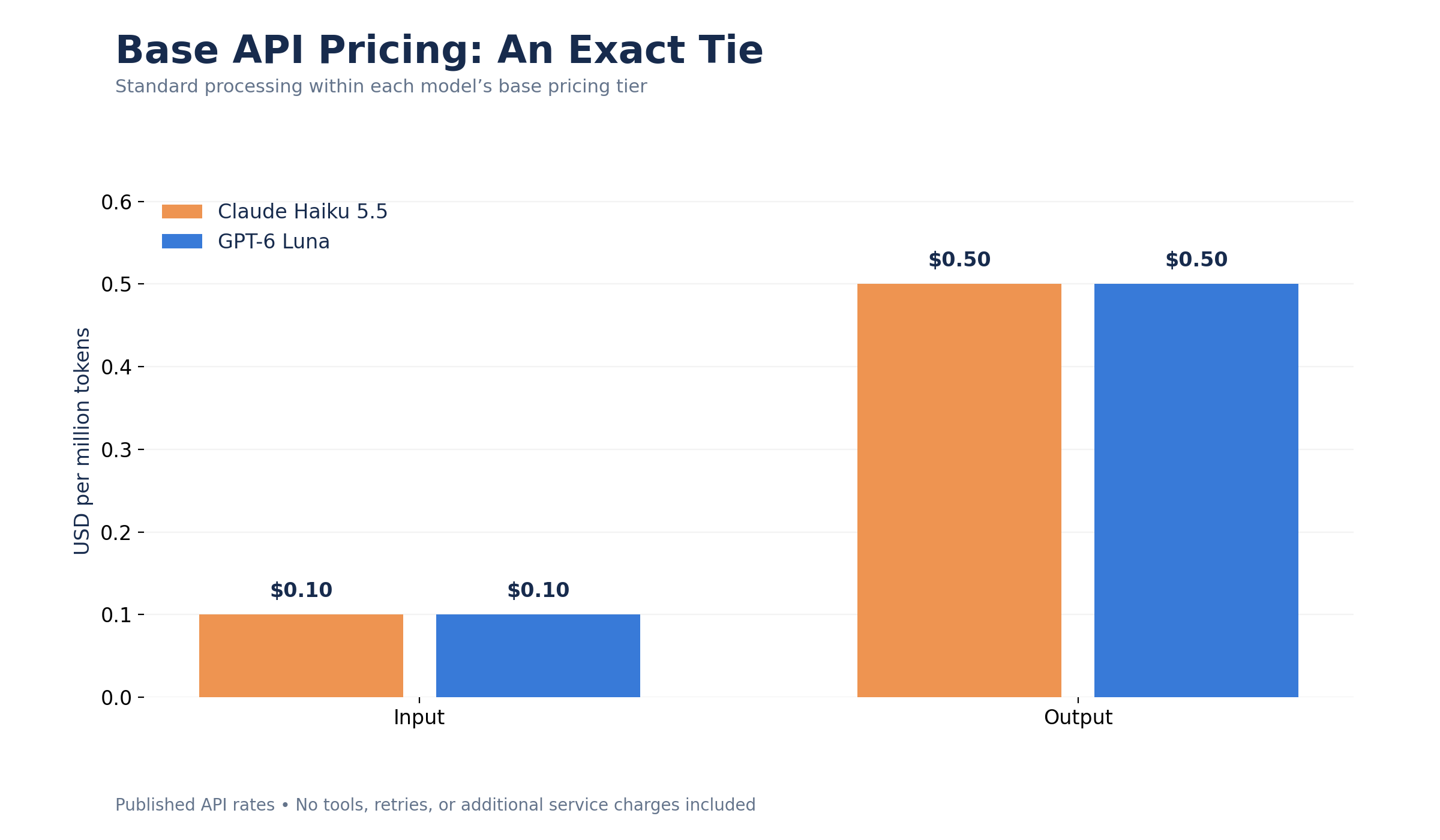
Claude Haiku 5.5 and GPT-6 Luna share base API prices of $0.10 per million input tokens and $0.50 per million output tokens. Haiku leads in Anthropic’s published benchmark comparison; Luna finishes faster in a separate client test and retains base pricing for longer inputs, as detailed in our GPT-6 Luna API pricing guide. The better choice depends on your workload.
Longer prompts, excessive output, and failed attempts can erase apparent savings. A high benchmark score or fast first response does not establish the lowest operating cost. When evaluating ways to reduce AI API costs, compare how much each model costs to deliver an acceptable result.
Keep your spending tied to usage with LinkModel’s pay-as-you-go pricing—no minimum spend and no monthly platform fee. Transparent model prices and volume discounts shown before requests make budgeting easier. Explore the available models and start with a small workload before scaling your spending.
Updated October 8, 2026. This article reviews official documentation, published evaluations, and public user questions.

Claude Haiku 5.5 vs GPT-6 Luna: Which Model Should You Choose?
Test Haiku when its reported benchmark strengths resemble your tasks. Test Luna when longer-input pricing or interactive turnaround matters most. For short requests, their matching base prices make output quality and actual usage especially important.
Use these starting points:
- Short extraction and classification: compare both on valid, accepted outputs.
- Long document inputs: evaluate Luna’s higher base-price threshold.
- Computer use, coding, and visual reasoning: include Haiku based on the cited benchmark results.
- Interactive applications: test Luna’s turnaround through your actual integration.
- Multi-step agents: measure the complete workflow, including tools and escalation.
These are pilot priorities, not unconditional winner declarations. When deciding how to choose an LLM, remember that a model that performs well on broad evaluations can still struggle with your schema, domain terminology, or source material.
Claude Haiku 5.5 vs GPT-6 Luna Pricing
Base rates match, but long-context thresholds differ substantially. Budget using the complete request and each model’s own token count.
Standard Input and Output Prices
All prices are USD per million tokens.
Claude Haiku 5.5
- Prompts up to 100,000 tokens: $0.10 input and $0.50 output.
- Prompts over 100,000 tokens: $0.50 input and $2.50 output.
GPT-6 Luna
- Prompts up to 272,000 input tokens: $0.10 input and $0.50 output.
- Prompts over 272,000 input tokens: $0.20 input and $0.75 output.
OpenAI specifies that Luna’s higher rates apply to the full request above its threshold. The thresholds describe pricing, rather than maximum context capacity.
The 100K–272K range deserves particular attention: Haiku has entered its higher tier while Luna remains at base rates. For a dedicated breakdown of Luna’s rates, see our GPT-6 Luna API pricing guide.
Short-Request Cost Example
Assume a request uses 10,000 uncached input tokens and 2,000 billable output tokens, with standard processing and no other charges.
For either model:
- Input costs $0.001.
- Output costs $0.001.
- Total token charges equal $0.002 per request.
- One thousand equivalent requests cost $2.
This is a calculated estimate, not an observed invoice.
For short requests, a provider decision based only on these rates produces no pricing advantage. Compare whether the models generate equally useful answers with similar usage.
Long-Context Cost Example
Assume the same workload measures 150,000 uncached input tokens and 5,000 billable output tokens on each model.
Haiku’s calculated charge
- Input: $0.075.
- Output: $0.0125.
- Total: $0.0875.
Luna’s calculated charge
- Input: $0.015.
- Output: $0.0025.
- Total: $0.0175.
Luna costs 80% less in this illustrative calculation. The difference comes from pricing tiers, rather than base prices.
The example assumes equal token counts and excludes caching, tools, and other charges. Actual documents must be counted separately for each model.
For long transcripts or document collections, also consider whether retrieval can supply only the relevant passages. As you review ways to reduce AI API costs, check whether every additional passage contributes to an accepted result.
Cache and Batch Pricing
At their base tiers, both models list $0.01 per million cache-read tokens and $0.125 per million cache-write tokens.
For Haiku, the $0.125 write rate applies to five-minute caching. One-hour writes cost $0.20. Above its prompt threshold, reads cost $0.05, five-minute writes $0.625, and one-hour writes $1.
Luna’s listed write rate should not be interpreted as evidence that its cache duration or mechanics match Haiku’s.
Both providers publish a 50% Batch discount relative to applicable standard rates. Anthropic documents that caching multipliers can stack with Batch pricing.
Choose the processing method around the workflow: prompt caching for eligible repeated context, Batch for asynchronous jobs, and immediate requests for live interactions.
Claude Haiku 5.5 vs GPT-6 Luna Benchmarks
Haiku leads in the cited vendor comparison, but the meaning of that lead depends on the task and evaluation conditions.
Anthropic’s Published Results
The launch comparison reports:
- GDPval-AA v2.1: Haiku 1620; Luna 1437.
- AA-Briefcase v1.1: Haiku 1578; Luna 1336.
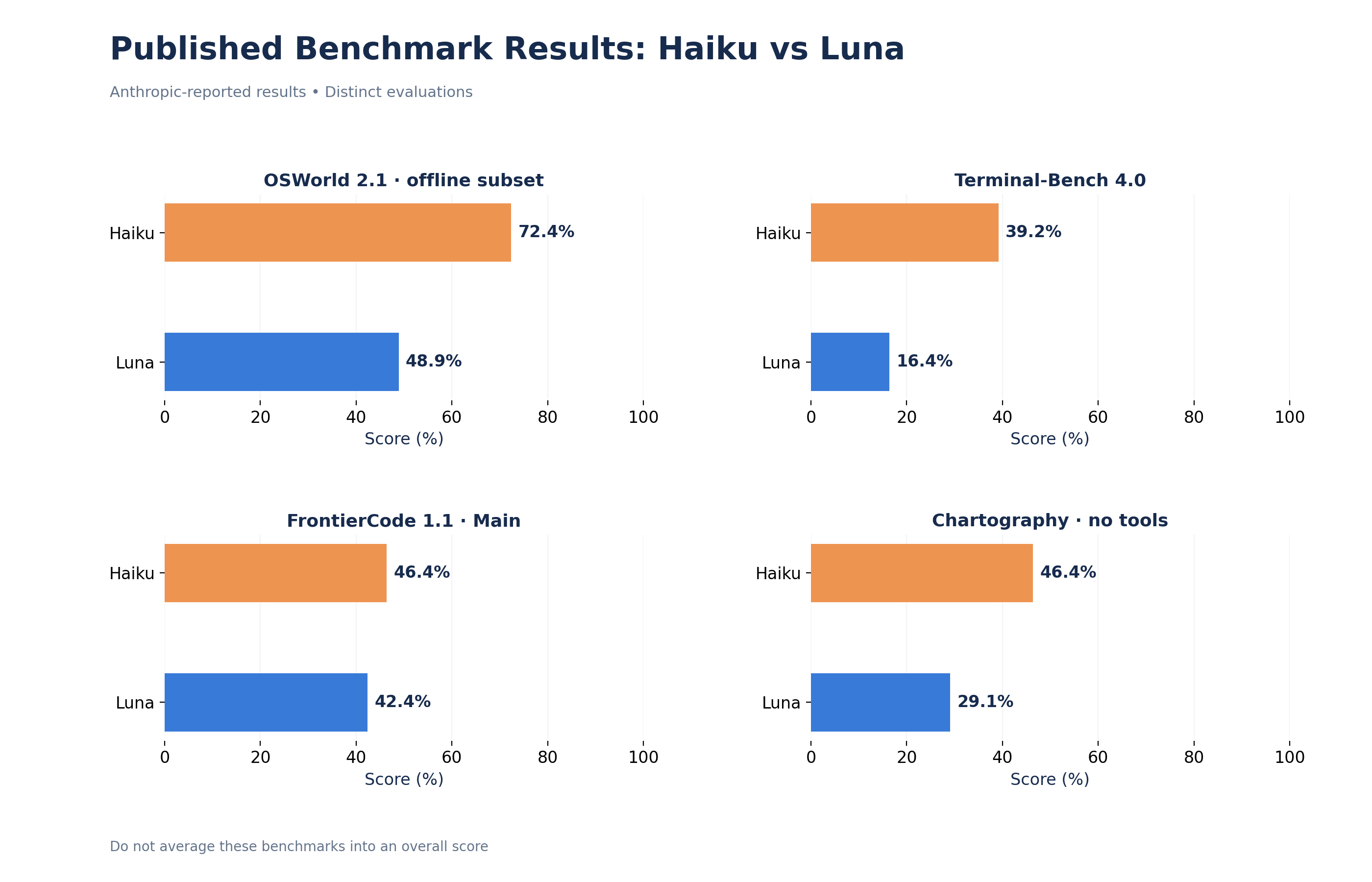
- OSWorld 2.1, offline subset: Haiku 72.4%; Luna 48.9%.
- Terminal-Bench 4.0: Haiku 39.2%; Luna 16.4%.
- FrontierCode 1.1, Main: Haiku 46.4%; Luna 42.4%.
- Chartography, no tools: Haiku 46.4%; Luna 29.1%.
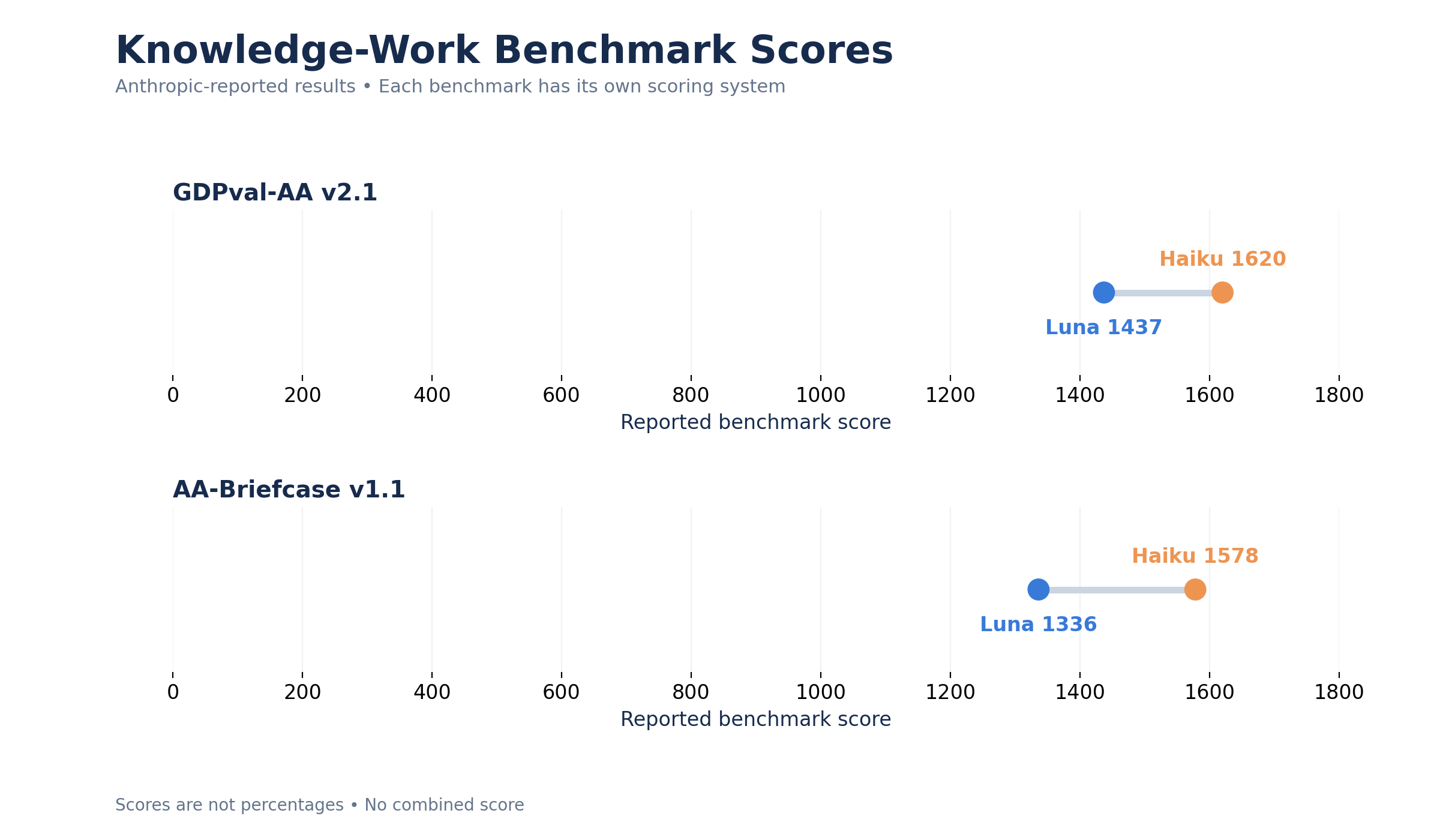
These are Anthropic-reported comparisons, not our independent measurements. The benchmarks use different scales and should not be averaged into an overall score.
Use them to decide what to investigate. A chart-analysis application needs numerical interpretation tests; an automation application needs navigation and recovery tests; a coding assistant needs independent behavior checks.
What the 160-Response Test Shows
Kingy AI reports 40 tasks, answered twice per model, producing 160 responses.
Haiku 5.5
- Strict passes: 60/80.
- Strict pass rate: 75.0%.
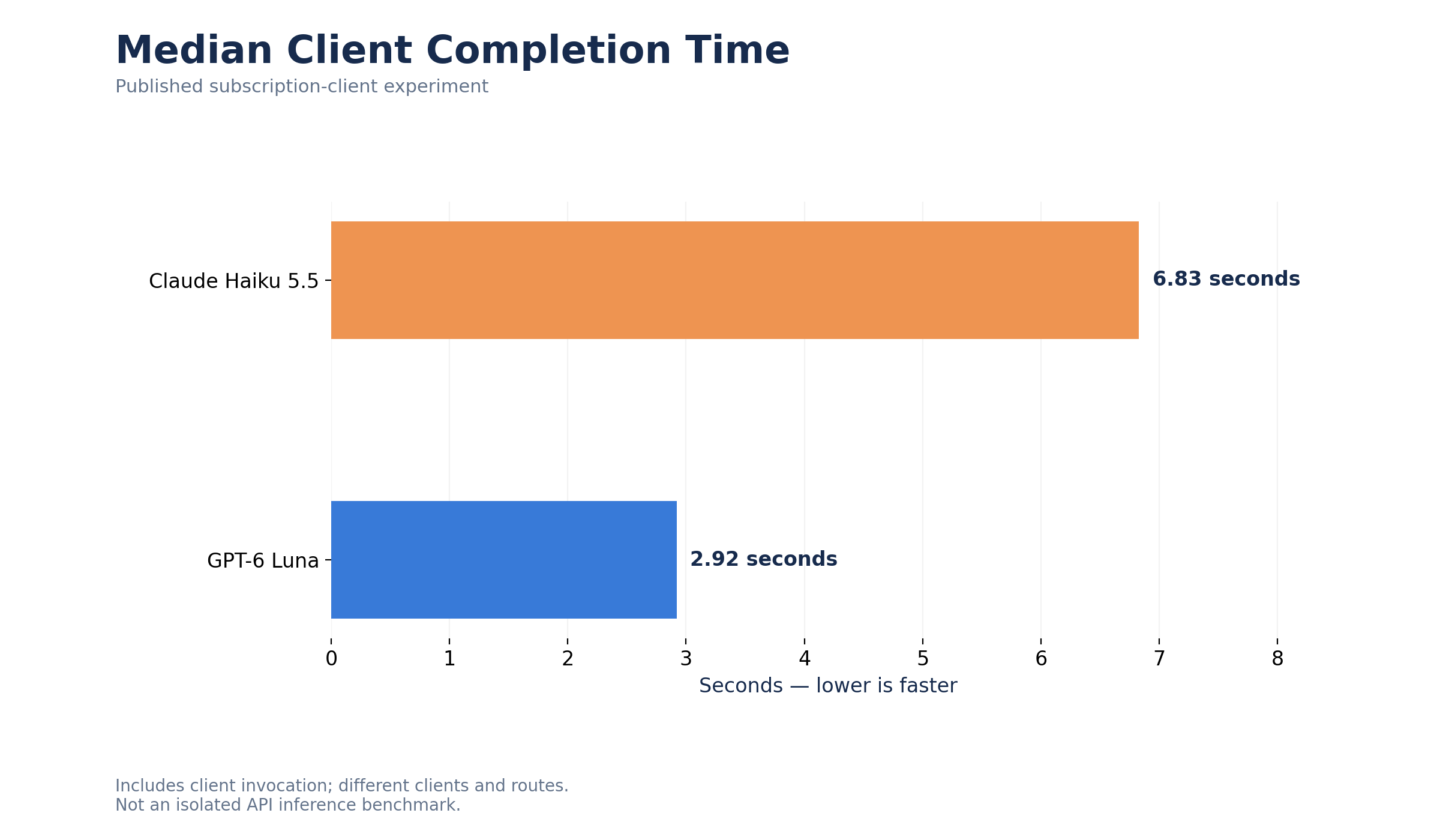
- Median client completion: 6.83 seconds.
GPT-6 Luna
- Strict passes: 51/80.
- Strict pass rate: 63.75%.
- Median client completion: 2.92 seconds.
Haiku’s strict pass rate was 11.25 percentage points higher. However, the experiment used different subscription clients and default budgets. Its scoring also rejected some substantively valid answers through exact-match requirements.
The findings support a bounded comparison. They do not establish universal quality or API-speed rankings.
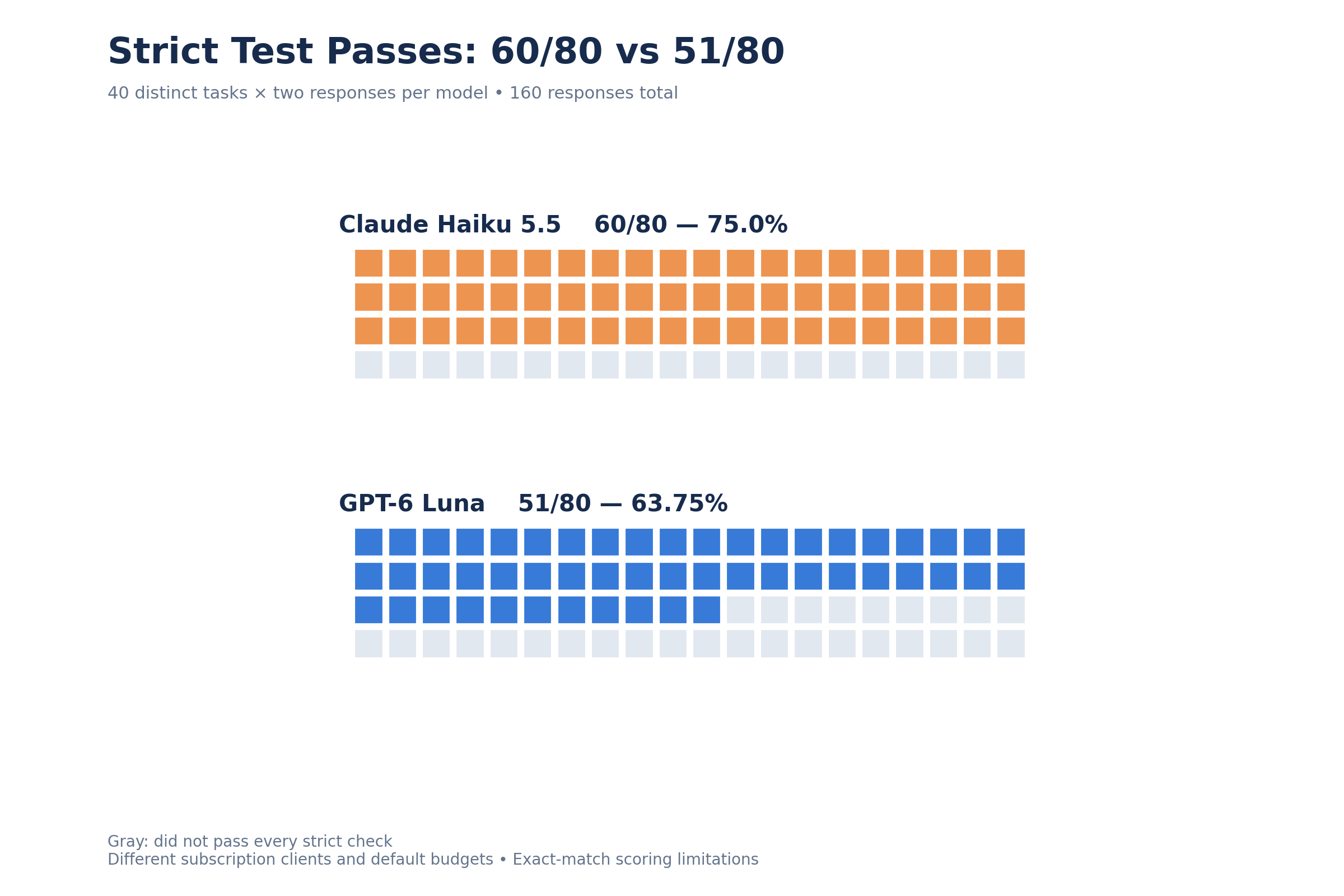
Two repetitions of a task are not two independent problems. The experiment contains 40 distinct tasks, rather than 160 distinct tasks.
Accuracy, Formatting, and Scoring Failures
A failed check can indicate an incorrect fact, invalid field type, omitted requirement, or acceptable wording that an evaluator rejects.
Those outcomes require different fixes.
For example, preserving an unknown value is appropriate when the source lacks the answer. Requiring one exact explanation can penalize that response without demonstrating hallucination.
Score factual accuracy, uncertainty handling, format compliance, and writing quality separately. For extraction workflows, include structured outputs and JSON mode in your evaluation, while checking returned values against the source. Inspect failures before interpreting a strict pass percentage as a general reliability rate.
Claude Haiku 5.5 vs GPT-6 Luna Speed
Luna completed faster in the cited client experiment. That result does not establish the fastest model through every API route.
Client Timing Versus Model Latency
The reported completion times include the tested client invocation. They do not isolate model inference.
Measure three distinct outcomes:
- Time to first token: when generation becomes visible.
- Output throughput: how quickly the answer streams.
- End-to-end completion: when the entire task finishes.
Retrieval, queueing, tools, and validation can contribute substantially to elapsed time. Use an AI API latency evaluation framework to keep these measurements separate when comparing your actual integrations.
For live support, early responsiveness matters. For automated document processing, accepted results per minute may be more useful.
Compare Turnaround at an Acceptable Quality Level
A short answer can finish quickly while omitting essential information. A longer answer can take more time while completing the task correctly.
Compare timing among outputs that satisfy the same requirements. Record both median and slow-request latency, and test realistic concurrency.
The useful question is how long users wait for usable work, rather than how quickly any response appears.
Claude Haiku 5.5 Enterprise Cases and Practical Lessons
Enterprise reports help translate model capabilities into evaluation ideas. Their baselines and measurement methods must remain visible.
Six Published Customer Reports
Anthropic’s launch page includes:
- Asana: over 30% lower task-completion latency and up to 2.5× faster inference per agent turn.
- HubSpot: 92.8% on a simulated CRM suite, averaged over three runs.
- AlphaSense: 400 document queries; 0.84 versus 0.76 for Haiku 4.5.
- Box: an 11-point improvement over Haiku 4.5 at approximately half the latency.
- Rogo: narrow financial-document lookups delegated to Haiku.
- Cognition: 66.2 on FrontierCode for a Devin Fusion configuration using Haiku as sidekick.
These are vendor-published customer reports. They are not six direct Haiku-versus-Luna tests, and system-level results cannot be attributed entirely to one component.
Document Questions and CRM Audits
The document cases suggest checking whether answers remain supported by specific passages.
Include missing answers, conflicting statements, reporting periods, and units. Require the model to preserve uncertainty rather than fill gaps.
For CRM audits, measure missed records and incorrect flags separately. Finding more candidates may still create unnecessary review if false positives rise.
Translate case results into acceptance criteria: source support, valid fields, appropriate uncertainty, and manageable review effort.
Narrow Delegation in Agent Workflows
A financial lookup is easier to validate than a complete report. In workflows involving function calling and tool use, a smaller model can retrieve a figure, a validator can check it, and a larger model can incorporate it.
This is a sensible architecture to evaluate, but it adds coordination and context. Its value must be measured at the system level.
A sidekick’s apparent efficiency does not establish that the entire agent workflow is cheaper.
Claude Haiku 5.5 vs GPT-6 Luna Cost per Successful Task
Cost per successful task connects spending with useful outcomes.
Calculate it as:
Total workflow spending ÷ accepted results.
A Worked Value Comparison
Consider two hypothetical workflows:
- Workflow A spends $10 and produces 700 accepted results: approximately $0.0143 per result.
- Workflow B spends $12 and produces 900 accepted results: approximately $0.0133 per result.
Workflow B spends more overall but delivers useful results at a lower unit cost.
These figures illustrate the method; they are not measured Haiku or Luna results.
Include API charges, cache operations, tools, retries, and fallback in workflow spending. Track human correction time separately.
A Reusable Evaluation Process
Select representative tasks and costly edge cases. Define acceptance before collecting responses.
Then:
1. Record model identity, route, processing mode, tools, and reasoning settings.
2. Count each model’s input separately.
3. Randomize request order.
4. Preserve all outputs, including failures.
5. Record usage, timing, retries, and escalation.
6. Inspect disputed scores.
7. Compare accepted-result cost and successful turnaround.
For writing, use blind review. For code, run independent tests. For extraction, validate facts and types against the source.
Matching reasoning-setting names do not guarantee equal internal compute. Document the settings without claiming perfect equivalence.
Claude Haiku 5.5 Migration and Budget Checks
Switching an existing integration requires compatibility work as well as a new rate calculation.
Recount Tokens and Review Output Limits
Anthropic’s migration guide reports approximately 30% more input tokens for the same text than Haiku 4.5, with content-dependent variation.
This comparison concerns Haiku 4.5, not Luna.
The guide also warns that thinking can consume the output budget before visible answer text appears. Recount prompts and inspect truncation before reusing older limits.
Validate Requests and Response Parsing
Migration changes involve adaptive thinking, sampling parameters, assistant prefill, and content-block parsing.
Check valid requests, complete answers, parser behavior, usage reporting, and error handling through a regression set. For implementation context, consult our Claude Haiku API guide, then validate model-specific behavior against the current provider documentation.
Net benefit = operating savings − migration and maintenance costs.
Our review of public user questions found concerns about long-session bills, domain accuracy, and switching costs. These are useful evaluation priorities, but unverified anecdotes cannot establish ROI or representative failure rates.
Conclusion
Claude Haiku 5.5 is a strong candidate when its reported benchmark strengths align with your tasks; GPT-6 Luna deserves priority testing when longer-input pricing or interactive turnaround matters most. Their identical base rates make quality and actual usage central to short-request comparisons. Enterprise cases provide useful pilot designs, but the final decision should come from representative inputs, explicit acceptance rules, and complete spending records. Choose the model that delivers the required quality at the best cost per successful task and acceptable completion time.
Frequently Asked Questions
Is Haiku 5.5 Cheaper Than GPT-6 Luna?
Base rates match.Luna retains base pricing for longer inputs. Actual costs depend on token counts, output consumption, caching, tools, and accepted results.
Which Model Is Faster?
Luna finished faster in the cited subscription-client test. Different routes and clients limit that finding. Measure usable-result turnaround through your own integration.
Which Model Is More Accurate or Less Likely to Hallucinate?
Haiku leads in the cited benchmarks and strict client-test pass rate. Those results do not establish a universal hallucination rate. Test domain errors, missing information, and conflicting evidence directly.
Does Haiku’s 100K Threshold Apply Only to the Latest Message?
Budget against the complete prompt submitted for the request, including relevant history and other input components. The threshold concerns pricing, rather than context capacity.
Can Reasoning, Verbosity, or Subscription Credits Change Costs?
Yes. Billable processing, longer answers, and repeated calls can change spending. Credits and allowances affect incremental charges, but **zero added spending does not mean zero economic cost or free API access.