Google Gemini API is the starting point for direct Nano Banana 2.1 access. LinkModel publishes Nano Banana 2.1 token rates 25% below Google’s Standard rates. OpenRouter and Vercel suit existing gateway integrations. The right provider combines suitable features, clear pricing, and an integration that fits your application.
Headline rates tell only part of the story. Thinking, reference inputs, repeated attempts, and rejected images can change the cost of producing usable assets. Compare the complete workflow before choosing where to generate.
LinkModel lists image output at $22.50 per million tokens, with one API key and unified model billing. Try your own brief in the playground, inspect the result, and evaluate whether the published discount and simpler integration fit your workflow.
Best Nano Banana 2.1 API Providers Compared
Choose by your requirements rather than a universal ranking. Google develops Nano Banana 2.1; other platforms provide alternative access, integration, and billing arrangements.
This review draws on official documentation, provider listings, published model evaluations, and documented usage scenarios. We checked LinkModel’s public model catalog and the pricing feed used by its pricing page. Rates were checked on October 9, 2026.
| Provider | Main reason to evaluate | Important distinction |
|---|---|---|
| Google Gemini API | Direct access | Native documentation and billing |
| LinkModel | Discounted unified access | Separate input, text, reasoning, and image rates |
| OpenRouter | Existing routing integration | Funding fees are separate from inference |
| Vercel AI Gateway | Existing Vercel workflow | No token markup does not mean discounted inference |
| CometAPI | Existing platform integration | Image-output pricing needs clarification |
The OpenRouter listing and Vercel catalog document their access options. The CometAPI product page also lists the model.
Which Provider Fits Your Workload?
For product photography, preserved packaging and product identity may outweigh a small rate difference. For interactive tools, slow requests and recovery behavior matter. For offline generation, accepted-image cost and delivery deadlines may dominate.
An existing gateway can reduce integration work, while direct access provides a useful reference implementation. The best choice is the one that meets your requirements at an acceptable total cost.
Nano Banana 2.1 API Pricing: Google vs LinkModel
Image-output pricing must be separated from text and reasoning pricing. A generic output-token quote cannot reliably describe the cost of generating an image.
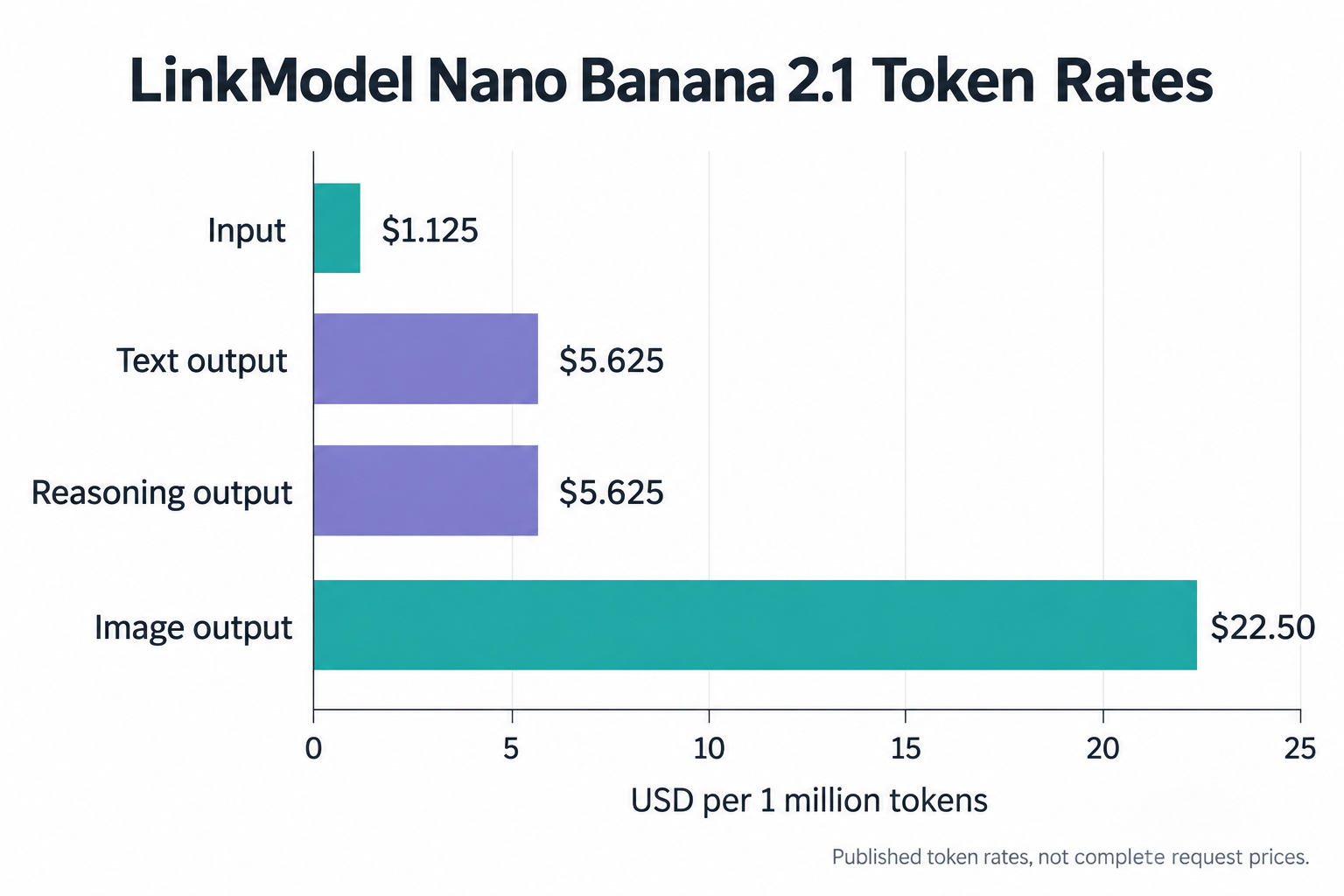
The public catalog behind the LinkModel pricing page lists these USD rates:
| Category | LinkModel per million tokens |
|---|---|
| Input | $1.125 |
| Text output | $5.625 |
| Reasoning output | $5.625 |
| Image output | $22.50 |
These categories are 25% below the corresponding Google Standard rates. That is a published rate comparison, not a guarantee that every workflow’s final bill falls by the same percentage.
Estimated Image-Output Cost by Resolution
Using the output-token quantities in Google’s official pricing footnote—1,120 at 1K, 1,680 at 2K, and 3,780 at 4K—produces the following estimates.
| Resolution | Google Standard | LinkModel |
|---|---|---|
| 1K | $0.0336 | $0.0252 |
| 2K | $0.0504 | $0.0378 |
| 4K | $0.1134 | $0.08505 |
These figures cover the estimated image-output component only. They are calculated from published rates and token assumptions, not measured LinkModel bills.
Google also offers discounted Batch pricing. Compare Batch and Standard only when their processing conditions fit the same workload.
What Does a Complete Request Cost?
A request can include input, text, reasoning, and image output. Additional services must be counted separately.
For an illustrative LinkModel request, assume:
- 1,000 input tokens: $0.001125.
- 1,000 combined text and reasoning output tokens: $0.005625.
- One 1K image using 1,120 image-output tokens: $0.0252.
The calculated total is $0.03195 before any separately applicable charges.
This is a budgeting example, not a typical-use claim. It shows why the image-output estimate and complete request price should not be treated as interchangeable.
Budgeting for 1,000 Images
Our research records include an earlier automation scenario needing more than 1,000 images monthly. It illustrates why small unit-price differences matter.
At exactly 1,000 outputs, LinkModel’s calculated image-output components are:
| Resolution | Estimated output budget |
|---|---|
| 1K | $25.20 |
| 2K | $37.80 |
| 4K | $85.05 |
Budget separately for inputs, reasoning, additional services, and repeated generation. Required finished assets—not merely attempted generations—should determine the production forecast.
Which Nano Banana 2.1 API Provider Should You Choose?
Start with the integration and controls you need, then compare complete pricing. The following recommendations describe suitable evaluation scenarios rather than measured performance winners.
Google Gemini API: Direct Model Access
Google is the natural starting point when you want to work from the model maker’s interface and documentation.
A direct implementation establishes baseline behavior for generation and editing. You can then evaluate another endpoint using the same assets and settings.
Choose this route when native controls and a direct provider relationship are your priorities.
LinkModel: Discounted Rates and Unified Workflows
LinkModel combines published discounted rates with access to multiple model workflows.
The LinkModel documentation describes task creation, polling, and output retrieval. That shared pattern can be useful for applications combining product images, descriptions, and promotional media.
The pricing advantage has a concrete basis: input, text, reasoning, and image output are separately listed. Evaluate the controls your application requires and check actual usage before increasing volume.
OpenRouter: Existing Gateway Applications
The OpenRouter model page identifies the route as google/gemini-nano-banana-2.1 and separates image-output pricing from text output.
OpenRouter’s account documentation lists credit-purchase fees of 5.5% for Standard and 8% for Business, separate from inference.
Keeping an existing integration can be practical. Include applicable fees and inspect the selected upstream before comparing total costs.
Vercel AI Gateway: Existing Vercel Workflows
Vercel’s pricing documentation describes provider-based token rates without markup, including bring-your-own-key usage.
That can fit an application already using Vercel or its AI SDK. Check image-specific rates and model settings exposed through the chosen interface.
Zero token markup is an integration pricing policy, not evidence of lower underlying model rates.
CometAPI: Clarify the Image Rate
The CometAPI pricing table lists $1.20 per million input tokens and $6 per million output tokens, alongside a 20% discount comparison.
The displayed arithmetic is consistent, but the reviewed table does not clearly distinguish image output.
Obtain the applicable image rate before converting the offer into a per-image estimate.
Nano Banana 2.1 API Features and Compatibility
Model capability and provider endpoint support are separate questions. Check the interface your application will actually use.
Google’s model documentation identifies gemini-nano-banana-2.1 and documents 1K, 2K, and 4K output, up to 14 references, thinking, grounding, and Batch support.
| Requirement | Endpoint check |
|---|---|
| Generation and editing | Accepted inputs and workflow |
| Resolution | Settings and returned dimensions |
| References | Count and supported formats |
| Thinking | Available levels and billing |
| Grounding | Availability and charges |
| Batch | Processing conditions and rates |
Product and Character Editing
Reference capacity does not guarantee unchanged details. Inspect packaging, color, shape, and identity across successive revisions.
Google describes consistency support for up to four characters and ten objects. That is different from guaranteeing 14 independent characters remain accurate.
A useful test is to change a product’s background, revise one surrounding element, and request another edit. Check whether the product remains intact throughout the sequence.
Thinking, Grounding, and Batch
Thinking defaults to medium, with minimal and high alternatives. Evaluate the available setting against quality, timing, and charges.
For factual graphics, review wording and numbers even when grounding is enabled.
Task polling does not establish access to discounted native Batch processing. Google also marks function calling and structured outputs as unsupported; wrapper metadata does not prove those underlying capabilities.
Nano Banana 2.1 Quality Benchmarks
Google’s original DeepMind model card provides evidence for selecting evaluation tasks.
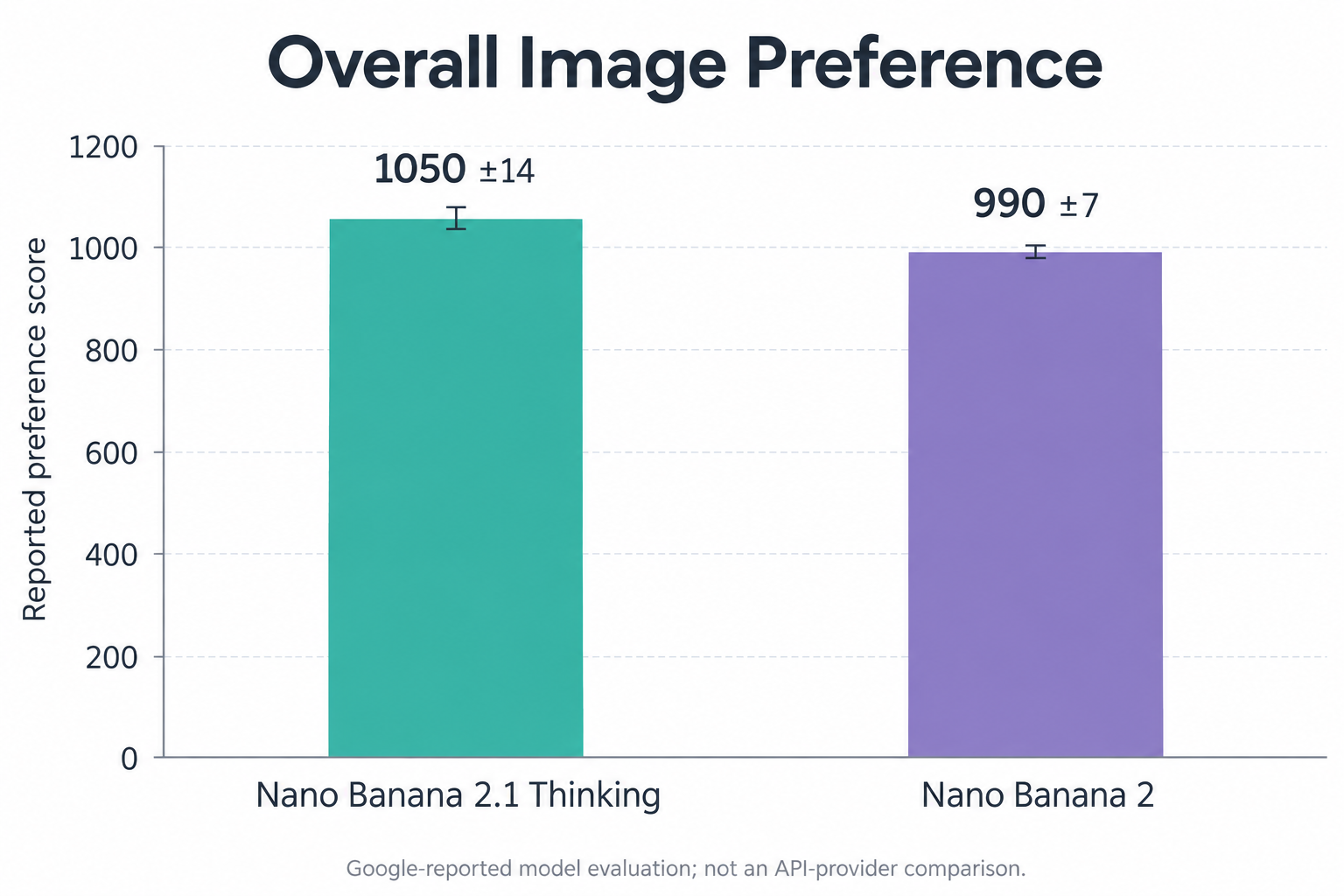
| Metric | 2.1 Thinking | Nano Banana 2 |
|---|---|---|
| Overall preference | 1050 ± 14 | 990 ± 7 |
| Infographic design | 1048 ± 17 | 961 ± 12 |
| Infographic factuality | 0.521 | 0.179 |
| Product consistency | 1024 ± 18 | 955 ± 22 |
| Multi-reference editing | 1066 ± 22 | 988 ± 13 |
These results support evaluating product edits and information-rich graphics. They compare model variants, not API providers.
Preference scores are not percentages, and factuality 0.521 does not mean 52.1% of images are entirely correct. Use the findings to design acceptance checks rather than declare a reseller superior.
Nano Banana 2.1 API Reliability and Retry Costs
Track generation completion, usable outputs, and latency separately. A valid response can still produce an unsuitable asset.
Measure P50 and P95 under expected concurrency. A good median does not eliminate slow requests that disrupt an interactive application.
Avoid Duplicate Generation After a Timeout
LinkModel’s first-call documentation warns that repeating an uncertain creation request can create another task and billing order.
A client timeout does not prove generation failed to start. Preserve the task identifier when available and inspect the existing task before resubmitting.
Confirm applicable failed-task billing when it matters to your workload. This review does not establish a universal refund rule.
Compare Cost per Accepted Image
Divide total billed generation spend by the number of images accepted for use.
An option charging less per attempt can cost more per deliverable if outputs need frequent replacement. Define acceptance before testing: correct text, preserved details, suitable composition, and required dimensions.
Include review and rework when they materially affect the business cost.
Try Nano Banana 2.1 Before You Scale
The most useful first test is your own brief. Open the LinkModel playground, select Nano Banana 2.1, and try a task you would otherwise generate through another service.
Start with a product scene, a text-heavy visual, or a controlled edit. Inspect the output against your requirements, then review the associated usage or charge. You do not need to begin with a large integration or production workload.
LinkModel’s published discount gives you a concrete reason to compare; your own result tells you whether it fits. Check the current model pricing before running the test, then expand only when quality and cost meet your expectations.
A Simple Evaluation Checklist
| Task | What to inspect |
|---|---|
| Product scene | Packaging and proportions |
| Infographic | Wording and numbers |
| Character revision | Identity across edits |
Record settings, timing, cost, and any manual corrections. One successful image does not qualify every workflow, but it can reveal whether further evaluation is worthwhile.
Moving from Playground to API
For application use, create an API key, confirm the model identifier, and follow the documented generation interface.
LinkModel’s task guidance recommends waiting about 10 seconds before polling image tasks, then checking every few seconds. This is polling guidance, not a generation-time promise.
Stop at Success, Failed, or Cancelled. Returned asset URLs are dynamically signed, so download or copy images you need rather than treating those URLs as permanent storage.
Conclusion: Choosing a Nano Banana 2.1 API Provider
Choose Google for direct access, consider OpenRouter or Vercel when they fit your existing application, and clarify CometAPI’s image rate before comparing costs. LinkModel’s published 25% reduction across input, text, reasoning, and image-output rates makes it worth evaluating, particularly when unified model access simplifies your workflow. Start with a representative task, compare the usable result and complete charge, and scale when both meet your requirements.
Frequently Asked Questions
Which provider is best for my project?
Google suits direct access. LinkModel offers discounted rates and unified workflows. OpenRouter and Vercel fit existing gateway applications. Choose according to required controls, integration effort, and total cost.
How much does an image cost on LinkModel?
Calculated image-output estimates are $0.0252 at 1K, $0.0378 at 2K, and $0.08505 at 4K. These exclude input, text, reasoning, and other applicable charges.
Should I use Standard or Batch for bulk generation?
Compare processing conditions and delivery deadlines alongside rates. Batch may suit non-interactive work, but ordinary asynchronous task polling does not automatically qualify as discounted Batch processing.
Does every provider support all model features?
Do not assume full parity. Verify references, thinking, grounding, resolution, and editing through the specific endpoint you intend to call.
How do I avoid unexpected costs?
Check complete rates, limit unnecessary generation, and avoid blindly resubmitting uncertain requests. Monitor usage and evaluate cost per accepted image before increasing volume.