OpenAI's official API and LinkModel both offer GPT Image 2.6 Flare and Sunburst, but LinkModel charges 35% less for matching standard token usage through November 30, 2026. That means a workload costing $100 at OpenAI's standard API rates costs $65 through LinkModel during the promotion. For developers building image-generation features, creating marketing assets, or producing visuals at scale, this is a meaningful opportunity to reduce recurring API expenses.
OpenAI's announcement that ChatGPT and Codex will share usage allowances for Plus, Pro, and Business subscribers starting in December 2026 has drawn criticism from users questioning the value of their subscriptions. Some have discussed canceling as AI spending becomes harder to justify. ChatGPT subscription allowances and standard API billing remain separate, but the discussion highlights a broader concern for developers and content teams: how can they keep AI spending predictable while meeting their actual workload requirements?
For teams that need programmatic access to GPT Image 2.6, LinkModel offers 35% lower corresponding standard token rates through November 30, 2026, pay-as-you-go billing, $0 minimum spend, and $0 monthly platform fee. New users automatically receive $1 in free Credits upon registration, without a payment card or recharge. These Credits never expire and apply to every model currently available on LinkModel; existing users cannot claim the signup reward again. With a visual Playground and unified model access, developers can explore the available workflow before deciding how to scale production.
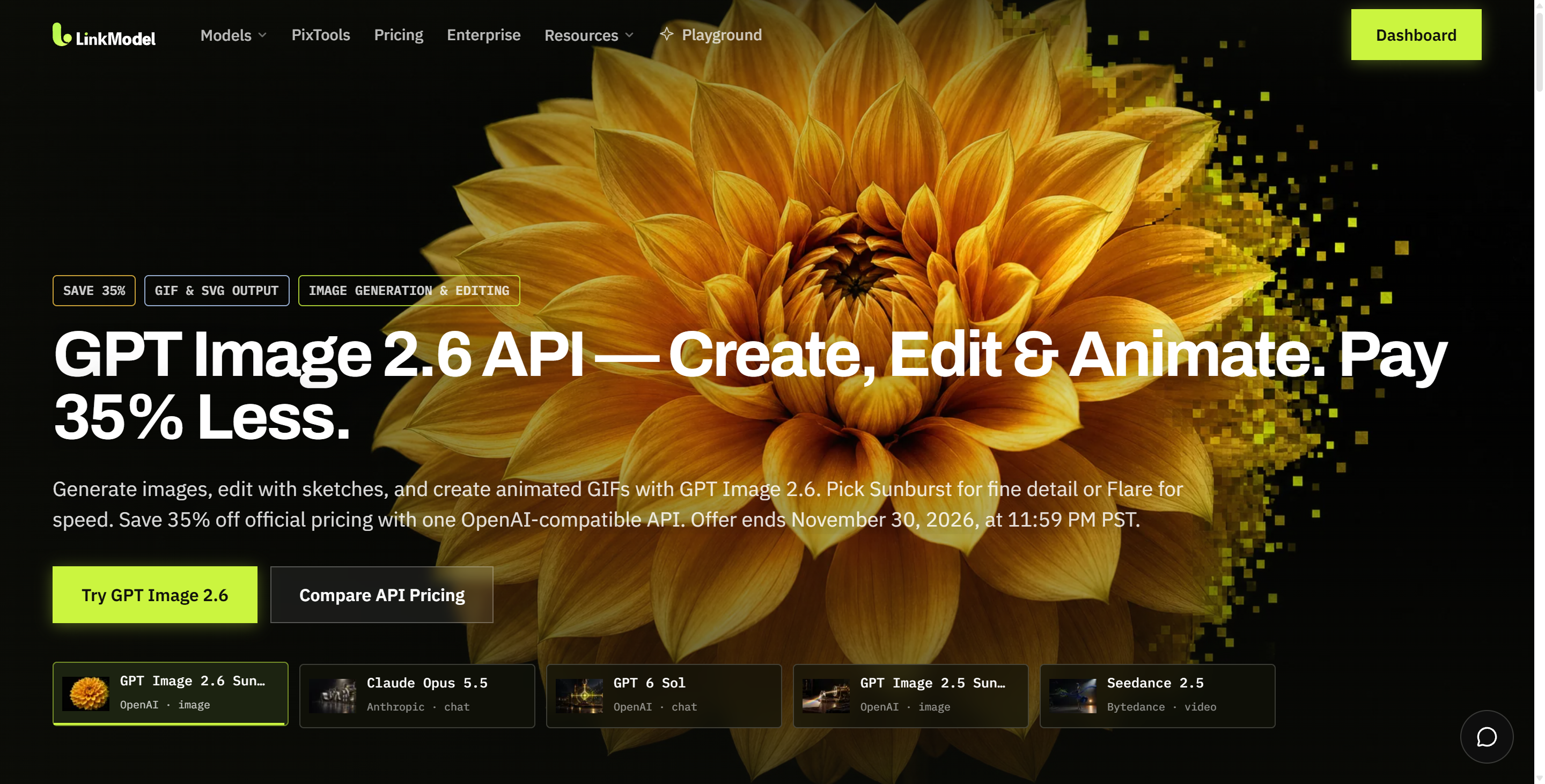
GPT Image 2.6 API: Official vs LinkModel at a Glance
Choose the official OpenAI API when direct provider integration and access to native API behavior are your priorities. Choose LinkModel when lower GPT Image 2.6 token costs and unified model management are more important.
Both platforms offer GPT Image 2.6 Flare and Sunburst. The differences are most relevant to pricing, integration, account management, and the specific features available through each API route.
| Comparison | Official OpenAI API | LinkModel |
|---|---|---|
| GPT Image 2.6 models | Flare and Sunburst | Flare and Sunburst |
| Image output rate | $30.00/1M tokens | $19.50/1M tokens |
| Image input rate | $8.00/1M tokens | $5.20/1M tokens |
| Text input rate | $5.00/1M tokens | $3.25/1M tokens |
| Access method | Native OpenAI endpoints | OpenAI-compatible unified API |
| Model ecosystem | OpenAI models | Multiple supported providers |
| Visual testing | OpenAI Platform tools | LinkModel Playground |
| Main advantage | Direct official integration | 35% promotional discount and unified model management |
At matching billable token usage, LinkModel charges $0.65 for every $1.00 charged at OpenAI's corresponding standard rates during the promotional period.
However, price is not the only consideration. Developers should also evaluate endpoint compatibility, advanced image features, billing transparency, and the support path available when something goes wrong.
A lower token price does not by itself establish identical latency, success rates, or support for every newly released API parameter.
GPT Image 2.6 API Pricing: How Much Can You Save?
Official OpenAI vs LinkModel Token Rates
GPT Image 2.6 Flare and Sunburst share the same official standard token pricing. LinkModel applies a 35% discount to the corresponding rates through November 30, 2026.
All prices below are in USD per 1 million tokens.
| Billing Category | OpenAI Official | LinkModel | Savings |
|---|---|---|---|
| Text input | $5.00 | $3.25 | 35% |
| Cached text input | $1.25 | $0.8125 | 35% |
| Image input | $8.00 | $5.20 | 35% |
| Cached image input | $2.00 | $1.30 | 35% |
| Image output | $30.00 | $19.50 | 35% |
The discount covers all five listed billing categories, not just image output.
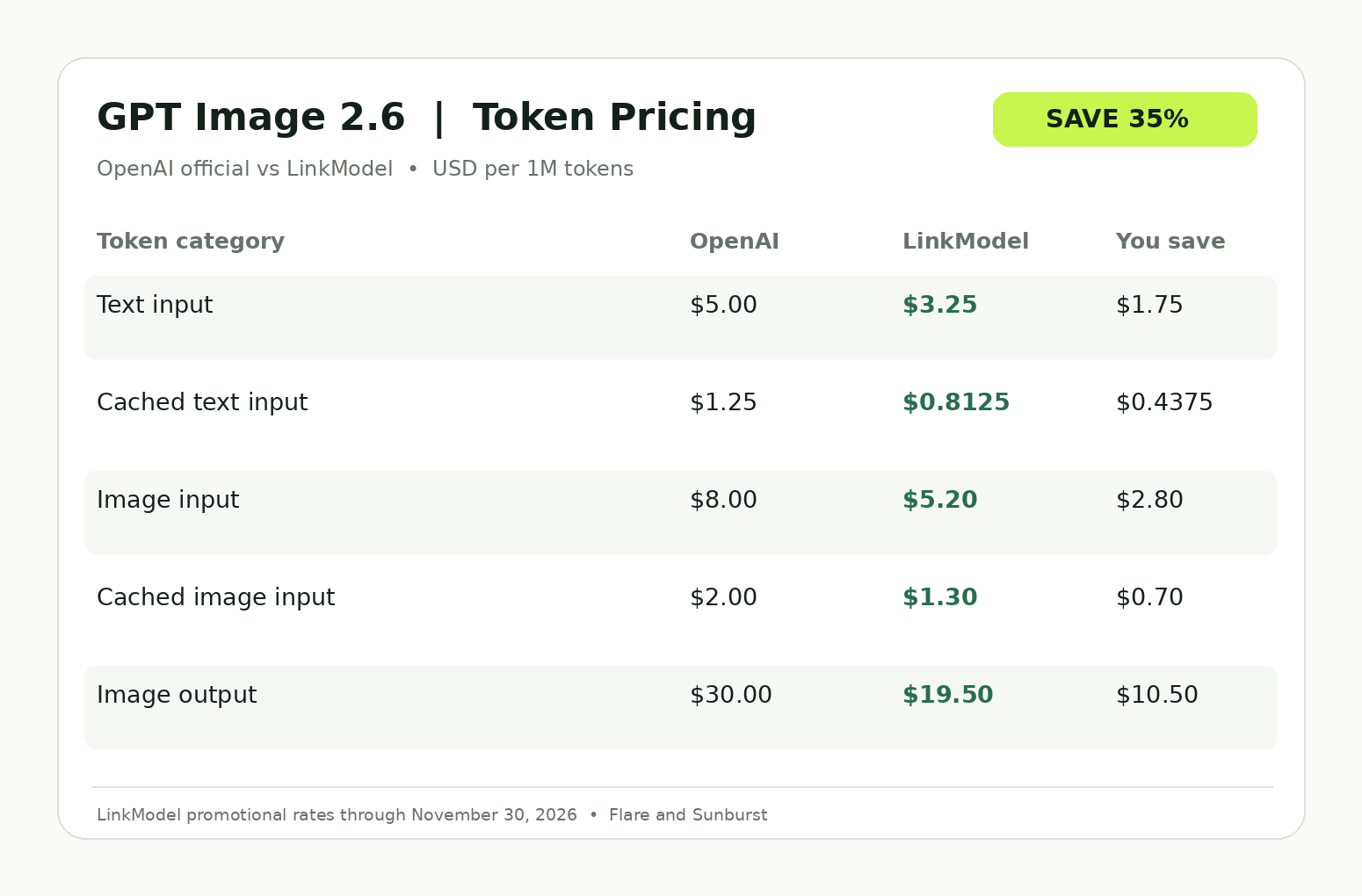
For example, one million image output tokens cost $30.00 through OpenAI versus $19.50 through LinkModel, saving $10.50.
At ten million image output tokens, the corresponding charges are $300 and $195, a difference of $105.
This matters for workflows combining written prompts, reference images, image editing, and final outputs. Applicable cached input pricing depends on the request route and its caching behavior.
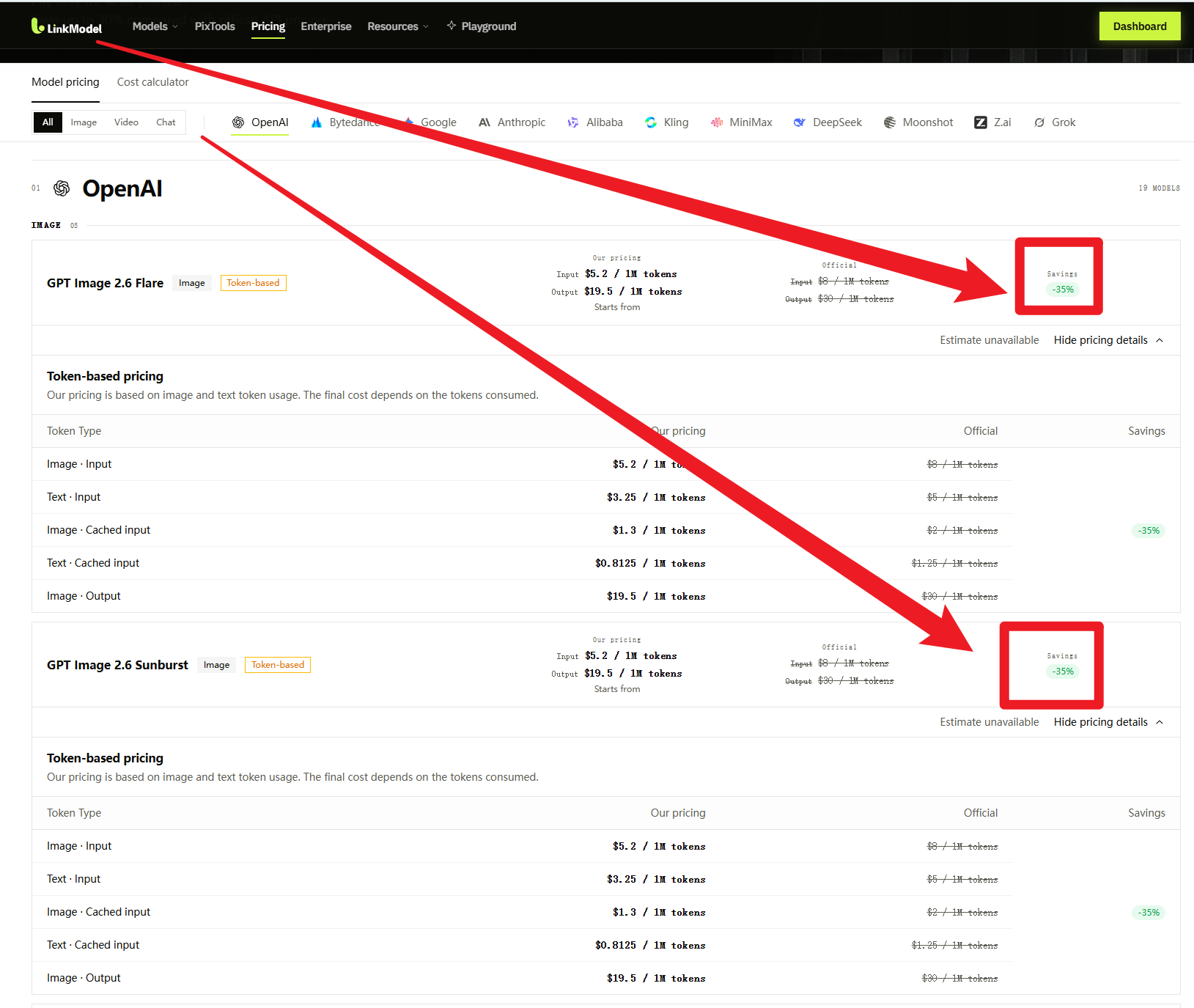
How to Calculate GPT Image 2.6 API Costs
GPT Image 2.6 does not have a universal fixed price per image. The total cost depends on token consumption and the components included in each request.
For a generation request without cached input, a useful starting formula is:
Total Cost = (Text Input Tokens × Text Input Rate + Image Input Tokens × Image Input Rate + Image Output Tokens × Image Output Rate) ÷ 1,000,000
Consider a text-to-image request consuming 200 text input tokens and 2,000 image output tokens.
| Cost Component | OpenAI | LinkModel |
|---|---|---|
| Text input | $0.00100 | $0.00065 |
| Image output | $0.06000 | $0.03900 |
| Total per request | $0.06100 | $0.03965 |
| 1,000 identical requests | $61.00 | $39.65 |
At matching usage, LinkModel saves $21.35 across 1,000 requests.
The 2,000 image output tokens are an explicit budgeting assumption, not a fixed token count for every image. A request involving reference photos would also include the relevant image input charges.
For more detailed per-image estimates, OpenAI provides a calculator in its Image Generation Guide. Developers can select their model, quality, and image dimensions to estimate output costs.
Why the Same Model Can Produce Different Bills
Image quality, dimensions, reference inputs, and repeated editing can all influence the amount billed.
GPT Image 2.6 supports five explicit quality settings: low, medium, high, xhigh, and max, as well as a separate complexity parameter.
Quality controls rendering quality, while complexity controls the amount of planning the model performs before rendering.
Higher rendering quality can increase image output-token usage. Greater planning complexity may also affect response time, even though changing complexity has no separate feature fee.
The most useful provider comparison therefore holds the model, task configuration, and billable token quantity constant instead of comparing two loosely defined prices per image.
GPT Image 2.6 Features: What Does Each API Support?
Sunburst vs Flare: Which Model Fits Your Workload?
GPT Image 2.6 offers two variants designed for different creative needs.
Flare emphasizes faster iteration. It is a useful starting point for advertising concepts, design exploration, early layouts, and workflows that benefit from generating several alternatives quickly.
Sunburst is intended for more demanding visual tasks, including detailed product imagery, complex compositions, text-sensitive layouts, and edits that require greater consistency.
The two models share the same published standard token rates on OpenAI and the same promotional rates on LinkModel.
| Decision Factor | GPT Image 2.6 Flare | GPT Image 2.6 Sunburst |
|---|---|---|
| Primary focus | Faster iteration | Detailed visual production |
| Typical use | Concepts and creative drafts | Product assets and complex editing |
| Official image output rate | $30/1M tokens | $30/1M tokens |
| LinkModel image output rate | $19.50/1M tokens | $19.50/1M tokens |
| Evaluation priority | Speed and acceptable results | Detail, layout, and edit accuracy |
Choosing the right model requires considering the number of attempts needed to produce an acceptable result, not simply selecting the fastest model.
Model Capabilities vs Platform-Specific API Support
OpenAI documents image generation, image editing, markup-guided editing, complexity control, SVG output, and animated GIF generation for GPT Image 2.6.
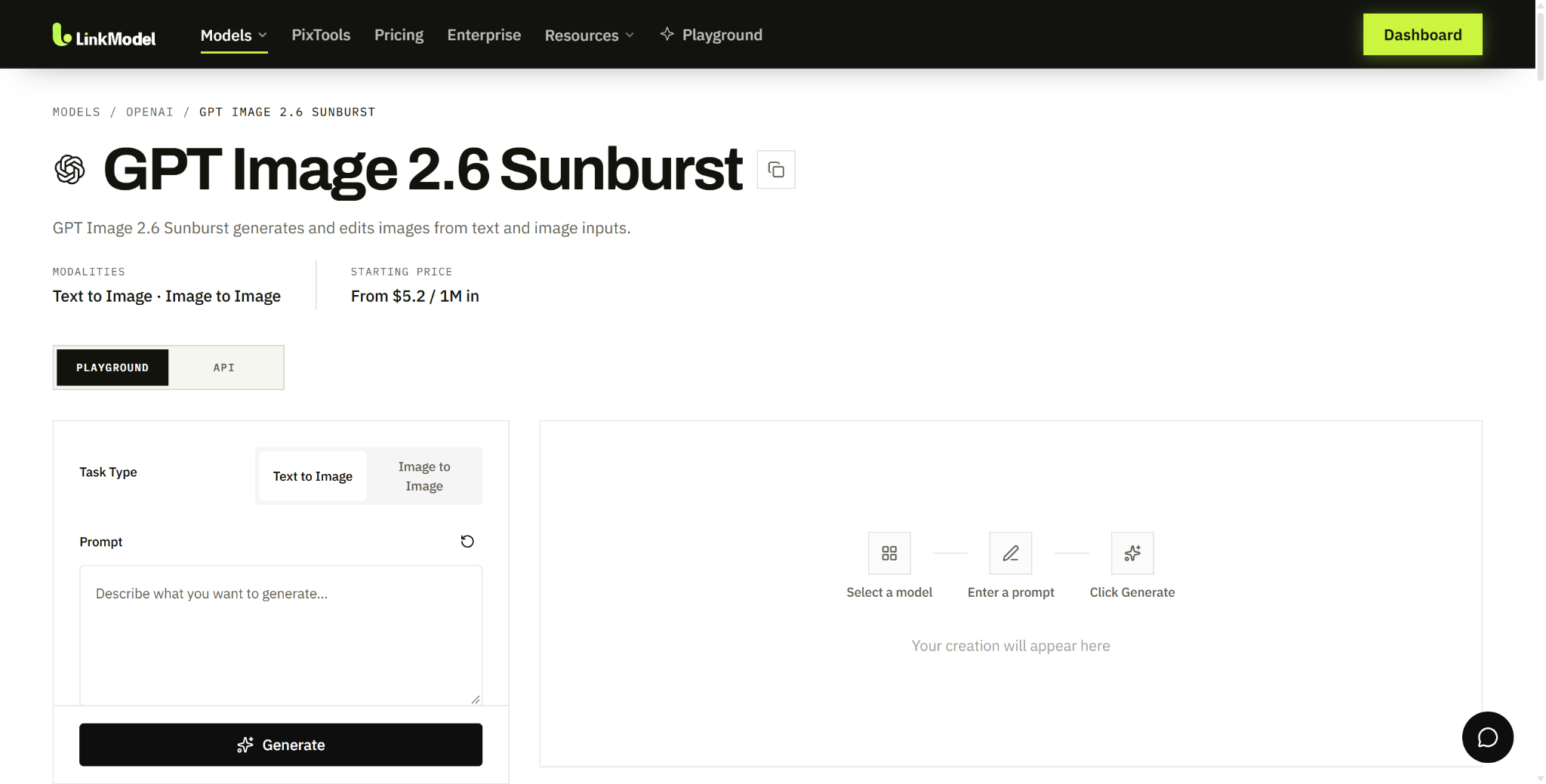
LinkModel lists both models and displays several relevant controls in its Playground.
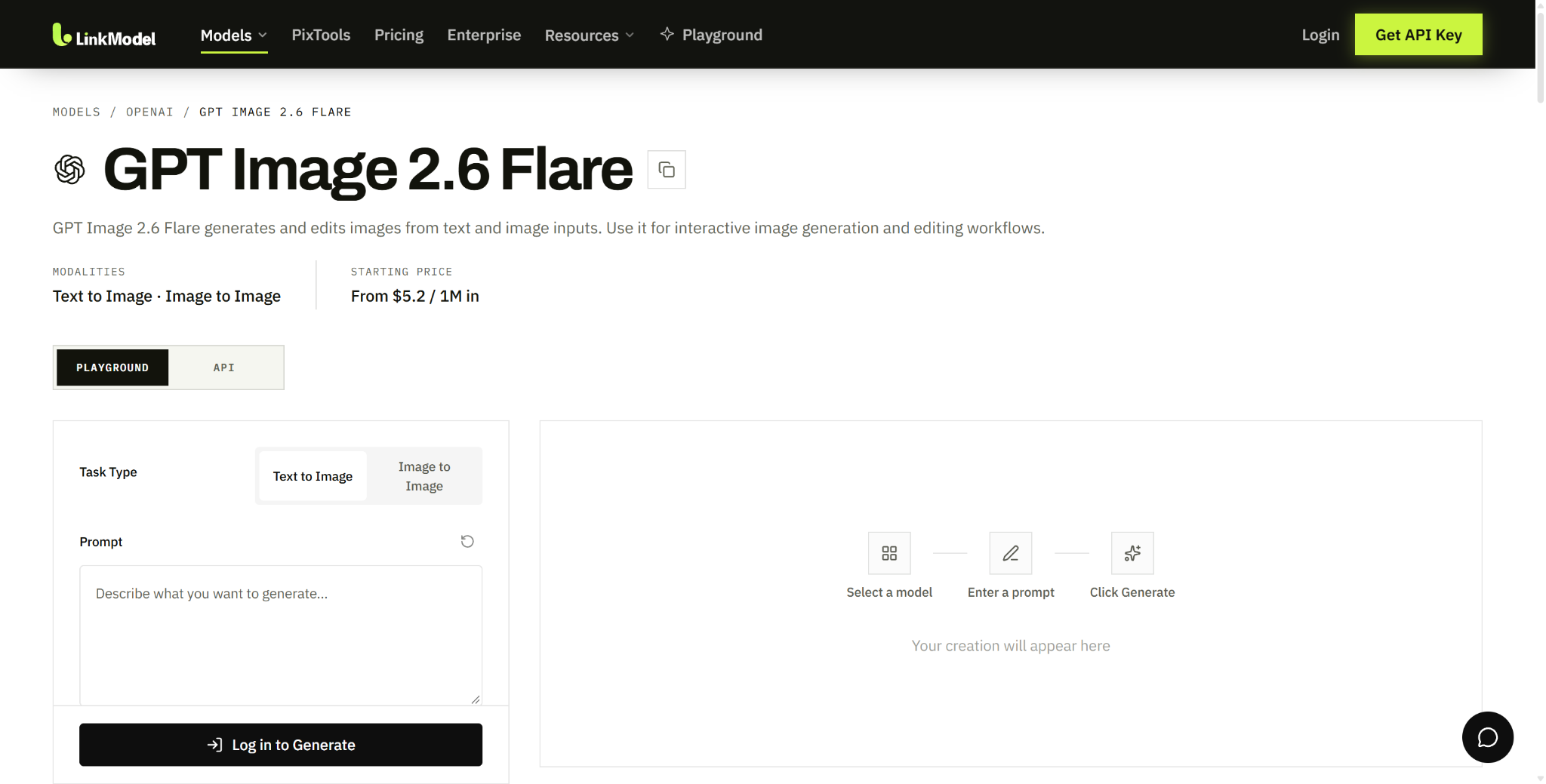
The important distinction is that a model's documented capability and a gateway's verified API behavior are not automatically the same thing.
| Capability | OpenAI Official API | LinkModel |
|---|---|---|
| GPT Image 2.6 Flare | Officially available | Listed in model catalog |
| GPT Image 2.6 Sunburst | Officially available | Listed in model catalog |
| Text-to-image | Supported | Playground task available |
| Image-to-image editing | Supported | Playground task available |
| Quality settings | Documented | Controls visible in Playground |
| Planning complexity | Documented | Controls visible in Playground |
| SVG output | Supported through Images API | Confirm the corresponding API route |
| Animated GIF output | Supported through Images API | GIF settings visible in Playground |
| Markup-guided editing | Documented | Verify editing request compatibility |
Visible Playground controls are useful evidence of the available product interface, but they should not be treated as proof that every possible API configuration has been tested successfully.
Developers relying on SVG, GIF, or specialized editing should check the exact request fields, response format, and endpoint supported by their chosen integration.
Special Output Formats and Cost Considerations
SVG and GIF workflows introduce additional considerations beyond ordinary still-image generation.
For SVG output, OpenAI describes a process in which the image model generates a reference image and an authoring model creates the SVG representation. Charges can therefore involve both stages.
Animated GIF requests depend on the selected output format, frame configuration, and actual token usage.
The financial advantage of LinkModel's published discount is clear for equivalent covered token usage. The operational decision still depends on whether the required output behavior is available through the intended route.
Switching from OpenAI to LinkModel: What Changes?
API Configuration and Compatibility
OpenAI's direct API uses native OpenAI endpoints and credentials.
LinkModel provides an OpenAI-compatible gateway through which developers can access supported models using familiar integration patterns.
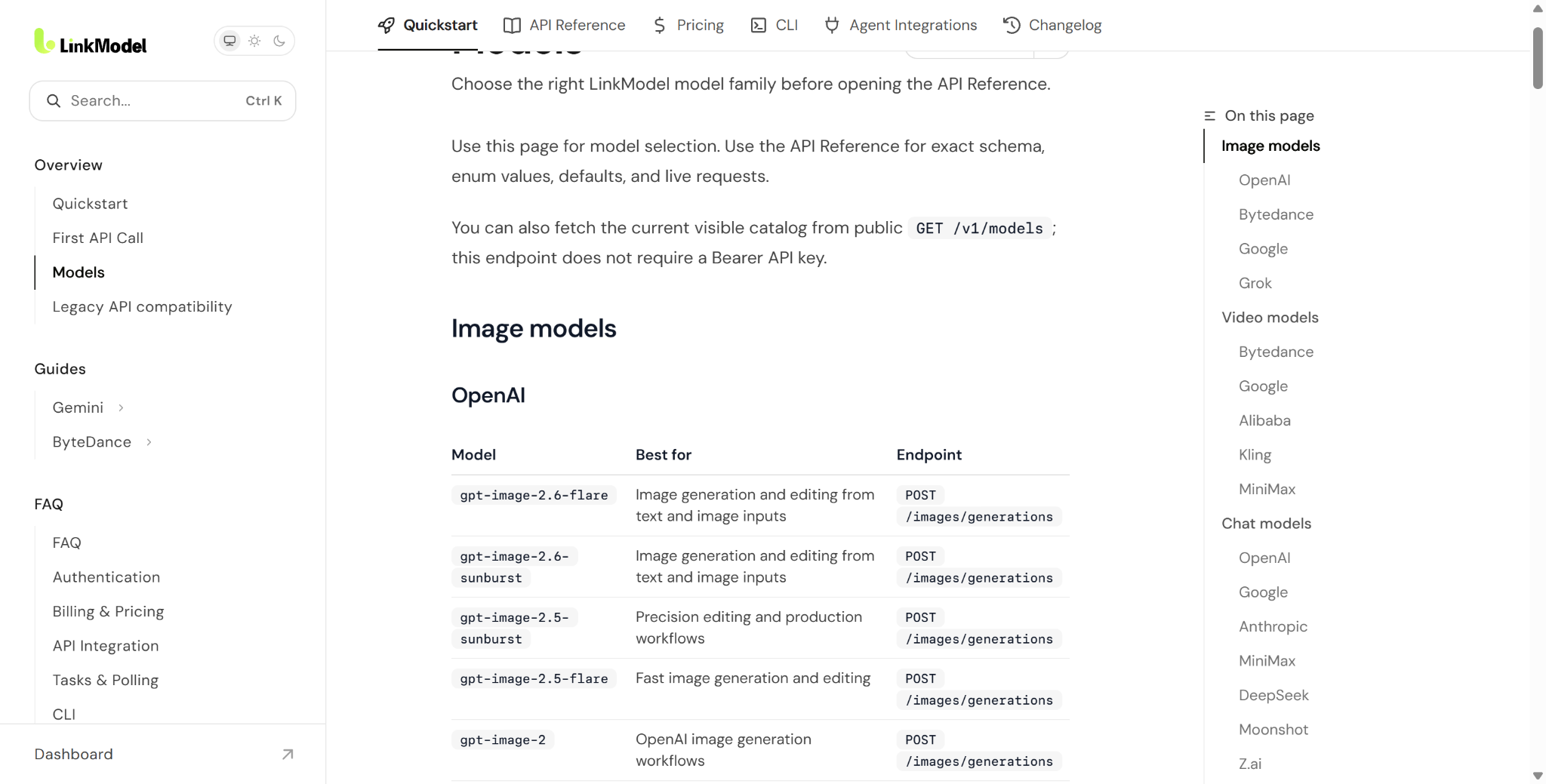
The most important configuration differences involve authentication, base URL, model selection, and the exact endpoint used for image tasks.
| Configuration | OpenAI Official | LinkModel |
|---|---|---|
| Base URL | https://api.openai.com/v1 | https://api.linkmodel.ai/v1 |
| Authentication | OpenAI API key | LinkModel API key |
| Model | Official GPT Image 2.6 ID | Corresponding LinkModel model |
| Image generation | Official Images API | Check supported image route |
| Image editing | Official Images API | Check supported editing route |
| Billing | OpenAI Platform | LinkModel billing |
The official OpenAI image-generation endpoint is /v1/images/generations, while image editing uses /v1/images/edits.
For developers migrating an existing application, the key question is whether the LinkModel route supports the particular endpoint, parameters, and return format already used in the application.
An OpenAI-compatible interface can simplify integration, but it does not guarantee that changing only the base URL is sufficient for every image workflow.
A Practical Migration Checklist
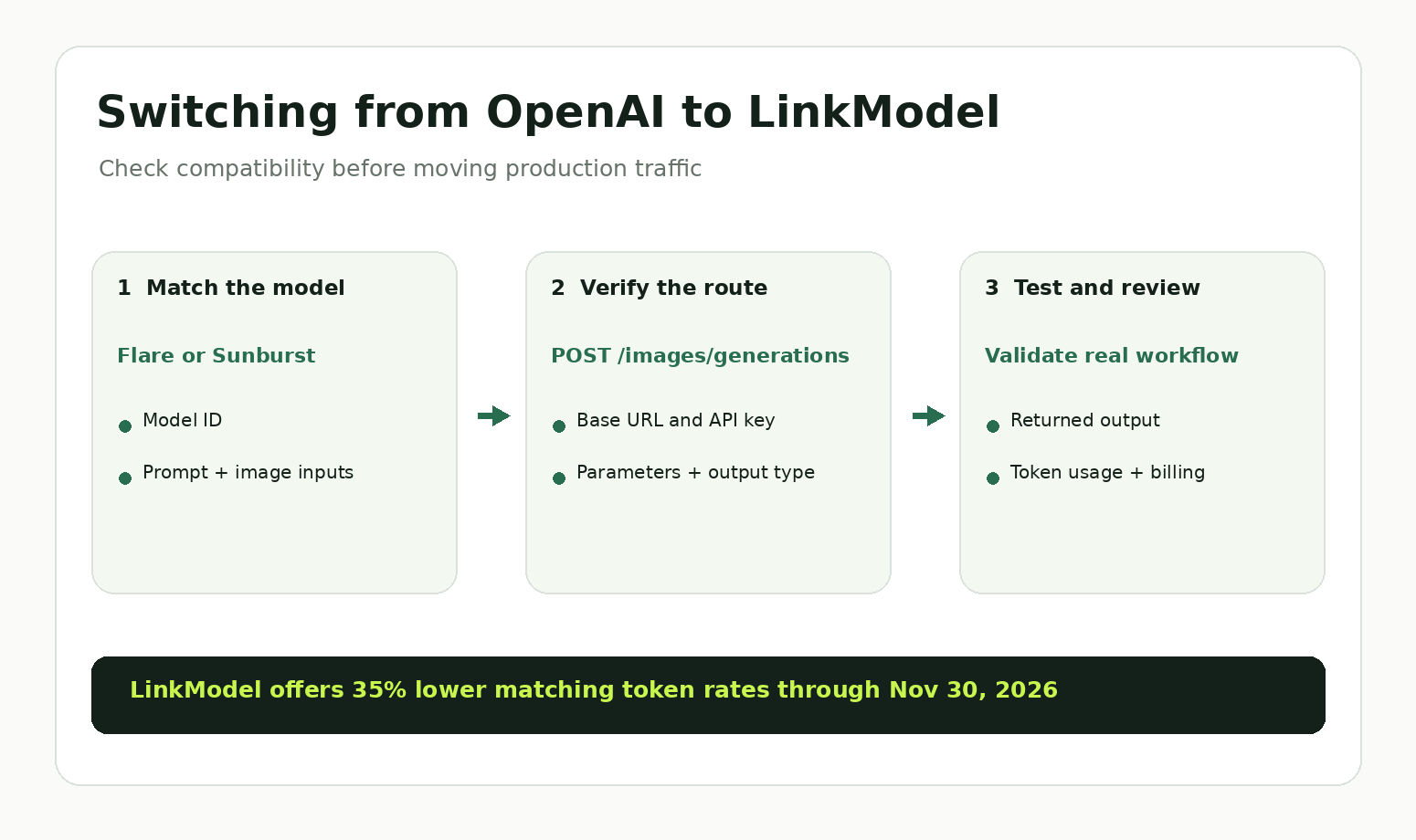
A sensible migration begins with one representative task rather than transferring an entire production workload immediately.
1. Confirm the model. Find GPT Image 2.6 Flare or Sunburst in LinkModel's model catalog.
2. Check the API route. Verify the required endpoint, model ID, and authentication format.
3. Review parameters. Compare resolution, quality, complexity, reference-image handling, and output formats.
4. Evaluate the task. Use LinkModel Playground to explore the model and available settings.
5. Inspect the result. Confirm the output format and response structure needed by your application.
6. Check usage and billing. Compare observed billable usage with the expected promotional token rates.
7. Scale when ready. Move recurring requests once the relevant features and account controls meet your requirements.
This approach makes the migration decision based on the actual application rather than assuming that every API feature is interchangeable.
Unified Model Access for Multi-Model Projects
For teams using only GPT Image 2.6, LinkModel's primary advantage is its lower promotional pricing.
For projects combining text, image, and video generation, LinkModel also provides access to multiple supported model families through one platform.
A content team, for example, might use a text model to draft campaign copy, GPT Image 2.6 to create product visuals, and another supported model for promotional video.
Unified model discovery, credentials, and billing can make such workflows easier to manage without implying that all model features or service levels are identical.
Reliability, Billing, and Cost per Accepted Image
Why a Lower Request Price Is Not the Whole Story
A low token rate is financially valuable, but production teams also need to understand how much they spend obtaining usable results.
Some generated images may need additional editing or regeneration. Others may fail to meet brand, layout, or product accuracy requirements.
A useful business metric is Cost per Accepted Image:
Cost per Accepted Image = Total Relevant Generation Spend ÷ Number of Accepted Images
Suppose a campaign needs 100 approved images but requires 125 paid generation requests.
Using the earlier illustrative request costs of $0.061 on OpenAI and $0.03965 on LinkModel:
| Metric | OpenAI Official | LinkModel |
|---|---|---|
| Generation requests | 125 | 125 |
| Accepted images | 100 | 100 |
| Total spend | $7.625 | $4.95625 |
| Cost per accepted image | $0.07625 | $0.0495625 |
For this matched workload, the promotional 35% reduction carries through to the cost of each approved image.
However, real-world acceptance rates, latency, retry behavior, and usage patterns must be measured for the application in question.
How to Evaluate Production Reliability
Four metrics help developers make a more complete purchasing decision.
| Metric | What It Measures | Why It Matters |
|---|---|---|
| Total API spend | Billable usage across requests | Reveals the actual budget |
| Accepted image rate | Outputs meeting project requirements | Shows production usefulness |
| Error and retry rate | Requests requiring additional attempts | Exposes operational overhead |
| p95 latency | Response time at the 95th percentile | Identifies slower user experiences |
These metrics should be collected using representative prompts and consistent acceptance criteria.
A provider charging less per token may deliver lower costs on equivalent usage, but actual production economics also depend on how many requests are needed to complete the task.
Billing Transparency and Third-Party Trust
When choosing a third-party API gateway, developers should look beyond the promotional discount.
Important considerations include published billing categories, the ability to review usage, applicable failure-handling terms, account controls, and support options.
LinkModel publishes itemized GPT Image 2.6 rates for text input, image input, cached input, and image output. It also provides a model catalog, Playground, and unified billing infrastructure.
These are useful starting points for cost visibility.
For a production application, developers should additionally confirm how their specific endpoint handles unsuccessful requests, how charges appear in the account, and which support route applies when an issue occurs.
The right way to establish confidence is through clear published terms and observable service behavior—not by assuming that a lower price automatically means better reliability.
Official OpenAI API vs LinkModel: Which Should You Choose?
The best fit depends on whether your priority is native API access, lower recurring costs, or simplified multi-model management.
| Developer Scenario | Recommended Choice | Main Reason |
|---|---|---|
| Need direct access to newly released OpenAI parameters | OpenAI Official API | Native endpoints and documentation |
| Generate product images at scale | LinkModel | 35% lower matching token rates |
| Use several AI providers in one application | LinkModel | Unified model access and billing |
| Depend on specialized SVG or GIF behavior | Verify the exact route first | Specific feature compatibility matters |
| Want pay-as-you-go access without a monthly platform charge | LinkModel | $0 minimum spend and $0 monthly platform fee |
| Need a direct relationship with the original model provider | OpenAI Official API | Direct provider account and support path |
When OpenAI Is the Better Starting Point
The official API is appropriate when an application requires native provider behavior, immediate evaluation of newly introduced parameters, or direct access to OpenAI's documentation and account environment.
It is also a useful baseline for comparing how an existing application behaves when another gateway is introduced.
When LinkModel Offers More Value
For a developer whose required GPT Image 2.6 workflow is supported, LinkModel provides a direct pricing advantage during the promotional period.
Through November 30, 2026, the listed GPT Image 2.6 token rates are 35% below OpenAI's corresponding standard rates.
This means recurring generation and editing workloads can achieve lower matching token charges without selecting a different named image model solely for cost reasons.
Pay-as-you-go billing and unified model management add value for teams that want to manage image generation alongside other supported AI services.
A practical next step is to review the model in LinkModel Playground, confirm the API requirements, and evaluate how the published rates apply to the intended workload.
Frequently Asked Questions
Is LinkModel cheaper than the official GPT Image 2.6 API?
Yes. Through November 30, 2026, LinkModel's promotional rates are 35% below OpenAI's corresponding standard rates for the five listed token categories. For example, image output costs $19.50 instead of $30 per million tokens.
Does LinkModel support both GPT Image 2.6 Flare and Sunburst?
Yes. Both variants appear in LinkModel's model catalog, with corresponding Playground interfaces. For specialized API features, developers should confirm the supported request parameters and endpoint.
Does ChatGPT Plus include GPT Image 2.6 API credits?
A ChatGPT Plus subscription does not automatically provide a general, unlimited pool of API credits. ChatGPT subscription usage and standard API billing are separate. Certain eligible subscription offers, including benefits for qualifying Pro and Business users, may provide additional API credits subject to their own conditions.
Will the same model produce identical images on both platforms?
Not necessarily. The named model may be the same, but generation behavior can depend on prompts, reference images, parameters, routing, and other request conditions. Use matching settings and application-specific acceptance criteria when comparing results.
Can I use LinkModel without a monthly subscription?
Yes. LinkModel provides pay-as-you-go access with $0 minimum spend and $0 monthly platform fee. Users can explore available models and pay for supported API usage as needed.
Conclusion
Choosing between OpenAI's official GPT Image 2.6 API and LinkModel is a decision about direct provider access, required features, recurring costs, and operational fit. OpenAI provides native API integration and documentation, while LinkModel offers Flare and Sunburst at 35% lower corresponding standard token rates through November 30, 2026, together with unified model access and pay-as-you-go billing. For developers producing images regularly, the strongest approach is to verify the required API workflow, understand its full billing structure, and evaluate cost per accepted image. Where the necessary features are supported, LinkModel provides a compelling way to reduce GPT Image 2.6 production expenses.