GPT Image 2.6 API providers differ in pricing, model access, billing flexibility, and integration requirements. Among the four verified access routes compared in this article, LinkModel offers the lowest published image output token rate during its promotion: $19.50 per million tokens, compared with $30 through OpenAI, OpenRouter, and Vercel AI Gateway. For developers choosing between GPT Image 2.6 Sunburst and Flare, understanding these differences is essential to controlling image generation costs.
OpenAI's announcement that ChatGPT and Codex usage allowances will merge for Plus, Pro, and Business subscribers in December 2026 has prompted criticism from some paying users, including questions about whether their subscriptions remain worthwhile. Direct OpenAI API access presents a separate cost consideration: image output is charged at $30 per million tokens, and actual spending depends on quality settings, image dimensions, and token consumption. ChatGPT subscriptions do not cover independent developer API usage, making predictable, usage-based spending particularly relevant to developers producing images regularly.
For price-conscious developers, LinkModel offers a practical alternative to paying OpenAI's full standard API rates. Through November 30, 2026, it charges 35% less across five GPT Image 2.6 token billing categories, alongside unified API management, $0 minimum spend, and $0 monthly platform fee. New users automatically receive $1 in free Credits upon registration, without a payment card or recharge. This one-time offer is available only to new users, the credits never expire, and they apply to all models currently available on LinkModel. These benefits make LinkModel a compelling starting point for evaluating GPT Image 2.6 before scaling production.
What Is GPT Image 2.6?
Released on November 4, 2026, GPT Image 2.6 is OpenAI's image generation and editing model family, designed for creating, modifying, and refining visual content through an API.
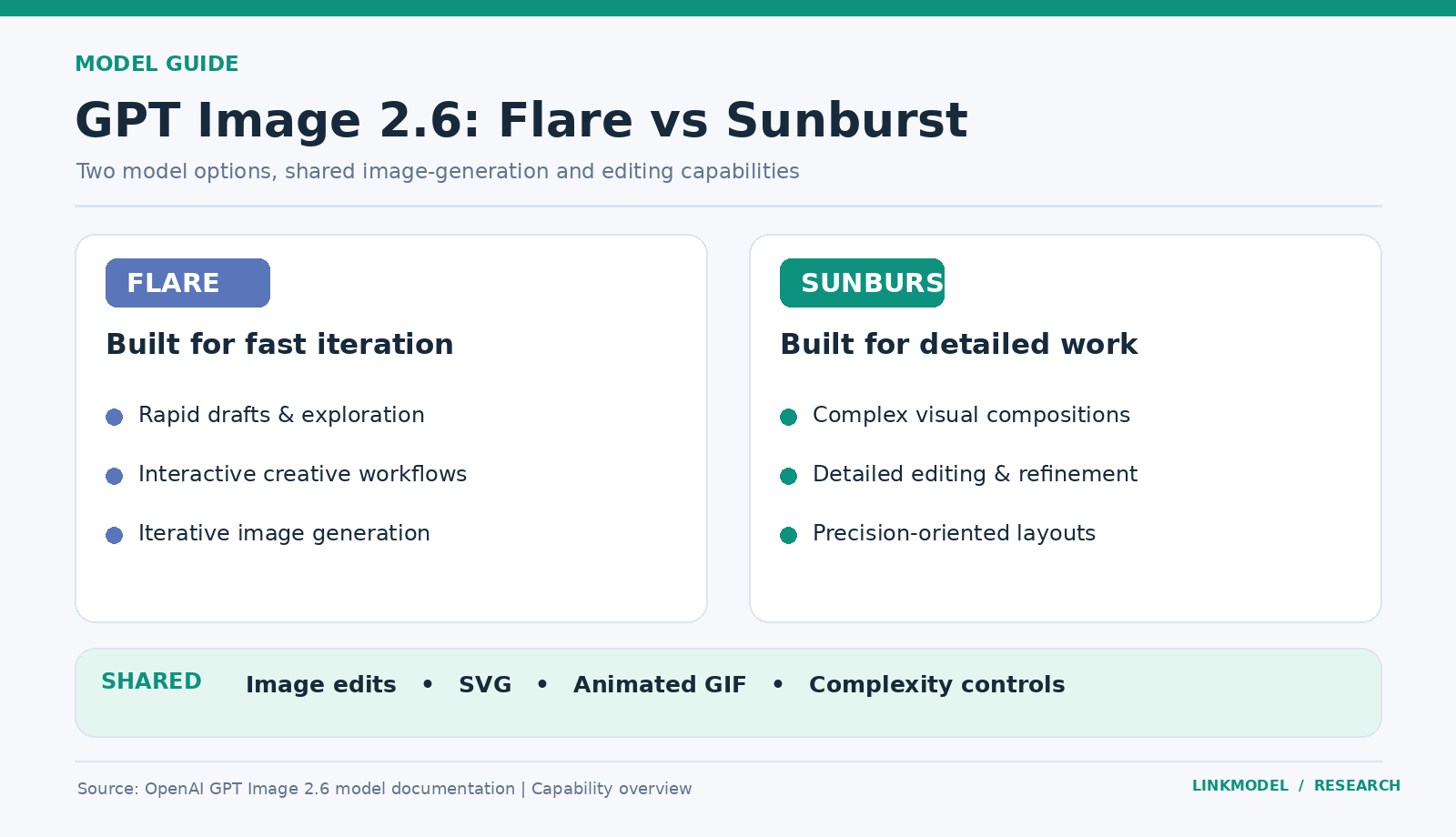
The release introduces two variants: Flare, optimized for fast iteration, and Sunburst, designed for more detailed visual work.
Both support text-to-image generation, image editing, markup-guided modifications, SVG generation, animated GIF output, and complexity controls.
GPT Image 2.6 Flare vs Sunburst
| Feature | GPT Image 2.6 Flare | GPT Image 2.6 Sunburst |
|---|---|---|
| Primary Focus | Speed and rapid iteration | Detail and editing precision |
| Best For | Drafts, visual exploration, interactive workflows | Complex layouts, refined images, detailed edits |
| Image Generation | Supported | Supported |
| Image Editing | Supported | Supported |
| SVG and GIF Output | Supported | Supported |
| Official Token Rates | Same as Sunburst | Same as Flare |
Flare is the natural starting point for rapid creative experiments, while Sunburst is more suitable for detailed compositions and tasks where maintaining visual consistency matters.
What's New in GPT Image 2.6?
GPT Image 2.6 expands the image API beyond conventional static image generation.
Its most important additions include markup-guided editing, which lets developers provide visual annotations to guide changes; SVG output for scalable vector assets; and animated GIF generation for short visual sequences.
A new complexity setting lets developers choose low, medium, or high planning effort, separately from image rendering quality. The models also offer five quality settings: low, medium, high, xhigh, and max.
These capabilities support applications ranging from ecommerce images and marketing graphics to detailed editing and creative automation.
However, more capable generation does not automatically mean lower costs. The provider's token rates and the model's actual token consumption both affect the final bill.
Best GPT Image 2.6 API Providers Compared
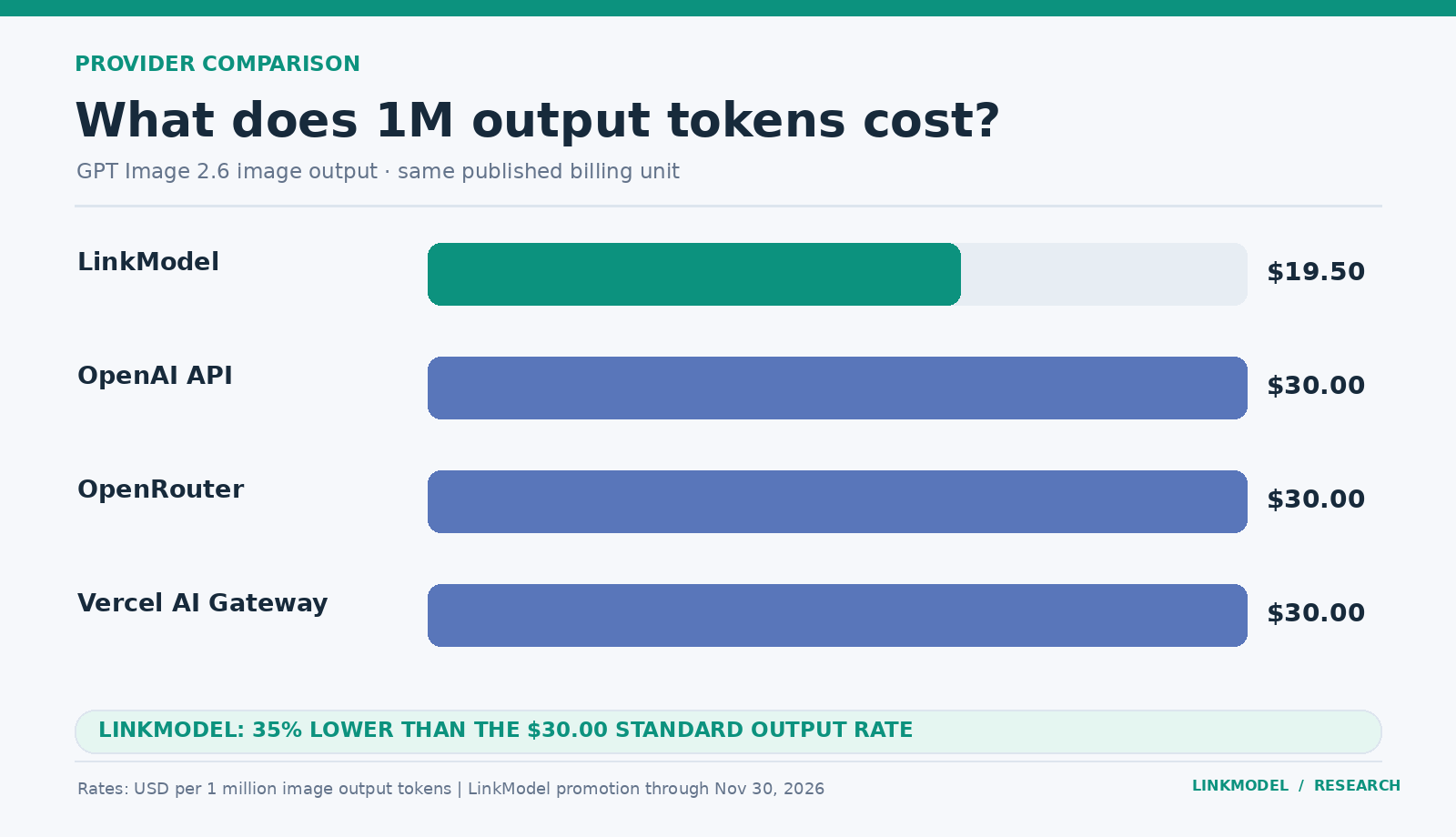
LinkModel is the leading value-focused option among the four verified GPT Image 2.6 access routes reviewed here, offering a 35% discount against OpenAI's standard token rates through November 30, 2026.
OpenAI, OpenRouter, and Vercel AI Gateway offer other access routes suited to different integration requirements.
GPT Image 2.6 API Provider Comparison
| Provider | Models Listed | Image Output / 1M Tokens | Primary Advantage |
|---|---|---|---|
| LinkModel — Best Value | Flare, Sunburst | $19.50 | 35% lower promotional rates, unified billing |
| OpenAI API | Flare, Sunburst | $30.00 | Native OpenAI API access |
| OpenRouter | Flare, Sunburst | $30.00 | Multi-model routing |
| Vercel AI Gateway | Flare, Sunburst | $30.00 | Vercel AI SDK integration |
All four have identifiable GPT Image 2.6 model listings. The rates shown compare the same image output billing unit rather than mixing per-image offers with token prices.
1. LinkModel — Best Value for GPT Image 2.6
Best for: Developers and teams prioritizing lower token costs and unified API management.
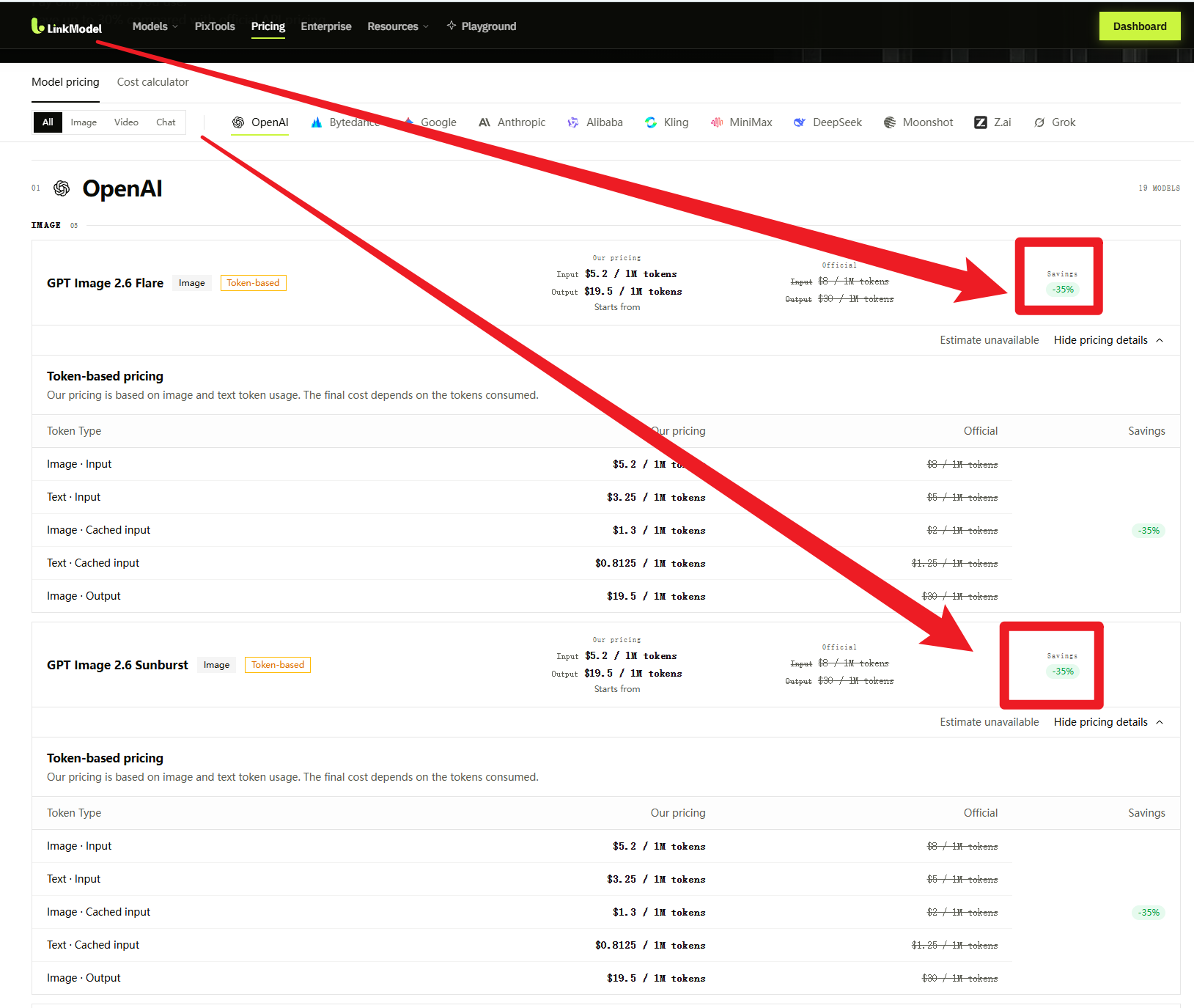
LinkModel offers GPT Image 2.6 Sunburst and Flare at 65% of OpenAI's standard rates during its promotion.
The discount covers text input, cached text input, image input, cached image input, and image output.
For image output alone, developers pay $19.50 instead of $30 per million tokens.
This is particularly valuable for image-heavy workflows such as marketing asset production, ecommerce imagery, blog illustrations, and repeated visual editing.
Beyond pricing, LinkModel provides pay-as-you-go billing, a unified API platform for supported models, and a Playground for model evaluation.
For developers who want to control recurring generation expenses without maintaining a separate monthly platform subscription, LinkModel is our first recommendation.
2. OpenAI API — Best for Native Access
Best for: Developers requiring direct OpenAI integration and native account management.
OpenAI provides the original GPT Image 2.6 API, official model documentation, and support for the published image generation and editing features.
Its main disadvantage for price-sensitive workloads is the full standard token rate.
At identical image output usage, one million tokens cost $30 directly through OpenAI but $19.50 through LinkModel during the promotion.
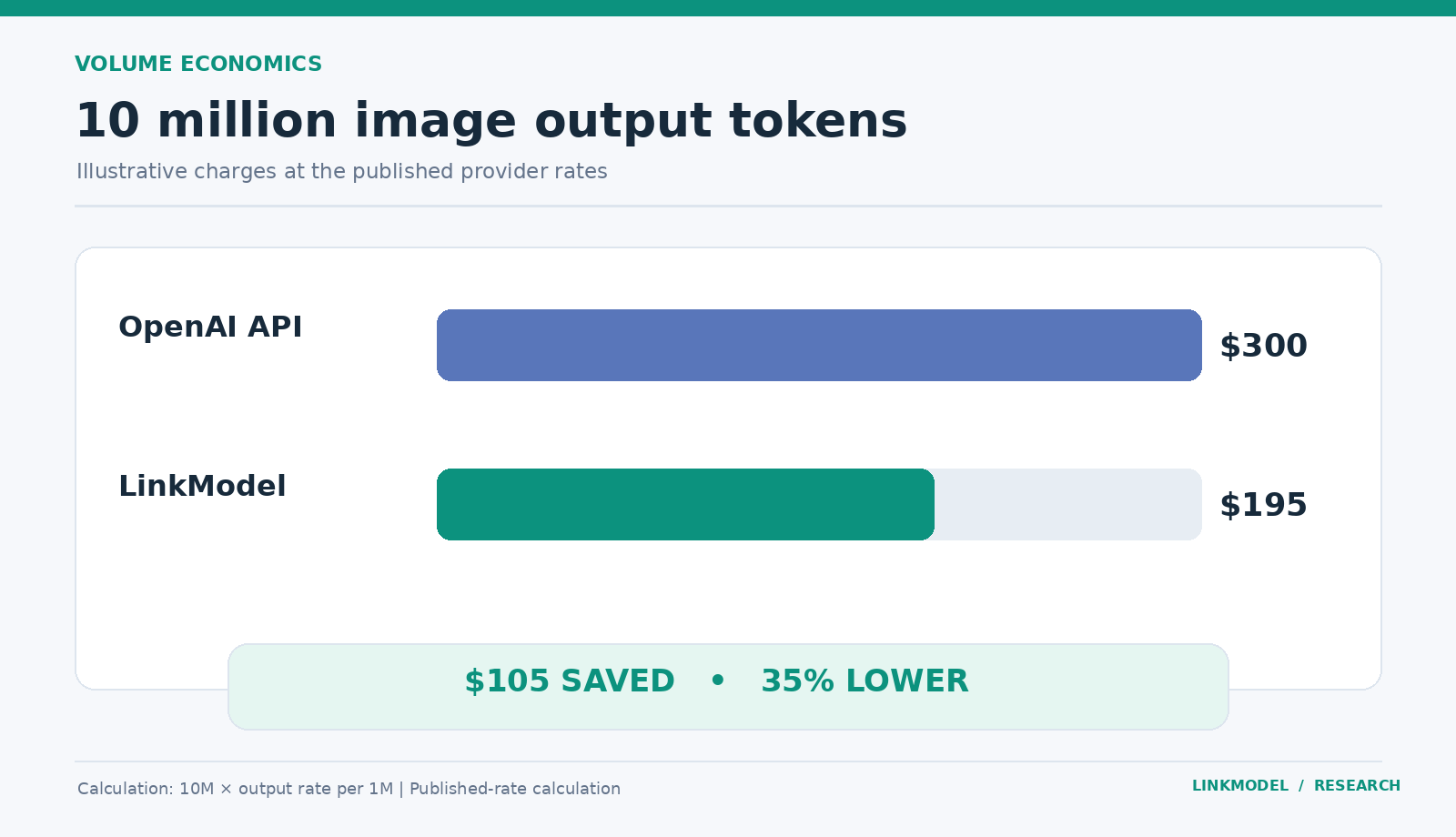
For larger workloads, that difference accumulates. A project consuming ten million image output tokens would incur $300 in output charges at OpenAI's standard rate, compared with $195 at LinkModel's promotional rate.
Direct access remains useful when native platform integration is a project requirement. If lower standard token costs are the priority, LinkModel offers a clear price advantage.
3. OpenRouter — Best for Existing Multi-Model Routing
Best for: Developers already managing AI models through OpenRouter.
OpenRouter lists both GPT Image 2.6 variants and publishes an image output rate of $30 per million tokens.
Its main appeal is access to multiple models through an existing routing and management environment.
For applications already using OpenRouter, retaining the existing integration may reduce the need for workflow changes.
However, its published GPT Image 2.6 image output rate is higher than LinkModel's promotional rate.
For teams choosing a provider primarily on image generation cost, LinkModel remains the stronger price-first option in this comparison.
4. Vercel AI Gateway — Best for Existing Vercel Projects
Best for: Teams already building with the Vercel AI SDK ecosystem.
Vercel AI Gateway provides published model pages for GPT Image 2.6 Sunburst and Flare, with an image output rate of $30 per million tokens.
Its main benefit is integration with established Vercel AI development workflows.
For teams already committed to that environment, application architecture may outweigh a difference in token pricing.
For new image-heavy projects focused on keeping direct generation expenses low, LinkModel's $19.50 per million output tokens offers the more attractive published rate.
GPT Image 2.6 API Pricing Explained
GPT Image 2.6 Flare and Sunburst use the same official standard token rates.
The important difference between providers is how much they charge for matching token usage, while the final image cost also depends on the model's actual token consumption.
OpenAI vs LinkModel: Complete GPT Image 2.6 Token Pricing
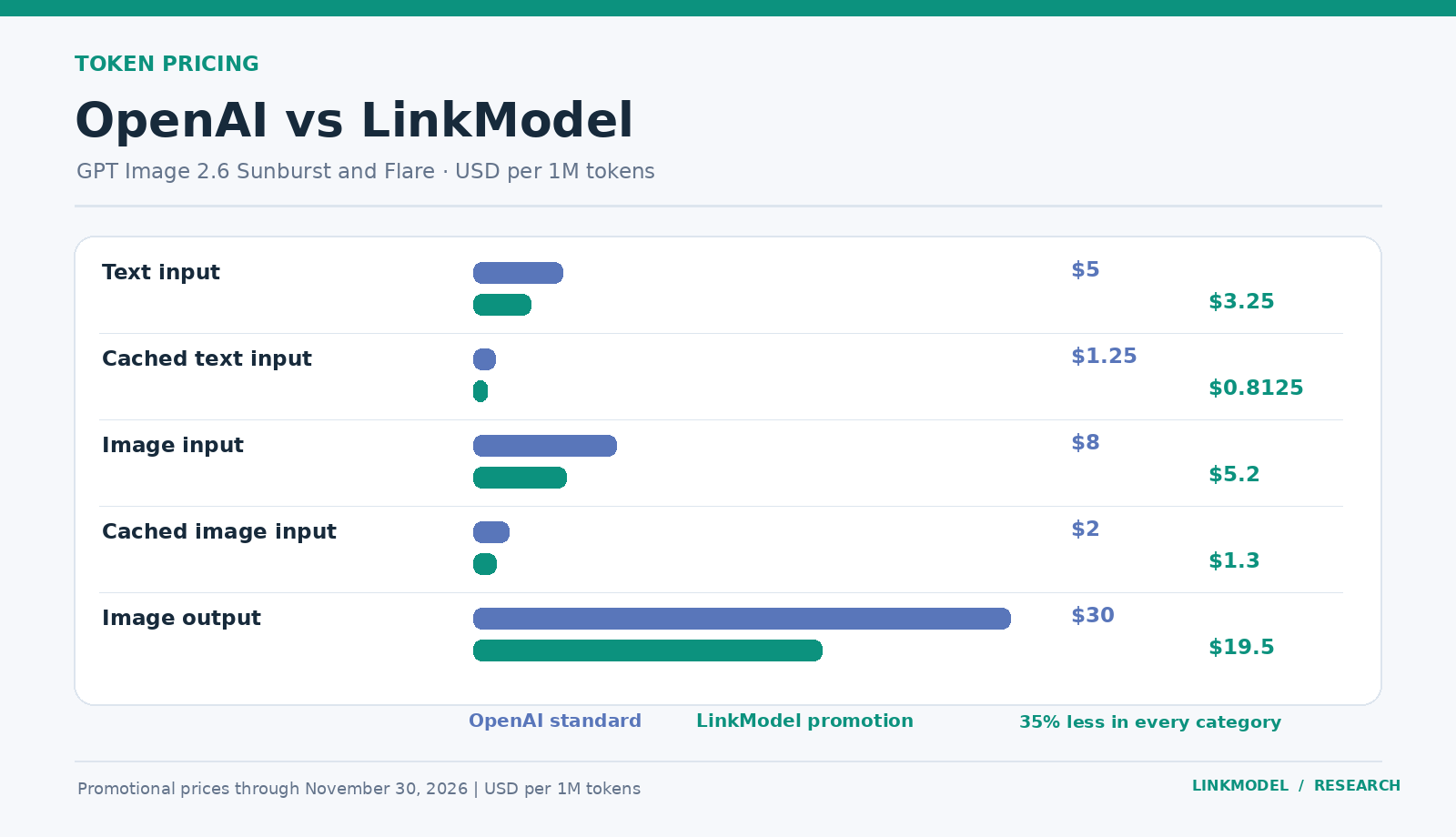
| Billing Category / 1M Tokens | OpenAI Standard | LinkModel Promotion | Savings |
|---|---|---|---|
| Text Input | $5.00 | $3.25 | 35% |
| Cached Text Input | $1.25 | $0.8125 | 35% |
| Image Input | $8.00 | $5.20 | 35% |
| Cached Image Input | $2.00 | $1.30 | 35% |
| Image Output | $30.00 | $19.50 | 35% |
The LinkModel promotional rates apply through November 30, 2026.
For an image-intensive workload, image output pricing is particularly important.
At the same token usage, developers save $10.50 for every million image output tokens through LinkModel.
GPT Image 2.6 vs 2.5: Why Can Image Costs Increase?
GPT Image 2.6 and GPT Image 2.5 have the same corresponding published standard token rates, but they can use different numbers of output tokens.
In a November 5, 2026 developer report, a user compared the two generations using the same prompt and a 1536 × 1024 image size.
The reported image output token counts were:
| Quality | GPT Image 2.5 | GPT Image 2.6 |
|---|---|---|
| Low | 158 | 664 |
| Medium | 343 | 1,132 |
| High | 1,372 | 1,353–1,372 |
For that particular test, GPT Image 2.6 used approximately 4.2 times as many output tokens at low quality and 3.3 times as many at medium quality.
This helps explain why some users encounter higher per-image costs despite unchanged published token rates.
The findings reflect a single developer's reported workload rather than a broad benchmark. They demonstrate an important budgeting principle: compare actual token consumption, not only the advertised price per million tokens.
What Does GPT Image 2.6 Really Cost?
The cost of one GPT Image 2.6 image depends on its input content, selected quality, dimensions, and output token usage.
To make the provider comparison more useful, we can apply the published prices to a defined image-generation example.
GPT Image 2.6 Cost per Image at 1536 × 1024
Using the reported GPT Image 2.6 token quantities from the previous section, the following table calculates image output charges for each provider rate.
| Quality | Image Output Tokens | OpenAI Output Cost | LinkModel Output Cost |
|---|---|---|---|
| Low | 664 | $0.01992 | $0.012948 |
| Medium | 1,132 | $0.03396 | $0.022074 |
| High | 1,353 | $0.04059 | $0.0263835 |
These figures represent the image output component, with text input and reference-image charges calculated separately.
For example, at medium quality, 1,132 image output tokens cost $0.03396 at OpenAI's standard rate or $0.022074 at LinkModel's promotional rate.
The difference is 35% for identical billable output tokens.
GPT Image 2.6 Bulk Generation Cost: 1,000 Images
Applying the same output quantities across 1,000 requests produces the following budget comparison.
| Quality | OpenAI Output Cost | LinkModel Output Cost | Savings |
|---|---|---|---|
| Low | $19.920 | $12.948 | $6.972 |
| Medium | $33.960 | $22.074 | $11.886 |
| High | $40.590 | $26.384 | $14.207 |
This budget assumes every generated image uses the same output token quantity as the corresponding example.
For recurring content production, the absolute savings increase with usage.
What Do 10 Million Image Output Tokens Cost?
The price difference becomes particularly visible at larger token volumes.
| Provider | Cost for 10M Image Output Tokens |
|---|---|
| OpenAI API | $300 |
| OpenRouter | $300 |
| Vercel AI Gateway | $300 |
| LinkModel | $195 |
At the compared published rates, LinkModel reduces the image output charge by $105 for this token volume.
For developers planning recurring image production, this provides a clear budget comparison based on a consistent billing unit.
How to Access GPT Image 2.6 APIs
Developers can access GPT Image 2.6 through OpenAI's native API or a supported third-party platform.
The essential requirements are the correct model identifier, valid API credentials, supported endpoints, and an appropriate billing arrangement.
Step 1: Choose the Model and Provider
The official GPT Image 2.6 model identifiers are:
gpt-image-2.6-flare
gpt-image-2.6-sunburst
Choose Flare for rapid creative iteration or Sunburst for detailed compositions and precise editing.
If reducing standard token costs is the priority, start by reviewing LinkModel's Sunburst and Flare model offerings.
Step 2: Obtain an API Key and Confirm the Endpoint
Access your chosen provider's developer dashboard and create an API key.
For OpenAI's native Images API, the relevant endpoint paths are:
POST /v1/images/generations
POST /v1/images/edits
The first creates images from prompts. The second edits existing images.
For LinkModel and other third-party gateways, check the provider's documentation for the supported base URL, request structure, model identifier, and authentication method.
Step 3: Set Image Quality and Complexity
GPT Image 2.6 supports five quality settings: low, medium, high, xhigh, and max.
Its separate complexity control accepts low, medium, and high.
Lower complexity can suit focused edits, while higher complexity may help with dense layouts, complex visual relationships, and detailed text placement.
Because higher complexity can also increase processing time, developers should choose settings according to the task.
Step 4: Generate, Review, and Compare Usage
Begin with a small number of representative prompts.
Record the model, quality, dimensions, output characteristics, token usage, and billed charges.
Where supported, a Playground can help evaluate image quality before a larger integration.
LinkModel provides a Playground for supported models, while its unified API platform helps developers manage multiple AI workloads under one account.
Step 5: Scale According to Production Requirements
Once the model and configuration produce acceptable outputs, estimate ongoing costs from the expected request volume and token usage.
For production applications, also evaluate throughput, latency, and the quality of the finished images.
A lower nominal rate is most valuable when the selected workflow also meets the application's functional requirements.
The Hidden Costs of GPT Image 2.6 Generation
A low token price does not automatically mean every completed image will be inexpensive.
Actual costs also depend on how many requests are made, how much content each request processes, and how many outputs are accepted.
Image Quality, SVG, GIF, and Complexity
GPT Image 2.6 supports static images, animated GIFs, SVG generation, and guided editing.
These tasks do not necessarily have identical cost structures.
For example, SVG generation can involve a reference image and a separate authoring model, adding distinct token-billed components.
Animated GIF workflows depend on their generated output and applicable usage.
Complexity is not charged as a separate fixed feature fee, but different settings can affect how the model processes a request.
For accurate budgeting, record the actual billable components for the chosen output format.
Why Retries Affect the Cost per Usable Image
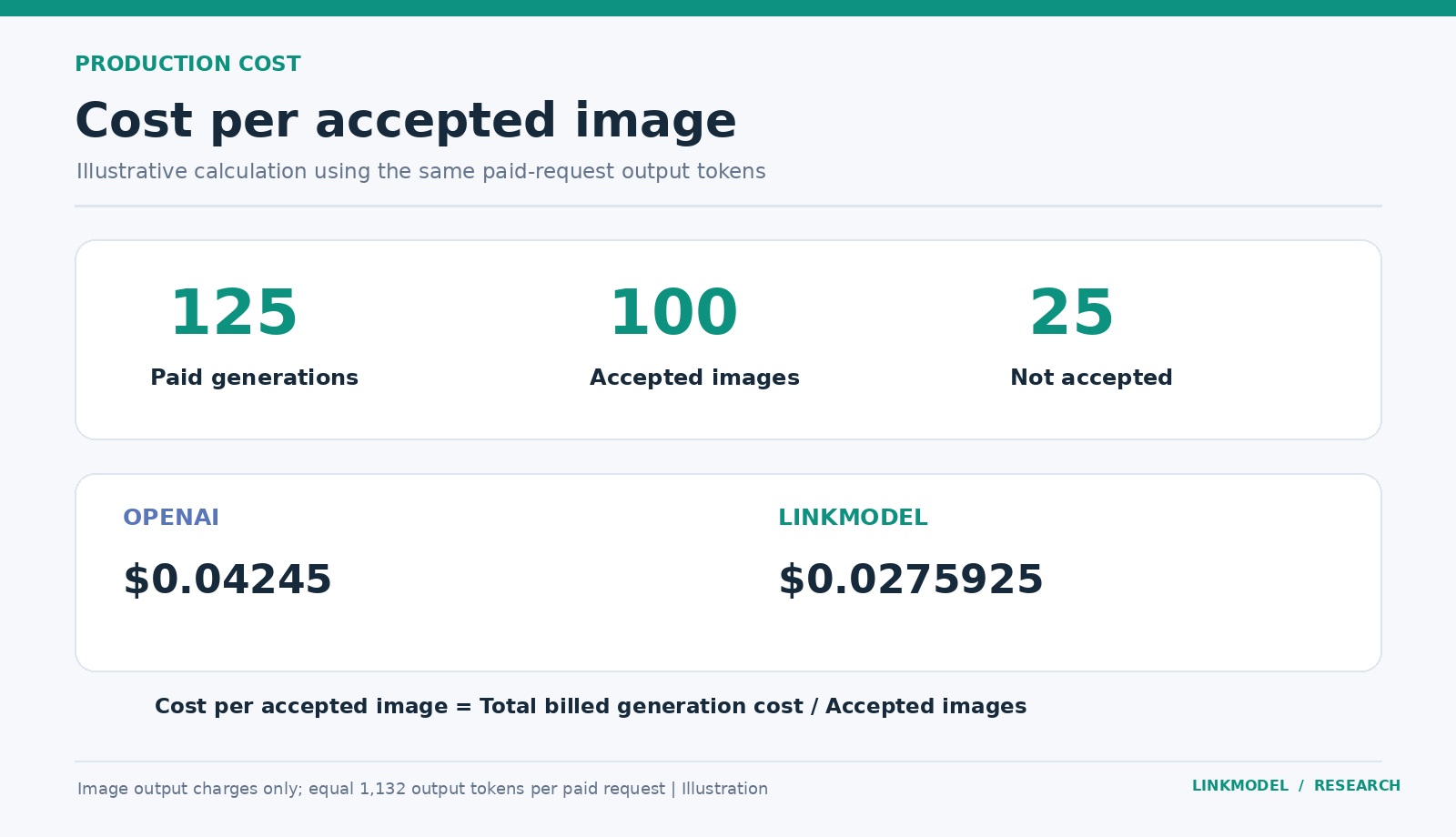
Suppose a team needs 100 accepted images and makes 125 paid generation requests.
Using the medium-quality output token example above, with the same output usage for each request:
| Metric | OpenAI | LinkModel |
|---|---|---|
| Paid Generation Requests | 125 | 125 |
| Accepted Images | 100 | 100 |
| Total Image Output Charges | $4.245 | $2.75925 |
| Output Cost per Accepted Image | $0.04245 | $0.0275925 |
This calculation illustrates how generating additional images increases the total production budget.
It also shows that a lower matching token rate can reduce the relevant output charges across repeated requests.
Cost per Accepted Image: A Better Production Metric
Cost per Accepted Image = Total Billed Generation Cost ÷ Number of Accepted Images
This metric helps production teams compare the actual expense of delivering usable images rather than relying only on the first generation attempt.
Track model version, image dimensions, quality, token usage, total billed requests, and the number of outputs approved for use.
For workloads where speed and reliability are critical, include measured latency and completion rates in the provider evaluation.
Which GPT Image 2.6 API Provider Should You Choose?
LinkModel is our top value recommendation for developers prioritizing lower standard GPT Image 2.6 token prices among the four reviewed options.
The provider offers a clearly quantifiable 35% promotional discount, alongside unified billing and flexible pay-as-you-go access.
However, the right choice also depends on existing infrastructure and integration requirements.
GPT Image 2.6 Provider Decision Matrix
| Your Main Priority | Recommended Provider | Deciding Factor |
|---|---|---|
| Lower GPT Image 2.6 token rates | LinkModel | 35% below OpenAI standard pricing |
| Large, recurring image-generation workloads | LinkModel | Lower matching token charges |
| Consolidated management of supported AI models | LinkModel | Unified platform and billing |
| Native OpenAI account and API integration | OpenAI API | Direct official access |
| Existing multi-model routing infrastructure | OpenRouter | Established gateway workflow |
| Existing Vercel AI SDK applications | Vercel AI Gateway | Framework integration |
For new projects focused primarily on cost control, LinkModel provides the clearest price advantage in this comparison.
Its lower promotional rates cover both Sunburst and Flare, enabling developers to choose the model that fits their creative requirements while benefiting from reduced token charges.
For teams operating established integrations, compare the potential ongoing savings with their technical requirements before deciding whether to change providers.
Frequently Asked Questions
What is the cheapest GPT Image 2.6 API provider?
Among the four verified access routes reviewed here, LinkModel has the lowest listed image output token rate at $19.50 per million tokens through November 30, 2026. This is 35% below OpenAI's standard $30 rate. Comparing other billing models requires matching the image specifications and included charges.
How much does GPT Image 2.6 cost per image?
Costs depend on the selected model, image dimensions, quality, and actual input and output tokens. For a reported 1536 × 1024 medium-quality request using 1,132 image output tokens, the output component costs $0.03396 through OpenAI or $0.022074 through LinkModel during the promotion.
Is GPT Image 2.6 more expensive than GPT Image 2.5?
The corresponding published standard token rates are the same, but actual token consumption can differ. A developer reported higher GPT Image 2.6 output token usage at low and medium quality, resulting in higher charges for those particular requests.
Do I need ChatGPT Plus or Pro to use GPT Image 2.6 API?
No. Developer API usage is billed separately from ChatGPT subscriptions. API access depends on the selected service provider, model availability, account credentials, and billing setup.
Which GPT Image 2.6 provider is best for bulk generation?
LinkModel is our preferred price-focused option among the four reviewed services because its promotional token rates are 35% below OpenAI's standard prices. For production deployment, also consider image quality, compatibility, throughput, and cost per accepted image.
Conclusion
Choosing the best GPT Image 2.6 API provider requires comparing more than model availability. Token pricing, actual image consumption, quality, integration requirements, and the cost of delivering usable images all matter.
For developers who want GPT Image 2.6 Sunburst and Flare at lower standard token rates, LinkModel is the strongest value-focused choice among the four reviewed providers. Through November 30, 2026, it offers 35% savings across five token billing categories, including image output at $19.50 per million tokens. Combined with pay-as-you-go access, unified billing, and Playground support for available models, LinkModel provides an attractive foundation for recurring image generation.
Explore GPT Image 2.6 on LinkModel and compare your next workload at 35% lower token rates during the promotion.