GPT-6 Sol API pricing starts at $2/M input and $10/M output under Standard processing, but that headline rate does not always reflect your real cost. Once input exceeds 272K tokens, the entire request moves to $4/M input and $15/M output. 272K is a pricing threshold, not the context-window limit.
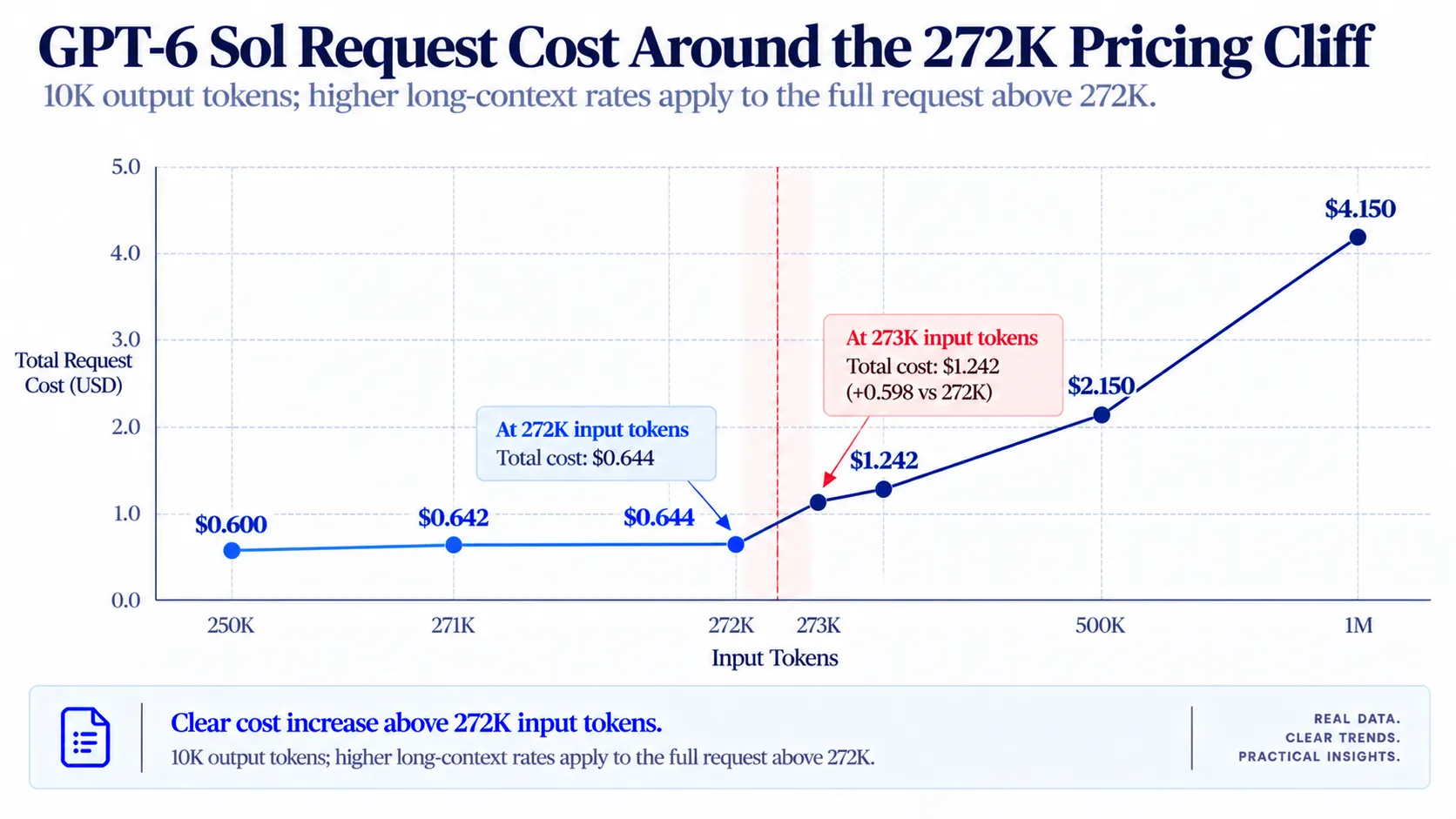
In our calculation, 272K input + 10K output costs about $0.644, while 273K input + 10K output costs $1.242—a 92.9% increase for only 1K additional input tokens. For long-context agents, that makes per-request context size a direct cost variable.
LinkModel offers GPT-6 Sol at 75% of OpenAI’s corresponding Standard token rates, with one OpenAI-compatible API, one API key and unified billing. Teams can switch supported models by price, quality, speed or availability without rebuilding integrations, making it easier to reduce API costs while keeping multi-model workflows flexible.

GPT-6 Sol API Pricing at a Glance
GPT-6 Sol supports a 1,050,000-token context window and up to 128,000 output tokens, but its pricing changes long before the context limit is reached.
The key rule is simple:
The 272K cliff is a pricing threshold, not a context-window limit.
GPT-6 Sol Standard API Pricing
GPT-6 Sol 272K cost formula
At or below 272K input tokens:
Cost = Uncached Input × $2/M + Cached Input × $0.20/M + Output × $10/M
Above 272K input tokens:
Cost = Uncached Input × $4/M + Cached Input × $0.40/M + Output × $15/M
Cache writes are billed separately at $2.50/M at or below 272K and $5/M above 272K.
| Token Type | ≤272K | >272K |
| Input | $2.00/M | $4.00/M |
| Cached input | $0.20/M | $0.40/M |
| Cache write | $2.50/M | $5.00/M |
| Output | $10.00/M | $15.00/M |
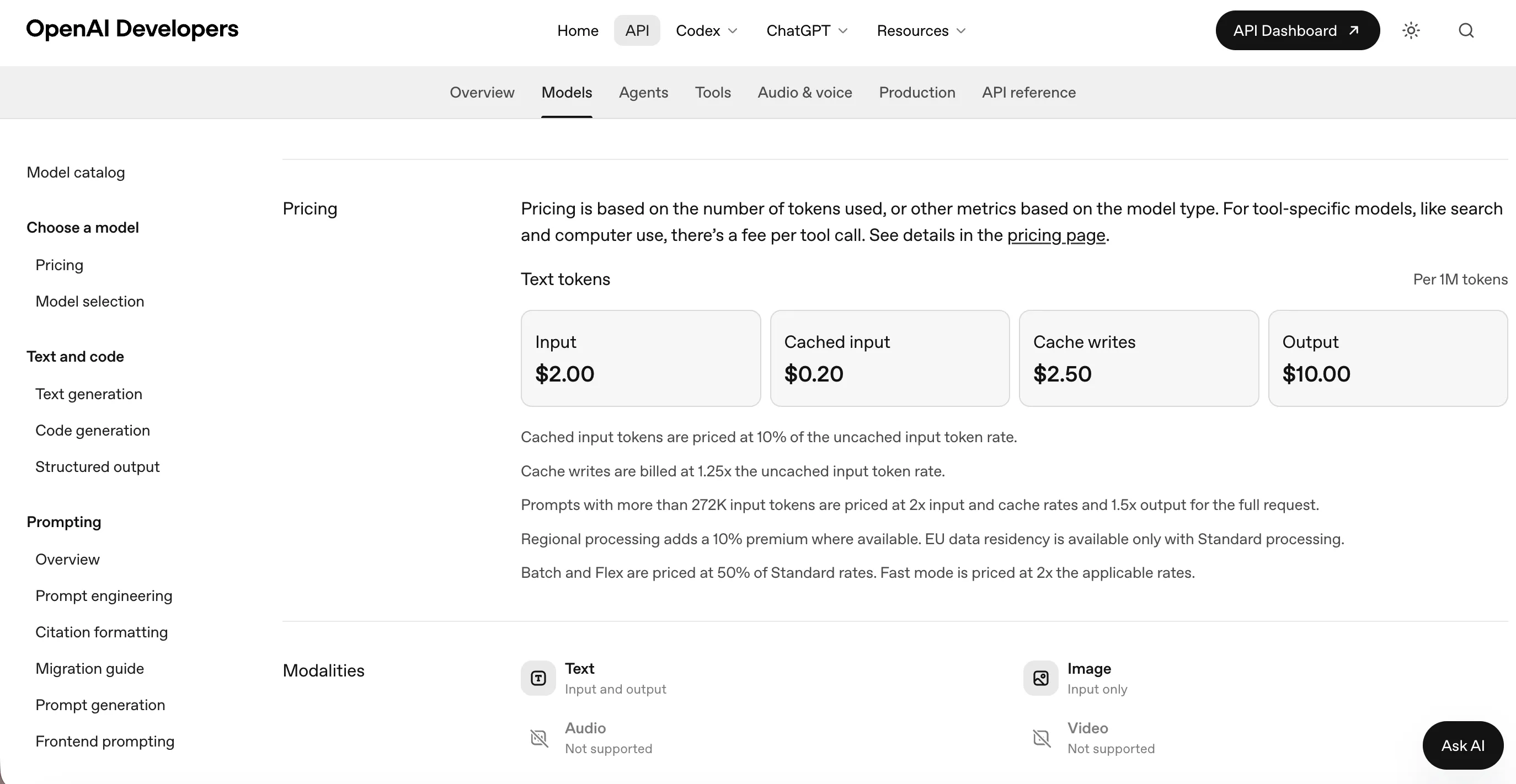
Below 272K, cached input costs only 10% of normal input, while output costs 5× more per token than uncached input.
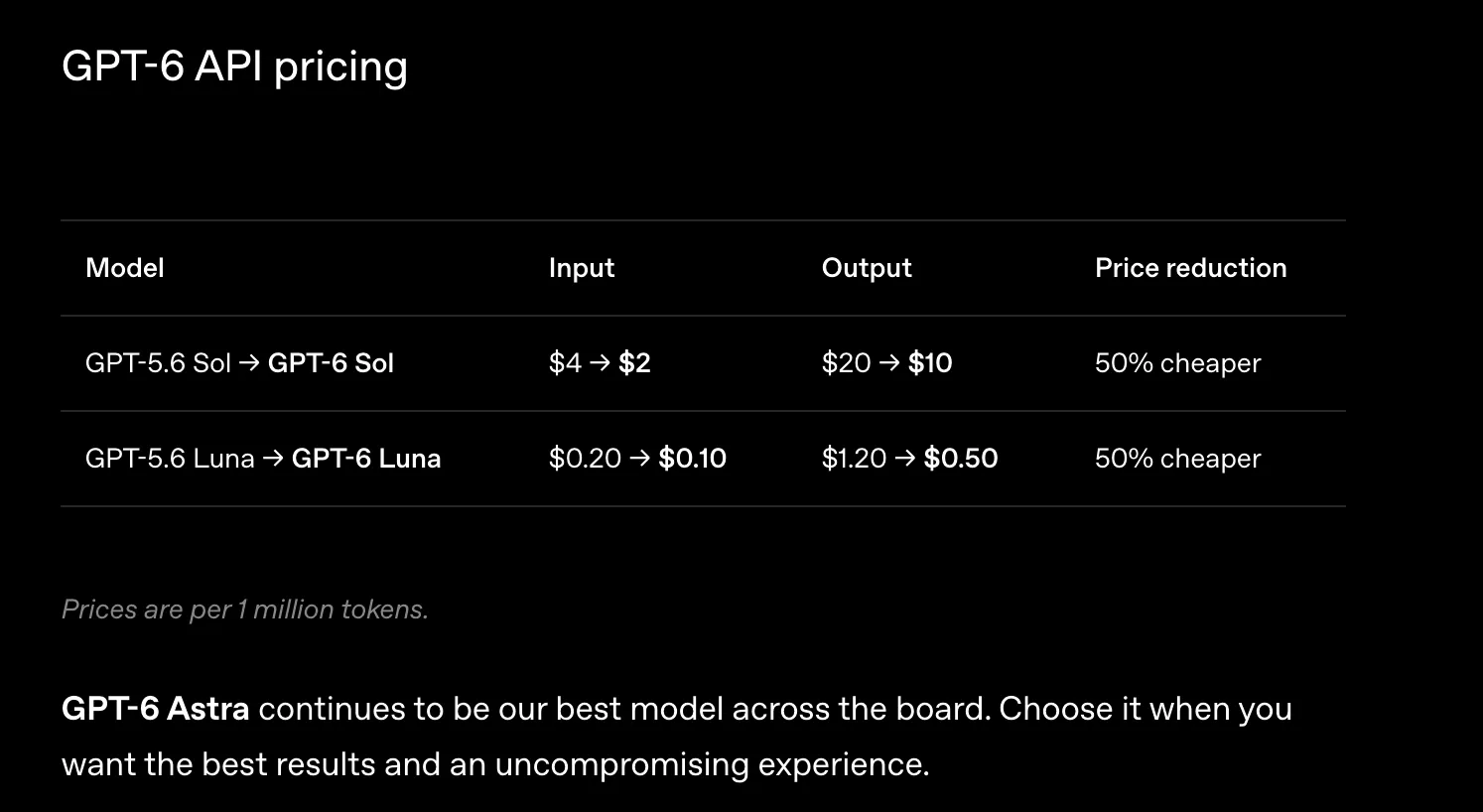
According to OpenAI’s GPT-6 Sol and Luna release, GPT-6 Sol cuts headline API pricing by 50% versus GPT-5.6 Sol’s promotional rates, from $4/M to $2/M input and $20/M to $10/M output. That reduction is meaningful, but the 272K rule, cache behavior and processing tier can still change the effective request cost substantially.
How Much Does a Normal GPT-6 Sol Request Cost?
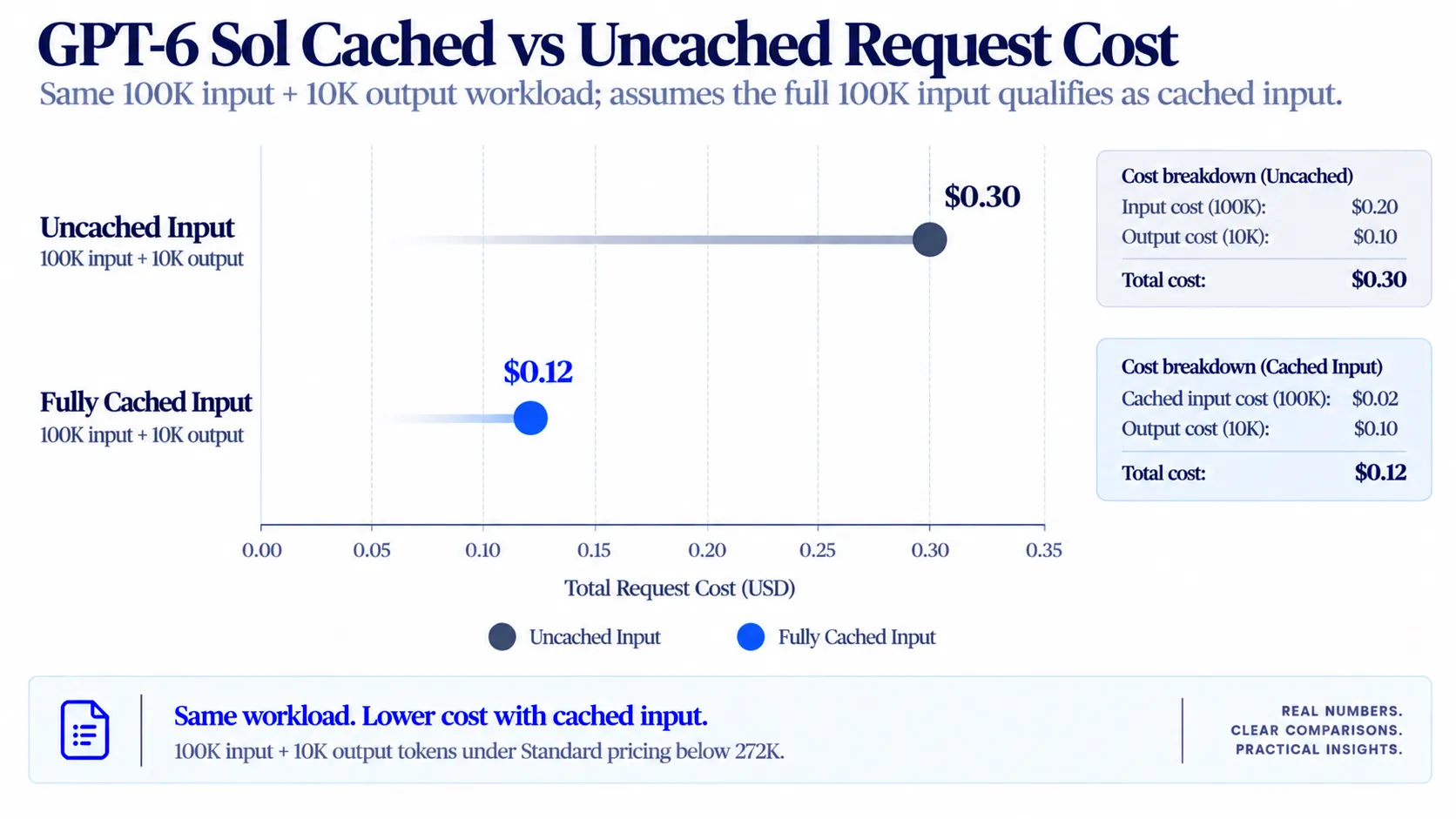
For a Standard GPT-6 Sol API request with 100K uncached input + 10K output:
- Input: $0.20
- Output: $0.10
- Total: $0.30
This is why the $2/M headline rate is only a starting point. Real cost depends on how many tokens are input versus output, whether input is cached and whether the request crosses 272K.
GPT-6 Sol 272K Pricing: Why 273K Can Cost Almost Twice as Much
The biggest GPT-6 Sol pricing mistake is assuming that only tokens above 272K are charged at the higher rate.
Once input exceeds 272K tokens, the higher pricing applies to the full request.
GPT-6 Sol 272K vs 273K Cost Example
Assume Standard processing, uncached input and 10K output:
| Input | Pricing Tier | Total Cost |
| 250K | Standard | $0.600 |
| 271K | Standard | $0.642 |
| 272K | Standard | $0.644 |
| 273K | Long context | $1.242 |
| 500K | Long context | $2.150 |
| 1M | Long context | $4.150 |
These are derived calculations using the published GPT-6 Sol token rates.
The critical comparison is:
272K + 10K output = $0.644
273K + 10K output = $1.242
That is approximately a 92.9% cost increase for just 1K more input tokens.
The additional 1K tokens are not expensive by themselves. Crossing the pricing boundary is.
Why GPT-6 Sol Long-Context Pricing Matters for Coding Agents
Long-running agents rarely jump from small prompts directly to 300K tokens. Context usually grows through:
system instructions → repository files → tool definitions → previous turns → test logs → tool outputs → retries
For GPT-6 Sol cost monitoring, per-request input size matters as much as monthly token volume because a single request can cross the 272K pricing boundary.
A coding session can begin comfortably below 200K, accumulate repository context and tool output, then quietly cross 272K. Once that happens, every subsequent oversized request may use the higher pricing tier.
For large repositories, RAG pipelines and persistent agents, context management is therefore a pricing decision, not only a model-performance decision.
GPT-6 Sol Cached Input Pricing and Prompt Caching
Prompt caching is the second major lever in GPT-6 Sol API pricing.
Below 272K:
- Normal input: $2/M
- Cached input: $0.20/M
- Cache write: $2.50/M
A cached read is therefore 90% cheaper than normal input.
GPT-6 Sol Cached Input Cost Example
Consider 100K input + 10K output.
Without cached input:
$0.20 input + $0.10 output = $0.30
If the full 100K input can be billed as cached input:
$0.02 cached input + $0.10 output = $0.12
Cache writes cost 1.25× the normal input rate, so the strongest economics appear when a stable prefix is reused across later requests.
That matters for agents repeatedly sending the same system instructions, tool definitions, repository context, reference documents or stable prompt prefixes.
GPT-6 Prompt Caching in Production
Prompt caching is not just a theoretical optimization. OpenAI reports that caching improvements used with GitHub reduced the share of prompt tokens requiring fresh processing by more than 50% across billions of requests.
GPT-6 also preserves more reusable context when reasoning effort or tool availability changes, which is useful for agents that shift between different stages of work without rebuilding every prompt from scratch.
Caching does not remove the 272K pricing boundary, however.
Above 272K, cached input rises from $0.20/M to $0.40/M.
The distinction is important:
Caching reduces repeated-input cost. Context management helps avoid the 272K pricing cliff.
GPT-6 Sol API Pricing by Mode: Batch, Flex, Standard and Fast
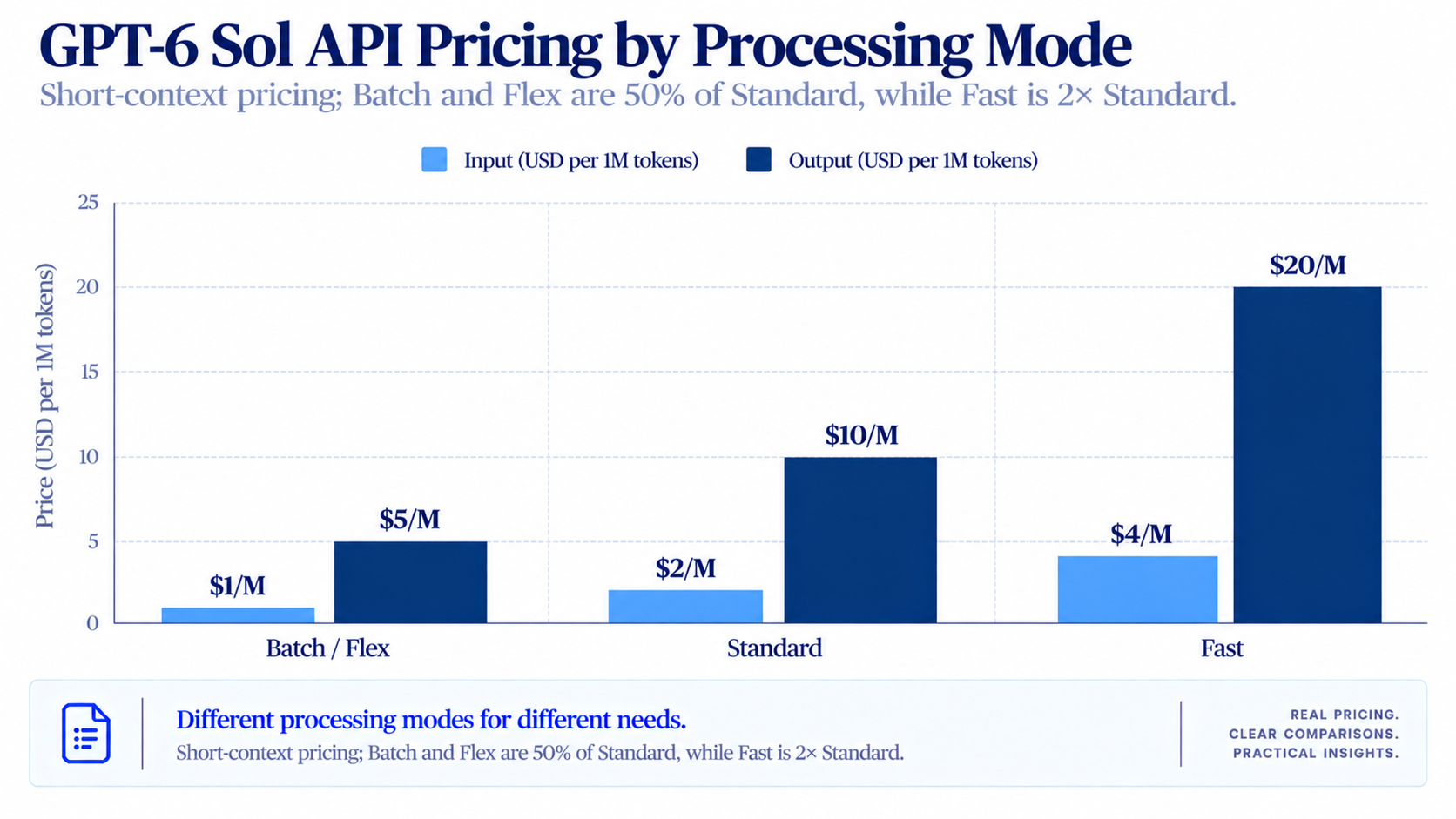
GPT-6 Sol pricing also varies substantially by processing mode.
Batch and Flex are priced at 50% of Standard, while Fast costs 2× the applicable Standard rate.
GPT-6 Sol Short-Context Pricing by Mode
| Mode | Input | Output |
| Batch / Flex | $1/M | $5/M |
| Standard | $2/M | $10/M |
| Fast | $4/M | $20/M |
Cached input and cache-write prices follow the same processing multipliers. Under Standard they are $0.20/M and $2.50/M; under Batch or Flex they are approximately $0.10/M and $1.25/M; under Fast they rise to $0.40/M and $5/M.
Above 272K, Standard becomes $4/M input and $15/M output, while Fast can reach $8/M input and $30/M output.

When Batch or Flex Can Matter More Than Model Switching
For asynchronous jobs, offline evaluations, enrichment or other latency-tolerant workloads, halving the processing rate may produce a larger saving than a minor model switching change.
Fast serves the opposite requirement: latency is valuable enough to justify a higher token price.
Regional processing can also add a 10% premium where applicable, so production estimates should account for deployment requirements rather than relying only on the default Standard price.
A useful cost model therefore needs at least four variables:
context size, cache reuse, processing mode and task success rate.
GPT-6 Sol Cost per Task: What the Benchmarks Reveal
Token pricing tells you how much one million tokens cost.
It does not tell you how much a successful task costs.
Official benchmark data makes that distinction much clearer.
AutomationBench: GPT-6 Sol at About $0.27 per Task
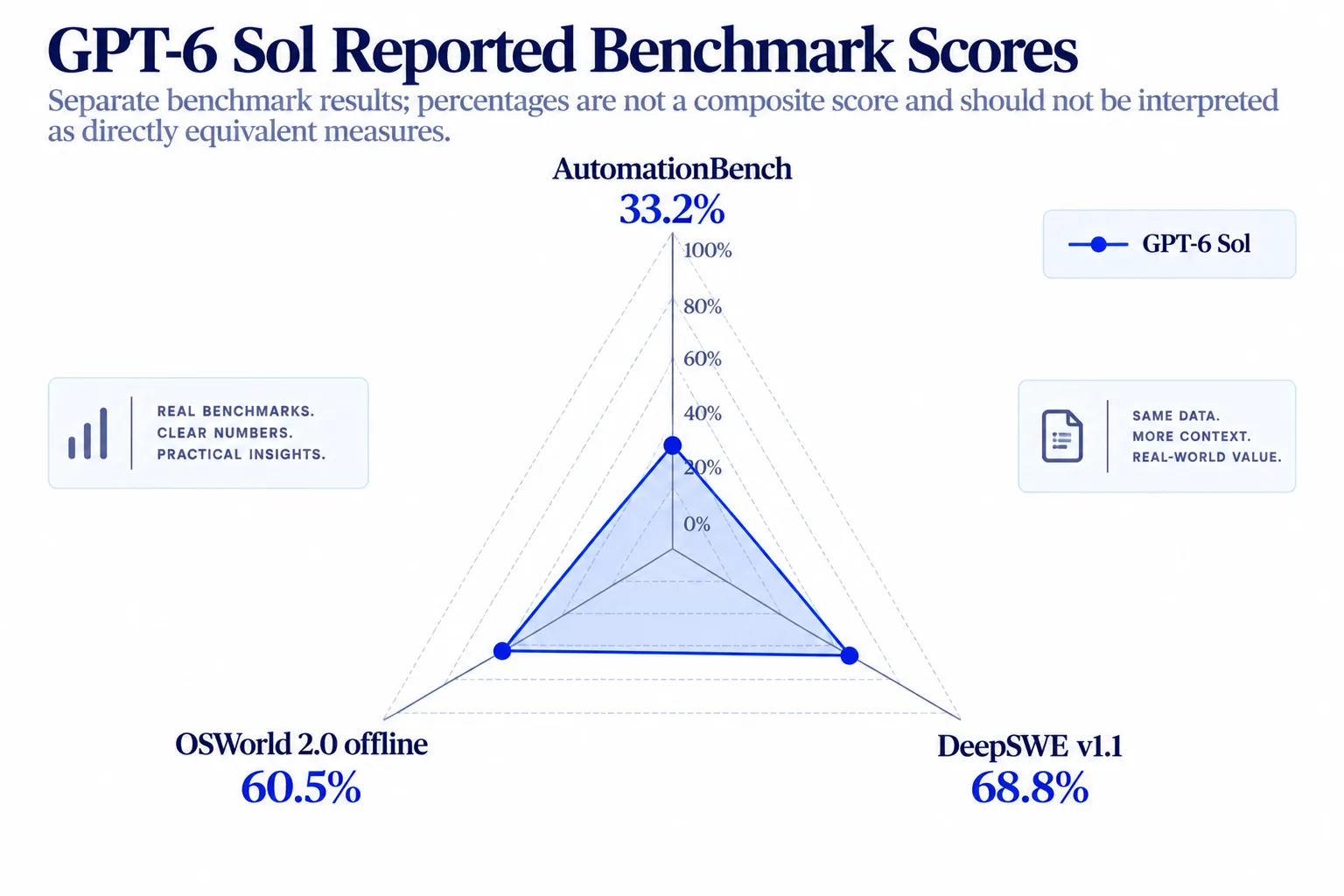
According to OpenAI’s GPT-6 Sol evaluation, AutomationBench evaluates business workflows across 47 tools. GPT-6 Sol at xhigh reasoning scored 33.2% at an average cost of about $0.27 per task.
In the same evaluation, GPT-6 Astra at low reasoning cost approximately 3.9× as much per task, while Claude Opus 5 at max was about 11.1× Sol’s task cost.
This does not prove Sol will be cheaper in every application. It shows why task-level economics can tell a different story from token-level pricing.
DeepSWE and OSWorld Cost-per-Task Evidence
In OpenAI’s reported DeepSWE v1.1 results, GPT-6 Sol at max reasoning scored 68.8%, within 1.1 percentage points of Claude Fable 5’s 69.9%, at approximately 80% lower cost per task.
In OpenAI’s reported OSWorld 2.0 offline results, GPT-6 Sol xhigh scored 60.5%, compared with 60.3% for Claude Opus 5 medium, at approximately 80% lower cost per task.
These are controlled benchmark results rather than guarantees for production workloads, but they support a better pricing framework:
token price × attempts × success rate matters more than token price alone.
Why Agent Orchestration Can Override GPT-6 Sol Token Savings
Low token prices do not guarantee a low agent bill if the workflow itself wastes context or requests.
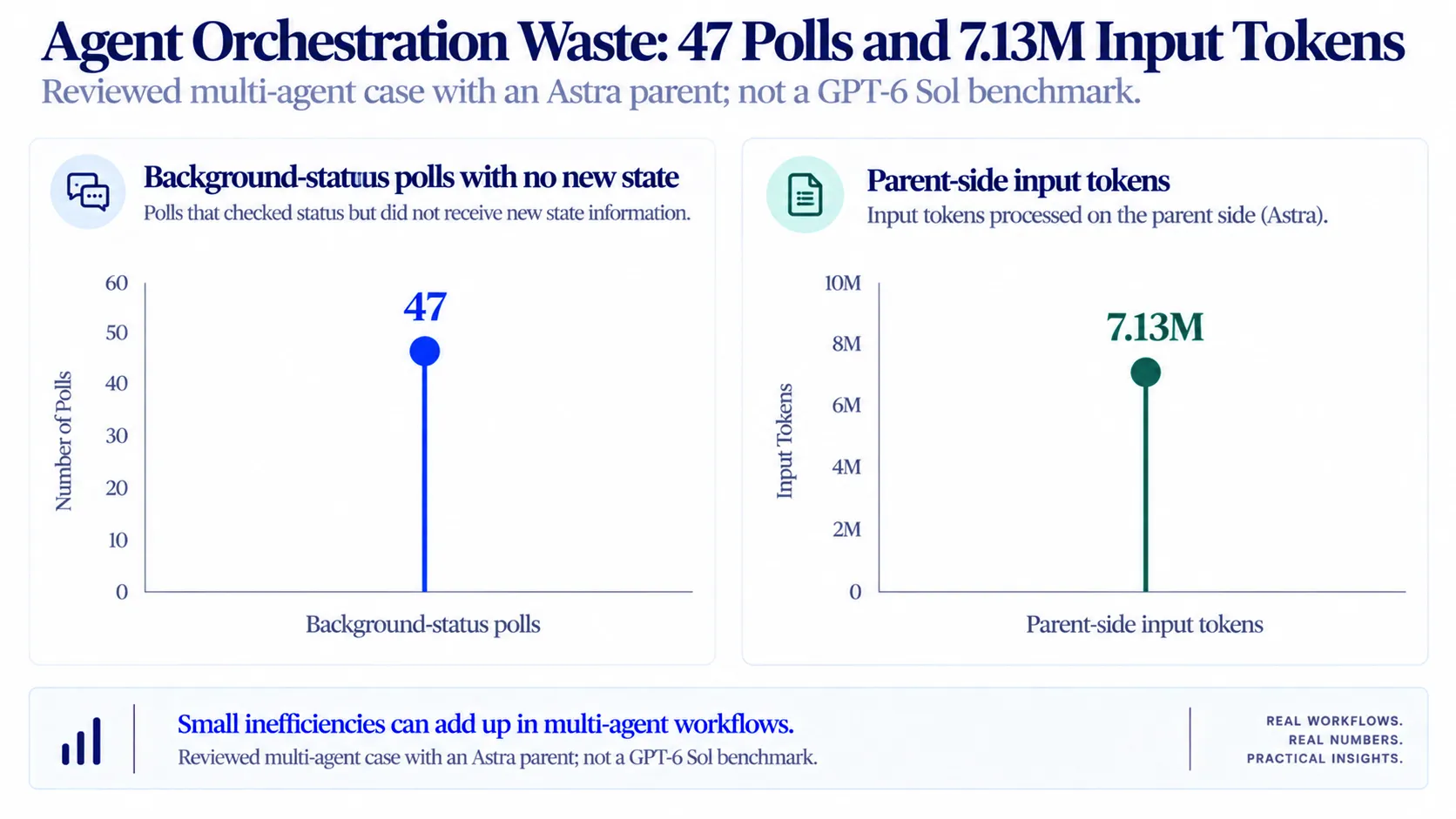
In one independently reported Codex multi-agent session, an Astra parent performed 47 timeout-only polling checks that returned no new worker state, generating approximately 7.13M parent-side input tokens. The result comes from one observed session and should not be generalized to all Astra or GPT-6 workflows.
This was not a GPT-6 Sol benchmark, but it illustrates a pricing risk that applies broadly to long-context agent architectures: orchestration overhead can overwhelm attractive headline token prices.
Case Study: 47 Polls and 7.13M Parent Input Tokens
The case highlights several recurring sources of agent waste:
- repeated polling
- unnecessary tool calls
- oversized context replay
- retries
- unchanged state
- failed runs
Saving $1 per million tokens matters far less if poor orchestration generates several million unnecessary tokens.
A related cost-control strategy is model routing. OpenAI positions Luna for focused, high-volume tasks, Sol for complex coding and agentic workflows, and Astra for the hardest end-to-end work.
A practical routing architecture can therefore use:
Luna for high-volume focused tasks → Sol for complex coding and agentic work → Astra for the hardest end-to-end tasks
This should not be treated as a universal routing rule. The useful principle is to route by task complexity, reliability requirements and failure cost rather than defaulting every request to the most expensive model.
How to Reduce GPT-6 Sol API Cost Before and After 272K
GPT-6 Sol’s pricing structure suggests several practical optimizations.
Keep Low-Value Context Below 272K
When a request is close to the threshold, removing even a small amount of unnecessary context can have an unusually large financial impact.
Useful tactics include:
- summarizing old conversation turns
- removing duplicated tool results
- retrieving only relevant repository files
- dropping obsolete logs
- avoiding repeated completed-task output
Near 272K, context reduction can matter more than a small token-price discount.
Measure Cached and Uncached Input Separately
Two workloads can process the same total number of input tokens and still have very different bills.
A workflow with strong cache reuse can be substantially cheaper than one that repeatedly processes fresh context.
Track cached input, uncached input and cache writes separately.
Measure Cost per Successful Task
For each production task, record:
input tokens, cached input, output tokens, reasoning level, retries, tool calls, failed attempts, total cost and success.
This reveals whether a high bill comes from the model or from poor workflow design.
A $2/M model stuck in a loop is not a cheap system.
Frequently Asked Questions
How much is GPT-6 Sol per 1M tokens?
Under Standard processing at or below 272K input tokens, GPT-6 Sol API pricing is $2/M input, $0.20/M cached input, $2.50/M cache writes and $10/M output.
What happens above 272K input tokens?
The full request moves into the long-context pricing tier. Under Standard processing, input becomes $4/M, cached input $0.40/M, cache writes $5/M and output $15/M.
Does only the part above 272K cost more?
No. The higher rates apply to the entire request. In our example, moving from 272K to 273K input with 10K output increases estimated cost from $0.644 to $1.242, or roughly 92.9%.
Can caching avoid the 272K cost cliff?
No. Caching lowers the cost of reusable input, but total context size still determines the pricing tier. Cached input costs $0.20/M below 272K and $0.40/M above 272K under Standard processing.
Is 272K the GPT-6 Sol context limit?
No. GPT-6 Sol supports a 1,050,000-token context window. The 272K mark is a pricing threshold, not the context limit: prompts above it move the full request into long-context pricing.
Conclusion
GPT-6 Sol’s real API cost depends on far more than its $2/M input and $10/M output headline rates. The 272K full-request repricing rule, prompt caching, processing mode and agent orchestration all determine whether long-context workloads remain economical.
In production, a practical strategy to reduce AI API costs is to control low-value context before the threshold, maximize useful cache reuse, match the processing tier to latency requirements and measure cost per successful task rather than token price alone. The central takeaway is simple: 272K is a pricing threshold, not the context-window limit—and with GPT-6 Sol, context architecture is part of cost architecture.