GPT-6.1 Terra is better suited to routine coding, document processing, visual reasoning, and well-scoped automation, while GPT-6.1 Sol is a stronger choice for complex software engineering, multi-step reasoning, and demanding coding agents. Terra costs half as much per input and output token at OpenAI's standard API rates, but reasoning effort, task completion quality, and retries also affect the final cost.
The AI agent cost debate has become more urgent following OpenAI's announcement that ChatGPT and Codex will share a unified usage allowance. The proposed change has sparked widespread frustration in Reddit discussions, with some subscribers threatening to cancel their plans or switch to competing services. For developers already concerned about reasoning effort and rapidly consumed usage limits, the question is no longer just whether Terra is cheaper than Sol, but which model delivers better results for the money spent.
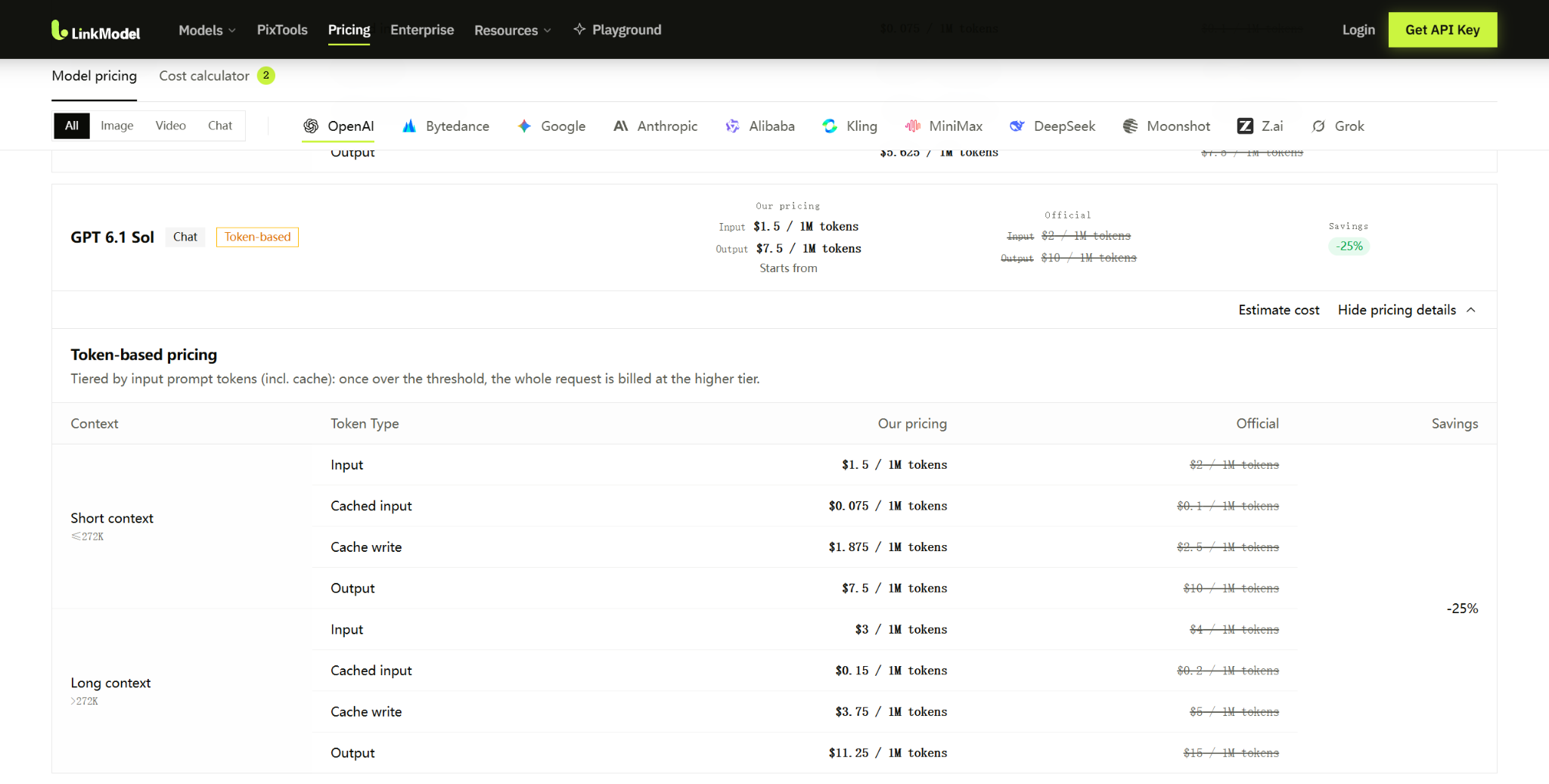
On LinkModel, GPT-6.1 Terra and Sol start at $0.75/M and $1.50/M input tokens for short-context requests, respectively—25% below their corresponding OpenAI Standard rates. LinkModel offers flexible pay-as-you-go billing with $0 minimum spend and $0 monthly platform fee. New users automatically receive $1 in free Credits after signup, with no payment card or recharge required. Existing users cannot claim the registration reward again, and the gifted Credits never expire and apply to every model currently available on LinkModel. Developers can compare both models, control their API spending, and choose the configuration that best fits their workloads.
GPT-6.1 Terra vs Sol: Key Differences at a Glance
Terra focuses on efficiency across everyday workloads, while Sol targets complex reasoning and software engineering. Both offer the same context capacity, but their performance characteristics, reasoning economics, and recommended workloads differ.
| Feature | GPT-6.1 Terra | GPT-6.1 Sol |
|---|---|---|
| Release date | October 26, 2026 | September 29, 2026 |
| Primary focus | Efficient visual reasoning, computer use, writing | Complex coding, reasoning, professional work |
| Official standard input | $1/M tokens | $2/M tokens |
| Official standard output | $5/M tokens | $10/M tokens |
| Official cached input | $0.05/M | $0.10/M |
| Context window | 1,050,000 tokens | 1,050,000 tokens |
| Maximum output | 128,000 tokens | 128,000 tokens |
| Reasoning effort | none, low, medium, high, xhigh, max | low, medium, high, xhigh, max |
| Input and output | Text/image input; text output | Text/image input; text output |
| Recommended workloads | Documents, vision, UI tasks, scoped fixes | Complex debugging, cross-file development, agents |
| LinkModel short-context input | $0.75/M | $1.50/M |
| LinkModel short-context output | $3.75/M | $7.50/M |
Sources: OpenAI's model directory, OpenAI API pricing, and LinkModel's Terra and Sol pages.
Same Context Window, Different Capabilities
Both models support a 1,050,000-token context window, but context capacity alone does not determine reasoning performance.
When working with a large codebase, a model needs to do more than read many files. It must understand dependencies, identify the correct changes, execute multi-step operations, and validate the result.
Sol is a stronger starting point for complex engineering, while Terra offers an attractive cost advantage for routine tasks with clear acceptance criteria.
API, Codex, and ChatGPT Work: Where Are the Models Available?
Both models offer API access and support relevant Codex and ChatGPT Work experiences.
The billing and usage mechanisms differ by access method:
- API: Usage is billed according to tokens and applicable service charges.
- Codex: Access and consumption depend on the user's product plan and usage allowance.
- ChatGPT Work: Model availability and usage follow the applicable product rules.
Developers should consider these differences when evaluating whether a model reduces API costs or helps them use a subscription allowance more efficiently.
Source: OpenAI Model Release Notes.
GPT-6.1 Terra vs Sol API Pricing: Is Terra Really 50% Cheaper?
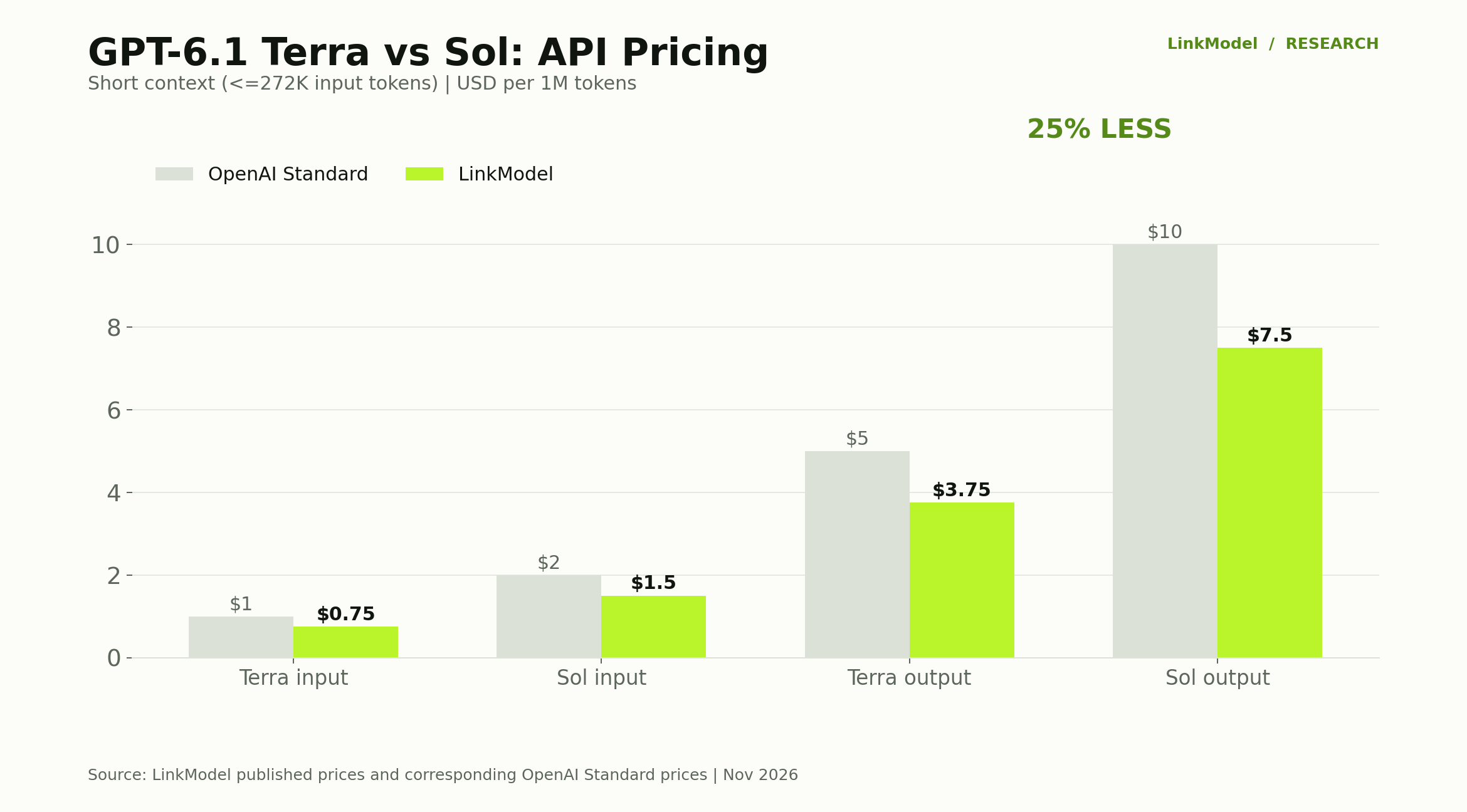
Yes. At OpenAI Standard API rates, Terra's input, output, and cached-input token prices are 50% lower than Sol's. LinkModel maintains the same price relationship between the models while publishing rates 25% below the corresponding OpenAI Standard prices.
Official API Pricing vs LinkModel Pricing
The following rates apply when total input prompt tokens, including cached input, are at or below 272K.
| Model and Token Type | OpenAI Standard | LinkModel | Savings vs Official |
|---|---|---|---|
| Terra Input | $1.00 | $0.75 | 25% |
| Terra Cached Input | $0.05 | $0.0375 | 25% |
| Terra Cache Write | $1.25 | $0.9375 | 25% |
| Terra Cache Write (12h) | $2.50 | $1.875 | 25% |
| Terra Output | $5.00 | $3.75 | 25% |
| Sol Input | $2.00 | $1.50 | 25% |
| Sol Cached Input | $0.10 | $0.075 | 25% |
| Sol Cache Write | $2.50 | $1.875 | 25% |
| Sol Output | $10.00 | $7.50 | 25% |
All prices are in USD per 1 million tokens.
Distinguishing ordinary input, cache reads, and cache writes helps developers understand how different request patterns affect costs. For workloads that reuse the same context, caching can also be an important part of cost optimization.
The 272K Context Threshold: Why Long Requests Cost More
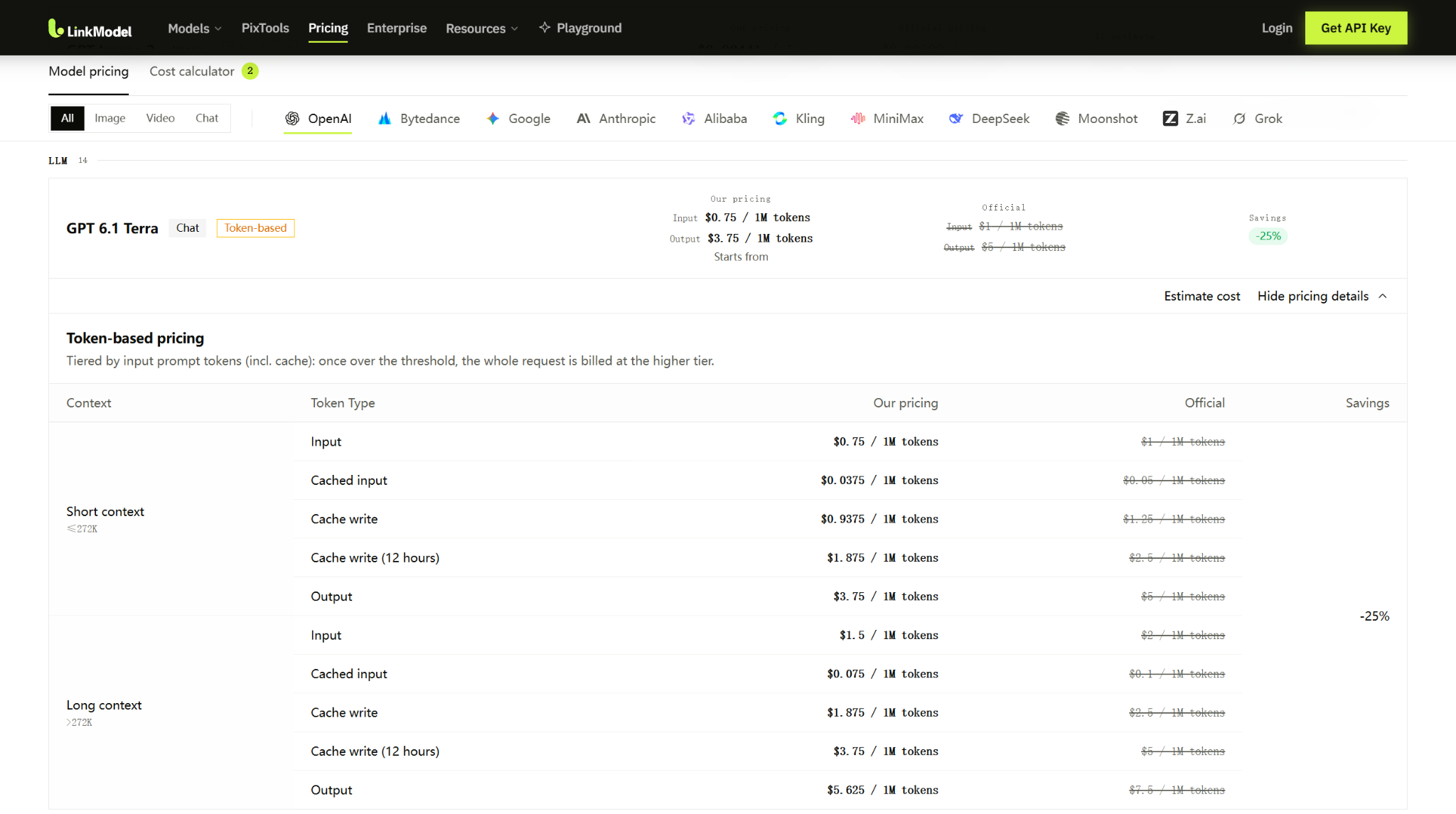
LinkModel uses tiered context pricing. When total input prompt tokens, including cached tokens, exceed 272K, the higher tier applies to the entire request.
| Long-Context Token Type | Terra | Sol |
|---|---|---|
| Input | $1.50/M | $3.00/M |
| Cached input | $0.075/M | $0.15/M |
| Cache write | $1.875/M | $3.75/M |
| Output | $5.625/M | $11.25/M |
For example, suppose a request contains 300,000 uncached input tokens and 20,000 output tokens.
Terra:
300,000 / 1,000,000 × $1.50 + 20,000 / 1,000,000 × $5.625 = $0.5625
Sol:
300,000 / 1,000,000 × $3.00 + 20,000 / 1,000,000 × $11.25 = $1.125
In this example, Terra costs 50% less than Sol.
For large repositories and long-document workflows, removing irrelevant context, limiting unnecessary output, and making effective use of caching can further improve cost efficiency.
Cost per Successful Task: Why Token Pricing Is Not Enough
The most meaningful unit of cost is not always one API request. For complex workflows, it can be the cost of successfully completing an entire task.
Suppose a short-context task requires 100,000 uncached input tokens and 10,000 output tokens per attempt, without caching or additional tools.
At LinkModel's published rates:
- Terra: $0.1125 per attempt
- Sol: $0.225 per attempt
If both models complete the task on their first attempt, Terra is clearly more economical.
However, coding agents and other complex workflows may need repeated execution, debugging, and corrections. A more useful metric is:
Cost per Accepted Task = Total Task Cost / Number of Accepted Tasks
Assuming independent attempts with a fixed cost per attempt:
Expected Cost per Success = Cost per Attempt / Success Probability
For example, suppose Terra has a 40% chance of success per attempt, while Sol has an 80% chance.
- Terra: $0.1125 / 0.40 = $0.28125
- Sol: $0.225 / 0.80 = $0.28125
Both models have the same expected cost per successful task.
This illustrates why a more expensive model can sometimes justify its higher unit price by completing difficult work more reliably.
When Does Switching From Terra to Sol Save Money?
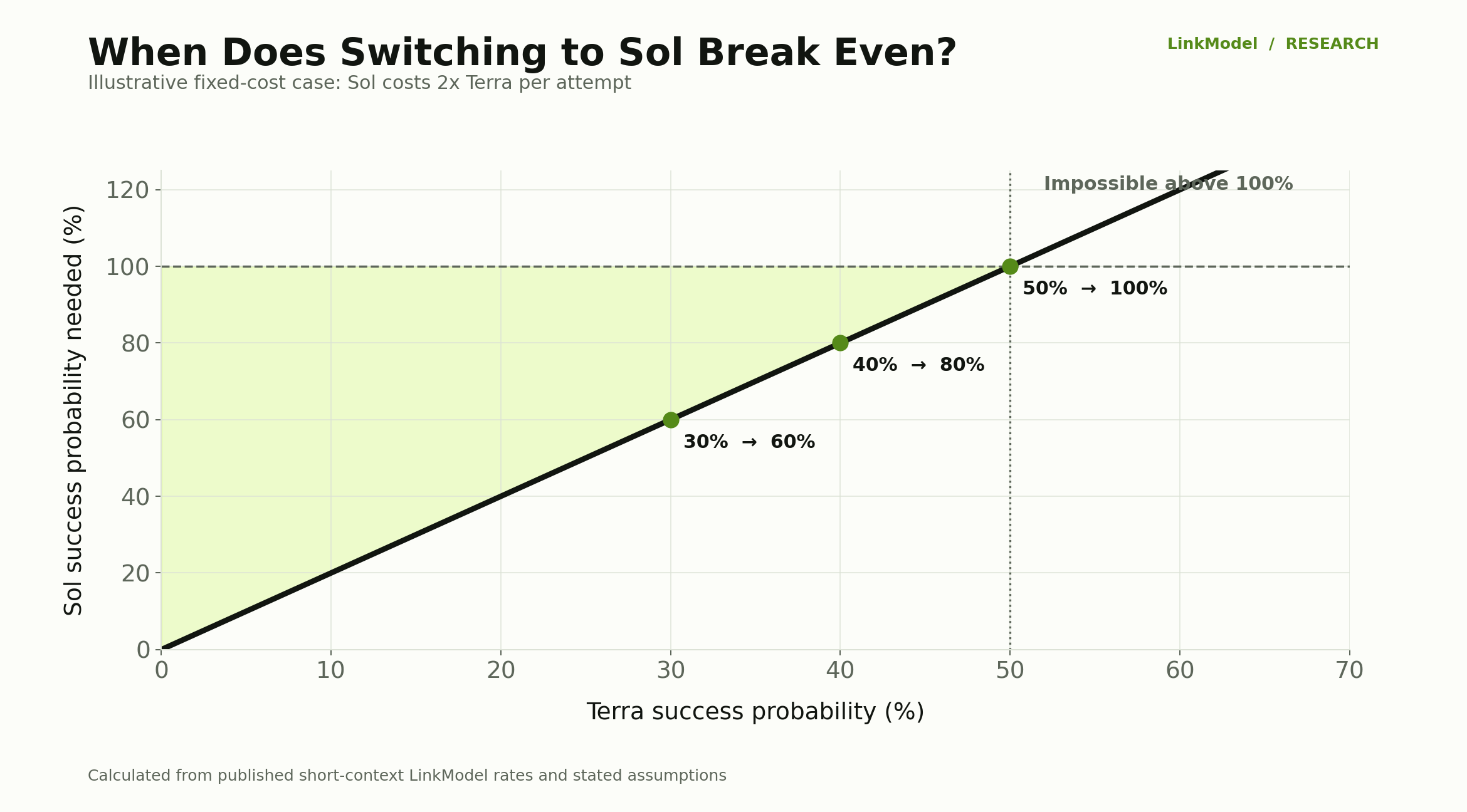
If Sol costs exactly twice as much per attempt as Terra, and all other conditions remain equal, the break-even relationship is:
Sol Success Probability = 2 × Terra Success Probability
| Illustrative Terra Success Rate | Sol Success Rate Needed to Break Even |
|---|---|
| 30% | 60% |
| 40% | 80% |
| 50% | 100% |
| 60% | 120% — not achievable |
If Terra already performs reliably on a particular workload, switching to Sol may not reduce the cost per successful task.
For tasks where Terra frequently fails but Sol completes the work consistently, Sol's higher price may offer better value.
The more general break-even relationship is:
Sol Success Probability / Terra Success Probability = Sol Cost per Attempt / Terra Cost per Attempt
This formula helps developers assess when to continue using Terra and when moving to Sol makes economic sense.
Coding Performance: Is Terra Better Than Sol for Programming?
Sol Medium leads Terra Medium on several complex coding and agent benchmarks, although Terra remains competitive on certain programming evaluations.
Independent Benchmarks: Terra Medium vs Sol Medium
Artificial Analysis reports the following results at Medium reasoning effort:
| Metric | Terra Medium | Sol Medium |
|---|---|---|
| Intelligence Index | 38 | 46 |
| Terminal-Bench 4.0 | 32% | 48% |
| AutomationBench-AA | 58% | 63% |
| FrontierCode 2.0 | 35% | 33% |
| Average benchmark task cost | $0.17 | $0.36 |
| Average benchmark task time | 2.5 min | 3.9 min |
Source: Artificial Analysis — Terra Medium vs Sol Medium.
Sol performs better on the overall intelligence measure, terminal-based agents, and automation.
Its Terminal-Bench 4.0 score of 48% is substantially higher than Terra Medium's 32%.
However, Terra scores 35% on FrontierCode 2.0, slightly above Sol's 33%.
These results show how performance depends on the programming workload. Sol is a stronger starting point for demanding software engineering, while Terra remains useful for selected coding tasks.
What Reddit Developers Reported
Real developer experiences on Reddit provide another perspective on how the models perform in practical projects.
In an r/codex discussion, a robotics software engineer shared a comparison made while developing a 2D pixel-art construction-management game prototype.
The reported results were:
| Configuration | Approximate Time | Five-Hour Allowance Used |
|---|---|---|
| Terra Max | 18 minutes | 33% |
| Sol Medium | 30 minutes | 24% |
Terra completed the task faster, while Sol consumed less of the user's subscription allowance.
The developer also preferred the richer buildings and scene elements produced by Sol.
Another developer described repeated attempts and missing functionality when using Terra for similar software features, which increased the effort required to finish the work.
These experiences highlight an important issue in coding-agent comparisons: generating code quickly does not always mean completing a development task more efficiently.
Developers should evaluate feature completeness, correction attempts, and the quality of accepted results alongside raw response speed.
Which Model Is Better for Coding Agents?
Different programming workloads benefit from different model strategies.
Scoped Coding
Small bug fixes, function implementations, code explanation, and test generation are suitable starting points for Terra Medium, especially when automated validation is available.
Repository-Level Development
Cross-file changes, dependency analysis, and large refactors are stronger candidates for Sol Medium because they demand more sustained reasoning and coordination.
Long-Running Coding Agents
Workflows involving tools, repeated testing, debugging, and revisions should be evaluated using reasoning effort, task completion, and retry costs together.
Terra Max vs Sol Medium: Which Reasoning Effort Is Worth the Cost?
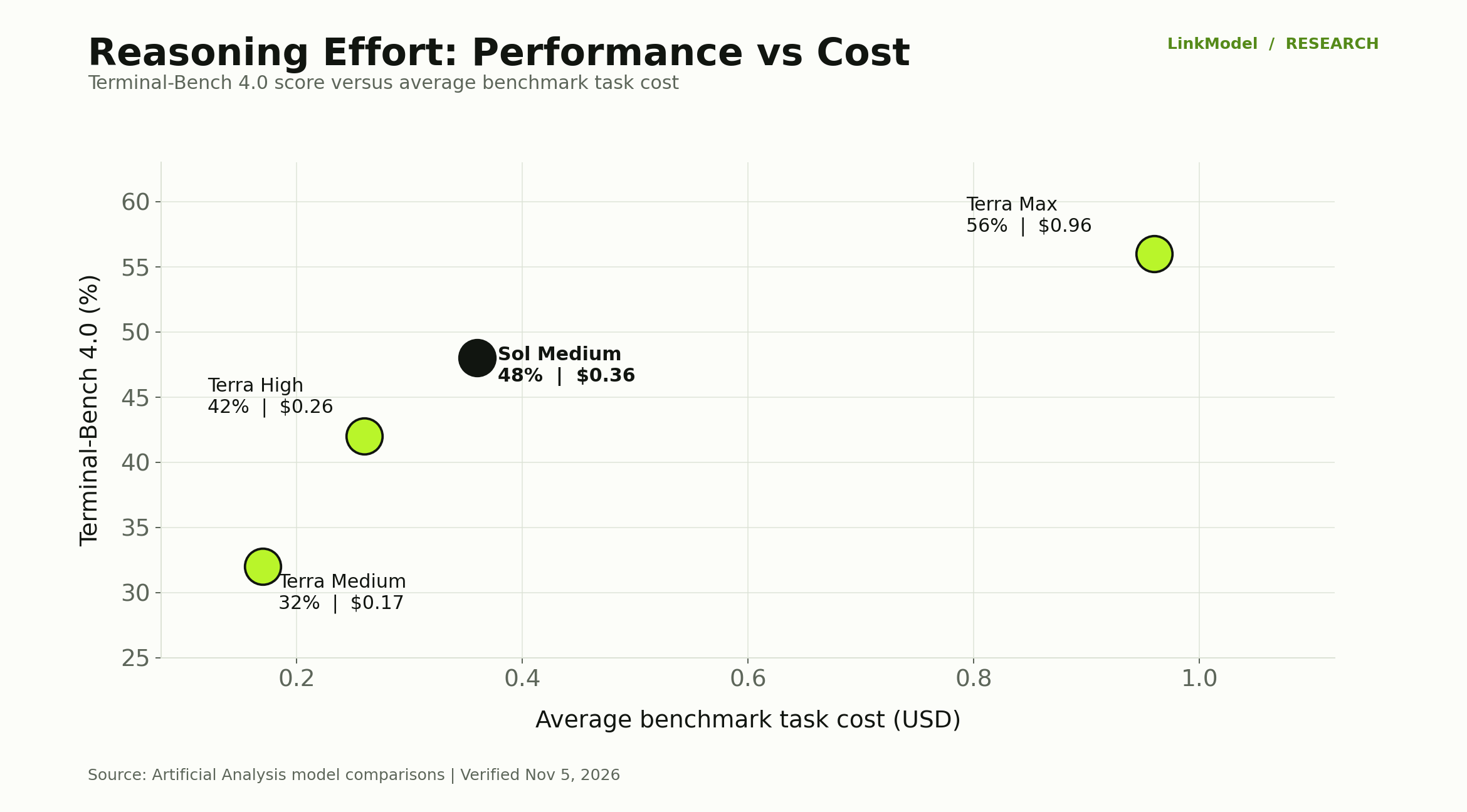
Terra Max can outperform Sol Medium on selected coding benchmarks, but its average task cost can also be substantially higher.
This makes reasoning-effort comparisons more useful than comparing the models' base token prices alone.
Comparing Terra Medium, High, Max, and Sol Medium
Artificial Analysis reports the following results:
| Configuration | Intelligence Index | Terminal-Bench 4.0 | Average Benchmark Task Cost |
|---|---|---|---|
| Terra Medium | 38 | 32% | $0.17 |
| Terra High | 42 | 42% | $0.26 |
| Terra Max | 51 | 56% | $0.96 |
| Sol Medium | 46 | 48% | $0.36 |
Sources: Medium comparison, Terra High vs Sol Medium, and Terra Max vs Sol Medium.
Four important patterns emerge.
Terra Medium: Offers the lowest average benchmark task cost in this comparison, making it attractive for simpler and more defined work.
Terra High: Improves coding performance while keeping average task cost below Sol Medium.
Sol Medium: Delivers stronger overall reasoning and Terminal-Bench performance than Terra High, with a lower average task cost than Terra Max.
Terra Max: Reaches 56% on Terminal-Bench 4.0, outperforming Sol Medium's 48%, but at a significantly higher average task cost.
For moderately difficult coding agents, Terra High and Sol Medium are particularly useful configurations to compare.
Why Terra Max Can Cost More Than Sol Medium
Artificial Analysis reports:
- Terra Max: $0.96 per benchmark task
- Sol Medium: $0.36 per benchmark task
Terra Max therefore costs approximately 2.67 times as much per average task.
The explanation is straightforward: the price per token and the number of tokens consumed are separate variables.
Higher reasoning effort can generate more reasoning and output tokens, increasing the total cost even when the model's base token price is lower.
Sol Medium can therefore offer a different balance between reasoning performance and spending on complex coding tasks.
How Should Developers Choose Reasoning Effort?
| Workload | Recommended Starting Point | Main Consideration |
|---|---|---|
| Classification and extraction | Terra none / low | Simple and easy to validate |
| Documents and routine vision | Terra medium | Balance quality and cost |
| Small code fixes | Terra medium | Automated testability |
| Moderately difficult agents | Terra High vs Sol Medium | Performance and cost trade-off |
| Complex software engineering | Sol medium | Stronger complex reasoning |
| Exceptionally difficult tasks | Evaluate higher reasoning settings | Pay for added reasoning when valuable |
Choosing the appropriate reasoning level is often more efficient than automatically using Max for every task.
Speed, Visual Reasoning, and Real-World Efficiency
Beyond coding performance, speed and visual understanding are important reasons to consider Terra.
Is GPT-6.1 Terra Faster Than Sol?
At Medium effort, Artificial Analysis reports:
- Terra: 2.5 minutes per task
- Sol: 3.9 minutes per task
Terra has a lower average task completion time in this comparison.
In a separate Reddit discussion, a user reported that some Codex tasks previously taking around 15 minutes with Sol were completed in approximately one minute after switching to Terra. The user was also satisfied with the results.
That kind of responsiveness can be appealing to developers processing large numbers of routine tasks throughout the day.
Visual Reasoning and Computer Use
OpenAI positions Terra for visual understanding, computer use, and natural-language writing.
Promising workloads include:
- Matching product photos with catalog information.
- Interpreting technical drawings and screenshots.
- Summarizing documents and extracting structured information.
- Understanding software interfaces and performing defined operations.
- Drafting concise reports, explanations, and written content.
Many of these tasks have clear input and output requirements, making them suitable for automated validation and scalable workflows.
A Practical Two-Model Workflow
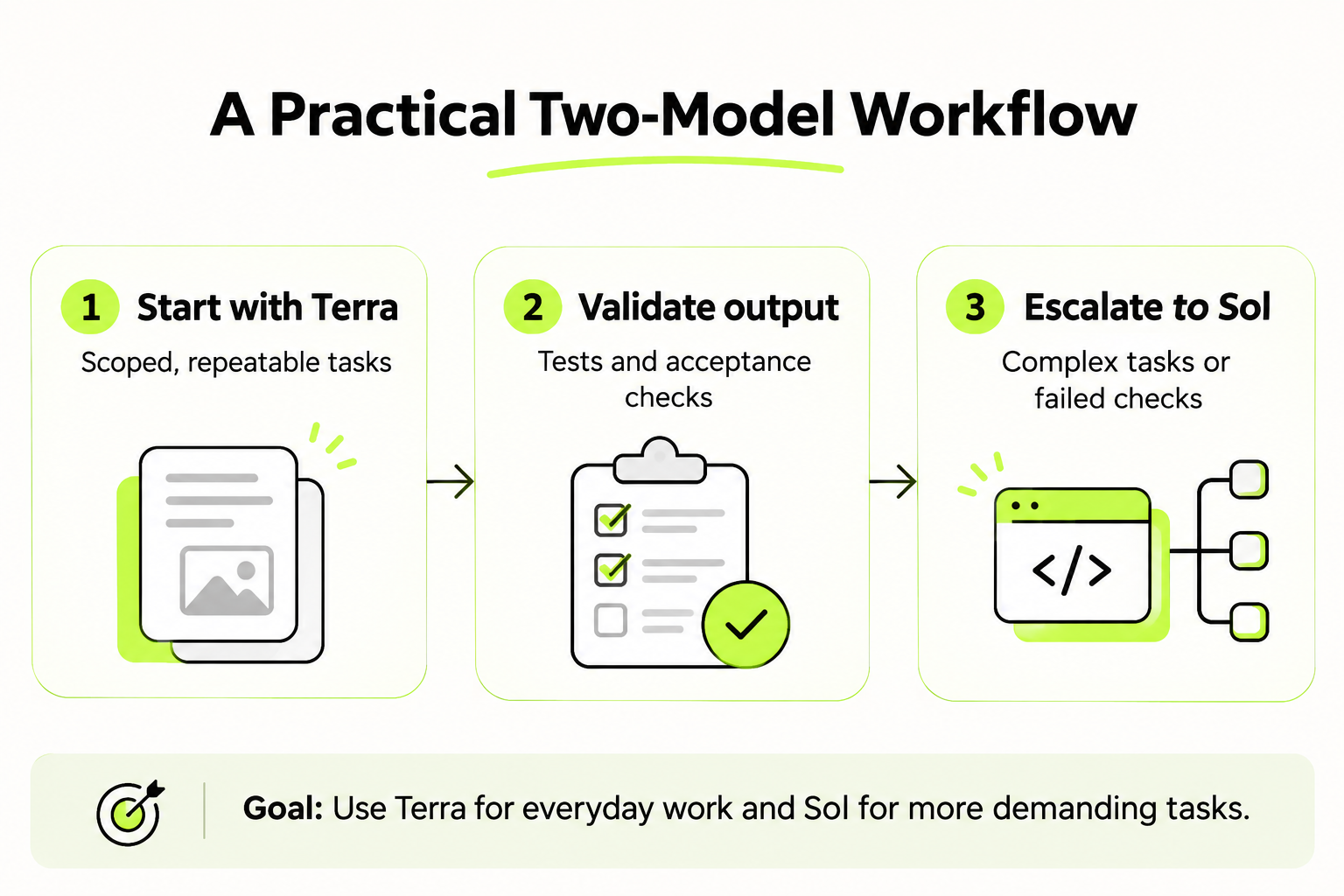
For a team handling documents, routine software maintenance, and complex development projects, a layered approach can be effective.
Step 1: Use Terra for extraction, classification, basic visual tasks, and scoped code fixes.
Step 2: Validate the output with predefined rules, unit tests, or necessary human review.
Step 3: Escalate tasks to Sol when they repeatedly fail, omit important requirements, or involve complex cross-module reasoning.
This strategy directs more expensive reasoning capacity toward difficult work while taking advantage of Terra's speed and lower token prices for routine operations.
Which Model Should You Choose—and How Can LinkModel Help?
Choose Terra as the starting point for frequent, clearly defined tasks, and Sol for complex coding and multi-step reasoning. For moderately difficult workloads, compare Terra High against Sol Medium to find a useful balance between performance and cost.
GPT-6.1 Terra vs Sol: Model Selection Matrix
| Workload | Recommended Starting Point | Main Reason |
|---|---|---|
| High-volume classification | Terra none / low | Low unit price, clear requirements |
| Document processing and writing | Terra medium | Balanced quality and cost |
| Screenshot and UI analysis | Terra medium | Strong visual and computer-use fit |
| Scoped code fixes | Terra medium | Easy validation |
| Moderately difficult agents | Terra High / Sol Medium | Balance reasoning and total cost |
| Cross-file development and complex debugging | Sol medium | Stronger multi-step reasoning |
| Highly demanding work | Evaluate higher reasoning settings | Prioritize completion quality |
How to Access Terra and Sol Through LinkModel
LinkModel offers public model pages for both options:
Developers should begin by selecting the appropriate model and API endpoint.
For ordinary text generation, use the supported request format for the selected model.
For coding agents, function calling, and other tool-dependent workflows, use the Responses API.
LinkModel's unified model access makes it easier to manage supported models and choose configurations based on task requirements.
LinkModel Pricing and Cost Benefits
Consider a short-context request containing 100,000 uncached input tokens and 10,000 output tokens:
| Model | OpenAI Standard | LinkModel |
|---|---|---|
| Terra | $0.15 | $0.1125 |
| Sol | $0.30 | $0.225 |
In this example, LinkModel costs 25% less than the corresponding OpenAI Standard rates.
For teams processing large volumes of requests, the absolute savings increase as token usage grows.
LinkModel also provides unified model management and pay-as-you-go billing, allowing developers to adjust their model selection as workloads change.
To compare reasoning configurations, start with a small collection of well-defined tasks and record token usage, execution time, and accepted results before selecting Terra or Sol for broader use.
Frequently Asked Questions
1. Is GPT-6.1 Terra better than Sol for coding?
Terra works well as a starting point for scoped, verifiable programming tasks, while Sol is better suited to complex software engineering. At Medium effort, Artificial Analysis reports Terminal-Bench 4.0 scores of 32% for Terra and 48% for Sol, although Terra scores slightly higher on FrontierCode 2.0.
2. Is GPT-6.1 Terra really 50% cheaper than Sol?
Their official standard API input, output, and cached-input token rates differ by 50%. Total task costs also depend on reasoning effort, token consumption, and retries.
3. Is Terra Max better than Sol Medium?
Terra Max scores 56% on Artificial Analysis Terminal-Bench 4.0, above Sol Medium's 48%. However, their average benchmark task costs are $0.96 and $0.36, respectively. Whether Terra Max is worth using depends on how much value the additional performance provides.
4. Which model is faster, GPT-6.1 Terra or Sol?
Artificial Analysis reports average Medium-effort task times of 2.5 minutes for Terra and 3.9 minutes for Sol, giving Terra an advantage in that comparison.
5. Can I use GPT-6.1 Terra and Sol through LinkModel?
Yes. LinkModel offers API access to both models with published pricing. For function calling and coding-agent workflows, use the supported Responses API.
Conclusion
GPT-6.1 Terra is a strong starting point for frequent, scoped document, visual, and routine coding tasks, while GPT-6.1 Sol is better suited to complex software engineering and multi-step reasoning. Terra's standard token prices are half of Sol's, but its Max reasoning configuration can cost more per evaluated task than Sol Medium. The best choice depends on reasoning effort, completion quality, and total task cost. LinkModel offers both models at published rates 25% below their corresponding OpenAI Standard prices, with flexible pay-as-you-go access to help developers match each workload with the right configuration.