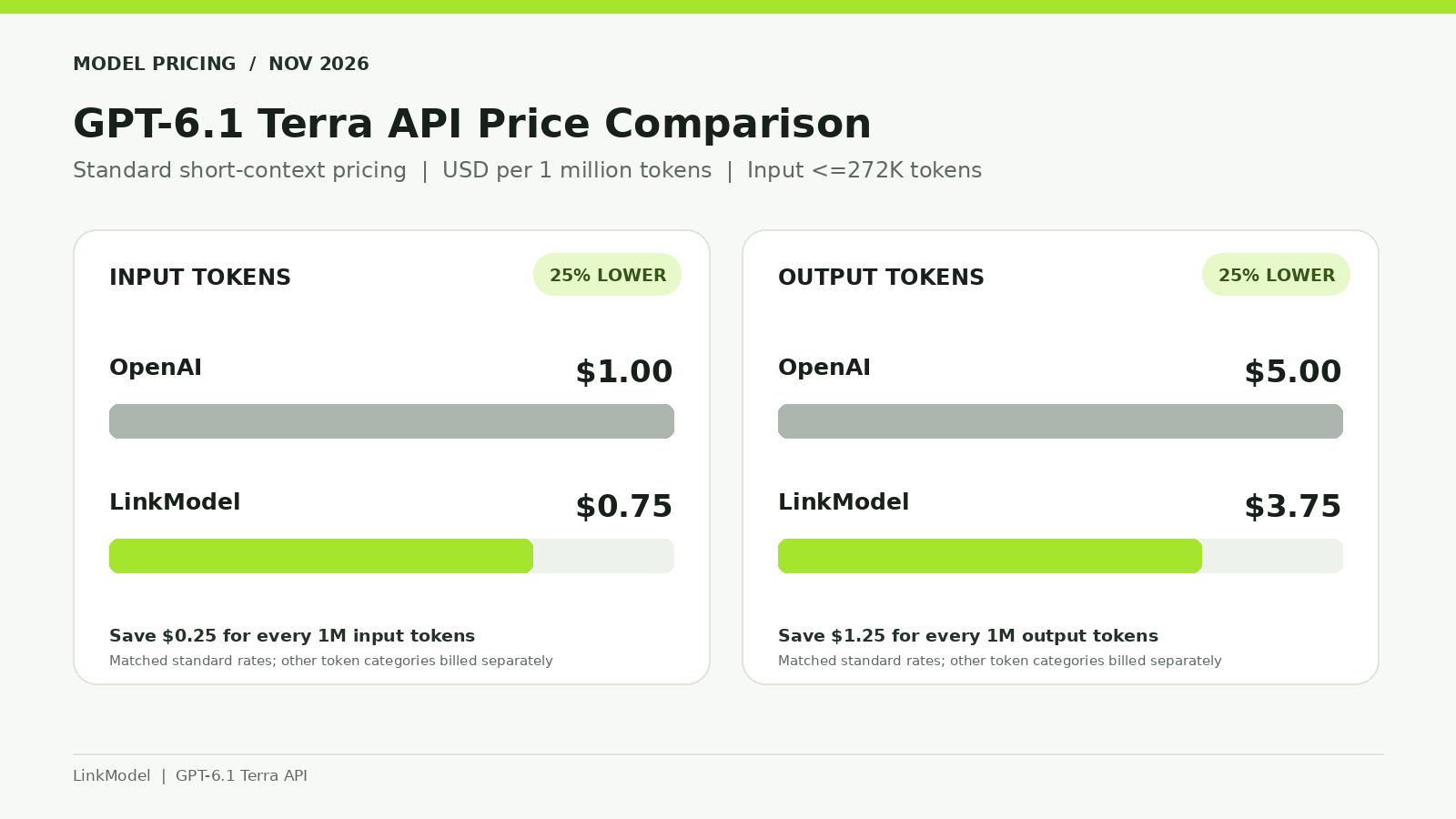
The GPT-6.1 Terra API provides access to OpenAI's efficient model for visual reasoning, computer use, professional writing, and scoped development tasks. Released on October 26, 2026, it costs $1.00 per million input tokens and $5.00 per million output tokens at OpenAI's standard short-context rates. LinkModel lists the corresponding rates at $0.75 and $3.75, offering 25% lower token pricing. But the real question for developers is not just how much each token costs. It is how much they spend to complete useful work.
That question has become more relevant following OpenAI's announcement that ChatGPT and Codex will share a usage allowance starting in December 2026 for Plus, Pro, and Business subscribers, while Instant chat remains excluded. The change has sparked frustration among some Reddit users, including concerns about subscription value and discussions of canceling. Although subscription allowances and API billing are separate, the debate highlights a broader concern: developers want predictable spending and AI models that actually finish their tasks.
For developers who want greater control over usage-based API costs, LinkModel offers GPT-6.1 Terra at 25% below OpenAI's published standard token rates, with $0 minimum spend and $0 monthly platform fee. Its unified platform also supports access to multiple models and consolidated billing, allowing teams to choose models according to workload rather than rely on a single option. That flexibility matters when balancing performance, reliability, and cost per completed task.
What Is GPT-6.1 Terra API?
GPT-6.1 Terra is an efficiency-focused model in OpenAI's GPT-6 family, designed for visual reasoning, computer use, clear writing, and responsive task execution. It sits between the lower-cost GPT-6 Luna and the more capable GPT-6.1 Sol.
GPT-6.1 Terra Specifications
| Specification | GPT-6.1 Terra |
|---|---|
| Model ID | gpt-6.1-terra |
| Release date | October 26, 2026 |
| Context window | 1,050,000 tokens |
| Maximum output | 128,000 tokens |
| Input modalities | Text and images |
| Output modality | Text |
| Default reasoning effort | medium |
| Reasoning levels | none, low, medium, high, xhigh, max |
| Primary strengths | Visual reasoning, computer use, writing |
| API interfaces | Responses API, Chat Completions |
According to OpenAI's published model specifications, Terra can interpret technical drawings, match product images to catalog records, interact with software interfaces, and draft professional communications.
Its large context window also makes it relevant for extensive documents and long task histories. However, longer prompts can trigger a higher billing tier, making context management important for cost-sensitive applications.
What Makes Terra Different From Sol and Luna?
The main differences among these models are their capability positioning and pricing, rather than a simple ranking from good to bad.
Luna targets focused, high-volume tasks where cost is a primary concern. Terra adds broader capabilities for visual reasoning, writing, and more demanding workflows. Sol is positioned for complex analysis, advanced coding, and professional tasks requiring stronger judgment.
Terra's value therefore depends on whether its additional capabilities justify the price difference over Luna, and whether it can deliver sufficient quality at a lower cost than Sol.
GPT-6.1 Terra API Pricing: OpenAI vs LinkModel
GPT-6.1 Terra API uses token-based pricing, with separate rates for standard input, cached input, cache writes, and generated output.
Based on the published rates reviewed on November 5, 2026, LinkModel's corresponding standard token prices are 25% below OpenAI's listed rates.
Standard GPT-6.1 Terra API Pricing
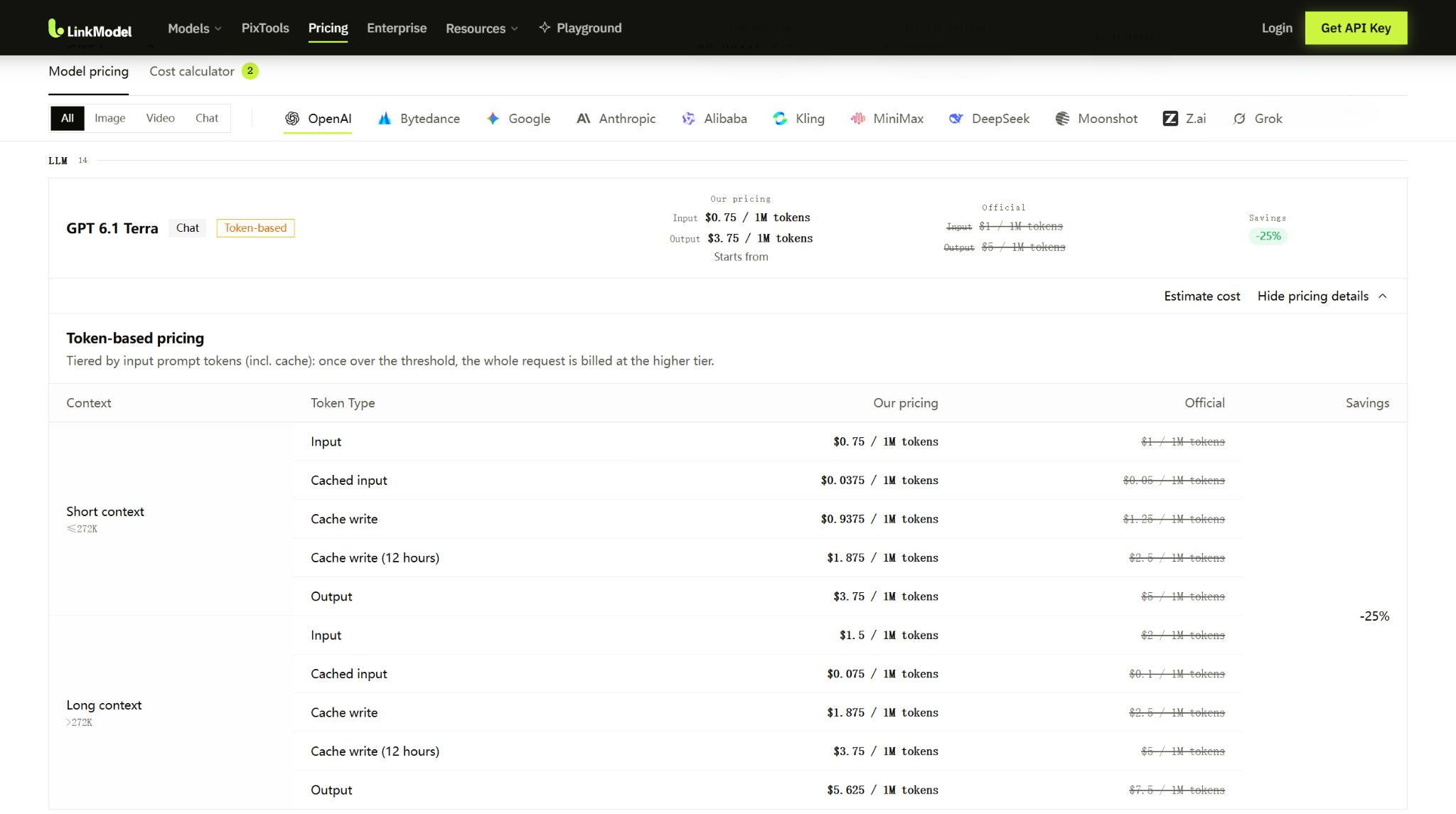
For requests with no more than 272K input tokens, the following short-context rates apply.
| Token Type | OpenAI | LinkModel | Savings |
|---|---|---|---|
| Input | $1.00 | $0.75 | 25% |
| Cached input | $0.050 | $0.0375 | 25% |
| Cache write, 30 min | $1.25 | $0.9375 | 25% |
| Cache write, 12 hours | $2.50 | $1.875 | 25% |
| Output | $5.00 | $3.75 | 25% |
All prices are in USD per million tokens.
Consider a request containing 100,000 regular input tokens and 10,000 output tokens.
At OpenAI's published rates, the cost is $0.15: $0.10 for input and $0.05 for output.
At LinkModel's rates, the same token usage costs $0.1125: $0.075 for input and $0.0375 for output.
That is a saving of $0.0375 per identical request, or 25%.
For a monthly workload consuming 10 million regular input tokens and 2 million output tokens, with all usage billed at these short-context rates, the calculated costs are $20 through OpenAI versus $15 through LinkModel.
The difference is $5 per month for the same token quantities. As usage scales, the lower per-token rate creates larger absolute savings.
Long-Context Pricing Above 272K Tokens
GPT-6.1 Terra supports a context window exceeding one million tokens, but requests with more than 272,000 input tokens enter a higher pricing tier.
Under this tier, input and cache-related rates double, while output rates increase by 50%.
| Token Type | OpenAI | LinkModel |
|---|---|---|
| Input | $2.00 | $1.50 |
| Cached input | $0.10 | $0.075 |
| Cache write, 30 min | $2.50 | $1.875 |
| Cache write, 12 hours | $5.00 | $3.75 |
| Output | $7.50 | $5.625 |
For a request containing 300,000 regular input tokens and 20,000 output tokens, the total calculated cost is $0.75 at OpenAI's rates and $0.5625 at LinkModel's rates.
That produces a $0.1875 saving for the same request.
Importantly, the threshold is determined by the number of input prompt tokens, including cached tokens. Once the request exceeds 272K, the higher rates apply to the entire request, not only the tokens beyond the threshold.
For large-document analysis, repository-scale coding, and long-running agents, context length can therefore affect both resource consumption and the applicable billing tier.
Does Prompt Caching Make Terra Cheaper?
Prompt caching can significantly reduce the price of repeatedly reading the same context, although cache writes and cache hits have different rates.
For short-context requests on LinkModel, cached input costs $0.0375 per million tokens, compared with $0.75 for ordinary input. A 30-minute cache write, however, costs $0.9375 per million tokens.
This makes caching potentially valuable for workloads that repeatedly reuse system instructions, document context, or task history.
For content used only once, the initial cache-write cost must also be considered.
The actual benefit depends on how frequently the same context is reused, how long it remains cached, and the number of successful cache hits.
GPT-6.1 Terra API Performance: What Do the Tests Show?
Published evaluations show that GPT-6.1 Terra can deliver competitive speed and cost efficiency across several workloads, although more capable models still have advantages in difficult reasoning and edge cases.
The most meaningful performance comparison considers task accuracy, response time, failure severity, and total cost, rather than a single benchmark score.
Data Analytics Benchmark: 40 Out of 43 Questions
An independent evaluation published on October 26, 2026 compared Terra, Sol, and Luna across 43 data analytics questions.
The benchmark used a synthetic wind-energy dataset and included straightforward analytics, ambiguous requests, data-quality checks, statistical traps, and hidden-pattern identification.
| Model | Correct Answers | Full Test Cost | Median Time |
|---|---|---|---|
| GPT-6 Luna | 38/43 | $0.13 | 18 s |
| GPT-6.1 Terra | 40/43 | $1.31 | 15 s |
| GPT-6.1 Sol | 43/43 | $2.61 | 18 s |
Terra answered approximately 93% of the questions correctly, with a total evaluation cost about half that of Sol.
The error distribution provides more insight than the overall score. Terra correctly handled all 20 straightforward analytics questions, all five ambiguous requests, and all three data-quality questions, but detected only three of five hidden patterns.
This suggests that Terra may offer a useful cost-accuracy balance for routine analytics with automated checks or human review.
For tasks requiring subtle statistical discoveries, Sol performed better in this evaluation.
The benchmark used synthetic data and a specific evaluation environment, with costs based on the prices available through the test platform at the time.
Customer Support Evaluation: 80 Runs
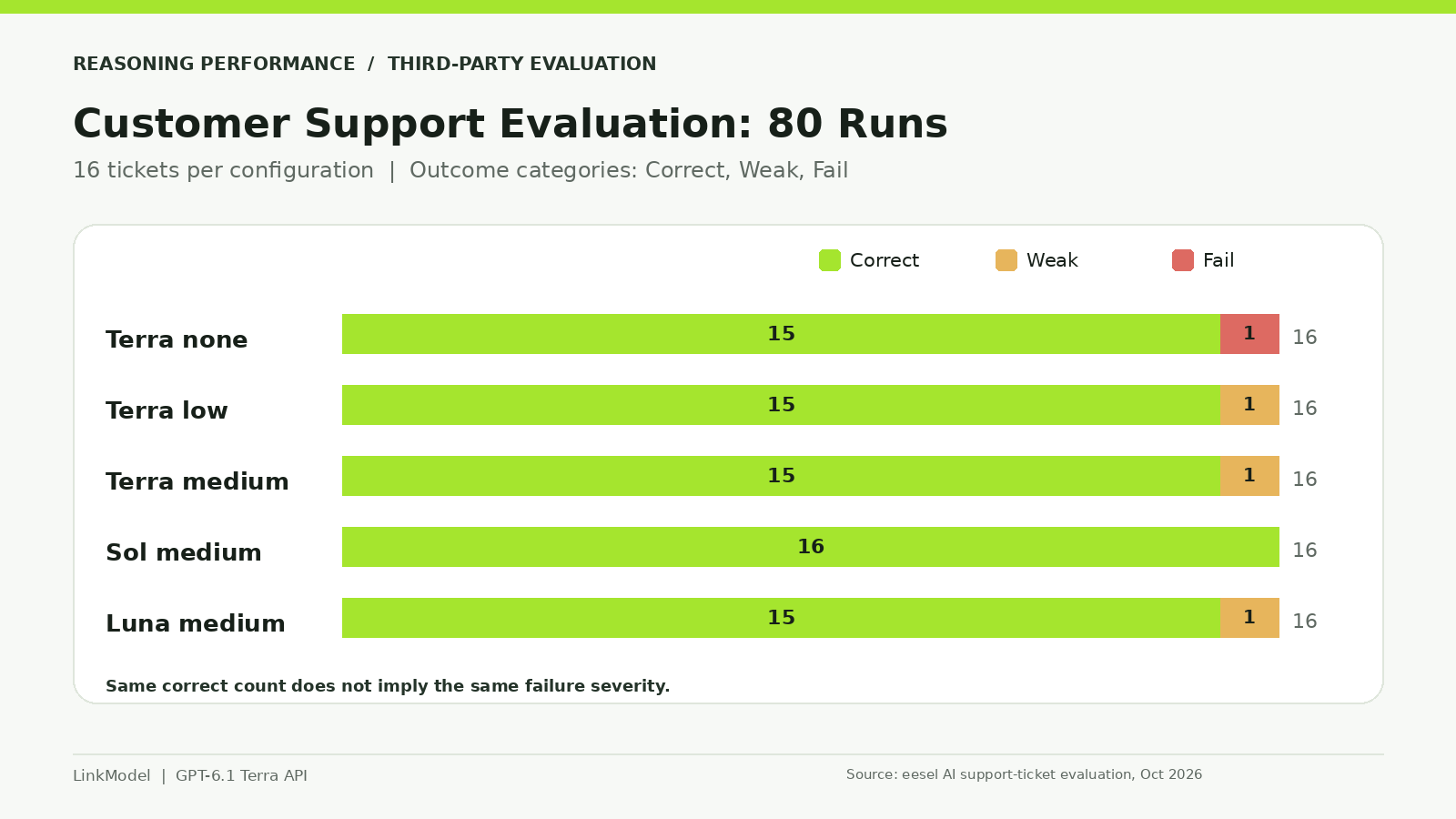
A separate independent evaluation tested five model and reasoning configurations across 16 customer-support scenarios, producing 80 runs.
The tasks covered multilingual understanding, policy interpretation, screenshot analysis, tool use, and exception handling. Results were classified as Correct, Weak, or Fail.
| Configuration | Correct | Weak | Fail | Cost per 1,000 Tasks |
|---|---|---|---|---|
| Terra none | 15 | 0 | 1 | $0.65 |
| Terra low | 15 | 1 | 0 | $0.75 |
| Terra medium | 15 | 1 | 0 | $0.92 |
| Sol medium | 16 | 0 | 0 | $1.62 |
| Luna medium | 15 | 1 | 0 | $0.14 |
The most important finding is that identical Correct counts can conceal very different operational risks.
In one Spanish-language address-change task, Terra at none effort generated a response that could lead the customer to believe the address had been handled, even though the system lacked a tool to perform the change.
Terra at low and medium avoided the same misleading promise but gave incomplete follow-up guidance. Sol at medium correctly recognized the need for escalation and clarified that the change had not been confirmed.
This illustrates a critical distinction for AI agents: fluent responses do not necessarily mean that the requested action has been completed.
In workflows connected to business systems, a false promise about an action can be more serious than a response that simply needs editing.
What Developers Report About Terra in Coding Tasks
Developer feedback on Reddit shows mixed experiences with Terra in Codex.
Some users report faster responses and useful progress on routine development work. Others describe situations where the model repeatedly outlined implementation plans without fully completing the requested code changes.
In one reported visual-interface project, a developer consumed 39% of a five-hour Codex allowance during approximately 20 minutes of Terra High and Max usage.
The same developer reported consuming 24% of the allowance during approximately 30 minutes with Sol Medium and preferred the detail of Sol's resulting output.
These figures describe individual Codex usage allowances rather than dollar-denominated API spending.
Nevertheless, they highlight a practical developer concern: the objective is completed work, not simply fast responses.
GPT-6.1 Terra Reasoning Effort: Is Higher Better?
GPT-6.1 Terra supports six reasoning-effort levels: none, low, medium, high, xhigh, and max. The default is medium.
Increasing reasoning effort may increase internal reasoning consumption, but more reasoning tokens do not guarantee better task completion.
How Reasoning Effort Affects Cost
In the 80-run support evaluation, all three Terra settings achieved 15 Correct outcomes out of 16 tickets, but their costs and processing times differed.
| Effort | Cost per 1,000 Tasks | Mean Time | Thinking Tokens Across 16 Runs |
|---|---|---|---|
| none | $0.65 | 2.5 s | 0 |
| low | $0.75 | 2.7 s | 331 |
| medium | $0.92 | 3.1 s | 721 |
Moving from low to medium increased the estimated cost by approximately 22.7%, without increasing the number of Correct outcomes.
Meanwhile, none was the cheapest setting but produced a misleading promise in one case. The remaining problems under low and medium were classified as Weak rather than Fail.
For these specific support scenarios, low offered a reasonable balance of cost and response quality.
However, the finding cannot be generalized to complex coding, long-running agents, or unrelated workloads.
Which Reasoning Setting Should You Choose?
For low-risk rewriting, classification, and repetitive processing, comparing none and low can be a useful starting point.
For workflows involving policy decisions, accurate step execution, or exception handling, the failure patterns of low and medium deserve closer attention.
For difficult coding and extended autonomous tasks, high, xhigh, and max may be worth evaluating to determine whether their additional reasoning delivers a meaningful improvement.
The central question is not which setting produces the most reasoning.
It is whether the additional cost produces enough measurable improvement to justify the expense.
GPT-6.1 Terra vs Sol vs Luna: Which Is Worth the Cost?
At OpenAI's published standard short-context prices, Terra costs half as much as Sol per input or output token, but ten times as much as Luna.
| Model | Input/M | Output/M | Primary Fit |
|---|---|---|---|
| GPT-6 Luna | $0.10 | $0.50 | Simple, high-volume, low-cost tasks |
| GPT-6.1 Terra | $1.00 | $5.00 | Visual tasks, writing, verifiable automation |
| GPT-6.1 Sol | $2.00 | $10.00 | Difficult reasoning, complex coding, advanced judgment |
Choose Terra for Verifiable Workloads
Terra is worth considering when tasks have clear boundaries, outputs can be checked, and limited human review or programmatic verification is practical.
In the 43-question analytics evaluation, it achieved 40 correct answers at about half Sol's test cost. In the customer-support evaluation, Terra Low also handled most tasks successfully at a lower estimated cost than Sol Medium.
These results suggest that Terra is a practical candidate for workloads balancing acceptable task quality with ongoing usage costs.
Choose Sol When Errors Are Expensive
Sol deserves consideration when tasks involve difficult reasoning, subtle errors, or substantial business consequences.
In the analytics evaluation, Sol answered all 43 questions correctly. In the support evaluation, Sol Medium achieved 16 Correct outcomes out of 16.
A higher per-token price does not necessarily mean higher end-to-end costs if the additional capability reduces corrective work or repeated attempts.
Choose Luna for High-Volume Simple Tasks
For straightforward classification, standardized text processing, and large volumes of repetitive work, Luna may be more economical when its output quality is already sufficient.
In the support evaluation, Luna Medium achieved 15 Correct outcomes out of 16 at an estimated $0.14 per 1,000 tasks.
Choosing Terra over Luna therefore requires a clear capability benefit rather than simply selecting the middle-priced model.
Is GPT-6.1 Terra API Worth It? The Real Cost per Task
GPT-6.1 Terra API is worth considering for cost-sensitive workloads with clear acceptance criteria and verifiable results. However, its actual economic value is better measured by the cost of successfully completed tasks than by token prices alone.
Cost per Successful Task Explained
Suppose each attempt has an average cost C and an independent probability of success p. If retries continue until success, the expected cost per successful outcome is:
Expected Cost per Success = Cost per Attempt ÷ Success Probability
The following scenarios illustrate the calculation rather than any measured model success rate.
| Scenario | Cost per Attempt | Success Rate | Cost per Success |
|---|---|---|---|
| Terra A | $0.01125 | 80% | $0.01406 |
| Terra B | $0.01125 | 50% | $0.02250 |
| Higher-cost model | $0.02000 | 98% | $0.02041 |
At an 80% success rate, Terra has the lower expected cost per completed task.
But if its success rate falls to 50%, its expected cost per success rises above that of the more expensive model, even though individual requests cost less.
This is why token pricing and task economics should be evaluated separately.
The Break-Even Point for Terra
Under the same assumptions, the minimum success probability needed for Terra to be more economical can be calculated as follows:
Terra Break-Even Success Rate = Terra Attempt Cost × Comparison Model Success Rate ÷ Comparison Model Attempt Cost
Using the example values:
$0.01125 × 98% ÷ $0.020 = 55.125%
This means Terra would have a lower expected cost per successful task when its success probability is above 55.125%, given the specified per-attempt costs and comparison model success rate.
The figure is a mathematical break-even threshold, not an observed GPT-6.1 Terra API success rate.
Real production workloads must also account for retry limits, processing time, and human correction costs.
What Actually Determines API Value?
Three factors matter when evaluating overall model costs.
Token spending: Input, output, cached tokens, and reasoning consumption contribute to API charges.
Task completion quality: A cheaper response that leaves work unfinished can create additional effort and repeated calls.
Human intervention and error costs: If automated results require extensive checking or rework, the final cost may exceed the token bill itself.
For coding agents and multi-step automation, cost per completed task can therefore be a more useful decision metric than cost per million tokens.
Why Consider LinkModel for Terra API?
LinkModel's clearest advantage for GPT-6.1 Terra is its published pricing.
For identical Terra token quantities in corresponding billing categories, its standard rates are 25% below OpenAI's published list prices, without requiring a minimum platform spend or fixed monthly platform fee.
Eligible new users also automatically receive $1 in free Credits after registration, with no payment card or recharge required. Existing users cannot repeatedly claim the signup reward.
LinkModel's unified model access and consolidated billing can also help teams manage different models within the same platform.
Once Terra meets the required quality standards for a workload, LinkModel's lower published token rates can further reduce the cost of the same API usage.
Frequently Asked Questions
1. How Much Does GPT-6.1 Terra API Cost?
OpenAI's standard short-context rates are $1 per million input tokens, $5 per million output tokens, and $0.05 per million cached input tokens. LinkModel lists corresponding rates of $0.75, $3.75, and $0.0375, representing 25% lower prices. Requests exceeding 272K input tokens use higher long-context rates for the entire request.
2. Is GPT-6.1 Terra Cheaper Than Sol?
At OpenAI's standard token rates, Terra costs half as much as Sol for both input and output. However, task success rates, reasoning consumption, and corrective work can change the real cost difference.
3. Is GPT-6.1 Terra Good for Coding?
Terra is worth evaluating for scoped development tasks with verifiable outcomes. For complex multi-file modifications or long-running work requiring high reliability, Sol is a useful quality comparison.
4. Which Reasoning Effort Should I Use?
There is no universally optimal setting. In one 16-ticket support evaluation, Terra Low and Medium each achieved 15 Correct results, but Low had a lower estimated cost. More difficult workloads require separate evaluations of higher reasoning settings.
5. Is GPT-6.1 Terra API Worth It for Production?
Terra is worth considering when tasks can be validated, ineffective retries can be limited, and error risks are acceptable. For higher-risk automation, task completion quality and full operational costs should remain the primary decision criteria.
Conclusion
GPT-6.1 Terra API offers a balance of performance and cost for visual reasoning, professional writing, and clearly defined automation tasks. Independent evaluations show competitive results across routine workloads, although difficult analysis and edge cases still reveal meaningful capability differences. LinkModel's published 25% standard token-price advantage further reduces API spending for the same usage. For developers managing long-term AI costs, the goal is not simply to select the cheapest model per token, but to choose one that reliably completes the required work at a sustainable cost.