You can use GLM 5.3 Flash for free in 2026 through OpenCode's limited-time free model, selected third-party services, or publicly available model weights for self-hosting. OpenCode is the most straightforward documented option for free coding experiments, while independent API access generally requires a paid service.
The challenge is that free access does not always mean an unrestricted free API. Developers may encounter rate limits, smaller context windows, delayed responses, or restrictions when connecting external applications. Understanding these differences helps you choose the right access method before committing to a coding workflow.
For developers who need an independent API, LinkModel offers GLM 5.3 Flash at 10% below Z.ai's published standard token prices, with $0 minimum spend and $0 monthly platform fee. New users automatically receive $1 in free Credits upon registration, with no payment card or recharge required. This one-time benefit cannot be repeatedly claimed by existing users; the gifted Credits do not expire and apply to all models currently available on LinkModel. You can therefore try the paid API before spending your own money.
Is GLM 5.3 Flash Free to Use in 2026?
Yes. GLM 5.3 Flash is available for free through selected access methods, although its standard hosted API is not permanently free.
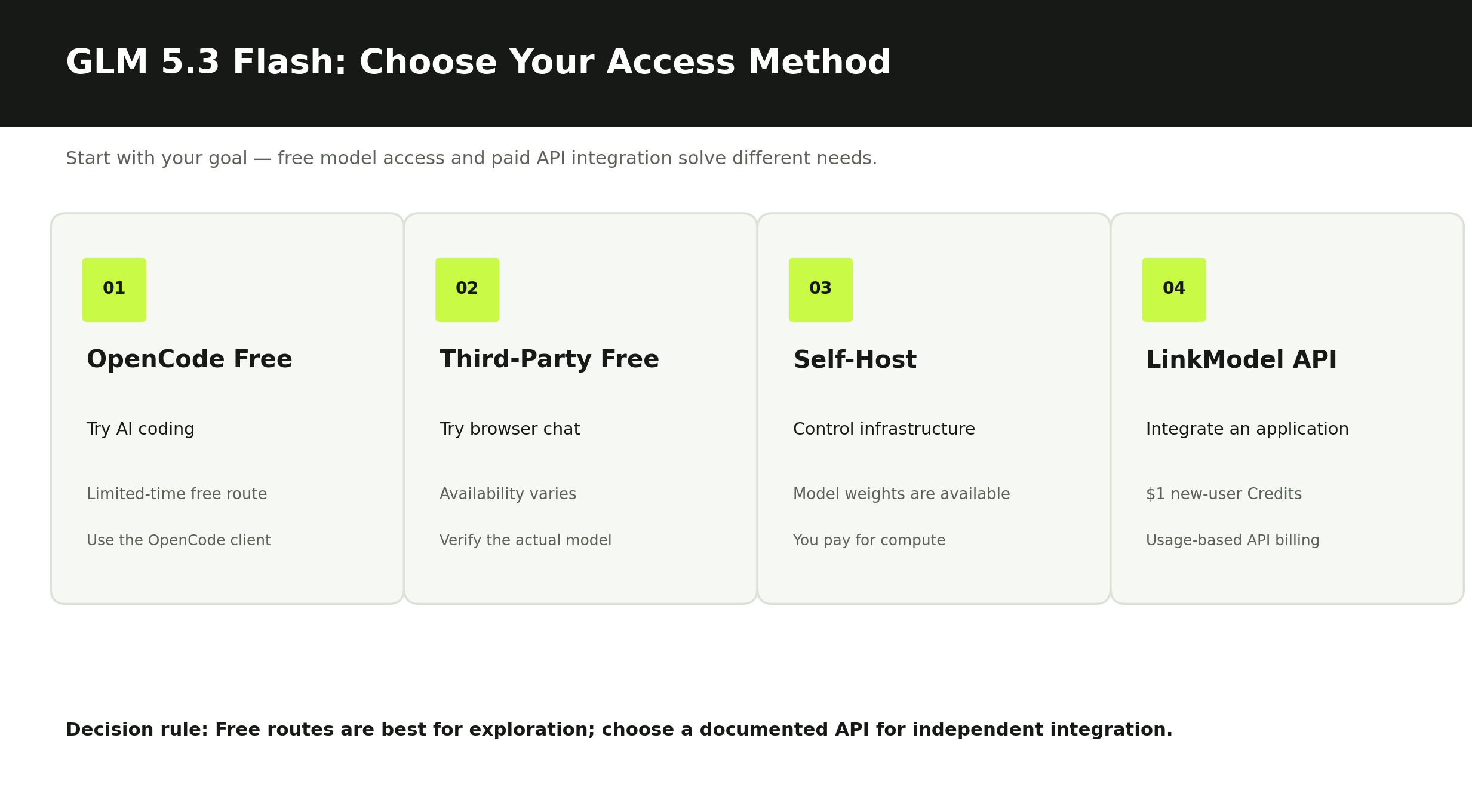
As of November 2, 2026, OpenCode continues to list GLM-5.3-Flash Free as a limited-time offering. Z.ai also provides paid API access and publicly released weights that developers can deploy independently.
| Access Method | Free Access | Main Limitation |
|---|---|---|
| OpenCode Free | Yes, for a limited time | OpenCode-only access and free-tier limits |
| Third-party free services | Sometimes | Provider-specific quotas and availability |
| Self-hosted model weights | Free to download | Hardware and infrastructure costs |
| Z.ai standard API | Paid | Token-based billing |
| LinkModel API | $1 new-user Credits | Usage-based charges after available Credits are consumed |
The important distinction is between the model itself, the service hosting it, and the application used to access it.
What Is GLM 5.3 Flash?
GLM 5.3 Flash is an open-weight, natively multimodal model released by Z.ai on August 26, 2026.
Its published specifications include:
- 320 billion total parameters, with approximately 18 billion activated per token.
- A mixture-of-experts architecture that balances capability and inference efficiency.
- Support for text, image, video, and file inputs, with text output.
- A context window of up to 1 million tokens on supported deployments.
- Function calling and configurable reasoning effort for agent-based workflows.
GLM 5.3 Flash is designed for coding, analysis, and long-running tasks involving tools or multiple reasoning steps.
The model's full capabilities depend on the provider. A free route may offer a smaller context window or fewer supported input formats than the underlying model.
Sources: Z.ai's GLM 5.3 Flash model documentation and the LinkModel GLM 5.3 Flash model page.
How to Use GLM 5.3 Flash for Free: 3 Ways
There are three practical ways to try GLM 5.3 Flash without paying for standard hosted inference: use OpenCode Free, find a currently available third-party free service, or self-host the released model weights.
The right choice depends on what you want to do.
| Your Goal | Recommended Option | Why |
|---|---|---|
| Try AI coding without paying for model calls | OpenCode Free | Documented free coding access |
| Chat through a browser | A currently available third-party free interface | Minimal setup, depending on availability |
| Control the deployment environment | Self-hosted model weights | Greater infrastructure control |
| Integrate GLM 5.3 Flash into your application | LinkModel API | Independent API access with $1 new-user trial Credits |
Use GLM 5.3 Flash Free in OpenCode
OpenCode is an open-source AI coding agent available as a desktop application and a terminal-based interface.
Its GLM-5.3-Flash Free offering is one of the most clearly documented ways to test the model without paying for inference.
Option A: Use the OpenCode Desktop App
1. Visit https://opencode.ai/download and download the desktop installer for your operating system.
2. Install and launch OpenCode Desktop.
3. Open an existing project or select a folder containing files you want the AI agent to work with.
4. Find the model selector in the session interface. Open it to view the models available to your current project.
5. Look for GLM-5.3-Flash Free under the OpenCode provider.
6. Select the free model and start a new coding task.
7. Send a simple prompt such as: "Explain what this Python function does and identify any potential errors."
Check the selected model before sending the request. The free version and the paid GLM 5.3 Flash route have similar names.
If the free model does not appear, check the available providers, update OpenCode, and review its current free-model documentation.
The available model list can depend on your OpenCode version, provider configuration, and session.
Option B: Use the OpenCode Terminal Interface
If you prefer working in a terminal:
1. Install OpenCode using the instructions for your operating system.
2. Open a terminal in your project directory.
3. Run opencode to start the application.
4. Enter /models to open the model selector.
5. Choose GLM-5.3-Flash Free.
6. Submit a short coding request to confirm the selected model works.
The documented full model identifier is:
opencode/glm-5.3-flash-free
A separate paid route uses a different model identifier. Make sure you are selecting the free entry.
Do You Need an OpenCode Account or API Key?
Apidog documented an October 2026 test in which it accessed the free model without signing in or purchasing an API key.
However, OpenCode's available providers and model selection can depend on the current client version and configuration. If a provider connection is requested, check OpenCode's documentation for that specific route before entering payment information.
The free model is distinct from OpenCode's paid Console service. Do not assume that activating a paid provider is required merely because the free model is not visible.
OpenCode states that its GLM-5.3-Flash Free provider follows a zero-retention policy and does not use submitted data for model training.
Try Third-Party GLM 5.3 Flash Free Services
Some independent providers offer free inference quotas, browser-based chat interfaces, or short-term API trials.
These services can be convenient when you want to experiment without installing coding software or managing a local model.
Before choosing one, check:
1. Model identity: Confirm that the service uses GLM 5.3 Flash rather than another GLM variant.
2. Free usage: Check whether access is genuinely free or funded by temporary signup Credits.
3. Usage limits: Review request quotas, concurrency restrictions, and expiration dates.
4. API access: Confirm whether the service permits external applications.
5. Model routing: Check whether requests can be redirected to another model.
Our review of developer discussions identified a Hugging Face community project that added fallback model routes after experiencing a payment-related error.
This is an important practical detail: a free chat website may continue producing replies even after its original GLM 5.3 Flash route becomes unavailable.
For model evaluations, confirm which model generated the response rather than relying only on the website's title.
Download and Self-Host GLM 5.3 Flash
Z.ai has released GLM 5.3 Flash model weights, allowing developers to build their own inference environment.
A typical deployment involves:
1. Downloading the weights or a supported quantized version from the official model repository.
2. Selecting an inference framework compatible with the model.
3. Provisioning adequate GPU memory, storage, and compute capacity.
4. Configuring the model runtime and context window.
5. Connecting the local or hosted endpoint to your intended application.
Self-hosting offers more control over the deployment environment, but it requires technical preparation.
GLM 5.3 Flash is a large mixture-of-experts model. Although only part of the model is activated for each token, deployment planning must still account for the full model weights.
The actual infrastructure requirements depend on quantization, precision, context length, memory offloading, and serving software.
Model weights can be downloaded without paying for hosted inference, but GPU rental, electricity, maintenance, and engineering time remain real expenses.
For casual experimentation, a hosted service is generally easier. Self-hosting is more relevant when infrastructure control is a primary requirement.
GLM 5.3 Flash Free Limits: Rate Limits, Speed, and Context
Free access can be useful for development and experimentation, but its restrictions become more important during long-running coding sessions.
The three most significant factors are request limits, response times, and context capacity.
How Many Free Requests Can You Make?
There is no universal daily request allowance for GLM 5.3 Flash Free.
Each service determines its own limits, which may depend on traffic, concurrency, and provider policies.
In a Reddit discussion about OpenCode's free model, one user reported running 18 concurrent sessions and sending 1,027 requests before receiving request rejections after approximately 13 minutes.
The same report described around 91 million input tokens, mostly cached, and approximately 240,000 output tokens.
The case illustrates how high-concurrency usage can eventually trigger free-tier limits. Actual allowances depend on the provider's current policies and traffic conditions.
If you encounter request rejections, reduce concurrency, review the service's usage policy, and avoid unnecessary retries.
Why Can GLM 5.3 Flash Free Be Slow?
A model designed for efficient inference can still experience delays when the hosting service is under heavy load.
In an October 16, 2026 test, Apidog measured response times ranging from 7 to 196 seconds across 11 short one-line questions using GLM 5.3 Flash Free through OpenCode.
The wide response-time range shows why provider load and queueing can matter as much as model efficiency when choosing a free service.
Developer discussions have also described interrupted responses and cases where a model displayed reasoning content without completing its final answer.
For coding agents, delays can affect the entire workflow. An incomplete step may require another attempt, increasing total task completion time.
Instead of evaluating only the speed of a single answer, consider how long the model takes to complete an entire coding task.
Does GLM 5.3 Flash Free Have a Smaller Context Window?
Yes, some free routes expose a smaller context window than the underlying model supports.
GLM 5.3 Flash supports up to approximately 1 million tokens of context on compatible deployments.
OpenCode free-route metadata and third-party testing describe a 200K-token context window, along with a smaller maximum output allowance than the paid route.
A 200K context window can accommodate many code explanations, smaller repositories, and ordinary development conversations.
However, large codebases, extensive tool output, and long-running agent sessions can require more aggressive context management.
The practical question is whether the context available from your chosen service can hold the information needed for your task.
GLM 5.3 Flash Free vs Paid API: What's Different?
Free and paid access can use the same underlying model, but they differ in availability, integration permissions, context capacity, and billing.
| Feature | Free Hosted Access | LinkModel Paid API |
|---|---|---|
| Initial model-call cost | Can be $0 | $1 Credits for eligible new users |
| Availability | May be temporary | Published usage-based pricing |
| External integrations | Provider-specific; OpenCode free route is restricted | API access for supported applications |
| Context window | OpenCode free route reported at 200K | Up to 1M tokens |
| Request limits | Free-tier policies | API account and provider limits |
| Billing | Free while eligibility lasts | Token-based usage billing |
A paid API does not automatically produce better answers. Actual performance depends on deployment conditions, configuration, and the task.
The main advantage for application developers is having a documented API service that can be integrated outside a restricted free client.
Can You Use the Free OpenCode API Outside OpenCode?
No. OpenCode's GLM-5.3-Flash Free route is intended for use through OpenCode, not as an unrestricted API endpoint for independent applications.
OpenCode's documentation states that free-tier chat models require OpenCode.
In its published test, Apidog also received a FreeTierError when attempting to access the free model from an external client.
If you want to connect GLM 5.3 Flash to a website, backend service, automation workflow, or another coding agent, choose a provider that explicitly supports the required integration.
When Should You Switch to a Paid GLM 5.3 Flash API?
Free access is useful for trying the model and completing occasional coding tasks.
A paid API becomes more relevant when you need independent application access, a larger supported context window, continuous workflows, or clear usage accounting.
Compare GLM 5.3 Flash API Pricing
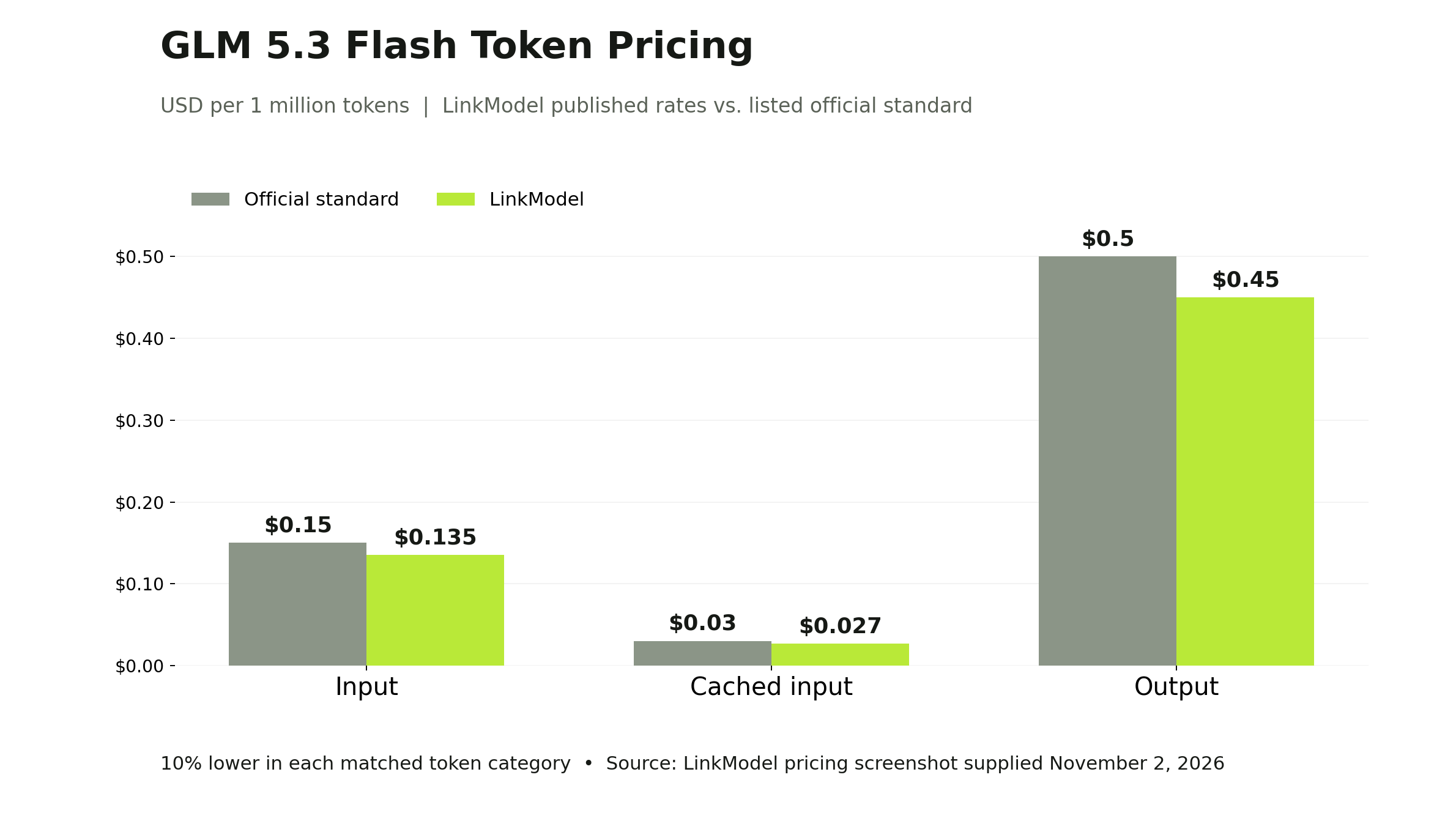
LinkModel publishes GLM 5.3 Flash token rates that are 10% lower than the corresponding official standard prices shown on its model pricing page.
| Token Category | Official Standard Price | LinkModel | Savings |
|---|---|---|---|
| Input | $0.15 per 1M | $0.135 per 1M | 10% |
| Cached input | $0.03 per 1M | $0.027 per 1M | 10% |
| Output | $0.50 per 1M | $0.45 per 1M | 10% |
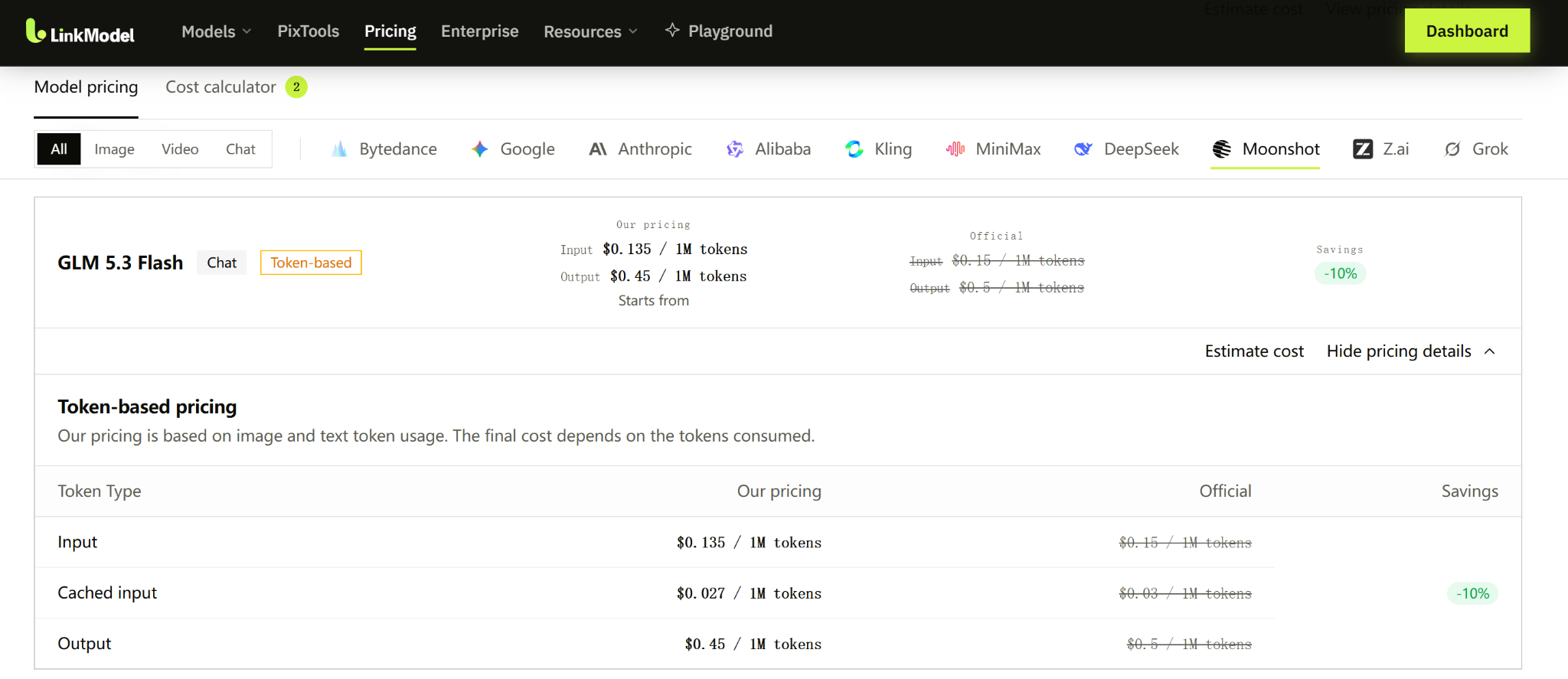
The official standard rates shown above are also reported in published GLM 5.3 Flash provider comparisons. LinkModel's public pricing page lists the matched rates and savings.
Consider a workload using one million ordinary input tokens and 200,000 output tokens.
Official standard cost: (1 × $0.15) + (0.2 × $0.50) = $0.25.
LinkModel cost: (1 × $0.135) + (0.2 × $0.45) = $0.225.
Savings: $0.025, or 10%.
At these prices, every million matching ordinary input tokens costs $0.015 less through LinkModel, while every million matching output tokens costs $0.05 less.
The absolute savings increase as token consumption grows.
What Can $1 in Free LinkModel Credits Cover?
LinkModel's $1 signup benefit allows eligible new users to test GLM 5.3 Flash through a metered API without purchasing Credits first.
The following calculations use LinkModel's published ordinary input and output rates.
| Example Workload | Input Tokens | Output Tokens | Cost |
|---|---|---|---|
| Small text task | 10,000 | 2,000 | $0.00225 |
| Medium coding task | 100,000 | 10,000 | $0.018 |
| Larger coding task | 500,000 | 50,000 | $0.09 |
For example, a request using 10,000 ordinary input tokens and 2,000 output tokens costs:
(10,000 ÷ 1,000,000 × $0.135) + (2,000 ÷ 1,000,000 × $0.45) = $0.00225.
At this token mix, $1 covers approximately 444 requests, giving developers a clear starting budget for initial testing.
Actual costs depend on each request's input, output, and cached-token usage.
A Practical Free-to-Paid Decision Rule
Continue using a free service if you are experimenting with prompts and can tolerate temporary availability, rate limits, or client-specific restrictions.
Consider a paid API when:
- You need external application integration.
- Your work regularly exceeds free-tier limits.
- You require a larger supported context window.
- Your application needs ongoing usage and cost tracking.
For production applications, compare task completion, total execution time, retries, and billed tokens.
The cheapest displayed token price does not always deliver the lowest cost per successfully completed task.
How to Try GLM 5.3 Flash on LinkModel
LinkModel lets developers move from free experimentation to an independently accessible, usage-based API.
Follow these steps:
- Visit the GLM 5.3 Flash model page at https://www.linkmodel.ai/models/glm-5.3-flash.
- Register for a LinkModel account. Eligible new users receive $1 in free Credits automatically, with no payment card or recharge required.
- Open the Playground and select GLM 5.3 Flash.
- Enter a simple coding task and submit it.
- Inspect the model's response and the displayed token usage.
- When you are ready for API integration, open LinkModel's API documentation and confirm the endpoint, authentication format, and supported parameters.
The published GLM 5.3 Flash model identifier is:
glm-5.3-flash
LinkModel provides a unified API platform for supported text, image, and video models, with consumption-based pricing rather than a required monthly platform subscription.
Its GLM 5.3 Flash rates are $0.135 per 1M ordinary input tokens, $0.027 per 1M cached input tokens, and $0.45 per 1M output tokens.
Real Coding Example: Debugging a Python Function with GLM 5.3 Flash
We used GLM 5.3 Flash in the LinkModel Playground to examine a Python function that calculates the average of a list of numbers.
The request asked the model to identify the bug, provide corrected code, and explain the expected output.
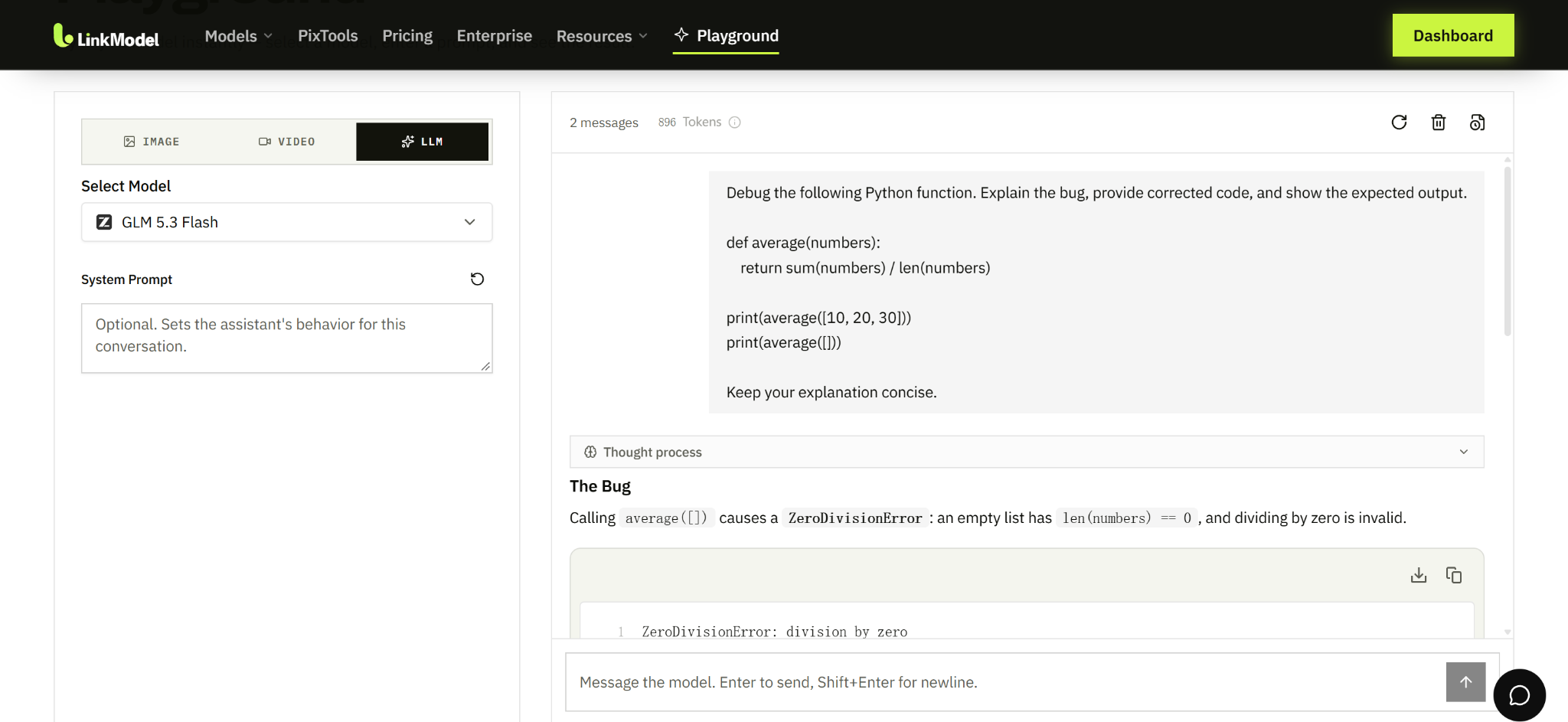
The original code was:
def average(numbers):
    return sum(numbers) / len(numbers)

print(average([10, 20, 30]))
print(average([]))
The original function works for a non-empty list but raises a ZeroDivisionError when the input is empty.
What GLM 5.3 Flash identified
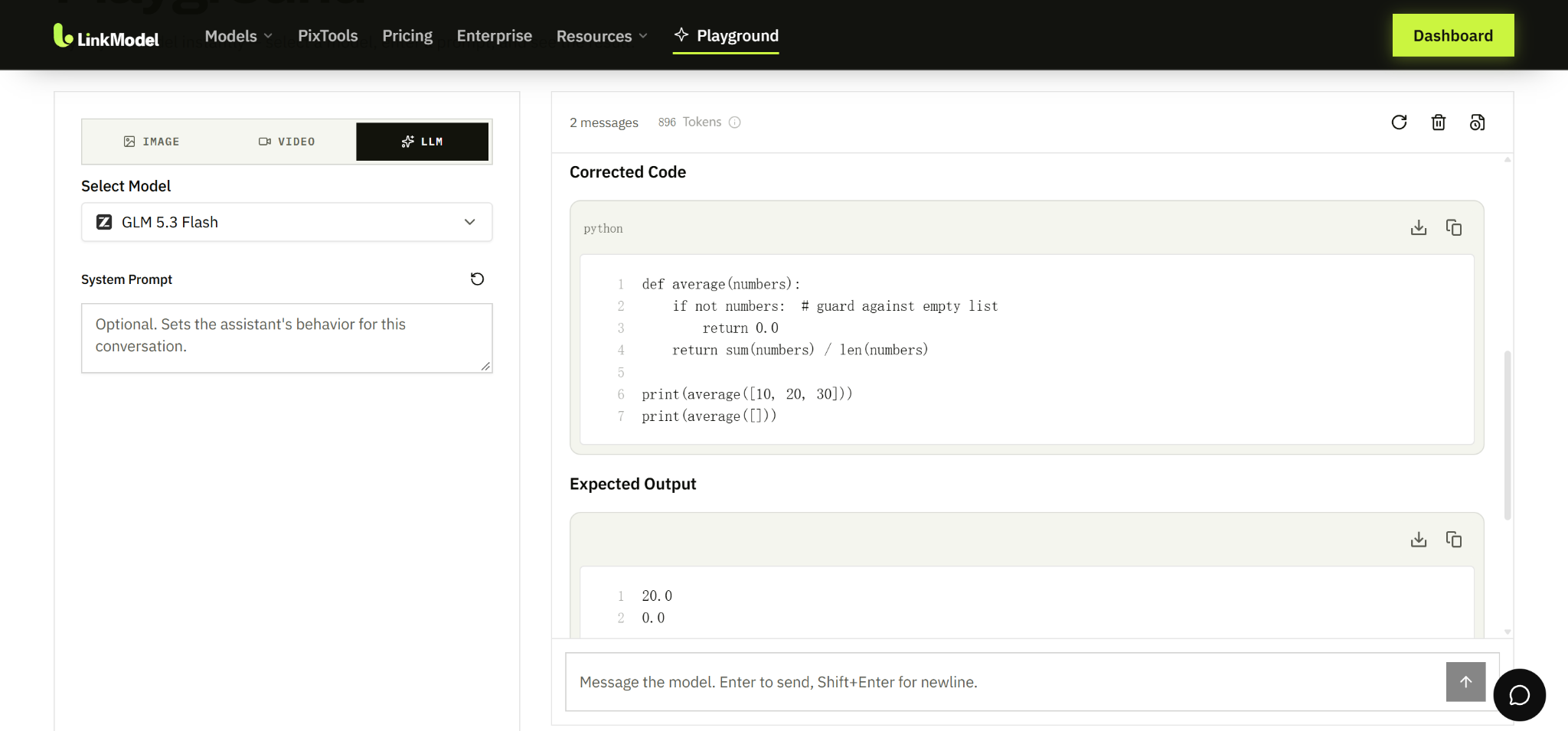
The model correctly explained that len(numbers) becomes zero for an empty list, making the division invalid.
It then produced a corrected implementation:
def average(numbers):
    if not numbers:
        return 0.0
    return sum(numbers) / len(numbers)

print(average([10, 20, 30]))
print(average([]))
The expected output was:
20.0
0.0
What makes the response useful?
The model did more than identify a Python exception.
It also explained that the mathematical average of an empty list is undefined. Returning 0.0 is one possible programming convention, but it can hide an invalid input if the application expects a meaningful average.
For stricter input validation, the model suggested raising a ValueError instead.
This distinction matters because debugging is not always about preventing a program from crashing. It also involves deciding how a function should behave when its input is invalid.
What the Playground displayed
The LinkModel Playground showed 896 tokens for the conversation. The interface displayed the submitted prompt, the selected GLM 5.3 Flash model, and the generated response.
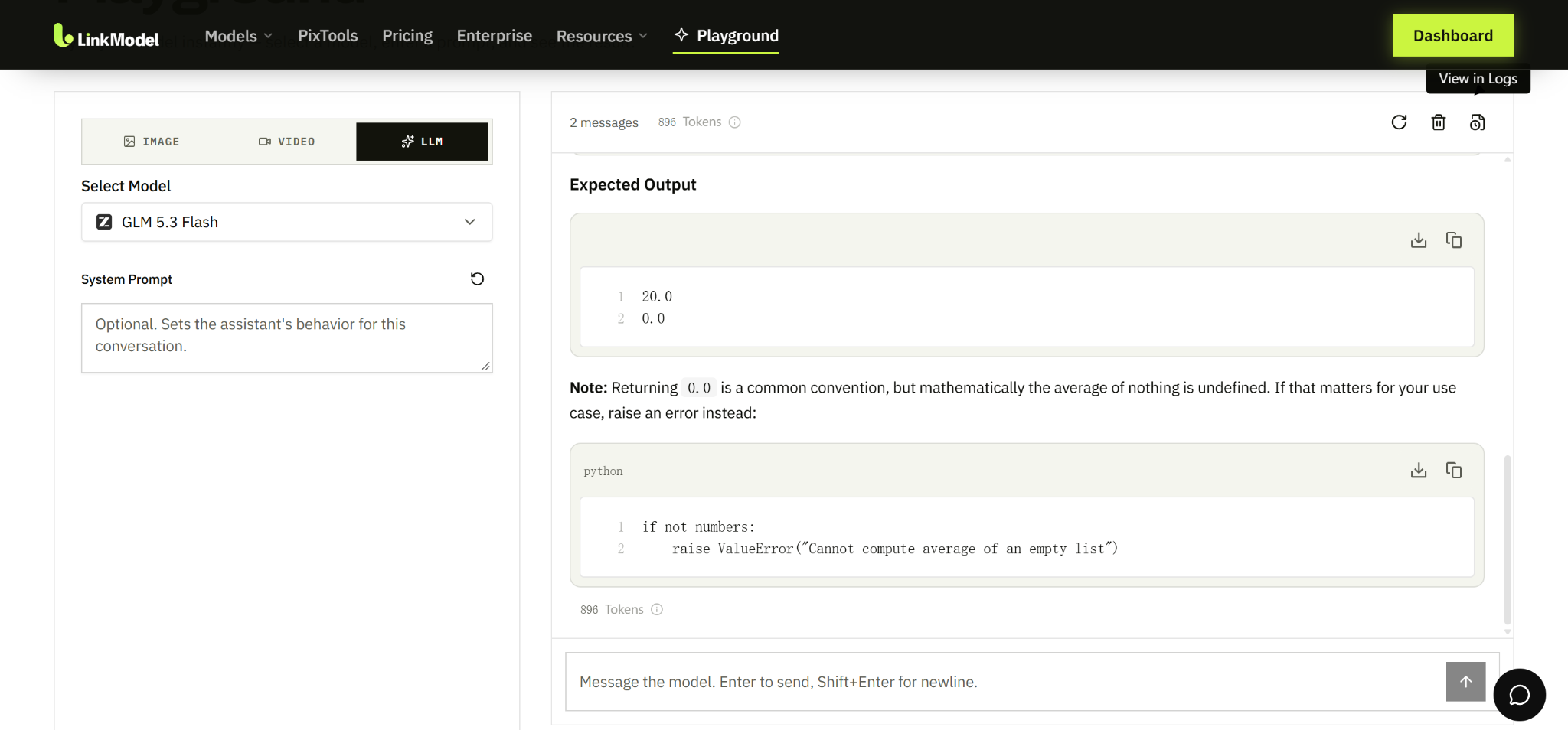
The screenshots document a successful small debugging interaction and provide a practical example of how developers can evaluate the model before using it in larger workflows.
A useful next step is to test the capabilities required by your application, such as function calling, streaming, structured output, or multimodal input, according to LinkModel's supported API documentation.
Frequently Asked Questions
Is GLM 5.3 Flash completely free?
Not through every access method. OpenCode currently provides a limited-time free model, some third-party services may offer free quotas, and the open model weights can be downloaded. Standard hosted inference and self-hosting infrastructure can still have costs.
How long will GLM 5.3 Flash remain free on OpenCode?
OpenCode describes GLM-5.3-Flash Free as a limited-time offering without a guaranteed permanent free period. Check its current model catalog before relying on long-term availability.
Can I use GLM 5.3 Flash for free without OpenCode?
Yes, through an available third-party free service or by deploying the public model weights. Third-party access may be limited, while self-hosting requires suitable infrastructure.
Does GLM 5.3 Flash Free require an API key?
The OpenCode free route has been accessed without a separately purchased API key, although provider setup may differ by client version and configuration. Independent paid APIs typically require authentication.
Is GLM 5.3 Flash Free as good as the paid API?
Both routes can use the same underlying model, but context windows, request limits, latency, and supported features may differ. A paid route is not automatically more accurate; compare it using the tasks and settings relevant to your application.
Conclusion
GLM 5.3 Flash can be used for free through OpenCode's limited-time offering, selected third-party services, or self-hosted open weights, but each method has different limits. For occasional coding experiments, OpenCode is a practical starting point. For external applications and ongoing API workflows, LinkModel offers GLM 5.3 Flash at 10% below the published official standard token prices, with $0 minimum spend, $0 monthly platform fee, and $1 in new-user Credits. Its Playground also provides a straightforward way to verify the model's behavior on a real coding task before moving to API integration.