For short-prompt standard access, the reviewed OpenRouter endpoints tie at $0.10 per million input tokens and $0.50 per million output tokens. Anthropic Batch offers lower published rates for eligible asynchronous work. Check the Claude Haiku 5.5 pricing breakdown against your request length before estimating costs.
A low token price can still mean a high bill. Longer prompts, platform fees, and retries can erase savings. Evaluate prompt caching alongside the cost of an acceptable result.
Keep spending flexible with LinkModel: pay as you go, with no minimum spend and no monthly platform fee. Transparent prices and volume discounts help you compare available options before scaling.
Cheapest Claude Haiku 5.5 API Providers: Comparison and Verdict
The reviewed public prices do not establish one provider as cheapest for every workload. They establish a starting-price tie among several standard endpoints and a separate discount for asynchronous processing.
| Access route | Price finding | What to verify |
|---|---|---|
| Anthropic direct | Published standard pricing baseline | Context tier and request features |
| Anthropic Batch | Lower input/output rates | Eligibility and asynchronous requirements |
| OpenRouter | Listed standard endpoints share starting rates | Plan fees and selected endpoint |
| Direct cloud accounts | Account-specific comparison needed | Region and purchasing terms |
| LinkModel | Haiku 5.5 price unconfirmed | Model availability and complete quote |
Review scope: Prices and listings were reviewed on October 8, 2026. Our research combines public documentation and published workload reports. We have not independently benchmarked these APIs, audited customer invoices, or compared private enterprise contracts.
Standard Provider Prices Listed on OpenRouter
The reviewed endpoint table lists five providers at the same starting rates.
| Provider | Input* | Output* | Cache read* |
|---|---|---|---|
| Anthropic | $0.10 | $0.50 | $0.01 |
| Google Vertex | $0.10 | $0.50 | $0.01 |
| Amazon Bedrock | $0.10 | $0.50 | $0.01 |
| Azure | $0.10 | $0.50 | $0.01 |
| Claude Platform on AWS | $0.10 | $0.50 | $0.01 |
USD per million tokens; starting rates shown through OpenRouter, before platform charges. These listings do not independently verify direct-cloud account prices or complete long-context billing conditions.
When starting prices tie, compare account charges, supported features, and complete task results. A nominal tie does not establish identical invoices.
Direct API, Cloud Platforms, and Aggregators
Anthropic develops Claude; direct and cloud channels expose the model; aggregators provide access across models or upstream endpoints. The LinkModel vs OpenRouter comparison explores how gateway choices differ, while this article focuses on Haiku 5.5 purchasing conditions.
These roles matter because the seller, billing relationship, and integration can differ. An aggregator’s displayed cloud endpoint price is not automatically the cloud platform’s direct purchasing price.
Keep Claude Platform on AWS and Amazon Bedrock separate in your evaluation. For an existing cloud application, obtain an account quote and consider integration effort alongside inference spending.
Claude Haiku 5.5 API Pricing: The 100K Context Threshold
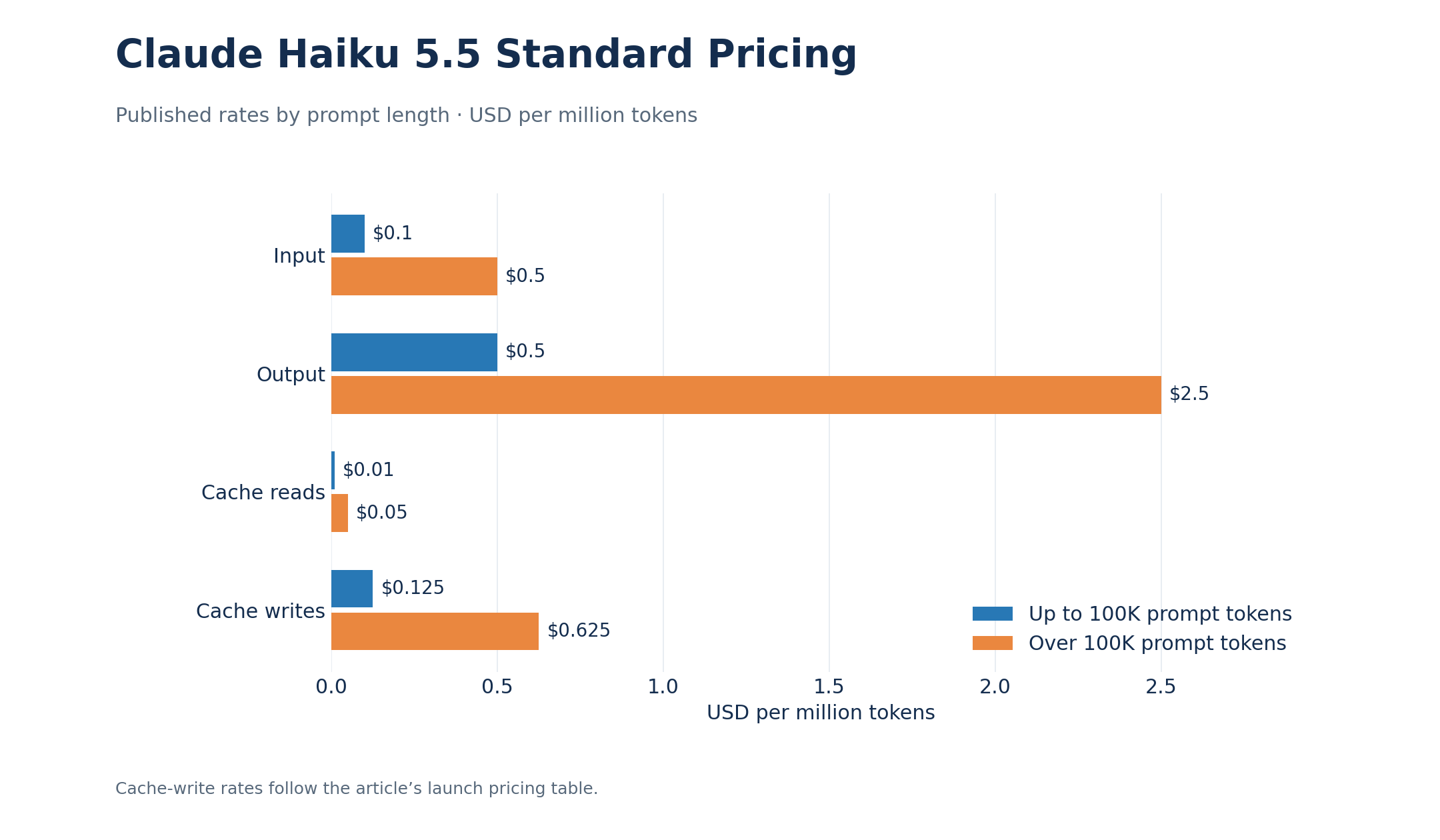
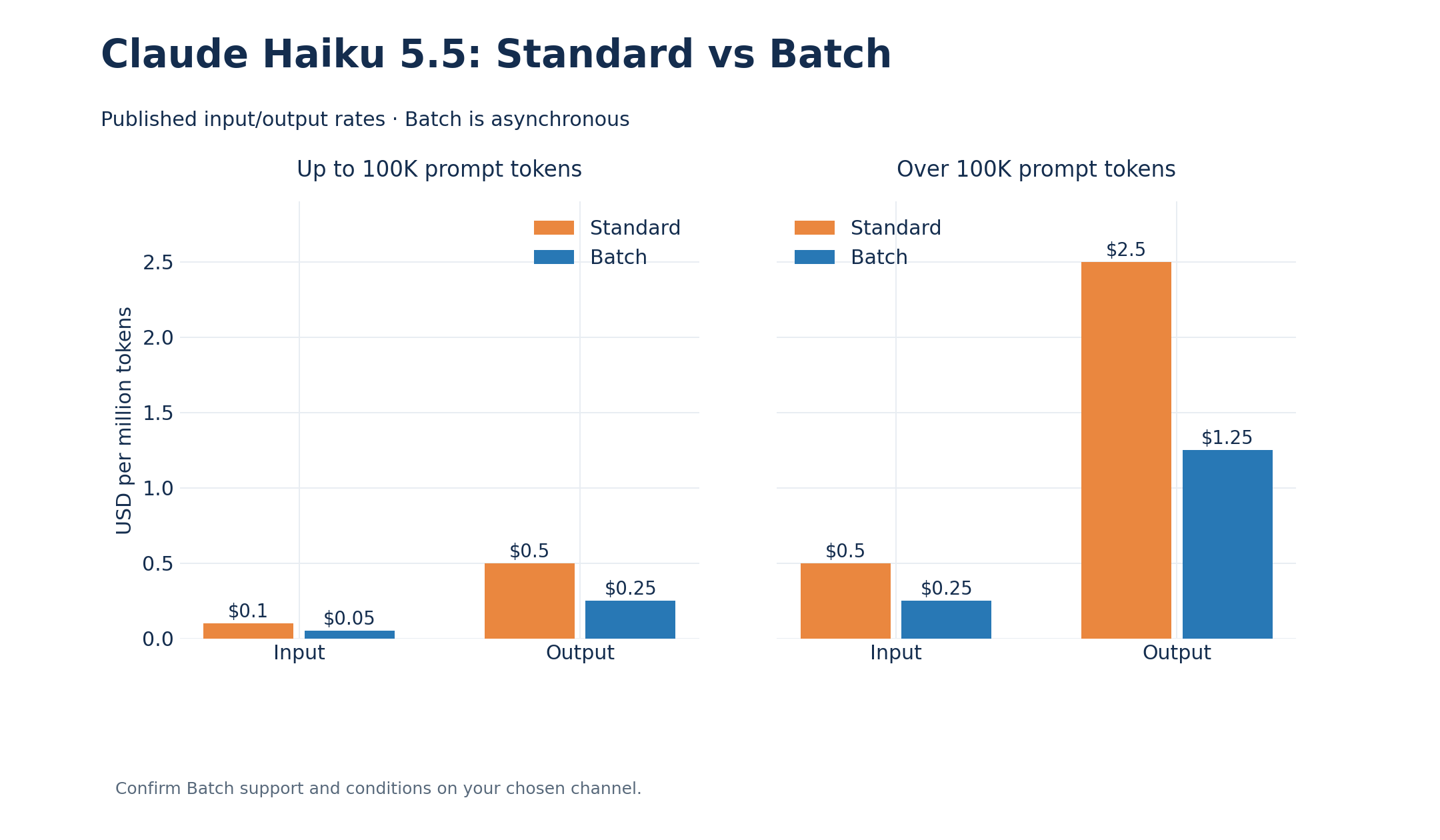
Anthropic’s launch pricing separates prompts up to 100,000 tokens from longer prompts.
| Token category | Up to 100K | Over 100K |
|---|---|---|
| Input | $0.10 | $0.50 |
| Output | $0.50 | $2.50 |
| Cache reads | $0.01 | $0.05 |
| Cache writes in the launch table | $0.125 | $0.625 |
USD per million tokens. Each listed rate rises fivefold in the longer-prompt tier, making request length essential to the comparison.
Budget for the Assembled Request
A short user instruction can accompany substantial input. System instructions, tools, conversation history, retrieved documents, and tool results can enlarge the assembled request. A context-window comparison helps distinguish model capacity from the separate pricing thresholds that affect your bill.
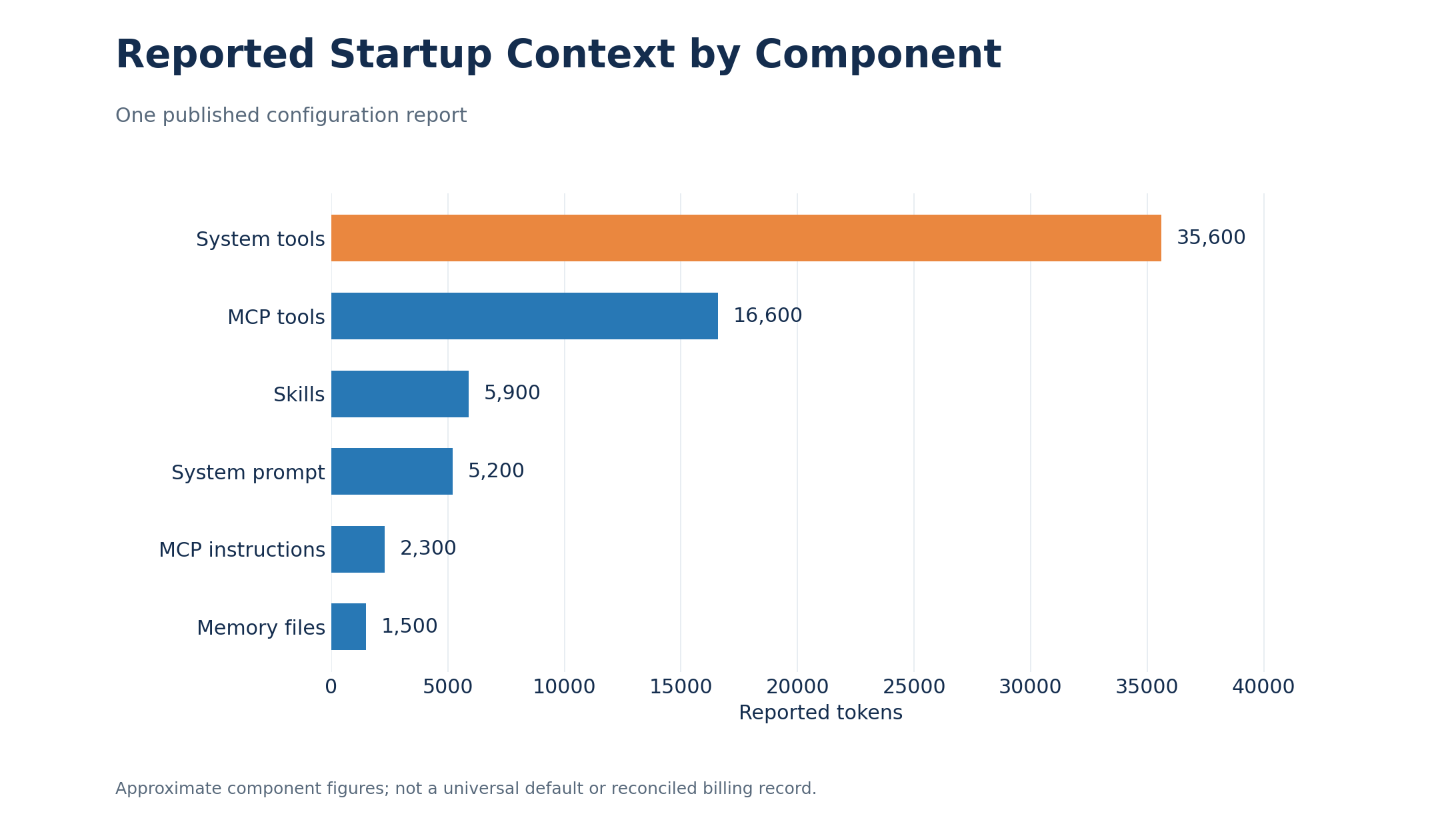
A published configuration report described approximately 66K tokens of startup context, with these components:
| Component | Reported tokens |
|---|---|
| System tools | 35,600 |
| MCP tools | 16,600 |
| Skills | 5,900 |
| System prompt | 5,200 |
| MCP instructions | 2,300 |
| Memory files | 1,500 |
The listed components total approximately 67,100 tokens. This was one approximate configuration report, not a universal default or reconciled billing record.
Audit context overhead before searching for a cheaper provider. Track request size throughout long sessions, and confirm the endpoint’s threshold-counting rules, including cached content.
Compare Equivalent Deployment Conditions
Regional restrictions can affect the quote. Anthropic documents a 1.1× multiplier for specified US-only inference on its first-party API and Claude Platform on AWS, alongside deployment-specific Foundry rules. Partner-operated platforms have independent regional pricing.
Compare deployments that satisfy the same requirements. A lower global price does not establish a cheaper equivalent service when your application requires regional processing.
Lower-Cost Haiku 5.5 API Processing: Batch and Caching
Processing mode and prompt reuse can change costs even when providers share starting rates. Evaluate these options against your request pattern.
Anthropic Batch Pricing
Anthropic publishes a 50% input/output discount for asynchronous Batch processing.
| Prompt length | Batch input* | Batch output* |
|---|---|---|
| Up to 100K | $0.05 | $0.25 |
| Over 100K | $0.25 | $1.25 |
USD per million tokens. Confirm Batch support and conditions on your chosen channel.
Evaluate Batch for scheduled extraction, offline classification, and summarization that can wait. Live support and interactive tools require a separate response-time assessment.
Batch establishes a cheaper mode for qualifying work, rather than a universal provider winner.
Prompt Caching: Include Write Costs and Reuse
For short prompts, Anthropic lists five-minute cache writes at $0.125, one-hour writes at $0.20, and reads at $0.01 per million tokens. Longer prompts use higher rates.
Measure actual cache reads and rewrites. A longer duration may help some traffic patterns, but its higher write price belongs in the calculation.
Caching should be assessed alongside total request volume and output consumption. Use the prompt caching guide to review reusable context and common implementation mistakes, then measure your actual cache reads and writes. Extensive cached input alone does not establish a low-cost workflow.
Claude Haiku 5.5 Provider Fees: OpenRouter vs Direct Access
Compare inference prices and platform charges separately. Matching token rates can still produce different total spending.
OpenRouter Platform Fees
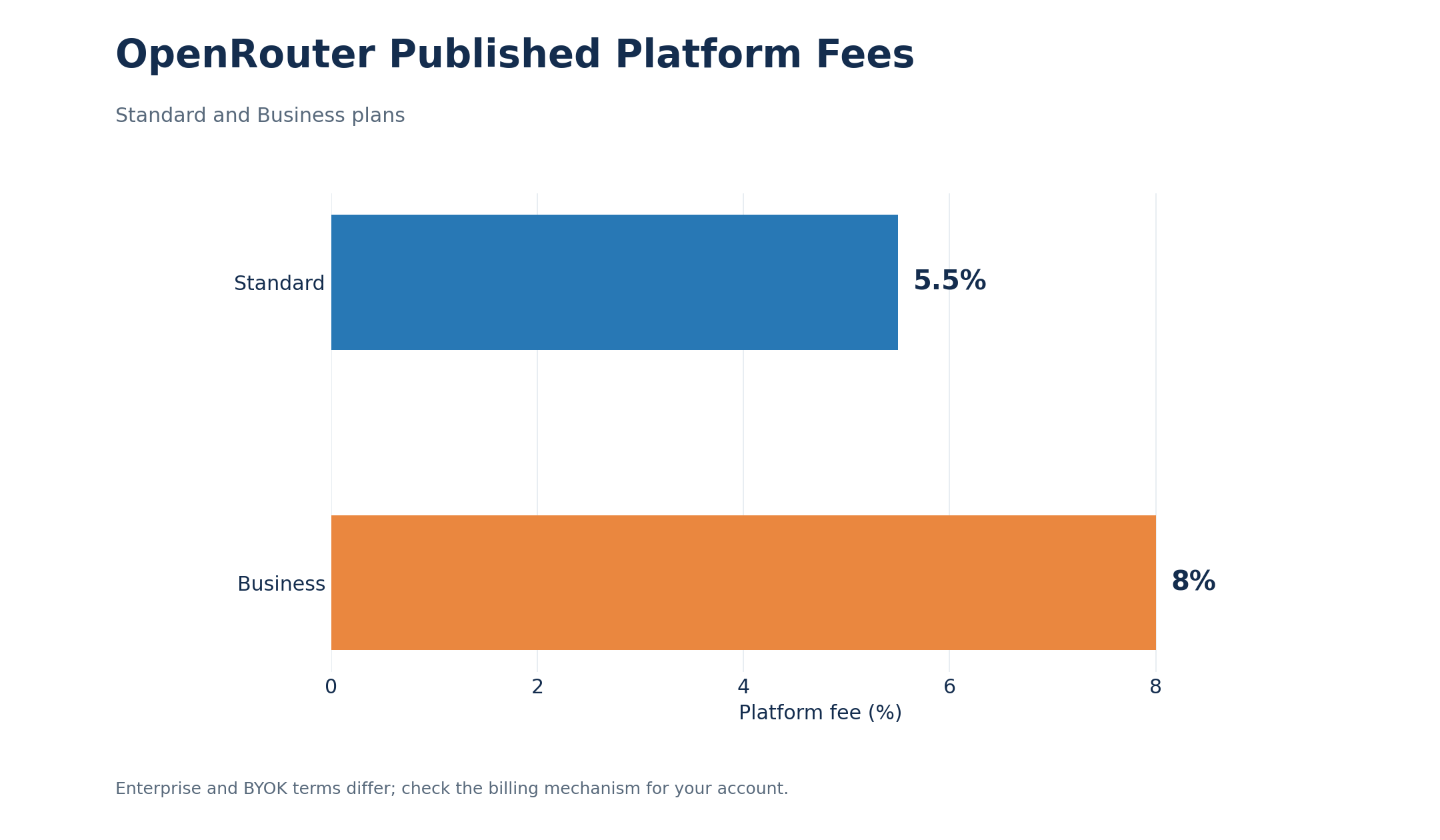
OpenRouter lists platform fees of 5.5% for Standard and 8% for Business, with separate enterprise and bring-your-own-key terms. Check the billing mechanism applicable to your account before calculating effective costs.
An aggregator may provide operational value when managing several models or channels. Evaluate that value against its charges rather than assuming a matched model price produces a matched invoice.
Direct and Cloud Purchasing Terms
Anthropic direct provides a useful baseline. Existing cloud customers should also examine account quotes, commitments, and migration effort.
Build your comparison from model spending, platform fees, optional services, and applicable taxes. The AI API cost-reduction guide provides related optimization ideas to evaluate against your workload. Track human correction time separately if it affects the business decision.
Choose the lowest complete cost among options meeting your requirements, rather than assigning a winner from a model card.
Haiku 5.5 API Cost Case Studies: Why Starting Prices Can Mislead
Our review of published tests shows why provider selection needs workload evidence. The Haiku 5.5 vs GPT-6 Luna comparison examines the related model-choice question. Here, the cases explain what to measure when comparing access routes; they are externally reported evaluations, not our own experiments.
Voxel Generation: Cached Tokens and Cumulative Cost
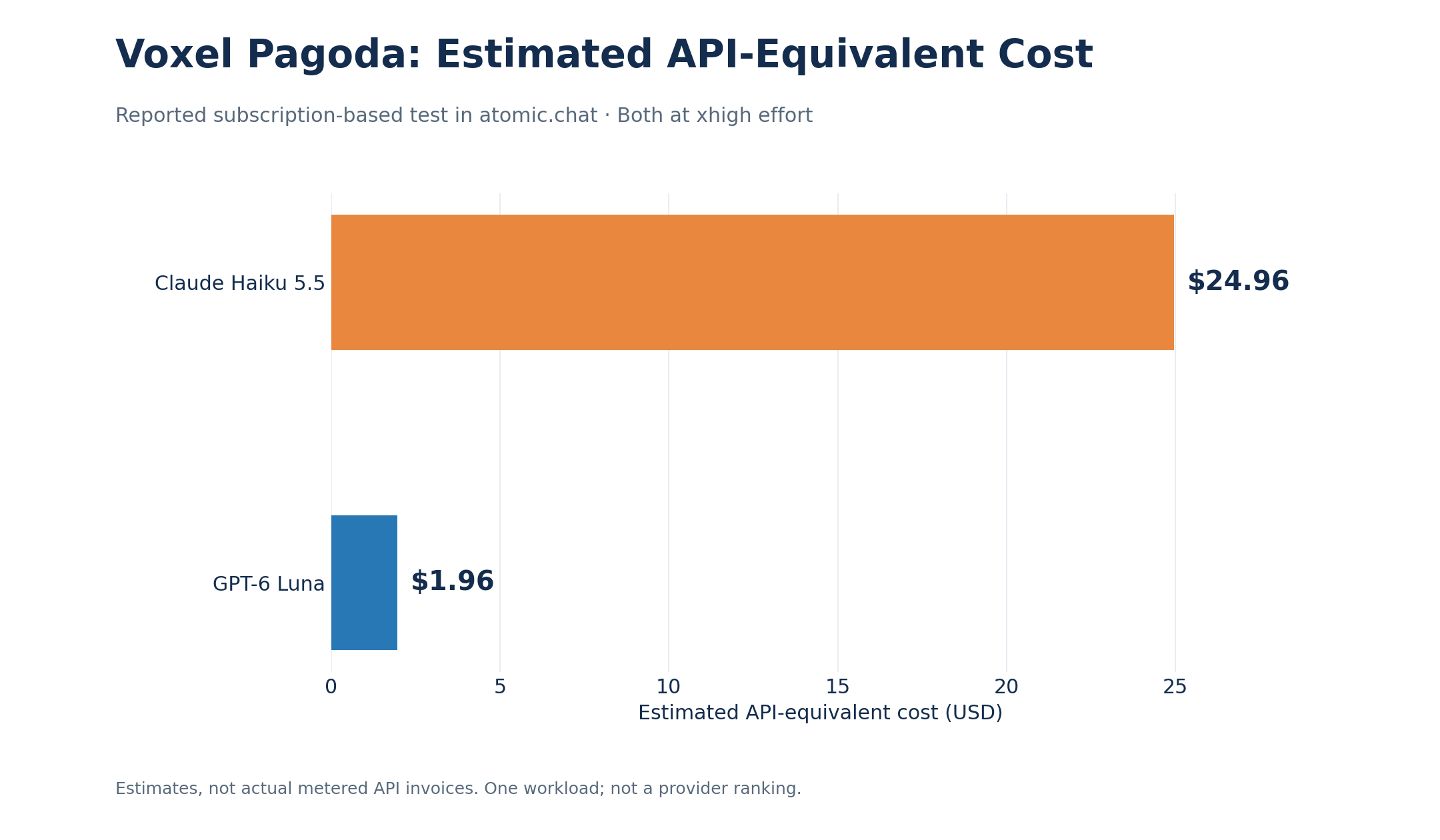
A published voxel-pagoda test ran Haiku 5.5 and GPT-6 Luna through subscriptions in atomic.chat, both at xhigh effort. It reported these API-equivalent estimates:
| Metric | Haiku 5.5 | GPT-6 Luna |
|---|---|---|
| Total input | 268.8M | 64.5M |
| Cached input | 262.7M | 61.1M |
| Output | 4.46M | 1.18M |
| Estimated API-equivalent cost | $24.96 | $1.96 |
These figures describe reported cumulative usage and estimated costs. They are not actual metered API invoices.
The estimated costs differ by approximately 12.7×, calculated from the reported values. Quality judgments were disputed, and the complete process was not independently reproduced.
The lesson is to measure complete sessions, including all billable attempts. This case cannot establish a universal model cost gap or show that another Haiku provider would change the result.
Synthetic Work Evaluation: Similar Scores, Incomplete Cost Evidence
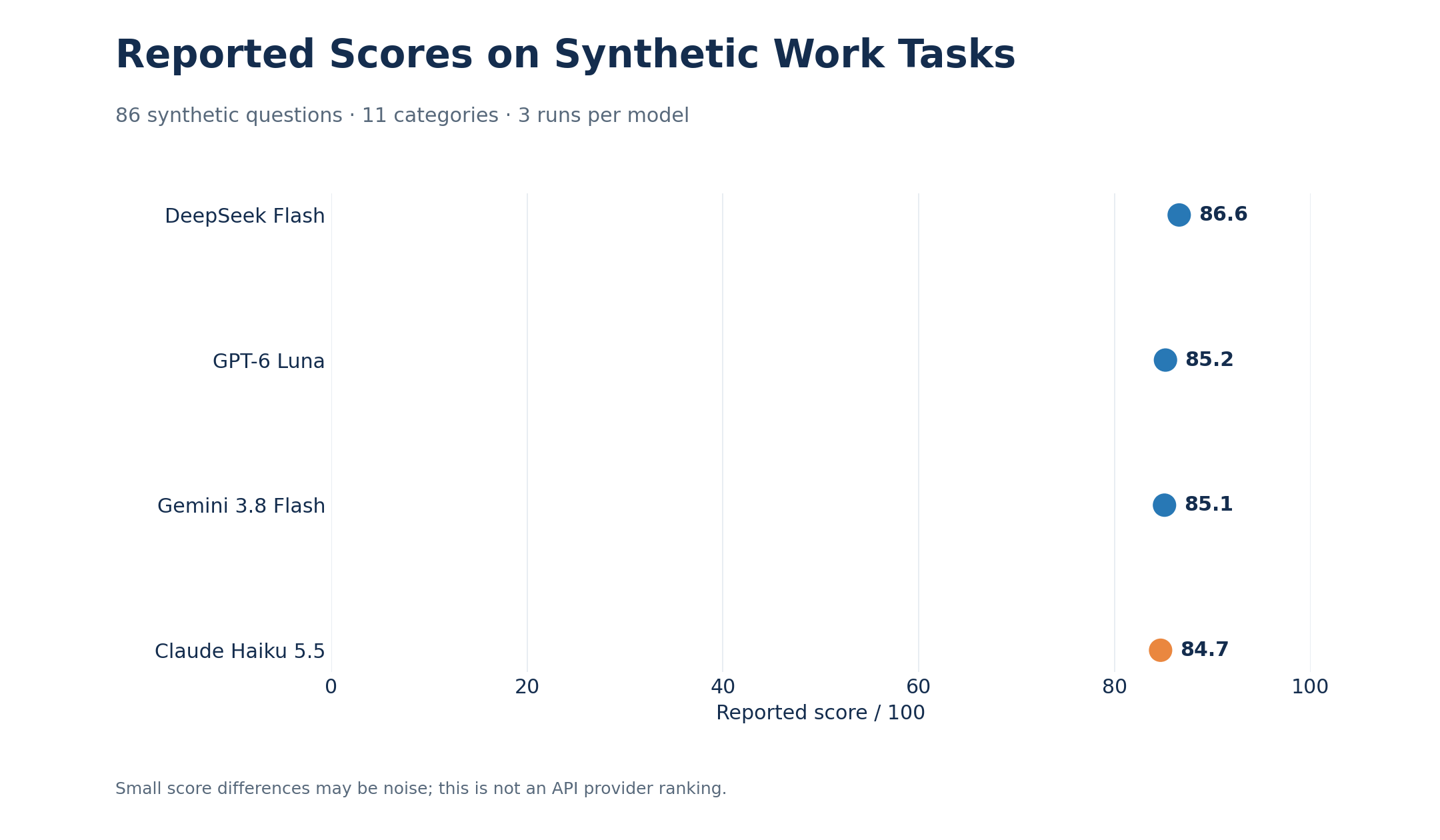
Another published test covered 86 synthetic questions across 11 categories, with three runs per model. Some answers received automatic grading; open-ended answers received blind Opus grading.
| Model | Reported score / 100 |
|---|---|
| DeepSeek Flash | 86.6 |
| GPT-6 Luna | 85.2 |
| Gemini 3.8 Flash | 85.1 |
| Haiku 5.5 | 84.7 |
Haiku’s reported median completion time was 3.5 seconds. The evaluator cautioned that small quality differences could be noise.
Haiku ran through a subscription and appeared as $0 in the harness; approximately $4 in API fees covered the broader comparison. Those figures do not establish Haiku’s API price.
For purchasing, test your own task categories. Overall scores can hide failures that increase correction, retries, and spending.
LinkModel Haiku 5.5 API: Confirm Availability and Pricing
LinkModel’s general pricing benefits are verified separately from Haiku 5.5 support. Its retrieved Anthropic catalog did not establish a Haiku 5.5 listing or model-specific quote. Support therefore remains unconfirmed in this review.
Evaluate the Published Pricing Benefits
LinkModel advertises pay-as-you-go pricing, no minimum spend, no monthly platform fee, and transparent prices with volume discounts. These features can make small-scale evaluation easier, but they do not establish a Haiku 5.5 discount.
Use the LinkModel model catalog to identify available options and check current model-specific rates before integrating.
Require a Model-Specific Quote
Before including LinkModel in a Haiku 5.5 ranking, confirm the callable model identifier, both context tiers, cache conditions, account access, and additional charges.
If support is confirmed, compare it with your existing route using identical prompts, tools, effort, output limits, and acceptance criteria. Discounts on other Claude models are not evidence of Haiku 5.5 pricing.
How to Choose the Cheapest Claude Haiku 5.5 API Provider
Public prices create a shortlist. Apply a practical LLM selection framework to define quality and response requirements, then use representative task results and reconciled billing to make the purchasing decision.
Measure Cost per Accepted Result
Use this metric:
Cost per accepted result = total billable test spending ÷ accepted results.
Define acceptance before testing. Include all billed attempts, not only the final successful request, and track human correction time separately.
The voxel case demonstrates why cumulative consumption matters. The synthetic evaluation demonstrates why task-specific acceptance matters. Neither substitutes for testing your own workload.
Match the Route to the Workload
| Workload | Evaluate first |
|---|---|
| Offline document processing | Suitable Batch access |
| Interactive support | Endpoints meeting response-time requirements |
| Existing cloud application | Current cloud quote and integration |
| Multiple-model application | Aggregator value plus fees |
| Long research or coding agent | Complete-session context and cache costs |
| LinkModel integration | Confirmed model access and complete quote |
These are evaluation priorities, not a tested provider ranking.
Run a Representative Pilot
Include ordinary requests, long inputs, tool calls, and known difficult tasks. Keep conditions consistent and document endpoint differences.
Record the channel, model, region, effort, token categories, charges, completion time, retries, and acceptance result. Reconcile usage with billing before expanding traffic.
A provider that looks cheapest on a short demonstration may perform differently across your actual request mix.
Conclusion
The cheapest Claude Haiku 5.5 API option depends on complete workload cost. The reviewed standard endpoints share starting rates, while Anthropic Batch offers lower published rates for eligible asynchronous processing. Compare equivalent deployment conditions, include platform charges, and count all billable attempts required for acceptable results. Explore the LinkModel model catalog to check available options and current prices, then confirm model-specific access and use a representative pilot to choose the lowest-cost route that meets your requirements.
Frequently Asked Questions
Which Claude Haiku 5.5 API Provider Is Cheapest?
The reviewed standard endpoints tie at their starting rates. Anthropic Batch offers lower published input/output rates for eligible asynchronous work. For live requests, compare context tiers, platform charges, and cost per accepted result.
Does the 100K Threshold Apply Only to My Latest Message?
Do not budget from the latest message alone. Instructions, history, tools, and retrieved content can enlarge the assembled request. Verify the endpoint’s exact counting rules and treatment of cached input before relying on a tier estimate.
Does Higher Effort Make Haiku 5.5 Better Value?
Only when improved acceptance justifies additional spending and waiting. Test effort settings separately. Matching effort names across models does not establish equal computational budgets.
Is Haiku 5.5 Faster or Cheaper Than Luna and DeepSeek?
The reviewed cases do not establish a universal winner. They use different tasks, configurations, and billing arrangements. Check the GPT-6 Luna API pricing guide when evaluating that alternative, then compare equivalent workflows. Keep actual API spending separate from subscription usage and API-equivalent estimates.
Why Can a Platform List Haiku 5.5 While My Account Cannot Use It?
A public listing and account access are separate checks. Confirm the exact model, eligible plan, region, permissions, and client support. For LinkModel, obtain model-specific confirmation before treating Haiku 5.5 as an available purchasing option.