
Jev AI is TypeSafe’s first public System One Model, a decision-focused AI model that returns typed probabilistic decisions instead of generating open-ended text. It uses three core primitives—Choice, Score and Noul—for tasks such as agent routing, model selection, classification, scoring, tool gating and verification. In short, Jev is designed for bounded decisions, not writing, coding or conversation.
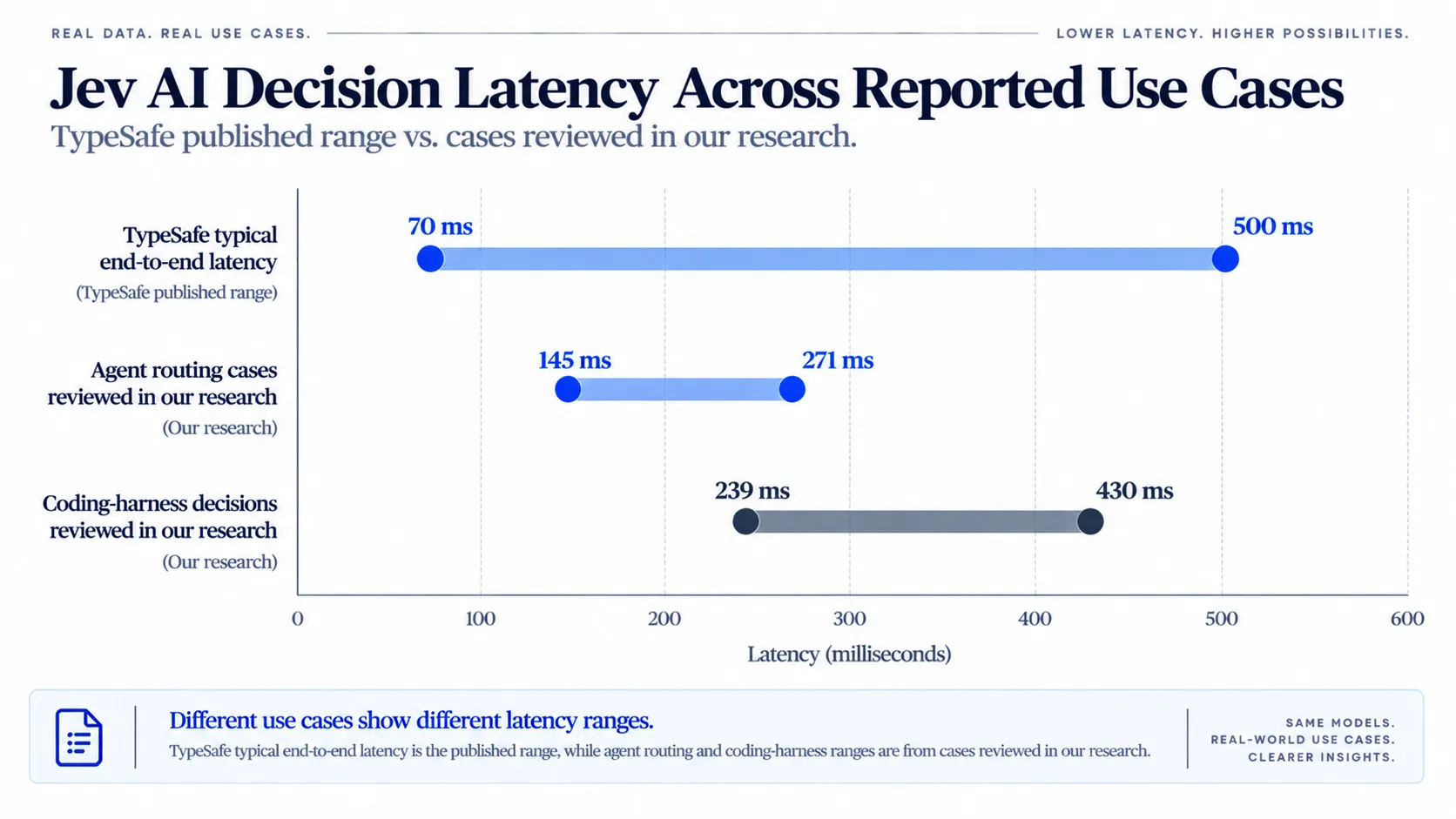
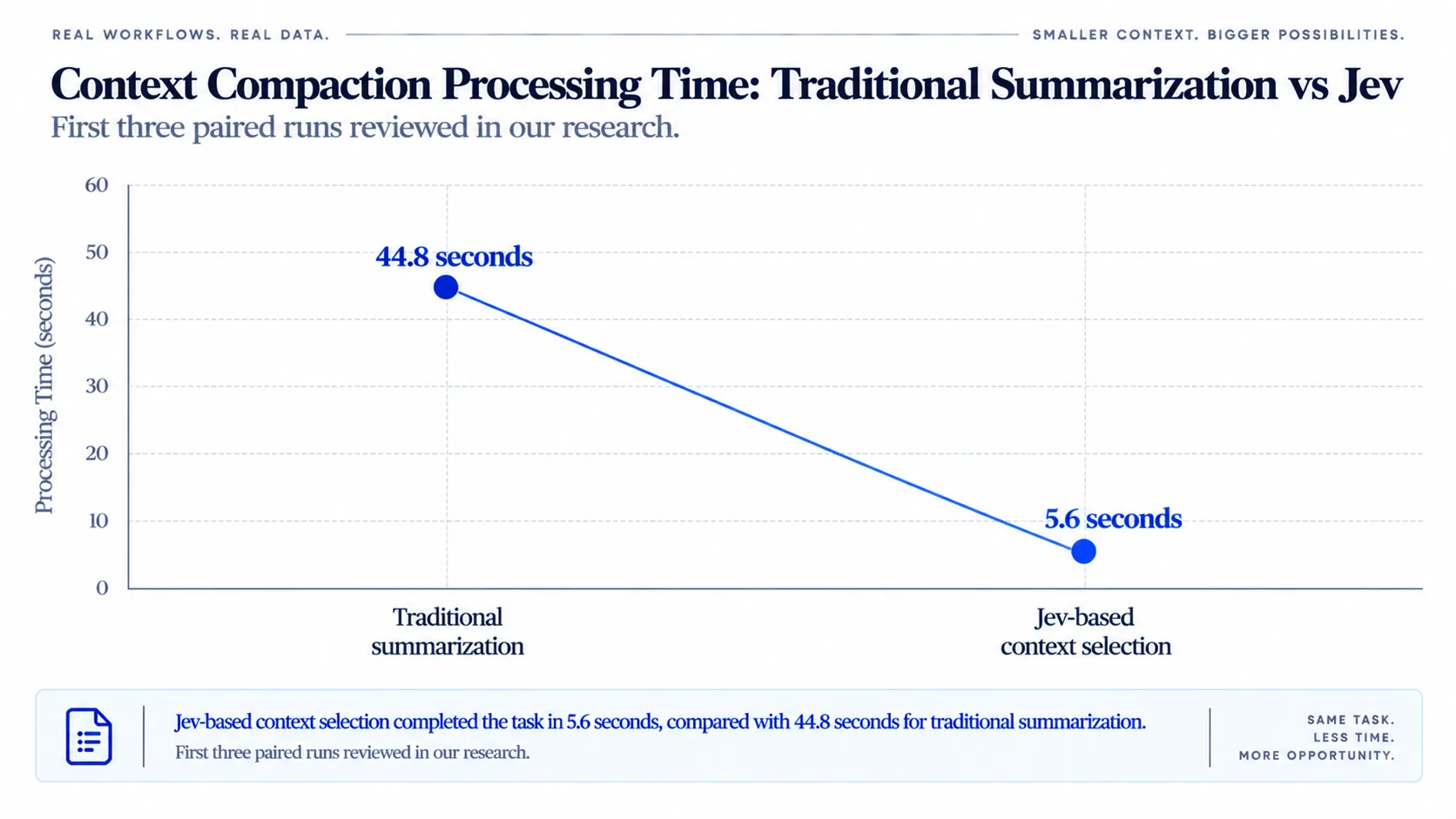
The problem is that many AI workflows still use a full LLM for small decisions, adding unnecessary cost and latency. In cases reviewed in our research, Jev-based routing took 145–271 ms, coding-harness decisions took 239–430 ms, and one early context-compaction test cut processing time from 44.8 seconds to 5.6 seconds. The goal is not to replace LLMs, but to use Jev for lightweight decisions and reserve expensive generation for tasks that actually need it.
LinkModel makes this multi-model workflow easier to run in production. With one OpenAI-compatible API, one API key and unified billing, developers can access supported leading models and switch by price, quality, speed or availability without rebuilding integrations—making it easier to decide first, then call the right model only when needed.
What Is Jev AI?
Jev converts application state into structured probabilistic decisions that software can act on directly. Instead of generating a paragraph and asking application code to interpret it, Jev evaluates predefined questions and returns typed probabilities for routing, scoring, classification or automation.
A useful mental model is a probabilistic decision primitive for software:
State → typed probabilistic decisions → application logic
For example, instead of asking an LLM to explain whether a customer request concerns billing, a Jev workflow can ask: “Which department should handle this request?” The allowed options are defined in advance, and the returned probabilities can feed directly into application logic.
LLMs are optimized for generation and reasoning; Jev is optimized for bounded decisions.
What Is a System One Model?
TypeSafe uses System One Model to describe models optimized for fast, structured judgments rather than open-ended generation.
The company says Jev uses a training approach called Reinforcement Learning for Calibrated Decisions, or RLCD, together with parallel sampling. Instead of producing a long answer token by token, the model evaluates predefined questions about a state and returns typed probabilities.
The intended software pattern is:
State → probabilistic decision → application logic
This separation matters because business rules remain in code instead of being buried inside prompts.
How Does Jev AI Work? Choice, Score and Noul
Jev currently exposes three core decision primitives: Choice, Score and Noul. Multiple questions can be evaluated against the same state, allowing one request to produce several independent judgments.
| Primitive | Question | Best for | Output |
| Choice | Which one? | Routing, classification | Probability by option |
| Score | How much? | Risk, quality, urgency | Ordered score |
| Noul | Is it true? | Verification, gating | Probability of true |
Choice: Which Option?
Choice answers “which one?”
For example, a support request might belong to:
- returns
- billing
- shipping
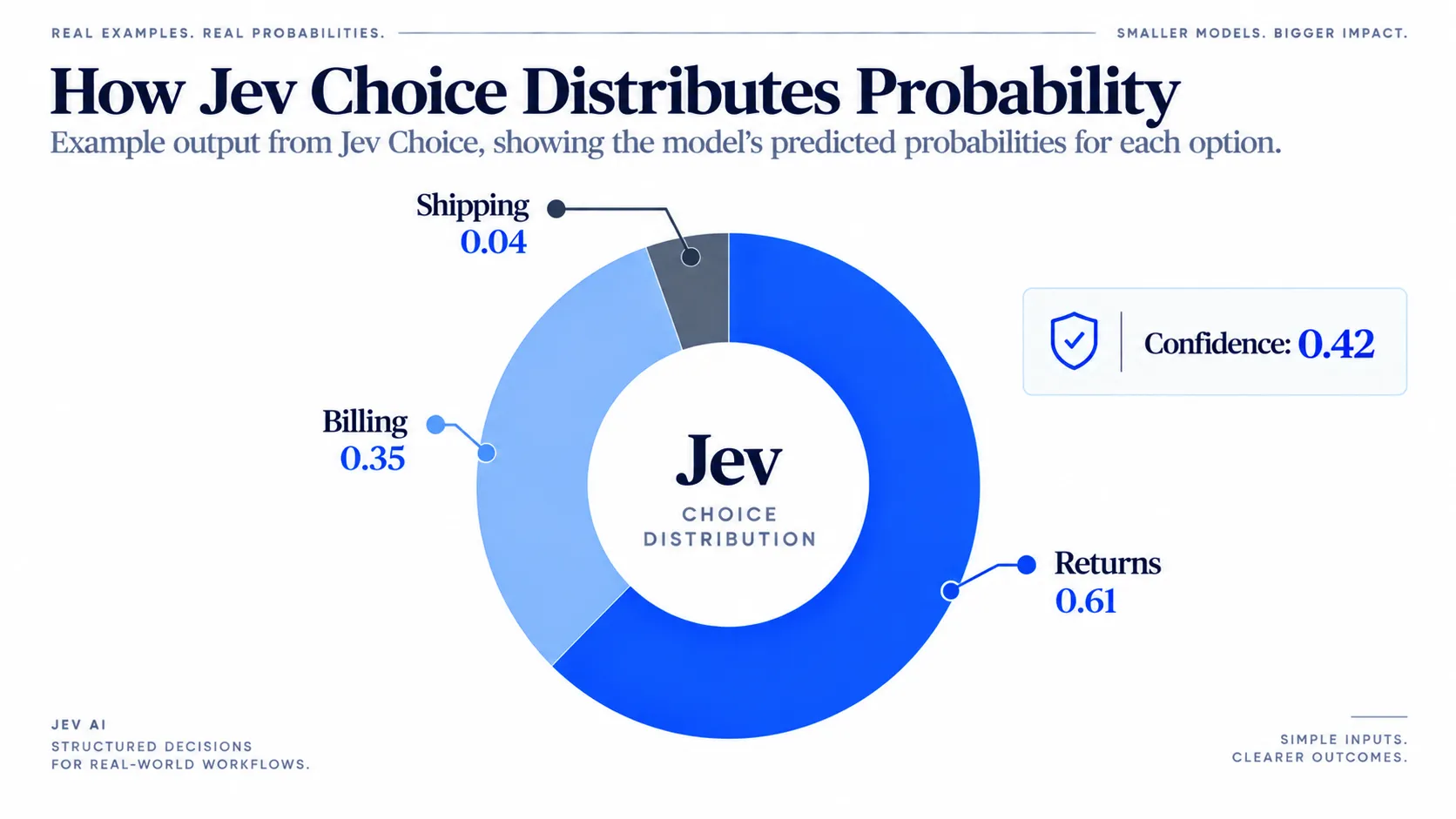
A documented example produces:
- returns: 0.61
- billing: 0.35
- shipping: 0.04
- confidence: 0.42
The system can route the request to returns while still recognizing that billing remains plausible.
Jev currently supports up to 255 Choice options, making Choice useful for larger routing taxonomies as well as simple classification.
Score: How Much?
Score handles ordered judgments such as:
- severity
- urgency
- risk
- quality
- customer frustration
Instead of forcing every case into a rigid category, Score can represent where an input lies across an ordered scale.
This becomes especially useful when the final decision should remain deterministic. A system can separately score market attractiveness, technical feasibility and differentiation, then combine those values using business rules in application code.
Noul: Is It True?
Noul handles yes-or-no questions.
A Noul value of 0.81 means an 81% probability that the statement is true. It does not mean an intensity of 81 out of 100.
Our review of user questions found that this is an important distinction. Use Noul for probability of truth; use Score for degree or severity.
Jev vs LLM: Decision Models vs Generative Models
The core difference between Jev and an LLM is decision versus generation.
| Dimension | Jev | Generative LLM |
| Primary task | Structured decision | Generation and reasoning |
| Output | Typed probability-driven result | Text or tokens |
| Answer space | Defined in advance | Open-ended |
| Routing | Core use case | Possible but heavier |
| Writing and coding | Not designed for it | Core capability |
| Control logic | Usually stays in code | May be encoded in prompts or structured-output schemas |
Jev is not a replacement for an LLM. A more useful production architecture is to use Jev for frequent bounded decisions and generative models for tasks that require writing, coding or deeper reasoning.
For example, Jev can decide whether a request should go to a fast model, a frontier model, a specialist agent or a human reviewer.
What Is Jev AI Best Used For?
Jev is best suited to frequent, bounded decisions where the output space can be defined in advance, such as agent routing, model routing, classification, scoring, tool gating, verification and context filtering.
Jev is a strong candidate when:
- the output space can be predefined
- the task requires judgment rather than generation
- the decision occurs frequently
- latency or cost matters
- probability or uncertainty is useful
- your application has a fallback for ambiguous cases
Good use cases include agent routing, model routing, intent classification, support triage, scoring, tool gating, verification and context filtering.
Jev is a poor fit when the task primarily requires long-form writing, coding, creative generation, conversation or open-ended research.
The strongest production pattern is often:
Jev for bounded decisions → stronger model or human fallback when necessary
Jev AI Pricing and Performance: What TypeSafe Reports
TypeSafe positions Jev around low-cost, low-latency decision-making.
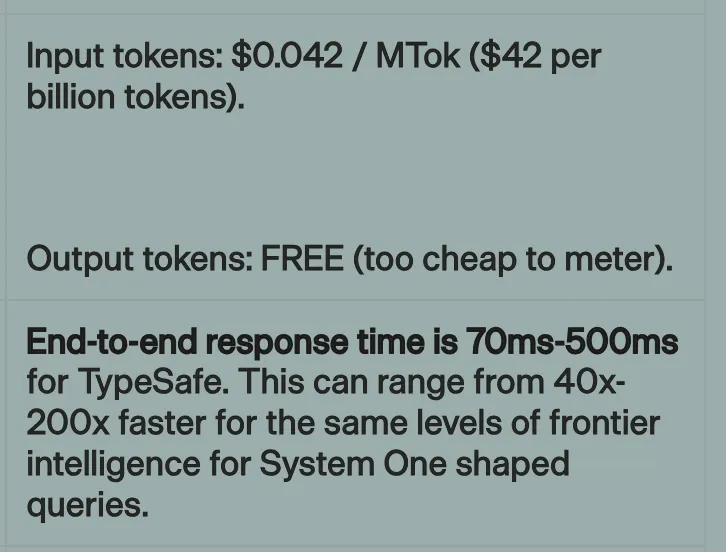
According to TypeSafe’s published Jev pricing and launch data, Jev input costs $0.042 per million tokens, while output is described as too inexpensive to meter. TypeSafe reports typical end-to-end latency of roughly 70–500 ms.
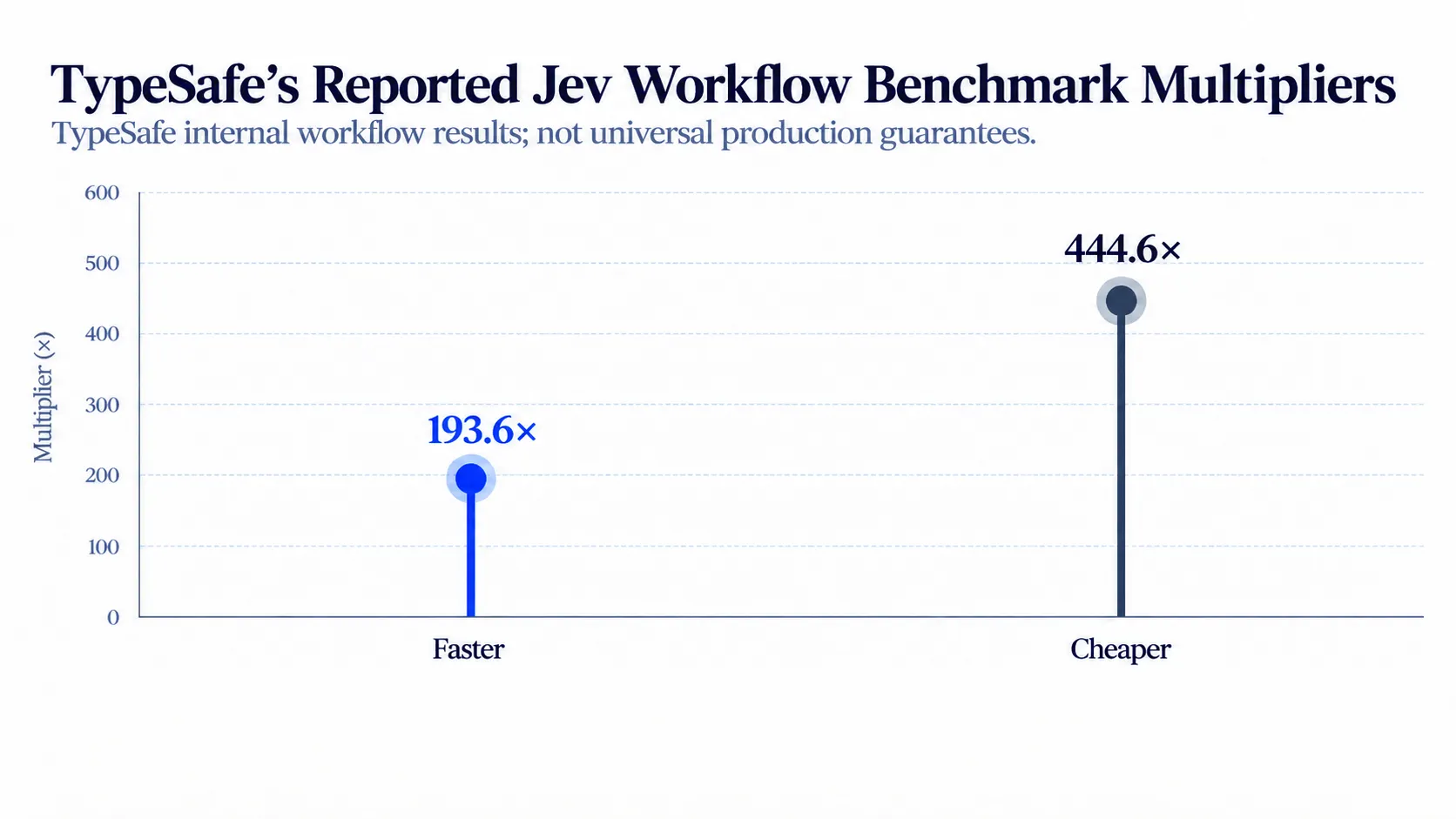
The company also reports internal workflow results of:
- 193.6× faster
- 444.6× cheaper
These are vendor-reported workflow results, not universal production guarantees. TypeSafe itself says these workflows may represent the higher end of real-world gains.
The more defensible takeaway is simpler:
A constrained decision can require far less computation than a full generative response.
Doom: High-Frequency Jev Decisions
TypeSafe’s Doom demonstration ran at approximately 10 Jev queries per second with an estimated cost of around $7 per hour.
Importantly, Jev was not interpreting raw game video. It received structured or textual environment state.
That makes the demo useful as evidence for high-frequency decision loops, rather than evidence that Jev is a general-purpose vision model.
Jev AI for Agents and Model Routing
In an AI agent workflow, Jev can act as a decision layer before an expensive LLM call, choosing which agent, model, tool or human fallback should handle the next step. This makes it especially useful for frequent routing decisions where the output space is known in advance.
Examples include:
- Which agent should handle this request?
- Which model should run?
- Which tool is relevant?
- Should this action require approval?
- Does the user need clarification?
This is where Jev becomes especially interesting.
Agent Routing: 145–271 ms in Cases We Reviewed
In two agent-routing cases included in our research, Jev selected specialized agents in 145 ms and 271 ms, with reported confidence values of 100% and 99%.
The sample size is only two cases, so these results should not be interpreted as a general routing benchmark.
Their value is architectural: routing can happen before a more expensive downstream model is invoked.
This avoids a common inefficiency where one LLM spends tokens understanding a request only to decide which second LLM should process the same request.
Model Routing With Jev
Jev can also route between models based on task type or complexity.
A production system might send:
- simple work to a fast model
- complex reasoning to a frontier model
- specialized work to a domain-specific model
- uncertain cases to human review
This makes Jev plus a multi-model API a natural architecture for agents that optimize cost and capability dynamically.
Jev Tool Gating and Agent Safety
Jev can also act as a semantic decision layer before tool execution.
A model may propose a tool action, while Jev evaluates whether the action appears risky enough to require escalation or review.
In a coding-harness case reviewed in our research, decision latency ranged from 239–430 ms, with reported cost of approximately $0.000013–$0.000027 per decision, equivalent to roughly $13–$27 per million decisions under those conditions.
However, Jev should not replace deterministic permissions.
A safer architecture combines:
- access controls
- deterministic rules
- Jev semantic risk evaluation
- human approval for high-impact actions
Probabilistic judgment can strengthen a safety system, but it should not become the only authorization layer.
Jev Context Compaction: 44.8 Seconds vs 5.6 Seconds
One of the most interesting cases in our research used Jev for semantic context selection instead of summarization.
Across the first three paired runs, the source context was approximately 75,000 characters.
The traditional summarization approach produced:
- 55% context reduction
- approximately 29.3K tokens remaining
- 44.8 seconds average processing time
The Jev-based approach produced:
- 75% context reduction
- approximately 16.1K tokens remaining
- 5.6 seconds average processing time
- approximately 13.2K additional tokens of headroom
- about $0.002 reported selection cost
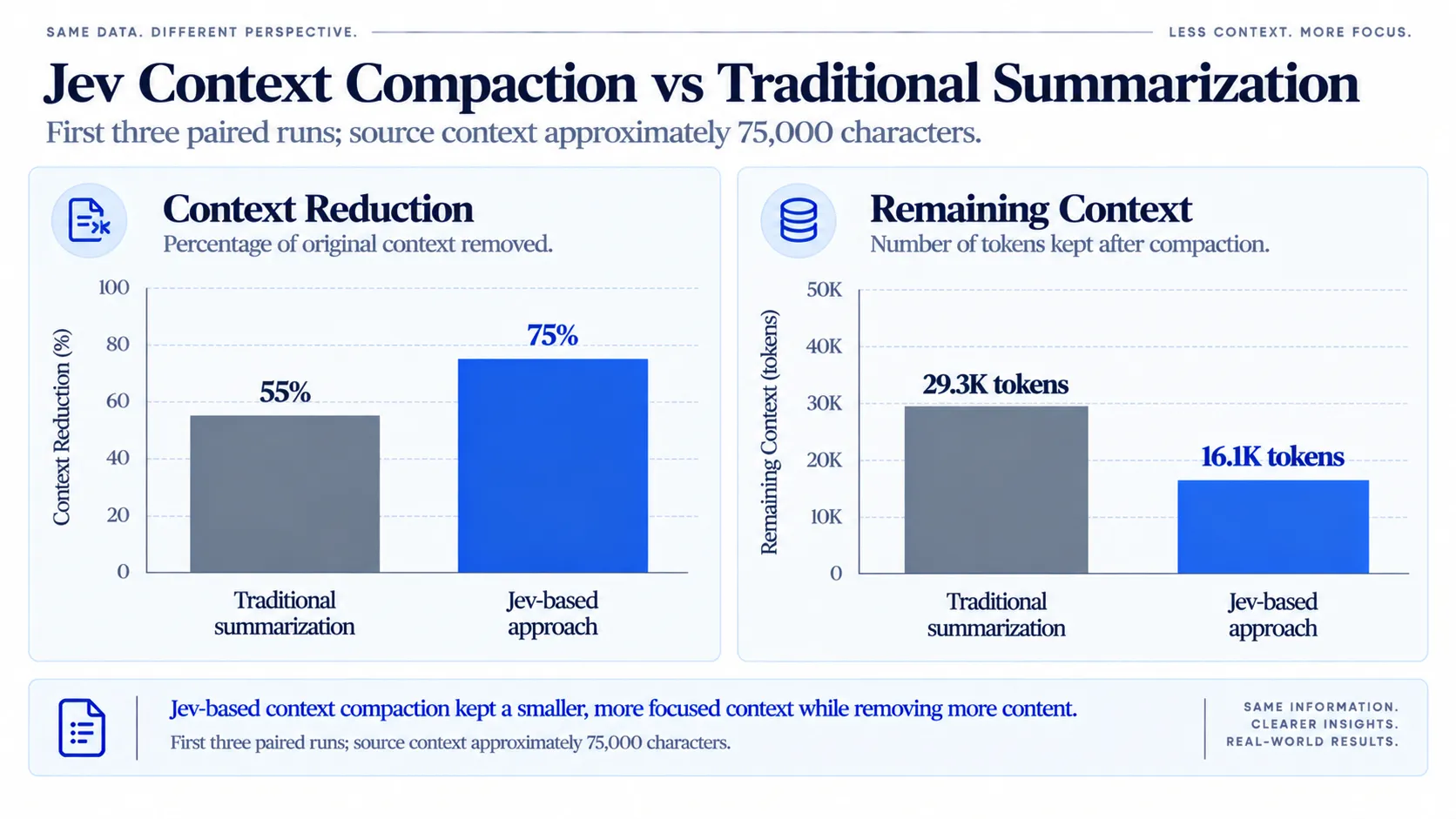
This was only a three-run experiment, so it does not prove that long-term memory quality or downstream task success improves.
But it reveals a useful architectural idea:
Context compression does not always require generating a summary. Sometimes the better operation is deciding what information deserves to survive.
What Jev AI Experiments Reveal About Harness Design
Our research found that several Jev experiments point to the same lesson: model quality is only one part of a decision system.
State representation, fallback logic and harness design can be equally important.
The Minecraft experiment shows the upside of cheap continuous decisions. In one reported setup, Jev processed approximately 150,000 tokens for about $0.01, updated a decision every 2 seconds, and reconsidered behavior every 5 seconds. This is a single experimental setup rather than a standard Jev cost benchmark, but it illustrates how inexpensive decisions can support continuous semantic control.
The Pokémon Red experiment shows the opposite problem: missing state. Jev completed four gym battles before entering repeated loops. Another model was later used to inspect logs and improve the state exposed to Jev. The lesson is simple: a decision model cannot reliably use information the harness never provides.
Jev Probability vs Confidence
In Jev, probability describes how likely a particular answer is, while confidence summarizes how certain the model is about the overall decision. Confidence is not the same as measured production accuracy.
For Choice, each candidate receives a probability. Confidence instead summarizes how concentrated or ambiguous the overall distribution is.
This enables confidence-gated workflows:
- high confidence → automate
- medium confidence → verify or escalate
- low confidence → ask the user or involve a human
But 99% confidence does not automatically mean 99% production accuracy.
Our review of user questions and technical discussions suggests that production teams should evaluate Jev on representative labeled data using measures such as:
- top-1 accuracy
- Brier score
- log loss
- expected calibration error
- coverage versus error
The important question is not simply whether Jev returns confidence.
It is whether that confidence is calibrated on your actual traffic.
Can Jev Still Make Wrong Decisions?
Jev constrains outputs to a predefined schema, which removes one class of generative failure.
If the allowed choices are:
- cat
- dog
- bird
Jev will not suddenly return elephant.
But it can still select dog when the correct answer is cat.
Therefore:
Jev can prevent invalid output types, but it cannot guarantee correct decisions.
This distinction between schema validity and decision accuracy is critical for production use.
Is Jev Just a Classifier?
Jev overlaps with classification, but its interface is broader than a conventional single-task classifier. Choice performs categorical selection, Noul handles binary judgments, and Score represents ordered evaluations through a structured output.
The main distinction is the general decision interface: developers can define different semantic decisions against application state without building a separate classifier pipeline for every task.
TypeSafe describes System One as a new model class built around RLCD and parallel sampling, but public information about Jev’s parameter count, training data and full architecture remains limited. For that reason, it is more defensible today to describe Jev as a new software abstraction for probabilistic decisions than to make strong claims about architectural novelty.
Jev Alternatives and External Benchmark Data
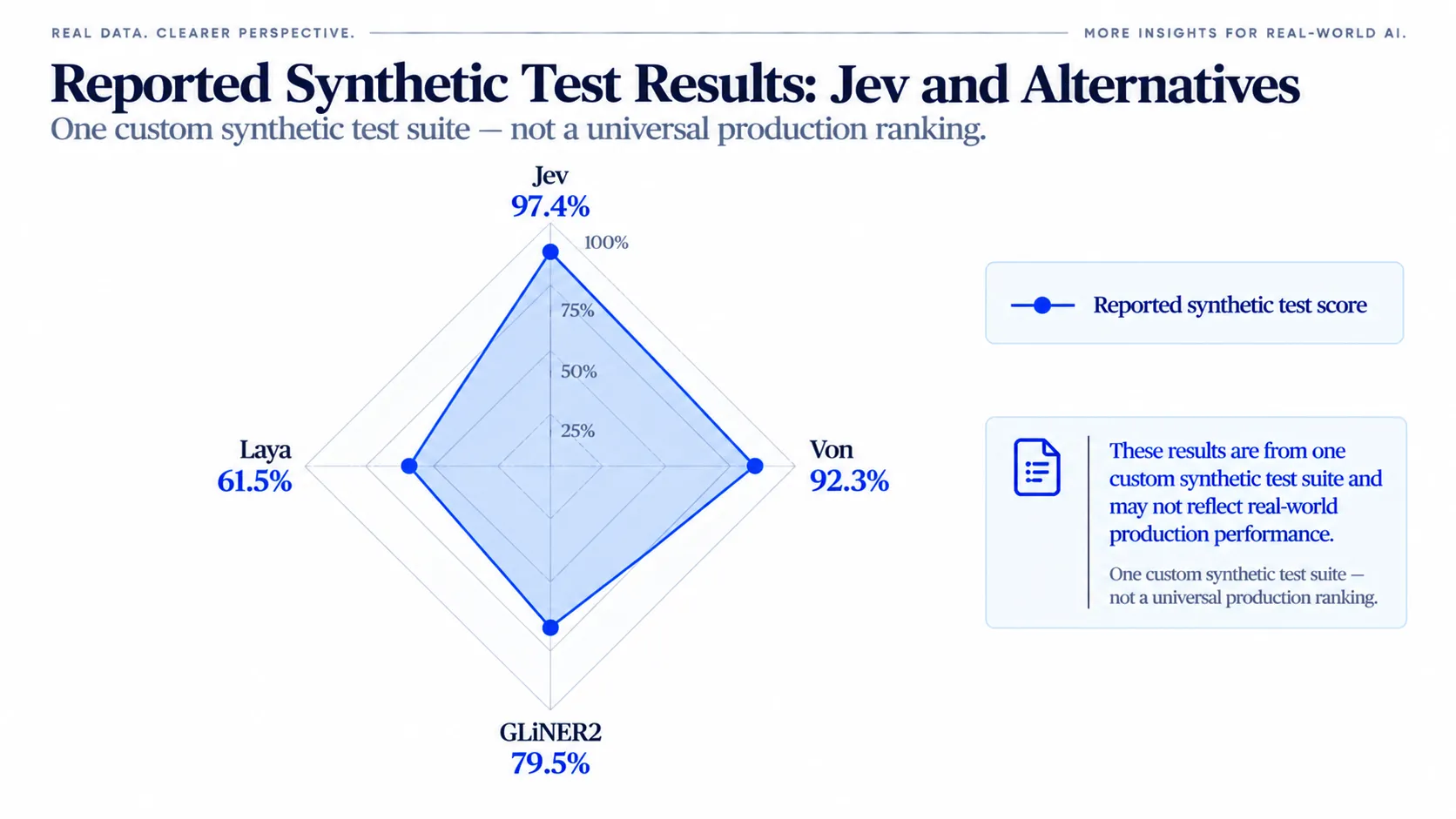
Our research also identified emerging alternatives including Laya, Von and OpenJev.
One externally reported synthetic test suite produced:
- Jev: 97.4%
- Von: 92.3%
- GLiNER2: 79.5%
- Laya: 61.5%
These results should not be used as a universal model ranking. They come from one custom synthetic test suite rather than a large standardized production benchmark.
Teams evaluating Jev should instead build a dataset representing their actual routing, scoring or gating decisions and compare accuracy, calibration, latency and failure behavior directly.
Frequently Asked Questions
Is Jev an LLM?
Jev is not a traditional generative LLM. TypeSafe describes it as a System One Model that evaluates state and returns typed probabilistic decisions rather than generating open-ended text.
Can Jev replace an LLM?
Usually not. Jev and LLMs solve different problems. Jev is suited to routing, scoring and gating, while LLMs remain better suited to writing, coding and open-ended reasoning.
Can Jev be wrong if it cannot hallucinate?
Yes. Jev can produce a valid but incorrect decision. Its constrained output space prevents invalid types, not every judgment error.
Is Jev confidence the same as accuracy?
No. Confidence reflects uncertainty in a particular Jev decision; it is not automatically the model’s measured accuracy on your production data. Thresholds should be calibrated using representative examples.
How can I access Jev AI?
As of September 2026, Jev is available through TypeSafe in early access. TypeSafe says it is bringing developers off the waitlist as access expands, so availability may change as the product moves beyond its initial release.
Conclusion
Jev AI is TypeSafe’s first System One Model, built to return typed probabilistic decisions rather than open-ended text. Its clearest use cases are agent routing, model selection, scoring, tool gating, verification and other frequent decisions with predefined outputs.
Jev is therefore better understood as a decision layer alongside LLMs, not a replacement for them. The model can reduce the cost and latency of bounded decisions, while generative models remain necessary when a workflow requires writing, coding or deeper open-ended reasoning.