

The best 1980s AI photo prompt for ChatGPT should preserve your face, define a specific 1980s setting, and recreate realistic 35mm film behavior. Use clear instructions for identity, year, location, clothing, objects, direct flash, mild grain, softer detail, and faded color instead of simply asking for a “vintage” look.
The problem is that many AI-generated images look retro at first glance but still feel obviously fake. Face drift, overly sharp detail, plastic skin, saturated colors, modern objects, and historically wrong backgrounds can quickly ruin the illusion. A photo may have grain and warm tones, yet still fail because the world inside the image does not look like it could have existed in the 1980s.
The solution is to prompt with clearer constraints: separate what must stay the same from what can change, define a precise 1980s scene, and describe film behavior instead of generic retro style.GPT Image 2.5is available onLinkModelat 75% of OpenAI’s corresponding API token rates—a 25% discount—with one OpenAI-compatible API, one API key, and unified billing.

Best 1980s AI Photo Prompt for ChatGPT
For most portrait transformations, start with this GPT Image 2 prompt:
Prompt:
Transform the uploaded photo into an authentic photograph taken in the mid-1980s. Preserve the person’s recognizable facial features, face shape, skin tone, age, proportions, and overall identity. Change only the hairstyle, clothing, accessories, environment, lighting, and photographic treatment.
Place the subject in an ordinary, historically plausible 1980s setting with period-accurate furniture, technology, architecture, objects, and fashion. Make the image look as if it were captured on consumer 35mm color film with direct on-camera flash, slightly soft detail, mild natural film grain, subtle exposure variation, realistic skin texture, slightly faded colors, and casual snapshot composition.
Avoid smartphones, LED displays, modern vehicles, contemporary fashion, HDR, hyper-sharp digital detail, plastic skin, cinematic color grading, extreme sepia, excessive scratches, and exaggerated retro effects. The final image should resemble a genuine photograph from the 1980s rather than a modern photo with a vintage filter.
The most useful structure is:
Identity → Exact Era → Period Styling → Historical Scene → Film Behavior → Natural Imperfection → Negative Constraints
This is a reusable framework rather than a guaranteed universal best prompt. Our research found no controlled benchmark showing that one exact prompt performs best across every face, scene, or image model.
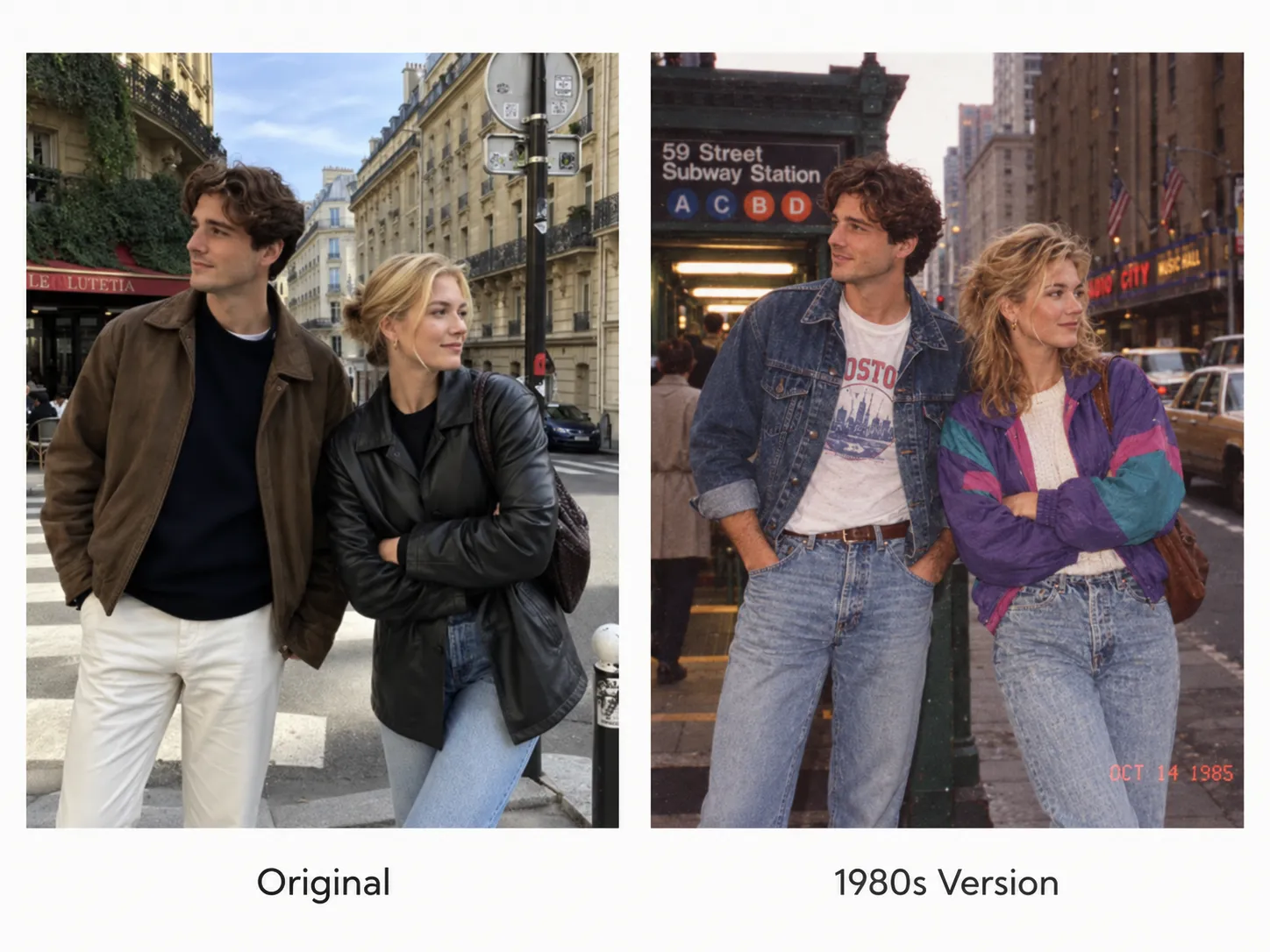
How to Make a 1980s AI Photo Prompt Look Realistic
A realistic 1980s AI photo prompt for ChatGPT has to solve two separate problems: visual style accuracy and historical world accuracy.
An image can have convincing grain and faded colors but still fail because its television, telephone, hairstyle, furniture, clothing, or street environment belongs to the wrong period.
Preserve Identity Before Adding the 1980s Style
When transforming a real portrait, first define what must stay unchanged.
A useful instruction is:
Preserve the subject’s recognizable facial features, face shape, facial proportions, skin tone, age, and overall identity. Change only the hairstyle, clothing, accessories, environment, lighting, and photographic style.
Our review of user questions found identity drift to be one of the most common concerns in AI photo transformations.
However, our research contains no measured facial-similarity score or identity-retention percentage, so claims such as “100% same face” would not be justified.
The practical rule is simple: separate what must stay from what may change.
Build a Historically Accurate 1980s Scene
“1980s” alone is too broad. A specific year, location, and situation gives the model much stronger constraints.
Instead of:
1980s photo
try:
1985 family snapshot inside an ordinary suburban living room
or:
1986 college-campus photograph in India
or:
1983 railway-platform snapshot
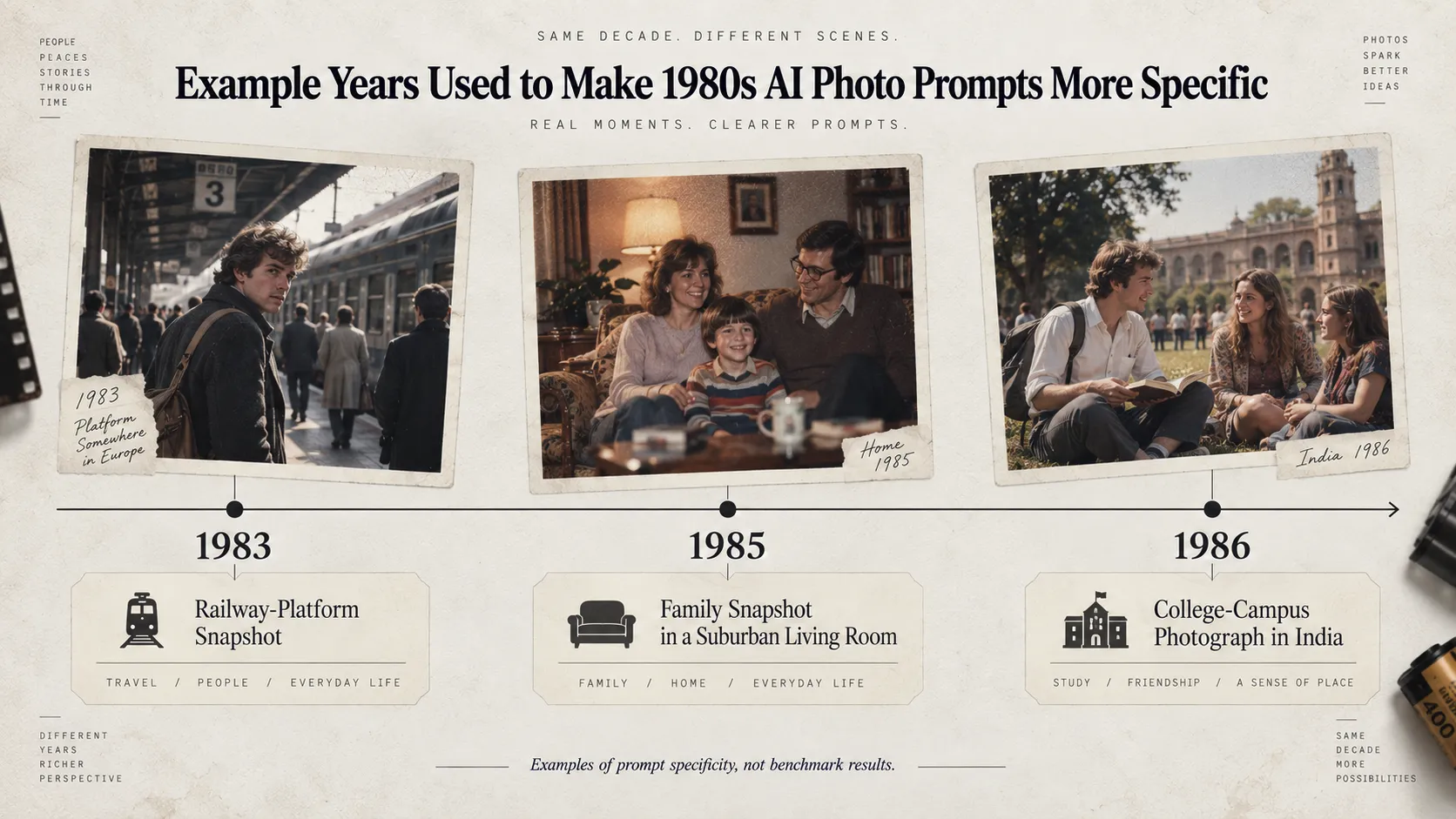
Our research found repeated errors involving public phones, CRT televisions, hairstyles, shopping bags, household objects, and interactions between people and props.
We describe this as the scene-level uncanny valley: individual objects may look believable, but the complete world does not feel historically possible.
The most useful QA question is:
Could this entire scene realistically have existed in 1985?
If not, adding more grain will not solve the problem.
Recreate 1980s Film Behavior, Not Just Film Grain
Film grain is only one part of analogue photography.
One ChatGPT workflow reviewed in our research combined Kodak or Fuji film references, direct flash, camera-specific language, and approximately ±2/3 stop exposure variation.
The important lesson is not that every prompt needs those exact parameters. It is that the creator described how the photographic system behaves, rather than relying on generic words such as “retro” or “vintage.”
Useful cues for image prompting include consumer 35mm film, direct flash, slightly soft focus, mild grain, subtle exposure variation, mixed color temperature, restrained saturation, faded but believable color, and print or scan texture.
The target should be believable imperfection. Too perfect looks digital; too damaged looks artificially nostalgic.
Best 1980s AI Photo Prompt Examples for ChatGPT
You do not need dozens of nearly identical prompts. A smaller set of scene-specific templates is more useful because each controls a different historical environment.
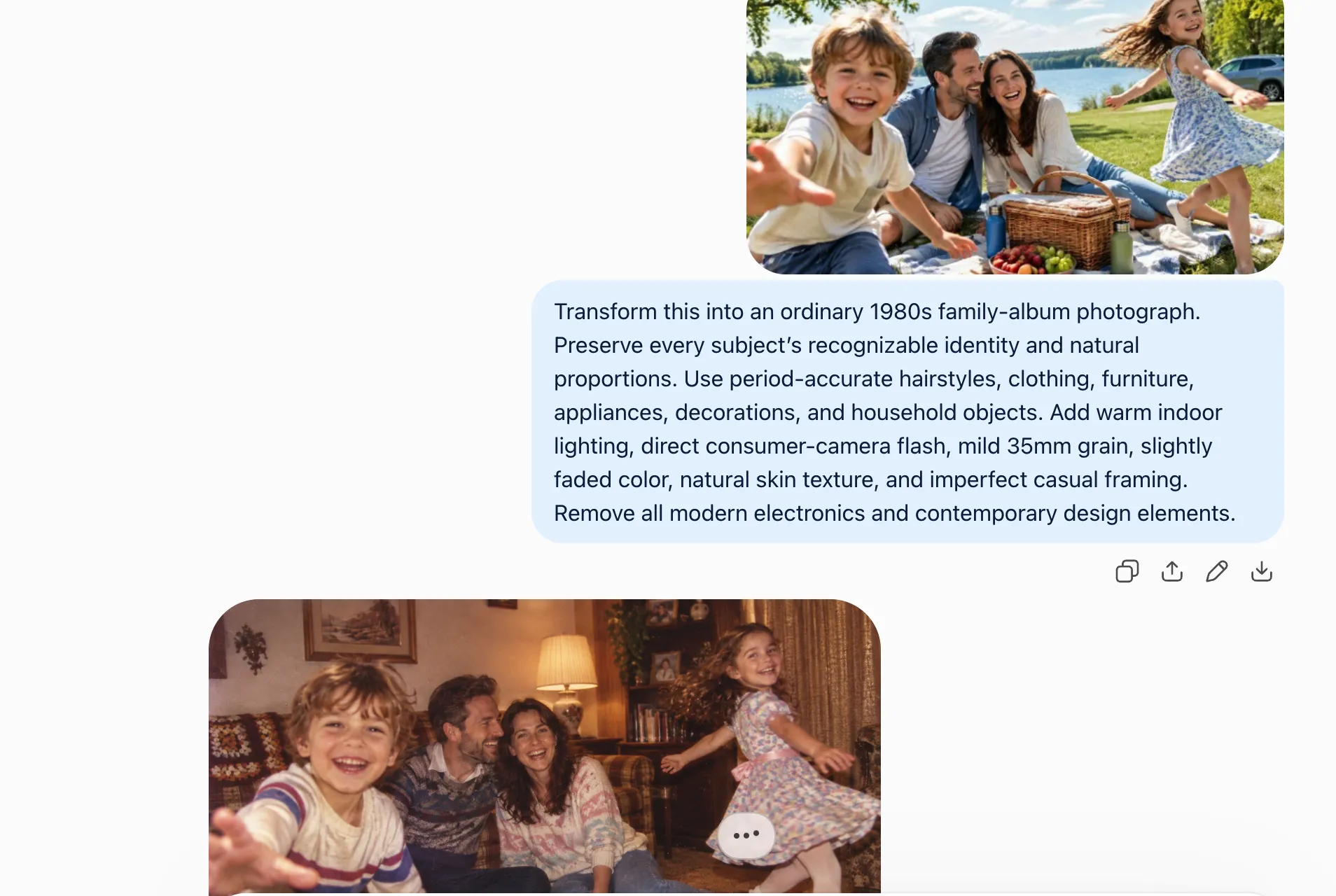
1980s Family Photo Prompt
Prompt:
Transform this into an ordinary 1980s family-album photograph. Preserve every subject’s recognizable identity and natural proportions. Use period-accurate hairstyles, clothing, furniture, appliances, decorations, and household objects. Add warm indoor lighting, direct consumer-camera flash, mild 35mm grain, slightly faded color, natural skin texture, and imperfect casual framing. Remove all modern electronics and contemporary design elements.
Family scenes are particularly useful for testing historical consistency because TVs, phones, furniture, appliances, switches, packaging, and interior design can quickly reveal a modern-looking generation.
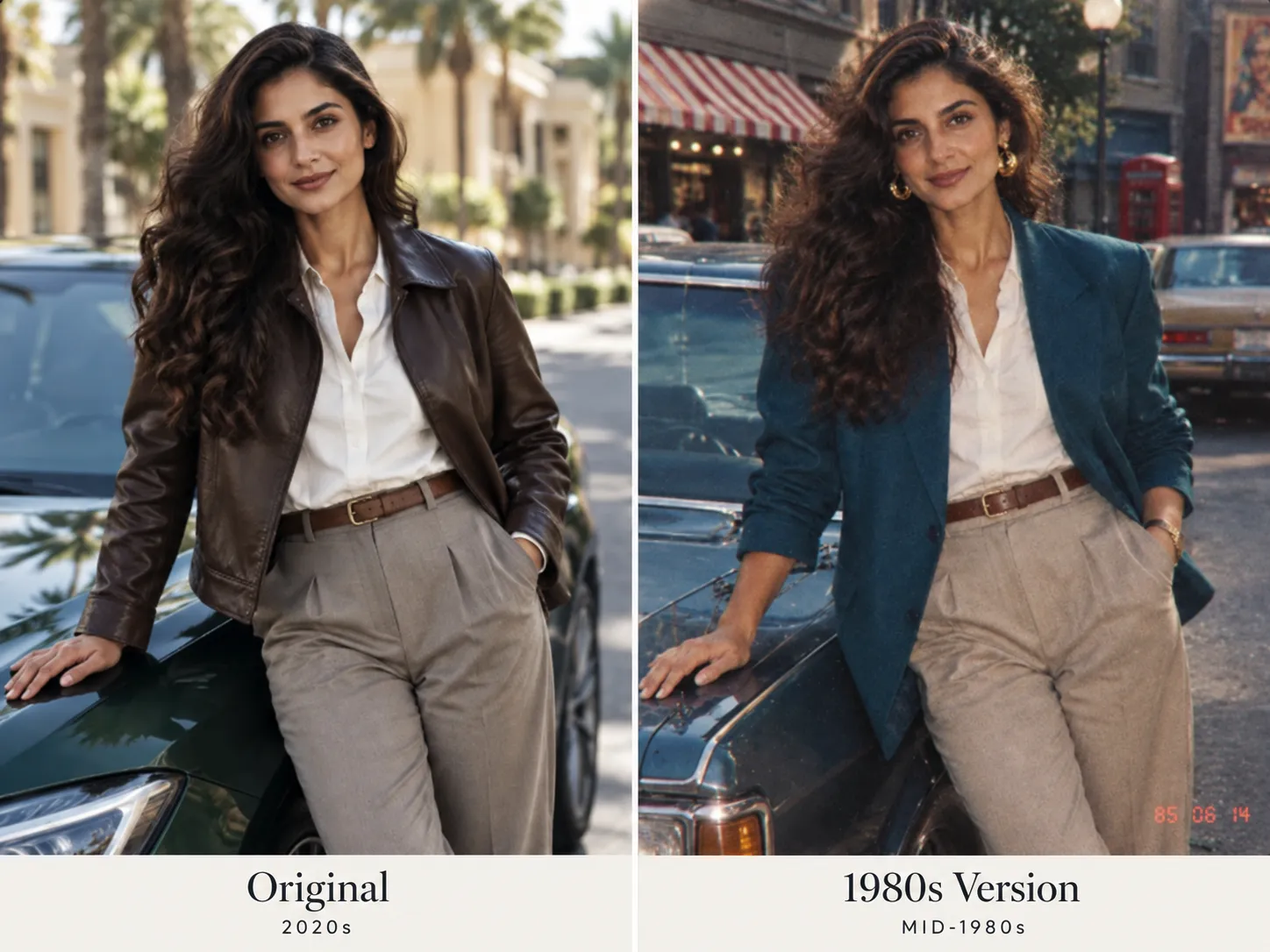
1980s Studio Portrait Prompt
Prompt:
Recreate this as a realistic mid-1980s studio portrait while preserving the person’s facial identity, age, and proportions. Use period-appropriate hair, clothing, makeup, jewelry, and a simple studio backdrop. Add restrained analogue grain, soft studio lighting, slightly faded color, realistic skin texture, and gently softened photographic detail. Keep the styling believable rather than theatrical or costume-like.
A studio setting reduces background complexity, making it useful when identity preservationmatters more than environmental storytelling.
1980s Indian and Kerala AI Photo Prompt
Prompt:
Recreate this photograph as a believable portrait taken in Kerala, India, during the 1980s. Preserve the subject’s recognizable facial identity and proportions. Use historically appropriate clothing, hairstyle, jewelry, architecture, furniture, and everyday objects for the location. Render the image with warm analogue color, subtle 35mm grain, soft detail, realistic flash, and natural exposure variation. Avoid modern objects, generic Western retro props, and exaggerated cultural stereotypes.
Regional prompting is valuable because our research identified recurring interest around Kerala family portraits, weddings, college photographs, studio portraits, and Malayalam cinema-inspired images.
The goal is not to add more cultural symbols. It is to make location, culture, year, environment, and photography agree with one another.
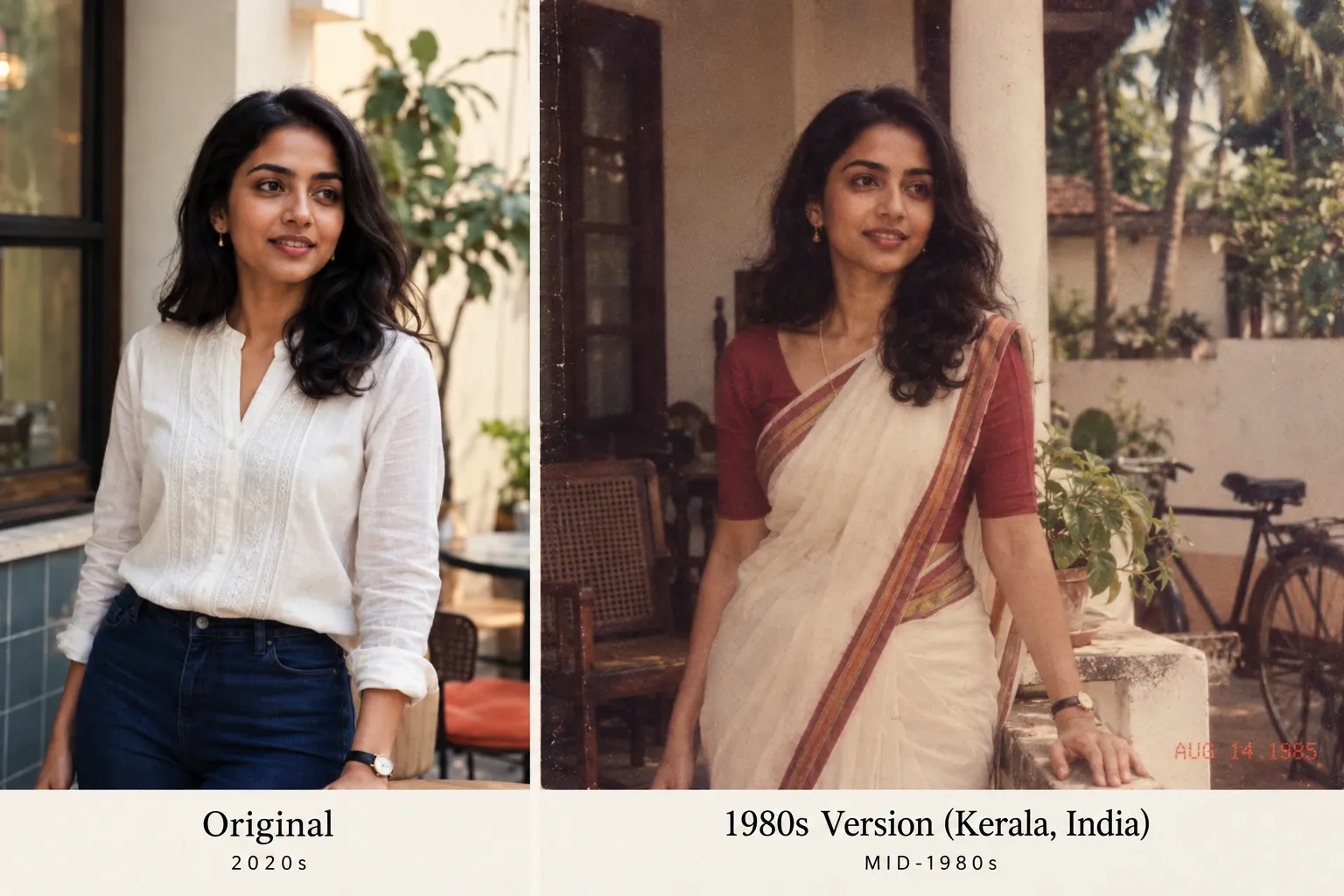
Short vs Long 1980s AI Photo Prompts
Longer prompts are not automatically better.
Our research identified three workable approaches.
- A detailed prompt can control camera, film, exposure, lighting, clothing, objects, environment, and composition.
- A short prompt can focus on an ordinary period-accurate scene and imperfect consumer-camera photography.
- A multi-step workflow can separate identity and historical styling from the final film treatment.
There is currently no controlled A/B test in our research proving that one approach consistently wins.
A better strategy is to make prompt length follow the failure:
- If the face changes, reinforce identity constraints.
- If the background feels modern, specify the year, location, and historical objects.
- If the image looks too digital, refine the film behavior.
- If every edit changes unrelated parts of the image, reduce the scope of each instruction instead of making the prompt longer.
Two-Step ChatGPT 1980s AI Photo Workflow
One useful case reviewed in our research came from a mobile AI workflow with a 100-character limit per prompt.
Instead of forcing everything into one instruction, the transformation was completed in two edits: first the appearance, then the film look.
Step 1: Fix Identity, Fashion, and Historical Scene
Prompt:
Preserve my facial identity, face shape, age, pose, and proportions. Change the hairstyle, clothing, accessories, and environment so they are historically plausible for 1985. Focus on accurate people, objects, fashion, and surroundings. Do not apply the vintage film treatment yet.
Before moving on, check the image for modern electronics, incorrect hair, architecture, furniture, signs, cars, and accessories.
Step 2: Add the 1980s Film Look
Prompt:
Keep the person, pose, clothing, objects, background, and composition unchanged. Change only the photographic rendering so it resembles a genuine mid-1980s consumer 35mm photograph with direct flash, slightly soft detail, mild natural grain, subtle exposure variation, realistic skin texture, and slightly faded color. Remove HDR and modern digital sharpness.
The broader workflow is:
Generate → Inspect → Identify Failure → Correct → Repair
This is often more useful than searching indefinitely for one “perfect” prompt.
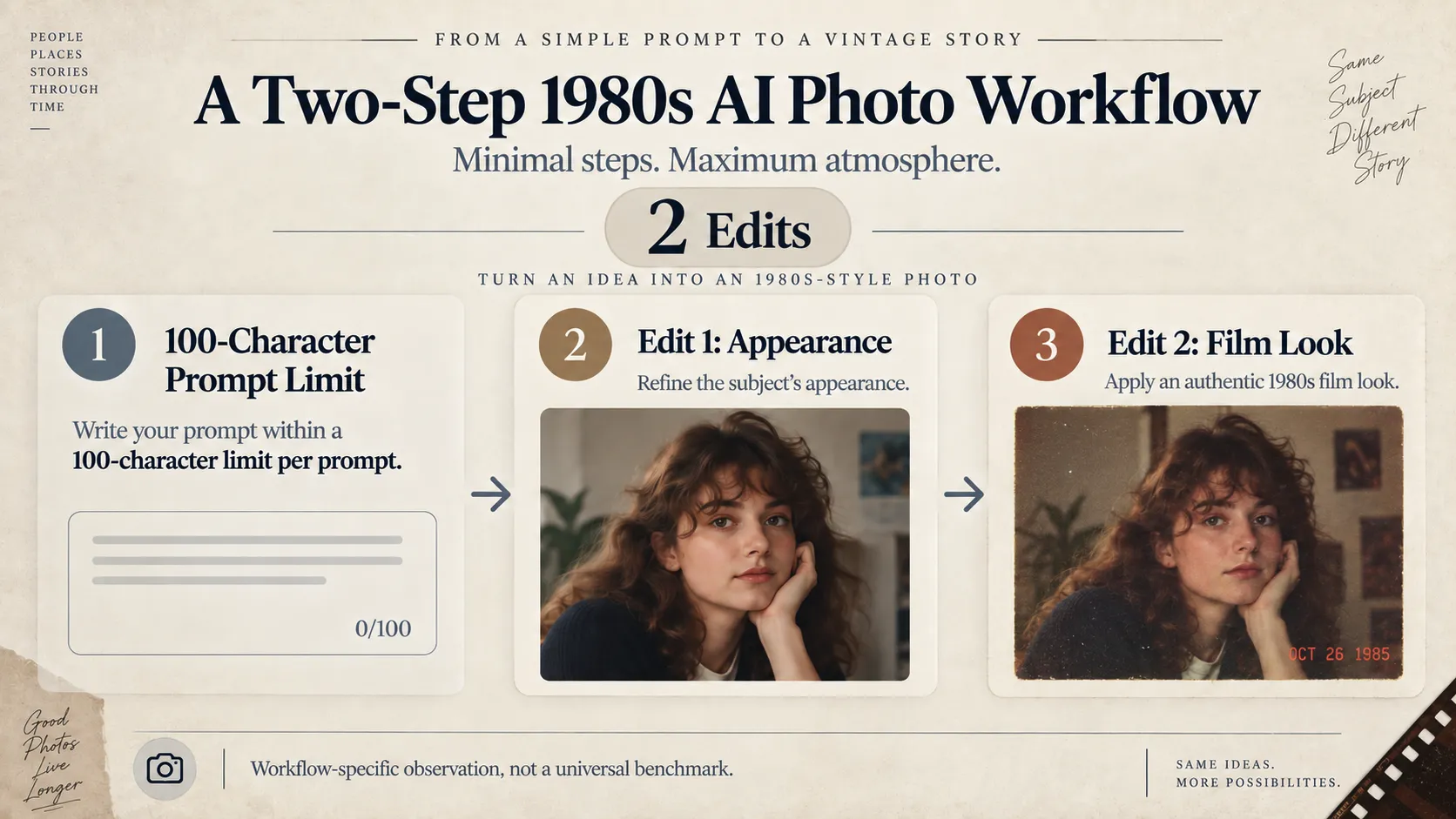
1980s AI Photo Case Studies and Workflow Data
Real workflows reveal where detailed prompting helps—and where AI generation still requires inspection and repair.
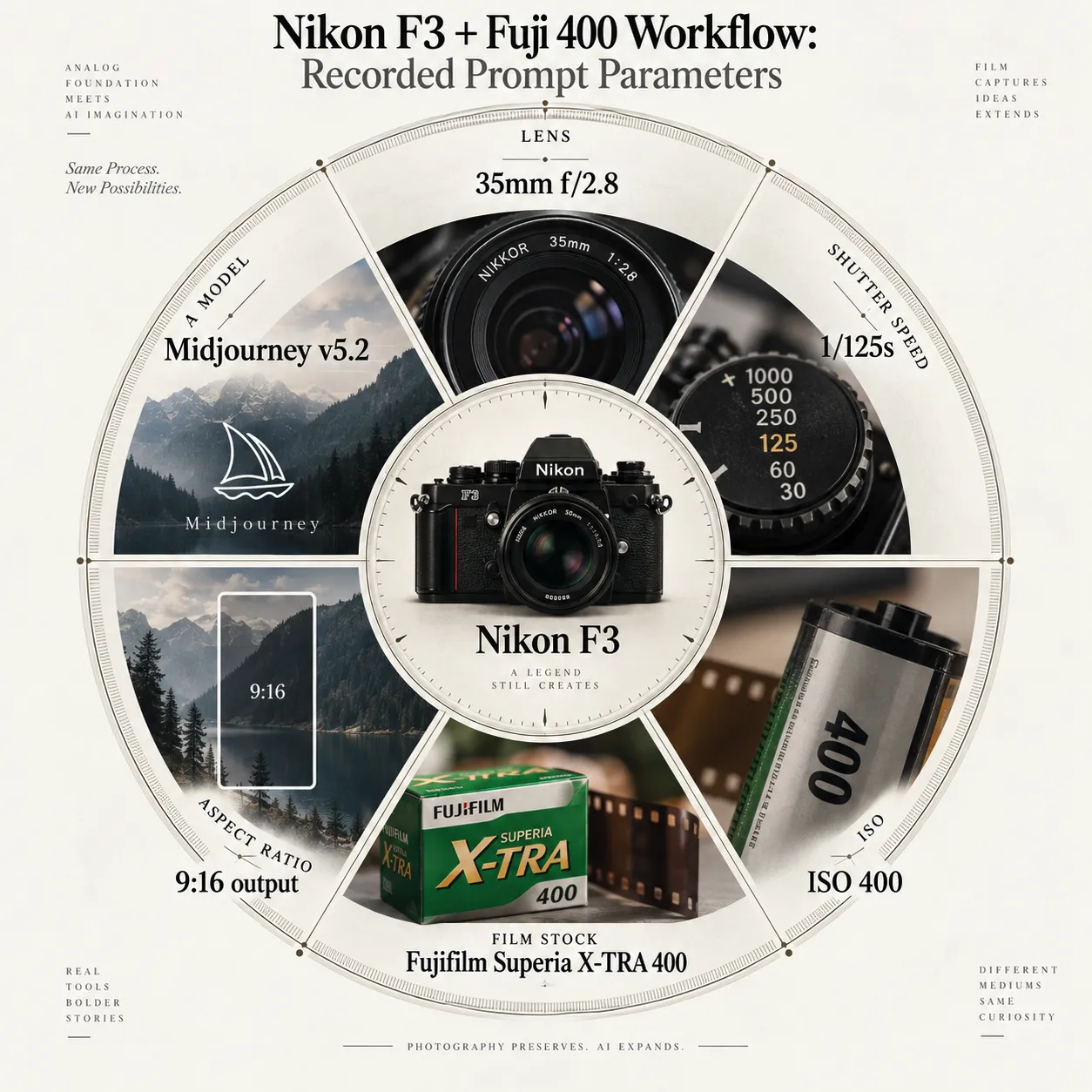
Nikon F3 and Fuji 400 Workflow
One Midjourney workflow reviewed in our research used:
Nikon F3, 35mm f/2.8, 1/125s, Fujifilm Superia X-TRA 400, and Midjourney v5.2.
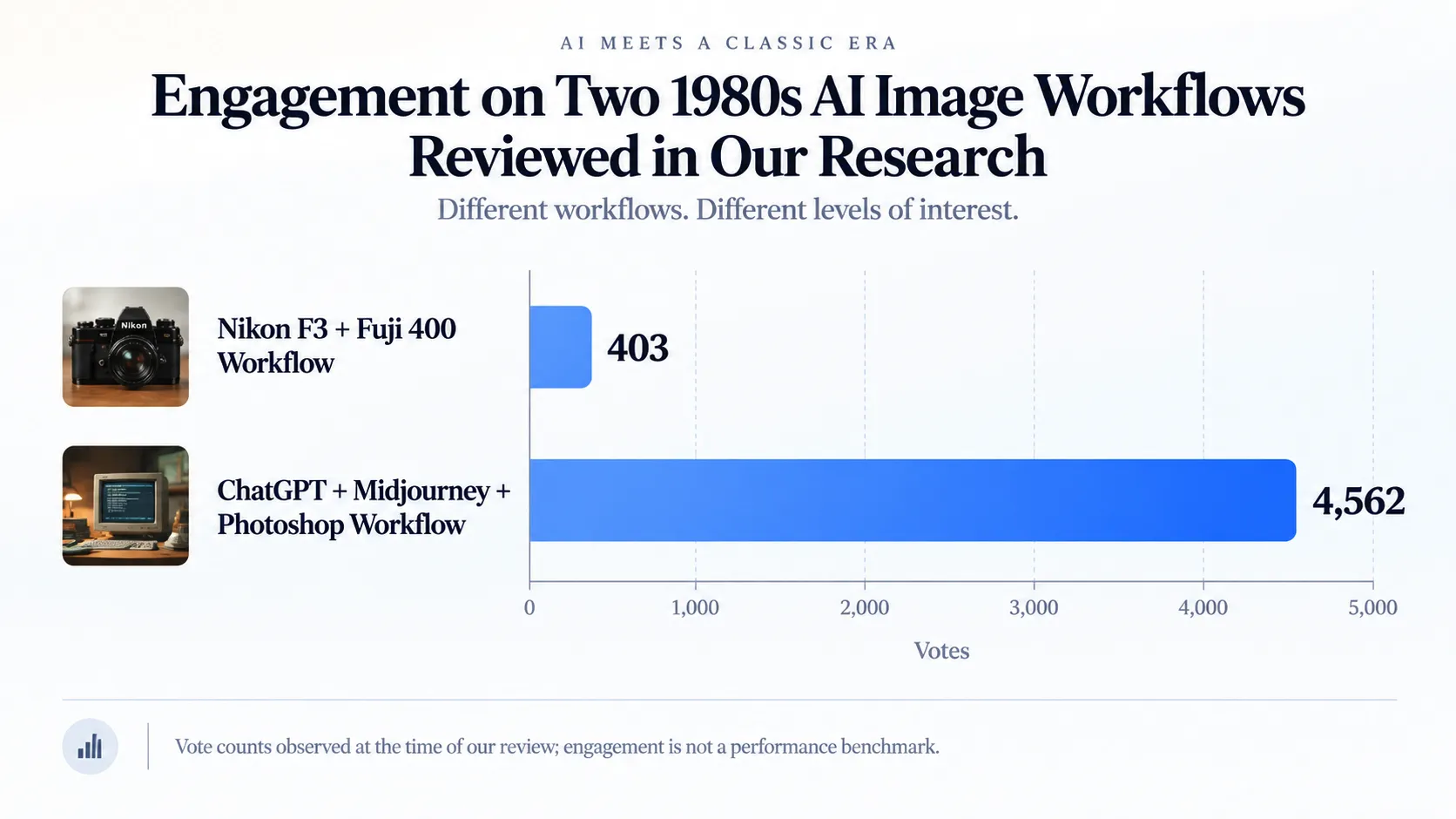
The composition was later expanded to 9:16, and the original discussion had approximately 403 votes at the time of our review.
Despite the detailed photographic parameters, the image still developed incorrect hands. The creator repositioned the subject and used Photoshop Generative Fill to repair the composition.
The lesson is important: photographic specificity can improve the intended visual language without eliminating structural AI artifacts.
Generation and repair should be treated as separate stages.
ChatGPT, Midjourney, and Photoshop Workflow
Another workflow reviewed in our research followed:
ChatGPT → Midjourney → zoom or outpainting → Photoshop
The project had approximately 4,562 votes at the time of our review.
The creator reported spending around one day on a set of images, with approximately eight hours per day spent on related design work.
These numbers are workflow-specific observations, not production benchmarks. They do show that polished AI imagery can involve considerably more work than a one-click generation.
The repeatable lesson is:
concept → generate → inspect → recompose → repair
Why Your ChatGPT 1980s AI Photo Looks Fake
Our review of user questions found a consistent set of failure modes.
| Problem | What to Change |
|---|---|
| Face changed | Reinforce identity, age, facial proportions, and skin tone |
| Image too sharp | Request softer consumer-film detail |
| Colors too saturated | Reduce saturation and use restrained analogue color |
| Skin looks plastic | Preserve natural skin texture and remove beauty retouching |
| Grain looks fake | Reduce grain, scratches, fading, and sepia |
| Background looks modern | Specify year, country, setting, and historical objects |
| Technology is wrong | Define plausible TVs, phones, cars, appliances, or signs |
| Hands or props fail | Edit only the affected interaction |
| Every edit changes everything | Explicitly state what must remain unchanged |
The most useful diagnostic question is not:
Does this look retro?
It is:
Does this look like an ordinary photograph someone could really have taken in the 1980s?
That distinction separates historical plausibility from a collection of modern retro stereotypes.
Is the ChatGPT 1980s AI Photo Trend Safe?
Uploading a real face deserves more care than generating a fictional character.
For individual ChatGPT users, turning off Improve the model for everyone prevents new conversations from being used to train ChatGPT. Temporary Chats are not used for training and are deleted from OpenAI’s systems after 30 days.
For privacy-sensitive photo transformations, review your Data Controls before uploading, avoid including unnecessary sensitive information in the source image, and obtain permission before uploading another identifiable person’s photograph.
It is also important to distinguish confirmed platform policy from user concerns or speculation. Claims that every uploaded face photo is automatically used for model training are too broad.

FAQ
What is the best 1980s AI photo prompt for ChatGPT?
The best starting prompt combinesidentity preservation, a specific year and setting, period-accurate clothing and objects, realistic consumer 35mm film behavior, restrained imperfections, and clear exclusions for modern digital aesthetics. Simply asking ChatGPT to “make it vintage” is usually too vague.
How do I keep my face the same in a ChatGPT 80s photo?
Define what must remain unchanged before describing the transformation. Preserve facial features, face shape, proportions, skin tone, age, and recognizable identity, then separately allow changes to hair, clothes, accessories, environment, and photographic style.
Why does my 1980s AI photo still look modern?
The most common causes found in our research are excessive sharpness, saturated colors, digitally smooth skin, modern technology, historically inaccurate objects, and cinematic lighting. Correct the specific failure instead of adding more generic retro adjectives.
Is a long 1980s AI photo prompt better than a short prompt?
Not necessarily. Our research includes detailed prompts, short consumer-camera approaches, and multi-step workflows, but no controlled evidence shows that longer prompts consistently perform better. Start with essential constraints and add detail only when a specific problem appears.
Is it safe to upload my photo to ChatGPT for the 80s trend?
ChatGPT provides Data Controls that allow individual users to turn off use of new conversations for model training, while Temporary Chat is not used for training and is deleted after 30 days. For sensitive images, review these controls, avoid unnecessary personal information, and get consent before uploading another person’s face.
Conclusion: How to Create a Realistic 1980s AI Photo With ChatGPT
The strongest 1980s AI photo prompt for ChatGPT is not the one with the most retro adjectives. A convincing image needs a recognizable subject, a historically plausible 1980s environment, believable consumer-film behavior, and only enough imperfection to remove modern digital polish. Our research suggests using Identity → Era → Scene → Film → QA → Repair: generate the image, inspect both photographic and historical accuracy, isolate the failure, and correct only what needs changing. When both the camera behavior and the world inside the image feel credible, the result stops looking like a modern vintage filter and starts looking like a photograph that could genuinely have been taken in the 1980s.