Status checked: August 13, 2026.
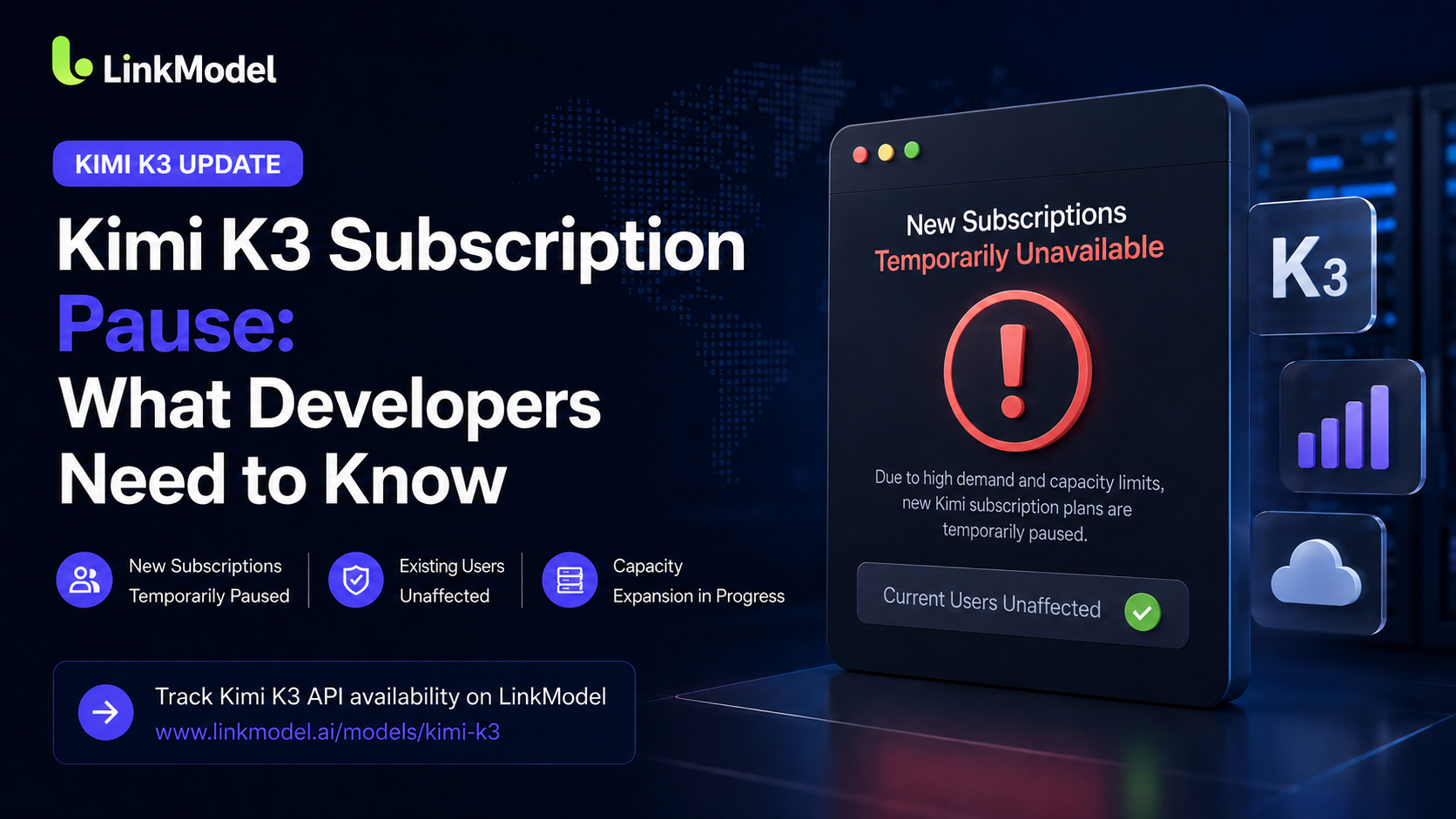
Short answer: Kimi has not fully reopened new individual membership purchases. Existing legacy subscribers can keep using and renewing their plans, while Kimi restores new subscription slots as computing capacity expands. The pause does not close the separately billed Kimi Open Platform API, and Kimi K3 is also live on LinkModel with API and Playground access.
| Access path | Current status | What it means |
|---|---|---|
| New individual membership | Not fully reopened | Kimi says new subscription capacity will return in batches; no full reopening date is confirmed |
| Existing legacy membership | Active | Existing paid users keep their benefits and plans continue to renew automatically |
| Manual renewal or legacy upgrade | Supported | Kimi says both remain available, although related interface work was still in progress in its notice |
| Kimi Open Platform API | Available | The API is a separate pay-as-you-go product with its own balance and API key |
| LinkModel Kimi K3 API | Available | The live Kimi K3 model page provides pricing, Playground and API entry points |
Sources: Kimi's membership plan adjustment notice, its current Moon Companion Plan guide, and the Kimi API troubleshooting guide.
Are Kimi K3 subscriptions still paused?
Yes, for new individual membership purchases. The most recent membership notice listed in the Kimi Blackboard says new plans are not yet open because of computing-capacity constraints. Kimi's standing Moon Companion Plan guide also says it has paused new individual subscriptions and will restore subscription slots gradually as capacity expands.
That is narrower than saying “Kimi K3 is unavailable.” The restriction applies to purchasing a new consumer membership. It does not remove the model, cancel existing subscriptions or close the separately operated API.
Kimi has not published a date for a full reopening. Its official guidance says the timing will appear on the relevant activity or subscription page when confirmed.
Why did Kimi pause new subscriptions?
Kimi attributes the restriction to computing-capacity constraints. It is adding service resources while revising the structure of its new membership plans.
The distinction matters because this is an access-management decision, not a model withdrawal. Restricting new subscriptions protects capacity for existing paid users while the provider expands infrastructure. It also explains why availability can differ across Kimi Membership, Kimi Code and the Open Platform API: they are separate products with separate accounts, benefits and billing systems.
What happens to existing Kimi subscribers?
Kimi's July 20 plan-adjustment notice gives existing users four specific assurances:
- Existing paid benefits remain unchanged. Legacy subscribers can continue using their plans.
- Legacy plans renew automatically. A display issue in the interface does not change the underlying subscription.
- Users who disabled auto-renewal can still renew. Kimi said the related interface feature was being completed.
- Legacy users can upgrade within the old plan family. The notice gives upgrading from the RMB 199 tier to the RMB 699 tier as an example.
These protections apply to people who already held the affected legacy plans. They do not mean a new user can purchase a new individual membership today.
Does the subscription pause affect the Kimi K3 API?
No. Kimi's own documentation says Kimi Membership and the Kimi Open Platform API are independent products. Membership benefits cannot be converted into API balance, and API balance cannot be used to buy a membership. Each product also uses its own account balance and credentials.
The Open Platform remains a pay-as-you-go route to Kimi K3. Kimi's current troubleshooting guide says direct API access uses the model ID kimi-k3 and unlocks after a successful top-up of at least $1 on the international platform.
This does not mean API capacity is unlimited. The same guide documents engine_overloaded_error for peak-hour capacity pressure and recommends honoring Retry-After, reducing concurrency and retrying with exponential backoff. That operational limit is different from the consumer-membership sales pause.
For Kimi K3 architecture, context length and official token prices, use the separate Kimi K3 specs and pricing guide. Keeping those details there prevents this status page from competing with the broader model query.
Can developers access Kimi K3 through LinkModel?
Yes. LinkModel's Kimi K3 model page is live and currently exposes both Playground and API entry points. It lists text, image and video input, text output, function calling, a 1,048,576-token context window and the following token prices:
| Token type | LinkModel price |
|---|---|
| Cache-read input | $0.30 / 1M tokens |
| Standard input | $3.00 / 1M tokens |
| Output | $15.00 / 1M tokens |
Use the live model page as the source of truth before deploying because model availability and prices can change after this article's status-check date.
Which Kimi K3 access path should you use?
The right route depends on the product you need rather than on the model name alone:
| Need | Recommended current route |
|---|---|
| Continue an existing Kimi consumer plan | Keep the legacy membership and its renewal path |
| Buy a new individual Kimi membership | Wait for Kimi to restore subscription availability |
| Build directly against Moonshot's API | Use the Kimi Open Platform with a separate API balance and key |
| Compare Kimi K3 with models from other providers | Use Kimi K3 on LinkModel or browse the model catalog |
For developers, the important takeaway is that a paused consumer subscription does not block API evaluation. Choose the direct Open Platform when you want a Moonshot account and native integration, or LinkModel when a shared model catalog and provider comparison better fit the application.
Kimi K3 subscription FAQ
Are new Kimi K3 subscriptions still paused?
Yes. As of August 13, 2026, Kimi's official help center still says new individual membership subscriptions have not fully reopened. Kimi is expanding computing capacity and plans to restore subscription slots gradually, but it has not confirmed a full reopening date.
Can existing Kimi subscribers renew their plans?
Yes. Kimi says existing legacy plans continue to renew automatically. Users who manually disabled auto-renewal can still renew, and existing users can upgrade within the legacy plan family, although related interface work was still being completed in the July 20 notice.
Is the Kimi K3 API affected by the subscription pause?
No. Kimi Membership and the Kimi Open Platform API are independent products with separate balances, benefits and credentials. The Open Platform continues to list kimi-k3 as a pay-as-you-go API model, although normal API rate limits and capacity errors can still occur.
Is Kimi K3 available through LinkModel?
Yes. LinkModel's Kimi K3 model page currently provides pricing plus Playground and API entry points. Check the live model page before deployment because availability and prices can change after this article's August 13, 2026 status check.
When will Kimi reopen new individual subscriptions?
Kimi has not announced a full reopening date. Its official guidance says subscription slots will return gradually as computing capacity expands and that users should follow the relevant activity or subscription page for current availability.