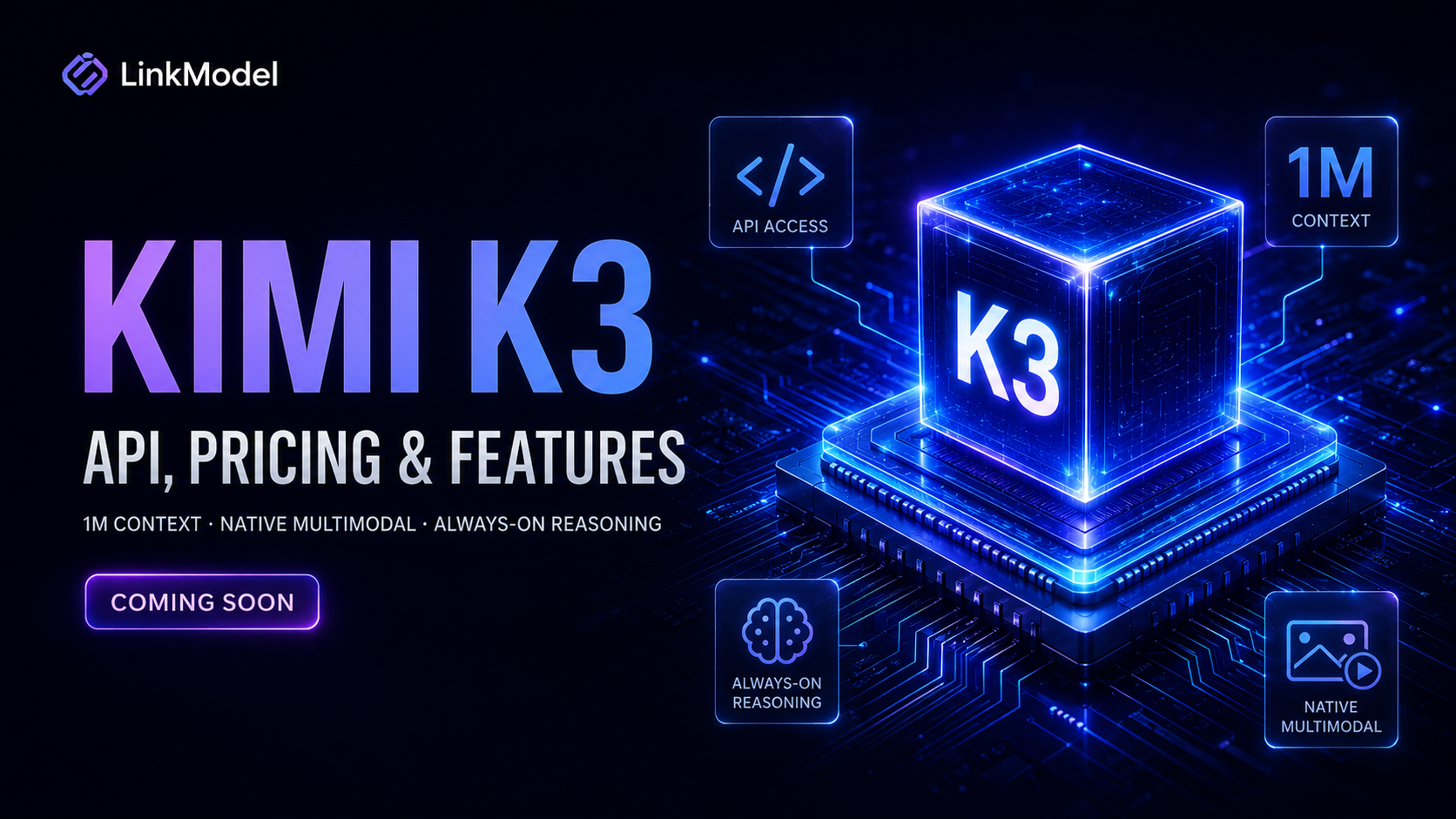
Kimi K3 is worth evaluating when a workload benefits from very long context, multimodal inputs, and sustained agent execution. It is a poor default for short, latency-sensitive calls. Compare completed-task cost—not parameter count—and confirm the live model ID, rate, and availability before routing production traffic.
A practical evaluation method
- Measure how much context the task actually uses instead of budgeting for the maximum window.
- Track cached and uncached input separately; repeated agent prefixes can change effective cost.
- Evaluate tool-call completion, retries, and reviewer corrections on the same task set.
TL;DR: Moonshot AI shipped Kimi K3, its new flagship for long-horizon coding, agentic knowledge work, multimodal understanding, and complex reasoning. It's a sparse Mixture-of-Experts model with 2.8 trillion total parameters, activating 16 of 896 experts per token, and a context window of 1,048,576 tokens — roughly 4× the 256K of recent K2.x models. Reasoning is always on, and it natively understands text, images, and video. Official pricing is $0.30 / 1M cache-hit input, $3.00 / 1M cache-miss input, and $15.00 / 1M output, flat regardless of context length. Kimi K3 is listed on LinkModel; confirm the live model page, model ID, and account availability before sending production traffic.
Latest update. Moonshot has temporarily paused new Kimi subscription purchases because of capacity constraints. Existing paid users keep their benefits, and the API is not part of the pause. Read our Kimi K3 subscription and availability update.
What is Kimi K3?
Kimi K3 is Moonshot AI's most capable flagship model to date, released in July 2026.
It uses a sparse Mixture-of-Experts architecture with 2.8 trillion total parameters while activating only 16 of its 896 experts for each token. This increases overall capacity without requiring every parameter to participate in every inference request — a very large architecture with meaningfully cheaper inference than a dense model of similar size.
The headline architectural pieces, in Moonshot's own naming:
- Kimi Delta Attention (KDA) — a hybrid linear-attention mechanism aimed at long-context processing and decoding efficiency. This matters most for large code repositories, long research documents, extensive tool-call histories, multi-step agent workflows, and large enterprise knowledge bases.
- Attention Residuals (AttnRes) — changes how information is retrieved across the depth of the model, letting it selectively pull useful signal from different layers rather than treating every prior representation the same way. Intended to improve reasoning quality and retention over long tasks.
- Stable LatentMoE — the sparse expert routing that activates 16 experts from the 896-expert pool per token.
- Quantization-aware training — MXFP4 weights and MXFP8 activations, applied from the SFT stage onward, for better compatibility with modern inference hardware.
Moonshot states the combined architecture and training improvements give Kimi K3 roughly 2.5× the overall scaling efficiency of K2.
What are the biggest Kimi K3 upgrades?
A one-million-token context window
Kimi K3 supports up to 1,048,576 tokens — approximately four times the 256K supported by recent K2.x models.
| Use case | Why the larger context matters |
|---|---|
| Large software repositories | Analyze more files and dependencies in one request |
| Research projects | Process multiple reports, papers, and data sources |
| Enterprise knowledge bases | Review large internal document collections |
| Long-running agents | Preserve longer task and tool-use histories |
| Legal and financial analysis | Process large document sets without frequent splitting |
| Multimodal applications | Combine long text with images and video inputs |
Context caching is handled automatically — no manual cache IDs, no separate cache duration to configure. For applications that repeatedly reuse long, stable prompt prefixes, this can meaningfully cut input costs.
Always-on deep reasoning
Unlike Kimi K2.5 and K2.6, which can run with thinking enabled or disabled, Kimi K3 always reasons before producing its final answer. Thinking cannot be turned off.
What you can control is how much of it happens. The API exposes a top-level reasoning_effort parameter with three levels — "low", "high", and "max" — where "max" is the default:
reasoning_effort="low" # or "high", or "max" (default)That knob matters for cost. Because reasoning tokens are billed as output at $15/1M, dropping to a lower effort level is the main lever for latency- or budget-sensitive workloads that still need K3's context window.
Always-on reasoning suits complex software engineering, multi-step planning, tool-assisted research, difficult document analysis, agentic workflows, and tasks requiring verification and self-correction. It's a poor fit for trivial, latency-critical calls where deep reasoning buys nothing.
Native image and video understanding
Kimi K3 processes text, images, and video within the same model. That enables understanding screenshots while modifying frontend code, analyzing charts and technical diagrams, reviewing video clips, building interfaces from visual references, and extracting information from multimodal documents.
The API accepts image and video content, though public image URLs may not be supported in all request formats — you may need uploaded file identifiers or Base64-encoded content.
Long-horizon coding
Kimi K3 is built to maintain progress across longer software-engineering tasks: navigating large repositories, using terminal tools, analyzing visual references, revising implementations, and continuing across extended task histories.
That covers repository-level coding agents, automated debugging, application migration, large-scale refactoring, frontend development from screenshots, test generation and repair, and multi-file feature implementation — closer to participating in the whole development workflow than generating isolated snippets.
More capable agent workflows
Kimi K3 supports function calling, required tool choice, dynamic tool loading, structured JSON output, partial response continuation, streaming reasoning, streaming final answers, multi-step tool execution, and automatic context caching. That's the feature set production agents need to interact with APIs, databases, search tools, development environments, and internal business systems.
How does Kimi K3 compare to previous Kimi models?
| Model | Main positioning | Context | Multimodal | Thinking mode | Best suited for |
|---|---|---|---|---|---|
| Kimi K2 | Original trillion-parameter agentic MoE model | K2-series | Primarily text | Separate variants | General agents, tool use, coding |
| Kimi K2 Thinking | Reasoning-focused K2 version | K2-series | Primarily text | Always enabled | Search, reasoning, multi-step tools |
| Kimi K2.5 | Native multimodal + agent-swarm model | 256K | Text, image, video | Optional | Visual agents, research, parallel workflows |
| Kimi K2.6 | General-purpose coding and agent model | 256K | Text, image, video | Optional | Coding, agents, multimodal apps |
| Kimi K2.7 Code | Dedicated long-horizon coding model | 256K | Text, image, video | Always enabled | Coding agents, repository engineering |
| Kimi K3 | New overall flagship | 1M | Text, image, video | Always enabled | Long-horizon coding, research, knowledge work, complex agents |
Kimi K3 vs Kimi K2 and K2 Thinking
K2 established the family's large-scale MoE architecture and agentic capabilities; K2 Thinking focused that on reasoning, search, and multi-step tool use. K3 keeps both directions and adds a larger parameter count, a much larger context window, native multimodal understanding, the new attention architecture, and better long-horizon execution. For work that needs both deep reasoning and very large context, K3 is the stronger option.
Kimi K3 vs Kimi K2.5
K2.5 introduced native multimodal intelligence and parallel agent workflows — its Agent Swarm concept let large numbers of sub-agents and tool calls operate across complex tasks. K3 offers a larger context window, a larger architecture, more advanced long-horizon reasoning, and improved coding. K2.5 may still fit workflows specifically designed around parallel agent execution.
Kimi K3 vs Kimi K2.6
K2.6 is the flexible general-purpose option, and its key advantage is that thinking is optional. K3 always reasons, which makes it more capable on hard tasks but adds latency and output cost on easy ones — though reasoning_effort="low" narrows that gap.
Choose K2.6 when: thinking needs to be off entirely, the task is simple, latency is the priority, or 256K context is enough.
Choose K3 when: the task needs very long context, complex reasoning, large repositories or document collections, or extended autonomous execution.
Kimi K3 vs Kimi K2.7 Code
K2.7 Code targets long-horizon coding specifically — repository-level engineering, instruction compliance, coding-agent workflows. Moonshot also ships Kimi K2.7 Code HighSpeed, which is attractive when output speed matters more than raw capability.
K3 is the broader flagship: 1M context, wider knowledge-work coverage, stronger multimodal reasoning, and a much larger architecture. K2.7 Code remains a strong pick for specialized, speed-sensitive coding; K3 fits teams that need coding, research, multimodal understanding, and knowledge work from one model.
Which Kimi model should you choose?
| Requirement | Recommended model |
|---|---|
| Thinking must be optional | Kimi K2.6 |
| General coding and agents | Kimi K2.6 |
| Dedicated coding agent | Kimi K2.7 Code |
| Fastest coding output | Kimi K2.7 Code HighSpeed |
| One-million-token context | Kimi K3 |
| Large repository analysis | Kimi K3 |
| Complex multimodal reasoning | Kimi K3 |
| Long research and knowledge work | Kimi K3 |
| Extended autonomous agent tasks | Kimi K3 |
The right answer depends on context length, task complexity, latency tolerance, and output cost. For a wider view across vendors, see best coding LLM API, GLM vs Kimi, and DeepSeek vs Kimi vs MiniMax.
How much does the Kimi K3 API cost?
Moonshot's official pay-as-you-go pricing:
| Token type | Official Kimi price |
|---|---|
| Cache-hit input | $0.30 per 1M tokens |
| Cache-miss input | $3.00 per 1M tokens |
| Output | $15.00 per 1M tokens |
Pricing is flat — it does not change with context length. Automatic context caching can significantly reduce input costs when applications repeatedly send the same stable prefixes: repository instructions, system prompts, project documentation, tool definitions, previously loaded source files.
Watch the output side. Because K3 always reasons, complex tasks generate longer reasoning traces, and reasoning is billed at the $15/1M output rate. The cheapest model per token is not always the cheapest per completed task — see how to reduce AI API costs and the prompt caching guide.
What should you test before migrating?
Kimi K3's specs are strong, but validate against your own production workloads.
Real-world latency. KDA is designed to improve long-context decoding, but always-on reasoning cuts the other way on simple requests. Measure time to first token, total generation time, tool-call latency, long-context performance, and behavior under concurrency — and check whether reasoning_effort="low" recovers enough latency for your path.
Cost under heavy output. Input pricing is competitive when caching works. Output at $15/1M is not. Compare cost per successful task, average output length, retry count, tool-call count, and total workflow cost.
Launch-stage API restrictions. Thinking cannot be disabled. Some sampling parameters may be fixed. Public image URLs may not be accepted in every request format. Official web-search tooling may still be in development. Multi-turn requests must preserve complete assistant messages. None of these remove K3's core value, but they can affect a migration from an existing K2.x application.
Frequently asked questions
Is Kimi 3 the same as Kimi K3?
Kimi 3 is an informal search variation. The official model name is Kimi K3.
What is the Kimi K3 context window?
Kimi K3 supports up to 1,048,576 tokens — approximately four times the 256K context window of recent Kimi K2.x models.
Does Kimi K3 always use reasoning?
Yes. Thinking is always enabled and cannot be turned off. You can still control depth with the reasoning_effort parameter, which accepts "low", "high", and "max", with "max" as the default.
Can Kimi K3 generate images or video?
No. Kimi K3 understands image and video inputs but is a text-output model — it does not generate images or video.
Is Kimi K3 open source?
Moonshot describes Kimi K3 as an open-source model in the three-trillion-parameter class and has committed to releasing the weights publicly by July 27, 2026. As of this writing the weights have not yet been published.
How much does the Kimi K3 API cost?
Officially, $0.30 per million cache-hit input tokens, $3.00 per million cache-miss input tokens, and $15.00 per million output tokens, flat regardless of context length.
The bottom line
Kimi K3 is a genuine architectural and product-level step up from the K2 family. The 1M-token context window, native multimodal understanding, always-on reasoning, new attention architecture, and stronger long-horizon behavior make it a better fit for complex coding, research, knowledge work, and agent workflows.
That doesn't mean every K2.x workload should migrate. K2.6 stays useful when thinking needs to be optional; K2.7 Code stays attractive for specialized, speed-sensitive coding. The decision comes down to required context length, reasoning complexity, latency tolerance, multimodal needs, output volume, and cost per completed task — and the only reliable way to settle it is running your own production prompts across both.
LinkModel is preparing Kimi K3 access so you can evaluate it against other leading models under one key, one bill, and one integration instead of a separate account per vendor. Final LinkModel pricing will be shown on the model page when the endpoint opens.
Specs and pricing per Moonshot's official Kimi K3 quickstart and pricing documentation.
Follow Kimi K3 on LinkModel
One API key for Kimi, GPT, Claude, Gemini and DeepSeek — centralized billing, easy model switching, and free credits on signup.