Grok 4.6 API pricing starts at $2 per million input tokens, $0.50 per million cached input tokens, and $6 per million output tokens on xAI's standard API. At 200K prompt tokens, xAI's published long-context rates rise to $4/M input and $12/M output. The model supports a 500K-token context window, but using more context can substantially increase the cost of a request.
The real challenge is predicting your bill. Cached tokens still count toward context length, reasoning increases billable output, and agent tools may carry separate charges. A request near the 200K threshold can become much more expensive without producing a noticeably longer answer. For coding assistants and research agents, token efficiency matters as much as the advertised rate.
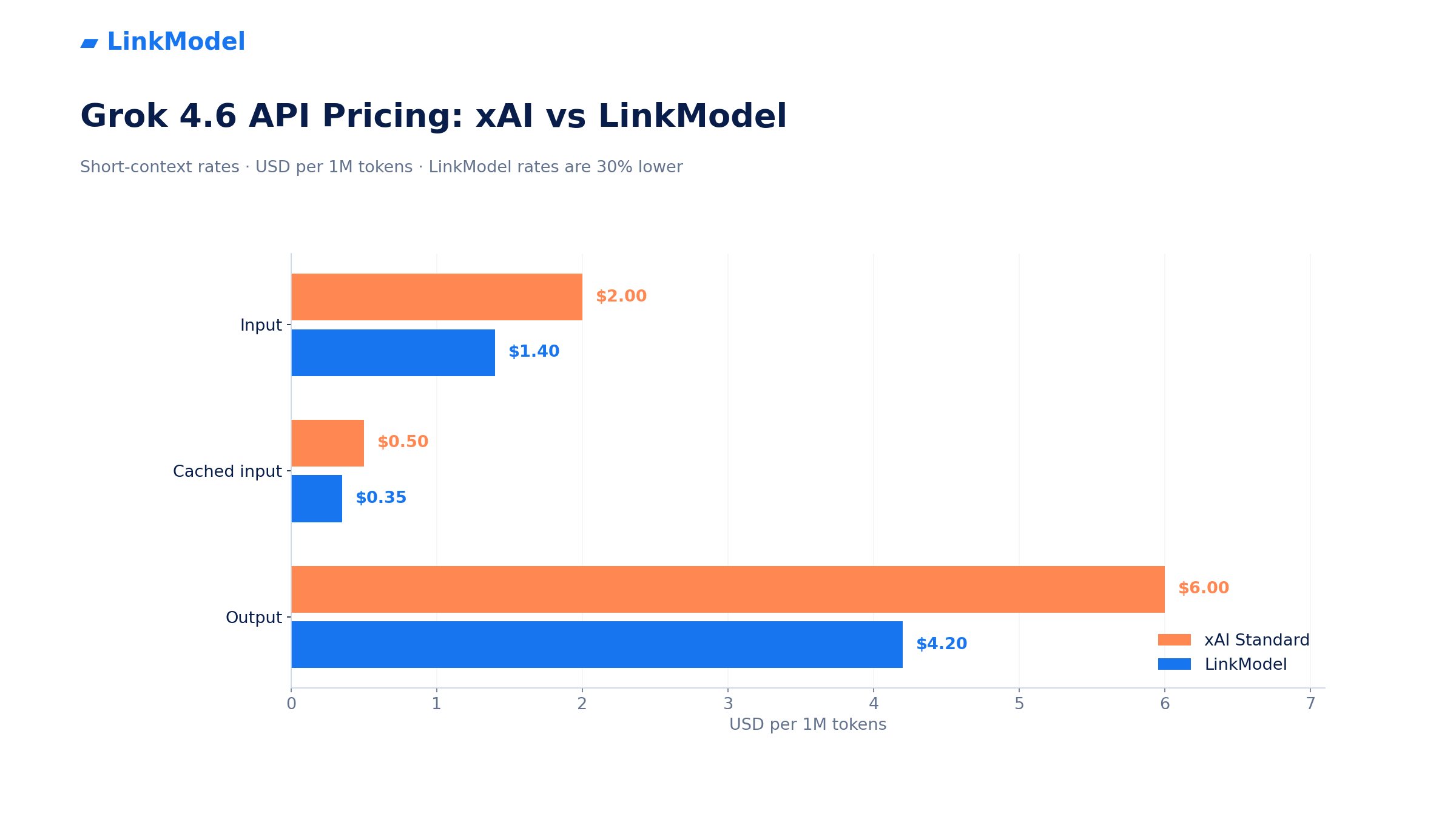
LinkModel makes Grok 4.6 more affordable with regular token prices 30% below xAI Standard:** $1.40/M input, $0.35/M cached input, and $4.20/M output for short-context requests. You also get pay-as-you-go billing, $0 minimum spend, $0 monthly platform fees, and unified access to multiple AI models. Explore LinkModel to reduce Grok 4.6 token spending without committing to a monthly platform subscription.
Grok 4.6 API Pricing: Official Rates vs LinkModel
Grok 4.6 uses tiered token pricing, with separate rates for uncached input, cached input, and output. At xAI's standard rates, input costs $2/M and output costs $6/M below the 200K prompt threshold. LinkModel lists corresponding prices that are 30% lower, including for long-context requests.
Grok 4.6 Pricing Table
All prices are in USD per 1 million tokens.
| Token category | xAI short context | LinkModel short context | xAI long context | LinkModel long context |
|---|---|---|---|---|
| Input | $2.00 | $1.40 | $4.00 | $2.80 |
| Cached input | $0.50 | $0.35 | $1.00 | $0.70 |
| Output | $6.00 | $4.20 | $12.00 | $8.40 |
| Reasoning output | $6.00 | $4.20 | $12.00 | $8.40 |
The savings are 30% for each listed token category. The prices above compare the same token quantities, rather than assuming that one provider automatically uses fewer tokens.
The short- and long-context rates are published in the xAI pricing documentation and the LinkModel model catalog.
An important distinction: reasoning output uses the output-token rate. It is displayed separately to explain the billing treatment, not because the same tokens are charged twice.
What Counts Toward Your Grok 4.6 API Bill?
A Grok 4.6 request can contain three billable token components:
- Uncached input: new prompt content processed at the regular input rate.
- Cached input: eligible reused prompt content processed at the lower cached-input rate.
- Billable output: generated output, including reasoning tokens.
For a request that stays in the short-context tier, the calculation is:
Request cost = (Uncached input ÷ 1M × input price) + (Cached input ÷ 1M × cached price) + (Billable output ÷ 1M × output price)
For example, 10K uncached input tokens and 2K billable output tokens cost:
| Provider | Input cost | Output cost | Total |
|---|---|---|---|
| xAI Standard | $0.020 | $0.012 | $0.032 |
| LinkModel | $0.014 | $0.0084 | $0.0224 |
At 50,000 identical requests, that is $1,600 on xAI Standard versus $1,120 on LinkModel, saving $480 in model-token charges.
Does Grok 4.6 API Pricing Include a Subscription?
The prices above are usage-based API token rates, not the price of a Grok consumer subscription or a coding editor's monthly plan.
API token billing and subscription usage quotas are different products. A subscription allowance does not translate directly into a fixed number of Grok 4.6 API requests, because token composition, reasoning, context length, and the application provider's rules may differ.
For developers who want usage-based access, LinkModel offers pay-as-you-go billing without a minimum spend or monthly platform fee
Grok 4.6 Long-Context Pricing: Why the 200K Threshold Matters
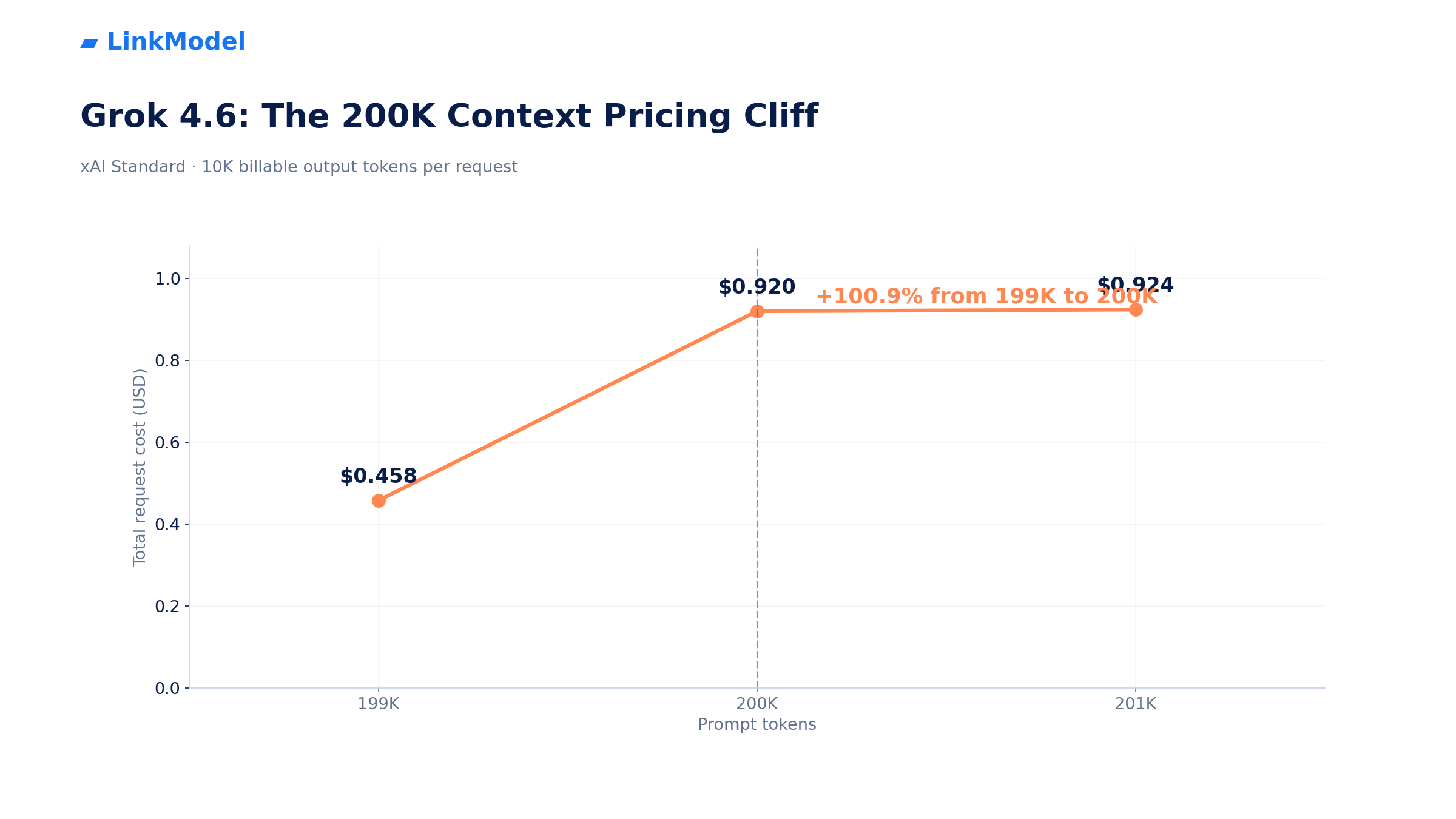
Grok 4.6 supports up to 500K context tokens, but xAI's long-context pricing starts at 200K prompt tokens. Once the long-context tier applies, the higher rates are charged across the request, not merely on tokens beyond the threshold.
This is one of the most important differences between Grok 4.6's headline token price and the amount developers may actually pay.
Case Study 1: The 199K vs 200K Pricing Jump
Consider three xAI Standard requests, each producing 10K billable output tokens.
| Prompt length | xAI pricing tier | Input cost | Output cost | Total |
|---|---|---|---|---|
| 199K | Short | $0.398 | $0.060 | $0.458 |
| 200K | Long | $0.800 | $0.120 | $0.920 |
| 201K | Long | $0.804 | $0.120 | $0.924 |
At 199K prompt tokens, the request costs $0.458.
At 200K prompt tokens, xAI's published pricing table places the request in the long-context tier, increasing the cost to $0.920.
That is approximately a 100.9% increase in total token cost for 1K additional prompt tokens.
Why does this happen? The pricing tier changes for the entire request, so both the input and output use the higher rates.
LinkModel also publishes short- and long-context rates, but its model page labels the short tier as up to and including 200K, with long-context pricing above 200K. Therefore, the exact 200K boundary should be checked against the provider's current billing terms rather than assumed to be identical.
For an unambiguous cross-provider comparison, the next example uses 190K and 240K prompts, which fall clearly on opposite sides of both published tier boundaries.
How Much Can Context Reduction Save?
Suppose a coding assistant sends 240K prompt tokens and generates 10K billable output tokens.
After removing irrelevant repository files, outdated conversation history, and duplicate logs, the prompt falls to 190K tokens while producing the same output length.
| Cost metric | 240K prompt | 190K prompt |
|---|---|---|
| Context tier | Long | Short |
| xAI Standard | $1.080 | $0.440 |
| LinkModel | $0.756 | $0.308 |
The revised request costs approximately 59.3% less on either provider.
This reduction comes from two effects: fewer input tokens and a lower pricing tier for the entire request.
The practical lesson is to remove irrelevant context, not necessary context. Aggressive trimming that causes incorrect answers and repeated requests can increase the total cost of completing the task.
Do Cached Tokens Count Toward the 200K Limit?
Yes. Cached input is still part of the total prompt length used to determine the applicable context tier.
For example, a prompt with 150K cached input tokens and 60K uncached input tokens contains 210K prompt tokens.
It qualifies for long-context pricing even though most of the prompt was served from cache.
Caching changes the price of eligible input tokens. It does not make those tokens disappear from the context calculation.
Grok 4.6 Cached Input Pricing: How to Cut Repeated Prompt Costs
Cached Grok 4.6 input costs 75% less per token than uncached input within the same pricing tier. At xAI's short-context rates, that means $0.50/M instead of $2/M. LinkModel offers the corresponding prices at $0.35/M and $1.40/M.
Prompt caching is particularly useful for coding agents, multi-turn conversations, customer-support systems, and applications that repeatedly send stable instructions.
How Grok 4.6 Prompt Caching Works
The xAI API can reuse a matching prompt prefix from an earlier request. This means caching is most effective when the beginning of the prompt remains consistent.
To improve cache reuse:
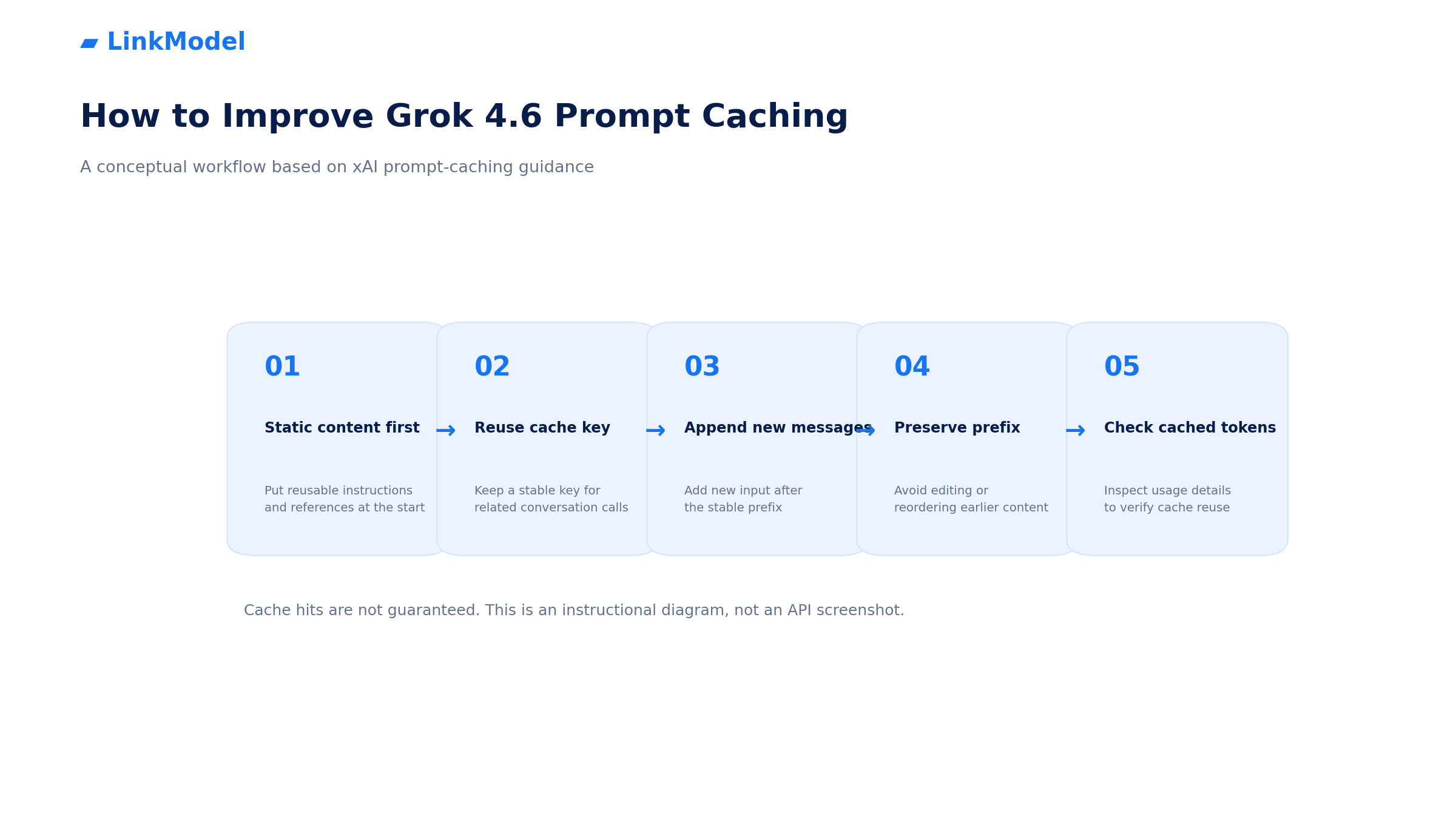
1. Put stable content first. Place system instructions, reusable examples, and reference material before frequently changing user content.
2. Preserve earlier conversation content. Editing or reordering existing messages can break the cached prefix.
3. Reuse a conversation-specific cache key. On the xAI API, the documented prompt cache key helps related requests reach the appropriate cache.
4. Preserve reasoning context where supported. Changing or omitting reusable reasoning content can reduce cache effectiveness.
5. Check actual cached-token usage. On xAI's Responses API, the cached-token field in usage details shows whether input was served from cache.
These are xAI API behaviors described in its prompt caching best practices. When using LinkModel, verify which cache-related parameters and usage fields its current endpoint supports rather than assuming every xAI-specific feature is identical.
Cache hits are not guaranteed. The first request may be a cache miss, and previously cached content may become unavailable.
Case Study 2: 80% Cached Input Across 100,000 Requests
Consider a repeated workflow with:
- 100K total input tokens per request.
- 80K cached input tokens.
- 20K uncached input tokens.
- 10K billable output tokens.
- 100,000 requests.
All requests remain below the long-context threshold.
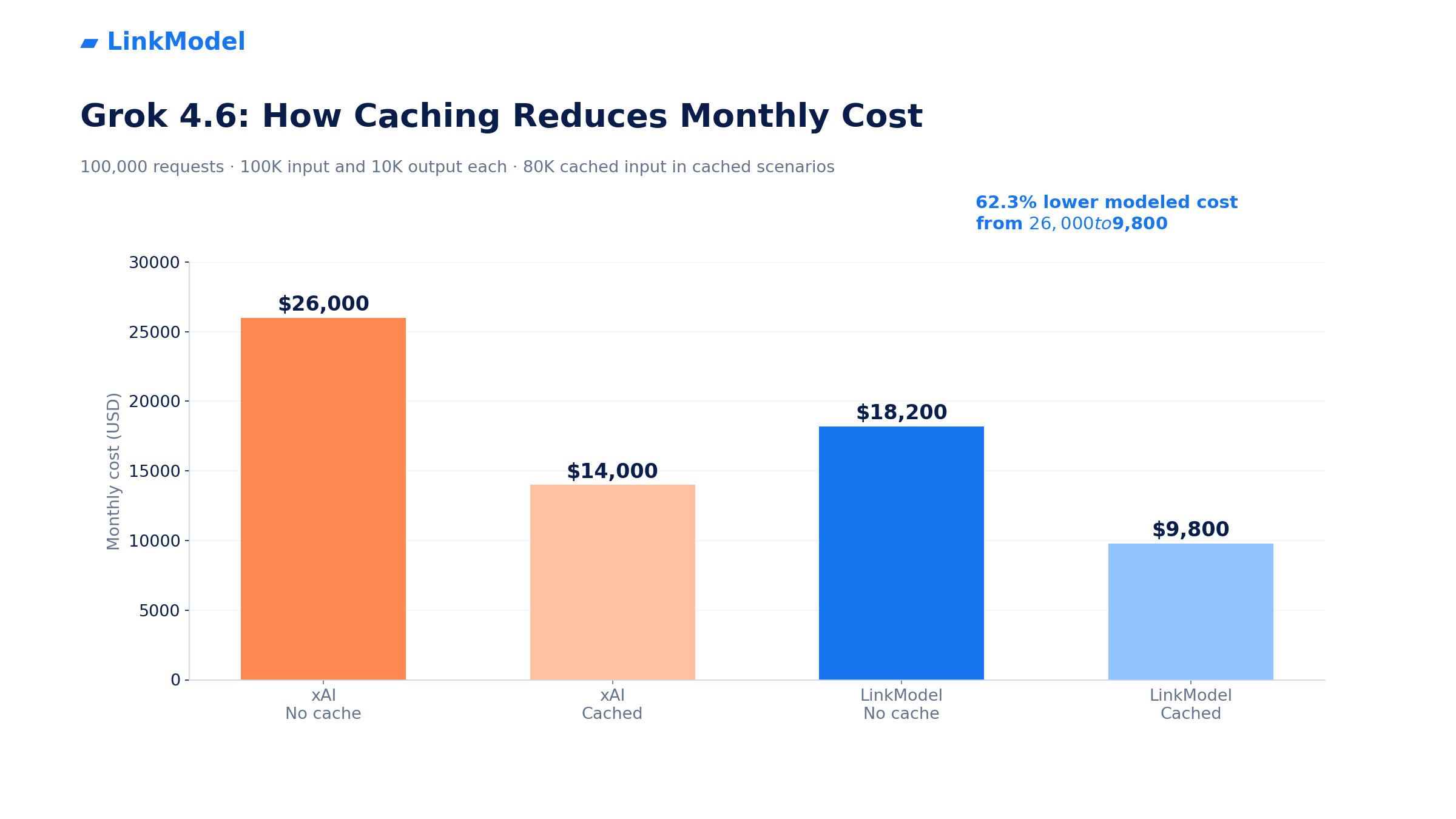
| Cost scenario | xAI Standard | LinkModel |
|---|---|---|
| One request without caching | $0.260 | $0.182 |
| One request with 80K cached input | $0.140 | $0.098 |
| 100K requests without caching | $26,000 | $18,200 |
| 100K requests with caching | $14,000 | $9,800 |
With caching, LinkModel's modeled cost is:
20K × $1.40/M + 80K × $0.35/M + 10K × $4.20/M = $0.098 per request
Compared with xAI Standard without caching, the modeled monthly bill falls from $26,000 to $9,800, a 62.3% reduction.
That figure combines two independent advantages: cached-input savings and LinkModel's lower published token prices.
It assumes the stated cache-hit distribution is achieved. Actual spending depends on the cache hits and output tokens recorded by the application.
When Is Grok 4.6 Caching Worth It?
Caching usually provides the greatest benefit when large portions of a prompt are repeated.
For example, a support assistant may reuse the same policy documentation across thousands of conversations. A coding agent may repeatedly reference stable project instructions. A document-analysis application may ask multiple questions about the same source material.
Caching provides less value when nearly all input changes between requests.
The right metric is not simply the number of requests. It is how many input tokens are actually billed at the cached rate.
Grok 4.6 Reasoning Token Pricing: Low, Medium, High, and Xhigh
Grok 4.6 offers four reasoning-effort settings: low, medium, high, and xhigh, with high as the default. Reasoning output is billed at the applicable output-token rate, so increasing reasoning usage can raise costs even when the visible response remains short.
According to the official Grok 4.6 model documentation, the model supports configurable reasoning alongside its 500K context window, image understanding, and tool-calling capabilities.
Are Grok 4.6 Reasoning Tokens Charged Separately?
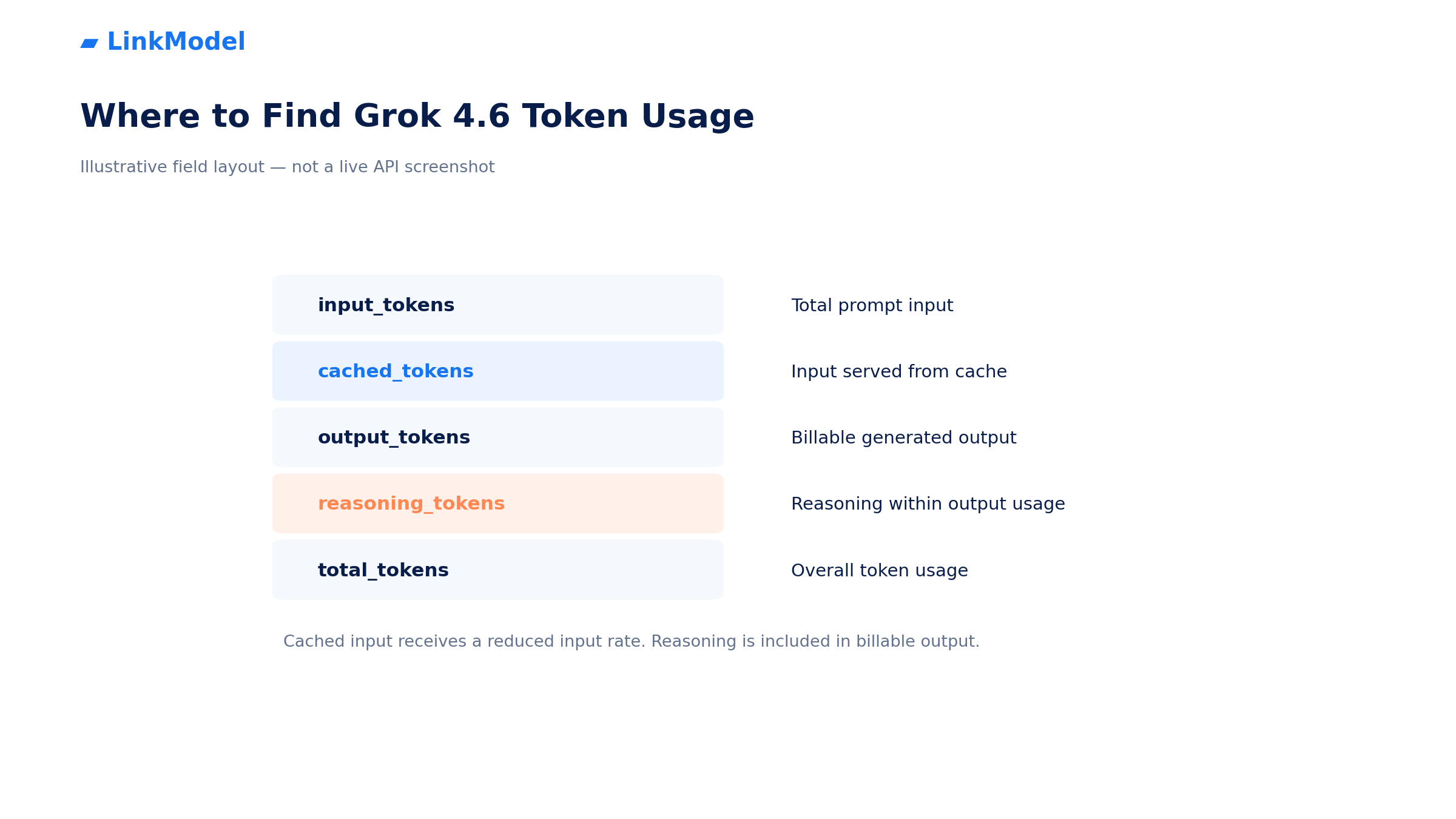
Reasoning tokens are billable output tokens. They use the same output-token price applicable to the request's context tier.
They should not be counted twice.
For cost estimation, add the billable reasoning tokens and other billable output tokens to obtain total output usage, then apply the output rate once.
For example, a request with 2K visible output tokens and 3K reasoning tokens has 5K billable output tokens, assuming those are the usage components reported by the API.
At xAI's short-context rate, 5K output tokens cost $0.030. At LinkModel's published rate, the corresponding charge is $0.021.
How Much Can Reasoning Increase the Bill?
Consider two possible token-usage profiles for the same 20K-token input prompt.
| Metric | Lower reasoning usage | Higher reasoning usage |
|---|---|---|
| Input tokens | 20K | 20K |
| Visible output tokens | 2K | 2K |
| Reasoning tokens | 3K | 15K |
| Total billable output | 5K | 17K |
| xAI Standard cost | $0.070 | $0.142 |
| LinkModel cost | $0.049 | $0.0994 |
The higher-reasoning example costs more than twice as much, despite producing the same number of visible output tokens.
These figures demonstrate the effect of different token counts. They are not measured performance results for specific reasoning-effort settings.
Which Reasoning Effort Should Developers Choose?
| Reasoning effort | Practical starting use case | Main evaluation |
|---|---|---|
| Low | Straightforward extraction or routine tasks | Accuracy at lower token usage |
| Medium | Everyday analysis and structured work | Cost-quality balance |
| High | Complex coding and multi-step reasoning | Task completion and total cost |
| Xhigh | Particularly difficult reasoning tasks | Whether additional reasoning improves success enough |
Higher reasoning effort is not automatically more cost-effective.
A configuration that uses fewer tokens but repeatedly fails may cost more per completed task than one that reasons longer and succeeds on the first attempt.
For production evaluation, use:
Cost per successful task = Total cost of all attempts ÷ Number of successfully completed tasks
This captures the effect of retries, reasoning, and task quality without assuming that the cheapest individual response is always the best choice.
Grok 4.6 API Cost Calculator: Per-Request and Monthly Examples
To estimate Grok 4.6 monthly spending, calculate the average cost of each request and multiply it by expected request volume. Separate short-context and long-context requests, and account for cached input, reasoning output, and tool usage where relevant.
Case Study 3: 100,000 Support Requests per Month
Suppose a customer-support application processes 100,000 requests per month.
Each request averages:
- 5K uncached input tokens.
- 1K total billable output tokens.
- No separately billed server-side tools.
Monthly usage equals 500M input tokens and 100M output tokens.
| Monthly cost component | xAI Standard | LinkModel |
|---|---|---|
| Input tokens | $1,000 | $700 |
| Output tokens | $600 | $420 |
| Total monthly token cost | $1,600 | $1,120 |
| Monthly savings | — | $480 |
| Annual savings at unchanged usage | — | $5,760 |
At this workload, LinkModel's 30% lower token rates save $480 each month without requiring any assumed improvement in caching or token efficiency.
Monthly Grok 4.6 API Budget Comparison
For identical billable token quantities at corresponding standard rates:
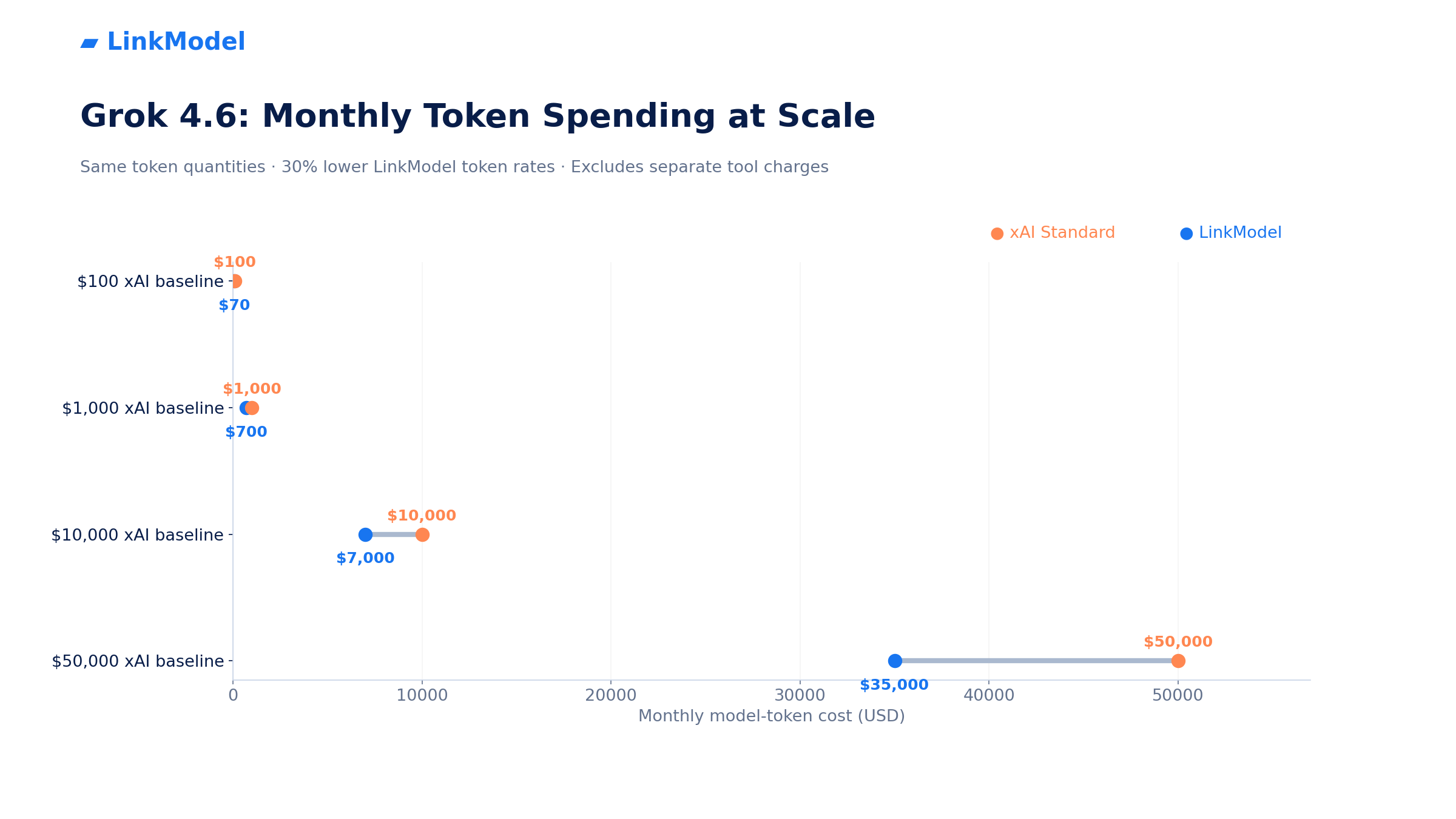
| xAI Standard token spending | LinkModel token spending | Savings |
|---|---|---|
| $100/month | $70/month | $30 |
| $1,000/month | $700/month | $300 |
| $10,000/month | $7,000/month | $3,000 |
| $50,000/month | $35,000/month | $15,000 |
For a workload equivalent to $10,000 in monthly xAI Standard token charges, LinkModel's published token prices reduce the modeled spending to $7,000.
That is $36,000 in annual savings if token usage and pricing remain unchanged.
These estimates exclude separately billed tools and other charges outside the compared model-token rates.
Why Request Volume Alone Is Not Enough
Two applications processing the same number of requests can have very different bills.
A classification service may send 1K input tokens and receive 100 output tokens. A coding agent may repeatedly send large repository contexts, generate substantial reasoning output, and invoke tools.
For more reliable forecasts, track average tokens per request, cache-hit rate, the percentage of requests reaching long-context pricing, and average tool usage.
The most useful budget is based on your workload's token distribution, not a generic cost per request.
Grok 4.6 Agent Pricing: Web Search, X Search, and Code Execution
Grok 4.6 agent workflows can incur server-side tool charges in addition to model-token costs. This matters for research assistants and coding agents because a short final answer may require multiple searches or code executions.
xAI publishes separate rates for its server-side tools. These charges should not be confused with the price of model-generated tokens.
Official xAI Server-Side Tool Pricing
| xAI tool | Published rate |
|---|---|
| Web Search | $5 per 1,000 calls |
| X Search — posts | $5 per 1,000 retrieved posts |
| X Search — profiles | $10 per 1,000 retrieved profiles |
| Code Execution | $5 per 1,000 calls |
These are the published xAI direct-API rates, as described in the official xAI pricing documentation.
Tool availability and billing are provider-specific. Do not assume that every xAI-hosted tool or parameter is available through LinkModel, or that LinkModel's 30% model-token discount applies to tool charges.
Case Study 4: A Research Agent With 10 Web Searches
Consider an xAI direct-API research workflow with:
- 20K uncached input tokens.
- 8K billable output tokens.
- 10 billable Web Search calls.
| Cost component | xAI cost |
|---|---|
| Input tokens | $0.040 |
| Output tokens | $0.048 |
| Web Search calls | $0.050 |
| Total | $0.138 |
In this example, Web Search accounts for approximately 36.2% of the total cost.
This is why an agent's cost should not be estimated from input and output tokens alone.
For research-heavy workflows, reducing redundant searches may deliver more savings than shortening a small prompt.
Total agent cost = Model-token cost + Applicable server-side tool charges
The example uses xAI's published direct-API rates. It does not assume that the same tool configuration is available through every third-party API provider.
Grok 4.6 Batch API Pricing: Standard vs Batch vs Priority
xAI offers a 20% Batch API token discount for Grok 4.6. Batch requests are processed asynchronously, making them suitable for workloads that do not require immediate responses.
Priority Processing serves a different purpose: higher scheduling priority at 2× standard token rates when the request is actually served at the priority tier.
Grok 4.6 Standard vs Batch Prices
| Token type | xAI Standard, short context | xAI Batch, short context |
|---|---|---|
| Input | $2.00/M | $1.60/M |
| Cached input | $0.50/M | $0.40/M |
| Output | $6.00/M | $4.80/M |
The Batch discount also applies to the corresponding long-context token rates.
For a short-context workload using 100M uncached input tokens and 20M billable output tokens:
| Pricing option | Total token cost |
|---|---|
| xAI Standard | $320 |
| xAI Batch | $256 |
| LinkModel published standard token rates | $224 |
LinkModel's standard Grok 4.6 token prices are 12.5% below the equivalent xAI Batch token prices.
However, the services are not operationally identical: Batch is designed for asynchronous processing, while standard requests are appropriate for interactive applications.
When Should You Use Batch or Priority?
Choose Batch when a workload can tolerate delayed completion, such as large-scale document classification or offline processing.
Choose standard processing when users expect immediate interactive responses.
Consider Priority Processing when lower latency has enough business value to justify its higher token rate.
For xAI Priority Processing, the 2× rate applies when the response confirms that it was served at the priority tier. Requests served at the default tier use standard pricing.
xAI also publishes a 10% token-rate premium for its US regional endpoint, where supported. That is an xAI-specific regional option, not a universal surcharge on Grok 4.6 usage through other providers.
Grok 4.6 vs Grok 4.7: Is the Newer Model More Expensive?
Grok 4.6 and Grok 4.7 have the same published xAI Standard token rates, including $2/M input, $0.50/M cached input, and $6/M output below 200K prompt tokens.
Both models also offer a 500K-token context window.
| Pricing metric | Grok 4.6 | Grok 4.7 |
|---|---|---|
| Short-context input | $2.00/M | $2.00/M |
| Short-context cached input | $0.50/M | $0.50/M |
| Short-context output | $6.00/M | $6.00/M |
| Long-context input | $4.00/M | $4.00/M |
| Long-context output | $12.00/M | $12.00/M |
| Context window | 500K | 500K |
The choice should therefore depend on task quality, reasoning-token usage, latency, and compatibility, rather than headline token price alone.
For an established Grok 4.6 application, migrating to 4.7 should involve regression testing against representative tasks.
A newer model is not automatically cheaper to operate simply because its published price per million tokens is unchanged.
How to Reduce Grok 4.6 API Costs
The most effective way to reduce Grok 4.6 spending is to optimize the entire request lifecycle: provider pricing, context length, cache reuse, reasoning usage, and tool calls.
| Cost lever | Recommended action | Why it matters |
|---|---|---|
| Provider price | Compare identical token categories and context tiers | Reduce eligible token charges |
| Context length | Remove irrelevant files and old history | Avoid unnecessary long-context pricing |
| Prompt caching | Keep stable prefixes and inspect cache hits | Lower repeated-input charges |
| Reasoning effort | Evaluate task success at different effort levels | Control billable output |
| Tool usage | Avoid redundant searches and executions | Reduce additional agent costs |
| Task success | Measure retries and completed outcomes | Optimize total cost, not just one response |
For a coding assistant near the 200K threshold, context reduction may be the highest-impact optimization.
For a support system with repeated instructions, caching may matter more.
For a research agent, server-side tool usage can represent a substantial share of spending.
There is no single optimization that dominates every workload. The right approach is to measure where the bill comes from and prioritize the largest controllable cost.
Why Choose LinkModel for Grok 4.6 API Access?
LinkModel offers Grok 4.6 at regular token prices 30% below xAI Standard, with no minimum spend or monthly platform fee.
For short-context requests, that means:
- $1.40/M input, versus $2/M at xAI Standard.
- $0.35/M cached input, versus $0.50/M.
- $4.20/M output, versus $6/M.
For long-context requests, LinkModel lists $2.80/M input, $0.70/M cached input, and $8.40/M output, maintaining the same 30% price advantage over the corresponding xAI Standard rates.
What Makes LinkModel Cost-Effective?
| LinkModel advantage | Practical benefit |
|---|---|
| 30% lower Grok 4.6 token rates | Reduce spending on comparable model-token usage |
| Pay-as-you-go billing | Pay according to actual usage |
| $0 minimum spend | Begin testing without a minimum purchase |
| $0 monthly platform fee | Avoid a recurring platform subscription charge |
| Unified API | Access supported AI models through one integration |
| Multi-model catalog | Compare alternatives without separate provider integrations for every model |
The price advantage is particularly meaningful for applications with sustained usage.
At an equivalent xAI Standard token bill of $1,000 per month, LinkModel's published rates reduce the modeled cost to $700.
At $10,000 per month, the modeled saving rises to $3,000 monthly.
These savings apply to the compared model-token charges, not automatically to separately billed tools or services.
Start Using Grok 4.6 for 30% Less
You do not need a large monthly commitment to benefit from lower Grok 4.6 token rates.
With LinkModel, developers can start with pay-as-you-go usage, avoid monthly platform fees, and access Grok 4.6 alongside other supported AI models through a unified API.
Explore LinkModel to access Grok 4.6 at 30% below xAI Standard token prices.
Frequently Asked Questions
How Much Does Grok 4.6 Cost per 1M Tokens?
At xAI Standard rates, Grok 4.6 costs $2/M input, $0.50/M cached input, and $6/M output below 200K prompt tokens. LinkModel lists corresponding rates of $1.40/M, $0.35/M, and $4.20/M, which are 30% lower.
Does Grok 4.6 Cost More Above 200K Tokens?
Yes. xAI's long-context pricing applies at 200K prompt tokens and above, increasing input to $4/M and output to $12/M for the entire request. LinkModel publishes its higher tier for prompts above 200K, so the exact boundary should be checked against the provider's current terms.
Are Grok 4.6 Cached and Reasoning Tokens Billed?
Yes. Cached input receives a discounted input rate, while reasoning tokens are billed at the applicable output-token rate. Reasoning usage should be included in total billable output without counting the same tokens twice.
Is Grok 4.6 Batch Cheaper Than Standard API?
xAI Batch offers a 20% token discount compared with xAI Standard. LinkModel's published standard Grok 4.6 token rates are 30% below xAI Standard, although Batch and interactive API requests serve different operational needs.
Is Grok 4.6 API Cheaper Than Grok 4.7?
Not at xAI's published Standard token rates. Grok 4.6 and Grok 4.7 share the same headline input, cached-input, and output prices. Actual task cost can still differ because of token usage, reasoning, tool calls, and task completion performance.
Conclusion
Grok 4.6 API pricing starts at $2/M input, $0.50/M cached input, and $6/M output on xAI Standard, but actual costs depend on context length, cache hits, reasoning output, and tool usage. The 200K context threshold is especially important because long-context rates apply across the request rather than only to excess tokens. Developers can lower spending by keeping prompts relevant, reusing cached content, selecting appropriate reasoning effort, and controlling unnecessary tool calls. For a more affordable starting point, LinkModel offers Grok 4.6 token rates 30% below xAI Standard, starting at $1.40/M input and $4.20/M output, with pay-as-you-go billing, no minimum spend, no monthly platform fee, and unified access to multiple AI models.