Gemini 4 Argon offers lower introductory API rates, while coding benchmarks show different winners: Google’s published comparison favors Argon on DeepSWE and Claude Opus 5.5 on FrontierSWE and Terminal-Bench. Argon’s Standard rates are $2/M input and $10/M output through November 30, 2026, versus Opus at $4/M and $20/M. The better choice depends on task completion, reasoning effort and repair costs.
Lower token prices do not guarantee cheaper completed work. Artificial Analysis reports weighted benchmark costs of $1.99 per task for Argon High, $1.82 for Opus High and $5.98 for Opus Max. Configuration matters—and Google’s announced December pricing doubles Argon’s introductory input and output rates.
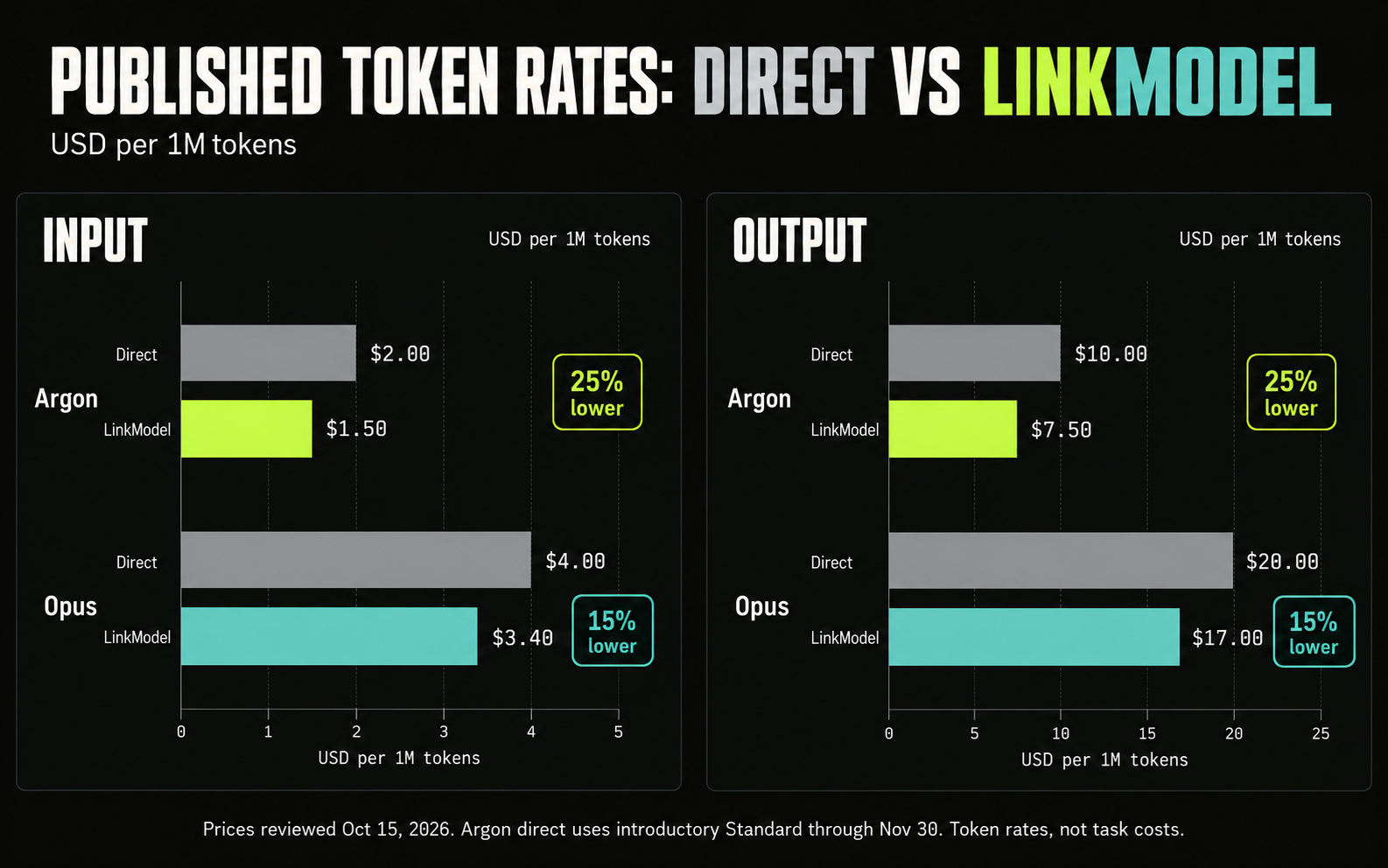
Access either model at lower published token rates through LinkModel. Argon API pricing is $1.50/M input and $7.50/M output—25% below Google’s introductory Standard rates; Opus costs $3.40/M input and $17/M output—15% below Anthropic Standard. LinkModel’s pricing gives API buyers a lower-rate option for both models, whether the priority is Argon’s current price advantage or Opus’s stronger results on selected engineering benchmarks.
Updated October 15, 2026. All prices are in USD; M means one million tokens.
Gemini 4 Argon vs Claude Opus 5.5: Which Should You Choose?
Consider Argon for lower current token rates and Opus for terminal-heavy engineering. Neither is the best choice for every coding or agent task.
| Your priority | Practical starting point |
|---|---|
| Lower introductory token cost | Argon |
| Terminal-heavy coding | Opus |
| Tasks resembling DeepSWE | Include Argon |
| Business automation | Compare the required tool workflows |
| Lower completed-task cost | Compare models and effort settings |
| Replacing an existing coding agent | Check the complete integration |
Benchmarks help identify candidates. They do not establish whether a model will preserve your interfaces, handle dependencies or recover from a failed command.
The distinction is model capability versus agent performance. Coding agents add prompts, file access, execution tools and context management. When those environments differ, the comparison measures complete workflows rather than isolating the models.
API Pricing: Google, Anthropic and LinkModel
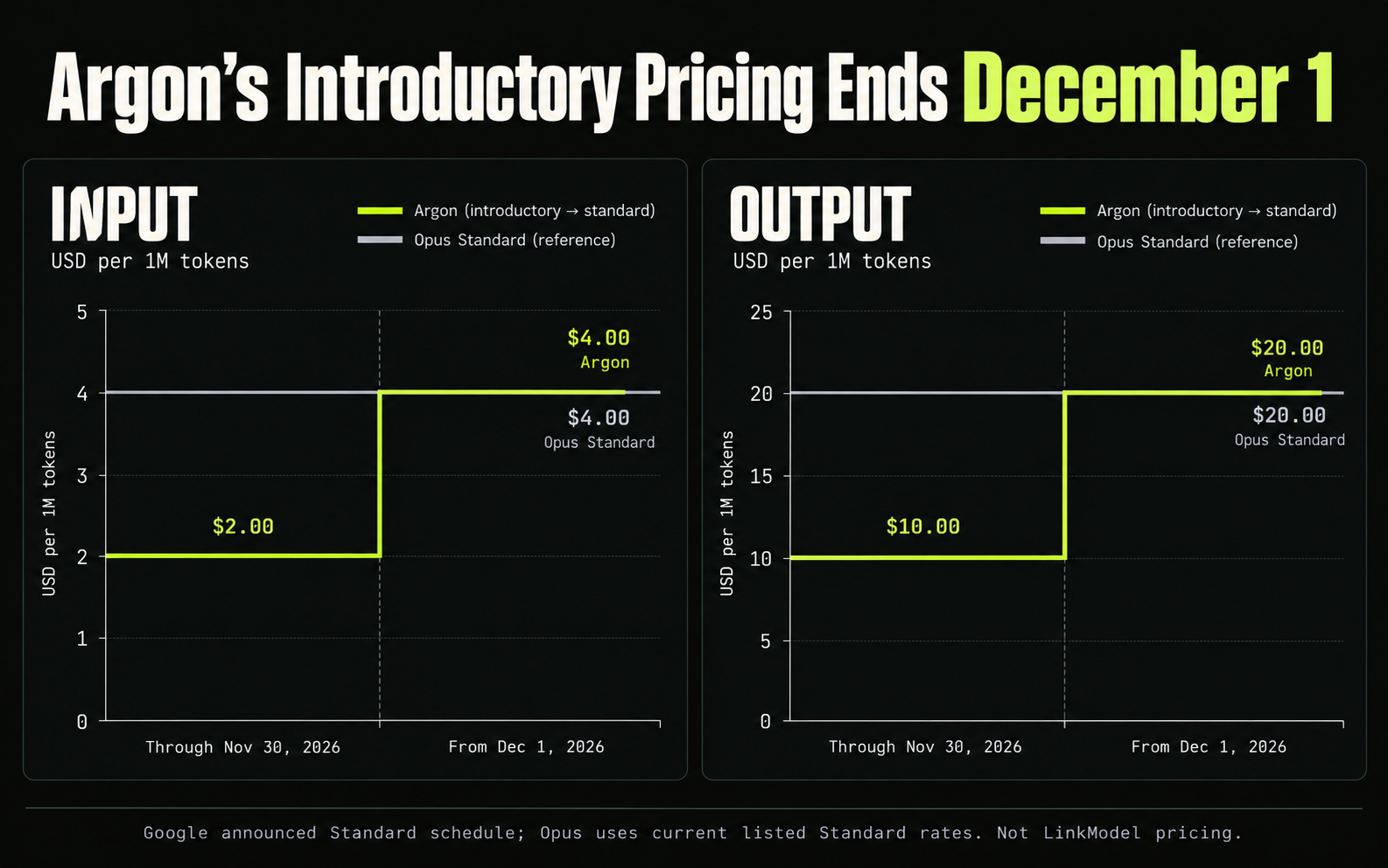
Argon’s introductory Standard input and output rates are half Opus’s corresponding rates. Google’s announced December rates remove that particular advantage.
Official Rates and Argon’s December Price Change
The Google API pricing table specifies these Standard rates:
| Argon token category | Through Nov. 30, 2026 | From Dec. 1, 2026 |
|---|---|---|
| Input | $2.00/M | $4.00/M |
| Output, including thinking | $10.00/M | $20.00/M |
| Cached input | $0.10/M | $0.20/M |
Anthropic’s pricing documentation lists Opus 5.5 Standard input at $4/M, output at $20/M and cache reads at $0.20/M. Five-minute cache writes cost $5/M; one-hour writes cost $8/M.
Matching rates do not imply matching billing behavior. Argon uses implicit caching, while Opus supports prompt-caching controls and separately priced writes.
For budgeting, distinguish introductory and ongoing prices. A workload that fits a budget in October may have different economics in December without any change in token consumption.
LinkModel Rates for Both Models
LinkModel lists lower corresponding token rates for Argon and Opus. Its pricing page lists Argon at 25% below Google’s introductory Standard rates, while its Opus model page lists rates 15% below Anthropic’s corresponding Standard rates.
| Token category | Argon on LinkModel | Opus on LinkModel |
|---|---|---|
| Input | $1.50/M | $3.40/M |
| Cached input | $0.075/M | $0.17/M |
| Output | $7.50/M | $17.00/M |
Argon’s listed reasoning-output rate is also $7.50/M. Follow the usage fields’ definitions when calculating charges: do not add reasoning tokens again if they are already included in billed output.
LinkModel’s Opus 5.5 API pricing also lists five-minute cache writes at $4.25/M and one-hour cache writes at $6.80/M.
These are published rate comparisons, not measured project savings. Google’s December announcement does not establish LinkModel’s future tariff.
Request Costs at Identical Token Usage
For 200,000 uncached input tokens plus 20,000 billed output tokens, the calculated costs are:
| Route | Calculated token cost |
|---|---|
| Google Argon, introductory Standard | $0.60 |
| Google Argon, announced December Standard | $1.20 |
| Anthropic Opus, Standard | $1.20 |
| LinkModel Argon, listed rates | $0.45 |
| LinkModel Opus, listed rates | $1.02 |
These are calculated token costs, not observed invoices. They assume identical usage and exclude cache operations, tools and other separately billed services.
The table isolates rate differences. It does not assume that both models consume the same number of tokens to complete a task.
Standard, Batch and Fast: Compare Matching Modes
A Standard-rate discount is not a claim to beat every processing option. Google lists introductory Argon Batch rates of $1/M input and $5/M output, rising to $2/M and $10/M in December. Anthropic lists Opus Batch at $2/M input and $10/M output.
Offline evaluation and document processing may therefore suit Batch better than interactive execution.
Anthropic’s Opus announcement separately lists Fast mode at $8/M input and $40/M output. Processing mode changes the price schedule; reasoning effort changes the work performed.
Compare the mode you will actually use. A gateway’s Standard pricing does not establish support for every first-party processing tier.
Coding Benchmarks: Where Argon and Opus Lead
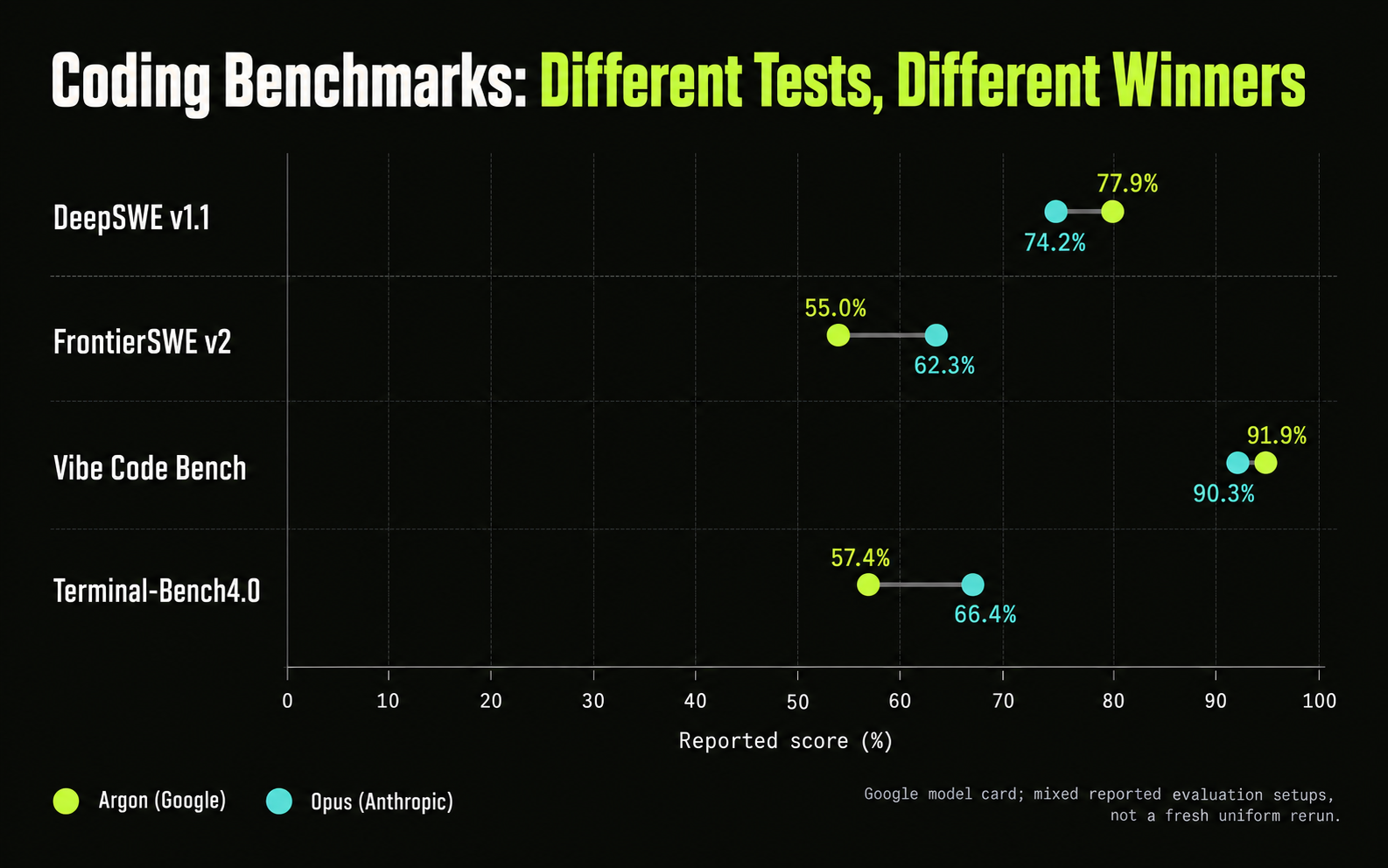
The coding evidence is split. Argon leads selected coding evaluations, while Opus leads important terminal and software engineering tests.
DeepSWE, FrontierSWE and Terminal-Bench
The Google DeepMind model card publishes:
| Coding benchmark | Argon | Opus 5.5 |
|---|---|---|
| DeepSWE v1.1 | 77.9% | 74.2% |
| FrontierSWE v2 | 55.0% | 62.3% |
| Vibe Code Bench | 91.9% | 90.3% |
| Terminal-Bench 4.0 | 57.4% | 66.4% |
Argon’s DeepSWE lead is 3.7 percentage points; Opus’s Terminal-Bench lead is 9.0 percentage points. Neither difference translates directly into developer productivity.
Google’s evaluation methodology combines self-computed results, external leaderboards and model system cards. Argon’s DeepSWE result uses a mini-swe agent harness; the Opus figure comes from its system card.
For terminal-heavy work, command recovery and multi-step execution matter. For repository changes, the more consequential question is whether the new code preserves existing behavior.
Independent Reasoning, Coding and Automation Results
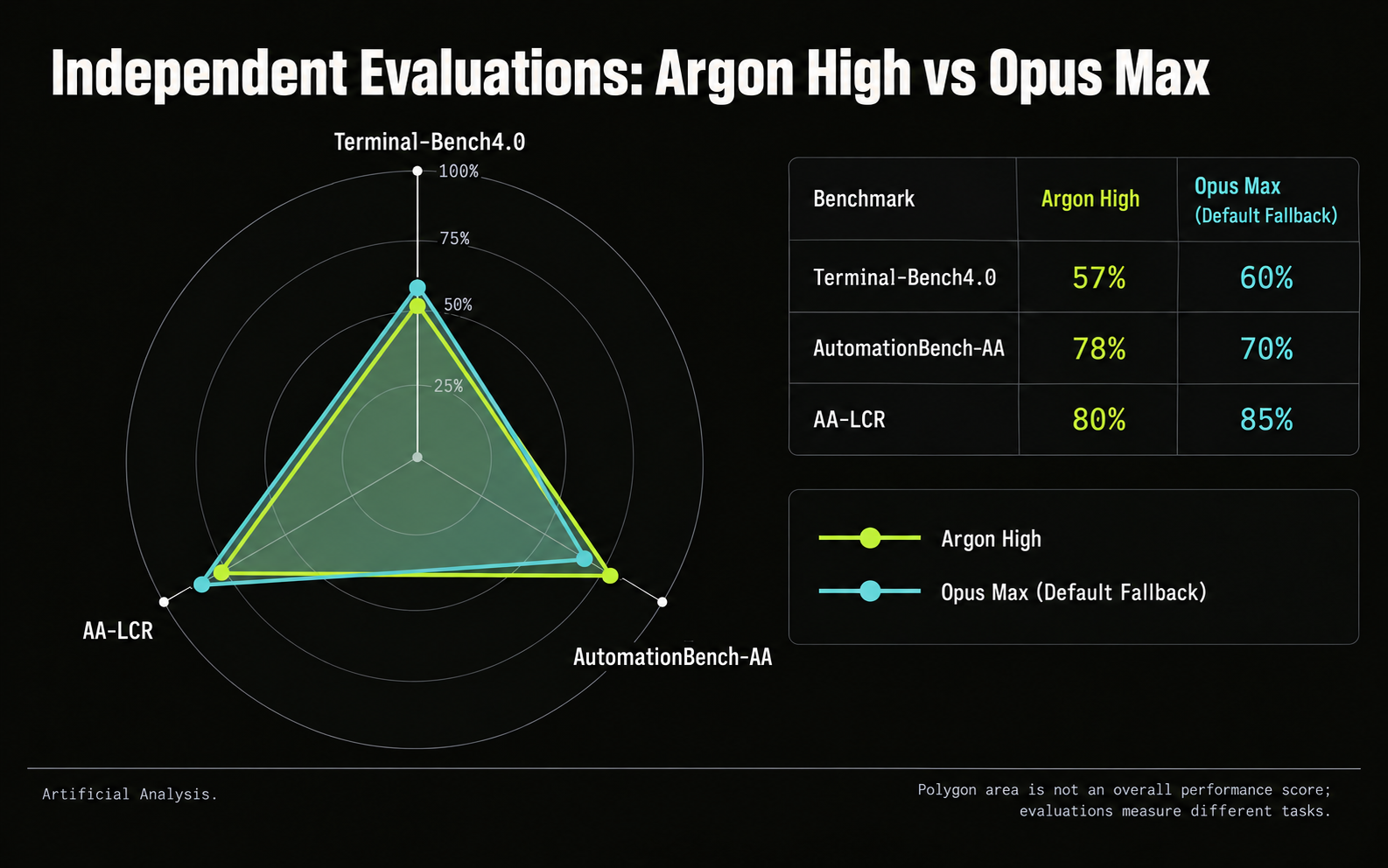
The Artificial Analysis comparison evaluates Argon High against Opus Max with Default Fallback:
| Evaluation | Argon High | Opus Max |
|---|---|---|
| Intelligence Index | 53 | 58 |
| Terminal-Bench 4.0 | 57% | 60% |
| AutomationBench-AA | 78% | 70% |
| AA-LCR long-context reasoning | 80% | 85% |
Opus leads the aggregate index and the listed terminal evaluation. Argon leads AutomationBench-AA.
Keep these results separate from Google’s table. Scores from different evaluation environments should not be averaged into a new ranking, and AutomationBench-AA is not interchangeable with AutomationBench.
A higher aggregate score is useful evidence, but it does not establish superiority in every workflow.
High vs Max: Why Task Costs Change
Comparing Argon only against Opus Max misses a lower-cost Opus configuration.
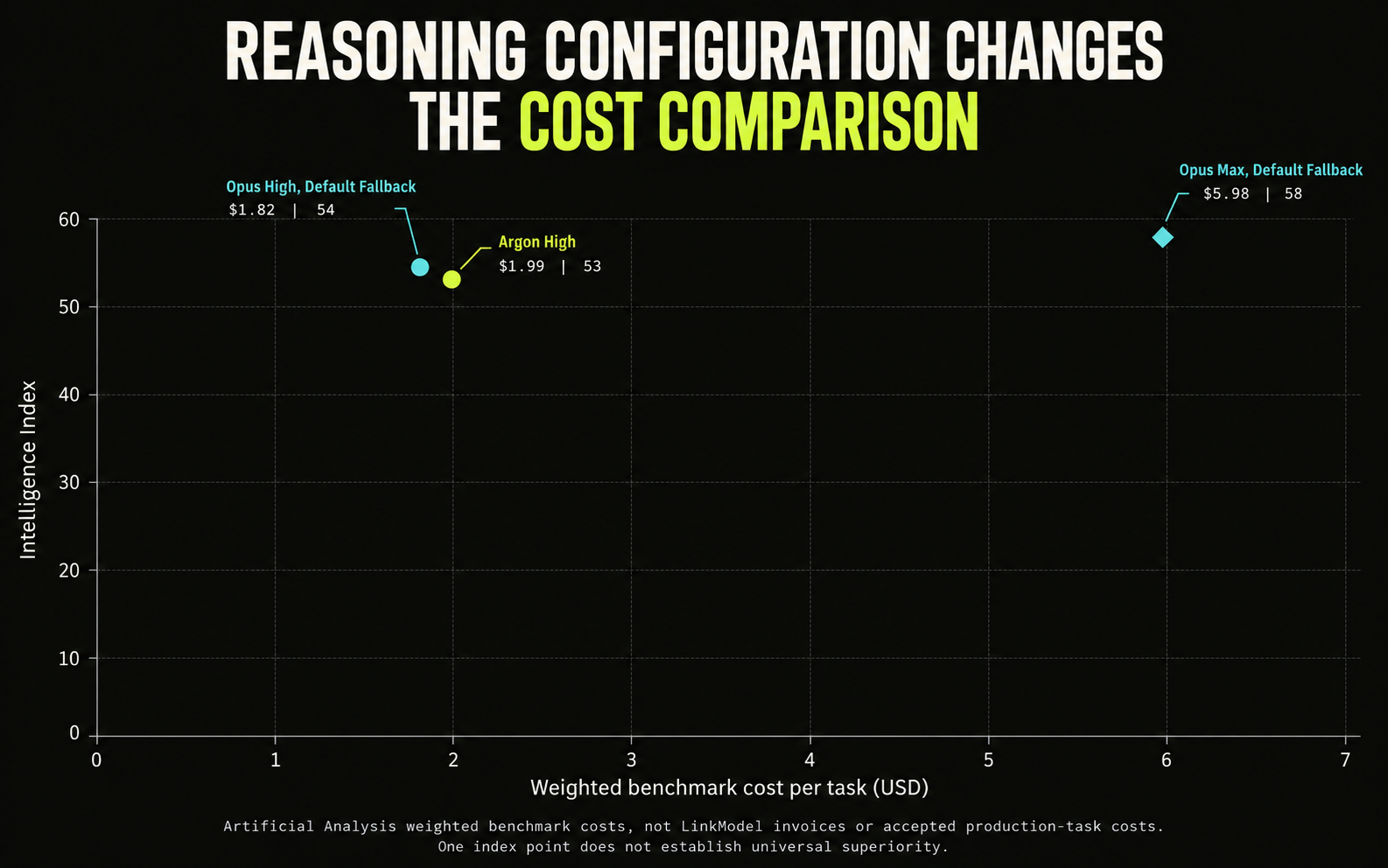
Artificial Analysis’s High-versus-Max comparison, alongside its Argon results, shows:
| Configuration | Intelligence Index | Weighted benchmark cost/task |
|---|---|---|
| Argon High | 53 | $1.99 |
| Opus High, Default Fallback | 54 | $1.82 |
| Opus Max, Default Fallback | 58 | $5.98 |
The one-point difference between Argon High and Opus High does not establish universal superiority. The useful finding is that higher token rates can coexist with lower measured task costs.
The Opus comparison reports approximately 36K output tokens per task at High versus 119K at Max, including approximately 18K versus 84K reasoning tokens. These are evaluation averages, not request limits.
The purchasing choice is therefore model plus effort setting. Higher effort is valuable when it improves the result enough to justify additional consumption.
Benchmark Cost vs Cost per Accepted Result
Weighted benchmark cost and production cost per accepted result are different metrics.
For an application, a useful measure is:
API cost per accepted task = total API spend across all attempts ÷ accepted tasks
Include failed attempts, continuations and repair calls. Track human correction time separately, or include it using a stated labor rate.
Illustrative scenario: each attempt uses the same 200K uncached input and 20K billed output tokens, excluding cache operations and other charges. At the listed LinkModel rates:
| Attempts at unchanged usage | Argon cost |
|---|---|
| One | $0.45 |
| Two | $0.90 |
| Three | $1.35 |
One Opus attempt at that usage calculates to $1.02. Two Argon attempts total $0.90, while three total $1.35. The lower rate provides room for some repetition, but not unlimited repair.
This calculation does not establish either model’s retry rate. Actual retries may also contain more context than the initial attempt, changing their cost.
Real Coding and Agent Cases: What Changes the Decision?
Our research reviewed public experiments involving games, short answers, Blender and Three.js. Each highlights a different problem with choosing models from token prices alone.
The following four cases come from a published developer experiment reporting single runs.
Kart Game: Completion Before Speed
Argon completed the game in 220.6 seconds for $0.306. Opus took 307.6 seconds and $0.641, reaching a 32,000-token cap that included 20,770 reasoning tokens; its result was truncated.
An incomplete artifact cannot be treated as equivalent to a working one. Output configuration can affect the result before broader coding capability becomes the deciding factor.
Short Questions: Formatting Is Part of Accuracy
Across 82 questions, Argon scored 82/82, costing $0.220 with a 3.355-second median. Opus scored 81/82, costing $0.069 with a 2.410-second median; its miss was formatting.
For automated decisions, response shape belongs in the acceptance criteria. Extra explanation can make a logically correct answer unusable.
Blender: Measure the Whole Session
Argon produced 43 objects and 240 frames over 61 steps, processing approximately 10.2M input tokens with about 419K cached tokens, for $22.13. There was no Opus control.
The decision-relevant figure is cumulative session cost. Initial prompt size alone cannot explain a long tool-driven workflow.
Three.js: Separate Charges from Estimates
The experiment lists 2,540 lines and a $2.45 API charge for Argon/OpenCode, versus 1,166 lines, 14m39s and a $14.14 estimated equivalent for Opus/Claude Code. Different agents, billing methods and earlier Argon failures prevent a complete delivery-cost comparison.
Code volume is not delivered value. Functional completeness and the cost of all attempts matter more than the successful run’s line count.
Frontend Design: Fidelity, Usability and Visual Polish
Frontend quality has several dimensions. Faster generation, accurate UI reconstruction and cinematic presentation do not necessarily favor the same model.
Tiny World: Browser Verification Matters
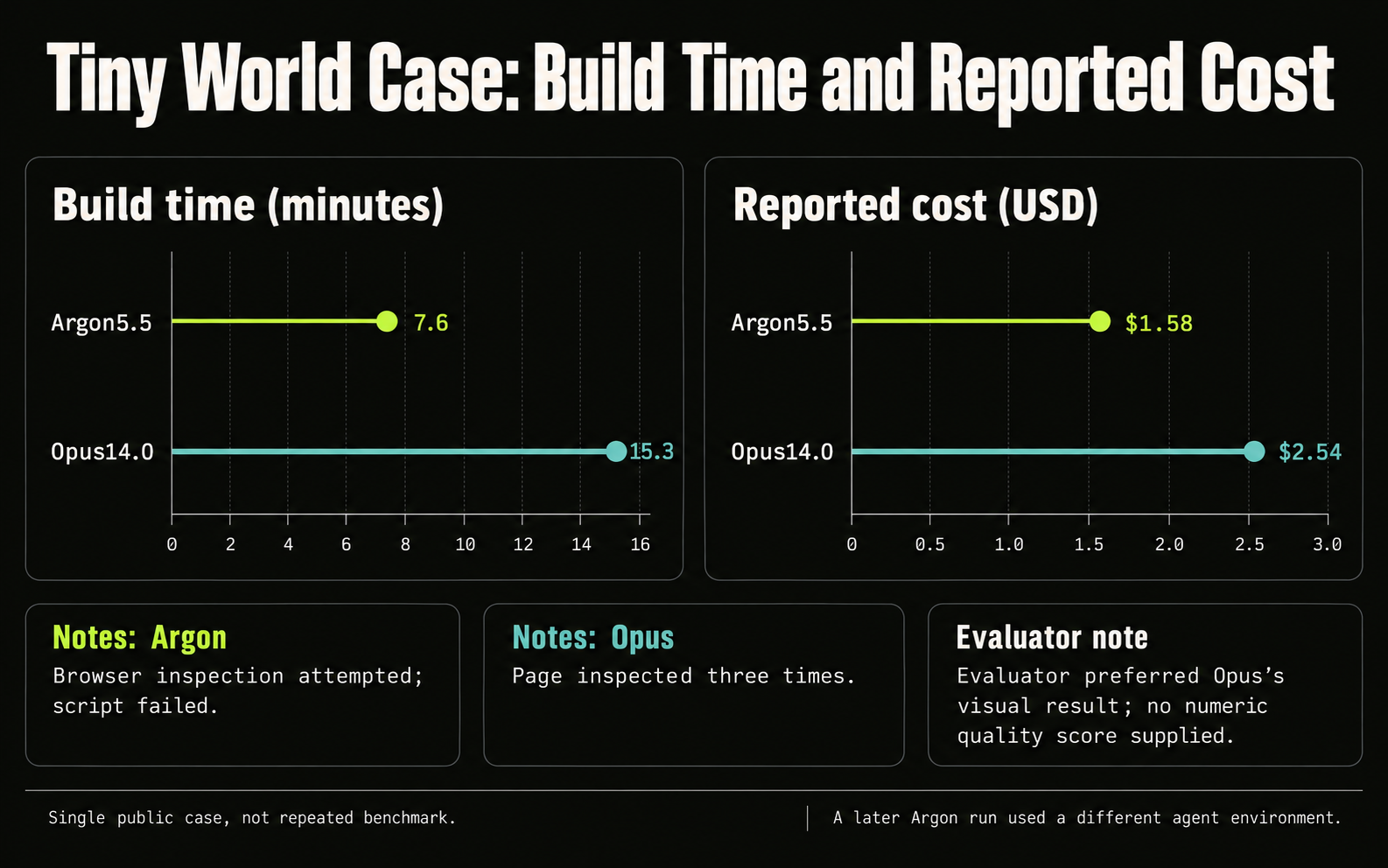
Our research included a same-prompt Tiny World comparison involving a playable cartoon planet.
| Recorded measure | Argon | Opus 5.5 |
|---|---|---|
| Build time | 5.5 minutes | 14 minutes |
| Reported cost | $1.58 | $2.54 |
| Page size | 56 KB | 48 KB |
Argon attempted browser inspection, but its script failed. Opus inspected its page three times. The evaluator preferred Opus’s visual result.
A later update described an improved Argon version through a different agent environment. That makes the harness part of the comparison.
For frontend work, mobile menus, controls, camera movement and browser errors belong alongside screenshot quality. A generated page’s appearance does not establish its usability.
Remotion: UI Accuracy and Cinematic Pacing Differ
A 14-second product-film comparison used the same repository and brief.
The review credited Argon with reconstructing more of the real interface and including more information per frame. Opus used fewer, larger camera moves and longer holds. The evaluator favored Opus’s presentation while recognizing Argon’s stronger UI fidelity; Argon also introduced a logo-rendering issue.
This was qualitative, without standardized scoring.
A product walkthrough may prioritize accurate screens, readable text and brand consistency. A promotional film may give more weight to pacing and visual hierarchy. The intended deliverable determines which strengths matter.
Backend Coding: Plans, Regressions and Repair Time
Backend reliability requires evidence beyond a plausible plan or a successful demonstration. Integration correctness and regressions affect the value of the generated code.
Python Planning: What an AI-Judged Score Measures
A production Python planning comparison used Opus at extra-high effort and Argon at High.
GPT-6 Astra judged the plans, assigning 77/100 to Opus and 59/100 to Argon. This is an AI assessment under different effort settings—not a measured difference in deployed code quality.
The useful distinction is between a persuasive plan and an implementable one. Missing migrations, dependencies, rollback behavior or tests can outweigh how clearly a plan is written.
Regression Case: Count the Repair Work
A repository regression case described 115 regressions detected by deterministic tests after roughly four hours of Argon High work, followed by approximately four hours of repair.
This single reported incident lacks an independently reproduced matched comparison. It cannot establish a general regression rate or a universal Opus advantage.
Its practical significance is that repair time can dominate apparent generation speed. A useful comparison distinguishes newly introduced failures from pre-existing failures and includes the work needed to restore acceptable behavior.
Code generation is one stage of delivery; accepted behavior is the outcome.
Context, Output Limits and Coding-Agent Integration
Both models offer large context windows, but input support and output execution differ. Capacity alone does not establish retrieval accuracy or complete generation.
Context Windows and Output Limits
Google’s Argon documentation and Anthropic’s Opus documentation describe:
| Capability | Argon | Opus 5.5 |
|---|---|---|
| Context | 1,048,576 shared tokens | 1M tokens |
| Native input modalities | Text, images, audio, video | Text, images |
| Output | Text | Text |
| Default/standard output limit | 65,536 tokens | 128K tokens |
| Extended output | Background long decode | 300K Batch beta |
| Default reasoning | Medium | Medium |
Argon shares its window across input, thinking and output. Long decode uses background execution and continuation hops; available output depends on the remaining budget.
Opus’s 300K output capability belongs to a Batch beta configuration, not ordinary online requests.
For large repositories, the distinction is between fitting files into a window and combining their constraints correctly. The AA-LCR results provide one relevant signal, rather than a guarantee for every long-context task.
Caching, Timeouts and Tool Recovery
Argon’s implicit caching and Opus’s prompt-caching controls require different operational assumptions. Effective input cost depends on actual reuse, cache writes and misses.
Google also recommends background execution or longer client timeouts for difficult Argon prompts. An application can interrupt a model before it delivers a result.
For coding-agent integration, the important behaviors are completion, tool recovery, continuation handling and usage accounting. A lower price or shared request convention does not establish compatibility with a particular coding client.
Using Argon and Opus on LinkModel: Pricing and Purchase Considerations
LinkModel is worth considering when you need API access to either model at lower published token rates. The purchasing decision also depends on the features your application requires and the platform’s credit terms.
When LinkModel’s Lower Rates Matter
LinkModel’s clearest advantage here is a lower published price for the corresponding token categories. For the same billed usage, lower input and output rates reduce token charges; the size of the benefit depends on the workload’s mix of fresh input, cached context and output.
Feature requirements still matter. LinkModel’s Opus model listing identifies automatic tool selection and notes that forcing a specific tool is unsupported. Applications built around mandatory named-tool calls therefore need particular attention.
The rates support a price comparison. They do not establish identical latency or support for every first-party feature, including specialized output and processing modes.
Which Model Fits Your Workload?
Choose around the requirements of the work, rather than the number of benchmark rows a model wins.
| Workload | Deciding evidence |
|---|---|
| Terminal engineering | Command completion and recovery |
| Backend changes | Regression results and repair time |
| Visual prototypes | Fidelity, usability and browser behavior |
| Short structured decisions | Exact-format acceptance and latency |
| Long artifacts | Complete output and continuation |
| Automation | End-to-end tool success |
Our review of user questions highlighted concerns about coding-agent replacement, quotas, incomplete outputs and regressions. These concerns are more useful model-selection criteria than an unqualified “best model” label.
Opus deserves early consideration for terminal-heavy engineering. Argon deserves consideration when current token rates, native multimodal input or extended output are important. Neither pattern establishes that one model should handle every task.
Keep subscription allowances separate from API economics. A percentage of an app’s weekly quota cannot be converted into a reliable cross-provider token-cost comparison.
Keep subscription allowances separate from API economics. A percentage of an app’s weekly quota cannot be converted into a reliable cross-provider token-cost comparison.
Frequently Asked Questions
Is Gemini 4 Argon better than Claude Opus 5.5 for coding?
Neither wins every evaluation. Argon leads DeepSWE and Vibe Code Bench in Google’s published table, while Opus leads FrontierSWE and Terminal-Bench. Repository changes, regressions and correction time determine which strengths matter in practice.
Is Gemini 4 Argon cheaper than Claude Opus 5.5?
Yes at the current listed Standard input and output rates, although completed-task costs can differ. Google lists Argon at $2/M input and $10/M output through November 30, 2026, versus Opus at $4/M and $20/M. LinkModel lists Argon at $1.50/M and $7.50/M, and Opus at $3.40/M and $17/M. Google’s announced December Argon rates rise to $4/M and $20/M.
Why can Opus High cost less despite higher token rates?
Consumption matters alongside rates. Artificial Analysis reports weighted benchmark costs of $1.82 for Opus High versus $1.99 for Argon High. These describe that evaluation, not every application or LinkModel invoice.
Can Argon replace Claude Code?
Argon is a model; Claude Code is a coding-agent application. An Argon-powered environment also needs suitable tools, permissions, context handling and recovery. A model score alone does not establish an equivalent replacement.
Can Argon generate one million output tokens?
Google documents long generation through background execution, subject to a shared input, thinking and output budget. It is not a million-token output allowance for every ordinary synchronous request, and the application must support the required execution behavior.
Conclusion
Gemini 4 Argon is the lower-rate option today, while Claude Opus 5.5 has stronger results on selected terminal and software engineering evaluations. Opus High’s benchmark costs also show why reasoning configuration matters as much as the model name. Choose around the work you need completed, accounting for output limits, regressions and repair costs. For API buyers, LinkModel provides lower published token rates for both models; its value is a concrete price advantage, with feature requirements and prepaid-credit terms remaining part of the purchase decision.