How to Choose an LLM in 2026: A Practical Decision Framework
How to choose an LLM API in 2026 — a step-by-step framework covering quality, cost, context, modality, latency and licensing, with a routing pattern that beats picking one.
LinkModel · Journal
Tutorials, product updates, and insights
How to choose an LLM API in 2026 — a step-by-step framework covering quality, cost, context, modality, latency and licensing, with a routing pattern that beats picking one.
Use the MiniMax Hailuo 2.3 API for stylized motion, anime, and product video. Learn the async request flow, prompt structure, and model selection.
A practical guide to GPT-5.3-codex — OpenAI's agentic coding model with mid-task steering and terminal/computer-use highs. When it beats a general model, and how to use it.
A practical GLM-5.1 API guide — Z.ai's open-weight 754B model built for 8-hour autonomous coding. Pricing, benchmarks, cache economics and how it stacks up.
A practical Gemini 3.1 Pro API guide — Google's frontier reasoning model at ~$2/$12 per million tokens. Pricing, the context cliff, benchmarks, and when Flash beats it.
A practical Gemini Flash API guide — 3.5 Flash, 2.5 Flash and Flash-Lite pricing compared, when each fits, and how Flash beats Pro on value for most production traffic.
A practical Claude Sonnet 4.6 API guide — near-Opus quality at $3/$15 per million tokens. Pricing, strengths, and when Sonnet is the smarter, cheaper choice than Opus.
A practical Claude Haiku 4.5 API guide — Anthropic's fastest, cheapest model at $1/$5 per million tokens. When Haiku is enough, and when to escalate to Sonnet or Opus.
The best AI video models with native audio in 2026 — Seedance, Kling, HappyHorse and Wan generate synced dialogue, ambience and lip-sync in one pass. Compared with code.
How to generate posters via API in 2026 — models that nail dense layouts and legible headlines (Seedream, GPT Image 2, Nano Banana Pro), with code and prompt tips.
How to generate AI avatar and talking-head videos via API in 2026 — Wan 2.6 role-play plus Seedance and Kling for consistent faces and synced voice. Models, code and tips.
A developer's guide to AI API rate limits — RPM vs TPM, why you hit 429 errors, exponential backoff, and how gateways with pooled capacity smooth throughput.
A guide to AI API latency in 2026 — TTFT vs tokens-per-second, what makes responses slow, model speed differences, and practical ways to make your app feel fast.
How to add AI to mobile apps in 2026 — pick fast low-latency models, keep per-user cost tiny, secure your API key with a backend proxy, and ship image, video and chat features.
A hands-on Seedance 2.0 API tutorial: authentication, your first video, text-to-video and image-to-video, the @ reference system, polling, and error handling.
Get more from GPT Image 2 — prompt patterns for perfect text rendering, precise layouts, reliable editing, and reference images, with copy-ready examples.
Using the GPT Image 1 API in 2026? It's deprecating October 23, 2026. Here's its pricing, how it compares to GPT Image 2, and how to migrate before the shutdown.
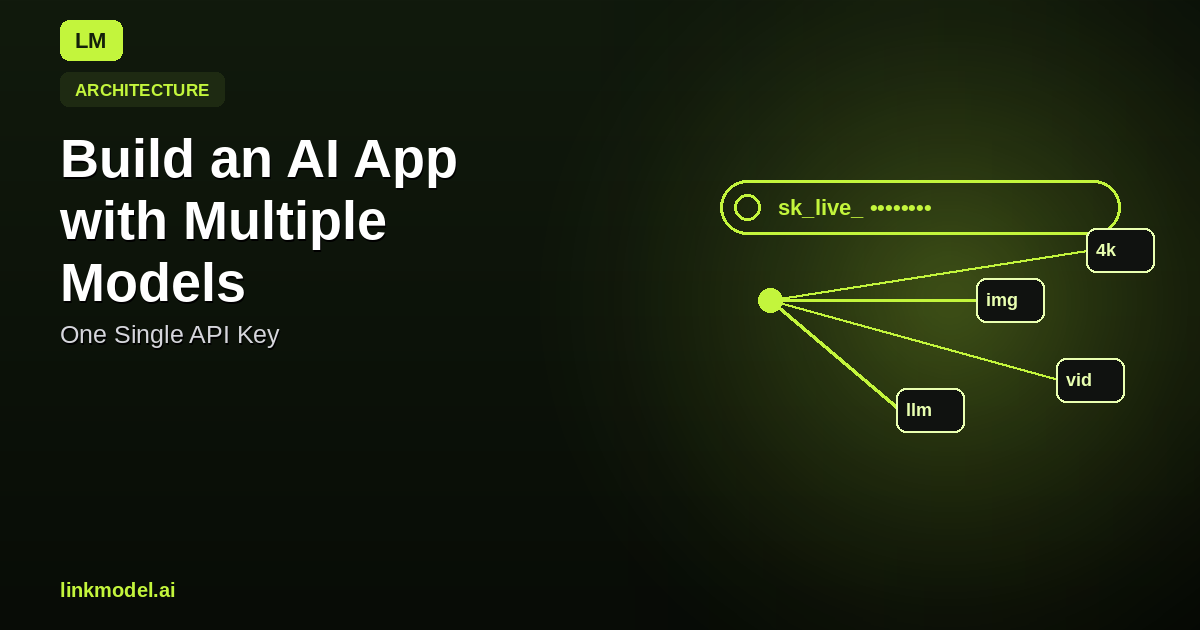
A practical architecture for building AI apps on multiple models — the gateway pattern, model-by-parameter switching, async task handling, routing, and fallbacks.