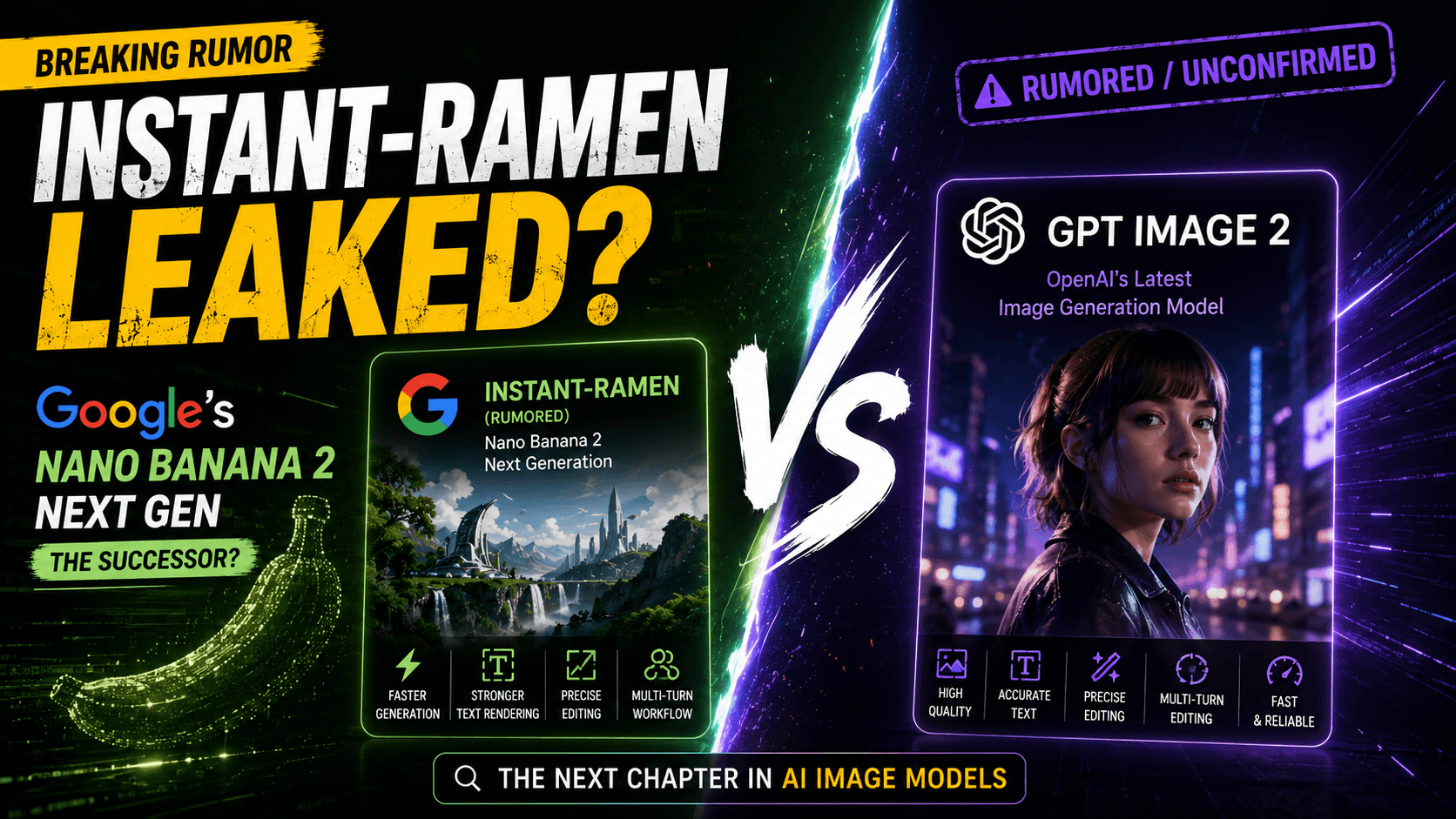
Over the past 24 hours, an intriguing new name has started showing up across the AI community: Instant-ramen.
It first surfaced in discussions on Reddit, X, and various repost communities, where some users described it as a suspected new Google image model — and a few even guessed it might be a successor to the Nano Banana line.
But before getting carried away, let's be clear about one thing:
It's far more likely to be a temporary codename appearing in an anonymous testing environment, a model arena, or a community screenshot. In other words, Instant-ramen isn't a formally confirmed product name yet — it's a signal worth watching.
And the reason this signal matters is its timing: OpenAI has already pushed GPT Image 2 into the spotlight, and the next round of competition among image generation models is just getting started.
Why is Instant-ramen being measured against GPT Image 2?
If the 2025 image model race was mostly about "who paints better," "who understands prompts best," and "who renders text best," then the 2026 race has clearly entered a different phase:
Who can most reliably turn image generation into production infrastructure.
OpenAI's GPT Image 2 is the poster child for this direction. It's positioned as an image model for high-quality generation and editing, emphasizing faster generation, better instruction following, more stable editing, and output that fits real product workflows.
That's exactly why, the moment Instant-ramen appeared, the community naturally slotted it into the same competitive frame:
- OpenAI has GPT Image 2
- Google has Nano Banana 2 / Nano Banana Pro
- If Instant-ramen is real, it's very likely Google's next move on the image model front
In other words, what makes Instant-ramen worth watching isn't whether its name sounds like yet another Google food-themed codename — it's whether it represents Google preparing a new image model to take on GPT Image 2 head-on.
From Nano Banana to Instant-ramen: what might Google be filling in?
Google's Nano Banana line has already proven one thing: an image model shouldn't just be a "text-to-image tool." It should be a visual intelligence module that understands context, supports multi-turn editing, and integrates into Gemini's multimodal system.
Nano Banana solved for speed and usability.
Nano Banana Pro strengthened professional quality, text rendering, complex composition, and finer creative control.
Nano Banana 2 keeps the focus on faster, cheaper image generation and editing better suited to calls at scale.
If Instant-ramen really exists, it most likely won't be a routine "slightly better image quality" upgrade — it'll be organized around a few more product-grade metrics.
1. Lower latency
Image generation is moving from one-shot creation toward multi-turn iteration and agent workflows.
The lower the latency, the more willing users are to keep editing, retrying, and extending.
2. Stronger editing stability
Real production work isn't about generating one beautiful image — it's about editing the same image over and over:
- Swapping the background
- Swapping the text
- Swapping the product
- Changing a person's pose
- All while preserving subject consistency
3. Better text and layout capability
Posters, ad creatives, infographics, menus, and e-commerce cards all need readable text.
Whoever nails stable text rendering gets closer to being a design productivity tool.
4. Better suited for batch API calls
For developers, an image model isn't a toy — it's a service.
Cost, throughput, failure rate, size flexibility, and multi-image input capability determine whether it can enter real business use.
5. Stronger multimodal context understanding
Google's advantage is Gemini.
If the image model can better understand text, images, user intent, conversation history, and real-world knowledge, then it's not just a generator — it's part of a visual agent.
What pressure does GPT Image 2 put on Google?
The arrival of GPT Image 2 raised the baseline for image model competition.
It doesn't just emphasize generation quality — it emphasizes being usable: understanding complex instructions, doing high-quality editing, accepting images as references, and serving more complex creative workflows.
That's direct pressure on Google.
Because in the real choices developers and creators make, models aren't only compared on "which image looks prettier."
People compare more practical questions:
- Which model is faster?
- Which model renders text more accurately?
- Which model follows editing instructions better?
- Which model better preserves character and product consistency?
- Which model has a more stable API?
- Which model is better for batch-generating marketing assets?
- Which model is easier to embed into an existing product?
If Instant-ramen really comes from Google, what it has to face isn't an abstract "image model market" — it's a productivity standard that GPT Image 2 has already redefined.
What might Instant-ramen actually be right now?
Based on current community discussion, there are roughly three possibilities.
First, it could just be a temporary codename in some anonymous model arena
Many models, before their official launch, first appear under anonymous names on arena-style platforms so users can blind-test and compare output quality.
Only after testing wraps up does the platform or vendor reveal the real identity.
If Instant-ramen belongs to this category, then every claim right now about "it comes from Google" is just community inference.
Second, it could be an image model Google is testing internally
This possibility can't be ruled out.
Google has already shown that it doesn't mind turning internal codenames into formal marketing assets.
Nano Banana is a textbook example.
If Instant-ramen does come from Google, it might correspond to a not-yet-public Gemini Image variant, such as:
- A faster Flash-Lite Image
- A lower-cost generation model
- A staged-rollout build of the next Nano Banana
Third, it might not be a Google model at all
This is the easiest possibility to overlook.
The AI community often guesses a model's origin from its output style, naming style, speed profile, and the background of whoever leaked it — but such guesses aren't always accurate.
Especially in anonymous arena settings, model identity is deliberately hidden by design.
If we want to benchmark it against GPT Image 2, which tests should we watch?
Assuming more users get to test Instant-ramen down the line, what's actually valuable isn't a handful of stunning sample images — it's a systematic comparison of how it and GPT Image 2 perform on real tasks.
Six categories of tasks are worth focusing on.
1. Text rendering
Test poster titles, fine-print captions, multilingual menus, ad copy in various languages, and brand slogans.
The key question:
Is the text readable? Does it garble? Does the layout survive multiple rounds of edits?
2. Local editing
Test swapping clothing, swapping backgrounds, replacing product packaging, removing objects, and changing expressions.
The key question:
Does the model only change what should be changed? Does it break the original image's structure?
3. Character and product consistency
Test how well the same character holds up across different scenes, angles, and styles.
The key question:
Do the face, clothing, logo, and product form carry over consistently?
4. Multi-image fusion
Test composing a character, a product, a background, a logo, and a reference style into one complete image.
The key question:
Is the fusion natural? Are the relationships between subjects correct? Can it obey complex constraints?
5. Layout and commercial assets
Test e-commerce hero images, app banners, social ads, infographics, and course covers.
The key question:
Can it generate commercial assets that are close to usable out of the box?
6. Speed and cost
Test response speed under the same prompt, failure rate, retry cost, and API ease of use.
The key question:
Can product teams integrate it reliably — not just use it for demos?
How should we think about Instant-ramen for now?
A reasonably safe read is this:
But the reason it's worth watching is that it shows up at a specific moment:
GPT Image 2 has already pushed the image model race toward a higher productivity standard, and Google will inevitably need to keep responding on speed, quality, editing stability, and API usability.
So the significance of Instant-ramen isn't just "does Google have a new model."
The bigger question is:
Just how large will the next generation of image models become as production infrastructure, rather than a content toy?
The three things most worth watching next:
- Whether a new image model ID shows up in Google AI / Gemini API documentation;
- Whether LMArena or related anonymous testing platforms reveal the model's identity;
- Whether Google DeepMind, Google AI Developers, or the official Gemini accounts confirm any relationship between Instant-ramen and the Nano Banana line.
If it's real, Google's image model roadmap may be moving from Nano Banana into a faster, lighter, more product-grade new phase.
And what it's really built to rival isn't just the previous generation of Nano Banana.
It's GPT Image 2, already standing in the spotlight.